
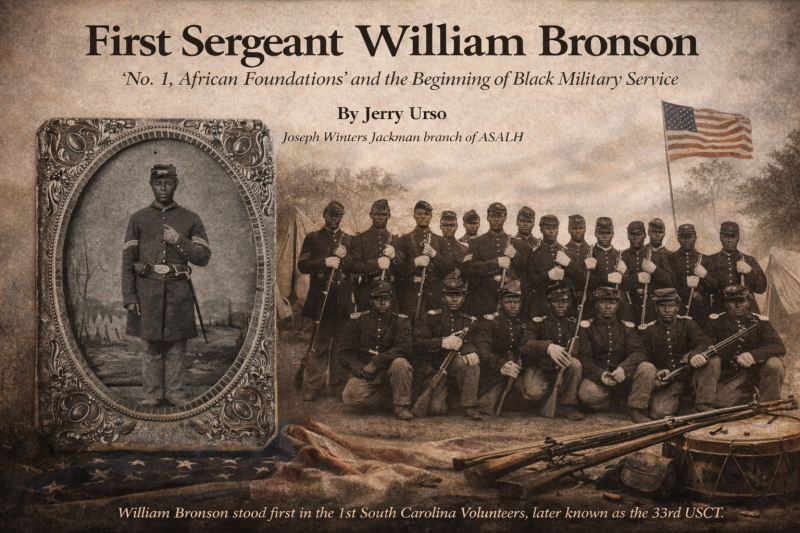
First Sergeant William Bronson
“No. 1, African Foundations” and the Structural Beginning of Black Military Service
Carpenter in a Slave Society
William Bronson was born enslaved on St. Helena Island, South Carolina, likely around 1830 [1]. He lived within the Gullah Geechee world of the Sea Islands — a distinct coastal society shaped by African cultural retention, tidal rice agriculture, and geographic isolation from mainland plantation centers. Though governed by the rigid structure of slavery, the Sea Islands developed strong communal bonds and a deeply rooted spiritual culture.
Bronson was a carpenter by trade [1]. In the plantation system, carpenters were skilled artisans responsible for constructing and repairing buildings, docks, storage facilities, and rice mill structures. Carpentry required precision, literacy of measurement, discipline, and structural awareness. Though enslaved, a skilled craftsman operated with a level of technical competence that required trust and oversight. This background would later translate naturally into military responsibility.
For three decades Bronson labored within the architecture of slavery. Then, in late 1861, that structure fractured.
Port Royal and the Federal Enclave
In November 1861, Union naval forces captured Port Royal Sound [2]. Confederate troops withdrew, and plantation owners fled inland, abandoning the Sea Islands. Thousands of enslaved people remained under Union protection. The region became one of the first sustained Federal occupations in the Deep South.
The Sea Islands were not a lawless experiment. The Department of the South established headquarters at Hilton Head. Federal infantry regiments such as the 3rd New Hampshire and 8th Maine were stationed in the region. Artillery guarded approaches. Most significantly, the United States Navy controlled surrounding waterways, ensuring supply lines and preventing Confederate return [2][3].
Within this protected military zone, Federal officials began considering whether formerly enslaved men might serve as soldiers.
The First Enlistment
In May 1862, Major General David Hunter authorized the recruitment of African American soldiers within the Department of the South [4]. This move preceded formal nationwide policy. Federal law had long restricted military service to white men. Political leadership in Washington remained cautious. The Emancipation Proclamation had not yet been issued.
Recruitment responsibilities fell to Sergeant Charles T. Trowbridge of the 1st New York Volunteer Engineers under Colonel Edward W. Serrell [4][5]. The engineers were already stationed in the Sea Islands building fortifications and infrastructure. The Black regiment formed within this broader military framework — protected by infantry, artillery, engineers, and naval forces.
On May 9, 1862, William Bronson enlisted [6].
His name appears first on the roll of what became the 1st South Carolina Volunteers of African Descent.
Colonel Thomas Wentworth Higginson, who assumed command later that year, recorded Bronson’s prominence in his memoir Army Life in a Black Regiment. Higginson wrote:
“The most efficient recruiting officer being Sergeant William Bronson of Company A in my regiment, who always prided himself on this service, and used to sign himself by the very original title, ‘No. 1, African Foundations,’ in commemoration of his deeds.” [7]
This passage confirms two critical facts. First, Bronson was not merely first by accident; he actively assisted in recruiting others. Second, he consciously understood his historical position.
The phrase “No. 1, African Foundations” appears in Higginson’s published account, drawn from his wartime diaries and letters [7].
Instability and Federal Authorization
Hunter’s early recruitment efforts were controversial. In August 1862, amid political tension and concerns about Hunter’s authority, much of the regiment was disbanded [4][8]. Only a core company under Trowbridge remained intact.
Bronson remained with it.
On August 22, 1862, Secretary of War Edwin M. Stanton formally authorized the enlistment of African American volunteers in the Department of the South [8]. The regiment reorganized at Camp Saxton near Beaufort under Brigadier General Rufus Saxton [3][9].
What had begun as an uncertain experiment became sanctioned federal policy.
Bronson’s service bridged both phases.
First Sergeant and Military Authority
Bronson rose to the rank of First Sergeant [6].
In Civil War infantry structure, the First Sergeant was the senior non-commissioned officer of a company. He maintained company rolls, supervised drills, enforced discipline, and served as operational backbone between officers and enlisted men. The position required reliability, authority, and administrative capability.
For a formerly enslaved carpenter to hold this rank in 1862–1863 was institutionally transformative. He now exercised authority inside the United States Army.
Dr. Seth Rogers, regimental surgeon and close associate of Higginson, wrote extensively about the discipline, intelligence, and morale of the early Black recruits in his wartime letters [10]. Though Rogers did not devote extended passages specifically to Bronson, his observations reinforce the broader environment in which men like Bronson operated — disciplined, motivated, and determined to prove their capacity as soldiers [10].
War Along the Coast
The 1st South Carolina Volunteers conducted operations along the coasts of South Carolina, Georgia, and Florida. Company A operated on St. Simons Island, Georgia, protecting freed communities from Confederate incursion [8]. The regiment participated in expeditions along the St. Mary’s River and in the occupation of Jacksonville, Florida [11].
Naval gunboats provided transport and firepower support during coastal expeditions [2]. Federal infantry and artillery units of the Department of the South provided broader strategic security. The Black regiment operated within coordinated military structure, not as an isolated force.
On January 1, 1863, the Emancipation Proclamation was publicly read at Camp Saxton before assembled troops and freed civilians [9]. Bronson had enlisted eight months earlier, before emancipation became federal policy.
Redesignation as the 33rd United States Colored Troops
In February 1864, the regiment was redesignated as the 33rd United States Colored Troops following the creation of the Bureau of United States Colored Troops in May 1863 [12]. Nearly 180,000 African American men would serve in Union ranks by the end of the war [13].
Bronson’s service extended through this redesignation. His name connects the experimental regiment of May 1862 with the fully institutionalized USCT structure.
He was present before federal consensus.
He remained after federal policy hardened.
Death and Historical Memory
William Bronson died in July 1865, shortly after the war’s end [1]. He was buried at Beaufort National Cemetery among Union soldiers [1][6].
Captain Charles T. Trowbridge, who had enlisted Bronson in May 1862, later reflected on the early formation of the regiment and acknowledged the foundational role of the first recruits [7]. While no large body of personal correspondence between Trowbridge and Bronson survives as a collected set, regimental memory consistently affirmed Bronson’s position as the first enlisted man [6][7].
Bronson left no memoir and held no public office during Reconstruction. His legacy rests not in speech but in structure.
A carpenter by trade, he understood foundations.
On May 9, 1862, within a secured Federal enclave in the Sea Islands, he laid one.
References
[1] National Park Service, “William Bronson,” Reconstruction Era National Historical Park.
[2] Richard Hatcher, “First South Carolina Regiment,” South Carolina Encyclopedia.
[3] National Register of Historic Places, “Camp Saxton Site.”
[4] Anders Bradley, “The First South Carolina Volunteer Infantry Regiment (1862–1866),” BlackPast.org.
[5] Guide to the 1st South Carolina / 33rd U.S. Colored Troops Records, Online Archive of California.
[6] National Park Service, Civil War Soldiers and Sailors System, 1st South Carolina / 33rd USCT records.
[7] Thomas Wentworth Higginson, Army Life in a Black Regiment (Boston: Fields, Osgood & Co., 1869).
[8] U.S. War Department correspondence, authorization by Edwin M. Stanton, August 1862.
[9] Rich Condon, “The Year of Jubilee Has Come,” American Battlefield Trust.
[10] Seth Rogers, wartime letters, published collections of Civil War correspondence.
[11] Irvin D. S. Winsboro, “Give Them Their Due,” Journal of African American History 92, no. 3 (2007).
[12] Magnolia Plantation Foundation, “History of the 33rd United States Colored Troops.”
[13] National Archives, “Black Soldiers in the U.S. Military During the Civil War.”
