
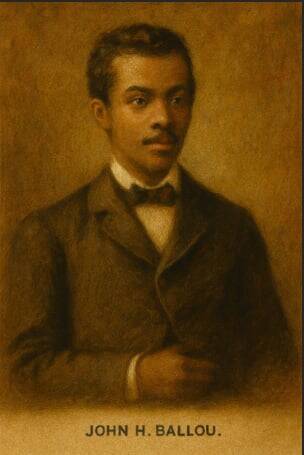
John Henry Ballou: From Providence to Jacksonville – A Legal Pioneer’s Journey Through the Color Line
By Jerry Urso, FPS
John Henry Ballou’s life bridged two geographic and cultural worlds: the abolitionist-rich, free Black community of Providence, Rhode Island, and the post-Reconstruction, Jim Crow-dominated South. He was a lawyer, educator, journalist, and fraternal leader, whose work challenged the racial exclusion embedded in America’s legal and civic systems. His role in the 1912 Florida Supreme Court case Bonaparte v. State revealed both his courage and his command of the law. From courtroom testimony to Masonic lodges, Ballou’s voice rang out for justice across state lines and generations.
Early Life and Education
John Henry Ballou was born in Providence, Rhode Island, on June 9, 1853, to David N. and Anna R. (Uchee) Ballou, both free persons of color [1]. His early education took place in the Providence public school system, and he graduated from Schofield’s Commercial College. He then pursued further studies under Professor C. W. Tarleton at Brown University [1]. Though he never earned a formal degree from Brown, Ballou’s academic rigor was recognized when Selma University in Alabama conferred upon him the honorary degree of LL.D. in 1892 [1].
Legal Career and Political Milestones
Ballou became the first African American admitted to the Rhode Island Bar in 1874, at age 21 [1]. He immediately took up civil rights causes, partnering with George T. Downing to help repeal a Rhode Island law that prohibited interracial marriage [1]. He was also a delegate to the Civil Rights Convention in the 1870s. After relocating to Florida, Ballou served briefly as professor of physics and mathematics at Cookman Institute in Jacksonville during the 1883–1884 academic year [1].
His legal career expanded when he was elected Judge of the Justice Court for Duval County’s 11th District in 1888, holding that office until 1892 [1]. Ballou's service in the judiciary made him one of the few Black elected judges in Florida during the post-Reconstruction period.
In 1892, he moved to Birmingham, Alabama, where he was retained as attorney for the Alabama Penny Savings Bank, the first Black-owned bank in the state. That same year, he founded the Co-operative Grocery Company, again demonstrating his commitment to economic empowerment and community uplift [1].
Journalism, Authorship, and Public Advocacy
Ballou was a dynamic and articulate writer. He edited the Eastern Review (1874–75) during his early years in Rhode Island and later published and edited several newspapers in Florida, including The Daily Promoter in 1912 and The Standard [1]. His articles often dealt with race relations, public policy, and the moral duties of African American citizens and leaders.
He co-authored the book Multum in Parvo (1912) with P. H. Thompson and I. W. Crawford [1]. That same year, he compiled the Dictionary of the Colored People of Jacksonville, Florida, a groundbreaking local biographical record [1]. His 1902 pamphlet, The National Publishing Board from a Denominational Standpoint, reflected his concern for transparency and representation in religious publishing.
Ballou's Courtroom Challenge: Bonaparte v. State
Ballou’s most historically significant moment came during the 1912 case Bonaparte v. State, where he testified as an expert witness in a challenge to the racially discriminatory jury selection process in Duval County, Florida. Harry Bonaparte, a Black defendant, had been convicted by an all-white jury. Ballou testified:
“I have attended the courts of this county and this court since 1881, and I know that no colored men have served on the jury in this court for the last 10 or 15 years…” [2]
He detailed the civic accomplishments of Jacksonville’s Black population, including their schools, churches, and extensive property holdings. Ballou emphasized the existence of “1,000 colored men of sound judgment… fully qualified for jury duty” [2]. He noted that the Prince Hall Masons in Jacksonville alone owned property worth over $90,000 and were constructing a new temple at a cost of $100,000 [2]. Despite corroborating testimony from others, the challenge was denied.
Chief Justice C.J. Hocker dismissed the motion, but the record of Ballou’s testimony—clear, detailed, and rooted in civic fact—remains a bold indictment of judicial racism in early 20th-century Florida.
His office is now part of the Sollie Mitchell Masonic History and Civil Rights Museum, operated under the Most Worshipful Union Grand Lodge of Florida. He was affiliated with multiple national and local fraternal organizations:
- Member, Most Worshipful Union Grand Lodge of Florida (PHA)
- Supreme Commander, Royal Lions of America
- Supreme President, Good Samaritan Benefit Society
- Supreme Vice-President, Afro-American Union
- Secretary, Florida Citizens Protective League [1]
His fraternal leadership was not ceremonial—these institutions provided insurance, burial aid, legal advocacy, and economic support at a time when Black Americans were denied access to mainstream civic services.
National Voice and Political Organizer
Ballou remained active in Republican politics. In 1903, he served as Secretary of the Lincoln League, an auxiliary of the national Union Republican organization in Baltimore, Maryland [1]. He spoke at meetings and conventions across the country, advocating for civil rights, voting access, and economic justice. His speeches were noted for their clarity, command of history, and moral urgency.
Legacy
Ballou led the way for a generation of civil rights lawyers in Florida, including D. W. Perkins, J. Douglas Wetmore, James Weldon Johnson, S. D. McGill, N. K. McGill, and Isaac L. Purcell. Each of these men stood on the legal and civic foundations Ballou helped establish.
- W. Perkins became Florida’s most influential Black attorney during the early 20th century and was known for defending civil rights cases throughout the state. He also played a key role in organizing Florida’s Black Bar and served as mentor to many younger lawyers.
- Douglas Wetmore famously challenged Jacksonville’s streetcar segregation laws, successfully helping overturn them through federal litigation. His legal writings and correspondence with W. E. B. Du Bois revealed the inner conflict of being a light-skinned Black lawyer passing in a segregated world.
James Weldon Johnson, though better known as a poet and civil rights leader, practiced law in Jacksonville and became the first African American admitted to the Florida Bar since Reconstruction. He later served as NAACP field secretary, taking the legal fight for racial justice to a national level.
- D. McGill was a fierce legal advocate, working closely with Perkins and others to litigate civil rights and voting rights cases. He was also active in Florida’s Masonic and political circles, helping organize resistance to Jim Crow laws.
- K. McGill, brother of S. D. McGill, contributed to legal and educational causes, reinforcing the McGill family’s reputation for leadership in the courtroom and the classroom.
Isaac L. Purcell helped challenge Florida’s streetcar segregation laws alongside J. Douglas Wetmore, laying the groundwork for later transit equity cases. He also served as counsel to major Black institutions and benevolent societies.
John Henry Ballou's name deserves a prominent place among early African American legal pioneers. As Rhode Island’s first Black lawyer [1], a Florida judge and civil rights advocate, an Alabama business founder, and a national fraternal leader, Ballou exemplified the intellect, strategy, and sacrifice required to confront racism across America’s legal and civic systems.
His 1912 courtroom testimony remains one of the most detailed legal accounts of racial jury exclusion in Florida’s history, and his publications helped document the rise of a politically conscious Black citizenry in the South. His life story speaks to the possibility—and the cost—of choosing to confront injustice from within.
Sources
[1] Who's Who of the Colored Race, 1915 edition, pp. 34–35.
[2] Bonaparte v. State, Florida Supreme Court, Dissenting Opinion of Chief Justice C.J. Hocker, 1912.
[3] Stages of Freedom, “Rhode Island Black Press Exhibit,” accessed July 2025, https://www.stagesoffreedom.org/riblackpress.
[4] Judicial Alabama Research Guide, “Early African American Lawyers in Alabama: 1890s,” Alabama Legal Library, https://judicial-alabama.libguides.com.
[5] University of Florida Digital Collections, “Black Political Activism in Florida, 1880–1920.”
