
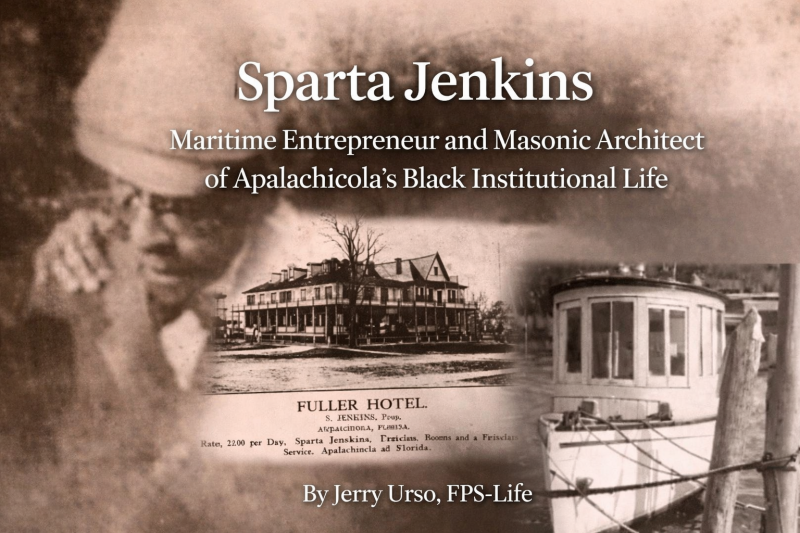
Sparta Jenkins: Maritime Entrepreneur and Masonic Architect of Apalachicola’s Black Institutional Life
By Jerry Urso, FPS-Life
Lodge, Church, and the Architecture of Black Self-Governance
To understand the full weight of Sparta Jenkins’s influence, one must situate his Masonic leadership within the broader matrix of Black institutional life in Apalachicola. In the late nineteenth and early twentieth centuries, the Prince Hall lodge and the African Methodist Episcopal church were not separate domains but interlocking pillars of communal stability. Across Florida, the same men who presided in the East of the lodge often chaired building committees in the church. They shared fundraising burdens, funeral responsibilities, and moral instruction. Sparta Jenkins’s documented role as Past Master of Hiram Lodge No. 17 and District Deputy Grand Master placed him within this inner circle of institutional architects [4][5].
Prince Hall Freemasonry in Florida during the period between 1877 and 1910 was engaged in a quiet but determined consolidation of structure. The Proceedings of the Most Worshipful Union Grand Lodge of Florida record annual sessions in which lodges reported membership totals, dues collected, property held, and disciplinary matters addressed [4]. These reports reveal a system striving for order in a segregated society that offered African Americans little protection. The lodge became an arena of self-regulation and parliamentary training. Officers learned to keep minutes, balance accounts, and adjudicate conflict. The District Deputy Grand Master, as an appointed emissary of Grand Lodge authority, ensured that this system functioned uniformly across districts.
Sparta Jenkins’s 1891 report to the Grand Lodge demonstrates this oversight in action. He noted that lodge records were neatly kept and that no dissension had been reported, but he also observed that dues were often in arrears and urged more prompt collection [5]. This seemingly routine comment reflects a larger truth: financial discipline was the backbone of institutional survival. Without dues, burial funds failed. Without burial funds, widows and orphans suffered. In urging stricter collection, Jenkins was safeguarding the welfare infrastructure of his district.
The lodge also provided symbolic authority. In a segregated town where African American civic participation was limited, the titles of Worshipful Master and District Deputy Grand Master carried recognition within the Black community. The lodge room became a training ground for leadership habits that extended beyond its walls. Jenkins’s experience as hotel proprietor and maritime operator would have complemented this fraternal discipline. He understood accounts, scheduling, and negotiation; the lodge required precisely those competencies.
Hiram Lodge No. 17 in Apalachicola operated within a vibrant Black district often referred to as “the Hill.” This neighborhood contained churches, fraternal halls, oyster houses, and small businesses. It was both economically productive and socially cohesive. When crises struck—such as the burning of local school facilities in the twentieth century—fraternal halls frequently provided temporary refuge and classroom space [6]. Though this occurred after Jenkins’s era, it reflects the institutional durability built by his generation.
Church life paralleled lodge life. St. Paul African Methodist Episcopal Church in Apalachicola began the construction of its Gothic Revival brick structure in the early twentieth century, reflecting the maturation of Black congregational ambition [7]. The building’s permanence signaled more than religious devotion; it was a declaration of endurance. While specific minutes must document individual officers, community histories consistently note the overlapping leadership between lodge and church during this period [7]. Given Jenkins’s stature within Prince Hall Masonry, his presence within this wider institutional ecosystem is historically coherent.
The interplay between economic and fraternal authority also shaped reputation. The Fuller Hotel advertisement positioned Jenkins as a provider of first-class service to steamer passengers [2]. In lodge settings, such commercial respectability enhanced credibility. A District Deputy who could manage both a hotel and a district command carried persuasive authority. Economic independence strengthened moral instruction.
It is critical, however, to maintain generational precision. Later narratives sometimes attribute mid-twentieth-century civil rights activism directly to Sparta Jenkins. Chronology indicates that such activism belonged to his descendants. What the elder Jenkins provided was structure: hotel infrastructure, maritime technology, and fraternal governance. These foundations would enable later generations—bearing the Jenkins name—to participate in twentieth-century reform movements with institutional backing.
Thus, Sparta Jenkins represents a foundational rather than agitational form of leadership. His era required consolidation; later eras required confrontation. Both were necessary, but they were not identical.
Maritime Innovation and Economic Leverage
The maritime record surrounding the Sadie J deepens our understanding of Sparta Jenkins’s economic imagination. Florida Memory identifies the launch as diesel-powered with a Tomahawk engine and credits Jenkins as owner, noting its status as the first engine-equipped vessel on Apalachicola Bay [3]. This technological leap cannot be overstated. Sail-driven oyster boats depended upon wind patterns and tide timing. Engine propulsion offered reliability, speed, and expanded hauling capacity.
The oyster industry was central to Apalachicola’s economy. Harvesting required early departure, heavy lifting, and timely delivery to market. An engine-equipped vessel reduced risk and increased efficiency. By investing in mechanization, Jenkins aligned himself with forward-looking maritime practice. The archival note that he leased the boat to Popham’s Cultivated Oyster Farms in 1933 for twenty dollars per month reveals additional layers of business strategy [3]. Leasing transformed a transport tool into a revenue stream independent of personal labor.
This diversification mirrors his approach to the Fuller Hotel. There, he capitalized on steamer traffic by ensuring that a porter met arrivals [2]. In maritime leasing, he capitalized on oyster production demand. In both instances, he leveraged Apalachicola’s geographic advantages. The river and bay were not obstacles but conduits.
The racial dynamics of the era add further complexity. Preservation commentary indicates that the Fuller Hotel, though Black-owned, operated within Jim Crow constraints that often meant serving white clientele [1]. Economic survival required strategic navigation of segregation. Jenkins’s ability to maintain ownership while operating within discriminatory frameworks demonstrates adaptive acumen rather than submission.
The cumulative picture is one of layered authority. Sparta Jenkins was not a single-industry merchant. He was a diversified entrepreneur embedded in the port economy. His hotel serviced maritime travelers; his boat serviced oyster enterprises; his lodge serviced communal welfare. Each sphere reinforced the others.
Moreover, his documented Masonic leadership in 1891 situates him during a period when Florida Prince Hall Masonry was stabilizing after Reconstruction’s upheavals [4][5]. The late nineteenth century was marked by increasing legal segregation and economic tightening for African Americans. Within this climate, disciplined lodge governance provided counterweight. Jenkins’s dual engagement in commerce and fraternal administration reveals a sophisticated understanding of survival mechanisms.
Modern commemorations by the City of Apalachicola and the Hillside Coalition of Laborers for Apalachicola recognize Jenkins as a central Black entrepreneur and maritime pioneer [8][9]. These commemorations are grounded in archival documentation rather than myth. The hotel advertisement exists. The Sadie J record exists. The 1891 District Deputy report exists. Hiram Lodge No. 17 lists him as Past Master [4][5].
What emerges is not a legend inflated by nostalgia but a documented institutional builder. Sparta Jenkins belongs within the broader narrative of Florida’s Gulf Coast Black leadership—a cadre of men who constructed durable economic and fraternal frameworks under segregation.
Legacy Across Generations and the Permanence of Structure
Sparta Jenkins’s life must ultimately be measured not only by the offices he held or the businesses he operated, but by the durability of the structures he helped sustain. His career unfolded during one of the most volatile transitions in American history. Born in the final decade of slavery, he matured during Reconstruction, navigated the rise of Jim Crow, and emerged as a respected economic and fraternal authority in a coastal town whose prosperity depended upon fragile maritime markets. That he achieved documented status as proprietor of a first-class hotel, owner of an engine-powered launch, Past Master of Hiram Lodge No. 17, and District Deputy Grand Master of the Most Worshipful Union Grand Lodge of Florida situates him among the institutional class of Black Florida in the late nineteenth century [2][3][4][5].
His 1891 report to the Grand Lodge reveals a tone of disciplined stewardship rather than flamboyance. He wrote of record-keeping, dues collection, and the general harmony of the lodges within his district [5]. These concerns reflect a mindset oriented toward order and sustainability. In a segregated society that offered few legal protections to African Americans, institutional discipline was survival. Financial arrears were not minor inconveniences; they threatened burial funds, relief systems, and the symbolic coherence of the fraternity. By urging prompt collection and expressing regret that business obligations limited his visitation schedule, Jenkins demonstrated both accountability and humility [5].
The lodge, the hotel, and the launch were not isolated ventures. They were components of a cohesive strategy of Black self-determination in a maritime town. The Fuller Hotel linked Jenkins to river and bay commerce, servicing steamer passengers and commercial travelers [2]. The Sadie J linked him to oyster cultivation and mechanized innovation on Apalachicola Bay [3]. Hiram Lodge No. 17 linked him to a statewide network of Prince Hall governance that cultivated administrative competence and mutual aid [4]. Together, these spheres created what might be described as layered sovereignty: economic independence, technological adaptation, and fraternal authority reinforcing one another.
It is important to underscore that this form of leadership differed from the protest-driven activism of the twentieth century. Sparta Jenkins’s era demanded construction rather than confrontation. The legal framework of Jim Crow narrowed avenues for overt political engagement, but it did not eliminate the possibility of disciplined institution-building. By consolidating property, embracing mechanical innovation, and maintaining fraternal order, Jenkins and his peers created stable environments in which later generations could organize more directly against segregation.
Subsequent descendants bearing the Jenkins name appear in mid-twentieth-century civic contexts. Community genealogies reference figures such as Harry or Harold Spartan Jenkins, indicating the continuation of the name across generations. Chronology makes clear that the civil rights activism of the 1960s cannot be attributed to the elder Sparta, who would have been over one hundred years old at that time. Yet this distinction does not diminish his influence. Rather, it clarifies it. The elder Jenkins laid the economic and institutional groundwork; his descendants inherited not merely a name but a framework of organized communal life.
The Hill district of Apalachicola—home to fraternal halls, churches, and Black-owned enterprises—was the stage upon which this generational continuity unfolded. The construction of St. Paul African Methodist Episcopal Church in brick during the early twentieth century symbolized permanence [7]. Prince Hall lodges provided parliamentary training and welfare support [4]. When educational facilities later burned or proved insufficient, fraternal halls functioned as temporary classrooms [6]. Such adaptive resilience did not arise spontaneously in the mid-twentieth century; it was the fruit of earlier discipline.
Municipal and community recognition in the present affirms Jenkins’s significance. The City of Apalachicola’s Black History Trail includes him among the figures who shaped the town’s African American heritage [8]. The Hillside Coalition of Laborers for Apalachicola highlights his proprietorship of the Fuller Hotel and his pioneering role in motorized bay transport [9]. These commemorations rest upon archival foundations: a printed advertisement identifying “S. Jenkins, Prop.” [2], a Florida Memory record naming him as owner of the Sadie J [3], MWUGL Proceedings listing him as Past Master and District Deputy Grand Master [4][5], and preservation documentation situating the Fuller Hotel within a lineage of Black ownership [1].
Sparta Jenkins’s historical importance lies in his embodiment of structured Black advancement in coastal Florida. He was neither a transient laborer nor a symbolic figure inflated by later nostalgia. He was a documented institutional actor operating within commerce, technology, and fraternal governance. His leadership reflects a broader pattern visible in Gulf Coast towns where maritime opportunity intersected with Prince Hall organization to create resilient Black civic ecosystems.
When measured against the arc of Florida’s Black history, Jenkins stands as part of the generation that converted emancipation into infrastructure. Others would later challenge segregation directly; he ensured there were institutions worth defending. The hotel offered lodging and revenue; the launch offered mechanized reach; the lodge offered discipline and mutual aid. These were not minor achievements. They were the scaffolding upon which dignity was maintained.
In examining his life, one sees the quiet architecture of endurance. The printed hotel advertisement speaks of first-class rooms and service [2]. The District Deputy’s report speaks of orderly records and financial vigilance [5]. The launch record speaks of innovation and leasing strategy [3]. Each document contributes to a composite portrait of a man who understood that permanence required structure. Through commerce and fraternity, Sparta Jenkins helped craft that structure in Apalachicola, leaving a legacy measured not in rhetoric but in enduring institutions.
References
[1] Historic Preservation Plan for the Chestnut Street Cemetery, Apalachicola, Florida, Florida Division of Historical Resources.
[2] Franklin County promotional publication reprinting Fuller Hotel advertisement, University of Florida Digital Collections.
[3] Florida Memory, State Archives of Florida, “Launch ‘Sadie J’” item record identifying Spartan Jenkins as owner.
[4] Proceedings of the Most Worshipful Union Grand Lodge of Florida, Prince Hall Affiliated, 1877–1910 (Hiram Lodge No. 17 listing “J. S. Jenkins, P.M.”).
[5] Proceedings of the Most Worshipful Union Grand Lodge of Florida, January 10, 1891 report signed “Spartan Jenkins, D.D.G.M.”
[6] Local historical accounts of Dunbar School relocation to fraternal halls in Apalachicola.
[7] Historical summary of St. Paul African Methodist Episcopal Church, Apalachicola, Florida.
[8] City of Apalachicola, Black History Trail.
[9] Hillside Coalition of Laborers for Apalachicola (H’COLA), Black Legends Panel.
