
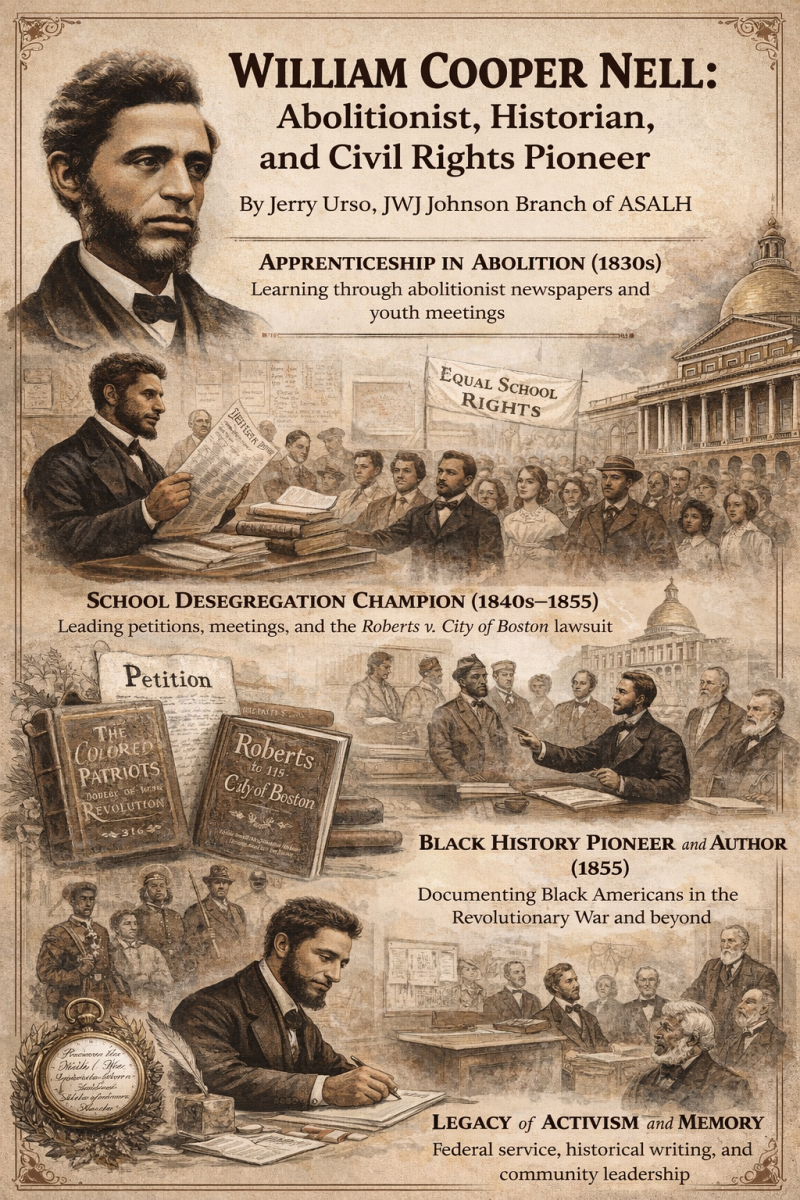
William Cooper Nell (1816–1874)
Abolitionist, Integrationist, Historian, and Guardian of Black Memory
Birth, Family, and the Formation of a Reform Household
William Cooper Nell was born on December 20, 1816, in Boston, Massachusetts, into one of the city’s most politically conscious Black families. His father, William Guion Nell, belonged to the first generation of free Black abolitionists in New England and was among the founders of the Massachusetts General Colored Association in 1826, the earliest statewide Black abolitionist organization in the United States [1]. His mother, Louisa Marshall Nell, was rooted in Boston’s free Black religious and mutual-aid networks, anchoring the family within institutions that sustained Black civic life.
Nell was raised in Boston’s Beacon Hill community, a dense and unusually active center of free Black life. Ministers, sailors, artisans, educators, and reformers lived within walking distance of one another, and public meetings were frequent. From childhood, Nell absorbed the idea that African Americans were not merely petitioners for justice but active agents shaping their own institutions. This environment produced not only abolitionists, but organizers who understood discipline, collective action, and moral authority.
Freemasonry formed part of this inherited civic architecture. Both William Guion Nell and his son moved within Prince Hall Masonic circles that overlapped closely with abolitionist leadership in Boston. In the early nineteenth century, Prince Hall Freemasonry functioned not simply as a fraternal order, but as a stabilizing framework for Black leadership, emphasizing education, moral conduct, and mutual obligation [2]. Though lodge records do not consistently preserve dates or offices for every member of this period, Nell’s lifelong associations with Prince Hall leaders confirm that Freemasonry was part of the institutional world in which he matured.
This household did not produce wealth or political office. It produced continuity—a multigenerational commitment to racial justice grounded in organization rather than spectacle.
Education, the Smith School, and the Injury of Segregation
William Cooper Nell received his formal education at Boston’s Smith School, the segregated public school for Black children located in the basement of the African Meeting House. The school existed because Black children were excluded from white public schools, yet its very existence reinforced racial separation as a civic norm. Nell excelled academically, but the structure of segregation denied him equal recognition.
A pivotal incident occurred during his student years when Nell was passed over for a merit award funded by the estate of Benjamin Franklin, despite having earned it. Instead of the prize, the school committee presented him with Franklin’s autobiography. Contemporary accounts and later historical reconstructions identify this moment as formative [3]. The gesture, intended as consolation, revealed the deeper logic of segregation: Black achievement could be acknowledged privately but not rewarded publicly.
Nell later recalled this episode as evidence that segregated education trained children—Black and white alike—to accept inequality as natural. Education, he concluded, was not neutral. It either affirmed citizenship or denied it. From this moment forward, Nell’s understanding of schooling shifted from personal advancement to public justice.
The Smith School became, in Nell’s mind, a symbol rather than a solution. Though many Black Bostonians had fought hard to secure the school as a refuge from exclusion, Nell increasingly saw it as a mechanism that allowed the city to avoid confronting its own racial contradictions. This realization would place him at the center of one of the longest and most consequential school integration battles in nineteenth-century America.
Apprenticeship in Abolition and the World of Print
William Cooper Nell entered public life through the world of abolitionist print, where newspapers, pamphlets, and meeting notices served as the nervous system of reform. In the 1830s, Boston’s antislavery movement relied heavily on the circulation of ideas, and Nell quickly learned that access to print meant access to power. His earliest documented public activities appear in abolitionist newspapers, particularly The Liberator, where notices of meetings and youth societies placed his name into the public record while he was still a teenager [4].
Nell became involved with the Juvenile Garrison Independent Society, a youth organization dedicated to moral reform, self-education, and antislavery advocacy. Notices published in The Liberator confirm that these meetings were not symbolic exercises but training grounds for future organizers. Young Black men were encouraged to read history, study political conditions, and develop the confidence to speak publicly. Nell distinguished himself within this environment through diligence rather than rhetoric, earning a reputation for reliability and intellectual seriousness.
Print culture also shaped Nell’s understanding of permanence. Speeches could be forgotten, but printed words endured. Newspapers preserved names, arguments, and events in ways that petitions and oral testimony often could not. This realization would later drive Nell’s insistence on documenting Black history as evidence rather than sentiment.
By the late 1830s and early 1840s, Nell’s name appeared with increasing regularity in abolitionist notices, committee listings, and organizational announcements. These appearances document continuity. Nell was not a brief participant in the movement but a sustained presence, embedded in its daily operations and trusted with responsibility [5].
William Lloyd Garrison, The Liberator, and Mutual Influence
William Cooper Nell’s long relationship with William Lloyd Garrison was central to his development as both an activist and a historian. Garrison’s newspaper, The Liberator, provided Nell with a public platform, but it also offered discipline. Garrison demanded precision, moral clarity, and consistency—qualities that shaped Nell’s own approach to reform.
Throughout the 1830s, 1840s, and 1850s, The Liberator carried notices documenting Nell’s participation in meetings, organizational leadership, and public presentations [6]. Garrison himself praised Nell in print, describing his efforts for the “intellectual and moral improvement of our colored youth,” language that positioned Nell as an educator and organizer rather than a mere supporter of the movement.
Yet the relationship was not one of imitation. While Garrison emphasized immediate emancipation and moral suasion, Nell increasingly focused on institutional inequality, especially in public education. Garrison opposed slavery everywhere; Nell targeted segregation where he lived. This difference did not divide them, but it shaped their collaboration. The Liberator became the place where Nell’s school-integration arguments, organizational notices, and historical research reached a broader audience.
Importantly, Nell was not simply echoing Garrison’s ideas. Newspaper coverage shows Nell acting independently—organizing petitions, chairing meetings, and mobilizing Black communities in ways that responded to local conditions in Boston [7]. Garrison’s respect for Nell rested on this independence. By the 1850s, Nell was no longer presented as a promising youth, but as a seasoned reformer whose work warranted public recognition.
This mutual influence reached its most mature form when The Liberator began publishing notices and commentary on Nell’s historical research in the early 1850s. The paper treated his work not as amateur antiquarianism but as serious scholarship with political relevance [8]. In doing so, The Liberator helped establish Nell’s reputation as a historian while he was still actively engaged in reform battles.
Frederick Douglass, Strategic Differences, and Shared Purpose
William Cooper Nell’s relationship with Frederick Douglass illustrates both the breadth of the abolitionist movement and the diversity of strategies within it. While Nell and Douglass shared a commitment to Black self-representation and racial equality, their methods and emphases diverged in ways that reveal the complexity of nineteenth-century reform.
Douglass emerged as the movement’s most powerful orator, using autobiography and speech to confront slavery and racism directly before national audiences. Nell, by contrast, worked primarily through organization, documentation, and local institutional reform. Newspaper records and correspondence indicate that Nell respected Douglass’s achievements, while remaining cautious about approaches that relied heavily on charismatic leadership or party politics [9].
Both men, however, understood the importance of print as authority. Douglass’s newspapers—The North Star and later publications—echoed themes that Nell advanced in Boston: the necessity of Black intellectual independence and the danger of allowing white reformers to define Black history. Though Nell did not regularly appear as a contributor to Douglass’s papers, the ideological alignment is evident. Each insisted that African Americans must speak for themselves, record their own experiences, and claim ownership of the national narrative.
Where Douglass increasingly embraced political abolitionism and constitutional argument, Nell remained focused on education, law, and historical memory. These differences did not signal estrangement. Rather, they reflected complementary roles within a broad movement. Douglass challenged the nation rhetorically; Nell challenged it structurally. Their shared insistence that Black citizenship rested on evidence—of service, sacrifice, and participation—would converge most clearly in Nell’s historical writing.
Black Leadership Networks, Prince Hall Masonry, and John T. Hilton
William Cooper Nell’s work unfolded within a dense network of Black institutional leadership that included churches, schools, mutual-aid societies, and fraternal organizations. Among the most influential figures in this network was John T. Hilton, Grand Master of the Prince Hall Grand Lodge of Massachusetts. Hilton appears repeatedly in abolitionist newspapers and meeting records as a presiding officer, speaker, and organizer during the very years Nell was most active in the struggle for school integration [10].
Prince Hall Freemasonry in antebellum Boston functioned as a stabilizing institution for Black leadership. It reinforced norms of education, moral conduct, discipline, and civic responsibility, and it provided a structured space in which Black men exercised authority at a time when such authority was routinely denied elsewhere. Nell’s lifelong associations with Prince Hall leaders situate him firmly within this institutional world, even when surviving records do not consistently identify lodge numbers or offices [11].
Liberator reports documenting public meetings in honor of Nell’s work for equal school rights show Hilton presiding as president, underscoring the alignment between Nell’s educational activism and Prince Hall leadership. These gatherings were not ceremonial. They were strategic assemblies where legal, political, and moral approaches were debated and coordinated. Hilton’s presence confirmed that Nell’s efforts carried institutional backing from Boston’s Black leadership class.
Freemasonry also intersected with Nell’s emphasis on historical memory. Prince Hall lodges preserved records, honored lineage, and emphasized continuity—values mirrored in Nell’s later historical work. While Nell never foregrounded fraternal identity in his public writing, the institutional habits of Freemasonry—order, documentation, and moral instruction—are visible throughout his career.
Together, these Black leadership networks provided Nell with legitimacy, support, and accountability. They ensured that his campaigns were not solitary efforts but collective enterprises rooted in established institutions.
The Long Campaign Against Segregated Schools
By the early 1840s, William Cooper Nell had committed himself fully to what would become the central public struggle of his life: the abolition of segregated public schools in Boston. While slavery remained the dominant moral issue nationally, Nell understood that in Massachusetts the most immediate denial of Black citizenship occurred through education. Segregated schools, he argued, were not temporary accommodations but permanent markers of caste.
Nell emerged as one of the principal organizers of what became known as the School Abolishing Party, a coalition of Black leaders, parents, and allies dedicated to dismantling the Smith School entirely. Meetings were held frequently at the African Meeting House, where strategy was debated and responsibilities assigned. Newspaper accounts and later historical studies confirm that Nell was among the most persistent voices in these gatherings, pressing the argument that separation itself—regardless of facilities or teachers—constituted injustice [12].
Petitioning became one of the movement’s most effective tools. Nell personally helped circulate and collect petitions demanding the closure of the Smith School and the admission of Black children to Boston’s common schools. These petitions, numbering in the thousands of signatures, forced the issue repeatedly before the Boston School Committee and city authorities [13]. The volume of signatures was itself a political statement, demonstrating that opposition to segregation was not confined to a few agitators but reflected broad community consensus.
Resistance came from multiple directions. Some white reformers supported abolition while stopping short of endorsing integration. Within the Black community, others feared that closing the Smith School would leave Black children vulnerable to hostility in white schools. Nell acknowledged these concerns but rejected compromise. Segregation, he insisted, taught inequality even when administered with good intentions.
Throughout the 1840s, Nell appeared repeatedly in abolitionist newspapers as an organizer, speaker, and committee member addressing school reform. These notices document continuity rather than episodic protest. Nell’s strategy relied on endurance—keeping the issue alive through repetition until officials could no longer ignore it [14].
Petitions, Public Meetings, and the Weight of Opposition
As the school-integration campaign intensified, opposition hardened. Boston’s School Committee defended segregation as a matter of administrative convenience and claimed that separate schools avoided “social friction.” Nell and his allies countered this logic forcefully, arguing that friction itself was evidence of injustice rather than a reason to preserve it.
Public meetings multiplied. Liberator reports and other newspaper accounts describe gatherings where Nell and fellow activists spoke at length, often before mixed audiences. At these meetings, Nell framed segregation as a violation of republican principles, emphasizing that Black children were citizens in training and that citizenship could not be conditioned on race [15].
The movement’s persistence drew increasing scrutiny. Nell became a visible target for critics who accused him of disturbing social harmony. Yet the same visibility strengthened his authority within reform circles. By the late 1840s, he was widely recognized as the most consistent advocate for educational equality in Boston, a reputation reinforced by his refusal to retreat after repeated setbacks.
The struggle also produced moments of internal reckoning. Some Black parents, exhausted by years of petitioning, questioned whether integration was achievable. Nell responded not by diminishing their concerns but by reframing the stakes. To accept segregation, he argued, was to concede that Black children were unfit for shared civic life—a concession that would echo far beyond schools.
These debates hardened Nell’s resolve and clarified his philosophy. Equality, he concluded, was not something granted after prejudice disappeared. It was something that created new conditions by forcing society to confront its own contradictions. This conviction set the stage for the movement’s turn toward the courts.
Roberts v. City of Boston: The Legal Test of Segregation
By the late 1840s, William Cooper Nell and his allies concluded that petitions and public meetings alone could not dismantle Boston’s segregated school system. The question had to be forced into the courts. This strategy culminated in the case of Roberts v. City of Boston, the most significant antebellum legal challenge to school segregation in the North.
The case arose when Sarah Roberts, a Black child, was denied admission to a nearby white public school and instead required to travel a considerable distance to attend the segregated Smith School. Nell understood the case as more than an individual grievance. It was a test of whether segregation itself could survive constitutional scrutiny. He worked closely with Black parents, community leaders, and legal advocates to frame the issue not as inconvenience but as a denial of equal protection [16].
The legal team included Robert Morris, one of the first African American attorneys in the United States, and Charles Sumner, then an emerging antislavery lawyer. Their arguments drew directly from the principles Nell had articulated for years: that segregation imposed psychological injury, branded Black children as inferior, and violated the spirit of republican equality. Sumner emphasized that education was foundational to citizenship and that exclusion from common schools carried lifelong consequences [17].
Throughout the proceedings, abolitionist newspapers followed the case closely. Reports framed it as a moral as well as legal contest, reflecting the degree to which the lawsuit embodied broader struggles over race, equality, and public institutions. For Nell, the courtroom became another arena in which the meaning of citizenship was contested.
Defeat Before the Court and the Meaning of Loss
In 1850, the Massachusetts Supreme Judicial Court ruled against the plaintiffs. Chief Justice Lemuel Shaw held that segregated schools did not violate the state constitution so long as the facilities were ostensibly comparable. The decision rejected the argument that separation itself constituted inequality and framed segregation as a matter of administrative discretion rather than moral principle [18].
The ruling was a profound disappointment. It not only upheld segregation in Boston but articulated a legal rationale that would echo nationally. Later legal historians identified Shaw’s reasoning as a foundation for the doctrine of “separate but equal” later enshrined in Plessy v. Ferguson (1896). For Nell, the decision confirmed a harsh truth: courts could legitimize injustice as readily as they could dismantle it.
Yet defeat did not end the movement. Nell interpreted the ruling not as a final judgment but as evidence that change would require legislative action and sustained public pressure. Abolitionist newspapers recorded his continued organizing after the decision, demonstrating that the loss did not diminish his resolve [19].
The defeat also sharpened Nell’s understanding of law’s limits. Equality, he concluded, could not be secured solely through legal argument divorced from moral consensus. The court’s refusal to recognize psychological harm underscored the need to reshape public understanding itself—a task Nell would increasingly pursue through historical writing as well as activism.
Rather than retreating from public life, Nell redoubled his efforts. He continued attending meetings, organizing petitions, and collaborating with allies across Boston’s Black leadership networks. The legal loss clarified the stakes and strengthened his belief that citizenship had to be asserted repeatedly, even when institutions resisted.
Legislative Victory: The End of School Segregation in Massachusetts
Despite defeat in the courts, William Cooper Nell and his allies refused to concede the principle of equality. If the judiciary would not dismantle segregated schooling, the legislature would have to be compelled to act. Throughout the early 1850s, Nell continued organizing petitions, attending public meetings, and maintaining pressure through abolitionist newspapers and reform networks [20].
The political climate in Massachusetts gradually shifted. Growing discomfort with the moral implications of segregation, combined with sustained agitation by Black activists and white allies, created an opening for legislative reform. In 1855, the Massachusetts legislature enacted a law prohibiting racial discrimination in public schools, effectively ending school segregation statewide [21].
This achievement marked a historic first. Massachusetts became the first state in the nation to mandate fully integrated public schools. For Nell, the victory validated more than a decade of unrelenting effort. It confirmed his conviction that segregation could not be softened into justice and that equality had to be claimed outright.
Abolitionist newspapers recognized the significance of the moment, crediting persistent agitation rather than judicial wisdom. Nell’s role was widely understood within reform circles, even when official credit was diffused across committees and legislators. The outcome demonstrated that organized moral pressure could succeed where legal argument alone had failed.
Public Recognition and the Gold Watch Presentation
The importance of Nell’s achievement did not go unnoticed by Boston’s Black community. In the wake of legislative victory, a formal public meeting was convened to honor his leadership in the long struggle for equal school rights. Contemporary accounts published in The Liberator describe the gathering as deliberate and dignified, reflecting both gratitude and collective pride [22].
The meeting was presided over by John T. Hilton, Grand Master of the Prince Hall Grand Lodge of Massachusetts, underscoring the institutional support Nell enjoyed among Black leadership. Speakers recalled Nell’s “disinterested and unceasing exertions,” emphasizing that his advocacy had endured criticism, fatigue, and repeated setbacks.
At the conclusion of the proceedings, Nell was presented with a gold watch, inscribed to recognize him as the champion of equal school rights. In nineteenth-century reform culture, such a gift symbolized disciplined labor and the passage of time—an acknowledgment that Nell’s victory was the product of years rather than moments.
The presentation carried meaning beyond personal honor. It functioned as a public declaration that the struggle for educational equality belonged to the community as a whole. Nell himself reportedly deflected praise, insisting that success was collective rather than individual. This insistence mirrored his broader philosophy: that reform was sustained not by heroes, but by institutions, memory, and shared resolve.
Newspaper coverage of the event confirms that Nell’s leadership was recognized during his lifetime, not reconstructed after his death. The gold watch ceremony fixed his role in the public record as one of the principal architects of school integration in Massachusetts [23].
William Cooper Nell as Historian and the Recovery of the Revolutionary Past
William Cooper Nell’s turn toward historical writing was not a retreat from activism but an extension of it. After years spent contesting segregation in schools and public institutions, Nell increasingly understood that law and policy rested on assumptions about the past. If African Americans were imagined as outsiders to the nation’s founding, exclusion could be justified as tradition. History, therefore, became a battleground.
By the early 1850s, Nell was already known within abolitionist circles as a careful historical researcher. Notices published in The Liberator in 1853 identified him as the author of an ongoing historical study examining Black participation in the American Revolution, well before the appearance of his major book [24]. These notices are critical, as they demonstrate that Nell’s historical work was recognized publicly during his lifetime and treated as serious scholarship rather than antiquarian curiosity.
Nell’s approach differed from celebratory patriotic histories common in the period. He focused instead on evidence—pension records, town documents, military rolls, correspondence, and local accounts that revealed the presence of Black soldiers, sailors, and laborers in the Revolutionary War. His aim was corrective. By documenting Black service, Nell sought to undermine claims that African Americans lacked historical standing as citizens.
This work also reflected Nell’s philosophy of reform. Just as segregation in schools taught inequality, historical omission taught exclusion. Recovering the past, in Nell’s view, was a necessary step toward securing rights in the present.
The Colored Patriots of the American Revolution
In 1855, the same year Massachusetts abolished school segregation, Nell published The Colored Patriots of the American Revolution [25]. The timing was not coincidental. The book functioned as a historical foundation for the very rights Nell had spent decades demanding. If African Americans had fought for independence, then exclusion from public institutions could not be reconciled with republican ideals.
The book catalogued Black participation across colonies and campaigns, naming individuals whose service had been forgotten or deliberately ignored. Nell resisted romanticization. His prose emphasized fact over flourish, allowing documentation to carry the argument. In doing so, he departed from abolitionist rhetoric that relied heavily on moral appeal, offering instead a record that demanded recognition.
Contemporary responses within abolitionist newspapers treated the book as a serious contribution to reform literature. The Liberator framed Nell’s work as essential reading for those committed to racial justice, reinforcing its function as political evidence rather than mere commemoration [26].
Modern historians have since recognized The Colored Patriots of the American Revolution as one of the earliest full-length history books authored by an African American. Long before Black history emerged as an academic field, Nell established its core method: recovery through documentation.
The book also reveals continuity in Nell’s thinking. Whether contesting segregated schools or reconstructing the Revolutionary past, he advanced the same principle: citizenship rested on participation, and participation could be proven.
Civil War Memory and the Expansion of Historical Labor
The outbreak of the Civil War did not diminish William Cooper Nell’s commitment to historical recovery; instead, it expanded its scope. As African Americans entered the Union Army in unprecedented numbers, Nell recognized that a new chapter of Black military service was unfolding—one that would also be vulnerable to erasure if not documented carefully. Newspaper accounts and later obituaries confirm that Nell devoted increasing attention during the war years to preserving the record of Black participation in the conflict [27].
Nell understood the stakes clearly. The war was being framed as a test of national unity and citizenship, and Black enlistment challenged long-standing assumptions about loyalty, courage, and capacity. Just as he had done with the Revolutionary era, Nell sought to ensure that African American service in the Civil War would not be reduced to footnotes or forgotten altogether. His work during this period included gathering information, corresponding with reformers, and contributing to discussions about how Black soldiers should be remembered in the nation’s historical narrative.
Contemporary newspaper notices and later obituary accounts describe Nell as being “engaged in the preparation of a history of the colored race in the war of the rebellion,” indicating that his historical ambitions extended beyond a single published volume [28]. Although this project was not completed as a standalone book during his lifetime, the record confirms that Nell’s historical labor continued actively into the postwar years.
This effort reflected a consistent philosophy. For Nell, military service constituted undeniable proof of citizenship. Whether in the Revolution or the Civil War, Black participation exposed the moral bankruptcy of exclusion. History, in his hands, became evidence assembled patiently against denial.
Clerkship, Federal Service, and Daily Civic Life
Alongside his reform and historical work, William Cooper Nell sustained himself through steady employment, most notably as a clerk in the Boston Post Office. According to contemporary obituary notices, he served in this position for approximately a decade prior to his death [29]. In the nineteenth century, federal clerkships were not granted lightly, particularly to African Americans. Such positions required literacy, reliability, and character, and they placed their holders within the civic machinery of the state.
Nell’s employment reflects the quiet dimension of his life that reform histories sometimes overlook. He was not a full-time lecturer or professional reformer supported by subscriptions. Instead, he balanced daily labor with public service, conducting research, attending meetings, and organizing in the margins of working life. This balance helps explain both the endurance of his activism and the modest material circumstances in which he lived.
Newspaper advertisements and notices from earlier decades also show Nell acting as a point of contact for employment opportunities for other Black men, using his address and reputation to facilitate access to work [30]. These small but telling records confirm that Nell’s reform commitments extended beyond ideology into practical assistance.
Federal employment also reinforced Nell’s belief in citizenship as lived experience. He participated daily in the operations of government even as he challenged that same government to live up to its professed ideals. In this sense, Nell embodied the contradiction of nineteenth-century Black citizenship: serving the state while struggling to be fully recognized by it.
Final Years, Illness, and Death
In the years following the Civil War, William Cooper Nell remained active intellectually and civically, even as his health declined. He continued his work as a clerk in the Boston Post Office while maintaining engagement with reform circles, historical inquiry, and public memory. Though he no longer occupied the central organizing role he had held during the school integration battles, he was widely regarded as a moral authority whose life embodied the continuity of the abolitionist struggle [29].
By the early 1870s, Nell’s health had begun to fail. Contemporary newspaper accounts report that he suffered a brief illness, lasting approximately a week, before his death. On May 25, 1874, William Cooper Nell died at his residence in Boston from what was described in the press as “paralysis of the brain” [31]. He was fifty-seven years old.
The tone of the reporting is significant. Nell was not described as obscure or forgotten. Instead, he was identified as “one of the most prominent and respected of the colored citizens of Boston,” a phrase that situates his life squarely within the civic consciousness of the city [31]. The obituary further emphasized his long service, his association with leading abolitionists, and his historical work, confirming that these aspects defined his public identity at the time of his death.
Funeral, Public Mourning, and Obituary Recognition
Funeral services for William Cooper Nell were held at Parker Memorial Church, a location symbolically aligned with liberal religious reform and abolitionist conscience. According to the Boston Evening Transcript, the service drew a large and diverse gathering, reflecting Nell’s reach across racial and institutional lines [32].
The service was conducted by Rev. William C. Gannett, with remarks offered by leading reformers, including William Lloyd Garrison, Wendell Phillips, William Wells Brown, and Charles W. Slack. That these figures spoke publicly at Nell’s funeral is decisive evidence of the esteem in which he was held. Their presence confirmed that Nell was regarded not as a secondary figure, but as a peer within the abolitionist movement.
Newspaper coverage described the remarks as deeply moving and emphasized the solemnity of the occasion. Floral tributes were sent by women’s reform circles and colleagues from the Post Office, underscoring the breadth of Nell’s personal and professional relationships [32]. He was interred at Forest Hills Cemetery, a burial ground associated with Boston’s reform-minded elite.
The Boston Globe obituary published several days earlier reinforced this public recognition. The paper highlighted Nell’s federal service, his abolitionist associations with Garrison and Phillips, his authorship, and his ongoing historical work related to Black participation in the Civil War [31]. The obituary framed Nell’s life as one of sustained moral labor rather than episodic activism.
Legacy: William Cooper Nell and the Architecture of Black Historical Memory
William Cooper Nell’s legacy rests not on a single victory or publication, but on the integration of activism, history, and institutional persistence. He was among the first African Americans to recognize that citizenship depended as much on memory as on law. His fight against segregated schools challenged the structures of exclusion in the present, while his historical writing challenged the narratives that justified those structures.
With The Colored Patriots of the American Revolution, Nell produced one of the earliest Black-authored history books in the United States, establishing a methodology grounded in documentation, recovery, and moral clarity. Decades before Black history emerged as a formal academic field, Nell demonstrated its necessity and its power.
Equally important was his model of leadership. Nell sought no office and cultivated no personal cult. His work was collective, sustained, and often invisible. He understood institutions—schools, lodges, churches, newspapers—as the true engines of change. In this sense, he belongs to a lineage of Black builders whose labor made later victories possible.
When Massachusetts abolished segregated schools in 1855, it marked a national precedent. When Nell’s funeral drew the leading reformers of his age, it marked something quieter but no less enduring: recognition that a life spent insisting on equality had altered the moral landscape.
William Cooper Nell did not merely witness history. He constructed the evidence by which history could no longer deny Black citizenship.
References
[1] Nina Mjagkij, ed., Organizing Black America: An Encyclopedia of African American Associations (New York: Garland Publishing, 2001), entry on the Massachusetts General Colored Association.
[2] Joseph A. Walkes Jr., Black Square & Compass: 200 Years of Prince Hall Freemasonry (Richmond, VA: Macoy Publishing, 1983).
[3] Stephen David Kantrowitz, More Than Freedom: Fighting for Black Citizenship in a White Republic, 1829–1889 (New York: Penguin Press, 2012).
[4] The Liberator (Boston), notices of Juvenile Garrison Independent Society meetings, October 16, 1833.
[5] The Liberator (Boston), abolitionist meeting notices listing William Cooper Nell, 1830s–1840s.
[6] The Liberator (Boston), William Lloyd Garrison commentary on the intellectual and moral improvement of Black youth, various issues.
[7] Arthur O. White, “Antebellum School Reform in Boston: Integrationists and Separatists,” Phylon 34, no. 2 (1973): 203–217.
[8] The Liberator (Boston), notices concerning Nell’s historical research on Black Revolutionary War service, 1853–1855.
[9] Frederick Douglass, The North Star (Rochester, NY), editorials on Black self-representation and citizenship.
[10] The Liberator (Boston), public meeting honoring William Cooper Nell, presided over by John T. Hilton, Grand Master, Prince Hall Grand Lodge of Massachusetts.
[11] Proceedings of the Prince Hall Grand Lodge of Massachusetts, mid-19th century sessions.
[12] Stephen David Kantrowitz, More Than Freedom, chapters on school segregation and Black activism in Boston.
[13] Boston School Committee petition records concerning the Smith School, 1840s.
[14] The Liberator (Boston), sustained coverage of the School Abolishing Party and integration petitions.
[15] The Liberator (Boston), reports of public meetings addressing segregated education.
[16] Roberts v. City of Boston, Massachusetts Supreme Judicial Court records (1850).
[17] Charles Sumner, legal arguments presented in Roberts v. City of Boston, 1849–1850.
[18] Lemuel Shaw, opinion of the Massachusetts Supreme Judicial Court in Roberts v. City of Boston (1850).
[19] The Liberator (Boston), post-decision coverage following Roberts v. City of Boston.
[20] Massachusetts legislative debates on public school integration, early 1850s.
[21] Massachusetts Acts of 1855, statute prohibiting racial discrimination in public schools.
[22] The Liberator (Boston), report on the public presentation of a gold watch to William Cooper Nell.
[23] The Liberator (Boston), follow-up coverage of community tribute to Nell.
[24] The Liberator (Boston), notices identifying Nell’s ongoing Revolutionary War research, 1853.
[25] William Cooper Nell, The Colored Patriots of the American Revolution (Boston: Robert F. Wallcut, 1855).
[26] The Liberator (Boston), notices and commentary on The Colored Patriots of the American Revolution.
[27] The Boston Globe, references to Nell’s work on Civil War historical documentation.
[28] The Boston Globe, May 26, 1874, p. 8, obituary of William Cooper Nell.
[29] The Boston Globe, May 26, 1874, obituary noting Nell’s service as a Boston Post Office clerk.
[30] Boston newspapers, employment notices and civic references involving William Cooper Nell.
[31] The Boston Globe, May 26, 1874, death notice and biographical summary.
[32] Boston Evening Transcript, May 29, 1874, funeral coverage of William Cooper Nell.
