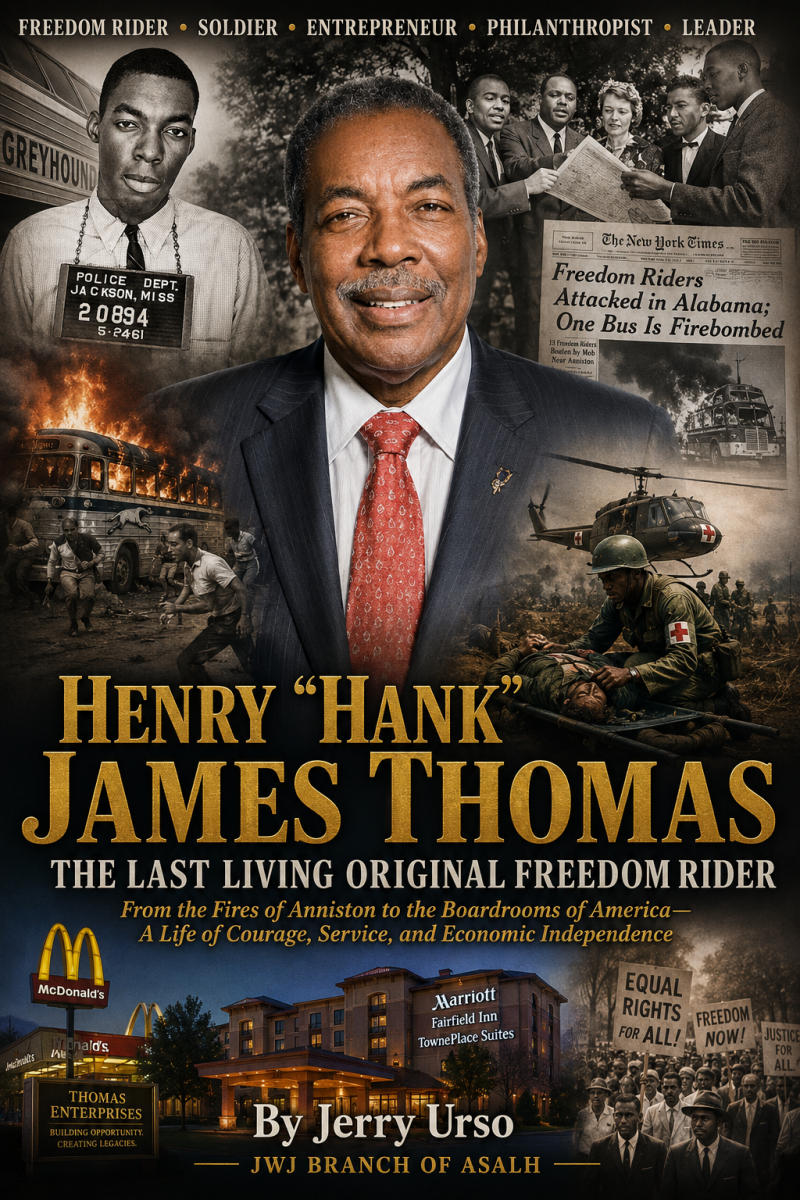
Henry "Hank" James Thomas
The Last Living Original Freedom Rider
From the Fires of Anniston to the Boardrooms of America
By Jerry Urso
JWJ Branch of ASALH
The history of the American Civil Rights Movement is often told through the names of towering figures such as Dr. Martin Luther King Jr., Rosa Parks, John Lewis, James Farmer, and Diane Nash. Yet history was not changed by famous leaders alone. It was transformed by ordinary men and women who accepted extraordinary risks, believing that freedom required action rather than words. Among those courageous individuals stands Henry "Hank" James Thomas, the last living original Freedom Rider, whose remarkable life spans nearly every major chapter of the modern struggle for African American equality.
Today, Thomas represents something increasingly rare in American history. He is not merely someone who studied the Civil Rights Movement or wrote about it. He lived it. He boarded one of two buses that departed Washington, D.C., on May 4, 1961, knowing that violence was almost certain. He survived one of the most infamous acts of racial terrorism in American history when a mob firebombed the Greyhound bus outside Anniston, Alabama. He continued serving his nation as a combat medic during the Vietnam War, earning the Purple Heart for wounds received in combat. He later became one of the nation's most successful African American entrepreneurs, proving that the struggle for equality did not end with the passage of civil rights legislation but continued through economic opportunity, business ownership, education, and community leadership.
Few Americans have lived a life that so completely reflects the evolution of Black America during the second half of the twentieth century. Thomas experienced legalized segregation as a child, confronted it directly as a young activist, defended his country as a soldier, and helped reshape American commerce as a businessman. His journey illustrates that the Civil Rights Movement was never solely about gaining access to public accommodations. It was about securing the full promise of American citizenship and creating opportunities for future generations.
As the years have passed and his fellow Freedom Riders have died, Henry "Hank" James Thomas has become the final living member of the original thirteen riders who launched one of the most consequential acts of nonviolent protest in American history. With the passing of Charles Person in 2024, Thomas became the last surviving original Freedom Rider, a living bridge to one of the defining moments of the Civil Rights Movement.
His story is therefore more than biography. It is living history.
Growing Up in Segregated Florida
Henry James Thomas was born on August 29, 1941, in Jacksonville, Florida, at a time when segregation governed nearly every aspect of life across the South. Although born in Jacksonville, much of his childhood was spent in nearby St. Augustine, one of America's oldest cities but also one of its most rigidly segregated communities during the Jim Crow era. Like countless African American children growing up in the 1940s and 1950s, Thomas learned at an early age that opportunity often depended not upon talent or character, but upon race.
The segregated South functioned through countless daily reminders of inequality. Separate schools, separate waiting rooms, separate drinking fountains, separate restaurants, and separate seating arrangements reinforced a social order designed to keep African Americans politically powerless and economically disadvantaged. For many Black families, these conditions fostered not despair but determination. Parents taught their children to pursue excellence despite injustice while quietly preparing them for the challenges they would inevitably face.
Thomas later recalled that these experiences shaped his understanding of fairness long before he became involved in organized activism. The injustices he witnessed were not abstract constitutional questions; they affected neighbors, classmates, churches, and entire communities. These early lessons would later inspire him to become one of the young people unwilling to accept segregation as permanent.
His education eventually brought him to Howard University, one of the nation's premier historically Black institutions. Howard had long served as an intellectual center for African American leadership, producing lawyers, physicians, educators, clergy, military officers, and civil rights advocates who would shape the nation's future. During Thomas's years there, the campus was alive with discussions about constitutional rights, nonviolent protest, student activism, and the responsibility of young people to challenge injustice.
Howard was not simply preparing students for careers. It was preparing many of them to change America.
Among those students was Henry "Hank" Thomas.
The Birth of SNCC and a Generation That Refused to Wait
The late 1950s and early 1960s witnessed an explosion of student activism unlike anything the United States had previously experienced. Sparked by the Greensboro lunch counter sit-ins in February 1960, thousands of young African Americans rejected the notion that change should come slowly or depend entirely upon court decisions. They believed direct action could expose injustice more effectively than speeches alone.
Out of this movement emerged the Student Nonviolent Coordinating Committee (SNCC), founded in April 1960 following a conference organized by veteran activist Ella Baker at Shaw University in Raleigh, North Carolina. SNCC would become one of the most influential organizations of the Civil Rights Movement, producing leaders whose names would become synonymous with courage, including John Lewis, Diane Nash, Julian Bond, Bernard Lafayette, Marion Barry, Bob Moses, and many others.[1]
Henry "Hank" Thomas became one of SNCC's founding members.
Unlike older civil rights organizations, SNCC was led primarily by students willing to place themselves directly in harm's way. They organized sit-ins, voter registration campaigns, demonstrations, and eventually the Freedom Rides. Their philosophy rested upon disciplined nonviolence, believing that exposing brutality before the eyes of the nation would force America to confront the contradiction between its democratic ideals and the realities of segregation.
For Thomas, joining SNCC represented more than membership in an organization. It represented a personal commitment to live according to principles of justice regardless of personal consequences.
That commitment would soon be tested in ways few could have imagined.
Boarding the Bus That Changed America
By the spring of 1961, the Civil Rights Movement had reached a pivotal moment. Although the United States Supreme Court had ruled in Morgan v. Virginia (1946) that segregation on interstate buses was unconstitutional and later reaffirmed federal authority over interstate travel in Boynton v. Virginia (1960), many Southern states simply ignored the law. Bus terminals continued to maintain segregated waiting rooms, lunch counters, and restrooms, while local officials refused to enforce federal decisions.[2]
The Congress of Racial Equality (CORE), under the leadership of James Farmer, developed a bold strategy to expose this defiance. An interracial group of volunteers would ride interstate buses through the Deep South, deliberately using facilities reserved for the opposite race. Their objective was not confrontation for its own sake. Rather, it was to demonstrate that federal law was meaningless unless the federal government was willing to enforce it.[3]
Henry "Hank" Thomas immediately understood the significance of the mission.
He also understood the danger.
The volunteers underwent training in nonviolent resistance. They practiced remaining calm while being insulted, shoved, punched, and even kicked. They rehearsed how to protect one another without striking back. Every participant knew there was a real possibility of arrest, serious injury, or death.
On May 4, 1961, thirteen Freedom Riders departed Washington, D.C., aboard two interstate buses, one operated by Greyhound and the other by Trailways. Seven were Black and six were white, deliberately challenging segregation by sitting together and using facilities reserved for the opposite race. Their destination was New Orleans, Louisiana, but the journey itself was the protest.[4]
Thomas, only nineteen years old, climbed aboard the Greyhound bus.
He could not have known that within ten days the world would know his name.
As the buses moved south through Virginia and the Carolinas, tension steadily increased. Verbal abuse became common. Threats followed. Reports reached the riders that white supremacist organizations were preparing violent resistance in Alabama and Mississippi. Yet no one turned back.
Each mile carried them closer to history.
The Fires of Anniston
Mother's Day, May 14, 1961, became one of the darkest and most significant days in the history of the Civil Rights Movement.
As the Greyhound bus approached Anniston, Alabama, it was met by a violent white mob that had gathered at the station. Armed with clubs, chains, pipes, and knives, the attackers surrounded the vehicle. Windows were smashed. Tires were slashed. Local law enforcement offered little protection.
Unable to remain at the station, the damaged bus attempted to leave Anniston. Unknown to the passengers, members of the mob pursued it by automobile.
Only a few miles outside the city, the slashed tires finally failed.
The bus came to a stop along the highway.
Within moments, the pursuing mob surrounded the vehicle once again.
One of the attackers hurled a firebomb through a broken window. Almost instantly, flames spread throughout the passenger compartment. Thick black smoke filled the bus, choking the riders as they struggled to breathe. Gasoline fumes ignited, and the bus rapidly became an inferno.
Inside were Henry "Hank" Thomas and the other Freedom Riders.
For a horrifying moment, it appeared they would all die.
The riders desperately attempted to escape, but members of the mob initially prevented them from leaving the burning bus. Only when the fire threatened to engulf the attackers themselves did the crowd move back, allowing the passengers to stumble through the smoke and flames.
Their ordeal was not over.
As Thomas and the others emerged coughing, burned, and disoriented, several members of the mob began beating them. The violence continued until law enforcement and emergency personnel finally intervened.
Photographs of the burning Greyhound bus soon appeared in newspapers around the world. The image became one of the defining symbols of the Civil Rights Movement, exposing to an international audience the brutal lengths to which segregationists would go to preserve white supremacy.[5]
For Thomas, the events at Anniston became a defining moment of his life.
He had looked directly into the face of hatred.
He had survived.
Refusing to Be Intimidated
Many observers believed the Freedom Rides had ended in Alabama.
The attackers certainly believed they had succeeded.
Their objective had never been simply to assault a handful of young activists. Their true goal was to terrorize anyone who dared challenge segregation. If fear could stop the Freedom Riders, then violence would once again preserve the racial order of the South.
Instead, the opposite occurred.
News coverage of the attacks outraged Americans across the country. Students from colleges and universities answered the call to continue the Freedom Rides. Under the determined leadership of Diane Nash and SNCC, new volunteers traveled south to replace those who had been beaten and arrested.
The movement grew stronger because of the violence.
Henry "Hank" Thomas and his fellow Freedom Riders demonstrated a profound truth that would become central to the Civil Rights Movement: courage is contagious.
Their willingness to suffer without surrender transformed a relatively small protest into an international crisis. The Kennedy administration, initially cautious, could no longer ignore the open defiance of federal law. Eventually, the Interstate Commerce Commission issued regulations that effectively ended segregation in interstate bus terminals, waiting rooms, restrooms, lunch counters, and other facilities.[6]
The Freedom Riders had accomplished precisely what they set out to do.
Not through force.
Not through retaliation.
But through extraordinary courage in the face of extraordinary violence.
From Freedom Rider to Purple Heart Veteran
For many Americans, surviving the Freedom Rides would have been enough to define a lifetime. Henry "Hank" James Thomas, however, viewed service as a continuing obligation rather than a single chapter. After helping confront injustice at home, he chose to serve his country abroad during one of the most divisive conflicts in American history.
Thomas entered the United States Army and served in Vietnam as a combat medic. It was a role that demanded exceptional courage. Unlike soldiers whose primary mission was to engage the enemy, combat medics rushed toward the wounded under fire, often exposing themselves to great danger in order to save others. The same selflessness that had led Thomas to board a segregated bus in 1961 now guided him across the battlefields of Southeast Asia.
During his military service, Thomas was wounded and awarded the Purple Heart, one of the nation's oldest and most respected military decorations. The honor recognized not only his sacrifice but also his willingness to place the lives of others above his own.
There is a striking irony in Thomas's life. As a young man, he risked his life to secure constitutional rights that many African Americans were still denied. Yet only a few years later, he wore the uniform of the United States and defended the same nation that had so often failed to protect him. Rather than allowing bitterness to define him, Thomas demonstrated a profound belief that America could continue to improve if its citizens remained committed to justice, service, and sacrifice.
His life reminds us that patriotism and the struggle for civil rights have never been contradictory. For many African Americans, including Henry "Hank" Thomas, the fight for equality has always been an effort to make America live up to its highest ideals.
Building an Economic Legacy
When Thomas returned home from Vietnam, he faced another challenge familiar to many veterans: building a future. The Civil Rights Act had outlawed many forms of discrimination, but equal opportunity was far from guaranteed. Rather than allowing obstacles to define his future, Thomas turned to entrepreneurship.
He began modestly, operating a neighborhood laundromat. It was not glamorous work, but it reflected a philosophy shared by many successful entrepreneurs: start where you are, master the fundamentals, and build steadily.
That philosophy proved remarkably successful.
Over time, Thomas became one of the nation's most accomplished African American franchise owners with McDonald's. His success extended beyond restaurants into the hospitality industry, where he acquired and developed Marriott-affiliated hotels, including Fairfield Inn and TownePlace Suites properties. Through vision, discipline, and perseverance, he built businesses that created jobs, generated wealth, and expanded opportunities within the communities they served.
His achievements represented something larger than personal success. For generations, African Americans had been denied equal access to capital, credit, and commercial opportunity. Thomas demonstrated that economic empowerment was an essential extension of the Civil Rights Movement. Legal equality opened doors, but business ownership created lasting independence.
He also understood that success carried responsibility. Throughout his career, Thomas invested his time and resources in organizations dedicated to education, health care, and community development. His service on the boards of institutions such as the APEX Museum and the Morehouse School of Medicine reflected his belief that leadership extends beyond business into the strengthening of communities.
A Living Synthesis of America's Great Black Leaders
Few individuals embody as many dimensions of African American leadership as Henry "Hank" James Thomas. His life does not mirror a single historical figure. Instead, it reflects the combined influence of several of the twentieth century's greatest Black visionaries.
Like W.E.B. Du Bois, Thomas recognized that education, intellectual development, and informed citizenship are essential to freedom. His lifelong commitment to preserving history and educating future generations echoes Du Bois's belief that knowledge empowers communities.
Like Booker T. Washington, Thomas understood the importance of economic independence. His remarkable success in business demonstrated that entrepreneurship, job creation, and financial stability are powerful instruments of social progress.
Like Dr. Martin Luther King Jr., Thomas embraced disciplined nonviolent resistance. As one of the original Freedom Riders, he willingly faced hatred without responding in kind, proving that moral courage could transform public opinion and ultimately change federal policy.
Like Malcolm X, Thomas embodied self-respect, resilience, and unwavering determination. He refused to allow violence or discrimination to define his future, demonstrating that dignity and strength are inseparable from the struggle for equality.
Like A. Philip Randolph, Thomas believed that civil rights and economic opportunity are inseparable. Randolph organized workers because he understood that political rights alone were not enough. Thomas lived that philosophy by pairing activism with business leadership, proving that equality must also include access to economic success.
And like Marcus Garvey, Thomas understood that achievement carries an obligation to uplift others. Throughout his life, he has invested in institutions, supported community initiatives, and encouraged younger generations to pursue excellence with confidence and pride.
Each of these leaders followed a distinct path, and Thomas has never claimed to represent any one of them. Yet his remarkable journey brings together many of their defining ideals: scholarship, courage, patriotism, entrepreneurship, self-determination, and service. Few Americans have lived a life that so completely bridges the moral struggle for civil rights with the practical work of building stronger communities through education, business, and leadership.
The Last Witness
Today, Henry "Hank" James Thomas occupies a singular place in American history. With the passing of his fellow Freedom Riders, he has become the last living original Freedom Rider. That distinction is more than symbolic. It makes him the final firsthand witness among the original thirteen who willingly placed their lives at risk to force the nation to confront the injustice of segregation.
As historians, we often rely on documents, photographs, and newspaper accounts to reconstruct the past. Yet no archive can replace the voice of someone who was there. Thomas carries within him memories that no textbook can fully capture—the sounds, fears, conversations, hopes, and resolve of those young men and women who believed that ordinary citizens could change a nation.
His life is a reminder that history is not only something we study. Sometimes, history sits across the table from us, ready to tell its story.
The Last Witness
History remembers many of the great architects of African American progress. W.E.B. Du Bois challenged the nation to recognize the power of education and intellectual leadership. Booker T. Washington championed economic self-reliance, entrepreneurship, and business ownership. Dr. Martin Luther King Jr. demonstrated the transformative power of nonviolent direct action. Malcolm X inspired generations through his uncompromising call for dignity, self-respect, and self-determination. A. Philip Randolph proved that civil rights and economic justice must advance together through opportunity, labor, and fair employment. Marcus Garvey encouraged Black enterprise, institution-building, and pride in African heritage and achievement.
Remarkably, Henry "Hank" James Thomas's life reflects elements of each of these traditions.
As one of the original Freedom Riders, Thomas lived Dr. King's philosophy of nonviolent resistance, willingly risking his life to confront injustice without responding in hatred. Like Malcolm X, he demonstrated extraordinary courage, personal discipline, and an unwavering commitment to human dignity in the face of violence. His service as a combat medic in Vietnam and the sacrifice that earned him the Purple Heart revealed a patriotism rooted not in blind acceptance but in the belief that America could become better than it was.
Yet Thomas's story did not end with the victories of the Civil Rights Movement.
Recognizing that legal equality alone could not secure lasting freedom, he embraced the principles long advocated by Booker T. Washington and A. Philip Randolph. Thomas understood that political rights must be accompanied by economic independence. Beginning with a neighborhood laundromat, he built one of the nation's most successful African American business enterprises, becoming a leading McDonald's franchise owner and later expanding into Marriott-affiliated hotels. Through entrepreneurship, he created jobs, opened doors for others, and demonstrated that business ownership is one of the most enduring expressions of freedom.
His commitment to education, historical preservation, and mentoring future leaders reflects the vision of W.E.B. Du Bois, who believed that informed leadership would elevate the entire community. His philanthropy, civic service, and investment in institutions echo Marcus Garvey's conviction that lasting progress depends upon building strong organizations capable of serving future generations.
No one individual can fully embody the philosophies of these historic leaders, each of whom offered unique approaches to the struggle for equality. Yet Henry "Hank" James Thomas has lived a life that remarkably brings together many of their highest ideals. He has been a freedom fighter, a soldier, a successful entrepreneur, a philanthropist, and a community leader. He fought to open America's doors through the Civil Rights Movement and then walked through those doors to create economic opportunity for others.
Today, as the last living original Freedom Rider, Henry "Hank" James Thomas is more than the final surviving member of a historic protest. He is the living continuation of generations of Black leadership that believed freedom requires education, courage, economic independence, institution-building, and an unwavering commitment to justice. His life reminds us that the Civil Rights Movement did not end when segregation fell. Its ultimate purpose was to create a nation where every citizen could not only claim equal rights but also build a future through opportunity, enterprise, and service to others.
When future historians seek an individual whose life bridges the philosophies of Du Bois, Washington, King, Malcolm X, Randolph, and Garvey, they will find that bridge in Henry "Hank" James Thomas—a man who transformed courage into service, service into leadership, and leadership into a legacy that will inspire generations yet to come.
