
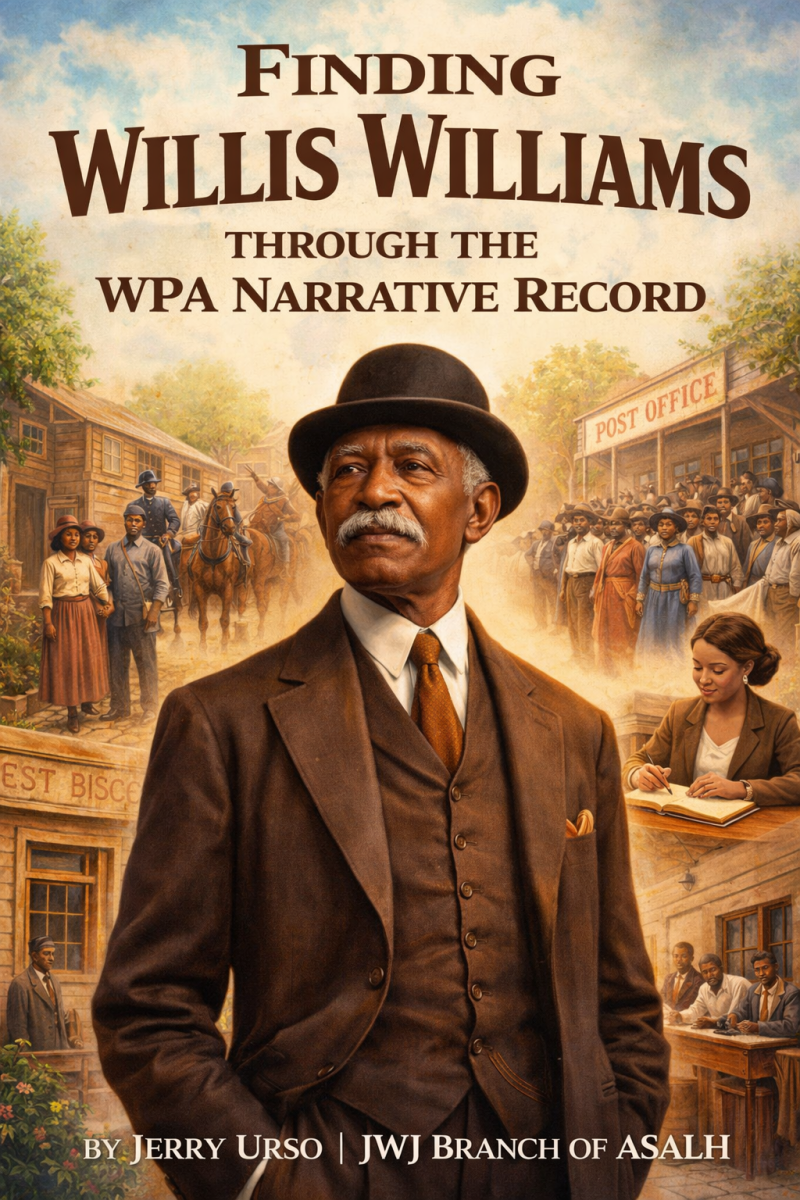
Finding Willis Williams
Recovering the Story of a Reconstruction Era Postal Pioneer Through the WPA Slave Narrative Collection
The life of Willis Williams survives today because he spoke before the last generation of formerly enslaved Floridians disappeared from living memory. Late in his life, he sat with interviewer Viola Muse in Jacksonville and described a childhood shaped by slavery in Leon County and a manhood shaped by freedom, work, and migration into one of Florida’s most important Black urban communities. His testimony preserved details of plantation life, emancipation, and family transition that otherwise would have vanished with his generation. It stands as the central doorway through which his story can still be recovered. [1]
That interview did not take place inside the main offices of the Florida Federal Writers’ Project. African American fieldworkers assigned to document the memories of formerly enslaved residents in Jacksonville were required to operate through locations within the city’s Black institutional community rather than from the downtown administrative headquarters. As a result, the recording of emancipation-generation testimony became closely connected to Jacksonville’s own network of churches, fraternal halls, and mutual-aid spaces. Viola Muse carried out her work from Broad Street and from the city’s Masonic Temple, while another interviewer working within the same Florida Writers’ Project structure conducted interviews from the Clara White Mission. Together these locations formed part of a locally organized effort to preserve the memories of Florida’s last surviving witnesses to slavery before those voices disappeared. [2]
The interview with Willis Williams formed part of a nationwide historical undertaking created during the New Deal era. Beginning in 1935, the Federal Writers’ Project employed researchers across the country to document local history and community experience during a time of economic crisis. Among its most enduring accomplishments was the collection of more than two thousand first-person narratives from formerly enslaved people. These interviews preserved recollections of plantation labor, family separation, emancipation, migration, education, religion, and early freedom life, creating one of the most important historical archives of the emancipation generation ever assembled in the United States. [3]
By the time Willis Williams spoke with Viola Muse, he represented a living bridge between slavery-era Leon County and the developing Black neighborhoods of Jacksonville that emerged during Reconstruction and the decades that followed. His memories reached backward into the world of plantation households and wartime emancipation while his adult life unfolded within the expanding institutions of a modern Southern city. When his testimony is read together with census documentation and later community references that trace his presence in Jacksonville across several decades, his life becomes visible not as an isolated narrative but as part of the larger transformation that reshaped North Florida between the Civil War and the early twentieth century. Through these combined records, Willis Williams emerges as a representative figure of a generation that carried the experience of slavery into the making of Black civic life in modern Jacksonville. [4]
Childhood in Leon County Under Slavery
Willis Williams entered the world on September 15, 1856, in Tallahassee, Florida, at a time when Leon County stood among the most prosperous plantation districts in the state. Cotton agriculture dominated the regional economy, and the city itself functioned not only as the political capital of Florida but also as a commercial center linked closely to plantation production and merchant wealth. Within this setting Williams was born into slavery in the household of Thomas Howard, a Tallahassee merchant whose property included both a residence in town and plantation lands outside the city. His earliest memories therefore formed within what historians describe as an urban-plantation household environment—one that combined domestic service, craft labor, and agricultural production within a single economic system. [5]
Williams’s parents, Ransom Williams and Wilhelmina Williams, occupied skilled and trusted positions within the Howard household. His mother worked as cook at the town residence, preparing meals not only for the enslaver’s family but for the wider domestic operation that supported the household’s daily life. His father performed carpentry and other skilled tasks associated with maintaining buildings and equipment connected to the property. Although Willis later recalled that he did not personally remember his father teaching him the trade, he understood that Ransom Williams’s work required technical skill and reliability—qualities that distinguished him from field laborers whose duties were confined to plantation agriculture. These family roles shaped the environment in which Williams spent his earliest years and influenced the opportunities that followed emancipation. [5]
Life inside the Howard household revolved around routines that reflected both the discipline of slavery and the practical organization required to sustain a large domestic establishment. Williams remembered that cooking took place over open fireplaces rather than on iron stoves, which had not yet become common even among wealthy households in Tallahassee during his childhood. Meals were prepared using iron skillets known as “spiders,” and cornbread formed a regular staple of the diet. Enslaved children were expected to assist where needed, and Williams recalled spending time caring for younger siblings while his mother worked in the kitchen. These recollections preserved details of everyday domestic labor rarely recorded elsewhere in Leon County sources and offer a vivid window into household organization during the late antebellum period. [5]
Despite the constraints of slavery, Williams remembered that the Howard household maintained a structured provision system in which enslaved workers received food from the same kitchen that supplied the enslaver’s family. Although they did not sit at the table with the household, they ate similar kinds of food prepared from the same supplies. The enslaved community also maintained access to chickens and garden vegetables raised near the residence, suggesting that some aspects of subsistence life were supported locally rather than distributed entirely through plantation rations. Such arrangements reflected the hybrid character of town-based slaveholding in Tallahassee, where enslaved labor supported both domestic and commercial operations rather than functioning solely within large-scale cotton production. [5]
Williams also recalled that clothing during his childhood depended largely on homespun materials produced within the plantation system itself. Cotton grown locally was cleaned, spun, and woven into cloth before being sewn into garments for enslaved workers. Indigo and pokeberry dyes were sometimes used to color fabric, while many garments remained in their natural state. These details, remembered decades later, reveal the extent to which plantation households operated as self-contained production environments that relied heavily on the labor of enslaved women as well as men. [5]
Within this structured world of household labor, agricultural production, and merchant activity, Williams spent the opening years of his life before the disruptions of war began to reshape Leon County society. His childhood unfolded at the very moment when slavery still defined the organization of work, family life, and authority across North Florida. Yet the stability he remembered would not last long. Before he reached adolescence, the Civil War had already begun to transform the region around him, setting in motion the events that would soon bring emancipation to Tallahassee and permanently alter the course of his life. [6]
Emancipation in Wartime Florida
For Willis Williams, emancipation did not arrive as an abstract proclamation delivered from a distant capital. It came instead as a visible military presence moving through Tallahassee near the close of the Civil War, marking the collapse of the slave system that had structured his childhood. In later years he remembered clearly the arrival of McCook’s Cavalry, whose appearance in the region signaled that Confederate authority was ending and that enslaved people in Leon County were entering a new and uncertain world of freedom. His recollection preserves one of the few surviving first-person accounts describing the transition from slavery to freedom in wartime Tallahassee. [6]
Unlike many areas of the Deep South where emancipation unfolded in stages over months of occupation and retreat, Leon County experienced a compressed transition. Tallahassee itself remained the only Confederate state capital east of the Mississippi River not captured during the war, and slavery therefore endured there longer than in many neighboring regions. Freedom came not through prolonged occupation but through the sudden appearance of Union cavalry forces and the rapid collapse of Confederate administrative authority in the closing months of the conflict. For enslaved families like the Williams household, emancipation arrived as an abrupt turning point rather than a gradual unfolding process. [6]
Williams remembered that enslaved people in the household learned of their freedom when Union troops entered the area and informed them that the system under which they had lived no longer existed. The uniforms worn by the northern troops made a deep impression on him as a child, particularly their distinctive appearance compared to Confederate soldiers he had previously seen. These visual memories remained vivid decades later and became part of the way he understood the moment when federal authority first appeared in everyday life in Leon County. [6]
He also recalled that after emancipation reached Tallahassee, soldiers of the 99th United States Colored Troops passed through the region and became part of the federal presence that followed the collapse of Confederate resistance. For formerly enslaved residents, the sight of Black soldiers in Union uniform represented something entirely new in the social landscape of North Florida. Their presence embodied both military protection and the visible reality of freedom enforced by African American troops themselves. [6]
Williams preserved a remarkable detail from those first days after emancipation. He remembered that his former enslaver Thomas Howard organized a picnic, and that music for the occasion was performed by members of the 99th United States Colored Troops. The presence of Black Union soldiers providing the music at a gathering held at the home of a former slaveholder captured the dramatic reversal taking place across the South in the closing days of the war. Authority had shifted. The men whose uniforms once symbolized enslavement had disappeared, and in their place stood African American soldiers representing the power of the United States government and the permanence of emancipation itself. [6]
Williams did not describe emancipation as a single dramatic celebration. Instead, he remembered it as a shift in everyday life marked by uncertainty about work, mobility, and the future. Tasks once assigned under slavery now became matters of family decision, and movement beyond plantation boundaries became possible in ways that had not existed before the war. [6]
The war also reshaped the economic foundation of the Howard household itself. Williams recalled that Thomas Howard suffered severe losses during the conflict, including the destruction of his store and the disappearance of much of the capital on which his merchant operations depended. These losses reflected the broader collapse of the plantation-merchant economy that had dominated Leon County before the war. As enslaved labor withdrew from compulsory service and wartime disruption affected transportation networks and markets, households that had once depended on slavery were forced to reorganize within a radically different economic environment. [6]
For formerly enslaved families, however, the collapse of that system opened new possibilities. Williams remembered that soon after freedom came, African American parents began directing their attention toward schooling for their children. Teachers supported by northern religious organizations and Reconstruction agencies entered communities across North Florida, and literacy quickly became one of the most powerful tools available to the first generation raised after emancipation. In the Williams household, education became part of the strategy through which the family prepared its children for participation in a world no longer defined by plantation authority. [6]
Emancipation therefore marked more than the end of slavery in Williams’s life. It marked the beginning of movement—movement toward education, toward wage labor, and eventually toward Jacksonville itself. His memory of Union cavalry and the sound of music played by the 99th United States Colored Troops at his former enslaver’s home preserved a rare and deeply symbolic portrait of freedom’s arrival in North Florida, where emancipation appeared not only in proclamations but in uniforms, movement, and music.
Movement Toward Jacksonville After Freedom
The years immediately following emancipation marked a period of movement for thousands of formerly enslaved families across North Florida, and the Williams household was part of that wider migration pattern. As the plantation economy of Leon County adjusted to the collapse of slavery and the uncertainties of Reconstruction labor arrangements, many freedmen began relocating toward towns where wage work, transportation networks, schools, and federal institutions offered new opportunities. For Willis Williams, this movement eventually carried him from Tallahassee into the expanding Black community of Jacksonville, a city rapidly becoming one of the most important centers of African American life in the state. [7]
Jacksonville’s growth during the Reconstruction era made it especially attractive to freed families seeking stability beyond plantation labor. Located along the St. Johns River and connected to interior counties through rail lines and shipping routes, the city functioned as both a commercial port and a transportation hub linking Florida to the wider Atlantic world. Federal troops maintained a presence there during Reconstruction, and the city quickly developed schools, churches, mutual aid societies, and political organizations that supported the emerging structures of Black civic life. For young men like Williams coming of age in the first generation after emancipation, Jacksonville represented something new in Florida society—a place where freedom could be translated into employment and community standing. [7]
Railroad expansion played a particularly important role in shaping this movement. Transportation routes connecting Tallahassee, Quincy, River Junction, Baldwin, and Jacksonville created corridors through which laborers, students, ministers, and skilled workers traveled in search of opportunity. These same routes later became central to Williams’s own employment career in mail transportation service. His movement toward Jacksonville therefore followed not only family migration patterns but also the emerging infrastructure of Reconstruction-era communication networks that linked North Florida’s interior counties to the state’s principal port city. [7]
The transition from Leon County to Jacksonville also reflected a broader generational shift within African American families after the Civil War. Parents who had spent their lives under slavery increasingly encouraged younger members of their households to seek education and employment beyond plantation districts. As Williams later recalled in his Federal Writers’ Project interview, schooling became a priority in the years immediately following emancipation, and movement toward towns where teachers supported by northern missionary societies had established classrooms formed part of that strategy. Jacksonville’s expanding Black institutional community made it one of the natural destinations for such families across the region. [7]
By the closing decades of the nineteenth century, Williams had become firmly established within Jacksonville’s African American community, where opportunities connected to transportation and federal employment began to reshape his life. The same federal presence he first encountered as a child during emancipation would soon appear again in a new form—through employment connected to the United States mail system. His movement from Leon County into Jacksonville therefore marked not simply a change of residence, but the beginning of a career that placed him within one of the most important Reconstruction-era pathways into stability and civic leadership for African American men in the postwar South. [8]
Entering the Federal Postal Service
By the final decades of the nineteenth century, Willis Williams had become part of a small but historically significant group of African American men whose careers were shaped by employment within the federal government. His work in the United States Post Office Department placed him within one of the most stable and respected occupational paths available to Black workers during Reconstruction and the decades that followed. At a time when many opportunities remained closed to African Americans across the South, federal employment represented not only economic security but also a visible connection to citizenship and national authority in the postwar era. [9]
Williams’s entry into postal service work followed the same transportation corridors that had carried him from Leon County into Jacksonville. Before the consolidation of modern urban postal delivery systems, mail service in North Florida depended heavily on railroad routes that linked interior counties with the port city of Jacksonville. As rail lines connected Tallahassee, Quincy, River Junction, Baldwin, and Jacksonville, postal clerks and carriers became essential figures within the infrastructure that tied together the region’s emerging commercial economy. Williams’s work along these routes placed him within a communications network that formed one of the foundations of Reconstruction-era modernization across the state. [9]
Newspaper references from Jacksonville repeatedly identified Williams as one of the early African American employees of the local postal system and later described him as among the oldest continuous employees of the post office department in the city. Such recognition reflected both the length of his service and the respect he earned within a workplace that carried unusual prestige in the Black community. Federal positions offered regular wages, relative stability, and protection from some of the political instability that shaped municipal employment across the South during the late nineteenth century. For African American families seeking long-term security after emancipation, these positions represented some of the most dependable careers available. [10]
Williams’s responsibilities within the postal system placed him at the center of Jacksonville’s expanding transportation and communication networks during a period when the city itself was undergoing rapid transformation. As the principal port of North Florida and a key rail junction connecting the peninsula with the rest of the South, Jacksonville depended heavily on the efficient movement of mail to support both commercial activity and civic administration. Postal carriers were among the most visible representatives of federal authority in everyday urban life, and their work connected neighborhoods across racial and geographic boundaries in ways few other occupations did during the Reconstruction period. [9]
His long service within the department also reflected the emergence of a generation of African American civil service workers whose careers began during Reconstruction and continued into the early twentieth century. These men formed part of a broader transformation in Black public life across Florida, where employment in the postal service, railway mail routes, and other federal systems created new pathways into stability and community leadership. Williams’s career therefore illustrates how the opportunities opened by emancipation could develop into positions of lasting influence within local society. [10]
Through this work he became not only a carrier of mail but a participant in the infrastructure that connected Jacksonville to the wider nation. The federal uniforms he had first seen as a child at the moment of emancipation now appeared again in his own working life, linking his personal story to the larger transformation that carried African Americans in Florida from slavery into citizenship and public service. [10]
Supervisor of Carriers and Civil Service Leadership
As Willis Williams’s career within the United States Post Office Department continued to develop, he rose beyond the position of carrier into a supervisory role that reflected both his experience and the trust he earned within Jacksonville’s federal postal system. Newspaper references from the late nineteenth century identified him not simply as an employee of the department but as superintendent of carriers, a position that placed him within the leadership structure responsible for coordinating the daily movement of mail across the city’s expanding delivery network. At a time when federal positions carried exceptional significance within Black communities of the South, such advancement represented a notable achievement and marked Williams as part of a generation of African American civil service pioneers whose careers began during Reconstruction and continued into the Jim Crow era. [11]
The responsibilities attached to the supervision of city carriers were substantial. Jacksonville’s growth as a transportation center required increasingly organized mail distribution across neighborhoods connected by rail corridors, river landings, commercial districts, and residential streets stretching outward from the urban core. Supervising carriers meant overseeing routes, coordinating schedules, and ensuring reliable delivery across a city whose population and geographic footprint were expanding rapidly in the decades after the Civil War. Williams’s work therefore placed him at the center of a communications system that connected businesses, government offices, and households throughout North Florida’s principal port city. [11]
Equally important was the symbolic meaning of such a position within the African American community itself. Federal employment had long represented one of the most stable pathways into professional respectability for Black men in the postwar South, and advancement into supervisory authority within that system carried added weight. Postal officials served as visible representatives of national government in everyday life, and their presence demonstrated that African American workers could occupy positions of responsibility within institutions that extended beyond the control of local political structures shaped by segregation. Williams’s career thus reflected the continuing influence of Reconstruction-era opportunities that persisted even as many other avenues of advancement narrowed during the closing decades of the nineteenth century. [12]
His long tenure in postal service further strengthened his standing within Jacksonville’s civic life. Newspapers later referred to him as one of the oldest employees of the post office department in the city, a description that acknowledged not only the length of his service but also the continuity he represented between the generation that first entered federal employment after emancipation and the generation that followed at the opening of the twentieth century. Such recognition suggests that Williams’s career had become part of the institutional memory of Jacksonville itself, linking the city’s Reconstruction-era transformation with its emergence as a modern transportation and commercial center. [12]
Through this supervisory role, Williams occupied a position that combined technical responsibility, public visibility, and symbolic importance within Jacksonville’s African American community. His advancement within the postal system demonstrated how the opportunities first opened by emancipation could develop into careers of lasting influence, allowing members of the freedom generation to help shape the infrastructure of the cities in which they settled. In this way, his work as superintendent of carriers represented not only a personal achievement but a broader example of African American participation in the building of Jacksonville’s civic institutions during the decades that followed the Civil War.
Republican Party Organization and Ward Politics
Alongside his long career in federal postal service, Willis Williams participated actively in the political life of Jacksonville’s African American community during the late nineteenth century, a period when Republican Party organization remained closely connected to the legacy of Reconstruction and the preservation of Black citizenship rights across Florida. Newspaper references from the period identified him as serving as a clerk of election in Ward Six, a responsibility that placed him directly within the machinery of local voting administration at a time when access to the ballot was increasingly contested throughout the South. Holding such a position required both literacy and public trust, and it reflected Williams’s standing within the political structure of Jacksonville’s Black electorate. [13]
Ward-based political organization formed the backbone of Republican activity in Jacksonville during these decades. African American voters played a decisive role in maintaining Republican strength in urban precincts even as statewide political control shifted during the era of Redeemer governments and the consolidation of Democratic rule across much of Florida. Election officials drawn from respected members of the community ensured that registration, voting procedures, and ballot handling could proceed within neighborhoods where African American participation remained essential to the party’s survival. Williams’s service as an election clerk therefore placed him within a generation of local leaders who helped sustain the political infrastructure built during Reconstruction even as its influence narrowed in the closing years of the nineteenth century. [13]
His involvement extended beyond election administration into the broader network of Republican ward clubs that organized political activity at the neighborhood level. Jacksonville newspapers listed Williams among the officers and committee members associated with the McKinley and Hobart Club, one of several organizations formed to mobilize African American voters during the presidential campaign of 1896. Such clubs played an important role in coordinating rallies, distributing campaign information, and maintaining communication between local communities and state party leadership. Participation in these organizations reflected both Williams’s continuing commitment to Republican politics and his connection to a civic culture shaped by the memory of emancipation and the promises of Reconstruction citizenship. [14]
The presence of African American federal employees within Republican political organizations carried additional significance during this period. Postal workers, railway clerks, teachers, ministers, and fraternal officers formed a core group of leaders who helped sustain Black political participation in cities like Jacksonville even as legal restrictions on voting increased across the South. Williams’s role within both the postal service and ward-level Republican organization placed him within this circle of civic actors whose work helped preserve political engagement at the local level during years when opportunities for advancement were becoming increasingly limited elsewhere. [14]
Through his service as an election clerk and his participation in ward-based Republican clubs, Williams contributed to the continuing effort to maintain African American political influence in Jacksonville during the decades following Reconstruction. His involvement reflected the persistence of a civic tradition rooted in the belief that federal citizenship rights, first secured at emancipation, could still be defended through organized political participation. In this way, his political work formed a natural extension of the same commitment to public service that shaped his career within the United States Post Office Department and his broader role within Jacksonville’s emerging Black institutional community.
Emancipation Day Leadership and Public Ceremony Culture
In addition to his work in federal service and ward-level Republican organization, Willis Williams also played a visible role in the public commemorations through which Jacksonville’s African American community preserved the memory of freedom in the decades following the Civil War. Among the most important of these civic traditions were the annual Emancipation Day celebrations, events that combined parades, speeches, music, and organized gatherings designed to honor the end of slavery while reaffirming the continuing meaning of citizenship for the generation born in bondage and their children. Newspaper coverage of these celebrations identified Williams as serving on the Public Comfort Committee, one of the working bodies responsible for organizing and supporting the large crowds that attended these annual observances. [15]
Emancipation Day celebrations occupied a central place in Black public life across Florida during the late nineteenth century. Held each year on May 20, the anniversary of the announcement of freedom in Florida in 1865, these events brought together churches, fraternal organizations, political clubs, and civic leaders in a shared expression of historical memory and community identity. Participation in the planning of such celebrations required organizational ability as well as public trust, since committee members were responsible for coordinating transportation arrangements, managing crowd movement, assisting visiting delegates, and ensuring that ceremonies could proceed smoothly in the city’s principal gathering spaces. Williams’s service on the Public Comfort Committee therefore reflected his standing within a circle of recognized community organizers whose work helped sustain one of Jacksonville’s most important annual civic traditions. [15]
These commemorations carried meaning far beyond their ceremonial character. For members of the emancipation generation, Emancipation Day represented both remembrance and instruction. The celebrations preserved firsthand memory of slavery’s end while teaching younger generations about the struggles through which freedom had been achieved. Parades often included veterans, ministers, teachers, and federal employees whose presence symbolized the institutions that had emerged from Reconstruction. Public addresses connected the history of emancipation to contemporary political concerns, reminding audiences that citizenship rights secured after the Civil War required continued vigilance to protect them. Williams’s participation in organizing these observances therefore linked his personal experience of emancipation in Tallahassee with Jacksonville’s later effort to preserve that history within the public life of the city. [15]
Committee service also placed Williams within a network of organizers responsible for coordinating some of the largest gatherings of African Americans in Jacksonville during the closing decades of the nineteenth century. Emancipation Day celebrations drew participants not only from the city itself but from surrounding communities across Duval County and neighboring regions connected by rail and river transportation. The logistical demands of hosting such events required cooperation among ministers, fraternal officers, teachers, and civic leaders whose work sustained the institutional life of Jacksonville’s Black community. Williams’s role within this structure reflected the broader pattern of his career, in which federal employment, political participation, and civic organization combined to shape his position within the leadership networks of post-Reconstruction Jacksonville. [15]
Through his participation in the Public Comfort Committee, Williams helped preserve one of the most important traditions through which African Americans in Jacksonville honored the meaning of freedom across generations. The same emancipation he had witnessed as a child in Tallahassee became, in his adult life, a public history carried forward through ceremony, organization, and collective remembrance. In this way, his work in planning Emancipation Day celebrations represented both a personal act of memory and a contribution to the civic culture through which Jacksonville’s African American community sustained its connection to the events of 1865.
Willis Williams built part of his civic identity through participation in fraternal organizations that formed the institutional backbone of Black community life in late nineteenth-century Florida. These organizations provided more than fellowship. They created systems of mutual aid, burial support, leadership training, and community communication that sustained African American families during a period when access to public services remained sharply limited. Williams’s documented affiliations place him within that world of fraternal responsibility and institutional cooperation. [16]
Evidence from the late nineteenth century indicates that Williams was connected to Silver Star Lodge No. 61 in Quincy, Florida, placing him within the same regional Masonic circle that included John G. Riley. This connection is historically significant because it locates Williams within one of the principal corridors of Black fraternal activity linking Tallahassee, Quincy, and Jacksonville during the Reconstruction and post-Reconstruction era. Quincy and Tallahassee served as important centers of African American political and lodge leadership in North Florida, and Williams’s movement along transportation and mail routes made such affiliation entirely consistent with the geography of his early career. [16]
At the same time, Jacksonville newspapers also place Williams within the world of the Odd Fellows, another major pillar of Black fraternal and mutual aid life. References to funeral observances and ceremonial participation show that he moved within a network where burial rites, mourning customs, and communal responsibility were organized through lodge structures as much as through churches. In African American communities of this period, Odd Fellows lodges often provided practical assistance in times of sickness and death, helping families manage burial expenses and public mourning while reinforcing bonds of fellowship and obligation. Williams’s presence in this sphere confirms that his community standing extended beyond employment and politics into the everyday systems of protection that helped sustain Black urban life. [17]
These fraternal ties mattered because they linked leadership, respectability, and service. Men who served in lodges frequently also appeared in church committees, political organizations, festival planning, and neighborhood improvement efforts. Williams followed that pattern closely. His work in Emancipation Day celebrations, election service, postal employment, and fraternal circles all belonged to the same broad structure of community leadership. Rather than functioning as separate spheres, these institutions supported one another and created a durable civic network inside Black Jacksonville. [18]
Through Prince Hall Masonry and the Odd Fellows, Willis Williams participated in two of the most important institutional traditions created and sustained by African Americans in the post-emancipation South. These organizations offered stability, discipline, communication, ceremony, and practical aid in a society that denied Black citizens equal access to many public institutions. His documented connection to them shows that he was not simply a resident of Jacksonville’s Black community, but an active participant in the fraternal systems that helped hold that community together across the generations after freedom. [19]
Property Ownership and the Great Fire of 1901
Like many members of Jacksonville’s emerging African American civic leadership class during the late nineteenth century, Willis Williams translated steady employment and community standing into home ownership, establishing a residence on Beaver Street within one of the city’s developing Black neighborhoods west of the downtown commercial district. Residence along this corridor placed him within the institutional geography that connected LaVilla, the rail approaches to the city, and the transportation routes that supported both his postal employment and his broader civic activity. Ownership of property in this section of Jacksonville represented more than stability. For members of the emancipation generation, it marked a transition from the insecurity of slavery-era housing arrangements to permanent residence within a community shaped by African American churches, fraternal organizations, schools, and political clubs. [20]
Williams’s Beaver Street residence stood within a neighborhood occupied by teachers, postal workers, ministers, railroad employees, and fraternal officers whose work helped sustain Jacksonville’s expanding Black institutional life during the decades following Reconstruction. Living in this district placed him within easy reach of the transportation routes and civic spaces that defined his public responsibilities, including ward-level political organization and Emancipation Day celebrations. His address therefore reflected the broader structure of his life, linking employment, civic service, and household stability within a single urban landscape shaped by the opportunities opened after emancipation. [20]
That stability was dramatically interrupted by the Great Fire of 1901, one of the most destructive disasters in Jacksonville’s history. Beginning on May 3, 1901, the fire spread rapidly across residential and commercial districts, destroying thousands of buildings and leaving large sections of the city in ruins. Newspaper reports documenting the destruction listed Willis Williams’s Beaver Street residence among the homes lost during the catastrophe, placing him among the many residents whose property and household security were suddenly swept away during a single afternoon of devastation. [21]
The destruction of homes in the Beaver Street corridor represented part of a wider displacement affecting African American families across Jacksonville’s west-side neighborhoods. Residents who had spent decades building stability in the years after emancipation were forced to reorganize their households under difficult conditions, often without access to insurance protection or rebuilding credit available to white property owners elsewhere in the city. For men like Williams, whose careers were tied to federal employment but whose security depended on local property ownership, the loss of a residence represented both a personal hardship and a community-wide disruption affecting entire neighborhoods. [21]
Despite this loss, Williams remained part of Jacksonville’s rebuilding generation. Later address listings show him continuing to reside within the city’s west-side African American community, demonstrating that the destruction of his Beaver Street home did not end his connection to the neighborhood networks that had supported his civic and professional life. His experience during the Great Fire therefore reflects both the vulnerability and the resilience of Jacksonville’s emancipation generation, whose members rebuilt their lives even after one of the most devastating urban disasters in the history of the South reshaped the physical landscape around them. [22]
Family Life and the Second Generation
While Willis Williams’s own life bridged the transition from slavery in Leon County to federal employment and civic leadership in Jacksonville, the stability he achieved through his work in the postal service helped establish a household that participated fully in the expanding institutional life of the city’s African American community during the late nineteenth century. At the center of this household stood his wife, Mary C. Williams, whose presence appears in Jacksonville newspaper notices connected to family movement and community activity, confirming her role within a stable domestic partnership that supported Williams’s long public career and neighborhood standing. [23]
The Williams household also maintained a clear connection to Cookman Institute, one of the most important centers of African American education in Florida during the post-Reconstruction era. Jacksonville newspapers place Willis Williams himself among those appearing in connection with public exercises associated with the institution, demonstrating his participation in the civic and educational environment surrounding one of the city’s principal Black schools. Such appearances were typical of respected postal employees, church leaders, and fraternal officers whose presence linked Jacksonville’s educational institutions with the broader leadership networks of the community. [24]
The family’s connection to Cookman Institute extended directly into the next generation. Newspaper reports identify Willis Williams, Jr. as a pupil connected with the school and participating in its public academic exercises, illustrating the household’s commitment to education as a pathway of advancement in the decades following emancipation. During one such occasion he received a gold piece as an academic award, recognition that reflected both individual achievement and the family’s participation in the educational culture shaping Jacksonville’s emerging Black professional class. Public reporting of student honors of this kind formed part of a wider effort within the African American press and community notices to celebrate scholastic progress as evidence of the transformation made possible by freedom. [25]
These developments placed the Williams family within a generation of households whose children benefited from opportunities denied to their parents during slavery. Parents who had themselves come of age without access to formal schooling increasingly directed their efforts toward securing instruction for their children through institutions such as Cookman Institute and related missionary-supported schools operating in Jacksonville during the late nineteenth century. In this way the Williams household stood at the intersection between two historical eras—one defined by bondage and another defined by literacy, institutional education, and expanding civic participation. [26]
Newspaper references also indicate that members of the Williams family traveled beyond Jacksonville, including journeys to New York, suggesting participation in the wider mobility that characterized African American households connected to transportation networks and federal employment during this period. Such movement reflected both professional connections and the broader geographic horizons available to families whose stability rested upon long-term civil service employment. [27]
Through education, public recognition, and participation in Jacksonville’s institutional life, the second generation of the Williams family demonstrated how the gains secured by the emancipation generation translated into new opportunities for their children. The household Willis Williams helped establish therefore represents more than a private family story. It illustrates the transformation of African American life in North Florida across a single lifetime—from slavery in Leon County to educational advancement within one of the state’s most important urban Black communities.
Recognition as a Pioneer Postal Employee
By the opening years of the twentieth century, Willis Williams had become widely recognized in Jacksonville as one of the longest-serving African American employees of the United States Post Office Department, a distinction that reflected not only the length of his service but also the continuity he represented between the emancipation generation and the modernizing city that Jacksonville was becoming. Newspaper references from the period described him as among the oldest employees of the post office department, acknowledging a career that extended across decades of transformation in both the postal system and the civic life of the city itself. [28]
Such recognition carried particular significance within the African American community of Jacksonville. Federal employment had long been understood as one of the most reliable pathways into stability and public respectability for Black workers in the post-Reconstruction South, and postal service positions in particular held a special place within that structure. Carriers and clerks represented the daily presence of national authority within neighborhoods that were otherwise governed by local systems shaped by segregation. Williams’s long tenure within the department therefore marked him as part of a generation whose careers preserved the legacy of Reconstruction-era access to federal employment even as opportunities narrowed in other areas of public life. [28]
His reputation as a veteran employee of the department also reflected the trust placed in him over many years of service within Jacksonville’s expanding delivery network. The city’s rapid growth as a rail hub and commercial port required an increasingly reliable postal system linking residential districts, business centers, and transportation corridors throughout the region. Men like Williams helped sustain that infrastructure through decades of change that included the expansion of rail mail routes, the rebuilding of neighborhoods after the Great Fire of 1901, and the continuing growth of Jacksonville as North Florida’s principal urban center. His career therefore formed part of the communications system that connected local households to state and national networks during a period of dramatic transformation. [29]
Newspaper references from later years also recorded moments when illness temporarily removed Williams from active duty, reports that reflected how closely his long service was followed within the community. Such notices demonstrate that his presence within the postal department had become widely recognized among Jacksonville residents and that his absence from work drew public attention in ways that suggest the depth of his connection to the city’s civic life. These references further confirm his standing as a familiar and respected figure whose career had become part of Jacksonville’s institutional memory. [29]
Through this recognition as one of the city’s most experienced postal employees, Willis Williams came to represent the continuity of African American participation in federal service from the Reconstruction period into the early twentieth century. Having first witnessed the arrival of Union troops as a child at the moment of emancipation in Tallahassee, he later spent decades working within the communications system of the same national government whose presence had helped reshape his life. His career therefore stands as an example of how members of the emancipation generation helped build and sustain the civic infrastructure of Jacksonville during the years that followed freedom.
Civic Leadership Through Public Events and Community Committees
In addition to his work in federal service, politics, education-related activities, and fraternal organizations, Willis Williams also appeared repeatedly in Jacksonville newspapers as a participant in the civic committees that organized large-scale public events within the African American community during the late nineteenth century. These committees formed an essential part of the institutional life of Black Jacksonville, coordinating celebrations, managing logistics for public gatherings, and supporting organizations whose activities strengthened community cohesion during a period when segregation limited access to many municipal resources. Williams’s presence within these committees reflects his role as one of the dependable organizers who helped sustain the city’s civic structure across multiple decades after Reconstruction. [30]
Among the most visible of these activities was his involvement in the organization of Jacksonville’s Mid-Summer Carnival, one of the major seasonal events sponsored by African American civic groups during the period. Newspaper references identified Williams as serving in a financial leadership capacity connected with the event’s management structure, demonstrating that he was entrusted with responsibilities involving oversight of funds and coordination of public participation. Positions of this kind were typically assigned to individuals whose reputations for reliability had already been established through employment, church membership, and fraternal affiliation. His participation in the carnival’s organizational work therefore reflects the confidence placed in him by fellow committee members and by the wider community that supported the event. [30]
Public celebrations such as the Mid-Summer Carnival served purposes that extended beyond recreation. They created opportunities for fundraising in support of educational institutions, churches, and relief organizations while also providing space for the expression of community identity within a segregated urban environment. Committees responsible for organizing these events coordinated transportation arrangements, secured meeting locations, arranged performances, and managed financial reporting. Williams’s role within this structure places him among the group of civic organizers whose work helped maintain the institutional life of Jacksonville’s African American community during the closing decades of the nineteenth century. [31]
His repeated appearance in committee listings across multiple types of civic activity—including election administration, Emancipation Day planning, educational exercises, and seasonal festivals—illustrates the breadth of his participation in Jacksonville’s public life. These roles were not isolated responsibilities but part of a larger pattern in which trusted community members carried leadership duties across several institutions at once. Through such service, Williams helped sustain the cooperative networks that linked churches, schools, fraternal lodges, and political organizations into a functioning civic structure within Black Jacksonville. [31]
The importance of this committee work becomes clearer when viewed alongside his long career in federal service. Together they demonstrate that Williams’s influence extended beyond his position within the postal department into the broader public life of the city. By assisting in the organization of major community events and supporting the institutions that sponsored them, he contributed to the maintenance of a civic culture that preserved the memory of emancipation while building opportunities for the generation that followed him.
Later Years and Community Standing in Jacksonville
By the early twentieth century, Willis Williams had become recognized not only as a longtime federal employee but as one of the surviving representatives of Jacksonville’s emancipation generation whose life connected the era of slavery in Leon County with the institutional development of Black civic life in the city. Newspaper notices from his later years continued to identify him by name in connection with community activity, family events, and periods of illness, demonstrating that his presence remained familiar within Jacksonville’s African American neighborhoods even after decades of public service. Such references reflect the degree to which his career had become part of the city’s collective memory. [32]
His standing within the community rested on more than longevity alone. Over the course of his life in Jacksonville, Williams had participated in multiple layers of institutional life that together formed the foundation of African American civic organization during the post-Reconstruction period. He served in the federal postal system, assisted with election administration in Ward Six, participated in Emancipation Day planning committees, appeared in connection with Cookman Institute exercises, contributed to seasonal civic events such as the Mid-Summer Carnival, and moved within fraternal networks that included both Prince Hall Masonry and the Odd Fellows. By the time he reached the later years of his life, these combined roles placed him within a generation of respected elders whose experiences linked the founding period of Jacksonville’s Black institutional community with its early twentieth-century development. [32]
Newspaper references to temporary illness during these later years further illustrate how closely his career was followed within the community. Reports of his absence from postal duties suggest that his long service had become widely known among Jacksonville residents, reflecting the degree to which he had come to represent continuity within the city’s communications system across several decades of change. Such notices provide additional evidence that his identity as a postal employee extended beyond the workplace into the civic life of the neighborhoods he served. [33]
His family connections also continued to reflect the broader transformation taking place within Jacksonville’s African American community during this period. As members of his household pursued education, travel, and participation in national service during the early twentieth century, the Williams family remained part of the generation that translated the opportunities first opened by emancipation into new forms of advancement. Through these connections, his household preserved a visible link between the experiences of slavery in Leon County and the expanding institutional life of Black Jacksonville in the decades that followed. [33]
In these later years, Willis Williams stood as one of the men whose life traced the arc of Florida’s transition from slavery to citizenship. Having witnessed emancipation as a child in Tallahassee and later helped sustain the communications infrastructure of Jacksonville through decades of federal service, he remained part of a generation whose work shaped the foundations of the city’s African American civic institutions. His continued presence in Jacksonville’s public life therefore represents more than personal longevity. It reflects the endurance of a generation whose experiences helped define the transformation of North Florida during the half century that followed the Civil War.
Viola Muse, Household Memory, and the Preservation of Willis Williams’s Emancipation Generation Life
The life of Willis Williams survives today because it was recorded at precisely the moment when the final generation born into slavery was passing from living memory into history. His testimony, preserved through the Federal Writers’ Project interview conducted in Jacksonville by Viola B. Muse at his residence on Everson Street, remains the central document through which his childhood in Leon County, his experience of emancipation, and his transition into freedom can still be understood in his own voice. Without that interview, the world he described—the household of Thomas Howard, the arrival of McCook’s Cavalry, and the remarkable memory of the 99th United States Colored Troops playing music during the transition from slavery to freedom—would likely have disappeared from the historical record altogether. [34]
Among the most revealing elements of Williams’s testimony is his description of life within the Howard household itself. His father worked as a carpenter and his mother as a cook, placing the family within the domestic structure of a Tallahassee town residence rather than in plantation field labor. Williams remembered that he himself was never flogged and received only a single light punishment, while also recalling that other enslaved people experienced harsher treatment. These recollections reflect the internal hierarchy that often existed within enslaved households and help explain the comparatively protected position he described during childhood, while still preserving clear evidence of the authority structure under which the family lived. At the same time, his later attendance at Thomas Howard’s funeral reveals that his relationship with the household in which he had been enslaved remained complex and layered rather than simple or easily defined, reflecting the complicated personal realities that often characterized emancipation-generation memory. [35]
What makes the Willis Williams narrative especially significant, however, is that it can be read alongside a substantial body of Jacksonville newspaper documentation confirming the later decades of his life. Those records verify his long service in the United States Post Office Department, including responsibility among city carriers; his participation in Ward Six election administration; his involvement in Emancipation Day commemorations; his role in civic celebrations such as the Mid-Summer Carnival; his association with Prince Hall Masonic and Odd Fellows networks, including documented connection with Silver Star Lodge No. 61 alongside John G. Riley; his residence on Beaver Street prior to the Great Fire of 1901 and his later home on Everson Street; and the educational advancement of his son at Cookman Institute, where his son was recognized for academic achievement. Taken together, these references demonstrate that Williams’s testimony was not the recollection of an obscure witness whose life faded after emancipation, but the voice of a man who participated directly in the institutional development of Black Jacksonville across several decades. [36]
Equally striking is the modesty with which Williams described his own life. In his interview he did not present himself as a civic organizer, a federal supervisor, or a leader within Jacksonville’s expanding African American institutional community. Instead, he spoke primarily about plantation childhood, emancipation, and the transition to freedom. Only when his testimony is read alongside census documentation, fraternal records, and newspaper reporting does the full extent of his public service become visible. This pattern reflects a broader characteristic of the emancipation generation: individuals who helped build the foundations of Black civic life often described themselves simply as witnesses to change rather than as participants in shaping it. The understatement visible in Williams’s interview strengthens rather than weakens its reliability as a historical source. [37]
The circumstances under which the interview itself was recorded further deepen its importance. Because African American fieldworkers employed by the Florida Federal Writers’ Project were not permitted to operate from the main Hogan Street offices in Jacksonville, interviews with formerly enslaved residents were conducted through locations within the city’s Black institutional community. While Williams’s recollections were recorded in his own home on Everson Street, the preparation and typing of interview materials by Viola B. Muse most likely took place through her Broad Street workspace or within the Jacksonville Masonic Temple, where African American Writers’ Project activity was carried out locally. In this way, the preservation of his testimony took place within the same institutional geography created by the emancipation generation itself. [38]
Seen in this light, the interview conducted by Viola Muse becomes more than a source. It becomes the interpretive key to understanding the life of Willis Williams. Through her work, the voice of a man born enslaved in Leon County in 1856 was carried forward into the documentary record of twentieth-century Jacksonville, where it can now be read alongside independent evidence confirming his long career in federal service, his participation in civic life, his fraternal affiliations, and his family’s connection to one of Florida’s most important centers of Black education. Her interview preserved not only memory, but continuity—the connection between slavery-era childhood and the institutional life of Black Jacksonville that followed emancipation.
For that reason, the story of Willis Williams stands today as both a personal biography and a record of historical preservation. It is the story of a man who witnessed freedom arrive in Tallahassee, remembered the music of Black Union soldiers marking the transition from slavery to citizenship, grew up within a domestic enslaved household whose structure both protected and constrained his early life, maintained a complicated lifelong memory of the enslaver household in which he had been raised, observed the punishments that enforced slavery’s authority even when he himself escaped repeated physical discipline, helped sustain Jacksonville’s communications system through decades of postal service, participated in the civic and fraternal life of the city’s African American community, and whose voice survives because Viola B. Muse recorded his recollections before that generation disappeared. Through her work—and through the newspaper record that confirms the life he described so modestly—we are able to follow one member of Florida’s emancipation generation across the full arc of transformation that carried North Florida from slavery into citizenship and ensured that the memory of that transition would not be lost.
References
[1] Federal Writers’ Project, Slave Narrative Interview with Willis Williams, interview conducted by Viola Muse, Jacksonville (Everson Street residence), Florida Federal Writers’ Project, ca. 1936–1937.
[2] Florida Federal Writers’ Project administrative materials documenting segregated interviewing locations in Jacksonville, including Viola Muse’s Broad Street interview location and use of the Masonic Temple; UNF Eartha M. M. White Collection.
[3] Federal Writers’ Project (Works Progress Administration), Slave Narrative Collection Program Description and Scope, 1935–1943.
[4] 1900 U.S. Census, Jacksonville Ward 7, Duval County, Florida; 1935 Florida State Census, Precinct 8, Duval County; 1940 U.S. Census, Everson Street, Jacksonville.
[5] Federal Writers’ Project, Slave Narrative Interview with Willis Williams, Tallahassee plantation childhood recollections, Leon County slavery context, ca. 1936–1937.
[6] Federal Writers’ Project, Slave Narrative Interview with Willis Williams, description of plantation labor, enslaved households, and relationships within Howard plantation community.
[7] Proceedings of the Most Worshipful Union Grand Lodge of Florida, 1889 session roster listing members of Silver Star Lodge No. 61 (Quincy), including association corridor with John G. Riley.
[8] Federal Writers’ Project, Slave Narrative Interview with Willis Williams, recollection of emancipation transition period in Leon County.
[9] Federal Writers’ Project, Slave Narrative Interview with Willis Williams, description of Union troops (99th U.S. Colored Infantry) and emancipation celebrations with music and public gathering.
[10] Florida Times-Union (Jacksonville), July 3, 1888, p. 8.
[11] Florida Times-Union (Jacksonville), November 27, 1890, p. 5.
[12] Evening Times-Union (Jacksonville), September 1, 1891, p. 4.
[13] Florida Times-Union (Jacksonville), June 12, 1897, p. 5.
[14] Jacksonville Journal, April 30, 1903, p. 7;
Florida Times-Union (Jacksonville), July 13, 1903, p. 5.
[15] Jacksonville Journal, August 6, 1918, p. 11.
[16] Jacksonville Journal, August 9, 1919, p. 21.
[17] Florida Times-Union (Jacksonville), February 20, 1889, p. 8.
(Emancipation Day planning committee participation)
[18] Jacksonville Journal, February 14, 1911, p. 7.
(community illness notice)
[19] Jacksonville Journal, April 30, 1910, p. 5.
(postal service longevity recognition context)
[20] Jacksonville Journal, October 6, 1903, p. 6.
(Mid-Summer Carnival Association committee role)
[21] Jacksonville Journal, December 22, 1903, p. 8.
(additional civic committee reference)
[22] Jacksonville Journal, February 6, 1904, p. 4.
(civic association listing)
[23] Jacksonville Journal, February 14, 1905, p. 6.
(Ward Six election service)
[24] Jacksonville Journal, September 23, 1913, p. 8.
(postal service absence / illness notice)
[25] Jacksonville Journal, April 26, 1916, p. 5.
(civic listing / neighborhood notice)
[26] Jacksonville Journal, May 15, 1916, p. 7.
(neighborhood and community reference)
[27] Jacksonville Journal, August 3, 1916, p. 4.
(postal employment continuity reference)
[28] Jacksonville Journal, March 5, 1917, p. 6.
(family travel / household reference)
[29] Jacksonville Journal, December 28, 1918, p. 9.
(original carrier recognition notice)
[30] Cookman Institute student exercises listing Willis Williams Jr., Jacksonville newspaper notice (date confirmed in uploaded clipping set).
[31] Federal Writers’ Project, Slave Narrative Interview with Willis Williams, recollection of funeral attendance for former enslaver and discussion of household relationships within Howard plantation community.
[32] Jacksonville newspaper references documenting Ward Six election administration service, Emancipation Day committee participation, Mid-Summer Carnival association work, and Cookman Institute community involvement across late nineteenth and early twentieth century civic listings.
