
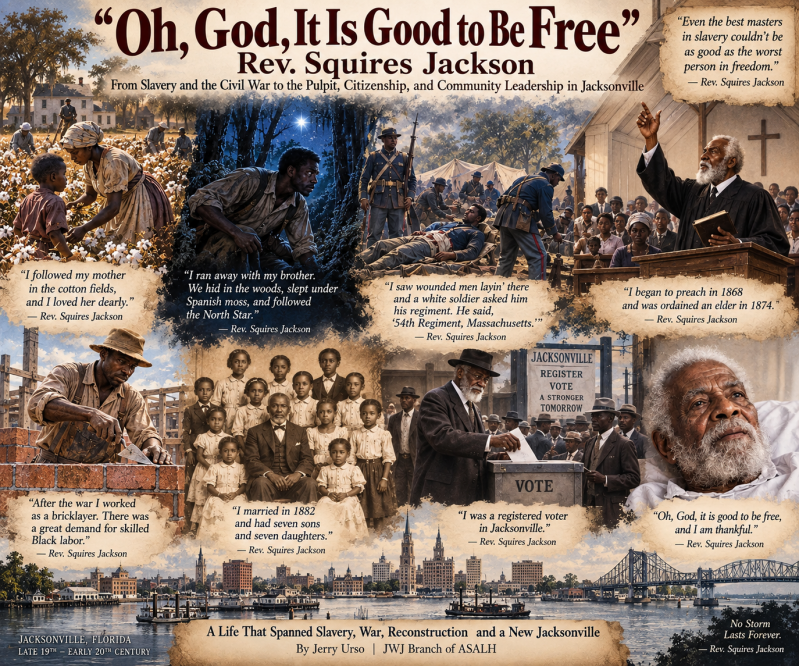
“Oh, God, It Is Good to Be Free”
Rev. Squires Jackson: From Slavery and War to Freedom, Citizenship, and the Pulpit in Jacksonville
By Jerry Urso
JWJ Branch of ASALH
On September 11, 1937, Federal Writers’ Project interviewer Samuel Johnson sat with Rev. Squires Jackson at his home at 706 Third Street in Jacksonville, Florida. Jackson was three days short of his ninety sixth birthday. Lying comfortably in bed beneath white sheets, the elderly minister carried Johnson backward through nearly a century of Florida history. He remembered his mother laboring in cotton fields, learning to read when enslaved people were forbidden to do so, running away during the Civil War, encountering wounded Black Union soldiers, working as a bricklayer after emancipation, answering the call to preach, marrying, raising fourteen children, acquiring property and participating in the political life of Jacksonville. Near the end of the interview, Jackson summarized that extraordinary journey with words that deserve to stand beside his name: “Oh, God, it is good to be free, and I am thankful.” [1]
Born Into Slavery
Squires Jackson was born in a weather beaten shanty in Madison, Florida, on September 14, 1841, into a large enslaved family. When he was about three years old, he moved to Jacksonville with his mother and the man Jackson called his “Master.” Jackson remembered the enslaver as a prominent political figure who could be personally kind toward those he held in bondage, but who nevertheless prohibited them from learning to read and write. [1]
Jackson's most vivid childhood memories centered upon his mother. Deeply devoted to her, he followed her into the cotton fields while she picked and hoed cotton under the threat of the overseer's lash. He also remembered that enslaved workers on the plantation were forbidden to sing while they worked. Yet Jackson believed that even the overseer's vigilance could not silence what he described as their silent songs of labor and prayers for freedom. [1]
Despite the prohibition against literacy, Jackson learned to read and write. He remembered being caught unexpectedly with a newspaper. Thinking quickly, he turned the paper upside down and declared, “Confederates done won the war.” His enslaver laughed and walked away without punishing him. [1]
There was humor in the way the elderly Jackson remembered the incident, but there was also resistance. Learning to read gave an enslaved person access to knowledge that slavery attempted to control. Before legal freedom came, Jackson had already begun crossing one of the boundaries imposed upon him.
The World Squires Jackson Remembered
Jackson's interview preserved details of nineteenth century life that official records rarely capture. He remembered boys playing ball and shooting marbles on Sundays until church time. Sunday meals might consist of rice and salted pork prepared in large iron pots hanging over an indoor hearth, with coffee made from parched cornmeal sometimes added as a treat. [1]
He remembered open wells, handmade shoes fashioned from cowhide, wooden washtubs, feather mattresses, homemade soap and household medicines. Cloth was woven by hand. Jackson remembered enslaved women dancing as they moved back and forth while weaving. He described a world in which necessities later purchased ready made required enormous amounts of human labor. [1]
His memories also preserved glimpses of early Jacksonville. Jackson recalled seeing his first buggy in 1851. He remembered seeing ice for the first time in 1857, when a ship brought it into Jacksonville, and recalled a white businessman named Moody operating an icehouse near the foot of Julia Street. [1]
These seemingly small memories matter. Through Squires Jackson we see not only slavery but the physical world in which enslaved and free Black Jacksonville residents lived.
Running Away
As war engulfed the South, Jackson remembered making the dangerous decision to run away with his brother. They traveled toward Lake City while men searched for them. Jackson hid among trees and groves and sometimes covered his face and body with Spanish moss while sleeping. He remembered navigating by the North Star and connected his ability to find his way with what he described as an instinct inherited from his Indian grandmother. [1]
One night Jackson concealed himself in a tree near a creek and overslept. White women fishing nearby discovered him and went to summon men. Jackson escaped before he could be captured. After days of exhausting travel, he remembered reaching Lake City. [1]
Jackson was nearly ninety six when he told Samuel Johnson about events that had occurred more than seventy years earlier. Some of the dates attached to the Civil War portion of the 1937 transcription do not correspond with the known dates of the military events Jackson described. That does not require us to discard his recollections. His experiences can instead be placed within the documented sequence of the war in North Florida while allowing Jackson's own voice to remain intact. [1]
The 54th Massachusetts and Olustee
One of the most remarkable portions of Jackson's testimony concerns his encounter with wounded Black Union soldiers. He remembered entering a horse stable being used as a makeshift hospital. Wounded Black soldiers were stretched out on the ground, and Jackson was disturbed by both their condition and the medical attention they were receiving. He recalled a white soldier asking one of the wounded men which regiment he belonged to. The answer remained in Jackson's memory for more than seventy years:
“54th Regiment, Massachusetts.” [1]
The historical record provides important context for Jackson's recollection. The 54th Massachusetts Infantry, one of the best known Black regiments of the Civil War, participated in the Union expedition into North Florida in 1864. On February 20, 1864, Union and Confederate forces met at the Battle of Olustee, west of Jacksonville. Olustee became the largest Civil War battle fought in Florida and ended in a serious Union defeat. [2]
The 54th entered the fighting and helped slow the Confederate advance while the battered Federal army withdrew. National Park Service documentation shows that the regiment suffered more than seventy wounded during the battle. The 54th Massachusetts and the 35th United States Colored Troops helped protect the retreat of the Union force. [3][4]
This documented history gives Jackson's recollection a logical setting. The date he supplied during his elderly recollection may have been displaced, but the 54th Massachusetts was in North Florida, fought at Olustee, suffered substantial casualties and participated in the Union retreat toward Jacksonville. Jackson's memory of encountering wounded soldiers of the regiment therefore fits naturally within the events surrounding the 1864 Olustee campaign. [1][2][3]
What Jackson remembered most was not battlefield glory. He remembered suffering. Seeing wounded Black soldiers lying in those conditions convinced him that military life was not for him. He recalled slipping away again and eventually making his way toward Tallahassee. [1]
Freedom and the Bricklayer's Trade
At the close of the Civil War, Jackson returned to Jacksonville and began working as a bricklayer. He remembered that skilled Black labor was in great demand during the postwar period. [1]
That transition represented something slavery had denied him. His labor now belonged to him. A skill that once could have enriched someone claiming ownership over him could now support Jackson himself.
Jackson eventually became a property owner. By 1937 he told Samuel Johnson that he owned his home and “plenty of other property around the neighborhood.” [1] The boy who had followed his enslaved mother through cotton fields had become a skilled tradesman capable of accumulating property in his own name.
The Call to Preach
Freedom also allowed Jackson to pursue a spiritual calling. He remembered attending church on Sundays and eventually believing that God was calling him into the ministry. Jackson began preaching in 1868 and was ordained an elder in 1874. [1]
Those dates place his ministry directly within the first generation after emancipation, when Black churches became some of the most important independent institutions created and strengthened by freedpeople. Churches offered worship, but they also became centers of education, mutual assistance, political organization and community leadership.
Jackson's surviving Federal Writers’ Project narrative does not explicitly identify the congregation in which he was ordained or served. His use of the term “ordained an elder” is important because elder was a recognized ordained ministerial office within African Methodism. Jacksonville's historic Black religious landscape included important congregations such as Mount Zion A.M.E. and Bethel, and several Jacksonville residents interviewed in connection with the Federal Writers’ Project were associated with these historic congregations. Taken together, these circumstances make a Bethel connection a reasonable possibility, although the surviving Jackson narrative does not establish a specific pastoral assignment there. [1][5]
What is established beyond question is the larger transformation. The boy who had been prohibited from learning to read became a man entrusted with preaching the Word.
Marriage, Children and Property
Jackson married in 1882 and became the father of seven sons and seven daughters, fourteen children in all. [1]
For a man born into slavery, family carried particular meaning. Under slavery, marriages and family relationships existed beneath the constant power of an enslaver to separate husbands, wives, parents and children. Jackson lived long enough in freedom to establish a legally recognized family and see another generation grow from it.
His family grew alongside his economic independence. He owned the home in which Samuel Johnson interviewed him and stated that he possessed additional neighborhood property. [1] His life after emancipation was therefore not simply a story of survival. It was a story of building.
From Slavery to Political Citizenship
One of the most intriguing statements in Jackson's interview concerns politics. Jackson told Samuel Johnson that after the Civil War he had once been considered as a candidate for the Florida Senate but declined to run. [1]
That statement should be understood as Jackson's own testimony about his political life. It also belongs within the extraordinary political world created by Reconstruction. Formerly enslaved Black men entered political conventions, registered to vote, held public office and participated in Republican politics across Florida. Jackson had emerged from slavery at precisely the moment when Black citizenship was being defined and contested.
We now have independent evidence that Jackson continued exercising political citizenship long after Reconstruction. A published Jacksonville voter record from 1911 contains the name Squires Jackson. The record appeared in the Jacksonville Journal on June 13, 1911. [6]
That record is particularly significant because Jackson was a Black man born enslaved in 1841 who remained a registered voter during the Jim Crow era. Florida and other Southern states had erected increasingly restrictive political systems intended to reduce Black electoral participation. Yet Squires Jackson remained on Jacksonville's voter rolls.
His journey had carried him from being legally classified as another man's property to exercising the franchise as an American citizen.
A Life in Jacksonville's Black Community
Jackson lived most of his extraordinary life after emancipation. During those decades, Jacksonville's Black residents created churches, businesses, schools, fraternal organizations, newspapers, political organizations and mutual aid societies despite the restrictions imposed upon them.
A 1928 Jacksonville Journal clipping identifies Squire Jackson in connection with Columbian Square, Jacksonville Circle No. 8. [7] The record provides another glimpse of Jackson participating in Jacksonville's organized Black community when he was already an elderly man.
This is why Squires Jackson should not be remembered solely under the label “former slave.” He was formerly enslaved, and that experience shaped his understanding of freedom for the remainder of his life. But slavery occupied only the beginning of an extraordinarily long journey.
He became a bricklayer, preacher, ordained elder, husband, father of fourteen, property owner, registered voter and community participant. He also remembered having been considered for the Florida Senate. [1][6][7]
Samuel Johnson Preserves His Voice
Another Black Jacksonville man made it possible for much of this story to survive. Samuel Johnson, working with the Federal Writers’ Project, interviewed Jackson in September 1937. The Library of Congress preserves Jackson's testimony as part of the collection now known as Born in Slavery: Slave Narratives from the Federal Writers’ Project, 1936–1938. [8]
A census can establish a household. A deed can document property. A voter list can establish political participation. None can tell us what Squires Jackson remembered when he closed his eyes and thought about his mother in the cotton fields.
Samuel Johnson preserved that.
He preserved Jackson remembering the North Star and Spanish moss. He preserved the wounded Black soldier who answered, “54th Regiment, Massachusetts.” He preserved Jackson's secret literacy, his first sight of ice, his work as a bricklayer and his belief that God had called him to preach.
Most importantly, Johnson preserved Jackson's own judgment about slavery and freedom.
“No Storm Lasts Forever”
At nearly ninety six years old, Squires Jackson could look backward across an extraordinary distance. He had known slavery personally. He had experienced flight and war. He had witnessed emancipation and Reconstruction. He had worked with his hands, preached from the pulpit, built a family, acquired property and exercised his right to vote.
Jackson did not allow memories of an enslaver he considered comparatively kind to soften his judgment of slavery. Near the end of the interview he acknowledged the harshness he had experienced, gathered himself and declared:
“No storm lasts forever.” [1]
His faith, he believed, had carried him through.
Then Jackson addressed the idea that a supposedly good master could somehow make slavery acceptable. Few people living in 1937 possessed greater authority to answer that question than a man who had personally experienced both bondage and freedom.
Jackson's judgment was unequivocal:
“Even the best masters in slavery couldn't be as good as the worst person in freedom.” [1]
Then came the words that summarize his entire journey:
“Oh, God, it is good to be free, and I am thankful.” [1]
Squires Jackson had entered the world in a weather beaten shanty in Madison in 1841. He followed his mother into cotton fields. He learned to read when literacy was forbidden. He ran away and moved through a North Florida landscape transformed by war. He remembered wounded Black soldiers of the 54th Massachusetts. He survived emancipation, returned to Jacksonville, became a skilled bricklayer, answered the call to preach, became an ordained elder, married, raised fourteen children, accumulated property and exercised the right to vote.
By September 1937, nearly a century of American history lived within the memory of the elderly minister resting at 706 Third Street.
Jackson told Samuel Johnson that he was now “waiting to hear the call of God to the promise land.” [1]
Before that call came, however, Rev. Squires Jackson left Jacksonville something priceless.
He told his story.
Samuel Johnson wrote it down.
And Squires Jackson left future generations the testimony of a man who had personally known the difference between slavery and freedom.
References
[1] Federal Writers’ Project. “Squires Jackson.” Interview of Rev. Squires Jackson by Samuel Johnson, Jacksonville, Florida, September 11, 1937. Slave Narratives: A Folk History of Slavery in the United States From Interviews with Former Slaves, Florida Narratives. Federal Writers’ Project, Works Progress Administration. Library of Congress. Library of Congress transcript
[2] National Park Service. “Olustee.” The Civil War: Battle Detail. U.S. Department of the Interior. Documentation of the February 20, 1864 Battle of Olustee and the Union expedition into North Florida. National Park Service, Battle of Olustee
[3] National Park Service. “South Central Pennsylvanians in the 54th Massachusetts Infantry.” Documentation of the 54th Massachusetts at Olustee and the regiment's casualties. National Park Service, 54th Massachusetts Infantry
[4] National Park Service. “Isaac S. Hawkins: Prisoner of War.” Historical account documenting the 54th Massachusetts and 35th United States Colored Troops during the retreat following Olustee. National Park Service, Isaac S. Hawkins
[5] National Park Service. “Bethel Baptist Institutional Church, Jacksonville, Florida.” African American Civil Rights Network. History of Jacksonville's historic Bethel congregation, including its Civil War and Reconstruction history. National Park Service, Bethel Baptist Institutional Church
[6] Jacksonville Journal (Jacksonville, Florida), Tuesday, June 13, 1911, p. 14. Jacksonville voter record containing Squires Jackson.
[7] Jacksonville Journal (Jacksonville, Florida), Wednesday, August 22, 1928, p. 13. Notice identifying Squire Jackson in connection with Columbian Square, Jacksonville Circle No. 8. User supplied newspaper clipping.
[8] Library of Congress, Manuscript Division. Born in Slavery: Slave Narratives from the Federal Writers’ Project, 1936–1938, Florida Narratives. Library of Congress collection record
