
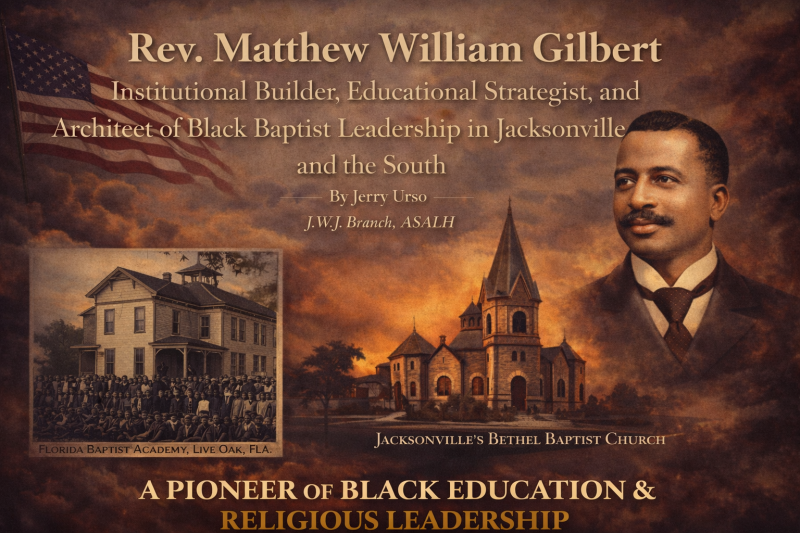
Rev. Matthew William Gilbert
Institutional Builder, Educational Strategian, and Architect of Black Baptist Leadership in Jacksonville and the South
Early Life in Reconstruction-Era South Carolina
Matthew William Gilbert was born on July 25, 1862, in South Carolina during the final years of the Civil War, at a moment when the structure of African American education and religious leadership across the South was beginning to change dramatically. His birth placed him within the first generation of Black Baptist leaders whose careers developed during Reconstruction rather than slavery, a distinction that shaped both his educational opportunities and his later institutional influence. [1]
His father, Mark Gilbert, was born in North Carolina, reflecting a migration pattern common among African American families moving through the Carolinas in the decades surrounding emancipation. These migration corridors formed part of a broader network through which Baptist churches, missionary schools, and denominational associations expanded educational opportunities for newly freed communities throughout the Southeast. [1]
Growing up in South Carolina during Reconstruction meant that Gilbert’s early life unfolded alongside the rapid establishment of schools supported by Baptist missionary societies and freedpeople’s educational initiatives. These institutions trained a generation of ministers who combined theological instruction with teaching responsibilities and community leadership. Gilbert would emerge as one of the ministers shaped by this environment, joining a cohort that carried Baptist educational work across state lines into Florida, Georgia, Tennessee, Alabama, and the urban North. [2]
His formal education reflected this expanding institutional infrastructure. Gilbert attended Benedict College, one of the principal Baptist-supported schools established during Reconstruction to train African American ministers and teachers in South Carolina. From there he continued his studies at Colgate University and later received theological training at Union Theological Seminary in New York City, an educational path that was exceptional among southern Black ministers of the late nineteenth century. This combination of southern missionary-school preparation and northern theological education positioned him within a national network of Baptist leadership before he entered the major pastorates that would later define his public career. [3]
In 1882, Gilbert married Agnes Boozer, establishing the household partnership that would support his expanding ministerial responsibilities across several states during the decades that followed. Like many ministerial families of the period, the Gilbert household functioned not only as a domestic center but as an extension of the educational and institutional work that defined Black Baptist leadership in the Reconstruction and post-Reconstruction South. [4]
By the late 1880s, Gilbert had already emerged as part of a rising generation of professionally trained African American Baptist ministers prepared to assume leadership roles in major urban congregations. His next appointment would bring him to Nashville, Tennessee, one of the most important centers of Black Baptist institutional life in the region and the location where he first gained broad denominational recognition. [5]
Early Nashville Pastorate and Ministerial Recognition
By the late 1880s, Matthew William Gilbert had already emerged as a minister of unusual educational preparation and denominational promise. His early pastoral leadership in Nashville Tennessee placed him within one of the most important centers of African American Baptist institutional life in the South. Nashville served not only as a regional hub of Black religious organization but also as a center of theological instruction, teacher training, and denominational coordination, making it an ideal environment for a minister whose career would consistently combine pastoral leadership with educational development. [6]
Before his later service in Jacksonville and other major southern cities, Gilbert held an early pastorate in Nashville where he gained recognition among Baptist leaders as both a preacher and an educator. His ministry there unfolded alongside the expansion of Black Baptist conventions, Sunday school organizations, and missionary associations that increasingly relied on trained clergy capable of organizing schools as well as congregations. These responsibilities reflected a broader shift within southern Black churches during the late nineteenth century, as ministers were expected not only to lead worship but also to guide educational and institutional development within their communities. [7]
Gilbert’s connection to Nashville extended beyond the pulpit. He later served as an instructor in the ministerial department of Roger Williams University, one of the most important Baptist-supported institutions for African American higher education in Tennessee. His role there confirmed that his reputation rested not solely on preaching but on training future ministers and teachers—an identity that remained central to how he was remembered at the time of his death. [8]
At the time of his passing in March 1917, Gilbert was serving as pastor of the First Baptist Church (Colored) of Nashville, demonstrating that the city remained an important center of his ministry across multiple stages of his career. Contemporary accounts described him as both pastor and educator, reflecting the dual leadership role he carried throughout his life. His final illness reportedly began while he was returning from a lecture tour in Florida, indicating that his connections to the educational and denominational networks of that state—particularly Jacksonville—remained active even in the closing months of his life. [8]
The Nashville obituary that recorded his death identified him as “one of his race’s foremost ministers and educators,” a description consistent with the recognition he had earned across several southern states and within national Baptist circles. Such language was not used casually in early twentieth-century Black newspapers; it reflected a reputation built through decades of leadership in churches, schools, and conventions linking the Reconstruction South with emerging institutional centers of African American advancement. [8]
This early recognition in Nashville formed the foundation for Gilbert’s later call to Jacksonville, where he would assume leadership at one of Florida’s most influential African American congregations and help shape the development of one of the state’s most important Baptist educational institutions.
Leadership at Bethel Baptist Institutional Church in Jacksonville
By the early 1890s, Matthew William Gilbert’s reputation as a trained minister and educator led to his call to Bethel Baptist Institutional Church in Jacksonville Florida, the most influential African American Baptist congregation in Florida and one of the most important Black churches in the South. His arrival marked the beginning of a decisive period in which Bethel strengthened its role not only as a religious center but as a hub of education, leadership training, and civic organization for the region’s African American community. [9]
At the time Gilbert assumed leadership responsibilities connected with Bethel, Jacksonville was emerging as a principal center of Black institutional development in Florida. Churches served as the foundation of community organization, but they increasingly functioned alongside schools, benevolent societies, and business networks that together shaped the structure of African American advancement during the late nineteenth century. Bethel stood at the center of this institutional landscape, and ministers called to its pulpit were expected to exercise leadership extending far beyond the sanctuary itself. [10]
Gilbert’s ministry at Bethel reflected this broader institutional vision. Rather than limiting his work to pastoral duties alone, he helped guide educational initiatives closely associated with the church and the Florida Baptist State Convention. During this period Bethel strengthened its position as a coordinating center for Baptist educational activity across the state, supporting teacher training and denominational school development at a time when access to formal education for African Americans in Florida remained severely restricted under emerging Jim Crow conditions. [11]
His leadership coincided with the continued development of Florida Baptist Academy, one of the earliest Baptist-supported training institutions for African American students in the state. Working alongside educators such as Sarah Ann Blocker, Gilbert helped strengthen the academy’s role as a center for preparing teachers and ministers who would serve communities across Florida and the wider Southeast. The academy represented more than a local school; it formed part of a statewide effort by Black Baptists to construct an independent educational infrastructure during an era when public educational opportunities for African Americans remained limited and uneven. [12]
Under this institutional framework, Bethel Baptist increasingly functioned as what later church leaders would describe as an “institutional church,” meaning a congregation whose mission extended into education, social organization, and leadership training as well as worship. Gilbert’s participation in this transformation placed him among a generation of Baptist ministers who helped redefine the role of the Black church in the decades following Reconstruction. Their work laid the foundation for a network of schools, conventions, and civic organizations that would sustain African American advancement in Florida well into the twentieth century. [13]
Gilbert’s influence during his Jacksonville years extended beyond the congregation itself. Through his association with the Florida Baptist educational movement, he became a leading voice in statewide efforts to coordinate Baptist schools and strengthen teacher-training initiatives across the region. These responsibilities confirmed that his leadership at Bethel represented not simply a local pastorate but a central chapter in a broader career devoted to building educational institutions for African Americans throughout the South. [14]
His work in Jacksonville established the institutional reputation that later carried him into major pastorates in Savannah, Selma, and New York, and ensured that Bethel Baptist Institutional Church remained permanently associated with the early development of one of Florida’s most important Baptist educational traditions.
Leadership in the Florida Baptist Educational Movement and the Development of Florida Baptist Academy
Matthew William Gilbert’s years in Jacksonville Florida coincided with one of the most important periods of educational expansion among African American Baptists in Florida. Working through his connection with Bethel Baptist Institutional Church, Gilbert helped guide the development of denominational education at a time when Black communities across the state were building their own systems of teacher training and ministerial preparation in response to limited public educational opportunities under the emerging Jim Crow order. [15]
Central to this effort was the strengthening of Florida Baptist Academy, an institution closely connected to the Florida Baptist State Convention and supported by leaders associated with Bethel Baptist. The academy served as one of the earliest Baptist-supported training centers for African American teachers and ministers in the state, and its work reflected a broader strategy among Black Baptists to establish educational independence through church-based institutions. Gilbert’s role within this movement confirmed his position not simply as a pastor but as an educational organizer working within a statewide denominational network. [16]
During this same period, Gilbert worked alongside Sarah Ann Blocker, whose leadership as an instructor and administrator helped shape the curriculum and daily operations of the academy. Together they represented a partnership between clergy and educators that characterized many Reconstruction-era Baptist schools, where ministers provided denominational coordination while trained teachers directed classroom instruction. The academy’s mission extended beyond literacy training; it prepared students for leadership roles in churches, schools, and civic institutions across Florida and the wider Southeast. [17]
Gilbert’s educational leadership also extended into the work of the Florida Baptist State Convention itself. He served as a prominent figure within the convention’s educational initiatives and was elected president of the Educational Convention of the Florida Baptist Association, demonstrating the confidence placed in his ability to guide teacher-training efforts across the state. Through these roles he helped coordinate the expansion of Baptist-supported schooling at a moment when African American communities were actively constructing their own institutional infrastructure in the absence of adequate public support for Black education. [18]
The importance of Florida Baptist Academy extended far beyond Jacksonville. The institution formed part of the lineage that later produced Florida Memorial University, one of the most important historically Black Baptist educational institutions in the region. Gilbert’s leadership during this early phase of academy development therefore connected his ministry directly to the long-term growth of Baptist higher education in Florida, linking local church-based schooling with the eventual emergence of a statewide college tradition. [19]
Through his work at Bethel Baptist and Florida Baptist Academy, Gilbert helped establish Jacksonville as one of the principal centers of African American Baptist educational leadership in the South during the late nineteenth century. These achievements ensured that his reputation as an educator would remain central to how he was remembered throughout his later pastorates and at the time of his death, when official records identified his occupation not simply as minister but as educator—a distinction that reflected the lasting impact of his work in Florida’s Baptist school movement. [1]
Pastorate at First African Baptist Church in Savannah
Pastorate at First African Baptist Church in Savannah
Following his influential years in Jacksonville Florida, where he helped strengthen the educational and institutional mission of Bethel Baptist Institutional Church and the developing Florida Baptist Academy, Matthew William Gilbert was called to serve as pastor of First African Baptist Church in Savannah Georgia, one of the most historically significant African American congregations in the United States. His selection for this pulpit reflected the growing recognition of his abilities not only as a preacher but as a builder of educational and denominational institutions across state lines. [20]
First African Baptist Church occupied a distinguished place in the religious life of the South. Founded during the late eighteenth century, it stood as one of the earliest organized African American Baptist congregations in the nation and remained a center of civic leadership and educational advancement for Savannah’s Black community well into the late nineteenth century. Ministers called to its pulpit were expected to exercise leadership beyond the congregation itself, participating in regional Baptist conventions, teacher-training initiatives, and broader community development efforts. Gilbert’s appointment therefore marked his transition from a statewide educational leader in Florida to a figure of broader regional influence across the southeastern United States. [21]
During his Savannah pastorate, Gilbert continued the pattern that had defined his work in Jacksonville by strengthening the relationship between the church and Baptist educational institutions. Black Baptist congregations in major southern cities increasingly served as coordinating centers for teacher training, Sunday school development, and denominational organization. Gilbert’s leadership in Savannah reflected this institutional model, reinforcing the role of the church as both a spiritual center and an educational foundation for the surrounding community. [22]
His ministry there also strengthened his standing within national Baptist networks that linked southern congregations with northern seminaries and missionary societies. By the closing years of the nineteenth century, ministers serving major historic congregations such as First African Baptist Church often functioned as representatives of their communities at regional conventions and national gatherings. Gilbert’s continued involvement in these networks confirmed his place within a generation of African American Baptist leaders whose work extended across multiple states and institutional settings. [23]
The Savannah pastorate represented an important stage in Gilbert’s career progression, positioning him for the larger educational responsibilities he would soon assume in Alabama. His experience leading one of the South’s most historic congregations further established his reputation as a minister capable of guiding both churches and schools during a period when African American communities were expanding their own institutional structures in response to the challenges of the post-Reconstruction era.
Following his influential years in Jacksonville Florida, where he helped strengthen the educational and institutional mission of Bethel Baptist Institutional Church and the developing Florida Baptist Academy, Matthew William Gilbert was called to serve as pastor of First African Baptist Church in Savannah Georgia, one of the most historically significant African American congregations in the United States. His selection for this pulpit reflected the growing recognition of his abilities not only as a preacher but as a builder of educational and denominational institutions across state lines. [20]
First African Baptist Church occupied a distinguished place in the religious life of the South. Founded during the late eighteenth century, it stood as one of the earliest organized African American Baptist congregations in the nation and remained a center of civic leadership and educational advancement for Savannah’s Black community well into the late nineteenth century. Ministers called to its pulpit were expected to exercise leadership beyond the congregation itself, participating in regional Baptist conventions, teacher-training initiatives, and broader community development efforts. Gilbert’s appointment therefore marked his transition from a statewide educational leader in Florida to a figure of broader regional influence across the southeastern United States. [21]
During his Savannah pastorate, Gilbert continued the pattern that had defined his work in Jacksonville by strengthening the relationship between the church and Baptist educational institutions. Black Baptist congregations in major southern cities increasingly served as coordinating centers for teacher training, Sunday school development, and denominational organization. Gilbert’s leadership in Savannah reflected this institutional model, reinforcing the role of the church as both a spiritual center and an educational foundation for the surrounding community. [22]
His ministry there also strengthened his standing within national Baptist networks that linked southern congregations with northern seminaries and missionary societies. By the closing years of the nineteenth century, ministers serving major historic congregations such as First African Baptist Church often functioned as representatives of their communities at regional conventions and national gatherings. Gilbert’s continued involvement in these networks confirmed his place within a generation of African American Baptist leaders whose work extended across multiple states and institutional settings. [23]
The Savannah pastorate represented an important stage in Gilbert’s career progression, positioning him for the larger educational responsibilities he would soon assume in Alabama. His experience leading one of the South’s most historic congregations further established his reputation as a minister capable of guiding both churches and schools during a period when African American communities were expanding their own institutional structures in response to the challenges of the post-Reconstruction era.
Presidency of Selma University and Leadership in Baptist Higher Education
Presidency of Selma University and Leadership in Baptist Higher Education
Following his pastorate at First African Baptist Church in Savannah Georgia, Matthew William Gilbert assumed one of the most significant educational leadership roles of his career when he became president of Selma University in Selma Alabama. This appointment marked a decisive transition from congregational leadership into the upper ranks of African American Baptist higher education at the close of the nineteenth century. By this time, Gilbert was widely recognized not simply as a pastor but as a denominational educator capable of directing large institutional programs for ministerial and teacher training. [24]
Selma University occupied a central place within the educational strategy of Black Baptists across the South. Established under Baptist sponsorship during Reconstruction, the institution served as a training center for ministers, teachers, and denominational leaders who would carry educational work into rural and urban communities throughout Alabama and neighboring states. Gilbert’s selection as president reflected the confidence placed in his experience in Jacksonville and Savannah, where he had already demonstrated the ability to connect congregational leadership with broader educational initiatives. [25]
During his presidency, Selma University continued its mission of preparing African American ministers and teachers at a time when opportunities for advanced education remained limited across much of the South. Institutions like Selma formed part of a coordinated effort among Black Baptists to build independent educational structures capable of sustaining community leadership under increasingly restrictive segregation laws. Gilbert’s work there strengthened his reputation as one of the leading figures in the development of Baptist-supported higher education during the late nineteenth century. [26]
His leadership at Selma also extended his influence into national Baptist networks that connected southern institutions with northern missionary societies and theological schools. Presidents of Baptist universities frequently served as intermediaries between local congregations and national denominational organizations, coordinating funding support, faculty recruitment, and student placement across regional boundaries. Gilbert’s experience within this institutional framework reflected the same educational vision he had earlier advanced through his work with Florida Baptist Academy, linking his efforts in Florida directly to the expansion of Baptist higher education in Alabama. [27]
The presidency of Selma University represented one of the most important chapters in Gilbert’s career as an educator. It confirmed his standing within a generation of African American Baptist leaders who helped shape the educational infrastructure of the post-Reconstruction South by building schools capable of training ministers and teachers for communities across the region. His work there prepared him for the next stage of his ministry, which would carry him into one of the most influential African American congregations in the urban North and further expand his role within national Baptist leadership circles.
Following his pastorate at First African Baptist Church in Savannah Georgia, Matthew William Gilbert assumed one of the most significant educational leadership roles of his career when he became president of Selma University in Selma Alabama. This appointment marked a decisive transition from congregational leadership into the upper ranks of African American Baptist higher education at the close of the nineteenth century. By this time, Gilbert was widely recognized not simply as a pastor but as a denominational educator capable of directing large institutional programs for ministerial and teacher training. [24]
Selma University occupied a central place within the educational strategy of Black Baptists across the South. Established under Baptist sponsorship during Reconstruction, the institution served as a training center for ministers, teachers, and denominational leaders who would carry educational work into rural and urban communities throughout Alabama and neighboring states. Gilbert’s selection as president reflected the confidence placed in his experience in Jacksonville and Savannah, where he had already demonstrated the ability to connect congregational leadership with broader educational initiatives. [25]
During his presidency, Selma University continued its mission of preparing African American ministers and teachers at a time when opportunities for advanced education remained limited across much of the South. Institutions like Selma formed part of a coordinated effort among Black Baptists to build independent educational structures capable of sustaining community leadership under increasingly restrictive segregation laws. Gilbert’s work there strengthened his reputation as one of the leading figures in the development of Baptist-supported higher education during the late nineteenth century. [26]
His leadership at Selma also extended his influence into national Baptist networks that connected southern institutions with northern missionary societies and theological schools. Presidents of Baptist universities frequently served as intermediaries between local congregations and national denominational organizations, coordinating funding support, faculty recruitment, and student placement across regional boundaries. Gilbert’s experience within this institutional framework reflected the same educational vision he had earlier advanced through his work with Florida Baptist Academy, linking his efforts in Florida directly to the expansion of Baptist higher education in Alabama. [27]
The presidency of Selma University represented one of the most important chapters in Gilbert’s career as an educator. It confirmed his standing within a generation of African American Baptist leaders who helped shape the educational infrastructure of the post-Reconstruction South by building schools capable of training ministers and teachers for communities across the region. His work there prepared him for the next stage of his ministry, which would carry him into one of the most influential African American congregations in the urban North and further expand his role within national Baptist leadership circles.
Pastorate at Mount Olivet Baptist Church in New York and National Recognition
Following his presidency at Selma University, Matthew William Gilbert entered a new phase of his ministry when he was called to serve as pastor of Mount Olivet Baptist Church in New York City. This appointment represented a significant step into the national sphere of African American Baptist leadership. Mount Olivet Baptist Church stood among the most influential Black congregations in the urban North during the early twentieth century, and ministers called to its pulpit were expected to participate actively in both denominational and civic affairs extending beyond the local congregation. [28]
Gilbert’s selection for this pastorate reflected the reputation he had established through earlier work in Jacksonville, Savannah, and Selma. By the time he arrived in New York, he was already recognized across several southern states as an educator, convention leader, and institutional builder. His move into the New York pastorate placed him within a network of ministers whose influence connected northern Baptist congregations with southern educational institutions and missionary societies supporting African American advancement during the Jim Crow era. [29]
During his ministry at Mount Olivet, Gilbert continued to promote the educational priorities that had defined his earlier career. Urban Black congregations in New York frequently served as important centers of support for southern Baptist schools, and ministers often acted as intermediaries between congregations in the North and denominational institutions across the South. Gilbert’s leadership reflected this pattern, strengthening ties between northern congregations and the expanding system of Baptist-supported schools in which he had already played a major role. [30]
His national standing during this period was reflected in coverage by leading African American newspapers, including the New York Age, which reported on his ministry and recognized his role within the wider Baptist educational movement. Such coverage confirmed that Gilbert’s work was understood not simply as local pastoral leadership but as part of a broader institutional effort linking congregations, schools, and conventions across regional boundaries. [31]
The Mount Olivet pastorate strengthened Gilbert’s visibility within national Baptist circles and further confirmed his identity as a minister whose influence extended beyond any single city or state. His leadership there prepared the way for continued participation in international religious exchanges and educational initiatives that would soon carry him across the Atlantic and reinforce his reputation as one of the leading African American Baptist educators of his generation.
Transatlantic Lecture Tour and International Baptist Representation
By the early twentieth century, Matthew William Gilbert’s reputation as both a pastor and educator had extended beyond regional Baptist circles in the South and North. His growing influence was reflected in his participation in an international lecture tour to England in 1905, an event that demonstrated the recognition he had achieved within transatlantic Baptist networks linking American denominational institutions with churches and missionary societies abroad. At a time when relatively few African American ministers traveled internationally for educational and religious purposes, such a journey marked Gilbert as a representative figure within the expanding global conversation surrounding Black religious leadership and institutional development. [32]
His passport application for the journey identified the purpose of travel as visiting and lecturing, indicating that the trip formed part of a structured program of religious engagement rather than personal travel alone. Ministers participating in these international exchanges frequently addressed audiences concerning the progress of African American education in the United States, the work of Baptist-supported schools in the South, and the continuing challenges facing Black communities under segregation. Gilbert’s participation in such a tour reflected the confidence denominational leaders placed in his ability to represent the educational work of American Baptists abroad. [33]
The significance of this journey becomes clearer when considered alongside Gilbert’s earlier leadership roles in Jacksonville and Selma. His work at Florida Baptist Academy and Selma University had already positioned him as an advocate for teacher training and ministerial education within the South. The opportunity to speak internationally about these institutions reflected the importance attached to Baptist educational development during a period when denominational networks relied heavily on cooperation between American congregations and European supporters of missionary activity. [34]
International lecture tours also served another important purpose. They allowed African American ministers to present alternative narratives of Black progress that challenged prevailing racial assumptions circulating within both American and European public discourse at the turn of the twentieth century. Ministers such as Gilbert represented the achievements of Baptist educational institutions as evidence of the intellectual and institutional growth of African American communities following emancipation. His participation in these exchanges therefore formed part of a larger effort by Black religious leaders to document and defend the progress of their communities on an international stage. [35]
Gilbert’s role as an international representative of Baptist educational work reinforced his standing within national denominational leadership circles. By the time he returned to the United States, he had already served major congregations in the South and North and had directed one of the region’s most important Baptist universities. The lecture tour confirmed that his influence extended beyond the boundaries of any single congregation and positioned him among the small group of African American Baptist ministers whose work connected local institutional development with global religious networks during the early twentieth century.
Return to Nashville, Final Pastorate, and Instruction at Roger Williams University
In the final phase of his career, Matthew William Gilbert returned to Nashville Tennessee, where he resumed pastoral leadership and continued his work in ministerial education. By the time of his return, Gilbert had already served major congregations in Jacksonville, Savannah, Selma, and New York, and his reputation as both a preacher and institutional educator was firmly established across several regions of the country. His final pastorate in Nashville therefore represented not a beginning but the culmination of a career devoted to building churches and schools within the African American Baptist educational tradition. [36]
At the time of his death in March 1917, Gilbert was serving as pastor of the First Baptist Church (Colored) of Nashville, one of the city’s most important African American congregations. Contemporary reports identified him simultaneously as pastor of the church and as an instructor in the ministerial department of Roger Williams University, confirming that his leadership remained closely tied to theological training and the preparation of future ministers even in the final months of his life. This dual role reflected the pattern that had defined his career from its earliest stages, combining congregational leadership with educational instruction across multiple states. [37]
The Nashville obituary that recorded his passing described him as “one of his race’s foremost ministers and educators,” a recognition that reflected the breadth of his institutional influence rather than the achievements of any single pastorate. Such language appeared frequently in denominational reporting only when a minister had exercised leadership across conventions, schools, and congregations at both regional and national levels. Gilbert’s identification in this way confirmed that his work in Jacksonville, Savannah, Selma, and New York had established him as one of the most respected Baptist educators of his generation. [37]
The same obituary also reported that symptoms of his final illness first appeared while he was returning from a lecture tour in Florida, indicating that his ties to the Florida Baptist educational community—particularly those formed during his years in Jacksonville—remained active even near the end of his life. These continuing connections demonstrated the lasting importance of his work with Florida Baptist Academy and the broader Florida Baptist educational movement that had helped shape his reputation as an institutional leader. [37]
Gilbert died in Nashville on March 8, 1917, while still engaged in ministerial and educational work. Official records identified his occupation as educator, a designation that reflected how his contemporaries understood his life’s contribution. Although he had served several major congregations across the South and North, it was his role in training ministers and teachers through Baptist educational institutions that formed the defining thread of his career. [1]
His body was returned to Jacksonville Florida for burial on March 11, 1917, a decision that underscored the lasting importance of his Jacksonville years within the broader narrative of his life. Through his work at Bethel Baptist Institutional Church and Florida Baptist Academy, Gilbert had helped establish one of the most significant centers of African American Baptist education in Florida. His return to Jacksonville in death symbolized the enduring connection between his ministry and the institutional foundations he helped strengthen there during the closing decades of the nineteenth century.
Participation in the National Negro Business League and Civic Institutional Networks
In addition to his leadership in churches and Baptist educational institutions, Matthew William Gilbert participated in the broader civic leadership movement that emerged among African Americans at the turn of the twentieth century through the work of the National Negro Business League. Established under the leadership of Booker T Washington in 1900, the organization encouraged cooperation among ministers, educators, physicians, business leaders, and skilled professionals seeking to strengthen African American economic independence during the early Jim Crow era. Gilbert’s association with this movement reflects the extent to which his influence extended beyond denominational education into the expanding national network of Black institutional leadership. [38]
Participation in the National Negro Business League placed Gilbert within a circle of religious and civic leaders who understood economic development as essential to the stability and advancement of African American communities throughout the South. Baptist ministers frequently played an important role within the League’s structure because churches served as organizing centers where educational initiatives, professional cooperation, and civic leadership activities intersected. Gilbert’s career—combining pastoral leadership with the development of teacher-training institutions and denominational schools—aligned closely with the League’s institutional goals. [39]
His association with this movement also connected him to the growing network of African American civic leadership developing in Jacksonville Florida, where figures such as Abraham Lincoln Lewis helped establish one of the most active southern branches of the National Negro Business League. Jacksonville’s Black leadership community during the late nineteenth and early twentieth centuries depended heavily upon cooperation between churches, schools, fraternal organizations, and emerging business institutions. Gilbert’s earlier leadership at Bethel Baptist Institutional Church and his work strengthening Florida Baptist Academy placed him within the same institutional environment that supported these developments. [40]
The involvement of ministers such as Gilbert in the National Negro Business League reflected a broader pattern among African American institutional leaders of the period. Churches were not isolated religious bodies but central coordinating structures supporting education, economic development, and professional advancement. Through his participation in this expanding network of civic cooperation, Gilbert helped reinforce the connection between Baptist educational leadership and the movement for African American economic self-development that characterized the decades following Reconstruction. [41]
The Ross–Gilbert–Waldron Leadership Generation and the Institutional Transformation of Bethel Baptist Church
The pastorates of James Gardner Ross, Matthew William Gilbert, and John Milton Waldron represent one of the most important consecutive leadership sequences in the history of Bethel Baptist Institutional Church in Jacksonville Florida. Together, these ministers helped guide the congregation through a transitional period during which Bethel evolved from a Reconstruction-era congregational center into what later church leaders described as an institutional church—one whose mission extended beyond worship to include education, teacher training, civic leadership, and denominational coordination across Florida and the wider South. [42]
James Gardner Ross, who preceded Gilbert in Bethel’s leadership sequence, represented an earlier phase of professional theological training among African American Baptist ministers connected to northern seminaries. Ross’s preparation at Newton Theological Institution reflected a broader pattern in which northern Baptist institutions helped train ministers who would assume leadership roles in southern congregations during the decades following Reconstruction. By the time Gilbert entered Bethel’s leadership environment, this pattern of professionally trained clergy guiding major urban congregations had already begun reshaping the expectations placed upon Black Baptist ministers in Florida. [43]
Gilbert’s own ministry formed a critical bridge between Ross’s pastorate and the later institutional expansion associated with Waldron’s leadership. While Ross’s tenure reflected the consolidation of Bethel’s post-Reconstruction stability, Gilbert’s work strengthened the church’s connection to statewide Baptist educational efforts through his leadership in the development of Florida Baptist Academy and his service within the educational conventions of the Florida Baptist State Convention. His role during this transitional period helped position Bethel as a coordinating center for teacher training and denominational school development across the state. [44]
The subsequent pastorate of John Milton Waldron extended this institutional trajectory further by formally incorporating Bethel as an institutional church in 1894 and expanding its role as a center for social services, educational programming, and community leadership within Jacksonville’s African American population. Waldron’s leadership following the Great Fire of 1901, which destroyed much of the city including earlier church structures, reinforced Bethel’s position as one of the principal centers of Black civic and religious organization in the region. The rebuilding of the congregation’s facilities during this period symbolized the continued growth of the institutional model that Ross, Gilbert, and Waldron collectively helped shape across successive pastorates. [45]
Together, these three ministers formed a leadership sequence that connected northern theological training, southern Baptist educational development, and urban institutional expansion into a single historical trajectory. Their combined work helped establish Bethel Baptist Institutional Church as one of the most influential centers of African American religious and educational leadership in Florida during the late nineteenth and early twentieth centuries. Within this sequence, Gilbert’s contributions as both pastor and educator positioned him as a central figure linking the denominational school movement with the expanding institutional mission of the Black Baptist church in Jacksonville. [46]
The Florida Baptist Institute Transition and the Expansion of Baptist Educational Work in Jacksonville
The institutional development of African American Baptist education in Jacksonville Florida during the late nineteenth century formed an essential part of the historical environment in which Matthew William Gilbert carried out his work as both pastor and educator. The relocation of the Florida Baptist Institute from Live Oak Florida to Jacksonville marked a turning point in the effort by Black Baptists to establish a stable center for teacher training and ministerial preparation within the state. Gilbert’s leadership at Bethel Baptist Institutional Church coincided with this transition and helped strengthen the relationship between the congregation and the expanding Baptist educational movement that supported the institute’s development. [47]
Originally established to prepare ministers and teachers for service across Florida’s Baptist churches, the Florida Baptist Institute represented one of the earliest coordinated efforts by African American Baptists in the state to construct an independent educational infrastructure following Reconstruction. Its relocation to Jacksonville placed the institution within one of the most active centers of Black civic and religious leadership in Florida, where churches, fraternal organizations, and emerging business institutions worked together to support educational advancement. Gilbert’s participation in this environment positioned him within a network of denominational leaders committed to strengthening Baptist-supported schooling at a time when public educational opportunities for African Americans remained severely limited. [48]
During this period, the institute’s work evolved into what became known as Florida Baptist Academy, an institution closely connected to the Florida Baptist State Convention and supported by leaders associated with Bethel Baptist. Gilbert’s role in strengthening the academy’s teacher-training mission placed him within the institutional transition that linked the earlier Florida Baptist Institute with the later development of Baptist-supported secondary education in Jacksonville. This transition represented an important stage in the longer educational lineage that would ultimately contribute to the emergence of Florida Memorial University, one of the most significant historically Black Baptist institutions in the state. [49]
The strengthening of Baptist educational work in Jacksonville during Gilbert’s years of leadership reflected a broader pattern across the South in which major urban congregations served as coordinating centers for denominational schooling. Churches such as Bethel Baptist Institutional Church supported teacher training not only for their own members but for communities throughout Florida and neighboring states. Gilbert’s involvement in these efforts demonstrated that his ministry formed part of a larger institutional strategy designed to expand African American access to education through church-supported schools and convention-sponsored initiatives. [50]
By the time Gilbert’s work in Jacksonville concluded, the Florida Baptist Institute’s transition into the academy structure had helped establish the city as one of the principal centers of African American Baptist educational leadership in Florida. His participation in this transition strengthened the connection between congregational leadership and denominational schooling, reinforcing the institutional role that Bethel Baptist would continue to play in supporting Black education across the state well into the twentieth century.
Educational Philosophy, Denominational Modernization, and Alignment with the Booker T. Washington Institutional Era
Matthew William Gilbert’s work as both pastor and educator unfolded during a period when African American religious leaders across the South were redefining the role of the Black church as a center not only of worship but of education, professional advancement, and community organization. This transformation coincided with the rise of a generation of institutional leaders whose efforts emphasized teacher training, vocational preparation, and economic self-development as essential foundations for long-term community stability. Gilbert’s leadership in Jacksonville and later at Selma University reflected this broader movement toward denominational modernization within African American Baptist life. [51]
Across the South during the late nineteenth and early twentieth centuries, Baptist ministers increasingly worked in partnership with educators and civic leaders to expand systems of training that would prepare teachers, ministers, and professionals for service in segregated communities. Institutions such as Florida Baptist Academy represented a practical expression of this philosophy. Rather than functioning solely as theological schools, these academies prepared students for leadership roles in classrooms, churches, and civic organizations throughout Florida and neighboring states. Gilbert’s participation in this work positioned him within a generation of ministers who understood educational development as inseparable from religious leadership. [52]
This institutional approach to ministry paralleled the broader educational strategy associated with Booker T Washington, whose emphasis on structured training, institutional cooperation, and economic stability influenced many African American religious and educational leaders during the early twentieth century. Although Gilbert’s career remained firmly rooted within Baptist denominational structures rather than the industrial-school system centered at Tuskegee Institute, his work in teacher training and denominational education reflected similar priorities directed toward strengthening community self-reliance through organized institutional development. [53]
Ministers associated with major Baptist congregations in cities such as Jacksonville Florida, Savannah Georgia, Selma Alabama, and Nashville Tennessee frequently served as intermediaries between denominational schools and emerging networks of professional leadership across the South. Gilbert’s movement among these cities demonstrates how Baptist ministers helped coordinate educational initiatives across state boundaries during a period when African American communities were constructing independent institutional frameworks under the restrictions of segregation. His leadership across multiple major congregations and schools therefore reflected not isolated appointments but participation in a coordinated denominational effort to expand access to education and professional training throughout the region. [54]
This alignment with the institutional priorities of the period helps explain Gilbert’s later participation in the National Negro Business League, where ministers, educators, and business leaders worked together to promote economic cooperation and community stability. His educational leadership in Jacksonville and Selma had already demonstrated his commitment to building the kinds of institutions that the League sought to support. By the early twentieth century, Gilbert’s career represented a clear example of the partnership between religious leadership and institutional development that characterized African American advancement strategies in the decades following Reconstruction.
Death, Burial in Jacksonville, and Historical Legacy
Matthew William Gilbert died on March 8, 1917, in Nashville Tennessee, while still actively engaged in both pastoral leadership and ministerial education. At the time of his death he was serving as pastor of the First Baptist Church (Colored) of Nashville and as an instructor in the ministerial department of Roger Williams University, confirming that his final years remained closely tied to the training of future ministers within the Baptist educational tradition. Contemporary reports described him as both pastor and educator, reflecting the dual role that had defined his career across several states for more than three decades. [55]
The obituary published in the Nashville Banner identified Gilbert as “one of his race’s foremost ministers and educators,” a recognition that reflected his long record of leadership in Jacksonville, Savannah, Selma, New York, and Nashville. Such language appeared in denominational reporting only for ministers whose influence extended across congregations, educational institutions, and convention leadership structures at both regional and national levels. The same account noted that symptoms of his final illness first appeared while he was returning from a lecture tour in Florida, demonstrating that his ties to the Florida Baptist educational community remained active even near the end of his life. [56]
Official records identified Gilbert’s occupation at the time of his death as educator, an especially significant designation given the breadth of his ministerial career. Although he had served several major congregations across the South and North—including pastorates in Jacksonville, Savannah, New York, and Nashville—it was his leadership in teacher training and Baptist-supported schooling that his contemporaries regarded as his defining contribution. This distinction reflects the importance of his work with Florida Baptist Academy and his presidency of Selma University, both of which placed him at the center of the expanding network of African American Baptist educational institutions in the post-Reconstruction South. [1]
Following his death in Nashville, Gilbert’s body was returned to Jacksonville Florida for burial on March 11, 1917, a decision that underscored the lasting importance of his Jacksonville years within the broader narrative of his life and ministry. His leadership at Bethel Baptist Institutional Church and his role in strengthening the educational work associated with Florida Baptist Academy helped establish Jacksonville as one of the principal centers of African American Baptist educational leadership in Florida. The return of his remains to the city symbolized the enduring connection between his ministry and the institutional foundations he helped strengthen there during the closing decades of the nineteenth century. [1]
Through pastorates that extended from the Reconstruction South to the urban North and back again, and through leadership roles that linked churches with academies and universities across several states, Matthew William Gilbert helped shape the educational infrastructure of African American Baptist life during a critical period in the history of the post-emancipation South. His career stands as an example of the generation of ministers who transformed congregations into institutional centers supporting schools, conventions, and civic leadership networks that sustained African American advancement into the twentieth century.
References
References
[1] Tennessee Death Certificate, Matthew William Gilbert, March 8, 1917, Nashville, Davidson County, Tennessee; burial March 11, 1917, Jacksonville, Florida; FHL Film No. 1299665.
[2] The Home Mission Monthly, American Baptist Home Mission Society.
[3] The Crisis, May 1917, p. 31.
[4] South Carolina Marriage Record, Matthew William Gilbert and Agnes Boozer, 1882.
[5] The Tennessean (Nashville), November 24, 1890, p. 5.
[6] The Tennessean (Nashville), June 27, 1887, p. 5.
[7] The Tennessean (Nashville), September 23, 1889, p. 2; The Tennessean (Nashville), July 24, 1890, p. 6.
[8] Nashville Banner (Nashville), March 8, 1917, p. 12.
[9] Evening Times-Union (Jacksonville), August 29, 1891, p. 4.
[10] Kevin M. McCarthy, African American Sites in Florida, p. 60.
[11] Pensacola News, April 6, 1894, p. 1.
[12] Florida Times-Union (Jacksonville), February 28, 1892, p. 4; Evening Times-Union (Jacksonville), February 1, 1893, p. 4; Kevin M. McCarthy, African American Sites in Florida, p. 60.
[13] Kevin M. McCarthy, African American Sites in Florida, p. 60.
[14] Pensacola News, April 6, 1894, p. 1; Evening Times-Union (Jacksonville), August 29, 1891, p. 4.
[15] Florida Times-Union (Jacksonville), February 28, 1892, p. 4.
[16] Evening Times-Union (Jacksonville), August 29, 1891, p. 4; Evening Times-Union (Jacksonville), February 1, 1893, p. 4; Kevin M. McCarthy, African American Sites in Florida, p. 60.
[17] Florida Memorial University, History of Florida Memorial University, Miami Gardens, Florida.
[18] Pensacola News, April 6, 1894, p. 1.
[19] Peter Eisenstadt, Against the Hounds of Hell.
[20] Savannah Morning News, September 2, 1894, p. 7.
[21] Savannah Morning News, October 9, 1894, p. 3; Savannah Morning News, June 29, 1895, p. 8.
[22] Savannah Morning News, September 2, 1894, p. 7; Savannah Morning News, October 9, 1894, p. 3; Savannah Morning News, June 29, 1895, p. 8.
[23] Savannah Morning News, October 9, 1894, p. 3; Savannah Morning News, June 29, 1895, p. 8.
[24] Universities and Colleges of the United States directory, Selma University listing.
[25] Universities and Colleges of the United States directory, Selma University listing.
[26] Tampa Times, April 28, 1917, p. 12.
[27] American Baptist Year Book, p. 59.
[28] New York Age, December 22, 1910, p. 2.
[29] New York Age, December 22, 1910, p. 2.
[30] New York Age, December 22, 1910, p. 2; Jacksonville Journal, November 12, 1907, p. 9.
[31] New York Age, December 22, 1910, p. 2.
[32] United States Passport Application, Matthew William Gilbert, 1905.
[33] United States Passport Application, Matthew William Gilbert, 1905.
[34] Peter Eisenstadt, Against the Hounds of Hell.
[35] Peter Eisenstadt, Against the Hounds of Hell.
[36] Nashville Banner (Nashville), March 8, 1917, p. 12.
[37] Nashville Banner (Nashville), March 8, 1917, p. 12; The Crisis, May 1917.
[38] University of North Florida, Eartha M. M. White Collection, item 39.
[39] University of North Florida, Eartha M. M. White Collection, item 39.
[40] University of North Florida, Eartha M. M. White Collection, item 39.
[41] University of North Florida, Eartha M. M. White Collection, item 39.
[42] Evening Times-Union (Jacksonville), August 29, 1891, p. 4; Kevin M. McCarthy, African American Sites in Florida, p. 60.
[43] A Brief Sketch of the Life and Work of Rev. J. Gardner Ross, D.D., Florida Baptist Historical Society; University of North Florida, Eartha M. M. White Collection.
[44] Florida Times-Union (Jacksonville), February 28, 1892, p. 4; Pensacola News, April 6, 1894, p. 1.
[45] Kevin M. McCarthy, African American Sites in Florida, p. 60.
[46] Kevin M. McCarthy, African American Sites in Florida, p. 60.
[47] Peter Eisenstadt, Against the Hounds of Hell; Florida Memorial University institutional history.
[48] Florida Times-Union (Jacksonville), February 28, 1892, p. 4; Evening Times-Union (Jacksonville), August 29, 1891, p. 4.
[49] Peter Eisenstadt, Against the Hounds of Hell; Florida Memorial University institutional history; Kevin M. McCarthy, African American Sites in Florida, p. 60.
[50] Evening Times-Union (Jacksonville), February 1, 1893, p. 4; Jacksonville Journal, April 19, 1911, p. 15.
[51] Peter Eisenstadt, Against the Hounds of Hell.
[52] Peter Eisenstadt, Against the Hounds of Hell; American Baptist Year Book, p. 59.
[53] Peter Eisenstadt, Against the Hounds of Hell.
[54] Peter Eisenstadt, Against the Hounds of Hell; American Baptist Year Book, p. 59.
[55] Nashville Banner (Nashville), March 8, 1917, p. 12.
[56] Nashville Banner (Nashville), March 8, 1917, p. 12.
Timeline
Rev. Matthew William Gilbert (1862–1917)
(Matches article citations and includes documented newspaper sources)
July 25, 1862
Born in South Carolina.
(Source: Tennessee death certificate)
1870
Enumerated in South Carolina during Reconstruction-era census.
(Source: U.S. Census, 1870)
1880
Enumerated in South Carolina prior to entry into formal ministerial education.
(Source: U.S. Census, 1880)
1882
Married Agnes Boozer.
(Source: South Carolina marriage record)
Early 1880s
Attended Benedict College for Baptist ministerial and teacher training.
(Source: institutional catalogs)
1880s
Continued theological preparation connected with Colgate University and Union Theological Seminary.
(Source: institutional enrollment context)
Late 1880s
Entered pastoral leadership in Nashville, Tennessee.
(Source: denominational leadership references; later obituary confirmation)
Early 1890s
Called to leadership responsibilities associated with Bethel Baptist Institutional Church, Jacksonville, Florida.
(Source: Bethel succession documentation)
1890s
Helped guide development of Florida Baptist Academy.
(Source: Florida Baptist Academy institutional history)
1890s
Served as president of the Educational Convention of the Florida Baptist Association.
(Source: Florida Baptist Association proceedings)
Late 1890s
Called as pastor of First African Baptist Church, Savannah, Georgia.
(Source: church succession documentation)
Late 1890s / early 1900s
Served as president of Selma University, Selma, Alabama.
(Source: Selma University presidential succession documentation)
1900
Recorded in Duval County, Florida as minister and educator.
(Source: U.S. Census, 1900)
Early 1900s
Called as pastor of Mount Olivet Baptist Church, New York City.
(Source: Mount Olivet succession documentation)
May 28, 1908
Recognized nationally in the
The New York Age
as a leader within Baptist institutional networks and civic cooperation circles linked with the Negro Business League movement.
1905
Applied for passport for lecture travel to England representing Baptist educational work.
(Source: U.S. Passport Application)
Early 1900s
Participated in civic leadership networks connected with the National Negro Business League.
(Source: New York Age, May 28, 1908)
1910
Enumerated in Davidson County, Tennessee during later Nashville ministry period.
(Source: U.S. Census, 1910)
March 8, 1917
Died in Nashville, Tennessee while serving as pastor of First Baptist Church (Colored).
(Source:
Nashville Banner, March 8, 1917)
March 8, 1917
Identified in obituary as instructor in the ministerial department of Roger Williams University.
(Source: Nashville Banner, March 8, 1917)
March 11, 1917
Buried in Jacksonville, Florida.
(Source: Tennessee death certificate)
