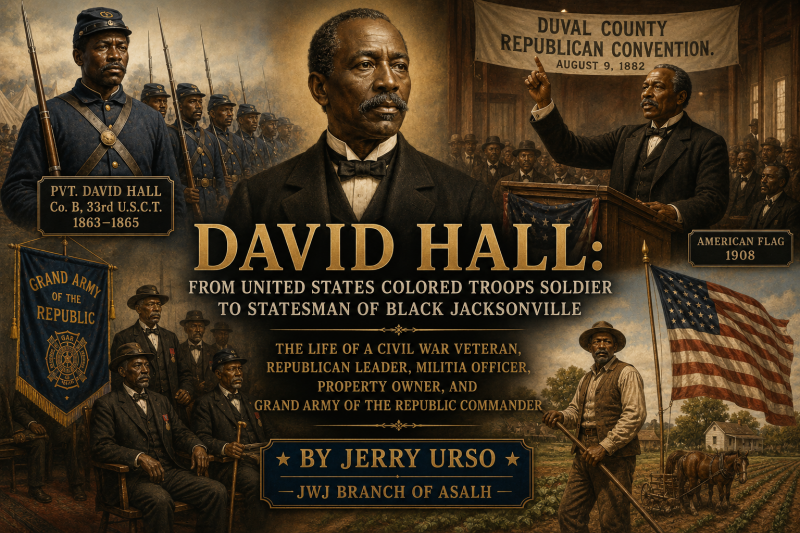
David Hall: From United States Colored Troops Soldier to Statesman of Black Jacksonville
The Life of a Civil War Veteran, Republican Leader, Militia Officer, Property Owner, and Grand Army of the Republic Commander
By Jerry Urso
JWJ Branch of ASALH
"If the colored people ever expected to be anybody or amount to anything they must stick together."
— David Hall, addressing the Duval County Republican Convention, August 9, 1882.[1]
A Soldier for Freedom
Few men buried at Jacksonville's historic Mount Herman Cemetery left behind a documentary record as rich and revealing as David Hall. Soldier, political leader, militia officer, property owner, and officer of the Grand Army of the Republic, Hall's life mirrors the extraordinary journey of thousands of African Americans who emerged from slavery, fought for the Union, embraced citizenship, and helped shape the political and civic life of the Reconstruction South.
Born in Georgia about 1839, David Hall entered adulthood during one of the most turbulent periods in American history. Although records have yet to reveal the circumstances of his early life, his birthplace and age suggest that he was born into slavery. Like countless other Black men, the Civil War transformed the course of his life. Rather than remaining a spectator, Hall answered the Union's call to arms by joining Company B of the 33rd United States Colored Infantry.[2]
His Compiled Military Service Record documents his service from 1863 until his honorable discharge at Fort Monroe, Virginia, in November 1865.[2] The 33rd United States Colored Infantry traced its lineage to one of the earliest African American regiments organized during the war. Black soldiers served under extraordinary danger. If captured, they faced execution, re-enslavement, or imprisonment rather than treatment as legitimate prisoners of war. Disease claimed many more soldiers than combat itself. David Hall survived both war and its hardships, returning to Jacksonville to begin building a new life.
Among the African American residents of Jacksonville enumerated in the 1870 federal census, David Hall is the only man bearing that name who was of an age consistent with documented Civil War service. When considered together with his military records, probate file, newspaper accounts, and obituary, the evidence establishes a clear documentary chain identifying the same individual throughout his adult life.[2][3][4]
Returning Home to Reconstruction Jacksonville
Five years after the war ended, David Hall appeared in the 1870 United States Census living in Jacksonville with his first wife, Phebe Hall. He was thirty-one years old and employed as a drayman, one of the city's essential occupations during Reconstruction.[3]
A drayman transported freight using a horse-drawn wagon, hauling lumber, cotton, building supplies, commercial merchandise, and cargo between Jacksonville's docks, warehouses, rail depots, and businesses. It was difficult physical labor requiring strength, dependability, and intimate knowledge of the city's growing commercial district.
The census reveals something even more remarkable. Only five years after leaving military service, Hall already owned $100 in real estate and $125 in personal property.[3] While these amounts appear modest today, they represented meaningful wealth for an African American laborer during Reconstruction. They demonstrate that Hall had already begun accumulating property at a time when many formerly enslaved people were only beginning to establish independent lives.
Those early investments became the foundation upon which he would build a lifetime of financial stability and community leadership.
Building a Life in Hansontown
As Jacksonville expanded during the 1870s and 1880s, David Hall did more than earn a living. He established himself as a respected citizen whose influence extended well beyond his neighborhood. Living in Hansontown, one of Jacksonville's earliest African American communities, Hall became part of a generation determined to transform freedom into lasting opportunity.
His growing prosperity is reflected most clearly in the documents he left behind. On May 16, 1903, David Hall executed a carefully prepared Last Will and Testament. Rather than the estate of a man living from paycheck to paycheck, Hall's will reveals a citizen who had accumulated property and planned thoughtfully for his family's future.[5]
The will identifies Charlotte Hall, his second wife, as the principal beneficiary. She inherited the family residence, household furniture, horses, wagons, and Lot 4, Block 14 in Hansontown.[5] These were not insignificant possessions. Horses and wagons represented essential transportation and valuable working assets in the years before automobiles, while ownership of a residence in Hansontown reflected decades of careful financial planning.
Hall also devised approximately ten acres of land in Duval County to his son-in-law, Richard Hunter.[5] The legal description contained within the probate file demonstrates that Hall owned both urban and rural property, placing him among a growing class of African American property owners who invested in land following Reconstruction. His decision to divide his estate rather than simply leave everything to one heir illustrates deliberate estate planning and a desire to provide for multiple branches of his family.
The probate proceedings reveal another fascinating chapter in Hall's life. His will named Michael J. Creston as executor. Before Hall's death, however, Creston had been convicted in the United States District Court for the Southern District of Florida and sentenced to five years in the federal penitentiary. A certified copy of the federal court proceedings was filed with the probate court, establishing that Creston was legally incapable of serving as executor.[5]
Because of this extraordinary circumstance, Charlotte Hall petitioned the Duval County Court to be appointed Administratrix with the Will Annexed. The court granted her request, allowing Hall's carefully prepared estate plan to be carried out despite the unexpected disqualification of the man he had originally trusted to administer his affairs.[5]
Ironically, the legal complication preserved one of the richest surviving records of David Hall's life. His probate file provides modern researchers with detailed evidence of his family, his property, his financial stability, and his concern for those he left behind.
A Voice in Republican Politics
Military service gave David Hall citizenship, but politics gave him a public voice.
During Reconstruction and the decades that followed, African American voters formed the backbone of Florida's Republican Party. Hall quickly emerged as one of Jacksonville's respected political leaders.
In August 1882, he addressed the Duval County Republican Convention during a period of internal disagreement within the party. Speaking before delegates, Hall urged unity among African American Republicans, declaring:
"If the colored people ever expected to be anybody or amount to anything they must stick together."[1]
The newspaper reported that his remarks were warmly applauded.[1]
Those words, spoken more than 140 years ago, reveal Hall's philosophy of leadership. He understood that political influence depended upon organization, cooperation, and collective action. Rather than encouraging division, he urged his fellow citizens to recognize that their future depended upon working together.
Hall's influence continued to grow. Newspapers repeatedly listed him as a delegate to Republican conventions representing Hansontown, one of Jacksonville's most politically active African American neighborhoods.[6][7][8] In 1884 he was elected President of the Hansontown Republican Club, demonstrating the confidence his neighbors placed in his judgment and leadership.[9]
These repeated elections were not accidental. They reflected years of earned respect within Jacksonville's Black community. Hall was not merely attending political meetings; he was helping shape the political direction of one of Florida's most important African American voting blocs during Reconstruction and the decades that followed.
Officer of the Jacksonville Guards
David Hall's commitment to public service did not end when he left the United States Colored Troops. Nearly two decades after the Civil War, he continued serving his community through the Jacksonville Guards, one of Jacksonville's organized African American militia companies.
On December 14, 1882, members of the Jacksonville Guards assembled at Fireman's Hall to elect officers. The meeting reflected the discipline and military traditions maintained by many Black veterans following the Civil War. During the election, David Hall was chosen as Second Lieutenant, a position that demonstrated the confidence his fellow Guardsmen placed in his military experience and leadership abilities.[10]
Organizations such as the Jacksonville Guards provided far more than ceremonial military drill. They promoted discipline, leadership, civic responsibility, and mutual protection within African American communities during an era when racial violence and political intimidation remained constant threats. Hall's election as a commissioned officer illustrates the respect he commanded among men who understood both military service and community responsibility.
His leadership in the Jacksonville Guards also reflects a broader pattern that characterized his life. Whether serving in uniform during the Civil War, speaking before political conventions, or leading veterans after the war, Hall consistently accepted positions of responsibility.
Leadership in the Grand Army of the Republic
David Hall's wartime service earned him lifelong membership in one of America's most influential veterans' organizations, the Grand Army of the Republic.
He became an active member of Charles Gabriel Post No. 6, Jacksonville's African American Grand Army of the Republic post. The organization united Union veterans, preserved the memory of the Civil War, advocated for veterans' rights, and promoted patriotism throughout the nation.
Hall's involvement was not passive. In May 1884, when Charles Gabriel Post organized its leadership, David Hall was elected Quartermaster, placing him in charge of the post's property, equipment, and financial supplies.[11] It was a position requiring honesty, organization, and the confidence of fellow veterans.
His leadership continued to grow. Newspaper accounts documenting the annual Department Encampment of the Grand Army of the Republic repeatedly listed David Hall among Jacksonville's delegates and participants, confirming that he remained active in veterans' affairs throughout the 1880s.[12][13]
By December 1893, Hall had risen to one of the highest offices within the organization. During the annual election of officers, he was chosen Junior Vice Commander of Charles Gabriel Post No. 6.[14] This office placed him among the principal leaders responsible for directing one of Florida's most respected African American veterans' organizations.
For Hall and his fellow Union veterans, the Grand Army of the Republic represented more than fellowship. It preserved the memory of Black military service, defended the rights won during the Civil War, and reminded future generations that African American soldiers had helped save the Union.
Community Leadership Beyond Politics
David Hall's influence extended well beyond politics and veterans' organizations. Newspapers repeatedly document his involvement in civic life, illustrating the broad respect he enjoyed throughout Jacksonville's African American community.
In preparation for Jacksonville's annual Emancipation Day Celebration, Hall served on the committee responsible for organizing one of the community's most important commemorative events.[15] Emancipation Day celebrations honored the end of slavery while reminding younger generations of the sacrifices made to secure freedom. Hall's participation reflected both his standing in the community and his personal connection to the events being commemorated.
His continued financial success also appears in municipal records. In 1906, Hall obtained a building permit for the construction of a cottage, further demonstrating that he remained active in acquiring and improving property well into the twentieth century.[16] This record complements the probate file, confirming that his estate represented decades of careful investment rather than wealth accumulated late in life.
Taken together, these records reveal a consistent pattern. David Hall was repeatedly entrusted with leadership. Whether elected by political delegates, fellow soldiers, Union veterans, or civic organizations, his contemporaries viewed him as a dependable, respected, and capable leader whose influence reached across nearly every aspect of Black Jacksonville's public life.
The Final Years
By the opening years of the twentieth century, David Hall had earned something few men achieve during their lifetime: the lasting confidence of an entire community. For more than twenty years, his fellow citizens repeatedly selected him to positions of responsibility. Veterans elected him an officer of Charles Gabriel Post No. 6. Members of the Jacksonville Guards entrusted him with a commission as Second Lieutenant. Republican voters chose him again and again to represent Hansontown at county conventions, while his neighbors elevated him to president of the Hansontown Republican Club.[17]
These honors were not bestowed because of wealth or political influence alone. They reflected a reputation built over decades of military service, public integrity, and dependable leadership. Whether speaking before political conventions, organizing Emancipation Day celebrations, serving fellow Union veterans, or helping guide civic organizations, Hall consistently placed himself in service to the broader community. The repeated confidence shown in him by his contemporaries speaks more eloquently than any single newspaper account. It demonstrates that David Hall had become one of the acknowledged leaders of Black Jacksonville during Reconstruction and the decades that followed.[17]
His financial life reflected the same steady progress. The 1870 census had recorded a young drayman with modest real and personal property. More than three decades later, his estate revealed the success of a lifetime of careful labor and investment. Hall owned his residence in Hansontown, household furnishings, horses, wagons, and additional acreage in rural Duval County, evidence that he had transformed military service and hard work into lasting economic security.[3][5] In an era when African Americans faced enormous legal, social, and economic barriers, such achievements represented far more than personal success. They demonstrated the possibilities created through perseverance, discipline, and community leadership.
When David Hall prepared his Last Will and Testament in 1903, he did not simply distribute property. He ensured that the stability he had spent decades building would continue after his death. His wife, Charlotte Hall, inherited the family home and personal property, while his son-in-law, Richard Hunter, received the rural acreage. The probate proceedings preserved the details of an estate carefully accumulated over a lifetime and reveal a man determined to provide for those who followed him.[5]
Death of a Respected Citizen
David Hall died at his home at 1236 Clay Street on November 9, 1908. The following day, the Jacksonville Journal announced the passing of a "Civil War veteran and respected citizen of Jacksonville." Although brief, those words accurately summarized a lifetime of service. His obituary noted that he remained a member of Charles Gabriel Post No. 6, Grand Army of the Republic, and that funeral services would be held at the Church of the Immaculate Conception, with arrangements by Geter & Bryan Funeral Directors.[18]
The respect expressed in that obituary had been earned over more than forty years. David Hall was remembered not only because he had fought for the Union, but because he had continued serving long after the war ended. He had become a political spokesman, a veterans' leader, a militia officer, a property owner, and a trusted representative of Hansontown.
Legacy
Today, David Hall rests in Mount Herman Cemetery among many of Jacksonville's early African American pioneers. His life illustrates the opportunities and challenges faced by the first generation of Black citizens to emerge from slavery into freedom. He defended the Union as a soldier, embraced citizenship during Reconstruction, accumulated property through honest labor, and devoted decades to strengthening the political and civic institutions of his community.
Few individuals buried at Mount Herman Cemetery can be followed so completely through the historical record. Military records document his service to the nation. Census records record his determination to build a life after the Civil War. Newspaper accounts preserve his leadership in politics, veterans' affairs, and civic organizations. Probate records reveal the financial independence he achieved through years of perseverance and careful planning. Together, these records present the portrait of a man who transformed military service into community leadership and whose influence helped shape Black Jacksonville during one of the most important periods in its history.[2][3][5][18]
More than a century after his death, David Hall remains an enduring example of the generation that secured freedom on the battlefield and then returned home to build institutions, neighborhoods, and opportunities for those who followed. His story deserves remembrance not simply because he served during the Civil War, but because he spent the remainder of his life proving what freedom could accomplish when joined with character, determination, and service to others.
References
[1] Florida Times-Union. "Republican County Convention." August 10, 1882, p. 1.
[2] Compiled Military Service Record of David Hall, Company B, 33rd United States Colored Infantry. National Archives and Records Administration.
[3] 1870 United States Federal Census, Jacksonville, Duval County, Florida, David Hall household, Roll M593_129, p. 510B. National Archives.
[4] Duval County, Florida, Marriage Records and Census Research identifying David Hall's first wife, Phebe Hall, 1870 United States Federal Census.
[5] Last Will and Testament of David Hall, dated May 16, 1903, Duval County Probate Records, Estate of David Hall.
[6] Duval County, Florida, Probate Record Book, Estate of David Hall, Petition for Administration with the Will Annexed, December 22, 1908.
[7] Duval County, Florida, Probate Record Book, Estate of David Hall, Certified Copy of Federal Court Judgment disqualifying executor Michael J. Creston.
[8] Duval County, Florida, Probate Record Book, Estate of David Hall, Order Appointing Charlotte Hall Administratrix with the Will Annexed.
[9] Florida Times-Union. Republican Convention Proceedings. August 8, 1882.
[10] Florida Times-Union. Republican County Convention. October 3, 1882.
[11] Florida Times-Union. Jacksonville Guards Election of Officers. December 15, 1882, p. 4.
[12] Florida Times-Union. Charles Gabriel Post No. 6, Grand Army of the Republic Organization Meeting. May 10, 1884.
[13] Florida Times-Union. Hansontown Republican Club. July 1, 1884, p. 4.
[14] Florida Times-Union. Department Encampment, Grand Army of the Republic. January 21, 1887, p. 8.
[15] Semi-Weekly Times-Union. Department Encampment, Grand Army of the Republic. January 27, 1887, p. 3.
[16] Evening Times-Union. Charles Gabriel Post No. 6 Election of Officers. December 7, 1893, p. 3.
[17] Florida Times-Union. Emancipation Day Celebration Committee, December 31, 1890; Building Permit Notices, February 17, 1906.
[18] Jacksonville Journal. Obituary of David Hall. November 10, 1908, p. 15.
