
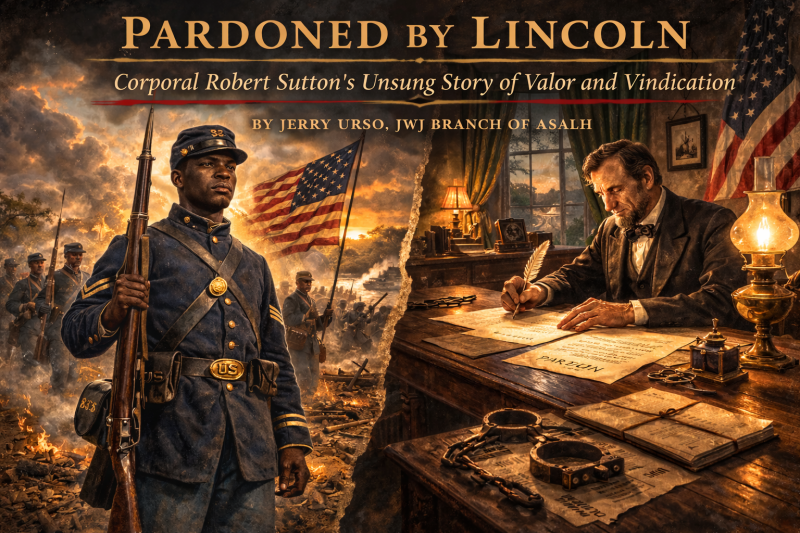
Pardoned by Lincoln: The Case of Sergeant Robert Sutton and the Meaning of Mercy in the United States Colored Troops
Introduction
In July 1863, in the midst of civil war, President Abraham Lincoln issued a pardon consisting of only eight words. The case concerned Sergeant Robert Sutton of the 1st South Carolina Volunteer Infantry, later redesignated the 33rd United States Colored Troops. Sutton had been convicted of mutiny and sentenced to death. Lincoln’s response was brief and decisive: “Let the sentence of Sergeant Sutton be remitted.”[1]
Those eight words carried enormous weight. They preserved the life of a Black noncommissioned officer who had previously been singled out by his commanding officer as “the wisest man in our ranks.”[2] They intervened in the volatile world of discipline within newly formed Black regiments. They also demonstrated Lincoln’s personal exercise of executive clemency during a war in which military law could be unforgiving.
The story of Robert Sutton’s pardon is not merely an episode of mercy. It reveals the tensions inside the United States Colored Troops, the limits of white command authority over Black soldiers, and the ways in which Lincoln used clemency to shape both justice and public perception during the Civil War.
Enslavement and Enlistment
Robert Sutton was born enslaved around 1838 on the Alberti plantation near Woodstock Mills along the St. Mary’s River on the Florida Georgia border. He labored in a steam powered lumber operation employing dozens of enslaved workers. Sutton later stated that he spent years “lumbering and piloting” along the river, navigating its narrow channels and wooded bends for the benefit of his enslavers.[3]
In late 1862, as Union forces consolidated their hold along the Atlantic coast, Sutton escaped in a dugout canoe and made his way toward Union lines near Fernandina, Florida. From there he traveled to Camp Saxton at Beaufort, South Carolina, where he enlisted in the 1st South Carolina Volunteer Infantry, one of the first Black regiments organized under federal authority.[4]
The regiment was formally mustered into United States service on January 31, 1863. Composed largely of formerly enslaved men from South Carolina, Georgia, and Florida, it was commanded by Colonel Thomas Wentworth Higginson, an abolitionist minister appointed under Brigadier General Rufus B. Saxton.[5]
At Camp Saxton on January 1, 1863, Sutton addressed a crowd gathered for the reading of the Emancipation Proclamation. According to Harriet Ware, he reminded the audience that many still had family “among the rebels” and that freedom would not be complete until all were liberated.[6] Higginson later wrote of Sutton that his understanding of slavery was “more thorough and far reaching than that of any abolitionist,” and that he possessed modes of thought that were “strong, lucid, and accurate.”[2]
The St. Mary’s River Expedition
In January 1863, Sutton’s intimate knowledge of the St. Mary’s River proved strategically invaluable. The regiment embarked on an expedition into Florida aimed at disrupting Confederate resources and securing supplies. Higginson relied on Sutton to pilot the vessels through narrow waterways toward Woodstock Mills, Sutton’s former place of enslavement.[7]
Upon arrival, Sutton confronted his former enslaver, Mrs. Alberti, in a moment Higginson described as emblematic of the war’s reversal of power. Sutton then produced the keys to the plantation’s slave jail and guided officers inside, where shackles, chains, and stocks were found. Higginson and regimental surgeon Dr. Seth Rogers both described the discovery as tangible proof of slavery’s brutality.[7][8]
During the same expedition near Township Landing on the Florida bank of the St. Mary’s, Sutton was wounded three times, including a head wound, yet reportedly refused medical attention until the following day so that he would not be removed from duty.[7]
This was the soldier who, only months later, would face a death sentence from a court martial.
The Mutiny Charge
In May 1863, while aboard the steamer Saxon near Fernandina, an incident occurred involving enlisted men who refused to go ashore during an expedition. Captain William J. Randolph ordered Sergeant Sutton to disarm one of the men who appeared most active in the refusal. According to the trial record, Sutton did not immediately carry out the order. Shots were fired. Two soldiers were killed and two wounded.[9]
Sutton was charged with mutiny, convicted, and sentenced to death.
Newspaper accounts from the South reported the conviction and death sentence.[10] The severity of the punishment reflected the rigid structure of military discipline during wartime, particularly in newly organized Black regiments whose conduct was under intense scrutiny from both Union and Confederate observers.
Yet the court martial unanimously recommended mercy, citing Sutton’s faithful service and value as a soldier.[9]
Lincoln’s Eight Words
The case was forwarded to Judge Advocate General Joseph Holt, who reviewed the proceedings. Holt concluded that Sutton had likely misunderstood Randolph’s order and urged approval of the recommendation for clemency.[9]
President Lincoln responded on July 21, 1863, with a brief order:
“Let the sentence of Sergeant Sutton be remitted.”[1]
Marshall Myers, in his study of Lincoln’s rhetoric, notes that the pardon was composed of only eight words and offered no detailed justification. Lincoln relied not on elaborate reasoning but on presidential authority itself.[1] His ethos as commander in chief was sufficient.
Lincoln frequently exercised clemency in cases involving soldiers, often when youth, confusion, or mitigating circumstances were present. In Sutton’s case, the intervention preserved not only a life but the credibility of justice within a regiment of formerly enslaved men whose loyalty was being tested in both military and political arenas.
Restoration and Reputation
Higginson later wrote that Sutton’s honor was restored and that he resumed his place in the regiment.[7] The charges were effectively rescinded, and Sutton continued to serve in the unit that was redesignated in February 1864 as the 33rd United States Colored Troops.
Dr. Seth Rogers had earlier compared Sutton to Toussaint L’Ouverture, writing that he “ought to be a leader, a general instead of a corporal.”[8] Such praise, coming from white officers in 1863, underscores the esteem in which Sutton was held.
The pardon did not erase the episode, but it reframed it. Rather than being remembered as a mutineer, Sutton stands in the record as a soldier whose judgment may have clashed with command but whose integrity and value were ultimately affirmed at the highest level of government.
Lincoln’s Clemency and Black Soldiers
Lincoln’s use of executive clemency during the Civil War served both moral and political purposes. In cases involving Black soldiers, it carried additional weight. The United States Colored Troops were fighting not only for Union but for recognition of their humanity and citizenship.
To execute a respected Black noncommissioned officer under contested circumstances could have sent a chilling message within the ranks. To pardon him signaled that justice would not be applied mechanically without regard to context.
Myers argues that Lincoln’s pardons often rested on presidential ethos rather than elaborate legal reasoning.[1] In Sutton’s case, the brevity of the pardon suggests decisive trust in Holt’s recommendation and perhaps in the broader understanding that Sutton’s service outweighed the confusion of the moment.
The Legacy of Robert Sutton
After the war, Sutton appears in the 1870 census in Glynn County, Georgia, near the river that had defined his early life in bondage.[11] He had survived slavery, combat wounds, court martial, and a death sentence.
The eight words written by Lincoln in July 1863 preserved a life that had already symbolized the transformation of enslaved laborer into soldier. The pardon stands as a testament to the complexity of Civil War military justice and to the fragile balance between discipline and equity in the United States Colored Troops.
Robert Sutton’s story is not merely about mercy. It is about authority, race, leadership, and the evolving meaning of citizenship in wartime America.
Conclusion
Higginson’s Full Verbatim on Robert Sutton
Any assessment of the pardon of Sergeant Robert Sutton must ultimately return to the words of his commanding officer, Colonel Thomas Wentworth Higginson. While Lincoln’s order was brief, Higginson’s evaluation of Sutton was expansive, reflective, and deeply revealing of how Sutton was regarded within the regiment.
In Army Life in a Black Regiment, Higginson wrote the following of Sutton:
“If not in all respects the ablest, he was the wisest man in our ranks. As large, as powerful, and as black as our good-looking Color-sergeant, but more heavily built and with less personal beauty, he had a more massive brain and a far more meditative and systematic intellect. Not yet grounded even in the spelling-book, his modes of thought were nevertheless strong, lucid, and accurate; and he yearned and pined for intellectual companionship beyond all ignorant men whom I have ever met. I believe that he would have talked all day and all night, for days together, to any officer who could instruct him, until his companion, at least, fell asleep exhausted. His comprehension of the whole problem of slavery was more thorough and far-reaching than that of any Abolitionist, so far as its social and military aspects went; in that direction I could teach him nothing, and he taught me much. But it was his methods of thought which always impressed me chiefly; superficial brilliancy he left to others, and grasped at the solid truth.”[2]
This passage is essential not merely for its praise, but for its implications. Higginson acknowledges Sutton’s lack of formal education while simultaneously affirming the depth and rigor of his intellectual capacity. He admits reciprocal learning. He elevates Sutton’s understanding of slavery above that of Northern reformers. In a war fought over the future of four million enslaved people, that acknowledgment carries moral and political weight.
Higginson also reflected on Sutton’s conduct during the St. Mary’s expedition and the later court martial. Writing of the mutiny charge, he noted that the “general voice of our officers sustained him and condemned his accusers,” and that Sutton “soon received a full pardon, and was restored in honor to his place in the regiment.”[7]
Taken together, these statements reinforce the meaning of Lincoln’s eight-word pardon. The president did not rescue a reckless subordinate. He intervened on behalf of a man whom his own officers regarded as disciplined, thoughtful, and indispensable.
Sergeant Robert Sutton stands in the record as a formerly enslaved river pilot who guided Union forces through hostile waters, confronted the instruments of his own bondage, endured wounds in combat, faced a death sentence under military law, and was restored by presidential clemency. His life bridges enslavement and citizenship, subordination and leadership, discipline and mercy.
The story of Robert Sutton reminds us that emancipation was not a single proclamation but a series of contested acts. Among them were eight handwritten words from Abraham Lincoln that ensured one soldier would live to continue the fight for freedom.
References
[1] Marshall Myers, The Rhetoric of Lincoln’s Clemency.
[2] Thomas Wentworth Higginson, Army Life in a Black Regiment, p. 62.
[3] Stephen V. Ash, Firebrand of Liberty.
[4] National Park Service, 1st South Carolina Volunteer Infantry (Colored).
[5] Daniel L. Schafer, Thunder on the River.
[6] Letters from Port Royal, 1863.
[7] Thomas Wentworth Higginson, Army Life in a Black Regiment.
[8] Dr. Seth Rogers correspondence, quoted in campaign records.
[9] Court Martial Record of Sergeant Robert Sutton, July 1863.
[10] The Free South, August 29, 1863; The New South, June 27, 1863.
[11] United States Census, 1870, Glynn County, Georgia.
