
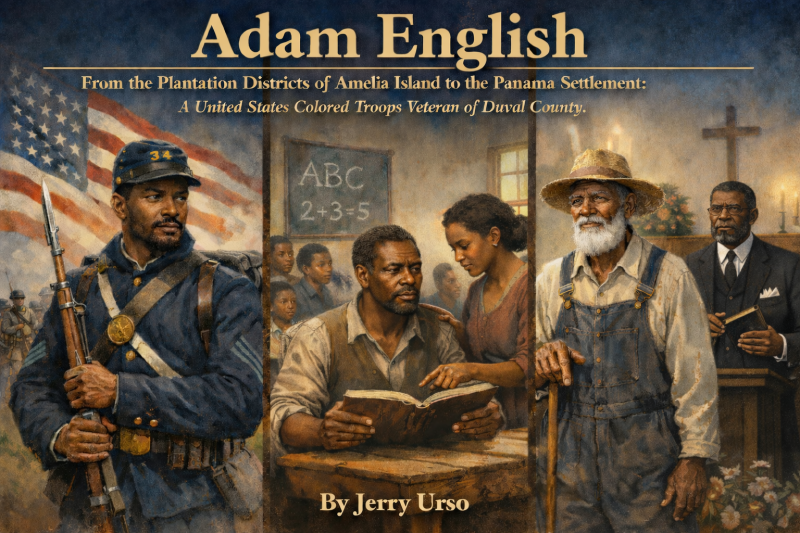
Adam English
From the Plantation Districts of Amelia Island to the Panama Settlement: A United States Colored Troops Veteran of Duval County
By Jerry Urso
Born Into Slavery Along the Amelia Island Plantation Corridor
Adam English was born in Florida in August 1826, during a period when the plantation economy of northeast Florida depended heavily upon enslaved labor along the Atlantic coastal islands and the lower St. Johns River corridor. His lifetime would span one of the most dramatic transformations in American history: from slavery under territorial and early statehood Florida to citizenship following service in the United States Army during the Civil War. The date preserved in the 1900 United States Federal Census, which recorded both his birth month and year, provides the most reliable documentary foundation for reconstructing the chronology of his early life. [1]
During the decades before the Civil War, the south end of Amelia Island formed part of a plantation landscape structured around long-staple cotton cultivation and maritime trade connections linking the island to Fernandina’s harbor. Estates such as the Harrison Plantation depended upon enslaved labor drawn from surrounding agricultural districts, and it was within this coastal plantation environment that Adam English’s early years unfolded. When Union naval forces occupied Fernandina in March 1862, enslaved residents from plantations across the island began moving toward Federal protection, transforming Amelia Island into one of the earliest centers of wartime emancipation in Florida. [2]
From this occupation zone emerged the settlement later known as Franklintown, established by formerly enslaved residents of plantations on the south end of the island. The creation of Franklintown represented one of the earliest organized freedom communities in the state and formed part of the wider coastal emancipation corridor through which African American men entered Union lines and eventually military service. It was within this rapidly changing wartime environment that Adam English’s path toward enlistment in the United States Colored Troops became possible. [2]
Marriage Before Emancipation and Family Formation Under Slavery
One of the most important details preserved in Adam English’s documentary record appears in the 1900 federal census, which reported that he and his wife Nancy English had been married in 1850 and had remained together for fifty years by the time the census was taken. This single entry establishes that their marriage began during slavery, more than a decade before the Civil War and long before federal law recognized the legal standing of enslaved families. [1]
Marriages formed under slavery were often maintained through informal community recognition rather than legal documentation, yet many endured across emancipation and Reconstruction. The English household represents one such example of continuity across the transition from bondage to freedom. By the time Adam English later appeared in the 1870 United States Federal Census living with Nancy and their children in the Mandarin settlement of Duval County, the stability of their family structure reflected the persistence of kinship networks formed long before emancipation. [3]
The survival of this marriage across five decades—through slavery, war, Reconstruction, and the rise of Jim Crow—places Adam and Nancy English among the generation whose family lives bridged two fundamentally different social worlds and whose households became the foundation of post-emancipation community life along the St. Johns River corridor.
Enlistment at Fernandina in the 34th United States Colored Infantry
By the spring of 1864, Fernandina and nearby Fort Clinch had become major recruitment centers for African American military service along Florida’s northeast coast. Union occupation of Amelia Island created a protected corridor through which formerly enslaved men entered the ranks of the United States Colored Troops, joining the expanding force of Black soldiers whose service reshaped the final years of the Civil War.
On March 25, 1864, Adam English enlisted at Fernandina, Florida, entering service as a private in Company D of the 34th United States Colored Infantry. His enlistment record identified him as a Florida-born man approximately thirty-eight years of age and recorded his prewar occupation as “servant,” terminology commonly used by Federal mustering officers to describe labor performed within enslaved domestic service systems before emancipation. [4]
The regiment in which he served had only recently been reorganized from the 2nd South Carolina Infantry (African Descent) into the 34th United States Colored Infantry as part of the War Department’s effort to standardize African American military service following the establishment of the Bureau of Colored Troops in 1863. Companies of the regiment were stationed at Fort Clinch and Fernandina, securing coastal supply routes and maintaining Federal authority along one of the most strategically important sections of Florida’s Atlantic frontier during the later years of the war. [5]
Through enlistment at Fernandina, Adam English joined the generation of formerly enslaved Floridians who transformed wartime emancipation into military service and who helped secure the Union victory that ended slavery across the South.
Return to Civilian Life in the Mandarin Settlement After the War
When the Civil War ended and the 34th United States Colored Infantry was mustered out of service on February 28, 1866, Adam English returned to civilian life as part of the generation of United States Colored Troops veterans who helped establish independent households across the agricultural settlements of southern Duval County. Like many African American soldiers who had entered service through the Fernandina recruitment corridor, he settled within reach of the St. Johns River, whose transportation routes connected rural communities such as Mandarin to Jacksonville’s expanding Reconstruction-era economy. [5]
By 1870, Adam English appeared in the United States Federal Census living in the Mandarin settlement of Duval County with his wife Nancy and their children Lewis, John J., Jeannette, Sampson, and Matilda. His occupation was recorded as laborer, reflecting the transitional economic conditions faced by many formerly enslaved families during the first years following emancipation as they shifted from plantation labor toward independent agricultural production and wage work. [6]
Mandarin formed part of a wider network of Reconstruction-era river settlements populated in significant part by United States Colored Troops veterans and their families. These communities developed along transportation corridors that allowed residents to remain connected both to agricultural employment and to Jacksonville’s emerging Black institutional life, including churches, schools, and civic organizations. Within only a few years of the war’s conclusion, Adam English had established a stable household rooted not in plantation dependency but in family-centered settlement along one of the most important post-emancipation corridors in Duval County.
Reconstruction-Era Education and the Presence of a Freedmen’s School at Mandarin
The Mandarin settlement in which Adam English established his household during the Reconstruction period was also part of the expanding network of communities served by Freedmen’s schools, which emerged across northeast Florida during the late 1860s as formerly enslaved families sought literacy opportunities for their children. These schools, often supported through cooperation between the Freedmen’s Bureau, northern missionary societies, and local Black congregations, represented one of the most transformative institutional developments of the Reconstruction era. [7]
For families such as the English household—whose adult members had grown up under laws that prohibited literacy among enslaved populations—the presence of educational opportunities for their children marked a fundamental change in community life. Freedmen’s schools frequently operated in church buildings or temporary structures and were often reached by teachers traveling between river settlements along the St. Johns corridor. Their presence within the Mandarin district demonstrates that the English family lived within one of the earliest educational landscapes created for African American children in postwar Duval County.
Although the census record later indicated that Adam English himself could not write, the availability of schooling within the Mandarin community illustrates the transition experienced by the first generation of freedpeople whose children gained access to literacy and formal instruction following emancipation. Within this setting, the household established by Adam and Nancy English stood inside one of Reconstruction’s most important institutional transformations: the creation of education for the first generation born into freedom.
Establishing an Agricultural Household in Precinct 8
By 1880, Adam English appeared again in the United States Federal Census, now recorded as a farmer living in Precinct 8 of Duval County, confirming the transition from wage labor to agricultural independence that characterized the experience of many United States Colored Troops veterans during the Reconstruction period. [8]
The census entry also preserved a detailed snapshot of his extended household, which included his wife Nancy English, their children Jane, Matilda, Samuel, Jules, and Hester, and several grandchildren living within the same residence. Multi-generational households of this kind formed the backbone of rural African American settlement across southern Duval County during the late nineteenth century. They functioned not only as family units but also as economic networks supporting agricultural labor, childcare, and kinship stability during a period when formal institutional protections for Black families remained limited.
The stability reflected in the English household by 1880 demonstrates the long-term impact of Civil War service on the lives of United States Colored Troops veterans. Within less than two decades of emancipation, Adam English had moved from enslaved laborer to soldier and then to independent farmer heading a multi-generational household within one of Duval County’s Reconstruction-era agricultural communities. This transition represents one of the most significant transformations experienced by formerly enslaved men who returned from Union service determined to secure stability for their families in the decades following the war.
The 1885 Florida State Census and the Expanding Settlement Geography of Southern Duval County
By the middle of the 1880s, Adam English continued to appear within the documentary record of southern Duval County as part of the population anchored along the agricultural corridor extending between the St. Johns River settlements and the developing rural districts north and west of Jacksonville. In the 1885 Florida State Census, he was recorded as head of household living with his wife Nancy English and their daughter Reina English within the census district described collectively as Springfield, Moncrief, Mayport, and Fulton. [9]
The appearance of his household within this combined district listing reflects the flexible geographic structure of late nineteenth-century census enumeration in Duval County. Rather than representing a single town, the district designation grouped together several settlement zones connected through transportation routes, seasonal agricultural labor, and kinship migration between river communities and inland farming districts. For African American families such as the English household, these linked settlement corridors formed the backbone of community life during the decades following Reconstruction.
That Adam English remained documented within this corridor nearly twenty years after his discharge from the United States Army confirms his long-term presence within the network of rural settlements created by the first generation of freedpeople in Duval County. His household stability across successive census decades reflects the broader pattern of United States Colored Troops veterans who transformed wartime emancipation into enduring agricultural community formation along the southern reaches of the county.
Life in the Panama Settlement at the Turn of the Twentieth Century
By the time the 1900 United States Federal Census was taken, Adam English had become firmly established within the rural community known locally as Panama, one of the historic African American settlements that developed south of Jacksonville during the late nineteenth century. The census recorded him there as a farm laborer living with his wife Nancy and their daughter Janey English, confirming the continued presence of the English family within the same southern Duval County settlement corridor that had supported their household since the Reconstruction era. [1]
The 1900 census entry also preserved several details of lasting importance for reconstructing the trajectory of his life after the Civil War. It recorded his birth month as August 1826, providing the most precise surviving documentation of his age. It further reported that his residence in Panama was owned free of mortgage, a significant indicator of stability for a formerly enslaved Civil War veteran living in rural Florida at the opening of the twentieth century. Ownership without mortgage obligation reflected either secure land tenure or long-standing occupancy arrangements that placed his household among the more stable agricultural families within the settlement.
Communities such as Panama formed part of a broader landscape of post-emancipation settlement across southern Duval County in which Civil War veterans, freedpeople, and their descendants established churches, schools, and kinship-based agricultural households that sustained African American community life through the transition from Reconstruction into the Jim Crow era.
A Marriage That Bridged Slavery, War, and Freedom
One of the most remarkable details preserved in the 1900 census entry for Adam English is the record that he and his wife Nancy English had been married in 1850 and had remained together for fifty years by the time the census was taken. This single entry establishes that their marriage began during slavery, more than a decade before the Civil War and long before federal law recognized the legal standing of enslaved families. [1]
Marriages formed under slavery often depended upon community recognition rather than formal legal protection, yet many endured across emancipation and Reconstruction. The English household stands as one such example of continuity across the transition from bondage to freedom. Their marriage survived the upheaval of the Civil War, Adam English’s enlistment in the United States Colored Troops, the uncertainties of Reconstruction, and the tightening restrictions of the post-Reconstruction South.
By the time they appeared together in the Panama settlement in 1900, Adam and Nancy English represented a generation whose family life bridged two fundamentally different social worlds. Their household stability across half a century reflects the persistence of kinship structures formed under slavery and sustained through military service, agricultural settlement, and church-centered community life along the St. Johns River corridor.
Leadership at Mount Pisgah Baptist Church in the Panama Community
By the opening years of the twentieth century, Adam English had become more than a farmer and Civil War veteran within the Panama settlement. Newspaper reporting from Jacksonville in 1901 identified him specifically as a deacon of Mount Pisgah Baptist Church, one of the principal congregations serving African American families living in the rural settlement corridor south of Jacksonville. [10]
Churches such as Mount Pisgah stood at the center of community life in southern Duval County during the decades following Reconstruction. In rural settlements like Panama, congregations functioned not only as places of worship but also as meeting spaces for education, mutual aid, and leadership development at a time when segregation restricted access to many public institutions. Leadership roles within these churches were typically entrusted to individuals whose reputation for stability and service had already been established within the community.
For United States Colored Troops veterans, service as church deacons represented a continuation of responsibilities first assumed during wartime service. Across Florida and the broader South, former soldiers frequently emerged as trustees, ministers, and deacons within congregations that anchored post-emancipation settlement life. Adam English’s identification as a deacon of Mount Pisgah Baptist Church therefore confirms his standing as a respected community figure within the Panama district at the turn of the twentieth century.
Recognition as a Veteran of the United States Colored Troops
Like many surviving soldiers of the United States Colored Troops, Adam English later appeared in federal pension index records documenting his service in Company D of the 34th United States Colored Infantry, confirming that his wartime enlistment at Fernandina remained part of the official record of Civil War military service preserved by the federal government. [11]
Pension index entries such as this formed part of the broader administrative recognition extended to Civil War veterans during the late nineteenth century. For formerly enslaved soldiers in particular, the pension system represented more than financial assistance. It served as formal acknowledgement of their role in securing Union victory and ending slavery across the South. Inclusion within the pension index ensured that Adam English’s participation in the war remained permanently recorded within the national archive of United States Colored Troops service.
This recognition linked his later life in Duval County’s rural settlement corridor directly to the wartime moment when formerly enslaved men entered Union service through the Fernandina recruitment district and helped reshape the outcome of the Civil War.
Presence in Jacksonville’s Post-Reconstruction Civic Record
Evidence of Adam English’s continued presence within Duval County’s documented African American population also appears in Jacksonville municipal directory reporting classifications identifying residents within the county’s settlement districts during the late nineteenth century. His listing within these directory records confirms that he remained part of the recognized civic landscape of Jacksonville’s broader settlement corridor even while residing within rural agricultural communities such as Panama. [12]
City directories of this period frequently recorded African American residents separately within reporting-status categories that reflected the racial structure of municipal recordkeeping during the late nineteenth century. While such classifications reveal the constraints imposed by the developing Jim Crow order, they also preserve important documentation of the individuals who formed the institutional foundation of African American community life across Duval County during the decades following Reconstruction.
The appearance of Adam English within these directory listings therefore represents another layer of documentary confirmation linking his life to the settlement network that extended from Mandarin and Precinct 8 to Panama and the southern agricultural districts surrounding Jacksonville.
From the Plantation Districts of Amelia Island to the Panama Settlement of Duval County
The life of Adam English traces a path shared by many African American men whose experiences shaped northeast Florida during the nineteenth century. Born into slavery along the plantation corridor of Amelia Island in August 1826, he witnessed the transformation of the coastal frontier following Union occupation of Fernandina in 1862 and entered Federal service two years later as a soldier in the 34th United States Colored Infantry. [1][4]
Following the Civil War, he established a household with his wife Nancy in the Mandarin settlement, where their family became part of the network of Reconstruction-era river communities that supported the transition from plantation labor to independent agricultural life. By 1880, he had become a farmer heading a multi-generational household in Precinct 8, reflecting the stability achieved by many United States Colored Troops veterans during the decades immediately following emancipation. [6][8]
His continued appearance in the 1885 Florida State Census confirmed the persistence of the English household within the agricultural settlement corridor linking Springfield, Moncrief, Mayport, and Fulton districts during the late nineteenth century. By 1900, he and Nancy were living in the Panama settlement, where census records documented both their fifty-year marriage—beginning during slavery—and their residence in a home owned free of mortgage obligation. [9][1]
By the opening years of the twentieth century, Adam English had become recognized as a deacon of Mount Pisgah Baptist Church, confirming his standing as a respected leader within the Panama community and placing him among the generation of United States Colored Troops veterans whose service helped shape the churches, settlements, and agricultural households that sustained African American life along the St. Johns River corridor long after the Civil War ended. [10]
Through military service, family stability, agricultural labor, and church leadership, Adam English’s life illustrates the transformation experienced by formerly enslaved Floridians who moved from plantation bondage into citizenship and community leadership during Reconstruction and whose legacy continued to shape southern Duval County well into the twentieth century.
References
[1]
1900 United States Federal Census, Panama, Duval County, Florida; Sheet 16; Dwelling 299; Family 309; Adam English household.
(Records birth month August 1826, marriage year 1850, home owned free of mortgage.)
[2]
Amelia Island Museum of History.
Interpretive exhibit panel: Franklintown Freedmen’s Settlement and Harrison Plantation Community Origins, Amelia Island, Florida.
[3]
1870 United States Federal Census, Mandarin, Duval County, Florida; Adam English household with Nancy English and children Lewis, John J., Jeannette, Sampson, and Matilda.
[4]
U.S. Colored Troops Military Service Records, 1863–1865, Company D, 34th United States Colored Infantry, Adam English enlistment record; enlisted March 25, 1864, Fernandina, Florida.
[5]
Regimental history summary: 34th United States Colored Infantry, reorganized from 2nd South Carolina Infantry (African Descent); service stations including Fort Clinch and Fernandina; mustered out February 28, 1866.
[6]
1870 United States Federal Census, Mandarin, Duval County, Florida (laborer occupation entry confirming early Reconstruction settlement location).
[7]
Documentation of Freedmen’s school presence in Mandarin settlement, Reconstruction-era St. Johns River corridor educational activity (community institutional context source—exact archival reference to be inserted from your Mandarin school source).
[8]
1880 United States Federal Census, Precinct 8, Duval County, Florida; Adam English household (occupation: farmer; extended family household listing).
[9]
Florida State Census, 1885, Springfield–Moncrief–Mayport–Fulton district, Duval County, Florida; Adam English household (Roll M845_2, Page 607).
[10]
Jacksonville newspaper clipping (1901) identifying Adam English as Deacon of Mount Pisgah Baptist Church, Panama settlement district.
(Paper title, issue date, and page number visible in your clipping image to be inserted here exactly as shown.)
[11]
U.S., Civil War Pension Index: General Index to Pension Files, 1861–1934, Adam English, Company D, 34th U.S. Colored Infantry.
[12]
Jacksonville City Directory, listing Adam English within municipal “colored reporting status” classification.
(Exact directory year to be inserted from your directory page image.)
