
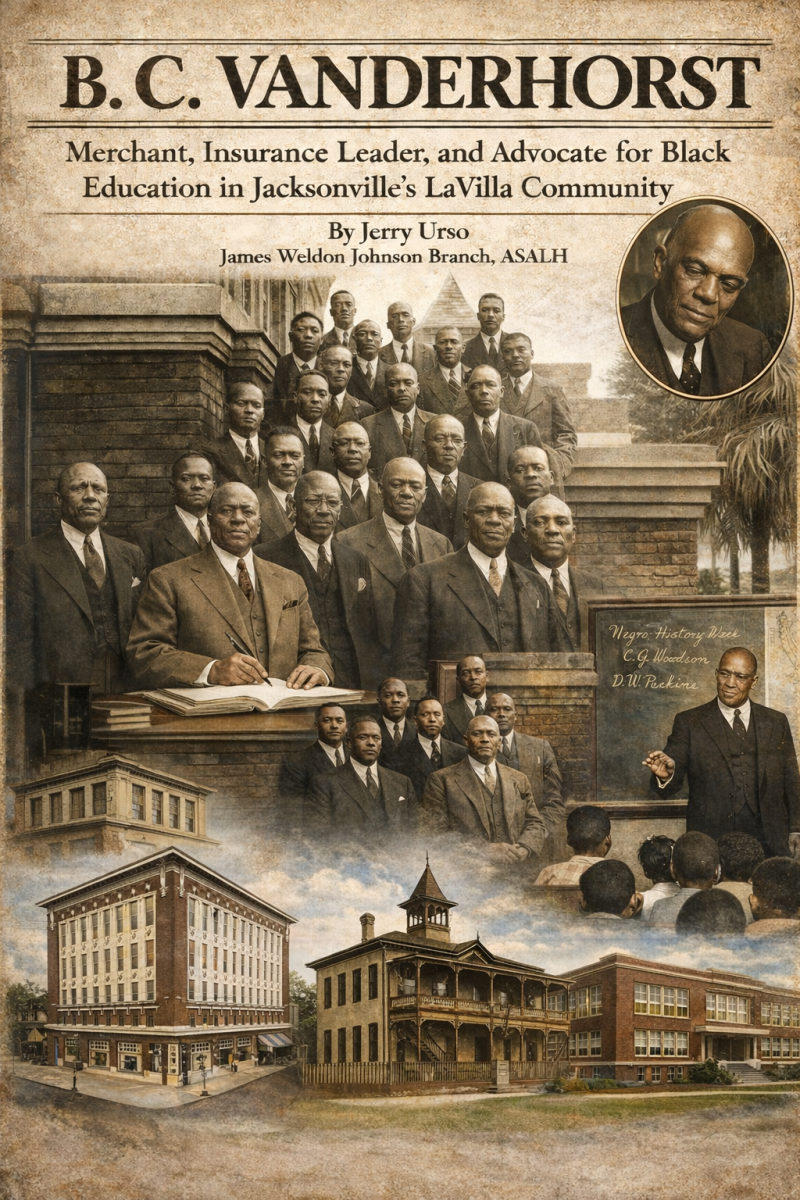
Byron C. Vanderhorst
Merchant, Insurance Executive, and Civic Leader in Jacksonville’s LaVilla Community
By Jerry Urso
James Weldon Johnson Branch, ASALH
Beginnings in Georgetown, South Carolina
The life of Byron C. Vanderhorst (B. C. Vanderhorst) began in the coastal town of Georgetown, South Carolina, a community deeply shaped by the rice plantation economy and the legacy of Reconstruction. Born in May 1878, Vanderhorst entered the world during a transitional era in American history when formerly enslaved families were navigating the uncertain decades following emancipation.¹
The earliest surviving record documenting his life appears in the 1880 United States Census, which lists him as a two-year-old child living on High Market Street in Georgetown with his parents Robert Vanderhorst and Mary Vanderhorst.² The household included several children—Robert, Carles, Byron, and John—illustrating the large extended families that were common among African American communities in the late nineteenth century.
Georgetown County during this period remained one of the historic centers of the Lowcountry rice economy, though the industry had entered a steep decline after the Civil War. Flooding, hurricanes, and changing agricultural markets devastated the once prosperous rice plantations. Many African American laborers and their families sought new opportunities beyond the rural coastal landscape that had defined their lives for generations.
Migration became a central feature of African American life during this period. Thousands of Black families moved from rural agricultural regions to expanding southern cities where railroad construction, port activity, and commercial development created employment opportunities. Among the destinations that attracted migrants was Jacksonville, Florida, a rapidly growing port city whose economy was expanding in the final decades of the nineteenth century.
For young men like Byron Vanderhorst, the move to Jacksonville offered the possibility of employment, entrepreneurship, and civic engagement within a vibrant African American community.
Migration to Jacksonville and Early Employment
By the turn of the twentieth century Vanderhorst had relocated to Jacksonville, Florida, joining a wave of African American migrants who were helping transform the city into one of the largest urban centers in the South. Jacksonville’s growth was driven by its strategic location as a railroad hub and shipping port. Lumber, naval stores, citrus products, and agricultural goods moved through the city’s docks and rail yards, creating jobs and commercial opportunities.
The 1900 United States Census records the twenty-two-year-old Vanderhorst living as a boarder in Ward One on Florida Avenue within the household of Elias J. Gregg and Mary Gregg.³ The Gregg residence included several children and additional boarders, reflecting the common practice of renting rooms to workers and migrants seeking employment in the expanding city.
Vanderhorst’s occupation at the time was listed as “clerk in shoe store.” Though modest in title, the position provided invaluable experience in business operations. Clerks in retail establishments performed multiple responsibilities, including managing inventory, assisting customers, maintaining accounts, and learning the financial mechanics of commerce.
Many successful African American entrepreneurs of the era began their careers in precisely this manner—working as clerks or assistants before establishing their own enterprises.
The Gregg household also included a young girl named Julia Gregg, who was seven years old in 1900. Years later she would appear in Vanderhorst’s household as a relative, illustrating the enduring social ties that often developed among families who shared living spaces during the early years of migration.
Jacksonville’s African American community during this period was expanding rapidly. Segregation limited access to white-owned businesses and financial institutions, but it also encouraged the development of Black-owned enterprises that served the needs of the community.
Within this environment Vanderhorst gained the commercial experience that would soon allow him to establish a business of his own.
Marriage, Family, and the Formation of a Household
During the first decade of the twentieth century Vanderhorst married Isoline Vanderhorst, and the couple began building their family within Jacksonville’s growing African American community. By 1910, the federal census lists the family residing at 616 Church Street in Ward Seven, one of the neighborhoods adjacent to the bustling LaVilla district.⁴
At the time the household consisted of Byron, Isoline, and their daughter Mary, who was three years old. Vanderhorst continued working as a shoe store clerk, but his life was clearly moving toward greater stability and economic advancement.
Ward Seven stood at the edge of LaVilla, a neighborhood that had become one of the most dynamic African American communities in the South. Churches, schools, theaters, restaurants, and business establishments filled the streets of the district. It was a place where African Americans created their own institutions despite the restrictions of segregation.
LaVilla also served as a cultural center where musicians, educators, ministers, and entrepreneurs contributed to the intellectual and economic life of Jacksonville. The neighborhood’s institutions would eventually play an important role in the city’s civil rights movement during the mid-twentieth century.
Within this environment Vanderhorst was developing the experience and connections that would soon allow him to transition from employee to business owner.
Merchant on Bridge Street
By the early 1910s Vanderhorst had taken the decisive step into entrepreneurship. He opened a shoe store along Bridge Street, one of the primary commercial corridors serving Jacksonville’s African American population.
Newspapers reported that the young businessman had established a retail establishment offering footwear and clothing to customers within the community.⁵ Bridge Street stood at the center of the LaVilla commercial district, an area filled with barber shops, restaurants, theaters, and professional offices operated by African Americans.
The success of Vanderhorst’s enterprise soon led to the formal organization of his business. In 1912, the B. C. Vanderhorst Shoe Company received a corporate charter with capital stock valued at ten thousand dollars, with Vanderhorst serving as president.⁶
City directories soon listed Vanderhorst residing at 409 Broad Street, placing him within walking distance of LaVilla’s commercial district and among the growing network of Black entrepreneurs operating businesses in Jacksonville.⁷
His rise from clerk to merchant reflected the broader development of African American entrepreneurship during the early twentieth century. Throughout the South Black businessmen established retail stores, insurance companies, banks, and professional services that formed the economic backbone of their communities.
For Vanderhorst, the shoe business represented the beginning of a much larger role in Jacksonville’s civic and economic life.
A Growing Household and the Emergence of a Black Middle Class
By the time of the 1920 United States Census, Byron C. Vanderhorst had firmly established himself within Jacksonville’s African American middle class. The census recorded him living at 731 West Beaver Street, where he owned his home, though the property remained mortgaged.⁸ Ownership of residential property represented a significant milestone for African American families during the early twentieth century, particularly in a segregated southern city where economic opportunities were often limited.
The Vanderhorst household had grown substantially. Living with Byron and his wife Isoline Vanderhorst were their daughters Ruth, Winnona, Grace, and Verdel, whose ages ranged from infancy to nine years old. Also residing in the home was Julia Gregg, the same young girl who had lived in the Gregg household where Vanderhorst boarded in 1900.⁹
The census described Vanderhorst as a merchant and employer in the retail shoe trade, confirming that he had successfully transitioned from employee to business owner. His literacy, property ownership, and role as an employer illustrate the emergence of a stable Black middle class in Jacksonville during the early decades of the twentieth century.
Families like the Vanderhorsts formed the backbone of African American civic life. Business owners frequently supported churches, educational institutions, charitable organizations, and civic initiatives that helped sustain the community during the era of segregation.
It was through this network of economic independence and social engagement that Vanderhorst would soon expand his activities beyond retail commerce and enter one of the most important sectors of Black enterprise: the insurance industry.
People’s Industrial Insurance Company
One of the most significant developments in Vanderhorst’s career was his involvement with the People’s Industrial Insurance Company, where he served as a manager during the 1920s.¹⁰ Industrial insurance companies played a vital role within African American communities because many white-owned insurance firms refused to insure Black policyholders or imposed discriminatory pricing structures.
Industrial insurance typically involved small policies designed to cover funeral expenses and emergency financial needs. Policyholders paid modest weekly premiums, which were collected by agents who traveled door to door throughout Black neighborhoods. This system created close relationships between insurance agents and the communities they served.
The presence of Black-owned insurance companies represented more than financial services. These institutions functioned as economic anchors within African American communities. They provided employment opportunities, supported civic organizations, and reinvested capital within neighborhoods that were otherwise denied access to traditional banking systems.
As a manager within the People’s Industrial Insurance Company, Vanderhorst became part of a growing class of African American financial professionals who were helping build economic stability for Black families in Jacksonville.
Afro-American Life Insurance Company
The People’s Industrial Insurance Company eventually became associated with the Afro-American Life Insurance Company, one of the most significant African American financial institutions in the United States.¹¹
Founded in Jacksonville in 1901 by a group of African American businessmen led by Abraham Lincoln Lewis (A. L. Lewis), Afro-American Life Insurance Company rapidly expanded into a regional powerhouse. The company provided life insurance policies to thousands of African Americans across the South and employed hundreds of agents, clerks, and administrators.
Afro-American Life Insurance Company played an especially important role in Jacksonville’s economic history. Through its financial success the company helped finance real estate development, business ventures, and community institutions throughout the region. One of its most famous contributions was the development of American Beach, a resort community created during segregation to provide African Americans with access to Atlantic Ocean beaches that were otherwise restricted.
The consolidation of smaller firms like the People’s Industrial Insurance Company into larger institutions such as Afro-American Life reflected the growing sophistication of Black financial networks during the early twentieth century.
Through his role within this insurance system, Vanderhorst participated in a national movement of African American economic self-determination that extended far beyond Jacksonville.
The Liberty League and Political Leadership
In addition to his work in business and finance, Vanderhorst also became involved in civic and political organizations within Jacksonville’s African American community. Among the most notable of these was the Liberty League, an organization dedicated to promoting civic participation and political engagement among Black citizens.¹²
During the early twentieth century African Americans faced systematic political disenfranchisement throughout the South. Poll taxes, literacy tests, and intimidation tactics were widely used to suppress Black voting rights. In response, civic organizations such as the Liberty League sought to mobilize African American voters, encourage political awareness, and advocate for civil rights.
Newspaper reports from the period indicate that B. C. Vanderhorst served as president of the Liberty League, presiding over meetings and delivering addresses that encouraged civic engagement within the Black community.¹³
Organizations like the Liberty League often held meetings in churches, fraternal halls, and community gathering spaces where residents discussed political issues, educational opportunities, and strategies for community advancement.
These organizations formed part of a broader tradition of African American civic leadership that extended across the South during the early twentieth century. Although many of these groups operated locally, they contributed to a wider network of activism that would eventually culminate in the civil rights movement of the mid-twentieth century.
Through his leadership in the Liberty League, Vanderhorst demonstrated that his commitment to community advancement extended far beyond the sphere of business.
The Jacksonville Negro Business League and the Philosophy of Economic Self-Help
Among the most important organizations connected to Byron C. Vanderhorst’s public life was the Negro Business League, an institution that emerged from the economic philosophy promoted by Booker T. Washington at the turn of the twentieth century. Founded in 1900 as the National Negro Business League, the organization sought to strengthen African American economic independence by encouraging entrepreneurship, cooperation among Black-owned businesses, and the circulation of capital within Black communities.¹⁴
Local branches of the league developed across the United States, particularly in southern cities where segregation restricted access to white commercial networks. Jacksonville became one of the strongest centers of this movement. The city already possessed a thriving Black business district in LaVilla, where restaurants, theaters, retail stores, barbershops, professional offices, and insurance companies formed a vibrant commercial environment.
Vanderhorst’s participation in the Jacksonville branch of the Negro Business League placed him within this expanding network of African American entrepreneurs. The organization regularly convened meetings where merchants, professionals, and educators discussed strategies for strengthening Black enterprise. Members often presented reports on business conditions, shared advice on marketing and management, and coordinated efforts to support one another’s commercial ventures.
These gatherings served a purpose beyond commerce. They reinforced a philosophy of racial self-help, the belief that economic strength was essential to achieving social and political advancement. Through the Negro Business League, business owners like Vanderhorst helped cultivate a generation of African American entrepreneurs who would build the institutional foundation of Black economic life in the early twentieth century.
The influence of the league extended far beyond local meetings. National conventions drew delegates from across the country, creating a platform where Black businessmen could exchange ideas and develop partnerships. Jacksonville’s participation in this movement placed the city among the leading centers of African American commercial activity in the South.
The Jacksonville Business Men’s League
Closely connected to the Negro Business League was the Jacksonville Business Men’s League, another organization that sought to strengthen the economic infrastructure of the African American community.¹⁵
Business leagues of this kind functioned as cooperative networks that allowed Black merchants to coordinate marketing efforts, share information about suppliers and customers, and promote commercial development within their neighborhoods. The organizations often sponsored public events designed to highlight the achievements of African American entrepreneurs and encourage residents to patronize Black-owned businesses.
For merchants such as Vanderhorst, membership in these organizations provided both practical and symbolic advantages. Cooperation among businesses helped stabilize local markets, while the public recognition associated with league activities enhanced the reputation of individual entrepreneurs.
Jacksonville’s Black business leaders understood that economic progress required collective action. By supporting each other’s enterprises they created a commercial environment capable of sustaining schools, churches, and civic institutions throughout the community.
Organizations like the Jacksonville Business Men’s League therefore played a crucial role in shaping the economic life of LaVilla during the early twentieth century. Through his participation, Vanderhorst joined a generation of businessmen who believed that the prosperity of the entire community depended upon the success of its individual enterprises.
Community Chest and Organized Charity
Another dimension of Vanderhorst’s public service involved participation in community charitable organizations, including efforts connected to the Community Chest movement.¹⁶
The Community Chest system developed during the early twentieth century as a coordinated approach to charitable fundraising. Rather than each organization soliciting donations separately, communities conducted annual campaigns that collected funds and distributed them among participating charities.
In many cities African American civic leaders created parallel fundraising networks to support institutions serving Black residents. Churches, orphanages, schools, and social welfare agencies relied heavily on these contributions.
Community Chest activities frequently involved local business leaders because they possessed both financial resources and organizational skills. Their participation lent credibility to fundraising campaigns and encouraged broader community support.
Through involvement in these charitable initiatives Vanderhorst demonstrated the social responsibility expected of successful businessmen within the African American community. Economic success was widely viewed not merely as a personal achievement but as a resource that should contribute to the welfare of the entire community.
These charitable networks also strengthened relationships among civic leaders, ministers, educators, and business owners, creating a unified leadership structure capable of addressing the challenges faced by African Americans in Jacksonville.
Stanton High School and the Campaign for a Fireproof Brick School
One of the most significant civic initiatives associated with Vanderhorst was his service as a member of the Board of Trustees for Stanton High School, Jacksonville’s leading African American educational institution.¹⁷
Stanton High School traced its origins to the Reconstruction era and was named after Edwin M. Stanton, the United States Secretary of War under President Abraham Lincoln. The school became one of the most important centers of African American education in Florida, producing generations of teachers, ministers, professionals, and civic leaders.
During the early twentieth century the trustees of Stanton High School advocated for improved educational facilities for Black students. At the time many schools serving African American children were housed in small wooden buildings that were vulnerable to fire and inadequate for the growing student population.
Vanderhorst and his fellow trustees petitioned the Duval County School Board to construct a single large fireproof brick school building rather than several smaller wooden campuses scattered throughout the city. Their argument emphasized efficiency, safety, and educational quality.
The campaign proved successful. In 1917 a new brick Stanton High School building was completed in the LaVilla neighborhood, representing one of the most modern educational facilities available to African American students in the region.
The construction of the building symbolized more than architectural progress. It represented the determination of Jacksonville’s Black civic leadership to secure better educational opportunities for future generations.
Through his role on the board of trustees, Vanderhorst contributed to an achievement that would influence thousands of students for decades to come.
Civic Culture and Negro History Week
By the mid–twentieth century Byron C. Vanderhorst had become recognized as one of the elder statesmen of Jacksonville’s African American civic community. Decades of business leadership, civic service, and organizational involvement had established him as a respected figure among educators, ministers, and business leaders throughout the city.
One of the events that illustrates this recognition occurred in 1954, when Vanderhorst participated in a Negro History Week celebration at Stanton High School.¹⁸ Negro History Week, created in 1926 by historian Carter G. Woodson, served as the precursor to what is now Black History Month. Woodson envisioned the observance as a way to promote public awareness of African American achievements and to encourage the teaching of Black history within schools.
Across the United States, African American schools and civic organizations hosted lectures, assemblies, and cultural programs during the annual observance. These events frequently invited prominent local leaders whose lives exemplified the contributions being celebrated.
At Stanton High School, Vanderhorst appeared as a featured guest during the program alongside several other prominent figures within Jacksonville’s Black community. His presence represented the connection between earlier generations of community builders and the students who would carry that legacy forward.
Educational programs such as these reinforced the importance of historical memory within African American communities. They served not only as celebrations of past accomplishments but also as reminders of the ongoing struggle for equality and opportunity.
Sharing the Stage with Community Leaders
The 1954 Stanton High School celebration brought together several of Jacksonville’s most influential African American leaders. Among those appearing alongside Vanderhorst was Daniel Webster Perkins (D. W. Perkins), a distinguished attorney and civic leader who played a central role in the city’s legal and fraternal institutions.¹⁹
Perkins had established a reputation as one of Jacksonville’s most prominent African American attorneys. His legal work, civic activism, and leadership within fraternal organizations made him a widely respected figure throughout Florida. By the mid–twentieth century he was recognized as a senior leader within the city’s African American professional class.
Also participating in the event was Eartha M. M. White, one of Jacksonville’s most celebrated humanitarian figures.²⁰ White devoted her life to social service and charitable work, establishing numerous institutions dedicated to helping the poor, the elderly, and disadvantaged youth. Her efforts eventually earned her the title “The Clara Barton of Florida.”
The presence of figures such as Vanderhorst, Perkins, and White at the Stanton program symbolized the interconnected network of leadership that sustained Jacksonville’s African American community during the era of segregation. Business leaders, attorneys, educators, and social reformers often worked together through churches, civic organizations, and fraternal institutions to address the needs of their community.
For the students attending the program, these individuals represented living examples of achievement and service. Their participation reinforced the message that education, entrepreneurship, and civic engagement were essential pathways toward community advancement.
A Lifetime in LaVilla
Much of Vanderhorst’s life unfolded within or near the historic LaVilla neighborhood, one of the most important African American districts in the South during the late nineteenth and early twentieth centuries. Located just west of downtown Jacksonville, LaVilla developed into a thriving cultural and commercial center after Reconstruction.
The district contained churches, theaters, schools, and numerous Black-owned businesses that served the surrounding community. Its streets became known for music, entertainment, and commerce, attracting visitors from across the region. During the early decades of the twentieth century LaVilla was sometimes referred to as the “Harlem of the South.”
Within this environment Vanderhorst operated his shoe business, participated in civic organizations, and helped support the institutions that sustained the neighborhood’s social life. His involvement in business leagues, insurance companies, educational initiatives, and charitable organizations placed him among the network of leaders who shaped the development of the community.
LaVilla’s institutions created opportunities that segregation otherwise denied. Churches provided spiritual leadership, fraternal organizations offered mutual aid and social networks, and business associations promoted economic independence.
Vanderhorst’s career reflects the broader pattern of leadership that emerged within these environments. Men and women who achieved success in business frequently devoted their time and resources to strengthening the institutions that supported their communities.
Legacy of Business and Community Leadership
By the time of his later years, Byron C. Vanderhorst had spent more than half a century contributing to the civic and economic life of Jacksonville. His career illustrated the possibilities available to African Americans who combined entrepreneurship with community leadership during the early twentieth century.
Beginning as a young shoe store clerk, he advanced to become a merchant, corporate officer, civic leader, and educational advocate. Through his involvement in organizations such as the Negro Business League, the Jacksonville Business Men’s League, and the People’s Industrial Insurance Company, he helped strengthen the economic foundation of Jacksonville’s Black community.
His service on the Board of Trustees of Stanton High School demonstrated a commitment to educational advancement that benefited generations of students. The successful campaign for a modern brick school building in 1917 stands as one of the most tangible accomplishments of that effort.
Participation in charitable organizations and civic groups further illustrates his dedication to public service. These activities reflected the broader tradition of African American leadership during the era of segregation, when community institutions often depended upon the initiative and generosity of local businessmen and professionals.
When Vanderhorst stood before the students at Stanton High School during the Negro History Week program in 1954, he represented a generation that had helped build the institutions sustaining Jacksonville’s African American community.
His life story—beginning in the post-Reconstruction South Carolina of the 1870s and extending into the modernizing Florida of the mid–twentieth century—reveals the enduring impact of entrepreneurship, civic engagement, and educational advocacy within African American history.
References
[1] 1900 United States Census, Jacksonville, Duval County, Florida; Ward 1, Florida Avenue; Enumeration District 36; sheet 13; listing Byron Vanderhorst, clerk in shoe store.
[2] 1880 United States Census, Georgetown, Georgetown County, South Carolina; High Market Street; Dwelling 152; household of Robert Vanderhorst.
[3] 1900 United States Census, Jacksonville, Duval County, Florida; household of Elias J. Gregg; listing Byron Vanderhorst as boarder.
[4] 1910 United States Census, Jacksonville Ward 7, Duval County, Florida; Church Street; household of Bryan Vanderhorst (Byron C. Vanderhorst).
[5] Florida Times-Union, Jacksonville, Florida, newspaper reports referencing B. C. Vanderhorst shoe business on Bridge Street.
[6] Florida corporate charter records documenting the incorporation of the B. C. Vanderhorst Shoe Company with capital stock valued at $10,000.
[7] Jacksonville City Directory, 1913, listing B. C. Vanderhorst residence at 409 Broad Street.
[8] 1920 United States Census, Jacksonville Ward 7, Duval County, Florida; West Beaver Street; household of Byron C. Vanderhorst.
[9] 1920 United States Census household listing for Julia Gregg residing with Byron and Isoline Vanderhorst.
[10] Jacksonville newspaper references to People’s Industrial Insurance Company and B. C. Vanderhorst’s management role.
[11] Historical records of Afro-American Life Insurance Company, Jacksonville, Florida, founded 1901 by Abraham Lincoln Lewis.
[12] Jacksonville newspaper coverage referencing Liberty League civic meetings.
[13] Florida Times-Union articles reporting B. C. Vanderhorst serving as president of the Liberty League.
[14] Proceedings and publications of the National Negro Business League, founded by Booker T. Washington in 1900.
[15] Jacksonville Negro Business League and Jacksonville Business Men’s League organizational notices in Florida newspapers.
[16] Community Chest charitable fundraising campaigns documented in Jacksonville newspapers.
[17] Historical accounts and school board records relating to Stanton High School trustees and construction of the 1917 brick Stanton High School building in LaVilla.
[18] Stanton High School Negro History Week celebration reports, Jacksonville newspapers, 1954.
[19] Biographical records of Daniel Webster Perkins, Jacksonville attorney and civic leader.
[20] Historical records and newspaper articles documenting the life and humanitarian work of Eartha M. M. White.
[21] Jacksonville city historical records describing development of the LaVilla district.
[22] Florida historical studies on African American entrepreneurship and business districts in Jacksonville.
[23] Duval County property and residential records documenting Beaver Street residence of Byron Vanderhorst.
[24] Historical research on African American insurance companies operating in Jacksonville during the early twentieth century.
[25] Archival newspaper collections documenting civic and business leadership among Jacksonville’s African American community in the early twentieth century.
