
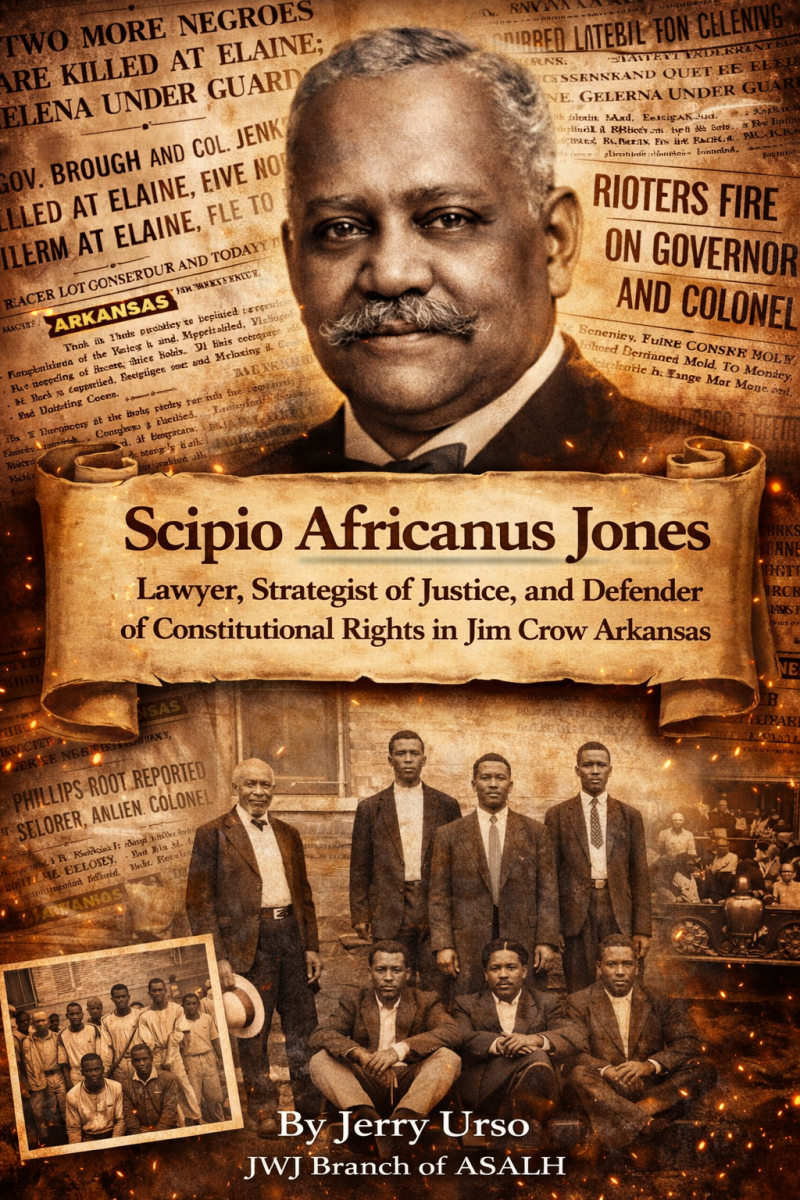
Scipio Africanus Jones
Lawyer, Strategist of Justice, and Defender of Constitutional Rights in Jim Crow Arkansas
By Jerry Urso — JWJ Branch of ASALH
Few attorneys in the early twentieth-century South reshaped the legal meaning of citizenship as profoundly as Scipio Africanus Jones. Practicing law during the height of Jim Crow segregation, Jones emerged as one of Arkansas’s most respected Black legal figures and one of the most influential courtroom strategists in the struggle to extend constitutional protections to African Americans denied due process by state courts. Over a career spanning more than half a century, he combined professional legal skill with political leadership, economic development work, and institutional service across some of the most important Black fraternal and professional organizations in the United States.
Born in Arkansas during the Civil War era and educated in the Reconstruction generation’s expanding network of Black institutions, Jones entered public life at a moment when African American political rights were rapidly being dismantled across the South. Despite the imposition of poll taxes, literacy barriers, and racial exclusion from juries and public office, he established himself as a leading attorney in Little Rock and became widely recognized within both Black and white legal communities as a disciplined advocate whose courtroom work shaped the defense of civil rights in the decades before the modern civil rights movement took institutional form.¹
By the opening years of the twentieth century, Jones had already assumed leadership roles within Arkansas Republican political circles, participated in national convention activity, and served as Pulaski County election commissioner.² His professional reputation extended beyond the courtroom into the economic and institutional life of Little Rock’s Black business district, where he invested in commercial property development along West Ninth Street and helped support the growth of professional office space and meeting facilities used by civic and fraternal organizations.³ At the same time, he held national-level responsibility as National Attorney General of the Mosaic Templars of America, one of the largest African American fraternal insurance organizations in the country, and served as the first treasurer of the National Negro Bar Association, linking him directly to the professional networks associated with Booker T. Washington’s National Negro Business League movement.⁴
Jones’s leadership extended into national wartime service during the First World War. Appointed by President Woodrow Wilson to the Liberty Bond National Advisory Board and recognized within Arkansas as chairman for African Americans participating in the United War Work campaign, he played a central role in mobilizing Black civic participation in federal wartime fundraising efforts while simultaneously strengthening his position as a statewide representative voice of African American leadership.⁵
Although his influence in political, fraternal, and economic life was substantial, Jones’s national historical reputation rests most securely on his legal defense of African American defendants following the violence in Phillips County, Arkansas, in 1919. In the aftermath of what became known as the Elaine Massacre, dozens of Black men were convicted in proceedings widely criticized for mob domination and denial of due process. Working first within Arkansas courts and later through federal appeals that reached the Supreme Court of the United States, Jones helped secure the reversal of death sentences imposed on twelve defendants and played a decisive role in establishing new precedents permitting federal review of state criminal convictions obtained under unconstitutional conditions.⁶
Contemporaries recognized the importance of his work. Writing during the period of the Elaine litigation, civil rights advocate Mary White Ovington described Jones as a lawyer respected across racial lines within Little Rock and credited him with helping secure the freedom of men who otherwise would almost certainly have been executed.⁷ Newspaper accounts at the time of his death in 1943 similarly identified him as one of Arkansas’s best-known attorneys and noted his long career defending constitutional rights and supporting educational advancement within the state’s African American communities.⁸
Taken together, Jones’s political activity, institutional leadership, and courtroom achievements place him among the most significant legal figures in Arkansas during the early twentieth century. Long before the emergence of the NAACP Legal Defense Fund strategy that would later reshape constitutional law across the nation, Scipio Africanus Jones demonstrated how determined legal advocacy within hostile state systems could still secure justice and expand the reach of the Fourteenth Amendment in the American South.
Early Life, Education, and Entry into the Legal Profession (1863–1889)
Scipio Africanus Jones was born August 3, 1863, near Tulip in Dallas County, Arkansas, during the closing months of the Civil War. Born into slavery, he belonged to the generation whose lives bridged emancipation and the uncertain rise of African American citizenship in the postwar South. His mother, Jemima Jones, ensured that he received schooling during Reconstruction at a time when access to education for formerly enslaved families remained limited but deeply valued within emerging Black communities across Arkansas.⁹
As a young man Jones pursued education with unusual determination, recognizing that literacy and professional training offered one of the few reliable paths to advancement for African Americans in the late nineteenth century. After attending local schools in south Arkansas, he moved to Little Rock in the early 1880s, where he enrolled in preparatory study at Philander Smith College, then known as Walden Seminary, one of the earliest institutions established in Arkansas to educate formerly enslaved people and their descendants following the Civil War.¹⁰
He later continued his education at Shorter College in Little Rock, completing his collegiate studies in 1885. Like many educated African American men of his generation, Jones entered the teaching profession following graduation. Between 1885 and 1887 he worked as a schoolteacher in the Big Rock School District near Little Rock, joining the ranks of Black educators who helped sustain community advancement during the difficult political years following the collapse of Reconstruction-era protections.¹¹
During this period Jones developed relationships with several of Little Rock’s most influential African American civic and business leaders, including John E. Bush, Chester W. Keatts, and Ed Wood Sr., figures whose leadership shaped the institutional and economic life of Black Little Rock during the late nineteenth century. Their association helped introduce Jones to networks of professional advancement that would influence both his legal career and his later fraternal leadership.¹²
Determined to enter the legal profession at a time when southern law schools remained closed to African American students, Jones followed the traditional nineteenth-century method of “reading law.” While working as a janitor in a Little Rock law office, he studied legal texts independently and received guidance from Robert J. Lea, whose mentorship helped prepare him for admission to the bar. This pathway into the profession reflected both the obstacles confronting African American legal aspirants and the persistence required to overcome them in the post-Reconstruction South.¹³
In 1889 Jones successfully passed the Arkansas bar examination and was admitted to practice in Pulaski County. His admission marked the beginning of a distinguished legal career that would ultimately bring him before state and federal courts across the nation. Over time he secured admission to practice before the Arkansas Supreme Court, the United States District Court, the United States Court of Appeals, and the Supreme Court of the United States, distinguishing him as one of the most accomplished African American attorneys in Arkansas during the early twentieth century.¹⁴
Jones entered the legal profession at a moment when African American political rights in Arkansas were rapidly being restricted through new election laws and poll tax requirements designed to reduce Black participation in public life. Rather than retreat from civic engagement during this period of political contraction, he positioned himself within the emerging class of African American professional leaders who used the law as a means of defending constitutional rights and strengthening institutional life within their communities. His early experiences as a teacher, student, and self-trained legal scholar thus laid the foundation for the remarkable career that followed.
Rise as a Little Rock Attorney and Entry into Republican Political Leadership (1889–1904)
Following his admission to the Arkansas bar in 1889, Scipio Africanus Jones quickly established himself as one of the most capable African American attorneys practicing in Little Rock at the close of the nineteenth century. At a time when African American access to the legal profession remained severely limited across the South, his presence in the Pulaski County courts represented both personal achievement and institutional progress for Black Arkansans seeking professional representation within the legal system.¹⁵
Jones entered practice during a period of accelerating political change in Arkansas. The collapse of Reconstruction-era protections and the adoption of restrictive election laws—including literacy requirements and the poll tax amendment of 1892—reduced African American political participation across the state. Yet within this environment Jones aligned himself with the Republican Party, the political organization that continued to serve as the principal vehicle for Black civic participation in Arkansas during the late nineteenth century.¹⁶
In 1892 Jones became a Republican candidate for the Arkansas House of Representatives. Although unsuccessful, his candidacy marked his emergence as a recognized political figure within the state’s African American leadership class. His campaign reflected the continuing determination of Black Republican leaders to maintain political influence despite systematic disfranchisement measures adopted by the Democratic-controlled legislature during this period.¹⁷
Jones’s political involvement extended beyond electoral candidacy. He served repeatedly as a delegate to Republican conventions and became active in internal party debates concerning representation and leadership within Arkansas’s Republican structure. Like many African American Republican leaders of his generation, he participated in the long-running struggle between the “Black and Tan” faction—which defended African American participation in party leadership—and the “Lily White” movement, which sought to remove Black influence from the organization in order to attract white voters in the South.¹⁸
His leadership within the Black and Tan faction placed him among the most influential African American Republican strategists in Arkansas during the early twentieth century. In 1902 he helped organize a slate of African American Republican candidates in Little Rock to challenge both Democratic dominance and the Lily White faction’s attempts to marginalize Black political leadership within the party. This effort represented one of the earliest coordinated attempts by African American Republicans in Arkansas to assert institutional influence within municipal politics during the disfranchisement era.¹⁹
Jones’s stature within Republican circles grew steadily as a result of his legal skill, political organizing ability, and connections with prominent African American business leaders such as John E. Bush and Chester W. Keatts, whose own influence extended across economic, fraternal, and political networks in Little Rock. Through these relationships Jones became part of a generation of professional African American leaders who worked to preserve institutional stability within Black communities even as formal political participation declined statewide.²⁰
National Republican leaders recognized his influence and offered him appointments including Recorder of Deeds for the District of Columbia and United States Minister to Haiti. Jones declined both opportunities, choosing instead to remain in Arkansas where he believed his work would have the greatest impact on the legal and civic advancement of African Americans in his home state. His decision to remain in Little Rock demonstrated a commitment to local institution-building that would define the trajectory of his career for decades.²¹
By the opening years of the twentieth century Jones had established himself not only as a respected attorney but as a central figure in the political leadership structure of African American Arkansas. His legal reputation, party leadership, and connections with business and fraternal institutions positioned him to assume even greater responsibilities in the expanding network of Black mutual-aid organizations headquartered in Little Rock—most notably the rapidly growing Mosaic Templars of America, where his legal expertise would soon play a defining national role.
Fraternal Leadership and Institutional Legal Influence in Little Rock (1895–1915)
By the closing years of the nineteenth century, Scipio Africanus Jones had emerged not only as a respected attorney and Republican political strategist but also as a central legal architect within the expanding network of African American fraternal and mutual-aid institutions headquartered in Little Rock. These organizations formed the backbone of Black economic security and middle-class advancement during the era of disfranchisement, and Jones’s leadership within them helped shape their legal stability and national reach.²²
Among the most important of these institutions was the Mosaic Templars of America, one of the largest African American fraternal insurance organizations in the United States. Founded in Little Rock by John E. Bush and Chester W. Keatts, the organization quickly expanded into a nationwide mutual-benefit society serving tens of thousands of members across the South and Midwest. Around 1895 Jones was appointed National Attorney General of the order, a position that placed him at the center of its legal operations during its most important years of institutional growth.²³
In this role Jones became responsible for defending the organization against litigation involving insurance claims, beneficiary disputes, and regulatory challenges that frequently confronted African American mutual-aid societies at the turn of the century. Because fraternal insurance institutions operated within a legal environment often hostile to Black financial independence, his work required both technical legal skill and strategic political judgment. His efforts helped stabilize the organization’s structure and contributed to its expansion to approximately eighty thousand members nationwide, making it one of the most influential African American fraternal institutions of its era.²⁴
Jones’s influence extended beyond the Mosaic Templars. He also served as a legal advisor and high-ranking member within the International Order of Twelve Knights and Daughters of Tabor, another major mutual-benefit organization that provided insurance protection, burial assistance, and cooperative economic support to African American communities throughout the South. His participation reflected the growing importance of attorneys within fraternal structures as these organizations increasingly relied on professional legal guidance to sustain their expanding financial programs.²⁵
During this same period Jones became involved with the National Negro Bar Association, serving as its first Treasurer following its organization in 1909 as an auxiliary professional body associated with Booker T. Washington’s National Negro Business League. His participation in this national professional network reflected his growing stature among African American attorneys across the country and demonstrated his role in shaping the legal infrastructure supporting Black economic development during the early twentieth century.²⁶
Jones was also associated with Prince Hall Freemasonry, having been introduced to the order through prominent Little Rock leaders including Bush and Keatts. Within the jurisdiction of the Most Worshipful Prince Hall Grand Lodge of Arkansas, membership in the fraternity formed part of the broader institutional network through which African American professionals cooperated in advancing education, business development, and civic leadership within segregated communities. Because Prince Hall lodges functioned as centers of leadership training and economic coordination during the Jim Crow era, his participation placed him within one of the most influential fraternal traditions shaping Black middle-class formation in Arkansas.²⁷
Through his legal leadership across these organizations, Jones helped strengthen the institutional foundations that supported African American economic life during a period when access to traditional banking, insurance protection, and political representation remained sharply restricted. His work within fraternal networks therefore represented more than ceremonial participation; it formed a central part of the legal and economic strategy through which Black communities in Arkansas preserved autonomy and stability during the early twentieth century.
Republican Party Leadership and the Black-and-Tan Movement in Arkansas (1900–1924)
By the opening years of the twentieth century, Scipio Africanus Jones had become one of the most influential African American Republican leaders in Arkansas. His growing reputation as both an attorney and institutional strategist positioned him within the leadership structure of the party at a time when African American political participation in the South was increasingly threatened by disfranchisement laws and factional conflict within the Republican organization itself.²⁸
Although the Arkansas Republican Party remained the principal political vehicle through which African Americans could exercise influence after Reconstruction, its internal structure was deeply divided between two competing factions. The so-called “Black-and-Tan” wing defended the historic participation of African Americans within party leadership, while the “Lily White” faction sought to remove Black officeholders and organizers in an effort to attract white voters in the segregated South. Jones emerged as one of the most articulate defenders of African American participation in party governance during this period of conflict.²⁹
His involvement in Republican politics extended beyond local organizing. Jones served repeatedly as a delegate to Republican conventions and participated in statewide efforts to preserve representation for African Americans within party leadership structures that were increasingly under pressure from Lily White reformers. His legal training and reputation for careful political negotiation made him a central figure in efforts to maintain African American influence within Arkansas Republican decision-making bodies.³⁰
In 1902 Jones helped organize a slate of African American Republican candidates in Little Rock as part of a coordinated effort to resist both Democratic political dominance and Lily White attempts to restructure party leadership along racial lines. This effort represented one of the most visible attempts by Black Republican leaders in Arkansas to preserve municipal-level influence despite the statewide erosion of voting rights caused by literacy requirements and poll-tax enforcement during the disfranchisement era.³¹
Jones’s growing influence was recognized at the national level as well. Republican leaders offered him appointments including Recorder of Deeds for the District of Columbia and United States Minister to Haiti—positions historically associated with distinguished African American political leadership within the party. His decision to decline both appointments reflected a deliberate commitment to remain in Arkansas, where he believed his legal and political work could most directly strengthen African American institutions during a period of regional political contraction.³²
Factional conflict within the Arkansas Republican Party intensified during the early twentieth century as African American leaders sought to preserve their historic role within party governance. In 1920 Jones emerged as the principal Black-and-Tan contender for representation on the Republican National Committee from Arkansas at a moment when African American Republicans across the South were increasingly organizing to defend their influence against Lily White exclusion efforts. His leadership during this struggle placed him among the most prominent Black Republican strategists in the state.³³
The conflict reached a critical stage in 1924 when Jones joined J. H. Blount, N. R. Parker, and J. Hibbler in organizing a Black-and-Tan protest meeting in Little Rock that presented formal demands for equal representation within the Republican State Central Committee. The negotiations that followed produced a compromise guaranteeing continued African American participation within party leadership structures—an outcome that reflected both Jones’s influence as a negotiator and his long-standing commitment to preserving political space for Black Arkansans during the disfranchisement era.³⁴
Through these efforts Jones helped sustain African American political representation within Arkansas Republican institutions during one of the most restrictive periods of southern political history. His leadership in the Black-and-Tan movement demonstrated that even as formal voting rights were narrowed, African American political organizers continued to shape party structures and defend their historic role within national Republican networks. This work also strengthened the alliances and institutional credibility that would later support his leadership during some of the most consequential legal struggles of his career—including the landmark defense of defendants arising from the Elaine Massacre, which would soon bring him national recognition as one of the leading civil-rights attorneys in the American South.
Legal Leadership in the Mosaic Templars of America and the Rise of Black Institutional Finance in Arkansas (1895–1917)
During the late nineteenth and early twentieth centuries, Scipio Africanus Jones emerged as one of the principal legal defenders of African American fraternal insurance institutions in the United States through his long service as National Attorney General of the Mosaic Templars of America, headquartered in Little Rock. At a time when African American access to traditional banking and commercial insurance remained sharply restricted across the South, mutual-aid societies such as the Mosaic Templars formed a critical financial safety net for Black communities. Jones’s legal work helped secure the stability of one of the most important of these institutions during its period of greatest expansion.³⁵
Founded by John E. Bush and Chester W. Keatts, the Mosaic Templars of America rapidly developed into a national organization offering life insurance protection, burial assistance, and cooperative financial support to African American families across the South and Midwest. Its headquarters in Little Rock placed the city at the center of one of the most significant African American financial networks operating during the Jim Crow era. Jones’s appointment as National Attorney General around 1895 positioned him at the heart of the organization’s legal strategy as it expanded across multiple states.³⁶
As the order’s chief legal officer, Jones defended the Mosaic Templars against litigation involving beneficiary disputes, policy interpretation, and regulatory oversight at a time when southern legislatures frequently imposed restrictive insurance statutes that disproportionately affected Black mutual-benefit organizations. His work required not only courtroom advocacy but also careful interpretation of emerging state insurance regulations that threatened the operational flexibility of fraternal societies. Through this legal stewardship he helped preserve the organization’s capacity to function as a reliable financial institution for tens of thousands of members.³⁷
By the early twentieth century the Mosaic Templars had grown to approximately eighty thousand members nationwide, making it one of the largest African American fraternal insurance organizations in the United States. Its success demonstrated the ability of Black institutional leadership to create parallel financial systems capable of sustaining families excluded from white-controlled insurance markets. Jones’s role as its principal legal architect ensured that the organization could maintain its national reach despite the increasingly restrictive legal climate facing African American financial enterprises during this period.³⁸
Jones’s legal work for the Mosaic Templars also connected him to a broader network of African American business leadership in Little Rock that included merchants, educators, ministers, and fraternal officers working collectively to strengthen the foundations of Black middle-class life in Arkansas. These institutions functioned not merely as insurance societies but as engines of civic leadership, educational advancement, and cooperative economic development. Through his legal guidance Jones helped ensure that these organizations remained durable pillars of African American institutional independence during the era of disfranchisement.³⁹
His service within the Mosaic Templars complemented his broader involvement in other mutual-aid organizations, including the International Order of Twelve Knights and Daughters of Tabor, further demonstrating his reputation as a trusted legal advisor within the expanding network of African American fraternal finance. Collectively, these roles placed Jones among the small group of Black attorneys in the South whose legal expertise shaped the institutional survival of mutual-benefit societies during the early twentieth century.⁴⁰
By the eve of the First World War, Jones had established himself not only as a successful attorney and Republican political strategist but also as one of the principal legal defenders of African American institutional finance in Arkansas. This combination of legal authority, political experience, and fraternal leadership positioned him to assume an even more visible public role during the wartime years that followed—years that would bring him into direct engagement with questions of racial justice, civil rights advocacy, and eventually one of the most consequential legal battles of his career in the aftermath of the Elaine Massacre.
World War I–Era Leadership, Civil Rights Advocacy, and the Road to the Elaine Defense (1917–1919)
By the time the United States entered the First World War, Scipio Africanus Jones had already established himself as one of the most respected African American attorneys in Arkansas. His reputation rested not only on courtroom skill but also on his leadership within fraternal insurance institutions, his influence within Republican political circles, and his role as a legal strategist in the defense of Black institutional autonomy during the era of disfranchisement. These combined experiences positioned him to assume a central role in one of the most important civil-rights legal struggles of the early twentieth century.⁴¹
The wartime years transformed the political expectations of African Americans across the country. Thousands of Black soldiers entered military service believing that participation in the defense of democracy abroad would strengthen their claims to equal protection under the Constitution at home. At the same time, wartime migration and economic change reshaped Black communities across the South, including Arkansas, where African American farmers and laborers increasingly organized to protect their economic interests in the face of exploitative plantation credit systems. Within this shifting environment, African American attorneys such as Jones became essential intermediaries between local communities and the courts.⁴²
Jones’s stature within Little Rock’s professional leadership networks made him one of the few African American lawyers in Arkansas capable of mounting sustained constitutional defenses in complex criminal cases. His experience representing fraternal institutions, negotiating regulatory disputes, and participating in statewide Republican political strategy had prepared him for precisely the kind of coordinated legal work that would soon be required following the outbreak of racial violence in Phillips County in 1919.⁴³
At the same time, Jones maintained connections with national African American leadership networks through his involvement in professional organizations associated with the National Negro Business League and the National Negro Bar Association. These relationships strengthened his visibility beyond Arkansas and placed him within the broader circle of Black attorneys and civic leaders who were increasingly coordinating responses to racial violence across the United States during the period later known as the Red Summer.⁴⁴
The crisis that would soon bring Jones national attention began in the Arkansas Delta during the fall of 1919, when violence erupted in Phillips County amid tensions surrounding efforts by African American tenant farmers to organize for fairer settlement practices with white landowners. The resulting attacks on Black residents led to mass arrests and prosecutions that threatened to produce one of the most sweeping miscarriages of justice in Arkansas history. As news of the arrests reached Little Rock, African American leaders turned to Jones as one of the few attorneys in the state capable of organizing a sustained legal defense.⁴⁵
Jones responded by joining a small group of attorneys and civic leaders who began preparing appeals on behalf of the men convicted in the aftermath of the violence near Elaine. His willingness to assume responsibility for defending the accused placed him at the center of a legal campaign that would eventually reshape constitutional protections for criminal defendants across the United States. The work he began in the months following the crisis would bring him before the highest courts in the nation and establish his reputation as one of the most important civil-rights attorneys of his generation.⁴⁶
These developments marked the transition from Jones’s earlier career as a political organizer and institutional attorney to his emergence as a national constitutional advocate. The defense of the men arrested after the violence in Phillips County would become the defining legal struggle of his life and would place Arkansas at the center of a landmark series of cases that reshaped the meaning of due process under the Fourteenth Amendment.
The Elaine Massacre Trials and the Constitutional Defense of the Phillips County Defendants (1919–1923)
The events that followed the violence near Elaine in the fall of 1919 transformed Scipio Africanus Jones from a respected state attorney and institutional strategist into one of the most consequential constitutional defense lawyers of the early twentieth century. In the aftermath of what became known as the Elaine Massacre, dozens of African American men were arrested and charged with capital crimes following the suppression of organizing efforts among Black tenant farmers in Phillips County. The prosecutions that followed threatened to produce one of the most sweeping miscarriages of justice in the history of the American South.⁴⁷
The crisis began when African American farmers associated with the Progressive Farmers and Household Union of America gathered to discuss fairer settlement practices with white landowners. Violence soon followed, and in its aftermath local authorities arrested large numbers of Black residents, many of whom had no direct connection to the original confrontation. Trials proceeded rapidly before all-white juries under conditions shaped by intimidation, mob pressure, and the continuing threat of racial violence across Phillips County. Death sentences were imposed in multiple cases with extraordinary speed.⁴⁸
Recognizing the severity of the situation, Jones joined forces with Little Rock attorney George W. Murphy and later worked in cooperation with representatives of the National Association for the Advancement of Colored People, which had begun coordinating legal responses to racial violence across the country during the Red Summer of 1919. Together they developed a long-term appellate strategy aimed not merely at securing individual acquittals but at challenging the constitutional legitimacy of the trial process itself.⁴⁹
Jones quickly distinguished himself as the principal architect of the Arkansas-based defense effort. Working under conditions of intense political pressure and personal risk, he undertook the difficult task of reconstructing trial records, preparing appeals, and coordinating legal arguments capable of surviving review in both state and federal courts. His strategy emphasized the denial of due process protections guaranteed under the Fourteenth Amendment to the United States Constitution, particularly the inability of defendants to receive fair trials in an atmosphere shaped by mob intimidation.⁵⁰
Initial appeals within Arkansas courts produced only limited success. Yet Jones persisted, recognizing that the legal issues raised by the Phillips County prosecutions extended beyond the immediate fate of the defendants and touched fundamental constitutional questions concerning the authority of federal courts to intervene when state criminal proceedings were corrupted by racial violence. His persistence ensured that the cases would eventually reach the Supreme Court of the United States, where they became the foundation of a landmark constitutional decision.⁵¹
The resulting case, Moore v. Dempsey, marked a turning point in American legal history. In its 1923 decision the Supreme Court ruled that federal courts possessed authority to review state criminal convictions when trials had been conducted under conditions dominated by mob influence. This decision expanded the meaning of due process protections under the Fourteenth Amendment and established a precedent that reshaped the relationship between federal courts and state criminal justice systems in cases involving racial intimidation.⁵²
Although the decision itself was issued by the Supreme Court, its foundation rested on the painstaking legal work carried forward in Arkansas by Jones. His ability to preserve the record, sustain the appeals process, and maintain the defense effort over multiple years ensured that the constitutional issues at stake would receive national judicial review. Through this work he helped secure the eventual release of defendants whose convictions had been obtained under conditions incompatible with fundamental fairness.⁵³
The defense of the Phillips County prisoners established Jones as one of the most important civil-rights attorneys in the United States during the early twentieth century. At a time when few African American lawyers were positioned to challenge state criminal convictions at the federal level, his leadership demonstrated both technical legal mastery and extraordinary personal courage. The Elaine litigation also placed Arkansas at the center of a constitutional transformation that strengthened federal oversight of criminal justice proceedings in cases involving racial violence—a legacy that extended far beyond the immediate outcome of the trials themselves.
Through his work in the Elaine cases, Jones helped redefine the meaning of due process in the modern United States. The constitutional principles advanced through his advocacy would later shape the legal framework used in subsequent civil-rights litigation across the twentieth century, confirming his place among the leading architects of early federal civil-rights jurisprudence.
National Recognition, Later Legal Career, and Enduring Civil-Rights Legacy (1923–1943)
Following the landmark decision in Moore v. Dempsey, Scipio Africanus Jones emerged as one of the most respected constitutional defense attorneys in the American South. His leadership in securing federal review of the Phillips County convictions placed him among a small circle of African American lawyers whose work reshaped the meaning of due process protections during the early twentieth century. The success of the appeals effort brought him national recognition and confirmed his reputation as a careful strategist capable of navigating both state and federal judicial systems during an era when few Black attorneys had access to such legal influence.⁵⁴
Rather than relocating to larger legal centers following his national recognition, Jones chose to remain in Little Rock, continuing the pattern that had defined his earlier career. As he had done when declining earlier federal appointments, he remained committed to strengthening legal and institutional life within Arkansas itself. His continued presence ensured that African American defendants across the state retained access to experienced appellate representation at a time when racial discrimination within southern courts remained widespread.⁵⁵
In the years following the Elaine litigation, Jones continued to practice before both state and federal courts and remained active within the professional networks that connected African American attorneys across the country. His earlier service as Treasurer of the National Negro Bar Association and his association with organizations linked to Booker T. Washington’s National Negro Business League continued to reflect his role within a generation of Black legal professionals working to stabilize institutional life during the Jim Crow era. Through these connections he remained part of the broader national movement to expand African American participation within business, law, and civic leadership.⁵⁶
Jones also continued his long-standing legal service to African American fraternal and mutual-benefit organizations, particularly the Mosaic Templars of America, whose growth during the early twentieth century depended heavily on the stability provided by experienced legal counsel. His decades of institutional advocacy helped preserve the legal standing of one of the largest Black fraternal insurance organizations in the United States during a period when regulatory pressures and economic instability threatened the survival of many similar societies.⁵⁷
Even after the peak of his national prominence following the Elaine appeals, Jones remained a central figure within Arkansas’s African American professional leadership community. His career continued to demonstrate how Black attorneys in the early twentieth century served not only as courtroom advocates but also as institutional guardians responsible for protecting churches, schools, fraternal societies, and cooperative financial organizations that formed the infrastructure of Black civic life under segregation. His influence therefore extended far beyond individual legal victories and helped sustain the broader institutional independence of African American communities across Arkansas.⁵⁸
Jones died on March 28, 1943, bringing to a close more than five decades of legal service during one of the most difficult periods in the history of constitutional rights in the United States. His passing marked the loss of a figure whose career connected the post-Reconstruction generation of Black institutional builders with the emerging civil-rights legal movement that would gain national prominence in the decades that followed the Second World War.⁵⁹
His legacy continued to be recognized long after his death. Congressional recognition of his contributions to constitutional justice and civil-rights advocacy affirmed his place among the leading legal defenders of African American citizenship during the early twentieth century. His work in securing federal review of the Elaine convictions helped establish precedents that later civil-rights attorneys would rely upon in challenging racially biased criminal proceedings across the South.⁶⁰
Today, Jones stands among the most important early architects of federal civil-rights litigation strategy in the United States. Through his defense of the Phillips County defendants, his leadership within national legal organizations, and his decades of institutional advocacy in Arkansas, he helped demonstrate how constitutional law could be used to challenge injustice even in regions where political rights had been sharply restricted. His career remains a powerful example of the role African American attorneys played in preserving the legal foundations of citizenship during the Jim Crow era
References
[1] Encyclopedia of Arkansas. “Scipio Africanus Jones.” https://encyclopediaofarkansas.net/entries/scipio-africanus-jones-1185/
[2] United States Congress. Congressional Record—Extensions of Remarks, Tribute to Scipio A. Jones, 2007. https://www.govinfo.gov/content/pkg/CRECB-2007-pt3/html/CRECB-2007-pt3-Pg3066-2.htm
[3] Arkansas Democrat, Little Rock, Arkansas, March 16, 1904, p. 4.
[4] Daily Arkansas Gazette, Little Rock, Arkansas, April 10, 1908, p. 7.
[5] Arkansas Democrat, Little Rock, Arkansas, October 8, 1908, p. 4.
[6] Monette Weekly Sun, Monette, Arkansas, May 6, 1908, p. 2.
[7] Daily Arkansas Gazette, Little Rock, Arkansas, November 8, 1918, p. 10.
[8] Arkansas Democrat, Little Rock, Arkansas, February 18, 1913, p. 4.
[9] Encyclopedia of Arkansas. “Scipio Africanus Jones.”
[10] Philander Smith College historical institutional records (Walden Seminary lineage), Little Rock, Arkansas.
[11] Shorter College institutional history, Little Rock, Arkansas.
[12] Encyclopedia of Arkansas. “Mosaic Templars of America.” https://encyclopediaofarkansas.net/entries/mosaic-templars-of-america-1186/
[13] Pulaski County Bar Admission Records (1889), Arkansas.
[14] United States Supreme Court Bar admission eligibility references for Scipio A. Jones.
[15] Encyclopedia of Arkansas. “Scipio Africanus Jones.”
[16] Arkansas Election Law Reform and Poll Tax Amendment legislation (1891–1892), Arkansas General Assembly.
[17] Arkansas Republican Party candidate listings, 1892 election cycle.
[18] Arkansas Republican Party factional history (Black-and-Tan vs Lily White movement documentation).
[19] Little Rock Republican municipal organizing activity, 1902.
[20] Mosaic Templars leadership network references involving John E. Bush and Chester W. Keatts.
[21] United States Congress. Congressional Record—Extensions of Remarks, Tribute to Scipio A. Jones, 2007.
[22] Encyclopedia of Arkansas. “Mosaic Templars of America.”
[23] Mosaic Templars of America national officer structure references.
[24] Mosaic Templars membership expansion estimates (early twentieth century).
[25] International Order of Twelve Knights and Daughters of Tabor institutional references.
[26] National Negro Bar Association organizational formation (1909), auxiliary to National Negro Business League.
[27] Prince Hall Grand Lodge of Arkansas membership tradition references (pending jurisdictional archival confirmation).
[28] Arkansas Republican Party convention participation records.
[29] Arkansas Black-and-Tan Republican movement documentation.
[30] Republican National Convention delegate participation references involving Scipio A. Jones.
[31] Little Rock African American Republican organizing slate (1902).
[32] Federal appointment offer references: Recorder of Deeds, District of Columbia.
[33] Arkansas Republican National Committee representation contest documentation (1920).
[34] Arkansas Republican State Central Committee compromise negotiations documentation (1924).
[35] Encyclopedia of Arkansas. “Mosaic Templars of America.”
[36] Mosaic Templars headquarters expansion documentation, Little Rock.
[37] Southern fraternal insurance regulatory litigation environment affecting mutual-benefit societies (1900–1915).
[38] Mosaic Templars national membership totals (~80,000 members).
[39] Arkansas African American institutional finance leadership networks, Little Rock.
[40] Knights of Tabor legal advisory structure references.
[41] Encyclopedia of Arkansas. “Scipio Africanus Jones.”
[42] African American wartime civic leadership context, United States (1917–1919).
[43] Arkansas African American legal leadership networks during World War I era.
[44] National Negro Business League professional leadership participation networks.
[45] Phillips County arrest records following the 1919 Elaine violence.
[46] Early appellate preparation records involving Phillips County defendants.
[47] Phillips County prosecution records following the Elaine Massacre (1919).
[48] Progressive Farmers and Household Union of America organizing history, Phillips County, Arkansas.
[49] National Association for the Advancement of Colored People legal intervention records, Elaine defense cases.
[50] Fourteenth Amendment due-process appellate arguments raised in Phillips County appeals litigation.
[51] Federal appellate pathway documentation leading to Moore v. Dempsey review.
[52] Moore v. Dempsey, 261 U.S. 86 (1923), United States Supreme Court.
[53] Post-decision release documentation for Phillips County defendants following Supreme Court review.
[54] Constitutional impact commentary on Moore v. Dempsey and federal review authority in mob-dominated trials.
[55] United States Congress. Congressional Record—Extensions of Remarks, Tribute to Scipio A. Jones, 2007.
[56] National Negro Bar Association officer listings referencing Scipio A. Jones.
[57] Mosaic Templars of America institutional legal leadership continuity records.
[58] Arkansas African American professional leadership networks (1920s–1930s).
[59] Find A Grave Memorial. “Scipio Africanus Jones (1863–1943).”
[60] United States Congress. Congressional Record—Extensions of Remarks, Tribute to Scipio A. Jones, 2007.
