
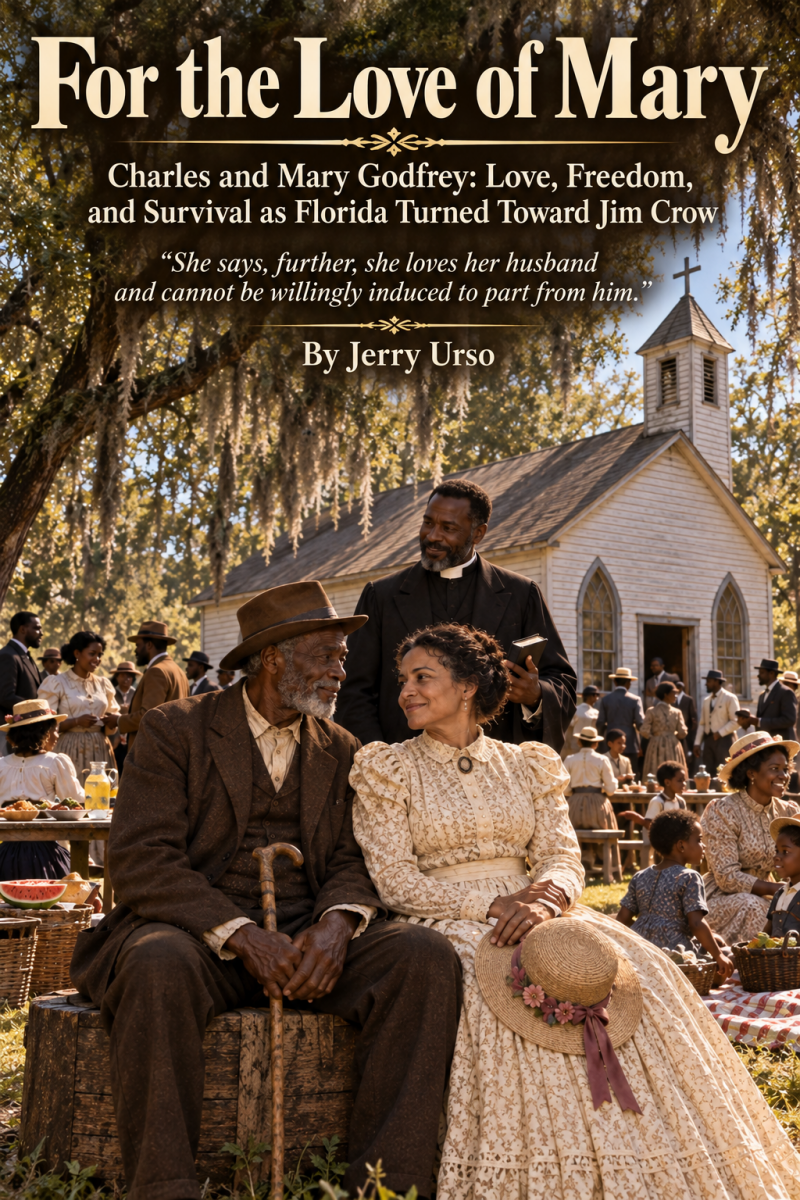
For the Love of Mary
Charles and Mary Godfrey: Love, Freedom, and Survival as Florida Turned Toward Jim Crow
“She says, further, she loves her husband and cannot be willingly induced to part from him.” [1]
By Jerry Urso
Some love stories survive because families carefully preserve them. Letters are folded into boxes, wedding photographs are passed from one generation to another, and names are written into family Bibles. The love story of Charles and Mary Godfrey survived for a very different reason. Their marriage became important enough for the newspapers to preserve because the State of Florida believed that loving one another might be a crime.
Charles Godfrey had been born into slavery in Georgia. By the time we encounter him in Jacksonville, he had already lived through one of the greatest transformations in American history. He had gone from a world in which Black people could be bought and sold to one in which Black men could vote, hold public office, organize communities, serve in militia companies, establish businesses, and build homes of their own. Yet Charles was not one of the famous men whose names filled histories of Reconstruction. He was one of the working men. His life depended upon his hands, his strength, and his ability to find another day's work.
By 1885, Charles was working in Jacksonville as a drayman, hauling freight through the streets and around the railroad depots of a growing commercial city. [2] It was difficult physical labor, especially for a man already described the following year as aged. Charles had spent much of his life working, first under the shadow of slavery and then as a free man responsible for making his own way in a country still deciding how much freedom it was willing to allow a Black man.
Jacksonville offered him a reason to stay. It offered work, certainly, but something else had been growing there since emancipation. Black people had been creating a world of their own.
A Place That Could Become Home
After the Civil War, Black people came to Jacksonville and the communities surrounding it in remarkable numbers. They came looking for work and family, churches and schools, safety and opportunity. Some had left plantations and farms. Others came from Georgia, from other Florida counties, and from the Bahamas. Some were simply following opportunity, while others were leaving places where exercising the rights of freedom could bring threats or violence. Jacksonville was not free of racism, but for thousands of Black people it offered something worth taking a chance on: the possibility of building a life.
LaVilla became one of the clearest expressions of that hope. Freedpeople settled there after emancipation, and its Black population grew dramatically during the 1870s. Hansontown bordered LaVilla, and together with other nearby Black communities they formed a growing Black world around Jacksonville. Families established homes, churches, schools, businesses, organizations, and relationships that helped turn neighborhoods into communities. Patricia Drozd Kenney described LaVilla as a place where the dreams of Reconstruction took physical form, where Black people used family ties, friendship, churches, schools, voluntary associations, and political participation to create a community in freedom. [3]
Jacksonville offered employment in the railroad yards, lumber mills, hotels, warehouses, docks, construction sites, and businesses of a rapidly growing city. Men like Charles were essential to that growth. They hauled freight, loaded ships, laid track, moved lumber, built houses, worked the docks, and performed the physical labor upon which the city's prosperity depended. But employment alone does not explain why Jacksonville became attractive to so many Black people. There was also strength in being surrounded by thousands of others who were trying to accomplish the same thing.
James Weldon Johnson later found beautiful language for the invisible bond he encountered within Black Jacksonville. He called it “the freemasonry of the race.” [4] It was a sense of belonging that did not require wealth or social position. It grew from shared experience and recognition, from churches and neighborhoods, from families and friendships, and from the knowledge that Black people were building something together. Charles was not a prominent businessman or politician, but he belonged to that world just as surely as the men whose names appeared in newspapers. He was one of the working men who made Black Jacksonville possible.
There was another reason Jacksonville could feel different from more isolated parts of Florida. Black people had developed political strength there, and during Reconstruction some were armed and organized as members of the state militia. Under Governor Harrison Reed, Black militia companies became part of the struggle to protect Reconstruction government at a time when Black voters and Republican leaders elsewhere in Florida faced intimidation and violence. Jacksonville's Magnolia Guards stood as a visible reminder that Black citizenship was not entirely defenseless. [5]
The presence of Black militia was one factor in the balance of power that developed in Jacksonville. It did not eliminate racial violence, nor can it be credited alone with protecting the city. Jacksonville also possessed a large Black population, Black political leaders, churches, schools, organizations, Republican political strength, and communities capable of acting collectively. Together these provided a measure of protection that could be much harder to find in an isolated rural county.
The Fortune family knew what the absence of such security could mean. Emanuel Fortune had been a prominent Black leader in Jackson County, where Reconstruction became a deadly struggle. Black voters, officeholders, and Republicans faced a campaign of terror as white opponents attempted to destroy the political changes that emancipation had made possible. The Fortune family eventually left Jackson County and came to Jacksonville. [6] Their journey helps explain why the city attracted Black people from elsewhere in Florida. They were not always simply moving toward jobs. Sometimes they were moving away from danger and toward community.
Jacksonville could therefore become more than a destination. It could become home.
For a Black man born during slavery, that mattered. Charles could work among other Black men, make his home near Black families, attend Black churches, know Black ministers, and live within a community that had grown from the freedoms won after the Civil War. He had survived slavery and entered freedom. Now he was trying to do something wonderfully ordinary with that freedom. He was trying to build a life.
And somewhere within that life, Charles found Mary.
The Woman Who Loved Him
We do not know where Charles first met Mary. We do not know whether they met through friends, through church, in Hansontown or LaVilla, or somewhere along the streets where Charles worked. We do not know what their courtship looked like or what Charles said when he asked Mary to become his wife. Those intimate details disappeared with them.
What survived was Mary's answer when someone tried to take her husband away.
Mary Godfrey complicated the racial world around her simply by existing. She was light enough that authorities looked at her and believed she was white. Mary did not understand herself that way. Her mother had been mulatto, and Mary declared herself one eighth Black. She had always lived among Black people, regarded herself as belonging among them, and expected to continue living among them. [1]
And she was married to Charles.
In June 1886, that marriage brought the law to their door. Charles and Mary were arrested for intermarrying. Charles was described in the racial language of the period as an “aged and full blooded African,” while Mary was described as “apparently a white woman.” [1] The authorities looked at them and believed they saw something forbidden: a Black man married to a white woman.
Their minister was pulled into the case with them. Rev. Robert N. Andrews had performed their marriage, and for doing so he too was indicted. Andrews was part of the Black community surrounding Jacksonville. In 1885 he was living in Hansontown with his wife Caselia, their children, and an elderly boarder. [7] He was a husband and father himself, yet performing a marriage for another couple placed him within reach of Florida's racial laws.
Andrews was able to provide a $300 bond. Charles and Mary were each required to provide the same amount, but they could not afford it. [1] Their lack of money now became part of their punishment. They were locked up.
For Charles, the moment must have carried a bitter meaning. He had been born in a country where Black husbands and wives could be separated because an enslaver decided to sell one of them. He had lived to see slavery destroyed and Black marriage legally recognized. Now, as an aging free man, he was again facing a government claiming power over whether he could remain with his wife.
Mary refused to make that decision easy for them.
She claimed her mother. She claimed her ancestry. She claimed the Black community in which she had lived. She made clear that she intended to continue living among Black people. Then, amid all the arguments over fractions of ancestry and racial classifications, Mary said the simplest and most important thing preserved from their lives:
“She says, further, she loves her husband and cannot be willingly induced to part from him.” [1]
That was Mary's answer to the State of Florida.
Freedom Had Changed the Law Once
Charles and Mary's arrest was part of a struggle that had begun almost as soon as slavery ended. Freedom had forced Florida to decide what being free actually meant. The first answer was often cruelly narrow. The Black Codes attempted to regulate the lives of newly freed people through laws governing work, movement, contracts, relationships, and civil rights. Florida even placed racial ancestry into legal fractions, treating one eighth Black ancestry as enough to classify a person as a person of color. [8]
That old racial arithmetic suddenly mattered enormously to Mary. What might otherwise have remained part of her family history became the difference between a marriage the state considered lawful and one it was prepared to prosecute.
Reconstruction had offered another vision. Florida's Constitution of 1868 embraced civil and political rights in language dramatically different from the world Charles had been born into. Black men voted. Black men held office. Schools expanded. Communities such as LaVilla grew. Black families established homes, businesses, churches, and organizations. [9] Freedom remained imperfect and dangerous, but for a time the direction seemed to be toward greater participation rather than greater exclusion.
Jacksonville became one of the places where those possibilities could actually be seen. Black policemen walked the streets. Black men participated in politics. Black militia companies stood armed under state authority. Black ministers led congregations. Black businessmen opened establishments. Working men like Charles earned wages in an expanding economy. The promise of Reconstruction was never complete, but it had created enough space for Black people to begin building something.
That progress also produced a reaction.
When the Law Became the Weapon
By the 1880s, those determined to restore white control no longer had to rely entirely upon intimidation and violence. Political power could turn the law itself into a weapon. The freedoms Black people had exercised during Reconstruction could be narrowed through statutes, voting restrictions, segregation, racial classifications, and criminal penalties imposed upon people who crossed boundaries white lawmakers believed should remain permanent.
The constitutional convention of 1885 revealed the direction Florida was taking. The new constitution required racial separation in public education, permitted the poll tax to become a condition attached to voting, and declared interracial marriage permanently prohibited. [10] The contrast with 1868 could hardly have been sharper. Less than two decades after Florida had moved toward broader Black citizenship, the state was constructing legal barriers around the progress Black people had made.
The 1885 Constitution had not yet been ratified when Charles and Mary were arrested in June 1886. Their prosecution came through racial marriage laws already on Florida's books. The new constitution would be ratified later that year. It did not create the danger Charles and Mary faced; it showed how determined Florida had become to preserve and strengthen the racial order that placed them in danger.
This was how the movement toward Jim Crow reached ordinary people. Charles did not need to be a Black politician challenging white political power. He did not need to lead a militia company or organize Black voters. He did not need to steal anything or commit an act of violence. The authorities merely had to believe he had crossed one of the racial boundaries the law was designed to protect.
His perceived violation was the woman he loved.
The authorities looked at Charles and saw a Black man. They looked at Mary and believed they saw a white woman. From that perception came arrest, indictment, bond, and jail. The law had turned their marriage into evidence.
But Mary would not fit neatly into the racial box necessary to prosecute them. Her ancestry challenged the assumption upon which the case had been built. She swore that she possessed Black ancestry, placing herself within the very racial category the authorities had attempted to deny her.
The prosecution collapsed.
On June 10, 1886, the cases against Charles, Mary, and the minister who married them were dismissed. [11][12] One newspaper preserved the moment when the ordeal finally ended. After the arrests, the indictments, the night behind bars, and the threat hanging over their marriage, “the man and woman went out of court happy.” [12]
Charles and Mary walked out together.
The Life of a Working Man
Charles did what working people have always done after history briefly notices them. He went back to work.
By 1888 he was living in Hansontown, bordering LaVilla, and working as a laborer. He remained there in 1889 and 1890. [13][14][15] His address placed him within the Black community that had helped make Jacksonville attractive to people searching for a life after slavery. The political world around him was changing, but Charles continued doing what he had done for decades: earning his living with his hands.
By the 1890s Charles was an aging Black working man. Fifty five was not necessarily young for someone who had been born during slavery and spent a lifetime performing physical labor. His body had carried him through slavery, emancipation, Reconstruction, and the retreat toward Jim Crow. He had worked through those changes without wealth or privilege, surviving one day and one job at a time.
In 1895 his name appeared again in a court matter, but Charles was not the accused. A woman named H. Reese was arrested for assault and battery after Charles swore out the warrant. [16] The brief account does not tell us what caused the confrontation, and we should not invent what the newspaper did not preserve. What it does show is an aging Black laborer who believed he had been wronged and turned to the courts for protection.
There is a painful irony there. Nine years earlier, the legal system had locked Charles in jail because of his marriage. Now the same system was the place he had to turn when he needed protection. His scattered appearances in legal records do not reveal a life of theft or serious criminality. They reveal something much more ordinary: a Black man trying to work, survive, grow old, and live within laws that did not always treat his freedom as something secure.
By 1896 Charles was still in Jacksonville and still a laborer. [17] There is something almost beautiful in the plainness of that description. After everything else, Charles was still there. He had survived.
For the Love of Mary
It would be easy to allow the law to become the main character in this story. There are constitutions to examine, statutes to interpret, racial classifications to explain, and the long transition from Black Codes through Reconstruction and into Jim Crow to understand. All of that matters, because without it we cannot understand why Charles and Mary ended up behind bars.
But this is not ultimately the story of a statute.
It is the story of Charles and Mary.
Charles had been born during slavery and spent his life working. He came into a Jacksonville where Black people had created something extraordinary from the possibilities of emancipation. They had built neighborhoods and churches, schools and businesses, political organizations and militia companies. They had created the bonds James Weldon Johnson would describe as “the freemasonry of the race.” [4] Jacksonville became a place where Black people could imagine not simply surviving, but belonging.
Charles belonged there.
And somewhere in that world, he found a woman who loved him.
We do not have their letters. We do not have their wedding photograph. We do not know what Mary called Charles when no one else was listening or what Charles said to comfort her while they sat in jail unable to afford their bond. Most of the private life they shared disappeared when they did.
But one piece survived because the law forced Mary to speak publicly about the man she loved.
She could have distanced herself from Charles. She could have allowed authorities to place her on the white side of the color line they were constructing around her. Instead she claimed her mother, claimed her ancestry, claimed her community, and claimed her husband.
“She says, further, she loves her husband and cannot be willingly induced to part from him.” [1]
Perhaps that is enough.
Florida could change its laws. The freedoms opened during Reconstruction could be narrowed. Black political power could be attacked. Schools could be separated. Voting could be restricted. Marriage could be regulated by race. The state could arrest an aging Black laborer, jail his wife, and indict the minister who had joined them together.
But the state could not decide what Mary felt for Charles.
On that June day in 1886, the case against them ended. The doors opened, and the couple who had entered the courthouse with the legality of their marriage hanging over them walked back into Jacksonville together.
The newspaper said they “went out of court happy.” [12]
After slavery, after hardship, after jail, and with Jim Crow gathering around them, Charles and Mary still had each other.
In the end, that is their story. It is a love story.
References
[1] The Florida Times-Union, June 9, 1886, p. 4, “A Mismatched Pair and the Officiating Clergyman Under Indictment.”
[2] The Florida Times-Union, December 16, 1885, p. 1, Charles Godfrey, identified as a colored drayman.
[3] Patricia Drozd Kenney, LaVilla, Florida, 1866–1887: Reconstruction Dreams and the Formation of a Black Community, M.A. thesis, University of North Florida, 1990.
[4] James Weldon Johnson, The Autobiography of an Ex-Colored Man (1912), chapter 5, describing his introduction to Jacksonville's Black social world as “the freemasonry of the race.”
[5] Florida State Troops records, Magnolia Guards, Jacksonville, Reconstruction era.
[6] Records concerning Emanuel Fortune and the Fortune family's experience during the Reconstruction era violence in Jackson County and subsequent connection to Jacksonville.
[7] Florida State Census, 1885, Hansontown, Duval County, p. 653, line 5, family 213, Robert N. Andrews household.
[8] Florida post Civil War legislation concerning interracial marriage and racial classification, including the statutory classification of persons possessing one eighth or more Black ancestry as persons of color.
[9] Constitution of the State of Florida, 1868, Declaration of Rights and provisions concerning political rights and public education.
[10] Constitution of the State of Florida, 1885, including Article XVI, Section 24.
[11] The Florida Times-Union, June 10, 1886, p. 4, proceedings involving Charles Godfrey, his wife, and Rev. R. N. Andrews.
[12] The News-Herald, June 10, 1886, p. 1, proceedings involving Charles Godfrey, his wife, and Rev. Andrews.
[13] Jacksonville, Florida, City Directory, 1888, Charles Godfrey, laborer, Hansontown.
[14] Jacksonville, Florida, City Directory, 1889, Charles Godfrey, laborer, Hansontown.
[15] Jacksonville, Florida, City Directory, 1890, Charles Godfrey, laborer, Hansontown.
[16] Daily Florida Citizen, May 31, 1895, p. 5, “Held for Assault and Battery,” warrant sworn out by Charles Godfrey.
[17] Jacksonville, Florida, City Directory, 1896, Charles Godfrey, laborer.
