
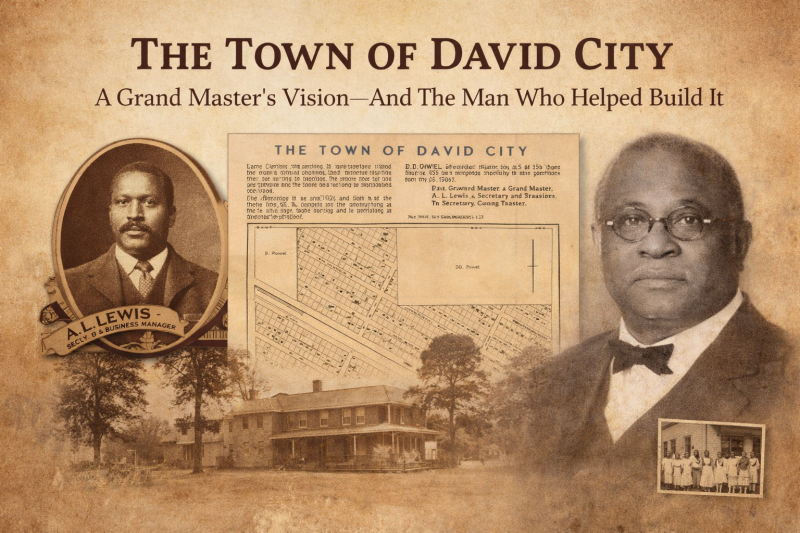
The Town of David City: A Grand Master’s Vision — and the Man Who Helped Build It
In the early twentieth century, when segregation defined opportunity and limited access to public services across Florida, African-American institutional leadership responded by building systems of protection of their own. Churches created schools. Mutual aid societies created insurance. Fraternal organizations created burial protection, pensions, and care facilities. Among the most ambitious of these efforts undertaken by the Most Worshipful Union Grand Lodge of Florida was the planned settlement known as David City, located approximately twelve miles south of Palatka in Putnam County on land formerly associated with the railroad community of Sisco.
David City was not a speculative real estate venture. It was a Grand Lodge land project organized around institutions already operating on the site and supported by two of the most capable African-American institutional builders in Florida history: Grand Master David Daniel Powell and Abraham Lincoln Lewis, secretary-treasurer of the development enterprise and president of the Masonic Benefit Association.
Together they represented a partnership in which vision and implementation worked side by side.
The Map That Preserved the Plan
The surviving broadside titled The Town of David City provides direct documentary evidence of the settlement’s structure and leadership. It clearly states that the property was
owned by the Most Worshipful Union Grand Lodge of Florida
and identifies the officers responsible for the enterprise:
D. D. Powell, Grand Master
A. L. Lewis, Secretary and Treasurer
J. A. Mitchell, Grand Secretary
The map further records that the settlement centered on the Colored Masonic Home in Putnam County, located along the Dixie Highway approximately twelve miles from Palatka.
Most importantly, the broadside documents the scale of the residential plan itself. It states that the townsite plat contained
1,560 residential lots measuring 50 by 150 feet
organized within a compact subdivision grid situated inside a larger institutional tract of approximately 132 acres owned by the Grand Lodge.
This was not a symbolic subdivision. It was a planned community core within a larger service-anchored campus landscape.
Why the Grand Lodge Chose the Sisco Site
Before the Grand Lodge acquired the property, the land had already supported the railroad settlement of Sisco, founded in 1884 by Seventh-day Adventist settlers Henry W. and Claire Sisco. Located along what became the Atlantic Coast Line Railroad corridor, the settlement once served citrus growers and lumber operations throughout the region. When the devastating freeze of 1895 destroyed the citrus economy across North Florida, Sisco declined and eventually left behind structures and acreage suitable for reuse.
Prince Hall leadership recognized opportunity where others saw abandonment. The remaining buildings, transportation access, and agricultural land made the site ideal for institutional development tied to settlement planning.
David City therefore grew from an earlier community footprint rather than beginning on undeveloped land.
The Colored Masonic Home: The Anchor of the Settlement
At the center of the David City property stood the Colored Masonic Home, remembered locally as the old Masonic home or old folks’ home. Operated through Prince Hall–affiliated women’s leadership connected with the Grand Lodge, the institution provided residential care for elderly African Americans at a time when such facilities were almost entirely unavailable to Black citizens in rural Florida.
The presence of the Masonic Home explains why the settlement plan developed where it did. David City began as a campus of service before it became a planned townsite. Rather than building institutions after families arrived, the Grand Lodge followed a different strategy. It created care first and then planned the community around it.
This approach reflected a broader philosophy within Prince Hall Masonry in Florida that community stability began with protection for those most vulnerable.
Why the Reform School for Girls Was Established
Located on the same Grand Lodge property was a reform school for girls arrested for minor offenses, an institution whose purpose reflected the realities African-American families faced during the Jim Crow era.
In early twentieth-century Florida, Black girls could be arrested for minor infractions such as truancy, vagrancy, dependency, or violations tied to poverty conditions. Once placed into county penal systems, they were often exposed to unsafe confinement environments, forced labor arrangements, and sexual exploitation. Community leaders across the South understood that these systems posed serious danger, especially to young girls without legal protection or family advocacy.
The reform school at the David City site existed to prevent that outcome.
Instead of allowing girls to enter penal institutions where abuse was common, Prince Hall leadership created a supervised residential setting intended to provide discipline, instruction, and protection. Institutions of this type were sometimes described as industrial or reform schools and were designed to guide young girls toward stability rather than punishment.
The presence of both the Colored Masonic Home and the girls’ reform school demonstrates that David City functioned as a coordinated campus of care before it functioned as a town.
The Structure of the Settlement Plan
The David City broadside shows a carefully designed residential grid containing 1,560 town lots measuring 50 by 150 feet, arranged along internal roadways positioned near the institutional center formed by the Colored Masonic Home. Surrounding this compact residential core were additional lands associated with the Grand Lodge property extending across approximately 132 acres.
These surrounding lands supported agricultural activity intended to strengthen household independence. The settlement followed a pattern common in early twentieth-century African-American cooperative land development projects in which residence, agriculture, and institutional support operated together as parts of a single community system.
Transportation access also shaped the plan. The settlement lay along the Dixie Highway corridor, later incorporated into U.S. Highway 17, and remained within reach of the Atlantic Coast Line Railroad, both of which made travel and agricultural shipment possible for residents.
Evidence preserved through landscape memory and institutional history indicates that members of the Craft and their families occupied portions of this land, demonstrating that David City progressed beyond planning into actual settlement use.
David Daniel Powell: The Vision Behind the Settlement
Understanding David City requires understanding the leadership of Grand Master David Daniel Powell, whose tenure guided the Most Worshipful Union Grand Lodge of Florida through some of the most difficult decades African-American institutions faced during the twentieth century.
During his administration the Grand Lodge remained stable through
two world wars
the Spanish influenza pandemic
the Great Depression
At the same time he secured the organization’s financial future by retiring the mortgage on the Grand Lodge Temple at 410 Broad Street in Jacksonville, ensuring permanent ownership of one of the most important Prince Hall buildings in Florida history.
Powell also helped raise $100,000 for Florida Memorial College, an extraordinary accomplishment at a time when African-American higher education depended heavily upon community support rather than state funding.
David City formed part of this larger program of institutional construction. Powell understood that land ownership extended the protective reach of the Grand Lodge beyond lodge halls into everyday family life.
Abraham Lincoln Lewis: The Man Who Made the Vision Practical
If Powell supplied the vision for David City, Abraham Lincoln Lewis supplied the structure that allowed the vision to move forward.
Lewis served as
Secretary-Treasurer of the David City enterprise
President of the Masonic Benefit Association
Founder of the Afro-American Life Insurance Company
Organizer of the Afro-American Pension Bureau
Assistant to Booker T. Washington in establishing the National Negro Business League
Through these roles he helped create financial systems that protected African-American families across Florida at a time when access to commercial insurance institutions was largely denied to them.
His experience in cooperative finance made him uniquely qualified to support land-based settlement planning. His later leadership in developing American Beach demonstrated his continued commitment to building African-American communities grounded in institutional stability and shared ownership.
Together Powell and Lewis formed one of the most effective institutional partnerships in early twentieth-century Florida.
Why the Settlement Did Not Fully Develop
The growth of David City did not end because the plan lacked strength or leadership. It was interrupted by changes in transportation infrastructure during the early 1930s when construction of U.S. Highway 17 reshaped the corridor that had once supported both the earlier Sisco settlement and the later Grand Lodge institutional campus.
During this process the old Masonic home disappeared, removing the central institutional anchor around which the settlement had been organized. Without that anchor and with transportation patterns shifting away from the railroad-based landscape that had originally supported settlement in the area, the momentum required to expand David City into a fully developed town diminished.
Even so, the presence of surveyed residential parcels, agricultural acreage across approximately 132 acres, the Colored Masonic Home, the girls’ reform school, and families connected with the Craft demonstrates that David City had already begun functioning as a real institutional community before those changes occurred.
The Meaning of David City in Florida History
The Town of David City stands as one of the clearest examples of how the Most Worshipful Union Grand Lodge of Florida translated the principles of Prince Hall Masonry into physical community development. On roughly 132 acres of Grand Lodge land, leadership created a coordinated settlement plan that combined elder care, youth protection, agricultural opportunity, transportation access, and residential stability into a single institutional landscape.
David City represents not simply a planned town, but a vision of protection and permanence shaped by a Grand Master who believed communities should be built as carefully as institutions and by a secretary-treasurer whose financial systems made such plans possible.
