
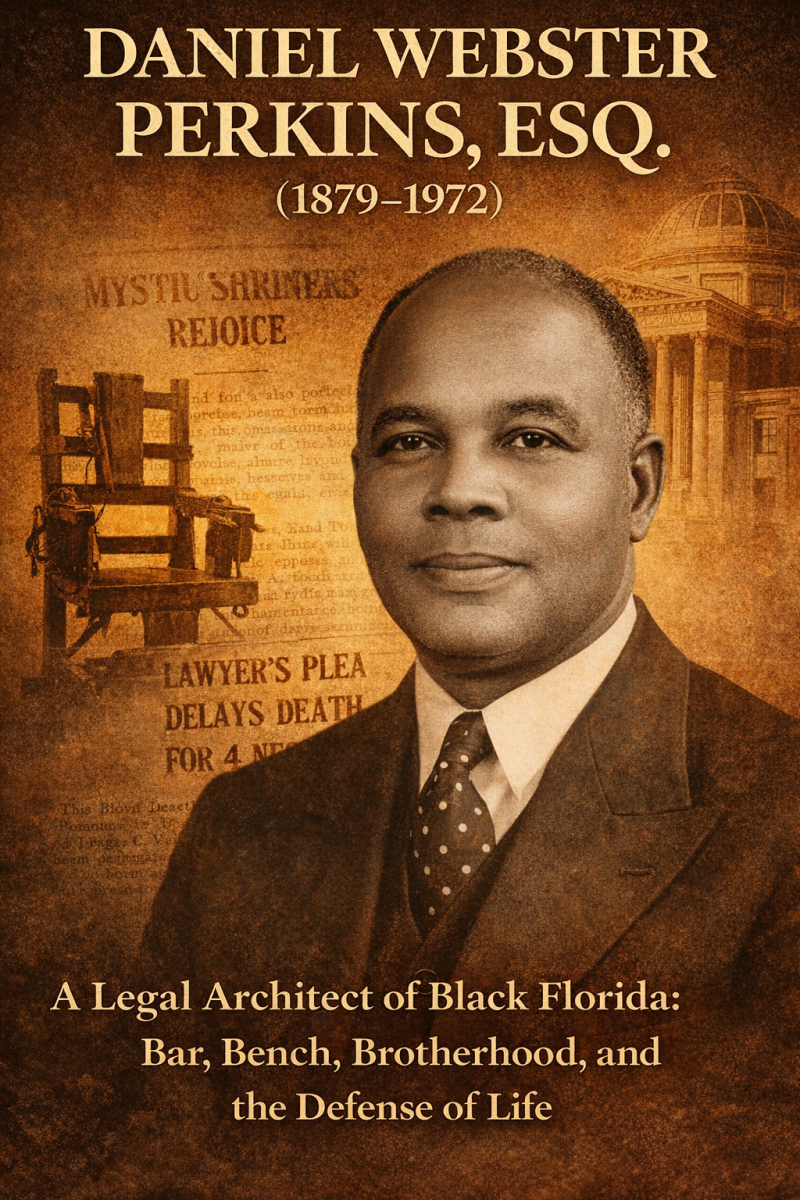
Daniel Webster Perkins, Esq. (1879–1972)
A Legal Architect of Black Florida: Bar, Bench, Brotherhood, and the Defense of Life
Introduction
Daniel Webster Perkins occupies a central place in the legal, civic, and fraternal history of Black Florida. Admitted to the Florida Bar in 1914, he was among the state’s earliest African American attorneys and one of the most enduring. His career unfolded across the most restrictive decades of Jim Crow, when the law frequently functioned less as a guarantor of rights than as an instrument of racial control. Perkins answered that reality not with spectacle, but with consistency—by practicing law at a level that compelled recognition, by defending Black institutions when they were threatened with erasure, and by stepping into the most perilous cases when constitutional protections were most likely to be ignored.
From early courtroom work in Tampa and Jacksonville to nationally reported victories defending Black fraternal sovereignty, from emergency interventions that halted executions to late-career leadership within the very organizations he once defended in court, Perkins’ life demonstrates how law could be used as architecture: something built carefully, reinforced repeatedly, and designed to last. The breadth of the record—newspapers across the country, professional associations, fraternal offices, and a modern courthouse dedication—confirms that his influence was structural rather than symbolic.
Early Life and Education: Preparing for a Hostile Profession
Born on January 9, 1879, in Elizabeth City, North Carolina, Daniel Webster Perkins came of age in the generation that inherited both the promises and the betrayals of Reconstruction. For African Americans with ambition, education offered one of the few durable defenses against exclusion. Perkins pursued that defense deliberately. He studied at North Carolina State Normal College, an institution dedicated to producing teachers and civic leaders, graduating in 1897. He continued his studies at Temple University in 1899, expanding his intellectual horizons beyond the South, before earning his law degree from Shaw University Law School in 1902.
This educational path mattered. Shaw’s law program emphasized constitutional doctrine, courtroom discipline, and ethical responsibility—qualities that Perkins would later insist defined Black legal professionalism. His training placed him among a small cohort of African American attorneys educated to meet the law on its own terms, capable of navigating both the technical demands of litigation and the racial hostility that often accompanied Black success in the profession.
Admission to the Florida Bar and Early Practice
Perkins was admitted to The Florida Bar in 1914, entering a profession that remained deeply segregated in practice if not always by statute. Florida’s courts were not welcoming spaces for Black attorneys, and advancement required both legal skill and personal resolve. Perkins began his practice with appearances in Tennessee and Florida, including Knoxville and Tampa, and quickly established himself as a working trial lawyer rather than a marginal practitioner.
Newspaper coverage from the mid-1910s places Perkins in active litigation within a year of his bar admission. These early reports are important not for their drama, but for what they imply: Perkins was trusted with serious matters and visible enough to attract press attention. He was building credibility in real time, case by case, within a legal culture that scrutinized Black attorneys harshly and waited for failure.
Jacksonville: Law in a Black Metropolis
In 1919, Perkins settled permanently in Jacksonville, Florida. At the time, Jacksonville functioned as the state’s Black metropolis—a city where African American institutions flourished despite segregation. Churches, fraternal halls, schools, newspapers, and civic leagues formed an interconnected civic ecosystem. Within that ecosystem, the Black lawyer occupied a pivotal role, translating grievances into legal claims and defending institutions against hostile forces.
Perkins’ Jacksonville practice became a fixture of this world. Known for disciplined courtroom conduct and careful preparation, he cultivated respect from judges and opposing counsel while mentoring younger Black attorneys. His presence helped normalize Black participation in Florida’s courts, not as novelty or protest, but as professional routine. Over decades, that normalization mattered as much as any single case. It signaled that Black legal authority could be sustained, not merely asserted.
Defender of Black Fraternal Sovereignty
The 1922 Shriners Injunction Case
One of Perkins’ most consequential legal victories came in 1922, when white Mystic Shriners sought an injunction in Tampa to prevent Black Shriners in Florida from using the Shrine name, insignia, regalia, and paraphernalia. The case threatened more than symbols. Fraternal organizations served as engines of mutual aid, leadership development, and public visibility for Black communities. To strip them of legitimacy was to undermine their very existence.
Perkins, identified in the press as legal adviser to the Masonic fraternity of the Most Worshipful Union Grand Lodge of Florida, met the challenge directly. A front-page article in The Buffalo American reported that the Circuit Court denied the injunction after Perkins dismantled the opposition’s arguments. The decision preserved the right of Black Shriners to operate publicly in Florida and sent a signal nationwide that Black fraternal bodies could defend their sovereignty in court.
National Recognition and Professional Standing
Perkins’ stature continued to grow. In January 1935, The Black Dispatch published a nationally syndicated column that named Perkins—alongside another Florida attorney—as one of “the strongest barristers of the legal profession in America.” The assessment emphasized that he practiced with “rare distinction” and according to the highest traditions of the law. This was not local boosterism. It was national recognition, published far from Florida, confirming that Perkins’ reputation extended beyond state lines.
From Legal Defender to Fraternal Statesman
By the late 1950s, Perkins’ relationship to Black fraternal life had matured into governance. A 1958 article in the Tampa Bay Times listing officers for the 59th Annual State Shriners Convention in Jacksonville names D. W. Perkins as “deputy” within Rabia Temple No. 8. The distinction is significant. The same article separately lists a B. J. Perkins as recorder, confirming that Daniel Webster Perkins held an executive role rather than a clerical one. The arc from courtroom defender to institutional leader underscores the trust placed in him over decades.
A Philosophy of Black Legal Professionalism
Perkins articulated his legal philosophy publicly in January 1942, writing in The Crisis about African American life in Jacksonville. Reflecting on Black lawyers in the city, he emphasized education, polish, and refinement—not as social affectations, but as professional necessities. He argued that Black attorneys, trained at leading law schools, ranked among the best in America and bore a special responsibility to protect the constitutional rights of the race.
These words carried weight because they were grounded in practice. Perkins had defended institutions, argued complex cases, and built a reputation under constant scrutiny. His essay stands as both reflection and instruction, offering a model of legal professionalism shaped by experience rather than theory.
The Raiford Case: Standing Between the State and Death
In August 1933, Perkins confronted the law at its most lethal edge. Four Black men—Izell Chambers, Jack Williamson, Charlie Davis, and Walter Woodward—were scheduled to die in Florida’s first planned quadruple execution at Raiford State Prison. Hours before the executions were to begin, the Florida Supreme Court granted a writ of error on Perkins’ plea, halting the deaths and returning the matter to the Broward County Circuit Court.
Perkins’ petition alleged that the men had been tortured into confessions by law-enforcement officers, subjected to prolonged abuse, threatened with firearms, and rushed to trial without being permitted to secure counsel of their own choosing. He asserted their innocence and argued that the convictions violated fundamental constitutional protections. The timing of the intervention—at the threshold of execution—made the case extraordinary. That the court paused at all speaks to the force of Perkins’ advocacy.
The case illustrates Perkins’ willingness to confront state power directly when life itself was at stake. It also demonstrates the risks borne by Black attorneys who challenged law enforcement in Jim Crow Florida. Perkins’ action was not symbolic. It was emergency lawyering in its starkest form, undertaken with full awareness of the personal and professional dangers involved.
Longevity, Reputation, and the Trial Lawyer’s Craft
Perkins’ career did not taper quietly. A 1953 article in The Miami News titled “Attorney Keeps Unblemished Record” documents his continued trial advocacy, judicial confidence, and spotless professional standing well into his seventies. In an era eager to discredit Black professionals, such a record confirms the respect Perkins earned across decades of practice.
Civic, Educational, and Professional Leadership
Beyond the courtroom, Perkins moved within a wide constellation of civic and professional organizations. His affiliations included Prince Hall Masonry, the Shrine, Knights of Pythias, Odd Fellows, Eastern Star, Heroines of Jericho, Bethel Baptist Institutional Church, the Business Men’s League, Afro-American Council, Civic League, National Bar Association, NAACP, Jacksonville Urban League, YMCA, and the Negro Business League. He also served on New Deal–era advisory bodies, including the WPA Educational Council and the NYA Advisory Council, linking law to education and public policy.
This breadth reflects Perkins’ belief that legal advocacy, civic organization, and economic development were inseparable. Law did not stand alone; it functioned as part of a broader architecture of Black survival and advancement.
Honors, Memory, and the Meaning of Place
Perkins’ peers recognized his influence during his lifetime. In 1968, the Colored Lawyers Association renamed itself the D. W. Perkins Bar Association, honoring a founding member whose standards shaped the profession. Decades later, his legacy received a permanent civic marker. In June 2022, the Daniel Webster Perkins Jury Assembly Room was dedicated at the Duval County Courthouse, with a public plaque unveiling in January 2024. The location is symbolically precise: the space where jurors assemble now bears the name of a lawyer who spent his life insisting that judgment be lawful, humane, and constitutional.
Conclusion
Daniel Webster Perkins’ legacy is cumulative and enduring. He defended Black institutions when they were vulnerable, intervened for individuals when death was imminent, and modeled a professional identity grounded in discipline, courage, and longevity. The documentary record—national newspapers, courtroom victories, fraternal leadership, and a courthouse dedication—establishes him as one of Florida’s central legal architects of the twentieth century. His life demonstrates how law, practiced consistently and courageously, could become a tool of survival, dignity, and permanence in a hostile landscape.
