
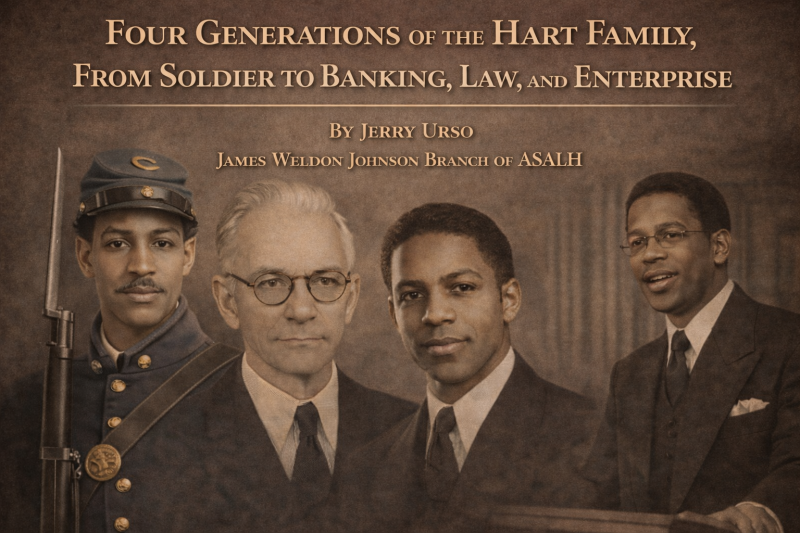
Four Generations of the Hart Family,
From Masonry to Banking, Law, and a New Generation of Black Enterprise
By Jerry Urso, FPS-Life
James Weldon Johnson Branch of ASALH
Sylvanus Henry Hart was born on August 29, 1860, in Darlington, South Carolina, at a moment when slavery still governed the legal order of the American South. Although he entered the world free, freedom itself was precarious, constrained by violence, custom, and the constant effort required for Black families to defend their place in public life. That tension shaped the Hart family long before Jacksonville became their home and explains why their story is best understood not as a sudden ascent, but as a careful, intergenerational construction of stability and purpose [1].
Reconstruction Foundations, Eli Hart and the Discipline of Skilled Labor
The family’s foundation was laid by Eli Hart, born in South Carolina in the 1820s. A skilled brick mason, Eli Hart belonged to a generation of free Black artisans whose trades anchored survival during slavery and became engines of advancement after emancipation. Masonry placed him at the center of permanence, courthouses, churches, and commercial blocks, structures meant to outlast shifting political promises.
During the Civil War, an Eli Hart appears in federal records as serving in the 31st United States Colored Troops, mustered in 1864 and discharged in November 1865. Although preserved within New York military record systems, such geography reflects federal recordkeeping rather than birthplace. Black soldiers, particularly those born in Southern states, frequently enlisted through Northern recruitment centers or were assigned federally to United States Colored Troops regiments. The timing, race, and postwar trajectory align closely with the Eli Hart who soon after appears in Jacksonville as a skilled tradesman, head of household, and civic participant [2].
After the war, Eli Hart settled in Jacksonville, a city transformed by Reconstruction into a magnet for freedpeople and skilled workers. He appears in the 1870 census as a brick mason and a male citizen over the age of twenty-one and later opened an account with the Freedman’s Savings and Trust Company, signaling early engagement with formal banking during the uncertain years of Black reintegration into the postwar economy. By 1880 he headed a household in Hansontown, one of Jacksonville’s emerging Black neighborhoods. Eli Hart died in August 1884 in LaVilla, but the habits he modeled, skill, saving, and civic presence, had already taken root [3].
Jim Crow’s Ascent and the Turn to Civic Leadership
Growing up in Hansontown and coming of age in LaVilla, Sylvanus Henry Hart learned his father’s trade. He worked as a brick mason and building contractor, inheriting the discipline of skilled labor. Yet as Reconstruction collapsed and Jim Crow narrowed Black political avenues, Black communities increasingly relied on parallel institutions to preserve self-governance and collective stability.
In 1887, Hart stepped into public life as Clerk of the Town of LaVilla, a predominantly Black municipality that functioned as a rare enclave of Black governance on the edge of Jacksonville. LaVilla’s officers managed records, property, and local administration at a time when Black authority was being systematically stripped elsewhere in Florida. Fraternal life reinforced this civic standing. In 1893, Hart appears as a member of St. Johns Lodge No. 14 under the Most Worshipful Union Grand Lodge of Florida, Prince Hall Affiliation, a network that trained Black men in leadership, mutual aid, and institutional trust during the tightening grip of segregation [4].
Building Capital in a Segregated Economy
The turn of the twentieth century brought both danger and possibility. Jacksonville’s Black population expanded rapidly, yet access to capital remained restricted by race. In response, Hart undertook a bold experiment. On October 6, 1902, he founded the Capital Trust and Investment Company at 11 Cedar Street, now Pearl Street, launching Florida’s first Black-owned bank. Hart served as president alongside E. W. Robinson as secretary, George H. Mays as treasurer, and a board whose confidence in Black financial stewardship was unmistakable [5].
The bank prospered against formidable odds. By 1904 it held $20,000 in paid-in capital and served approximately 500 depositors, including white clients, an extraordinary measure of trust in a Jim Crow city. By 1907, the institution maintained exchange relations with major New York banks and joined the Bankers’ Money Order Association, issuing financial instruments payable nationally and abroad [6].
Hart’s rise coincided with Jacksonville’s rebuilding after the Great Fire of 1901, when reconstruction demanded credit, coordination, and confidence. As both builder and banker, Hart stood at the intersection of labor and finance, channeling Black earnings into homes, businesses, and education. By 1912 his personal worth exceeded $100,000, more than $3.2 million today, and the family resided at 512 West Ashley Street in LaVilla, a visible marker of permanence in an era designed to deny it [7].
Modern historical scholarship has since re-centered Hart’s bank within Jacksonville’s broader Black business ecosystem, recognizing Capital Trust and Investment Company as one of the city’s foundational, yet long overlooked, Black-owned enterprises of the early twentieth century [8].
World War I, Return Home, and the Law
The years surrounding World War I marked a generational shift. Black men enlisted in large numbers, hoping military service would yield citizenship dividends long denied at home. Although segregation followed them into uniform, service expanded horizons and sharpened expectations. Hart’s son, Sylvanus Henry Hart Jr., belonged to this cohort. A World War I veteran, he returned home to Jacksonville to find that the democracy he had defended abroad remained rationed at home.
Like thousands of Black veterans, Hart Jr. returned to segregated rail cars, restricted housing, and a legal system that offered little protection from discrimination. Rather than withdraw from public life, he advanced into it, entering legal practice in Jacksonville during the late 1910s. Newspapers of the period identify him as an attorney at law practicing in the city’s commercial core, where Black veterans and families increasingly required legal counsel to navigate contracts, property disputes, and racialized barriers. For Hart Jr., the law became both shield and instrument, transforming military service into professional advocacy during the height of Jim Crow [9].
Boom, Bust, and Foresight
The 1920 census captures four generations of the Hart family under one roof, Sylvanus Henry Hart, his wife Emma, their son, attorney Sylvanus Henry Hart Jr., and a five-year-old grandson, Sylvanus Henry Hart III. The boy grew up during the optimism of the 1920s, even as inequality persisted nationwide [10].
Hart himself traveled widely, spending six months in Europe in 1913 and later time in Cuba and Mexico, and by 1924 maintained a residence at 76 Edgecombe Avenue in Harlem, situating the family within the Black Atlantic world of finance and culture. When Hart closed his bank in 1926, every depositor was paid in full. That foresight spared families the devastation that followed the 1929 stock market crash, when bank failures wiped out Black savings at disproportionate rates [11].
The Fourth Generation Comes of Age
In December 1934, the Florida Times-Union published a photograph identifying Sylvanus Henry Hart III, explicitly styled “the 3rd,” upon his induction into the Revelers Club, a Black professional and social organization. The image marks the fourth generation’s public emergence as a young businessman, coming of age in the shadow of the Great Depression while carrying forward a culture of enterprise and civic engagement forged across slavery, Reconstruction, Jim Crow, and war [12].
A Continuous Legacy
Across four generations, the Hart family charted a path few Black families were permitted to walk continuously. Eli Hart, a free Black mason and probable United States Colored Troops veteran, built stability through skill and saving. Sylvanus Henry Hart transformed that foundation into civic authority and financial infrastructure during Jim Crow’s rise. Sylvanus Henry Hart Jr. returned from World War I to carry the legacy into the law. Sylvanus Henry Hart III stepped forward as a young business leader during the Depression.
In a nation determined to interrupt Black progress, the Harts endured, building, adapting, and transmitting purpose. Their story is not exceptional because it is triumphant, but because it is continuous.
References
[1] University of North Florida, biographical profile of Sylvanus Henry Hart.
[2] U.S. Civil War Muster Roll Abstracts, 1861–1900, entry for Eli Hart, 31st United States Colored Troops.
[3] U.S. Census, 1870 and 1880, Duval County, Florida; U.S. Freedman’s Savings and Trust Company Records, Jacksonville Branch; U.S. Census Mortality Schedule, 1885.
[4] Canter Brown Jr., Florida’s Black Public Officials, 1867–1924; Proceedings of the Most Worshipful Union Grand Lodge of Florida, 1893.
[5] Florida Times-Union, October 1902, Capital Trust and Investment Company announcement.
[6] Florida Times-Union, 1904–1907 banking coverage; Proceedings of the American Bankers’ Association.
[7] Florida Times-Union, 1912, wealth and residence notices.
[8] The Jaxson Magazine, “5 Forgotten Early 20th-Century Black-Owned Businesses.”
[9] Jacksonville Journal and Florida Times-Union, 1917–1920, World War I and legal notices.
[10] U.S. Census, 1920, Duval County, Florida.
[11] Florida Times-Union, travel and banking notices, 1913–1926.
[12] Florida Times-Union, December 9, 1934, Revelers Club photograph and caption.
Secondary References
University of North Florida archival portrait and summaries; assorted Jacksonville newspapers for civic and social notices.
