
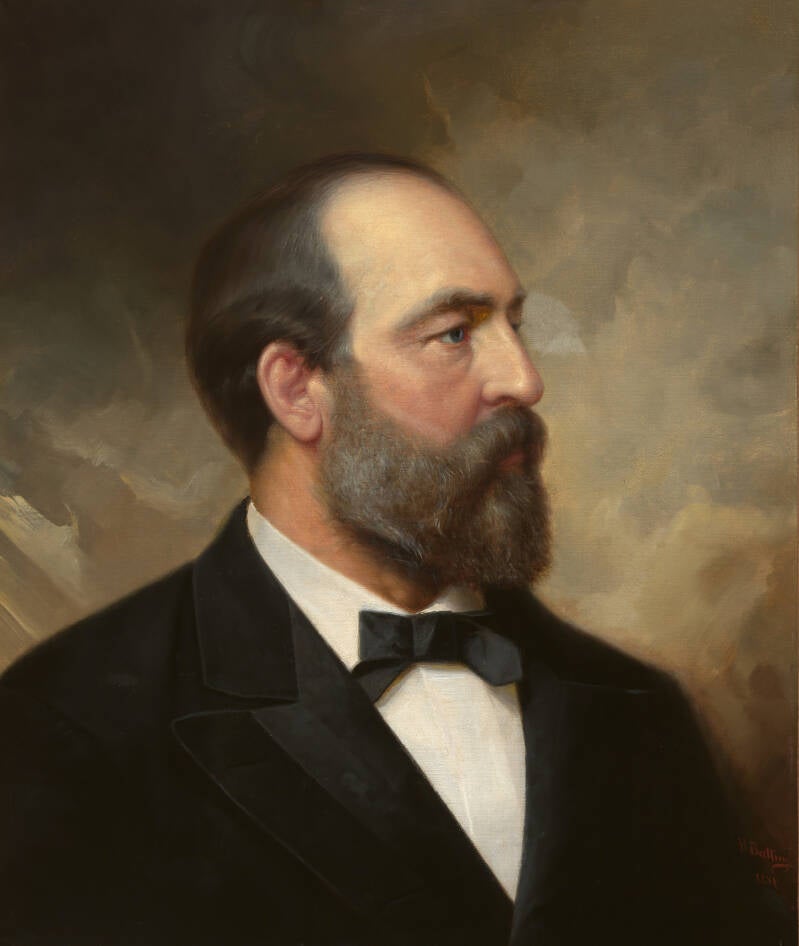
“What If”
Brother James Abram Garfield 20th President of the United States
Hon. Jerry Urso FPS-Life
“A brave man is a man who dares to look the Devil in the face and tell him he is a Devil”
James Garfield
White House Historical Association
Abstract
In the great halls of democracy where statues are erected, and names are immortalized one is entitled “What If”. James Abram Garfield was the last of the log cabin presidents. An ordained minister who invoked the name of the creator and followed the beatitudes of Jesus the Christ as equal to the Ten Commandments. He served in the Union Army as a General but led not with the sword but with righteousness and humility. Born impoverished and one of the most unlikely of men to occupy the white house James A. Garfield was the embodiment of the widowed son. His approach to Civil Rights was broad in scope as any we have seen even to this present day. He was ready to bring the troops back into the south to preserve reconstruction and break the backs of the Klan once and for all. James Garfield Was the Only U.S. President to prove a Math Theorem.
Early Life
James Garfield was born on November 19, 1831, to Abram and Eliza Ballou Garfield. When his father died in 1833, Eliza was left in an impoverished state. To assist his mother, James took on various jobs. At the age of sixteen, he ran away to work on the canal boats that shuttled commerce between Cleveland and Pittsburgh. During his six weeks on the boats, he fell overboard fourteen times and eventually caught a severe fever that forced him to return home. While recovering, Garfield made a vow to make his way in the world using his brains rather than his brawn. (1)
At age eighteen, Garfield experienced a religious conversion and was baptized into the denomination of his parents, the Disciples of Christ. In 1850, he enrolled at Williams College, where he thrived intellectually. He relished the opportunity to hear the renowned thinker Ralph Waldo Emerson and was both challenged and inspired by the strong personality of the college’s president, Mark Hopkins. Garfield saw himself as a reformer, strongly identifying with the antislavery ideals of the emerging Republican Party. These convictions would only deepen with time, shaping both his rise as a Union general during the Civil War and his later career in politics. After graduating from Williams College with honors in 1856, Garfield returned to the Western Reserve Eclectic Institute (now Hiram College) as a faculty member. Although officially appointed as an instructor in classical languages, he taught a broad range of subjects, including English, history, geology, and mathematics. (2)
The Civil War
In August 1861, James A. Garfield organized the 42nd Ohio Infantry and quickly rose from lieutenant colonel to full colonel within a matter of weeks. On January 10, 1862, he led Federal forces against Confederate troops commanded by Humphrey Marshall at the Battle of Middle Creek. Despite being greatly outnumbered, Garfield’s tactical skill led to a decisive Union victory and the collapse of Confederate control in Eastern Kentucky. His military acumen earned him steady advancement in the Union Army. By September 1863, during the Battle of Chickamauga, Garfield—now a major general and the youngest officer to hold that rank—made a daring ride under enemy fire to relay critical orders. He also served as chief of staff to Major General William S. Rosecrans, commander of the Army of the Cumberland. Before leaving military service to return to politics, (3)
Politics
Garfield was elected to the Ohio State Senate in 1859, serving until 1861. In 1862, while still in military service, he was elected to the U.S. House of Representatives to represent Ohio’s 19th district, where he would serve for nearly two decades. During his time in Congress, Garfield became known as a skilled orator and a staunch supporter of the gold standard. On civil rights, he took a more moderate stance than some of his Republican contemporaries, advocating gradual progress rather than radical change. Before the Civil War, Garfield opposed John Brown’s raid on Harpers Ferry, viewing it as misguided, yet he recognized that Brown’s trial and execution would become a pivotal moment—a spark that would help ignite the national conflict. (4)
Presidential Election
While attending the 1880 Republican National Convention, James A. Garfield had no intention of seeking the presidential nomination; he was there to support his friend, Secretary of the Treasury John Sherman. However, after multiple deadlocked ballots and growing frustration among delegates, Garfield unexpectedly emerged as the compromise candidate. On the 36th ballot, he was nominated as the Republican Party’s “dark horse” candidate. In the general election, Garfield narrowly defeated Democratic nominee General Winfield Scott Hancock, winning the presidency by a margin of just 10,000 popular votes, though his victory in the Electoral College was more decisive.
Mathematics
James A. Garfield was the first person to use the properties of trapezoids to prove the 47th Proposition of Euclid — more commonly known as the Pythagorean Theorem. His elegant and original proof stands alone in its ingenuity; any subsequent attempt to use trapezoids in proving the theorem has inevitably mirrored his method. Garfield’s paper remains the only known proof of the Pythagorean Theorem that employs trapezoids, a testament to his sharp intellect and creative reasoning. Yet, his brilliance in mathematics was matched by a profound spiritual insight. (5)
Freemasonry
Brother James A. Garfield became a Freemason in Ohio shortly after his election to Congress, joining Columbus Lodge No. 30 in Columbus. He remained affiliated with that lodge until May 4, 1869, when he demitted to help establish Pentalpha Lodge No. 23 in Washington, D.C. Garfield is listed as a charter member of Pentalpha Lodge and remained an active member until his death. In 1866, he became a Knight Templar through Columbia Commandery No. 2 in Washington, D.C. He was also a Master Mason and a member of the Scottish Rite, receiving the 4th through 14th degrees from the renowned Freemason Albert Pike in 1872. (6)
Prince Hall Freemasonry
National Park Service
James A. Garfield became well-known for his "front porch" speeches during the 1880 presidential campaign, delivered from his home in Mentor, Ohio. Among the many visitors were influential African Americans, including numerous veterans of the United States Colored Troops, who came to show their support. Garfield's inauguration on March 4, 1881, held particular significance for African Americans. It marked the first time African Americans participated in a presidential inaugural parade. The procession included African American troops, members of the Odd Fellows, and African American Freemasons—all of whom helped escort the President-elect to the Capitol for the swearing-in ceremony. (7)
Garfield, a committed Freemason, was deeply involved in the Masonic community in Washington, D.C. He invited his own Knights Templar Commandery, Columbia Commandery No. 2, to serve as his personal guard during the inauguration. Columbia Commandery remained closely associated with Garfield throughout his brief presidency and solemnly accompanied his remains to their final resting place following his assassination. (7)
James A. Garfield became acquainted with James Wormley, a prominent African American nurse, caterer, and hotelier whose reputation had grown nationally and internationally in the decade prior to the Civil War. Wormley, the son of free Black parents who arrived in Washington, D.C., in 1814, began operating a series of boarding houses and a restaurant on I Street NW between 15th and 16th Streets—just a block north of Lafayette Square and near St. John's Church, often called the "President's Church." Wormley’s influence extended beyond hospitality; he was also a dedicated Freemason. He was initiated, passed, and raised in Laurel Lodge No. 2 in Philadelphia, a lodge of Black Masons, on January 1, 1823. He later helped found the first lodge of Black Masons in Washington, D.C.—Social Lodge No. 7 (later renumbered as No. 1). In June 1825, he was listed as a founding member of the District of Columbia chapter of the Freemasons in Lodge No. 7. Wormley also served as Junior Deacon in the Most Worshipful Acacia Grand Lodge of Free and Accepted Masons of the District of Columbia, which was later renamed the Most Worshipful Prince Hall Grand Lodge of the District of Columbia in 1944. (8)
This historic event symbolized a major step forward in the inclusion of African Americans in public life and national celebrations, reflecting Garfield’s advocacy for civil rights and the growing civic presence of African American communities in the post-Civil War era.
Inauguration
Following the Compromise of 1877, which effectively ended Reconstruction and led to the withdrawal of federal troops from the South, James A. Garfield confronted the deep racial divisions in the United States head-on. In his inaugural address, he underscored the significance of African American citizenship with the following words:
“The elevation of the negro race from slavery to the full rights of citizenship is the most important political change we have known since the adoption of the Constitution of 1787. No thoughtful man can fail to appreciate its beneficent effect upon our institutions and people. It has freed us from the perpetual danger of war and dissolution. It has added immensely to the moral and industrial forces of our people. It has liberated the master as well as the slave from a relation which wronged and enfeebled both. It has surrendered to their own guardianship the manhood of more than 5,000,000 people, and has opened to each one of them a career of freedom and usefulness. It has given new inspiration to the power of self-help in both races by making labor more honorable to the one and more necessary to the other. The influence of this force will grow greater and bear richer fruit with the coming years.”
Garfield believed strongly in the protection of African American civil rights. He advocated for the return of federal troops to the South to ensure free and fair elections and to defend African Americans from escalating violence and intimidation, particularly from the Ku Klux Klan and other white supremacist groups. Though his presidency was tragically cut short, Garfield’s stance reflected a continued commitment to the promises of Reconstruction and the expansion of justice and equality in post-Civil War America. (9)
Death
National Archives
On July 2, 1881, President James A. Garfield, the 20th president of the United States, was shot by Charles J. Guiteau at the Baltimore and Potomac Railroad Station in Washington, D.C. The attack occurred less than four months into Garfield’s presidency. Though he initially survived the shooting, Garfield endured months of suffering before dying on September 19, 1881, in Elberon, New Jersey. He became the second American president to be assassinated, following Abraham Lincoln in 1865. Guiteau, who claimed he acted out of political vengeance, was tried for murder, found guilty, and executed by hanging one year later.
Historian David Oshinsky discusses Garfield's medical care in his fascinating new book Bellevue: Three Centuries of Medicine and Mayhem at America's Most Storied Hospital: “Had the responding physicians ... done nothing more than make Garfield comfortable,” Oshinsky writes, “he almost certainly would have survived. Instead they searched clumsily for the bullet, inserting unwashed fingers and filthy probes into the open wound.” (10)
At the time President Garfield was shot, Alexander Graham Bell was working in a laboratory in Washington, D.C. Like many Americans, he followed the unfolding tragedy through newspaper reports and grew increasingly alarmed by the president’s deteriorating condition. Garfield’s physician, Dr. Willard Bliss, was fixated on locating and removing the bullet lodged in the president's body, repeatedly probing the wound by hand—often causing more harm than good.
Determined to help, Bell believed he could invent a device to locate the bullet using principles he had encountered during his earlier experiments with the telephone. While trying to eliminate static interference in telephone lines, Bell had discovered that the presence of metal objects affected the induction balance circuit he was developing. He realized this phenomenon could be adapted into a metal-detecting device. Bell quickly went to work, hoping that his invention would allow Bliss to safely extract the bullet and save the president's life. (11)
According to an article in the New York Herald dated July 26, 1881, Wormley was immediately sought out to prepare the meals of the President by the attending physician, Dr. Willard Bliss. One of the foods most requested by the President was something called “beef tea.” This concoction was prepared from the finest tenderloin available. The meat was placed upon a broiling iron, not to cook but to sear the surface. It was then placed into a mechanical press provided by Wormley’s which compressed the meat with a pressure of 300-400 pounds until all the juices had been squeezed out of the steak. (12)
Legacy
During his brief time in office, Garfield made historic strides toward racial equality and civil rights. He appointed several prominent African Americans to significant federal positions, including Frederick Douglass, John M. Langston, Blanche K. Bruce, and Robert Elliott. These appointments were bold and unprecedented at the time, signaling a clear commitment to inclusion and progress—distinct from the cautious approaches of prior administrations.
Garfield’s legacy remains one of the great “what ifs” in American history. What if federal troops had returned to the South to protect African Americans from voter suppression and violence? What if Garfield had lived to fulfill the promises of his inaugural address—promises of unity, equality, and national healing?
While we can never fully know what might have been, what we can say with certainty is this: James A. Garfield lived as a man of God, a Brother in Freemasonry who upheld his oaths, and a leader who believed in equal rights for all. His life, though tragically brief, stands as a testament to the enduring power of integrity, faith, and the pursuit of justice.
- https://millercenter.org/president/garfield/life-before-the-presidency
- President Garfield From Radical to Unifier By CW Goodyear
- President Garfield: From Radical to Unifier By CW Goodyear
- The Presidential election of 1880 Hardcover – January 1, 1958 by Herbert J. Clancy
- The Mathematical Magazine A Journal of Elementary and Higher Mathematics · Volume 1, Issue 1 1882
- Chris Ruli Grand Historian and Librarian Grand Lodge of the District of Columbia, F.A.A.M.
- National Park Service
- Tehuti Evans Grand Historian The Most Worshipful Prince Hall Grand Lodge of the District of Columbia,
- https://www.presidency.ucsb.edu/documents/inaugural-address-39
- Bellevue: Three Centuries of Medicine and Mayhem at America's Most Storied Hospital: David Oshinsky
- National Park Service
- National park Service
