
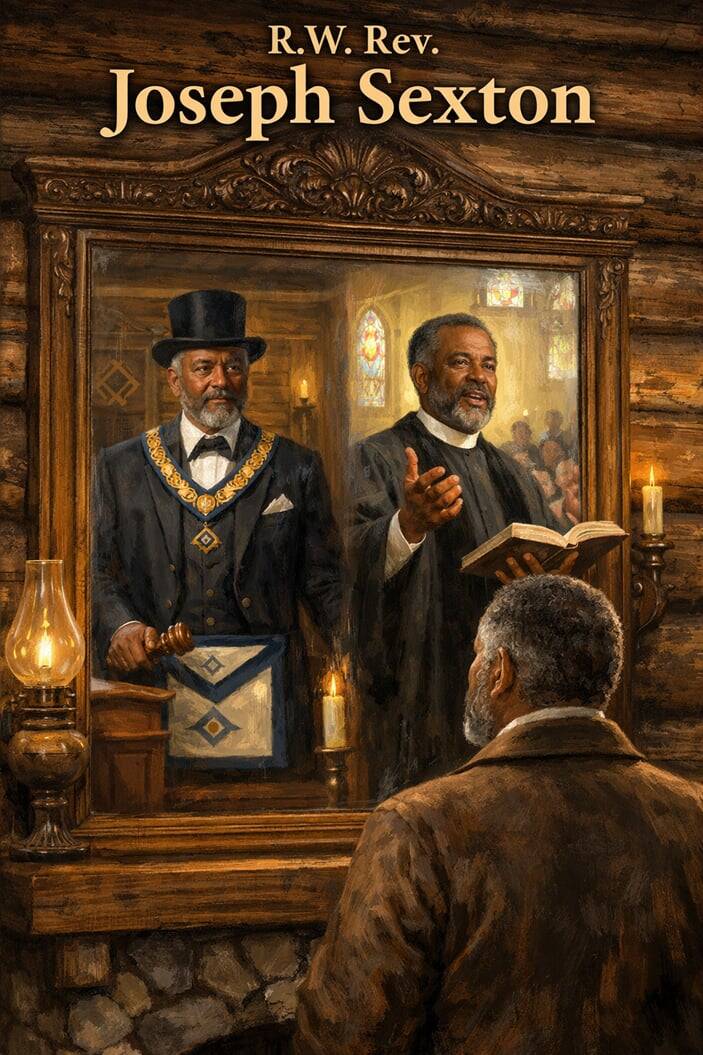
Rev. Joseph Sexton
Faith, Brotherhood, and the Quiet Architecture of Freedom
By Jerry Urso, FPS–Life
Grand Historian, Most Worshipful Union Grand Lodge of Florida, P.H.A.
Freedom did not arrive gently for Joseph Sexton’s generation. It arrived abruptly, unevenly, and without a map. Emancipation ended bondage, but it did not instantly create stability. Communities that had survived slavery now had to learn how to survive freedom—how to organize themselves, how to lead themselves, and how to hold together under new and unfamiliar pressures. Into that unsettled world stepped Rev. Joseph Sexton, not as a man seeking recognition, but as one willing to accept responsibility wherever it appeared.
The official record does not describe Sexton as dramatic or controversial. It does not frame him as a reformer with a singular vision or as a figure who dominated headlines. Instead, it reveals something far more telling: persistence. Across decades, his name appears steadily in church reports, conference proceedings, Masonic notices, and newspaper accounts—not because he demanded attention, but because he was consistently present where steadiness was required [1–19].
That quiet consistency is the key to understanding his life.
A Calling Formed After Emancipation
Joseph Sexton came of age in the years following emancipation, when African Americans were learning not only how to be free, but how to remain free together. Freedom, once achieved, required new forms of discipline and shared responsibility. For many, the church became the first place where those lessons could be learned.
Sexton turned toward the African Methodist Episcopal Zion Church, a denomination born of resistance to racial exclusion and strengthened by its abolitionist past [20][22]. Mother Zion had long understood that freedom without structure was fragile. Its ministers were expected to do more than preach salvation; they were expected to organize lives, build institutions, and model disciplined leadership.
After studying for the ministry following emancipation, Sexton accepted that calling fully [2]. He entered a tradition that prized movement over comfort and responsibility over permanence. Zion ministers were sent where congregations were weak, where leadership was still forming, and where order had not yet replaced uncertainty.
Ministry Under Open Skies
By 1871, Sexton was already trusted with leadership. A Florida newspaper records him presiding over a camp meeting near Simmons’ Hammock, one of the large outdoor gatherings that served as both religious revivals and communal assemblies for newly freed people [1]. Camp meetings were often the first public institutions freedpeople experienced after slavery. They were places of worship, but also of instruction, discipline, and communal rebuilding.
To preside over such a gathering required more than eloquence. It required patience, judgment, and moral authority. Sexton would have stood before people still carrying the memory of bondage and the anxiety of uncertainty, offering not only scripture, but reassurance that community and order were still possible.
In these early moments, Sexton’s ministry took shape not as performance, but as presence.
Florida Roads and the Weight of Responsibility
Sexton’s roots lay in Fort Meade, Polk County, where he was raised, but his ministry quickly pulled him outward [2]. He spent four years stationed in Pensacola, a port city whose docks connected Florida to the wider world. Pensacola was a place of opportunity and instability, where Black labor sustained commerce but social tension remained constant.
To serve in Pensacola required resilience. It was a city where leadership was tested daily, and Sexton’s long tenure there suggests that he possessed the steadiness required to remain. His work followed the same roads and waterways traveled by Black Floridians themselves, responding to need rather than convenience.
Everywhere he went, Sexton brought structure—organizing congregations, modeling discipline, and helping communities transition from survival to stability.
Crossing Water: Nassau and a Wider Horizon
In 1878, Sexton undertook a journey few ministers of his era would attempt. Traveling from Florida to Nassau, New Providence, by way of Key West, he crossed not only water, but jurisdiction and expectation [2]. He did not go as a visitor. He stayed for two years, assisting in the organization of churches in the Bahamas.
This work coincided with the A.M.E. Zion Church’s formal establishment of the Bahama Island Annual Conference, anchoring denominational life in the Caribbean [21]. Sexton’s role placed him among early African American religious leaders who extended structured church governance beyond the United States.
Crossing water carried risk. It also required trust. Sexton was sent because those who knew his work believed that institutions left in his care would endure. His ministry in Nassau formed part of a broader Black Atlantic network, linking Florida, Key West, and the Caribbean through faith, migration, and institutional responsibility.
Returning Home Seasoned and Known
When Sexton returned to Florida, he returned changed. Through the 1880s and 1890s, his name appears steadily in connection with church conferences, public gatherings, and Emancipation Day celebrations [3][4]. These mentions were not fleeting. They reflected recognition—quiet acknowledgment that Sexton had become someone others relied upon.
By the turn of the twentieth century, Tampa knew him well. He was no longer simply an itinerant preacher. He was an elder presence—measured, dependable, and respected—whose counsel mattered when decisions were being made [9–13].
In these years, Sexton embodied continuity. As generations shifted and communities evolved, he remained—a stabilizing figure whose long service lent credibility to the institutions he represented.
The Lodge and the Discipline of Brotherhood
Alongside his life in the pulpit, Sexton devoted himself deeply to Prince Hall Freemasonry. The lodge offered something complementary to the church: discipline, structure, and leadership training rooted in accountability. Where the church shaped conscience, the lodge shaped conduct.
Newspaper records place Sexton repeatedly within Grand Lodge activity in Florida, confirming his recognized standing within the Craft [5–7]. He was publicly identified as Right Worshipful Brother Joseph Sexton, holding the office of Territorial Grand Master [6].
In Prince Hall Masonry, such titles were never ornamental. A Territorial Grand Master was entrusted with oversight where the Craft was still developing—often beyond the borders of an established Grand Lodge. Authority was given only to men whose judgment had been tested and whose character was proven.
Territorial Grand Master of the Bahamian Islands
The fullest measure of Sexton’s Masonic stature appears at the close of his life. His obituary states plainly that he was a high-degree Mason and Territorial Grand Master of the Bahamian Islands [19]. That single line confirms decades of service and trust.
It reveals that Sexton’s authority crossed water just as his ministry once had. He governed Masonic affairs in the Bahamas with the same steadiness he brought to church organization years earlier. When he died in February 1909, all Masons were formally called to assemble—a summons reserved for leaders whose passing marked a genuine loss to the Craft [19].
The Closing of a Life
Rev. Joseph Sexton died after more than sixty years in Hillsborough County, Florida [19]. At the time of his death, he was still serving as a presiding elder in the A.M.E. Zion Church. Newspapers remembered him not for spectacle, but as one of Tampa’s most respected African American citizens.
His estate was quietly settled through probate, naming Levin Armwood as executor [18]. The closing of his civil affairs mirrored the way he lived—orderly, deliberate, and without excess.
Why His Life Still Speaks
Joseph Sexton did not leave behind statues or manifestos. What he left behind were institutions that worked.
In an age when freedom arrived without instructions, he understood that liberty needed structure to survive, discipline to endure, and moral leadership to give it shape. Through the church, he steadied souls learning how to live free. Through the lodge, he trained men to lead with restraint and accountability.
When the work called him across water, he went.
When stability required his presence, he stayed.
And when authority was entrusted to him, he carried it without spectacle.
Long after his voice fell silent, his name continued to appear—quietly and reliably—in conference minutes, Masonic notices, and the official record [17][19]. That is not dull history. That is the quiet architecture of freedom.
References
[1] Florida Peninsular (Jacksonville, FL), Sept. 23, 1871, p. 2.
[2] The Weekly Tribune (Florida), Mar. 16, 1878, p. 3.
[3] The Weekly Tribune (Florida), Mar. 5, 1881, p. 3.
[4] Florida Times-Union (Jacksonville, FL), Feb. 14, 1892, p. 5.
[5] Jacksonville Journal, Jan. 16, 1902, p. 6.
[6] Jacksonville Journal, Jan. 20, 1902, p. 6.
[7] Florida Times-Union, Jan. 17, 1902, p. 8.
[8] Jacksonville Journal, Jan. 17, 1903, p. 12.
[9] The Tampa Tribune, Oct. 1, 1903, p. 7.
[10] Jacksonville Journal, Jan. 6, 1904, p. 7.
[11] Jacksonville Journal, Feb. 20, 1905, p. 7.
[12] Jacksonville Journal, Feb. 21, 1905, p. 7.
[13] The Tampa Tribune, Feb. 28, 1907, p. 8.
[14] Jacksonville Journal, Oct. 29, 1908, p. 15.
[15] Jacksonville Journal, Oct. 30, 1908, p. 19.
[16] Jacksonville Journal, Jan. 21, 1909, p. 15.
[17] Jacksonville Journal, Mar. 24, 1909, p. 15.
[18] Jacksonville Journal, Probate Notice, Feb. 1909.
[19] “Joseph Sexton Dead—One of Best Known Negro Characters in City Passes Away,” Florida newspaper obituary, Feb. 1909.
[20] Mother African Methodist Episcopal Zion Church, historical overview.
[21] John Jamison Moore, History of the A.M.E. Zion Church in America (1884).
[22] New York City Landmarks Preservation Commission, Mother A.M.E. Zion Church Designation Report (1993).
