
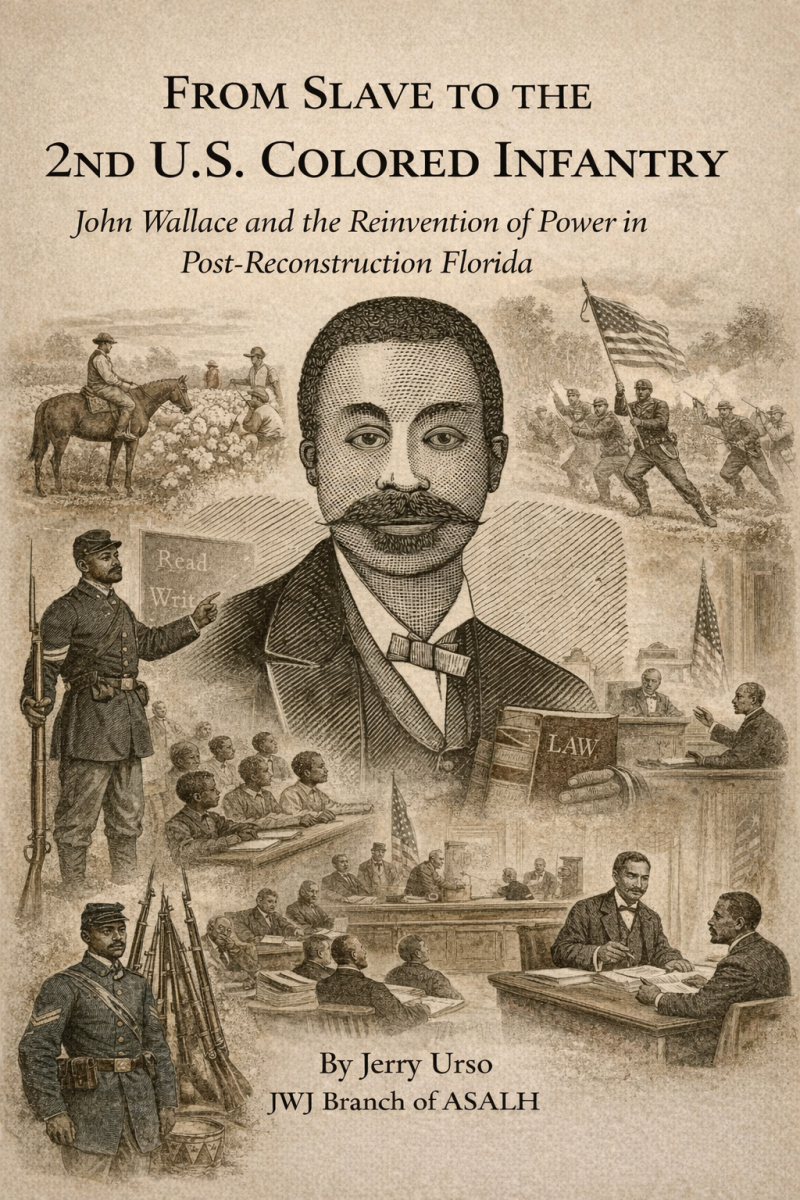
From Slave to the 2nd U.S. Colored Infantry
John Wallace and the Reinvention of Power in Post-Reconstruction Florida
Soldier, State Senator, Attorney, and the Contested Voice of Reconstruction
By Jerry Urso
JWJ Branch of ASALH
Born in Slavery, Formed in War
John Wallace was born enslaved in Gates County, North Carolina, in 1842 [1]. His early life unfolded within a system designed to suppress literacy, autonomy, and political identity. That world fractured in February 1862 when Federal troops moved through eastern North Carolina. During that campaign Wallace gained his freedom [1].
Freedom alone did not secure status or protection. Like thousands of newly emancipated men, Wallace sought permanence through Union service. On August 15, 1863, he enlisted in Company D of the Second United States Colored Infantry [1]. His enlistment papers indicate he signed with an “X,” suggesting that at the time of enlistment he could not write his name [1].
The regiment trained at Camp Casey in Virginia before deployment to Ship Island, Mississippi, in December 1863 [1]. Ship Island functioned as a Union staging ground in the Gulf, and from there Wallace’s military journey brought him to Florida.
On February 13, 1864, his unit was transferred to Key West [1]. According to Irvin D. Solomon’s study of Fort Myers during the Civil War, companies of the 2nd U.S. Colored Infantry participated in operations across southwest Florida, including actions near Fort Myers and along the Gulf Coast [2]. Wallace later claimed that during one of these engagements an exploding cannonball threw dirt into his eyes, an injury he asserted affected him for the remainder of his life [1].
In March 1865, Wallace took part in the Union expedition that culminated in the Battle of Natural Bridge near Tallahassee [1]. Confederate forces repelled the advance, preserving Tallahassee as the only Confederate capital east of the Mississippi not captured before Lee’s surrender [1]. Wallace remained in service until he was mustered out on January 5, 1866 [1].
Between enlistment and discharge, Wallace learned to read and write [1]. War had not only liberated him from bondage; it introduced him to discipline, organization, and federal authority. Those experiences would become the foundation of his political life.
Teacher in the Former Confederate Capital
After discharge, Wallace chose to remain in Tallahassee rather than return to North Carolina [1]. Reconstruction Florida was in flux. Federal authority lingered. Freedmen were organizing schools, churches, and political clubs. Education stood at the center of freedom’s meaning.
Laura Wallis Wakefield documents the central role teachers of freedmen played in stabilizing postwar communities in Florida [3]. By 1867 Wallace was teaching at a freedmen’s school organized on the plantation of William D. Bloxham, a former Confederate officer who would later become governor of Florida [1].
On December 30, 1867, the Semi-Weekly Floridian praised Wallace as “one of the best qualified, most thorough and untiring of our colored teachers,” reporting that more than seventy students attended the school [1]. The transformation was remarkable. A man who entered the army unable to sign his name was now instructing formerly enslaved children in literacy within the former Confederate capital.
In 1868, Wallace served as a page at the Florida Constitutional Convention [1]. Julianne Hare notes the importance of that convention in reshaping Florida’s political order under Reconstruction mandates [4]. Wallace was not yet a delegate, but he was present as a participant in the mechanics of state reorganization.
Within months, he would enter elected office.
Constable of Leon County and Entry into Elected Office
In 1868, the same year he served as a page at the Constitutional Convention, John Wallace entered elected office. He was chosen constable of Leon County, aligning himself with the Republican Party during the height of Reconstruction governance [1]. Leon County, home to Tallahassee, had a large freedmen population whose political participation had been made possible by federal oversight and the new state constitution.
Wallace emerged quickly as a visible spokesman for Black political rights. He was known as an aggressive speaker who warned that freedmen would defend themselves against intimidation and Ku Klux violence. The Weekly Floridian criticized him for inflammatory rhetoric, describing him as “violently excited” in public remarks [1]. Even at the outset of his political career, Wallace’s style was forceful and confrontational.
In 1870, Wallace was elected to the Florida House of Representatives, finishing among the top vote-getters in Leon County [1]. The election placed him among the growing number of African American legislators serving in Southern statehouses during Reconstruction. For a man born enslaved less than three decades earlier, the achievement was extraordinary.
Wallace was reelected in 1872. That same year he was fined thirty dollars for assault following a street altercation in Tallahassee [1]. The incident, often cited by critics, reflected both the volatility of Reconstruction politics and Wallace’s combative temperament. Political disputes during this period frequently spilled into physical confrontation, particularly in cities like Tallahassee where racial tension and partisan hostility ran high.
In 1874, Wallace won election to the Florida Senate [1]. His elevation to the upper chamber marked the peak of his formal political authority. He had moved in less than a decade from illiterate enslaved laborer to state senator.
Reconstruction had opened a door that had never before existed for men of his background.
Yet the stability of that political order was already eroding.
Legislative Turbulence and the Reed Impeachment Crisis
The Florida Republican Party during Reconstruction was deeply divided. Governor Harrison Reed faced multiple impeachment efforts between 1868 and 1872, largely over accusations involving railroad bonds and fiscal management [1]. Wallace became a member of a legislative committee tasked with investigating Reed.
His conduct during the crisis revealed a pattern that would later define his reputation. At different moments, Wallace defended Reed, asserted that evidence against him had been forged, and later supported impeachment proceedings before shifting again [1]. These reversals created confusion among party leaders and weakened Republican unity.
Clark suggests that Wallace’s movements between factions often benefited William D. Bloxham, the former Confederate officer who had employed Wallace as a teacher in 1867 [1]. Bloxham’s political fortunes advanced during periods of Republican instability, and Wallace’s legislative unpredictability sometimes aligned with those shifts.
By the mid-1870s, factional disputes within the Republican Party intensified. As Democrats reorganized and consolidated power, Republican divisions proved increasingly costly. Wallace’s independence, once seen as assertive leadership, began to appear destabilizing.
The Election of 1876 and the Collapse of Republican Control
The gubernatorial election of 1876 marked a decisive turning point. Republicans nominated Marcellus L. Stearns. Wallace, dissatisfied with the direction of party leadership, supported a splinter effort involving former Governor Harrison Reed before eventually withdrawing [1]. The fragmentation contributed to a narrow Democratic victory by George F. Drew—less than five hundred votes separated the candidates [1].
The loss proved historic. Republicans would not regain the Florida governorship until 1967.
With the Compromise of 1877 and the withdrawal of federal troops from the South, Democratic control hardened into a system of racial retrenchment. Black political influence declined rapidly. Jury service was restricted. Violence increased. Voting barriers expanded.
Wallace himself lost his Senate seat in 1878 by nine votes but successfully contested the result and was briefly restored [1]. Yet the broader trend was unmistakable. Reconstruction’s political experiment in Florida was collapsing.
For Wallace, the question became whether to persist in electoral politics or seek another path.
The Florida Independent Movement and Political Decline
By the early 1880s, the Republican coalition that had elevated John Wallace was fractured beyond repair. Federal protection had ended. Democratic control was consolidating. Black officeholding in Florida declined sharply after 1877. Rather than return quietly to private life, Wallace attempted one final political strategy: independence.
Wallace helped lead what became known as the Florida Independent movement, an effort to unite Black voters and liberal white dissidents outside the increasingly divided Republican structure [1]. The goal was pragmatic. If Republicans could no longer win statewide office and Democrats were consolidating white power, perhaps a cross-racial independent coalition could disrupt the alignment.
The effort failed.
In 1882 Wallace ran unsuccessfully for the Florida Senate as an Independent candidate [1]. Contemporary newspaper coverage confirms that he remained publicly visible during this period. The Weekly Floridian discussed Wallace in political commentary columns in both 1880 and 1882, reflecting ongoing public attention to his factional maneuvers and shifting allegiances [5][6]. Though no longer dominant, he was still considered politically relevant enough to attract press commentary.
But the electoral arithmetic had changed.
Democratic strength increased as Black voter suppression expanded. The Independent movement did not produce durable gains. Wallace’s final electoral efforts yielded defeat.
The legislative chamber that had once symbolized Black political ascent was no longer accessible.
At this moment—when many former Reconstruction leaders withdrew from public life or were pushed aside—Wallace took a different path.
He turned fully toward the law.
Reinvention as a Lawyer in Jacksonville
Wallace had been admitted to the Florida bar in 1874 while serving in the Senate [1]. During his legislative years, legal practice supplemented his political work. After his political decline in the 1880s, law became his primary professional identity.
He briefly accepted a federal appointment as a Customs House inspector in Key West, earning two dollars per day [1]. That position ended in 1885 following the election of Democratic President Grover Cleveland, who replaced many Republican appointees [1]. Wallace then relocated to Jacksonville and established a law office.
From that point forward, the newspaper record shows not a former legislator fading from relevance, but an active practicing attorney navigating the courts of northeast Florida.
On August 3, 1895, the Evening Times-Union reported that three suits were filed in United States Court against the S. F. & W. Railway and the Plant Steamship Line seeking $10,000 in damages each [7]. The plaintiffs were identified as John Wallace, Alice A. Wallace (his wife), and P. Wallace (a minor). Wallace was listed as attorney in the case [7].
The filing demonstrates several key facts:
Wallace was litigating in federal court.
He was pursuing corporate defendants.
His legal practice extended into civil damages and commercial claims.
He maintained recognized standing within Jacksonville’s legal community.
By the mid-1890s, Wallace had transitioned from factional political actor to professional advocate.
But one case, reported in 1901, reveals the full extent of his courtroom presence.
The 1901 Murder Trial in Green Cove Springs
By the dawn of the twentieth century, John Wallace had been practicing law for more than twenty-five years. Whatever his political fortunes had been in the 1870s and 1880s, by 1901 he was known publicly and professionally as “Attorney John Wallace.”
On April 10, 1901, The Metropolis of Jacksonville carried a brief but revealing report:
“Attorney John Wallace has returned from Green Cove Springs, where he defended and cleared his client, who was arraigned on trial for murder. He speaks in light terms of the treatment he received from the white citizens of Clay County, and praises Judge Call for his uniform courtesy in meting out justice to all who are brought before him.” [8]
The report is short, but its implications are substantial.
First, it confirms Wallace was actively practicing criminal defense at a high level in 1901—nearly three decades after his service in the Florida Senate. Murder trials were not minor matters. They demanded preparation, legal fluency, and courtroom authority. Wallace was not merely filing paperwork; he was standing before juries in capital cases.
Second, the article states that he “defended and cleared his client.” The phrasing strongly suggests acquittal. In the context of early twentieth-century Florida—where racial tensions were acute and legal proceedings were often uneven—securing an acquittal in a murder case was no small accomplishment.
Third, Wallace’s public comments reflect a careful professional posture. He praised both Judge Call and the white citizens of Clay County for their fairness [8]. Whether this praise reflected genuine experience or strategic diplomacy, it reveals how Wallace navigated the Jim Crow legal environment. The former Reconstruction senator, once accused of inflammatory rhetoric, now spoke in measured terms of courtesy and impartial justice.
This was not accidental.
By 1901 Wallace was operating within a political order firmly controlled by Democrats. Black officeholding had largely disappeared. Legal survival required careful positioning. Wallace’s tone in The Metropolis suggests an attorney aware of the environment in which he practiced.
Clark documents that between 1891 and 1904 Wallace appealed eleven cases to the Florida Supreme Court, winning four [1]. The 1901 murder defense confirms that his practice extended beyond appellate advocacy into serious trial work. He traveled across county lines, defended clients facing the gravest charges, and maintained a reputation sufficient to warrant newspaper mention.
The man who had once occupied the Florida Senate chamber had reinvented himself as a courtroom advocate in the Jim Crow South.
He did not disappear after Reconstruction.
He adapted.
Continued Practice, Failing Eyesight, and Professional Persistence
By the early 1900s, John Wallace had long since withdrawn from electoral politics. Yet the record shows no withdrawal from professional life.
On April 28, 1903, the Jacksonville Journal listed Wallace among attorneys involved in active litigation in the city’s courts [9]. The reference confirms that more than a quarter century after his first election to the Florida House, Wallace remained an active practitioner.
Clark documents that between 1891 and 1904 Wallace argued eleven appeals before the Florida Supreme Court and prevailed in four [1]. Many of these cases involved criminal or domestic matters. That record, though modest, demonstrates persistence. Wallace was not a symbolic figure trading on past reputation; he was a working lawyer earning fees through courtroom engagement.
His legal career was complicated by declining eyesight. Wallace attributed his vision problems to the Civil War injury he sustained near Fort Myers when an exploding cannonball threw dirt into his eyes [1]. While federal pension officials later questioned the severity of the wound, Wallace consistently maintained that his vision deteriorated as a result of that incident [1].
Because of his failing eyesight, Wallace worked in association with another attorney, Marcus C. Jordan, who assisted in legal preparation and shared in fees [1]. The partnership allowed Wallace to remain active in practice even as his physical condition declined.
The arc is striking.
The man who once signed enlistment papers with an “X” had built a career in law that endured for decades. Even as political doors closed and Reconstruction memory hardened into Lost Cause mythology, Wallace continued to operate within Florida’s legal system.
Final Illness and Public Funeral
In late November 1908, Wallace’s long professional career came to an end.
The Jacksonville Journal of November 30, 1908, reported under the headline:
“Funeral Largely Attended. Body of Late Attorney John Wallace Buried in Mt. Olive Cemetery.” [10]
The obituary described Wallace as:
A veteran of the Union Army
A former State Senator
A member of the State Bar
An attorney who had practiced for approximately thirty-four years [10]
The article noted that Wallace had undergone a delicate surgical operation at Brewster Hospital shortly before his death [10]. Clark identifies the cause as cystitis with prostate enlargement and confirms his death on November 25, 1908 [1].
One detail in the obituary is especially important: Wallace’s funeral was conducted with Masonic ceremonies [10]. This indicates that he retained fraternal standing and community respect at the time of his death. The phrase “Funeral Largely Attended” suggests that Wallace was not forgotten in Jacksonville civic life.
He had not died as a disgraced figure. He died as a recognized attorney, former legislator, and Union veteran.
A Contested Legacy
John Wallace’s name endures most prominently because of his 1888 book, Carpet-Bag Rule in Florida [11]. That work sharply criticized Reconstruction Republicans and portrayed Democratic rule as stabilizing and beneficial. Later historians associated with the Dunning School relied heavily on Wallace’s testimony to characterize Reconstruction governments as corrupt and incompetent [1].
Clark’s careful study reveals numerous factual inaccuracies and raises questions about authorship, suggesting the possible influence of William D. Bloxham and Democratic political interests [1]. Whether Wallace was primary author, collaborator, or instrument, the book shaped national memory of Reconstruction for decades.
Yet the full life of John Wallace cannot be reduced to that volume.
He was:
A man born enslaved in 1842.
A Union soldier in the 2nd U.S. Colored Infantry.
A teacher of freedmen in Tallahassee.
A constable and state legislator during Reconstruction.
A controversial factional actor in Republican politics.
A practicing attorney in Jacksonville for more than thirty years.
A criminal defense lawyer who cleared a client in a murder trial in 1901 [8].
A litigant in federal court against major corporations in 1895 [7].
A Union veteran buried with Masonic rites in 1908 [10].
His life reflects both the promise and the fracture of Reconstruction. He rose in an era when federal power briefly made Black political leadership possible. He navigated factional collapse. He authored—or was associated with—a text that later historians used to undermine the very political experiment that elevated him. And when politics closed, he reinvented himself as a lawyer in a transformed South.
John Wallace was not merely a footnote in Reconstruction historiography.
He was a survivor of it.
References
[1] James C. Clark, “John Wallace and the Writing of Reconstruction History,” Florida Historical Quarterly 67, no. 4 (April 1988): 409–427.
[2] Irvin D. Solomon, “Southern Extremities: The Significance of Fort Myers in the Civil War,” Florida Historical Quarterly 72, no. 2 (October 1993): 143–150.
[3] Laura Wallis Wakefield, Set a Light in a Dark Place: Teachers of Freedmen in Florida, 1863–1864 (University of North Florida thesis, 2000).
[4] Julianne Hare, Tallahassee: A Capital City History (Charleston: Arcadia Publishing, 2002).
[5] The Weekly Floridian (Tallahassee, FL), May 11, 1880, p. 2.
[6] The Weekly Floridian (Tallahassee, FL), June 20, 1882, p. 2.
[7] The Evening Times-Union (Jacksonville, FL), August 3, 1895, p. 1.
[8] The Metropolis (Jacksonville, FL), April 10, 1901.
[9] Jacksonville Journal (Jacksonville, FL), April 28, 1903, p. 8.
[10] Jacksonville Journal (Jacksonville, FL), November 30, 1908, p. 11.
[11] John Wallace, Carpet-Bag Rule in Florida: The Inside Workings of Civil Government in Florida After the Close of the Civil War (Jacksonville: DaCosta Printing, 1888; Gainesville: University of Florida Press reprint).
