
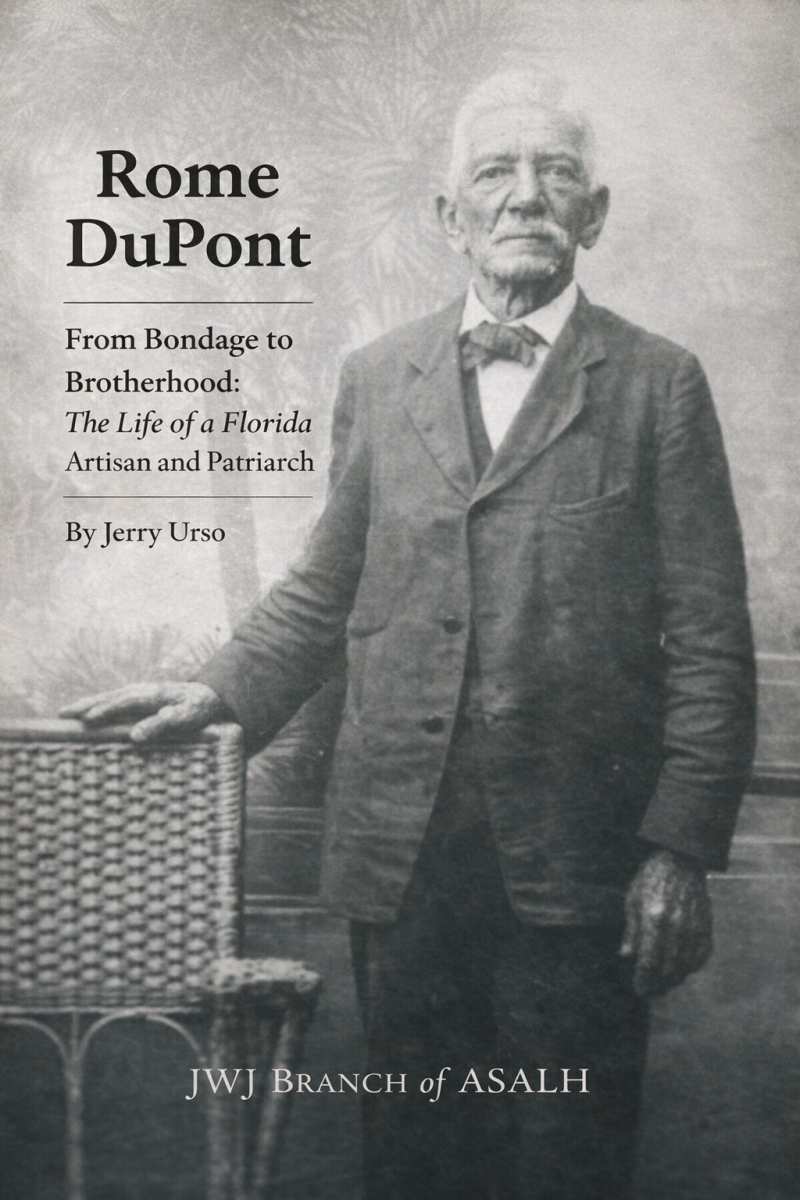
Rome DuPont
From Bondage to Brotherhood: The Life of a Florida Artisan and Patriarch
By Jerry Urso
There are men whose names appear in headlines, and there are men whose names appear in ledgers. Rome DuPont belongs to the latter category. His life was not defined by proclamations or dramatic public speeches. Instead, it was measured in census columns, city directories, property lines, lodge rolls, and the steady rhythm of labor. And yet, within those quiet records lies one of the most compelling generational stories in the history of Black Key West.
Born in Florida in April 1833, according to the 1900 United States Census [1], Rome DuPont entered the world at a time when slavery still structured the economic and social order of the state. The shifting reports of his parents’ birthplaces—France in one enumeration, Virginia in another, St. Augustine in another [1][2]—reflect the instability of nineteenth-century documentation, particularly among formerly enslaved families. What remains consistent is that Rome DuPont was Florida-born and part of the state’s pre–Civil War Black population.
By 1870, five years after emancipation, he appears in the federal census in Key West as a thirty-year-old carpenter [3]. The census marks him as unable to read or write. Yet on that same page, another entry stands out: “Male citizen over 21.” Rome DuPont was now a voter. The Constitution of 1868 had enfranchised Black men in Florida, and DuPont was counted among them.
In his household that year were his wife Amanda, their son Charles, and an eighteen-year-old named James Shackelford [3]. That young man would later serve as Worshipful Master of Mount Moriah Lodge No. 12. What appears in the census as a domestic arrangement would, over time, become a web of family and fraternal leadership.
Building a Life in Key West
Through the 1870s and 1880s, Rome DuPont’s occupation remained constant: carpenter. In the 1880 census, he was recorded as forty years old, head of household, residing on Duval Street in Key West [4]. Five years later, the Florida State Census of 1885 lists him at age forty-six, married, and still working as a carpenter, with adult children in the home [2].
By 1887 and 1888, the Key West City Directories list “Rome Depont” at the corner of Duval and Petronia, occupation carpenter [5][6]. The spelling variation is typical of nineteenth-century directories, but the identity is unmistakable. That intersection would anchor the DuPont family for decades.
What is striking in the 1900 census is not only that Rome DuPont owned his home on Petronia Street, but that he could now read and write [1]. Thirty years earlier he had been recorded as illiterate. By the dawn of the twentieth century, he was literate, married for forty years, and a property owner. The transformation mirrors the broader aspirations of Reconstruction: education, property, civic participation, and institutional belonging.
The 1920 census shows Rome DuPont at age eighty-one, widowed, retired, and still a homeowner in Ward Four of Key West [7]. He had lived through emancipation, the rise and fall of Reconstruction, the 1885 Constitution, and the tightening grip of Jim Crow. Yet through all of it, he remained rooted in the same community.
Mount Moriah Lodge No. 12
On March 29, 1875, Past Grand Master John H. Deveaux of Georgia chartered Mount Moriah Lodge No. 12, F. & A. M., in Key West [8]. Among the charter members was Rome DuPont. Also listed were James A. Roberts, Edward Brown, James R. Shackleford, Paul Seabrooks, William Walters, and Alexander Mickens [8].
A printed notice dated November 6, 1875 records that the lodge met at its room on Thomas Street on the first and third Mondays and Fridays of each month [8]. Four meetings per month speak to an active and disciplined body. In the 1870s, Prince Hall Masonry was more than ritual. It was governance, mutual aid, and civic structure.
Rome DuPont’s membership situates him within this framework of Black institutional self-determination. He was not simply building houses; he was helping build institutional continuity. His brother-in-law, James R. Shackleford, served as Worshipful Master of the lodge, and their shared household connection in 1870 reveals how tightly family and fraternity were intertwined [3][8].
A Generational Rise
Rome DuPont’s life becomes even more significant when viewed through the achievements of his son. Charles Fletcher DuPont rose to public prominence and is documented in Canter Brown Jr.’s Florida’s Black Public Officials, 1867–1924 as serving as sheriff of Monroe County from 1889 to 1893 following his election in 1888 [9].
The arc is remarkable. Within one generation, the son of a formerly enslaved carpenter became an elected county sheriff in Florida. That ascent was not accidental. It was built upon household stability, disciplined labor, literacy, property ownership, and fraternal structure. Rome DuPont provided the foundation upon which public office became possible.
The Quiet Architecture of Freedom
Rome DuPont’s life encapsulates the structural work of freedom. Born in bondage, he became a citizen. Illiterate in 1870, he achieved literacy by 1900. Renting in his early years, he owned property in later life. He was a charter member of a Prince Hall lodge that would nurture civic leadership in Monroe County.
He did not seek public acclaim. He built homes. He raised children. He joined a brotherhood. He stayed.
In the quiet records of Monroe County, the name Rome DuPont appears again and again. Each entry is small on its own. Together, they tell the story of endurance—of a man who moved from enslavement to enfranchisement, from marginalization to rooted stability, and whose legacy would echo in the civic leadership of the next generation.
Rome DuPont did not dominate the political stage of Florida. He built the platform upon which others would stand.
References
[1] 1900 United States Census, Key West, Monroe County, Florida, Ward 4, Petronia Street, Rome DuPont, born April 1833.
[2] 1885 Florida State Census, Key West, Enumeration District 3, Rome DuPont, age 46.
[3] 1870 United States Census, Key West, Monroe County, Florida, Rome DuPont household, dwelling 641.
[4] 1880 United States Census, Key West, Monroe County, Florida, Duval Street, Rome DuPont household.
[5] Key West, Florida, City Directory, 1887, Rome Depont, carpenter, Duval n Petronia.
[6] Key West, Florida, City Directory, 1888, Rome Depont, carpenter, Duval n Petronia.
[7] 1920 United States Census, Key West Ward 4, Monroe County, Florida, Rome DuPont, age 81.
[8] Mount Moriah Lodge No. 12 charter notice, November 6, 1875, Key West, Florida.
[9] Canter Brown Jr., Florida’s Black Public Officials, 1867–1924 (Tuscaloosa: University of Alabama Press, 1998), entry for Charles F. DuPont.
