
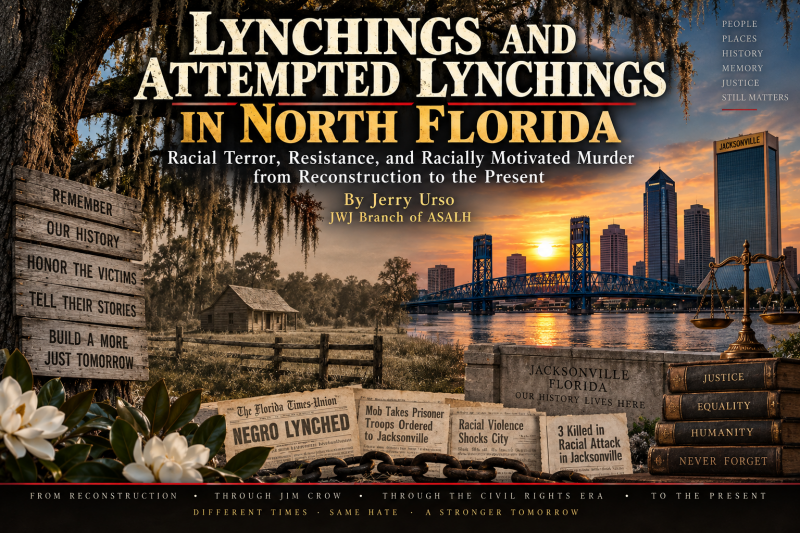
Racial Terror, Resistance, and Racially Motivated Murder from Reconstruction to the Present
By Jerry Urso, JWJ Branch of ASALH
The Irony of the Beginning: Margaret and Patrick Flynn — 1870
There is a striking irony at the beginning of this North Florida history of racial terror. One of the earliest fatal cases we have uncovered involved a white household. Margaret and Patrick Flynn lived in the Jacksonville region during Reconstruction, when support for the Republican government and the political rights of formerly enslaved people could make even white residents targets of organized violence. In March 1870, masked night riders came to the Flynn home seeking Patrick, whose political alignment placed the family within the struggle over Reconstruction. Margaret became the victim. She was shot during the raid and died from her wounds. Her murder demonstrated that the terror developing around Jacksonville was directed toward restoring white political supremacy, and anyone perceived as standing in the way could become a target.
The Flynn case is an important beginning because the racial purpose of the violence does not depend solely upon the race of an individual victim. Black voters, landowners, officeholders, and political organizers would bear the overwhelming weight of the terror, but white Reconstruction supporters could also be attacked for participating in the political transformation occurring after emancipation. The violence became serious enough that state officials confronted what they regarded as a broader threat to Reconstruction authority in Northeast Florida. Margaret Flynn therefore stands at an ironic beginning to this chronology: a white woman killed amid a campaign whose larger objective was the destruction of Black political advancement and the interracial political coalition supporting Reconstruction.
Hannah and Samuel Tutson: Terror Comes to a Black Family — 1871
In 1871, Hannah and Samuel Tutson, a Black married couple living in Clay County near Jacksonville, experienced the racial terror that was spreading across Northeast Florida. Disguised white men invaded their household at night and subjected the couple to extraordinary violence. Samuel was seized and brutally beaten and whipped, while Hannah suffered severe physical and sexual violence. The attack was connected to the Tutsons' independence and their determination to maintain possession of their land. Their experience demonstrates how Reconstruction violence could be used not only against voting and political organization but against Black families whose ownership of property and economic independence challenged the racial order that had existed under slavery.
The Tutsons survived, and what they did afterward makes their story especially important. In November 1871, Hannah and Samuel traveled to Jacksonville and testified before federal investigators examining Ku Klux Klan violence in the former Confederate states. Samuel described the attack and explained that disguises did not completely conceal men whose voices were familiar within the community. Hannah gave her own testimony about the violence inflicted upon her and their household. Instead of allowing terror to produce silence, the Tutsons carried what happened in their home into a federal hearing room. Their testimony became part of the congressional record and remains one of North Florida's most powerful firsthand accounts of Reconstruction racial terror and resistance.
Benjamin Reed: The Lynching Jacksonville Stopped — 1892
On July 4, 1892, Benjamin Reed, a Black Jacksonville teamster, became the intended victim of a threatened lynching following a workplace confrontation with white shipping clerk Frank Burrows that resulted in Burrows' death. Reed was arrested, but rumors quickly circulated that a white mob intended to seize and lynch him. Jacksonville's Black community responded by mobilizing around the jail to prevent Reed from being taken. The confrontation became sufficiently serious that state militia companies were ordered to Jacksonville. Florida's surviving military records explicitly state that the troops were dispatched after a large group of African Americans surrounded the Duval County Jail to prevent Reed's lynching.
The lynching was prevented. Reed remained in custody and faced the courts rather than being executed by a mob. His case deserves an important place in this history because lynching history cannot be understood solely through the people who were murdered. It must also recognize the people who resisted. The Black residents who assembled around the jail demonstrated that African Americans in Jacksonville were prepared to organize collectively in defense of the principle that an accused Black man was entitled to legal process. Benjamin Reed survived an attempted lynching because mob violence encountered organized resistance and government intervention. The event stands as one of North Florida's clearest documented examples of Black collective resistance successfully helping prevent a lynching.
The Man Whose Name Was Lost — May 9, 1909
On May 9, 1909, an unidentified Black man became the first victim on the modern Jacksonville Community Remembrance Project's list of documented racial terror lynchings in Duval County. The surviving history identifies him only as an unknown Black man. He was killed after an accusation involving a white woman, without receiving the protection of a trial or an opportunity for the accusation against him to be tested through the courts. His death followed a pattern that had become tragically familiar throughout the South: accusation, mob action, murder, and the absence of meaningful accountability for those responsible.
More than a century later, even his name remains missing from the known record. The Jacksonville Community Remembrance Project identifies him simply as “Unknown #1 Man,” lynched May 9, 1909. That absence is itself part of the history of racial terror. The violence did not merely take a man's life. It contributed to the disappearance of his identity from public memory. His inclusion among Jacksonville's recognized lynching victims represents an effort to restore at least part of what the mob and the passage of time erased: the recognition that a human being was taken outside the protection of law and killed.
Bowman Cook and John Morine: Black Veterans Lynched During the Red Summer — September 8, 1919
On September 8, 1919, Bowman Cook and John Morine, two Black World War I veterans, were taken from custody and lynched in Jacksonville during the nationwide period of racial violence remembered as the Red Summer. The Equal Justice Initiative marker erected through the Jacksonville Community Remembrance Project identifies a mob of approximately fifty white men as responsible. The violence developed amid racial conflict involving Jacksonville's Black taxi drivers and white passengers. Cook and Morine were arrested, but before the judicial process could determine their guilt or innocence, a mob removed them from custody and killed them. Contemporary NAACP documentation listed both men among the nation's 1919 lynching victims and recorded their deaths as occurring in Jacksonville on September 8.
Their status as veterans adds another dimension to the story. Black soldiers returned from World War I having served a country that continued to deny them equal treatment at home. Throughout the Red Summer, Black veterans became prominent symbols of a generation increasingly unwilling to accept racial subordination without resistance. Cook and Morine survived military service only to be denied the most basic protection of American law in Jacksonville. Their murders connected the city directly to the nationwide racial violence of 1919 and demonstrated that military service and a uniform offered no guarantee that Black veterans would be protected from mob violence once they returned home.
Benjamin Hart: An Innocent Man Taken by a Mob — August 24, 1923
Benjamin Hart was lynched in Duval County on August 24, 1923. Hart was a Black laborer working in northwest Duval County when white men searching for a Black man accused of looking through the window of a white residence seized him. Evidence available at the time raised serious questions about Hart's connection to the accusation, including information concerning his whereabouts. Nevertheless, he was taken away rather than being allowed to answer any accusation through the courts. Hart was killed, and the Jacksonville Community Remembrance Project now recognizes him among Duval County's documented racial terror lynching victims.
Hart's death demonstrates one of the fundamental characteristics of lynching. The issue was not whether an accused person was guilty or innocent. The mob claimed for itself the authority to accuse, judge, and kill, removing the victim from any legal process capable of testing evidence or establishing responsibility. EJI's remembrance work specifically places racial terror lynching within this larger system of racial control rather than treating it merely as extrajudicial punishment for alleged crimes. Hart's killing belongs within that history and also marked the beginning of an especially violent period in Duval County. Before 1923 ended, two more Black men, Edgar Phillips and Eugene Burnam, would be added to Jacksonville's documented list of racial terror victims.
Edgar Phillips: A Body in McGirt's Creek — December 18, 1923
On December 18, 1923, Edgar Phillips became another documented victim of racial terror in Duval County. His killing came only months after Benjamin Hart's lynching and during a period in which racial violence was again claiming Black lives around Jacksonville. Phillips was murdered and his remains were discovered in McGirt's Creek. The brutality associated with his death and the circumstances surrounding the disposal of his body placed his murder among the racial terror lynchings subsequently documented by the Jacksonville Community Remembrance Project. The project records his lynching date as December 18, 1923.
Phillips' death becomes even more significant when viewed chronologically rather than in isolation. Hart had been lynched in August. Phillips was killed in December. Less than two weeks later, Eugene Burnam would also be murdered. Three Black men were therefore lost to documented racial terror in Duval County within approximately four months. Seen together, the cases demonstrate why lynching cannot be understood solely as a collection of individual murders. Each killing existed within a larger environment in which violence against Black people could occur with little expectation that the perpetrators would face the same machinery of justice that operated against those accused of crimes.
Eugene Burnam: The Third Duval County Lynching of 1923 — December 30, 1923
Eugene Burnam was lynched in Duval County on December 30, 1923, becoming the third person now recognized by the Jacksonville Community Remembrance Project as a victim of racial terror in the county during that year. His death followed the August lynching of Benjamin Hart and the December killing of Edgar Phillips. The proximity of these murders is striking. Within the span of only a few months, three Black men were killed in circumstances that have subsequently placed their names among Jacksonville's documented racial terror lynching victims.
Burnam's murder closed a particularly violent year in North Florida's racial history. By examining Hart, Phillips, and Burnam together, a pattern emerges that can easily be missed when each case is treated as an isolated homicide. Lynching functioned through more than the death of the immediate victim. Each killing communicated danger to the surrounding Black community by demonstrating what could happen outside the protection of the courts. The names Benjamin Hart, Edgar Phillips, and Eugene Burnam therefore belong together in Jacksonville's historical memory as three men whose deaths made 1923 one of the darkest years in the city's documented history of racial terror.
Willie Washington: Death and Public Display — January 31, 1925
Willie Washington was killed in Jacksonville on January 31, 1925, and is recognized by the Jacksonville Community Remembrance Project as one of Duval County's racial terror lynching victims. His case differed from the familiar image of a mob seizing a prisoner from a jail. Washington was killed by a Jacksonville detective, and his body was subsequently publicly displayed at the county courthouse. The circumstances surrounding his death and the treatment of his remains transformed the killing into a public spectacle, connecting the case to the broader culture of racial terror in which the bodies of Black victims could be used to communicate power far beyond the individual who had been killed. The JCRP records Washington's death as a racial terror lynching on January 31, 1925.
The public dimension of Washington's death is essential to understanding why his name belongs in this chronology. Historically, lynching was not simply murder committed without legal authority. Spectacle frequently formed part of its power. Bodies were sometimes displayed, photographed, mutilated, or otherwise exposed to crowds so that the violence carried a message to an entire community. Washington's killing and the subsequent exhibition of his body therefore demonstrate how racial terror could intersect with official institutions rather than appearing only in the form of an anonymous mob operating beyond them. His death remains one of the most disturbing episodes in Jacksonville's twentieth century racial history.
Another Man Without a Name — February 9, 1925
Only days after Willie Washington's death, another unidentified Black man was lynched in Duval County on February 9, 1925. Like the unidentified victim killed in 1909, his identity has not survived in the currently recognized Jacksonville remembrance record. The Jacksonville Community Remembrance Project identifies him only as “Unknown #2 Man.” Whatever name his family used, whatever work he performed, and whatever community knew him have not yet been restored to the public history attached to his death. What remains certain is that he was recognized as another victim of racial terror in Duval County.
His death, coming shortly after Washington's, also demonstrates that Jacksonville's racial terror history did not end with the concentrated violence of 1923. The absence of his name should not reduce his importance. Instead, it exposes one of the continuing challenges of documenting lynching history. Newspapers, officials, and other record keepers did not always preserve the identities or lives of Black victims with the care necessary for later generations to reconstruct their stories. Recovering the identity of this man should therefore remain a research objective. Until that happens, his place in this history must remain visible precisely because his name has been lost.
Johnnie Mae Chappell: Murdered Because She Was Black — March 23, 1964
Nearly four decades later, racial violence took the life of Johnnie Mae Chappell, a 35 year old Black Jacksonville mother of ten. On March 23, 1964, Chappell had gone to purchase ice cream for her children and later retraced her route after discovering that she had lost her wallet. As she walked along New Kings Road with two neighbors, four young white men approached in a vehicle. The subsequent federal review of the case documented statements that the men had driven into a predominantly Black neighborhood after one of them proposed attacking a Black person. A shot was fired from the vehicle, striking Chappell in the abdomen. She died before reaching the hospital.
Four men were eventually charged in connection with the killing, but only J. W. Rich stood trial. Rich admitted firing the shot while claiming that the weapon discharged accidentally. He was convicted of manslaughter in December 1964, sentenced to ten years, and served three. Charges against the other men were dismissed. Decades later, the Justice Department reviewed the case but concluded that evidentiary and procedural problems prevented another prosecution. Jacksonville has since formally memorialized Chappell at the location of the killing, describing her as having been targeted because of the color of her skin. Her murder was not a traditional mob lynching, but it belongs in this broader history because it demonstrates the persistence of explicitly racial killing into the civil rights era.
Angela Carr, A.J. Laguerre Jr., and Jerrald Gallion: Racial Terror Returns to Jacksonville — August 26, 2023
On August 26, 2023, nearly sixty years after Johnnie Mae Chappell was murdered, Jacksonville experienced another explicitly racist attack when a white gunman targeted Black people at a Dollar General store. Angela Michelle Carr, 52, Anolt “A.J.” Laguerre Jr., 19, and Jerrald Gallion, 29, were killed. Laguerre was an employee of the store. The gunman had deliberately gone to a predominantly Black area and left writings expressing racist ideology before carrying out the attack. After killing Carr, Laguerre, and Gallion, he killed himself. The three victims had no personal relationship with their killer. Their race was what made them targets.
Their murders bring this chronology into the twenty first century and demonstrate why the history cannot end with the traditional lynching era. The methods changed dramatically between masked Reconstruction riders, jailhouse mobs, drive by racial murder, and a modern mass shooting, but each episode raises the same historical question of what happens when human beings are selected for violence because of race or because they stand in the way of a racial order. From Margaret Flynn and the Tutsons during Reconstruction, through Benjamin Reed's attempted lynching, the documented Duval County lynchings, Johnnie Mae Chappell's murder, and finally Angela Carr, A.J. Laguerre Jr., and Jerrald Gallion, North Florida's history contains both racial terror and resistance to it. Remembering that history means preserving not merely the manner in which these people were attacked or killed, but their names, their humanity, and the communities that refused to allow them to disappear from memory.
