
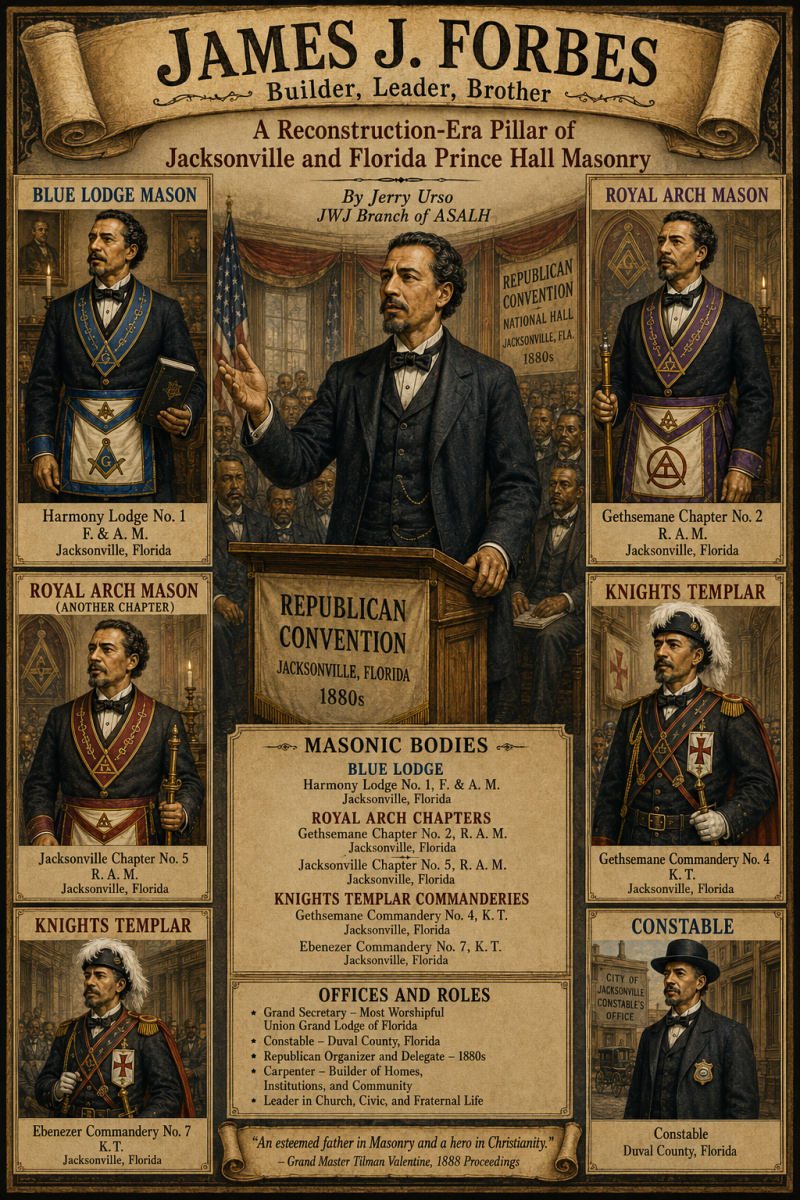
James J. Forbes
Bahamian Craftsman, Constable, Republican Organizer, and Grand Secretary of Florida Prince Hall Masonry
By Jerry Urso — JWJ Branch of ASALH
Introduction
In the turbulent decades following the Civil War, Jacksonville became one of the most important centers of Black political and institutional life in the American South. Freedmen, Black veterans, ministers, educators, laborers, craftsmen, and immigrants from the Caribbean converged upon the city seeking opportunity and security during Reconstruction. Out of that struggle emerged a generation of Black leaders who built churches, schools, businesses, political organizations, and fraternal institutions that would sustain African Americans through both Reconstruction and the dark rise of Jim Crow.
Among those builders was James J. Forbes — a Bahamian-born carpenter whose influence extended far beyond the workshop. Though largely forgotten in modern histories, Forbes occupied a remarkable number of leadership positions during the 1870s and 1880s. He was a skilled craftsman, a constable, a Republican political organizer, Secretary of Harmony Lodge No. 1, Grand Secretary of the Most Worshipful Union Grand Lodge of Florida, a Royal Arch Mason, and ultimately Eminent Commander of Ebenezer Commandery No. 7.
His life reveals the interconnected world of Black Jacksonville during Reconstruction — a world where politics, religion, craftsmanship, migration, and Prince Hall Masonry overlapped to create institutions capable of defending and advancing Black freedom in one of the most dangerous periods in Southern history.
When Forbes died in October 1887, the response from Florida Prince Hall Masonry demonstrated the esteem in which he was held. Grand Master Tilman Valentine publicly memorialized him in the 1888 proceedings of the Grand Lodge, calling him “our esteemed father in Masonry and a hero in Christianity.” Such language was not casually bestowed.[1] It reflected the death of a man viewed as one of the principal architects of early Florida Prince Hall Masonry and one of the stabilizing figures within Black Jacksonville’s civic and fraternal order.
From New Providence to Jacksonville
James Forbes was born in the Bahamas around 1838–1841, with records alternately identifying Nassau and New Providence as his birthplace. The 1870 United States Census lists him as a 29-year-old Black carpenter residing in Jacksonville, Florida.[2] The 1880 Census further identified both of his parents as natives of Nassau, firmly connecting Forbes to the Bahamian migration stream that profoundly shaped Black life in Florida during the nineteenth century.[3]
The movement of Bahamians into Florida accelerated after the Civil War. Jacksonville, Key West, Tampa, and other coastal cities attracted Black Bahamian immigrants skilled in carpentry, masonry, maritime labor, cigar work, and construction trades. Unlike many formerly enslaved Southern Blacks emerging from plantation systems, many Bahamian immigrants arrived with generations of artisan traditions and urban work experience. Their influence became deeply embedded within Florida’s Black middle class and institutional leadership.
Jacksonville in the Reconstruction era was expanding rapidly. Railroads, shipping, lumber, naval stores, and port commerce transformed the city into one of the South’s rising commercial centers. Black labor helped build that city physically, while Black institutions struggled to build it morally and politically. Men like Forbes occupied both worlds simultaneously.
The 1870 Census places Forbes in a household with Joseph R. Lowe and George Butler, both Black laboring men living in Jacksonville.[2] At the time, Black Jacksonville was still rebuilding itself amid racial violence, political uncertainty, and economic instability. Yet within only a decade, Forbes had emerged as one of the city’s recognized Black civic leaders.
By 1880, he was living on Ashley Street with his wife Julia R. Forbes and their son Henry J. Forbes.[3] Ashley Street was rapidly becoming one of the central arteries of Black Jacksonville life, linking churches, businesses, fraternal halls, and residential neighborhoods. Later city directories would place Forbes at 154 Pine Street in 1882 and 176 Cedar Street in 1887, tracing his presence through the evolving geography of Reconstruction-era Black Jacksonville.[4]
A Carpenter in a Rising Black City
The surviving records consistently identify James J. Forbes as a carpenter. Though seemingly simple, that occupation carried enormous significance during the nineteenth century.
Black carpenters in Reconstruction Florida were among the most respected members of the laboring class. They were builders not merely of houses, but of institutions. In cities like Jacksonville, Black craftsmen constructed churches, lodge halls, schools, storefronts, and homes at a moment when African Americans were attempting to establish independent civic life after emancipation.
The symbolic importance of craftsmanship within Prince Hall Masonry also cannot be overlooked. Freemasonry drew heavily upon architectural metaphors — builders, pillars, temples, and sacred construction. Men who worked with their hands in the building trades often occupied honored places within Black lodges because their labor reflected the fraternity’s deeper philosophical symbolism.
Forbes embodied this union of literal and symbolic construction. During the day he worked as a carpenter helping shape Jacksonville’s built environment. At night he operated within Masonic halls helping construct the organizational framework of Black civic life.
The 1887 Jacksonville City Directory identified him as “James J. Forbes, carpenter,” residing at 176 Cedar Street.[5] That same address would later appear in newspaper death notices following his passing in October 1887, confirming that the Cedar Street residence served as both his home and final place of illness.[6]
Constable, Civic Officer, and Republican Organizer
The 1880 Census listed Forbes not only as a carpenter, but also as a “Constable.”[3] This detail reveals his entry into the world of Black civic authority during Reconstruction.
Black constables occupied difficult and often dangerous positions in the postwar South. They represented law, order, and Republican authority in communities where white supremacist resistance remained intense. Many Black officeholders faced threats, intimidation, and violence for exercising even limited civic power.
Jacksonville during the 1870s and 1880s became a battleground between Reconstruction Republicanism and the rising forces of Redemption politics. Within this environment, Forbes emerged as an active Republican organizer.
In March 1882, the Florida Times-Union reported Republican ward meetings and delegate elections involving Black political leaders throughout Jacksonville.[7] Another article published the following day documented continuing Republican organization among Black voters.[8]
By October 1882, Forbes had risen to a visible leadership role. At a Republican convention held at National Hall, A. T. Hall served as chairman while J. J. Forbes was elected secretary.[9] The convention selected delegates to represent Duval County in district political proceedings, placing Forbes among an influential circle of Black Republican leaders that included Frank H. Orange, Rufus H. Johnson, A. D. Orange, George Johnson, and others.
These conventions were far more than routine political gatherings. They represented efforts by Black citizens to preserve political participation at a time when white supremacist violence and voter suppression increasingly threatened Reconstruction gains across Florida and the South.
Additional clippings from 1882 and 1884 continued to place Forbes within Jacksonville’s Republican organizing structure.[10] His repeated appearance in convention proceedings demonstrates that he was trusted not merely as a participant, but as an administrative officer capable of recording proceedings and managing political operations.
That administrative reputation would soon carry him into statewide prominence within Prince Hall Masonry.
Harmony Lodge No. 1
The Heart of Black Freemasonry in Jacksonville
If Black Republican politics represented one pillar of Reconstruction-era Jacksonville, Prince Hall Masonry represented another. Within Black communities across the South, Masonic lodges functioned as governments within governments — systems of mutual aid, leadership training, burial insurance, education, political coordination, and economic trust operating largely independent of hostile white institutions.
At the center of that world in Jacksonville stood Harmony Lodge No. 1.
James J. Forbes emerged within the records of Harmony Lodge during the formative years of organized Prince Hall Masonry in Florida. Proceedings from the 1870s identify him serving as Secretary of the lodge, a position requiring literacy, organizational discipline, and deep institutional trust. Secretaries maintained membership records, financial accounts, correspondence, notices, and official proceedings. In many respects, the secretary became the administrative backbone of the lodge itself.
Harmony Lodge No. 1 was no ordinary local lodge. It stood among the most influential Black fraternal bodies in Florida during Reconstruction. Its membership included ministers, teachers, politicians, craftsmen, businessmen, and civic leaders who shaped the direction of Black Jacksonville during the postwar decades.
The lodge existed within a broader ecosystem of Black institution-building. Churches and lodges frequently overlapped in membership and leadership. Ministers served as Masons, Masons organized political conventions, political leaders joined burial societies, and businessmen financed fraternal projects. The same names repeatedly surfaced across multiple spheres of Black civic life.
Within Harmony Lodge, Forbes moved among some of the most influential African American leaders in nineteenth-century Florida, including:
- Tilman Valentine
- John R. Scott
- William Simons
- N. J. Cambridge
- George W. Wetmore
- Joseph E. Lee
Together these men helped construct the institutional infrastructure of Black Florida during one of the most volatile periods in American history.
The importance of Harmony Lodge extended beyond ritual Masonry. In Black communities denied equal protection under white-controlled systems, lodges often became unofficial courts, welfare agencies, insurance networks, and leadership academies. Widows and orphans received assistance. Sick members received support. Funerals were conducted with dignity and public ceremony. Young men learned parliamentary procedure, public speaking, financial management, and civic responsibility.
For Black craftsmen such as Forbes, the lodge also provided professional trust networks. Business relationships frequently emerged through fraternal affiliation, and membership could enhance one’s standing within the broader community. A respected Mason was often viewed as a man whose word, labor, and moral conduct carried weight.
The administrative skill Forbes demonstrated within Harmony Lodge soon propelled him into statewide prominence. By the late 1870s he had entered the upper leadership ranks of Florida Prince Hall Masonry itself.
Grand Secretary of the Most Worshipful Union Grand Lodge of Florida
Architect of a Statewide Institution
The rise of James J. Forbes into the office of Grand Secretary placed him at the administrative center of Prince Hall Masonry in Florida.
In the nineteenth century, the office of Grand Secretary carried extraordinary importance. While Grand Masters served as symbolic heads of the fraternity, Grand Secretaries frequently ensured the organization’s day-to-day survival. They maintained charters, recorded proceedings, handled correspondence, preserved membership records, issued notices, tracked finances, and coordinated communication between lodges scattered across the state.
During Reconstruction and the years immediately following, such work became especially critical. Florida’s Black lodges operated within an unstable political environment marked by racial violence, economic hardship, and limited resources. Maintaining statewide organizational continuity required remarkable discipline and persistence.
Proceedings from the late 1870s identify Forbes serving within the Grand Lodge administration during the era of John R. Scott.[11] By the 1880s, he had become firmly associated with the administration of Grand Master Tilman Valentine.
An 1884 newspaper clipping publicly identified the officers of the “Grand Lodge of colored Masons,” listing Tilman Valentine as Grand Master and James J. Forbes as Grand Secretary.[12] Such newspaper references are important because they demonstrate the public visibility and legitimacy Black Masonic organizations possessed within Jacksonville’s African American community.
Forbes’ role as Grand Secretary meant that he occupied one of the most trusted positions within Florida Prince Hall Masonry. The office required literacy, reliability, organizational ability, and political tact. Grand Secretaries communicated not only with subordinate lodges, but also with Grand Lodges in other states and jurisdictions. They served as guardians of institutional memory.
This administrative leadership placed Forbes at the center of the expanding Black fraternal system developing across Florida during the late nineteenth century. Lodges were spreading into cities, railroad towns, timber communities, and agricultural regions. Prince Hall Masonry became one of the few durable statewide Black institutions operating during the collapse of Reconstruction.
The work was demanding. Meetings required travel. Proceedings had to be documented carefully. Membership disputes, charter questions, and financial matters all flowed through the Grand Secretary’s office. In an era before modern communications, maintaining statewide coordination required patience and discipline.
Yet Forbes managed these responsibilities while continuing to work as a carpenter and civic figure within Jacksonville itself. His career illustrates the enormous burden often carried by Black institutional leaders during the Reconstruction era. Few served in only one capacity. Most simultaneously balanced employment, family life, politics, religion, and fraternal leadership.
Forbes’ influence extended even further through the York Rite branches of Prince Hall Masonry, where he rose into some of the highest ceremonial offices available to Black Masons in nineteenth-century Florida.
Gethsemane Chapter No. 2
Royal Arch Masonry and the Office of Most Excellent High Priest
By the 1880s, James J. Forbes had advanced beyond the Blue Lodge system into the higher degrees of Prince Hall York Rite Masonry. His rise into Royal Arch and Knights Templar leadership reflected not only personal prestige, but also the rapid institutional expansion of Black Freemasonry in Florida during the post-Reconstruction era.
The surviving records indicate Forbes was associated with Gethsemane Chapter No. 2 and likely served as Most Excellent High Priest (M.E.H.P.), one of the highest offices within Royal Arch Masonry.
Royal Arch Masonry occupied a special place within nineteenth-century Black fraternal culture. While Blue Lodge Masonry formed the foundation of the fraternity, Royal Arch Chapters represented deeper levels of ritual instruction, sacred symbolism, and administrative trust. Membership in a Chapter was often associated with experienced Masons who had already proven themselves within lodge leadership.
The symbolism of Royal Arch Masonry centered heavily upon rebuilding, restoration, sacred knowledge, and the recovery of hidden truths. For Black Masons living during Reconstruction and the collapse of Reconstruction governments, those themes carried extraordinary meaning. African Americans throughout the South were literally attempting to rebuild families, communities, churches, political systems, and economic institutions after centuries of slavery and the devastation of war.
Men such as Forbes helped transform these symbolic teachings into practical civic action.
Royal Arch Chapters also served as elite leadership circles within Prince Hall Masonry. Officers were expected to possess literacy, ceremonial discipline, organizational ability, and moral standing within the community. Meetings involved complex ritual work, administrative planning, and coordination with other York Rite bodies developing across Florida.
Jacksonville emerged as one of the principal centers of Black York Rite Masonry in the state during this period. The city’s combination of political influence, commercial growth, and Black institutional leadership allowed advanced Masonic systems to flourish there earlier than in many other parts of Florida.
The rise of Forbes into Royal Arch leadership demonstrated how thoroughly he had become embedded within the upper levels of Black institutional life. He was no longer simply a carpenter or lodge secretary. He had become part of the governing framework of Black fraternal Florida.
Gethsemane Commandery No. 4 and Ebenezer Commandery No. 7
Knights Templar Masonry and the Public Face of Black Fraternal Leadership
If Royal Arch Masonry represented spiritual and administrative advancement, Knights Templar Masonry represented public prestige, ceremony, discipline, and visible authority.
The evidence suggests that James J. Forbes was associated at different times with both Gethsemane Commandery No. 4 and Ebenezer Commandery No. 7.
This dual association likely reflected the fluid and evolving nature of early Florida Prince Hall York Rite Masonry. During the Reconstruction and post-Reconstruction years, Commanderies were still being organized, restructured, and stabilized. Leadership often overlapped as experienced officers assisted multiple developing bodies.
By 1886, Forbes was publicly identified as “Captain General” within the Commandery structure during funeral proceedings connected to N. J. Cambridge.[13] The office of Captain General represented a major command position within Knights Templar Masonry and reflected Forbes’ growing prominence inside Florida’s York Rite system.
Only a year later, following his death in October 1887, newspaper notices identified Forbes as Eminent Commander of Ebenezer Commandery No. 7.[14] This title placed him at the very head of the Commandery.
Knights Templar Masonry held enormous public significance within Black communities during the nineteenth century. Unlike Blue Lodge Masonry, whose ceremonies remained largely private, Commanderies often operated in highly visible public settings. Uniformed processions, ceremonial marches, funerals, feast days, and public appearances projected discipline, order, and institutional dignity.
For Black communities facing constant racial hostility, these public displays mattered deeply.
Templar uniforms, swords, banners, plumed hats, and military-style formations communicated strength and respectability in a society that routinely attempted to deny Black manhood and citizenship. Public Masonic funerals especially became powerful civic demonstrations. Entire communities often attended these events, watching Black men march in disciplined ranks through city streets while honoring deceased brothers with ritual solemnity.
Such ceremonies projected the existence of organized Black authority.
Jacksonville’s Black Commanderies thus served not only fraternal functions, but also civic and psychological ones. They gave African Americans a visible structure of leadership, honor, discipline, and public order during an era when white violence sought to undermine Black advancement at every level.
Within that world, James J. Forbes rose to its uppermost ranks.
His progression from lodge secretary to Grand Secretary, from Royal Arch officer to Eminent Commander, reflected decades of institutional labor and earned trust. Few men in Reconstruction-era Florida occupied such a broad range of leadership positions across the Prince Hall York Rite system.
His rise also demonstrates how Prince Hall Masonry functioned as far more than a ceremonial fraternity. It operated as a parallel civic structure within Black society — producing administrators, organizers, political figures, and community leaders capable of sustaining Black institutional life long after the collapse of Reconstruction governments.
Business, Commerce, and Black Institutional Networks
Economic Leadership in a Changing Jacksonville
The public record surrounding James J. Forbes reveals a man whose influence extended well beyond politics and fraternal leadership. Like many upper-tier Black leaders of Reconstruction-era Jacksonville, Forbes moved within overlapping networks of commerce, trade, labor, and civic organization.
Jacksonville during the 1880s was rapidly transforming into one of Florida’s leading commercial centers. Railroads connected the city to inland agricultural regions, steamships linked it to northern markets and the Caribbean, and the lumber and naval stores industries generated enormous economic activity. Black labor powered much of that expansion, yet African Americans were often excluded from meaningful participation in white-controlled economic institutions.
As a result, Black leaders increasingly built their own interconnected systems of commerce, mutual aid, and professional trust.
Newspaper references place Forbes within these broader civic and business circles. A July 1885 Florida Times-Union article connected him to proceedings involving Jacksonville’s commercial activity and organizational meetings.[15] Additional notices demonstrate that Forbes regularly appeared among men engaged in institution-building rather than isolated labor.
This distinction matters.
During Reconstruction and the decades immediately following, Black leadership in Jacksonville depended heavily upon relationships of trust. Men who served together in lodges frequently worked together politically. Ministers endorsed businessmen. Republican organizers collaborated with craftsmen and educators. Fraternal halls became meeting places where economic opportunities, political strategies, and community responses to racial violence were discussed simultaneously.
Within that environment, Forbes occupied a strategic position.
As a carpenter, he belonged to Jacksonville’s skilled artisan class. As a constable, he exercised civic authority. As Grand Secretary, he managed statewide institutional correspondence. As a Commandery officer, he participated in some of the most visible ceremonial expressions of Black organizational power in Florida.
These overlapping roles made men like Forbes indispensable to the survival of Black institutional life during the collapse of Reconstruction.
The significance of Black craftsmen in Jacksonville’s growth cannot be overstated. Black carpenters, masons, painters, plasterers, dockworkers, and mechanics helped physically construct the expanding city while simultaneously building the civic infrastructure of Black neighborhoods such as LaVilla and Brooklyn.
Lodges themselves often depended upon these craftsmen. Masonic halls required construction, maintenance, furnishing, and expansion. Public celebrations required staging and organization. Funeral ceremonies demanded logistical coordination. The practical abilities of skilled laborers therefore became deeply intertwined with the ceremonial and political life of Prince Hall Masonry.
The city directory trail tracing Forbes from Pine Street to Cedar Street also situates him directly within the geography of Black Jacksonville’s institutional rise. These neighborhoods contained churches, fraternal halls, boarding houses, schools, and businesses operated by African Americans attempting to secure stability amid the increasing racial hostility of the late nineteenth century.
By the mid-1880s, however, that hostility was intensifying across Florida and the broader South. Reconstruction governments had collapsed. Black voting rights faced systematic attack. Segregation hardened. White supremacist violence increasingly shaped political life.
Within this changing environment, Black institutions such as Prince Hall Masonry became even more critical.
“A Hero in Christianity”
Faith, Respectability, and Moral Leadership
When Grand Master Tilman Valentine memorialized James J. Forbes in the 1888 proceedings of the Most Worshipful Union Grand Lodge of Florida, he employed striking language:
“Grand Secretary, J. J. Forbes, who departed this life October 13th, 1887; and our esteemed father in Masonry and a hero in Christianity…”[1]
The phrase reveals much about both Forbes and the expectations placed upon Black institutional leaders during the nineteenth century.
Within Black communities of the Reconstruction era, leadership required more than professional competence. Men who held public office, church authority, or high Masonic rank were expected to embody moral respectability, discipline, religious faith, and civic responsibility. Their behavior reflected not merely upon themselves, but upon the broader struggle for Black advancement.
Prince Hall Masonry and the Black church operated in especially close partnership during this period. Many leading Masons were ministers, trustees, deacons, choir leaders, or church officers. Lodge meetings often opened with prayer and scripture. Funeral ceremonies blended Christian and Masonic symbolism. Religious language permeated fraternal proceedings.
Jacksonville’s Black institutional leadership therefore developed within a deeply spiritual framework.
To describe Forbes as “a hero in Christianity” suggested that he was regarded as more than an efficient administrator or respected Mason. It implied moral character, public dignity, charitable conduct, and spiritual seriousness. Such praise also indicates that Forbes likely maintained strong ties to Jacksonville’s Black religious community, even if surviving records have not yet fully documented specific church affiliations.
The wording also reflects the importance of respectability politics within post-Reconstruction Black leadership circles. African American civic leaders operated under constant scrutiny from hostile white observers eager to portray Black citizenship as incapable of self-government. Consequently, Black institutions emphasized discipline, education, morality, ceremony, and public order as forms of racial defense.
Prince Hall Masonry became one of the principal vehicles for expressing that collective dignity.
Public Masonic processions displayed disciplined ranks of Black men in formal regalia. Funerals demonstrated organizational sophistication and communal solidarity. Grand Lodge proceedings emphasized education, morality, and institutional order. These were not superficial performances. They were declarations of Black humanity and citizenship in a society increasingly organized around segregation and racial exclusion.
James J. Forbes stood at the center of that world.
He represented a generation of Black Floridians who attempted to construct durable institutions capable of surviving the end of Reconstruction. Though many of their political victories were rolled back by white supremacy, the organizations they built — churches, schools, lodges, burial societies, and civic networks — continued sustaining Black communities into the twentieth century.
Forbes helped build those structures both literally and symbolically.
Death of James J. Forbes
The Passing of a Builder of Institutions
In October 1887, news spread through Black Jacksonville that James J. Forbes had died at his residence on Cedar Street.[6] The loss reverberated far beyond his immediate family. By the time of his death, Forbes had become one of the best-known administrative and fraternal figures within Florida Prince Hall Masonry and among Jacksonville’s Black civic leadership.
The newspaper notices announcing his passing identified him through his Masonic titles and responsibilities, demonstrating how closely his public identity had become tied to the institutions he served.[6][14] He was remembered not simply as a carpenter or political organizer, but as a leading officer in Florida’s growing Prince Hall York Rite system.
The death notices reflected decades of service across multiple bodies:
- Secretary of Harmony Lodge No. 1
- Grand Secretary of the Most Worshipful Union Grand Lodge of Florida
- Most Excellent High Priest associated with Gethsemane Chapter No. 2
- Officer within Gethsemane Commandery No. 4
- Eminent Commander of Ebenezer Commandery No. 7
His funeral became more than a private mourning ceremony. It represented a public demonstration of Black institutional unity during an era when African American civic life faced increasing pressure from segregation, voter suppression, and racial violence.
In nineteenth-century Black Jacksonville, Masonic funerals carried profound importance. Prince Hall lodges provided forms of dignity and ceremonial respect often denied African Americans within broader Southern society. Uniformed Knights Templar marched in formation. Officers appeared in regalia. Rituals emphasized immortality, brotherhood, moral character, and fidelity to sacred obligations.
For the Black community, these funerals symbolized organized leadership, discipline, and continuity.
The public mourning surrounding Forbes’ death also reflected the enormous trust placed in him during his lifetime. As Grand Secretary, he had preserved records, correspondence, proceedings, and organizational continuity for Florida Prince Hall Masonry during some of its most difficult years. Men like Forbes became the institutional memory of the fraternity itself.
The following year, Grand Master Tilman Valentine memorialized Forbes in the official proceedings of the Grand Lodge, referring to him as “our esteemed father in Masonry and a hero in Christianity.”[1] The wording carried deep meaning. It suggested not merely officeholding, but mentorship, moral authority, and foundational influence within Florida Prince Hall Masonry.
His death marked the passing of one of the fraternity’s builders during the fragile years following Reconstruction.
Legacy
Builder of Black Jacksonville and Florida Prince Hall Masonry
Though largely absent from modern historical narratives, James J. Forbes stands revealed through the surviving records as one of the important institutional builders of nineteenth-century Black Jacksonville.
His life intersected with nearly every major sphere of African American community leadership during the Reconstruction and post-Reconstruction era. He belonged to that generation of Black Floridians who understood that survival after emancipation required more than political freedom alone. It required institutions.
As a Bahamian immigrant from Nassau and New Providence, Forbes represented the important Black Atlantic migration networks that helped shape Jacksonville after the Civil War. Bahamian craftsmen, laborers, sailors, and entrepreneurs brought skills, traditions, and organizational experience that became deeply embedded within Florida’s Black urban communities.
As a carpenter, Forbes participated directly in the physical construction of Jacksonville during its period of rapid growth. The city’s neighborhoods, churches, halls, homes, and businesses rose through the labor of Black craftsmen whose contributions were rarely preserved in official histories.
Yet Forbes helped build more than structures.
Through Harmony Lodge No. 1, Gethsemane Chapter No. 2, Gethsemane Commandery No. 4, and Ebenezer Commandery No. 7, he helped construct the organizational framework of Black Florida itself.
These institutions became essential pillars of Black life during one of the most uncertain periods in Southern history. Hurricanes battered Florida’s coastline. Yellow fever epidemics devastated cities. Fires repeatedly threatened wooden urban neighborhoods. Reconstruction governments collapsed under white supremacist violence and political intimidation. Segregation steadily tightened across the South.
Yet Prince Hall Masonry endured.
The lodges, chapters, and commanderies helped sustain Black communities through those literal and political storms by providing burial assistance, leadership development, charity, fellowship, discipline, education, and mutual protection. In many communities, Prince Hall lodges functioned as unofficial governments and civic centers when Black citizens found themselves excluded from white institutions.
As Grand Secretary of the Most Worshipful Union Grand Lodge of Florida, Forbes occupied one of the most important administrative offices within that system. He helped preserve correspondence, maintain records, coordinate subordinate lodges, and stabilize the expanding fraternity during its formative years.
His rise through Blue Lodge, Royal Arch, and Knights Templar Masonry also demonstrated the respect he commanded among his peers. Few men in Reconstruction-era Florida occupied such a broad range of leadership positions across the York Rite structure.
In life, James J. Forbes stood as a craftsman, constable, political organizer, and Masonic leader. In death, he was remembered as “an esteemed father in Masonry and a hero in Christianity.”[1]
The phrase remains fitting.
Forbes belonged to the generation that transformed Prince Hall Masonry in Florida from scattered local lodges into a durable statewide institution capable of surviving Reconstruction’s collapse, environmental disasters, political violence, and the rise of Jim Crow.
He helped build Jacksonville with his hands.
He helped build Black Florida with his institutions.
References
[1] Proceedings of the Most Worshipful Union Grand Lodge of Florida, 1888. Memorial proceedings for Grand Secretary J. J. Forbes, including Grand Master Tilman Valentine’s statement referring to Forbes as “our esteemed father in Masonry and a hero in Christianity.”
[2] 1870 United States Federal Census, Jacksonville, Duval County, Florida. James Forbes entry. Age 29, born in New Providence (Bahamas), occupation carpenter.
[3] 1880 United States Federal Census, Jacksonville, Duval County, Florida. James Forbes household entry. Listed as carpenter and constable residing on Ashley Street with wife Julia R. Forbes and son Henry J. Forbes.
[4] Jacksonville, Florida, City Directory, 1882. James J. Forbes residence listing at 154 Pine Street.
[5] Jacksonville, Florida, City Directory, 1887. James J. Forbes residence listing at 176 Cedar Street; occupation listed as carpenter.
[6] The Florida Times-Union (Jacksonville, Florida), October 14, 1887, p. 5. Death notice and Masonic references concerning J. J. Forbes.
[7] The Florida Times-Union (Jacksonville, Florida), March 29, 1882, p. 4. Republican ward meetings and delegate proceedings involving Black political organizers in Jacksonville.
[8] The Florida Times-Union (Jacksonville, Florida), March 30, 1882, p. 1. Republican political convention and delegate proceedings involving J. J. Forbes and other Black Republican leaders.
[9] The Florida Times-Union (Jacksonville, Florida), October 5, 1882, p. 1. Republican convention at National Hall with A. T. Hall as chairman and J. J. Forbes elected secretary.
[10] The Florida Times-Union (Jacksonville, Florida), November 14, 1882, p. 1. Election and political notices connected to Black Republican civic leadership in Jacksonville.
[11] Proceedings of the Most Worshipful Union Grand Lodge of Florida, late 1870s and 1880s officer listings documenting James J. Forbes as Grand Secretary and officer within Florida Prince Hall Masonry.
[12] The Florida Times-Union (Jacksonville, Florida), January 20, 1884, p. 4. Public listing of Grand Lodge officers of the “Grand Lodge of colored Masons,” including Tilman Valentine and Grand Secretary J. J. Forbes.
[13] The Florida Times-Union (Jacksonville, Florida), May 9, 1886, p. 6. Funeral proceedings for N. J. Cambridge identifying J. J. Forbes as Captain General within the Knights Templar structure.
[14] The News-Herald (Jacksonville, Florida), October 14, 1887, p. 8. Obituary and funeral notice identifying J. J. Forbes as Eminent Commander of Ebenezer Commandery No. 7.
[15] The Florida Times-Union (Jacksonville, Florida), July 11, 1885, p. 4. Civic and commercial proceedings involving James J. Forbes and Jacksonville Black institutional networks.
[16] The Florida Times-Union (Jacksonville, Florida), July 26, 1883, p. 4. Jacksonville civic and political notice referencing James J. Forbes within Black community leadership networks.
[17] The Florida Times-Union (Jacksonville, Florida), January 23, 1887, p. 8. Fraternal and civic references connected to J. J. Forbes and Jacksonville Prince Hall Masonry.
[18] The Semi-Weekly Times-Union (Jacksonville, Florida), February 21, 1884, p. 3. Additional fraternal references involving J. J. Forbes and Jacksonville Prince Hall leadership.
[19] The Florida Times-Union (Jacksonville, Florida), April 18, 1884, p. 1. Republican convention and political proceedings involving Black Jacksonville leadership circles including J. J. Forbes.
