Dr. Joseph Robert Love
Grant’s Town and the Formation of a Public Mind
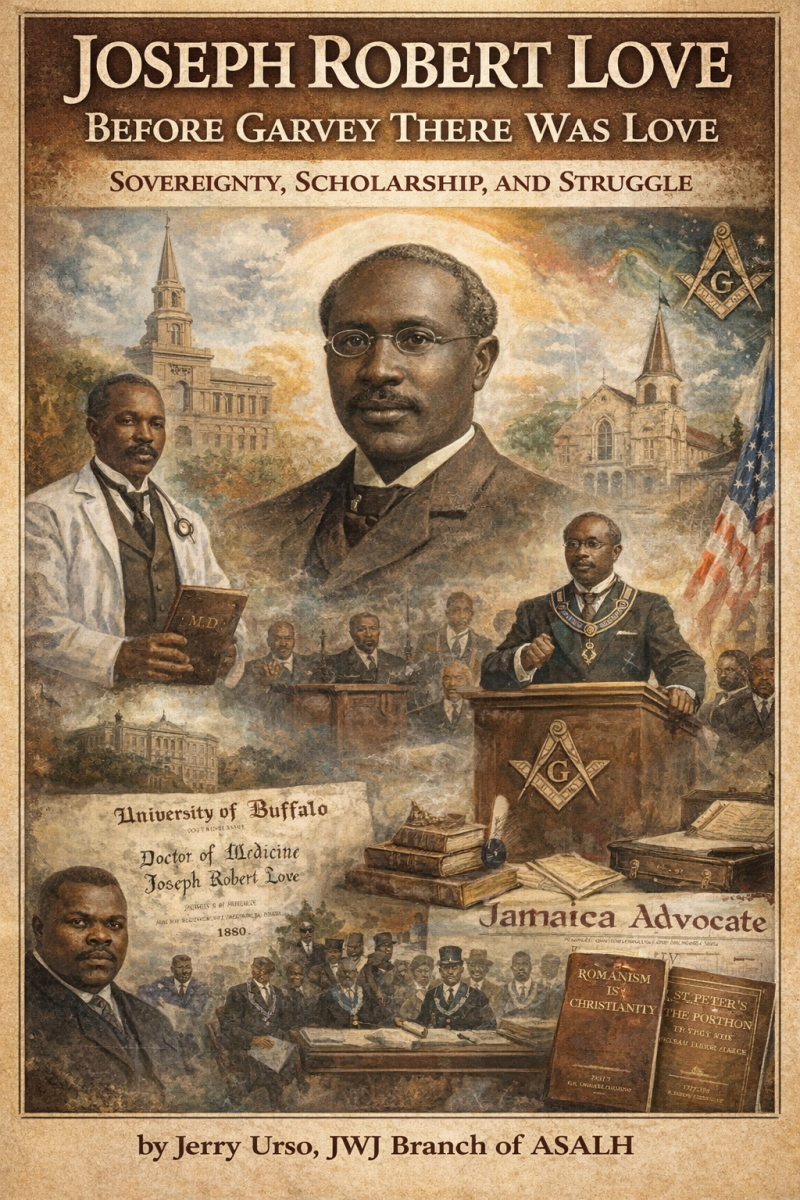
Before Garvey there was Love.
Long before Marcus Garvey electrified Harlem and Kingston with declarations of African redemption, Joseph Robert Love had already been writing, organizing, preaching, governing, and constructing institutional frameworks across the Black Atlantic world. Born on 2 October 1839 in Grant’s Town, Nassau, Bahamas, Love emerged from a community shaped by emancipation, Anglican order, and the disciplined pursuit of literacy [1]. Grant’s Town was not incidental to his development. It was a Black working community whose residents understood the connection between education and survival, between faith and self respect.
He was educated at St Agnes Parish School and Christ Church Grammar School in Nassau [1]. These schools were anchored in Anglican tradition, and Anglican structure left its imprint on him. Order, hierarchy, doctrine, and disciplined study formed the early architecture of his thinking. He became a teacher in the Bahamas before leaving for the United States in 1866 [2]. Teaching was his first public office. It revealed his conviction that education was not privilege but necessity.
Even in these early years, the themes that would define his life were visible. He gravitated toward institutions. He studied law and structure. He understood that communities rise through organization rather than impulse. The Bahamas formed him intellectually. Reconstruction America would test him administratively.
Florida Reconstruction and Episcopal Authority
When Joseph Robert Love arrived in Florida in 1866, Reconstruction was reshaping the South. Formerly enslaved men were entering political life. Black churches were expanding. Fraternal bodies were emerging as stabilizing forces in unstable territories. Violence and progress moved together.
In 1871, Bishop John F Young of the Diocese of Florida ordained Love a deacon [1]. This was a significant appointment. Black clergy within Southern dioceses were rare and often constrained within segregated structures. Love’s ordination placed him within official ecclesiastical authority at a moment when race, theology, and citizenship were being renegotiated.
In June 1871 he entered service at Trinity Church in Florida and by December he transferred to the Church of St Stephen in Savannah, Georgia [1]. His time in Savannah exposed the limitations of racial equality within ecclesiastical life. In 1872, alleging discrimination against darker complexioned congregants, he withdrew and established St Augustine’s Mission composed primarily of Black worshippers. During this period he also managed schools for Black children.
The archival record consistently preserves him with the title Reverend, and later memory sometimes elevates him to Bishop, reflecting the stature he achieved within Black communities [3]. His ecclesiastical work and his emerging constitutional thought developed together. Within the church he observed hierarchy, legitimacy, and exclusion. Those observations would later inform his Masonic jurisprudence and political philosophy.
He was not merely preaching. He was studying structure.
District Deputy Grand Master and the Southern Field of Masonry
In 1867, Joseph Robert Love was appointed District Deputy Grand Master for the Southern States by the Grand Master of the United Grand Lodge of New York, the body that today stands as the Most Worshipful Prince Hall Grand Lodge of the State of New York. This appointment placed him at the center of Reconstruction era Masonic expansion.
The deputation was operational rather than honorary. As District Deputy, Love represented the authority of the Grand Master in Southern territories where Prince Hall Masonry was expanding among newly emancipated communities. Lodges were being organized in regions where civil authority itself was contested. Constitutional clarity was essential.
The 1873 Annual Address of Grand Master William C H Curtis documents that the Grand Lodge granted a dispensation to organize Excelsior Lodge in Savannah and concurrently appointed Rev J R Love as District Deputy Grand Master for Georgia to oversee its development under lawful authority [4]. By 1874, the record indicates that a Grand Lodge of Georgia had been organized, rising in part from these same efforts [4].
Love’s fieldwork required travel, supervision of ritual, mediation of disputes, and the steady enforcement of constitutional norms. He was building more than lodges. He was building governance.
It was within this authority that St Johns Lodge No 14 was planted in Florida under lawful warrant, an act that would later connect directly to the formation of sovereign Masonic structure in the state. His name appears in later archival references not because he lived beyond his time, but because his foundational labor required preservation in historical proceedings [5].
The priest was now also a constitutional Mason.
The teacher was now a jurisdictional architect.
Before Garvey there was Love.
St Johns Lodge No 14 and the Planting of Sovereign Structure
Under his authority as District Deputy Grand Master for the Southern States, Joseph Robert Love did not merely supervise lodges that already existed. He planted them. Among the most significant of these foundations was St Johns Lodge No 14 in Florida, organized under lawful warrant during the Reconstruction era.
St Johns Lodge No 14 was not an incidental affiliation. It was part of a deliberate jurisdictional expansion strategy directed by the United Grand Lodge of New York. When Love established this lodge, he was extending constitutional Masonry into territory where governance, legitimacy, and racial authority were contested daily. Florida in the late 1860s and early 1870s was still reconstructing civic life. Black men were entering political participation for the first time. Institutions capable of training disciplined leadership were essential.
The lodge provided more than ritual fellowship. It functioned as a training ground in parliamentary order, literacy, accountability, and financial management. In communities facing hostility and economic instability, Prince Hall lodges were centers of mutual aid and structured self governance. Love understood this fully. His ecclesiastical and educational background had already convinced him that advancement required institutions rooted in law.
The later archival references that appear in early twentieth century Proceedings, including those preserved within historical compilations associated with Arturo Schomburg, reflect retrospective recognition of this foundational labor rather than evidence of his continued life beyond 1914 [5]. His name endured in records because he was instrumental in constructing the early framework of lawful Southern Masonry.
St Johns Lodge No 14 stands as tangible evidence of his work in the field. It was not memory alone. It was constitutional architecture.
Grand Master of Florida and the Assertion of Constitutional Independence
Joseph Robert Love is recorded as the first Grand Master of the Most Worshipful Sovereign Grand Lodge of Florida, serving from 1870 to 1872 [6]. The use of the word Sovereign was deliberate. It reflected an emerging constitutional philosophy within Prince Hall Masonry during Reconstruction.
The struggle at the time centered on whether Black Masonry would operate under the authority of a centralized National Grand Lodge known as the Compact or whether individual states would organize and govern themselves as sovereign Grand Lodges. Love’s tenure in Florida placed him directly within this debate.
To serve as Grand Master during Reconstruction was to govern amid instability. Rival Masonic bodies sometimes operated in overlapping territories. Questions of legitimacy were not theoretical. They affected recognition, visitation rights, and the very structure of authority. Love’s approach was rooted in jurisprudence rather than emotion. He leaned heavily upon established Masonic law, particularly the American doctrine articulated by Albert Mackey regarding exclusive territorial jurisdiction.
According to that doctrine, only one Grand Lodge may exercise authority within a given state. Love applied this principle to argue that once Florida organized its Grand Lodge under lawful authority, it was sovereign within its territory. A centralized national structure placed above it would violate the constitutional order of Masonry.
His leadership therefore belonged not merely to Florida but to the broader movement toward state sovereignty within Prince Hall Masonry. The Florida Grand Lodge under his administration became part of the constitutional reformation that would reshape Black Freemasonry permanently.
His work required drafting governing documents, issuing charters, stabilizing subordinate lodges, and defending jurisdictional integrity. It required firmness under pressure and clarity in principle.
The priest who had observed ecclesiastical hierarchy now defended fraternal sovereignty.
Georgia Leadership and the Doctrine of Exclusive Jurisdiction
After Florida, Love’s executive labor continued in Georgia. He is recorded as serving as Grand Master within the Georgia Grand Lodge framework beginning in 1874, following his earlier District Deputy authority in the state [4]. Georgia presented perhaps even more complex jurisdictional challenges than Florida.
Reconstruction politics in Georgia were tense and volatile. Racial hostility was pronounced. Fraternal organizations were closely observed. Within Prince Hall Masonry, the divide between the National Grand Lodge and Independent State Grand Lodges sharpened.
Love’s constitutional reasoning matured during this period. He relied upon Mackey’s articulation of exclusive territorial jurisdiction, arguing that once a Grand Lodge was properly constituted within a state, no external body could impose authority over it without violating Masonic principles.
The Delaware Conference of 1878 would later mark the effective decline of National Grand Lodge dominance and the triumph of sovereign state organization [7]. The groundwork for that outcome was laid by leaders like Love who insisted that Prince Hall Masonry mirror the constitutional structure of mainstream American Masonry.
There is intellectual irony here. Albert Mackey, whose jurisprudence Love mastered and deployed, did not recognize Prince Hall Masonry as legitimate in racial terms. Yet Love used Mackey’s logic to defend Black Masonic sovereignty. He appropriated the legal framework of exclusion to construct institutional stability for his own people.
In Georgia, Love was not merely organizing lodges. He was defining order.
Before Garvey articulated global race pride, Love was articulating constitutional sovereignty within Black institutions.
The National Grand Lodge Controversy and the Constitutional Crisis
The constitutional struggle within Prince Hall Masonry during the 1870s was not a minor administrative disagreement. It was a foundational crisis concerning sovereignty, legitimacy, and structure. Joseph Robert Love stood squarely in the center of it.
At issue was the authority of the National Grand Lodge, often referred to as the Compact, which claimed centralized governance over Black Masons throughout the United States. Opposing it were emerging Independent State Grand Lodges asserting that each state body, once lawfully organized, was sovereign within its territory.
Love’s position was clear. He believed that constitutional Masonry rested upon the principle that a Grand Lodge is the supreme authority within its jurisdiction. He leaned upon the American doctrine of exclusive territorial jurisdiction articulated by Albert Mackey, who maintained that only one Grand Lodge could operate lawfully within a given state.
Love’s argument was not emotional rhetoric. It was jurisprudential reasoning. If Prince Hall Masonry sought regularity and structural parity with mainstream American Masonry, it could not operate under a fourth tier of authority placed above sovereign state Grand Lodges. Such a structure violated the established Landmarks and introduced innovation without precedent.
The conflict was not purely theoretical. It affected recognition, visitation rights, and the constitutional standing of lodges across the South. The Delaware Conference of 1878 marked the decisive turn toward sovereign state governance and away from centralized National control [7]. Love’s earlier labor in Florida and Georgia formed part of the intellectual and structural groundwork that made that shift possible.
There is profound irony in this chapter of his life. Mackey, whose constitutional writings Love mastered, did not recognize Prince Hall Masonry in racial terms. Yet Love employed Mackey’s jurisprudence to defend Black institutional sovereignty. He separated the logic of law from the prejudice of the man and used it effectively.
In doing so, he ensured that Prince Hall Grand Lodges would ultimately mirror the constitutional structure of their white counterparts. That structural symmetry would become essential in the twentieth century during recognition movements.
Love was not merely participating in debate. He was shaping the constitutional destiny of Black Masonry.
Buffalo Priesthood and the First Black Medical Degree
In 1876, Joseph Robert Love relocated to Buffalo, New York, accepting a call as Rector of St Philip’s Episcopal Church, one of the earliest Black Episcopal congregations in that city [3]. His transition to Buffalo did not represent retreat from Southern labor. It represented expansion of intellectual ambition.
In 1877, Bishop Arthur Cleveland Coxe ordained him to the priesthood within the Diocese of Western New York [1]. While serving as rector, Love enrolled in the University of Buffalo Medical School. On 25 February 1880, he received his Doctor of Medicine degree, becoming the first person of African descent to graduate from the institution [1][4].
His thesis, Philosophy of Practical Medicine Versus Empiricism, reflected disciplined analytical reasoning. He was not pursuing medicine casually. He was mastering professional science during a period when racial barriers to higher education were formidable.
At his graduation dinner, in response to a toast to Our Colored Fellow Citizens, Love expressed hope that the colored American citizen would emerge from social ostracism and meet his white brothers on the equal plane of education and merit [4]. The remark revealed both optimism and realism. He understood that equality would not be granted sentimentally. It would require credentialed excellence.
In Buffalo, he embodied three roles simultaneously. He was priest, physician, and constitutional Mason. Each required disciplined study and public trust. His life in Buffalo demonstrates the scale of his ambition. He was not confined to a single sphere.
He believed in mastery.
Haiti and the Formation of a Transnational Political Vision
In 1881, Love moved to Haiti, serving as rector of an Anglican church in Port au Prince [2]. Haiti was not merely another posting. It was the first Black republic in the Western Hemisphere, a living symbol of emancipation and sovereignty. Yet it was also politically unstable.
Following a dispute within church leadership, Love left clerical office and entered service as a physician in the Haitian army during a period of revolt. Haiti exposed him to the fragility of Black governance under internal and external pressure. He witnessed firsthand the challenges of political authority in a post colonial society.
He encountered significant political difficulty and was eventually expelled in 1889 [2]. Attempts to return were unsuccessful. Haiti was a formative crucible. It sharpened his understanding of power, sovereignty, and racial destiny beyond American Reconstruction.
The experience expanded his horizon from regional to transnational. He began to think not only about state sovereignty in Masonry but about Black sovereignty across nations.
Haiti taught him that independence without stability is precarious. Structure matters. Governance matters. Education matters.
These lessons would travel with him to Jamaica.
Jamaica and the Founding of the Jamaica Advocate
When Joseph Robert Love arrived in Jamaica in 1889, he entered a colonial society in which political authority remained concentrated in the hands of a white minority while the Black majority labored under restricted franchise, limited educational access, and economic hardship. He did not arrive as a quiet expatriate. He arrived as a seasoned clergyman, physician, constitutional Mason, and political thinker formed by Reconstruction America and tested in Haiti.
In December 1894, Love founded the Jamaica Advocate, a newspaper that quickly became one of the most influential Black voices on the island [5]. The paper was not merely informational. It was instructional. Through its pages Love encouraged political participation, voter registration, civic discipline, and educational reform. He treated the press as an instrument of organized uplift.
Love consistently argued that education was the foundation of advancement. He advocated equal access to secondary education for both male and female students, insisting that a people could not rise above the standard of its womanhood [5]. In a colonial society where female education often lagged behind male instruction, his position was forward looking and deliberate. He understood that institutional reform required intellectual reform.
The Jamaica Advocate also became a platform for expanding the elected representation within the Legislative Council. Love encouraged qualified Black voters to register and participate in elections. In 1896 he supported Alexander Dixon, one of the first Black men in decades to win election to the Council [5]. Love himself later entered the political arena directly and in 1906 was elected to represent St Andrew in the Jamaican House of Representatives [5].
He did not separate writing from action. His journalism translated into candidacy. His editorials translated into legislation.
In addition to his newspaper work, Love authored two books, Romanism is Not Christianity in 1892 and St Peter’s True Position in the Church Clearly Traced in the Bible in 1897 [7]. These works reveal that his theological engagement never ceased. Even while advocating political reform, he continued to debate doctrine and ecclesiastical authority.
The Jamaican period represents the full flowering of his intellectual life. The priest became legislator. The physician became public critic. The Mason became nationalist thinker.
Before Garvey stood on global platforms declaring Africa for the Africans, Love was already using the printed page to awaken racial consciousness.
Mentor to Marcus Garvey and the Transmission of Pan African Thought
Marcus Garvey would later dominate the language of Pan Africanism in the twentieth century, but the intellectual soil in which Garvey grew had been cultivated by men like Joseph Robert Love. Garvey acknowledged Love’s influence upon his early racial consciousness [5]. In Jamaica, Love’s presence as a scholar, orator, and editor shaped the thinking of younger activists who watched him carefully.
Love’s Jamaica Advocate published proceedings and commentary related to early Pan African conferences, including the London gathering of 1900. He connected local political reform with global Black solidarity. He encouraged pride in African ancestry and demanded structural advancement rather than mere symbolic inclusion.
Garvey reportedly took elocution lessons from Love and absorbed his emphasis on disciplined public speech and intellectual preparation. Love believed that mastery of language and law preceded mastery of destiny. He modeled scholarship before agitation.
Yet Love’s approach differed from Garvey’s later mass mobilization. Love operated within institutional channels. He sought elected office. He drafted arguments grounded in law. Garvey would build global organizations and mass movements. Love built foundations.
The relationship between them represents transmission rather than duplication. Love belongs to the generation that bridged Reconstruction constitutionalism and Caribbean nationalism. Garvey belongs to the generation that globalized that consciousness.
Before Garvey, there was Love.
Legacy of Joseph Robert Love in Masonry, Medicine, and Nationhood
Joseph Robert Love died on 21 November 1914 and was buried at Half Way Tree near Kingston [5]. His tombstone bears words that summarize his life with precision. Journalist. Orator. Patriot.
Yet his legacy extends beyond inscription.
In Masonry, he helped plant lawful lodges in the Reconstruction South and served as the first Grand Master of the Most Worshipful Sovereign Grand Lodge of Florida from 1870 to 1872 [6]. He later served within the Georgia Grand Lodge framework beginning in 1874, defending the doctrine of exclusive territorial jurisdiction and contributing to the constitutional reformation that culminated in the decline of centralized National Grand Lodge authority [7]. His work ensured that Prince Hall Masonry would stand upon sovereign state foundations identical in structure to mainstream American Masonry.
In medicine, he became the first person of African descent to graduate from the University of Buffalo Medical School in 1880, mastering professional science at a time when racial barriers were formidable [1][4]. He demonstrated that intellectual excellence could coexist with political activism.
In religion, he served as deacon and priest within the Episcopal Church, founded missions for Black congregants when discrimination arose, and authored theological works that engaged doctrinal controversy [1][7].
In politics, he was elected to the Jamaican House of Representatives in 1906 and used journalism to expand Black participation in governance [5]. He advocated equal education for women and men. He supported land reform and civic discipline. He treated citizenship as responsibility rather than entitlement.
His life connects Nassau, Florida, Georgia, Buffalo, Haiti, and Jamaica in a single arc. He moved across the Black Atlantic carrying structure with him. Wherever he went, he built institutions.
Before Garvey there was Love. Before mass mobilization there was constitutional formation. Before global rhetoric there was disciplined scholarship.
Shout out to Dave Gillarm Jr. for bringing this Brother to your attention. History is often rediscovered through the diligence of those who care enough to look.
References
[1] Episcopal Diocese of Georgia Archives
[2] Lumsden Joy, Joseph Robert Love 1839 to 1914 West Indian Extraordinary
[3] Spectrum News NY1, Archives preserved from Buffalo church dating back to 1860s
[4] University at Buffalo School of Medicine profile Joseph Robert Love
[5] Monteith and Richards, Jamaica in Slavery and Freedom
[6] Proceedings Most Worshipful Sovereign Grand Lodge of Florida 1870 to 1872
[7] C V Black, A History of Jamaica
Primary Archival and Institutional Sources
Proceedings of the United Grand Lodge of New York, 1873 Annual Address of Grand Master William C. H. Curtis.
Proceedings of the Most Worshipful Sovereign Grand Lodge of Florida, A.Y.M., 1870 to 1872.
Proceedings of the Georgia Prince Hall Grand Lodge, early 1870s organization period.
Archive of the Episcopal Diocese of Georgia, Joseph Robert Love record.
http://archives.georgiaepiscopal.org/?page_id=1368
University at Buffalo School of Medicine Profile, Joseph Robert Love, MD.
https://medicine.buffalo.edu/oiace/diversity/diversity-month/diversity-month.host.html/content/shared/smbs/instruction_and_help_oiace/black-history-month-profiles/joseph-love.detail.html
African Caribbean Institute of Jamaica Profile, Dr. Robert Joseph Love.
https://acij-ioj.org.jm/dr-robert-joseph-love/
Jamaicans.com feature article
Remembering Dr. Joseph Robert Love Priest Physician Journalist and Jamaica’s First Pan African Nationalist.
https://jamaicans.com/remembering-dr-joseph-robert-love-priest-physician-journalist-and-jamaicas-first-pan-african-nationalist/
Annual Report of the National Association for the Advancement of Colored People, January 1, 1922.
Scholarly and Historical Secondary Sources
Lumsden, Joy.
Joseph Robert Love 1839 to 1914 West Indian Extraordinary. Afro American Historical Association of the Niagara Frontier.
Monteith, Kathleen E. A., and Glen Richards, editors.
Jamaica in Slavery and Freedom History Heritage and Culture. University of the West Indies Press, 2002.
Black, C. V.
A History of Jamaica. Collins, 1975.
Edward White.
Rise Up. The Paris Review, 2016.
Hallikaar, Viktoria.
Archives preserved from Buffalo church dating back to 1860s. Spectrum News NY1, 2025.
Masonic Jurisprudential Sources Referenced in Analysis
Mackey, Albert G.
The Masonic Jurisprudence and the American Doctrine of Exclusive Territorial Jurisdiction.
Mackey, Albert G.
The Landmarks of Freemasonry.
Proceedings and historical references connected to the Delaware Conference of 1878.
Institutional Clarifications and Historical Communications
Wardally, Kevin P.
Senior Grand Warden, Most Worshipful Prince Hall Grand Lodge of the State of New York.
Personal communication and archival clarification regarding District Deputy authority, Excelsior Lodge oversight, and historical proceedings context.
Feliciano, Joshua.
Prince Hall Grand Lodge of New York.
Historical discussion and archival context review.
Prince Hall Grand Lodge of Georgia.
Institutional historical confirmation of Georgia Grand Lodge formation period and leadership framework.
Gillarm, Dave Jr.
Private historical referral and source introduction regarding Joseph Robert Love’s early Prince Hall record and Grand Lodge leadership context.
Additional Contextual Sources Used in Development
The Episcopal Diocese of Florida historical records.
St Philip’s Episcopal Church Buffalo archival material.
University of Buffalo Medical School graduation record, February 25, 1880.
Haitian military and Anglican mission references, late nineteenth century.
Jamaica Advocate newspaper historical accounts.
Jamaican Legislative Council election records, 1906.
Clarification on 1917 Proceedings Reference
Proceedings referencing Joseph Love in 1917 were used as retrospective archival preservation of earlier authority, not as evidence of continued life beyond 1914. The material is understood as historical narrative inclusion and not a contemporary activity record.
