
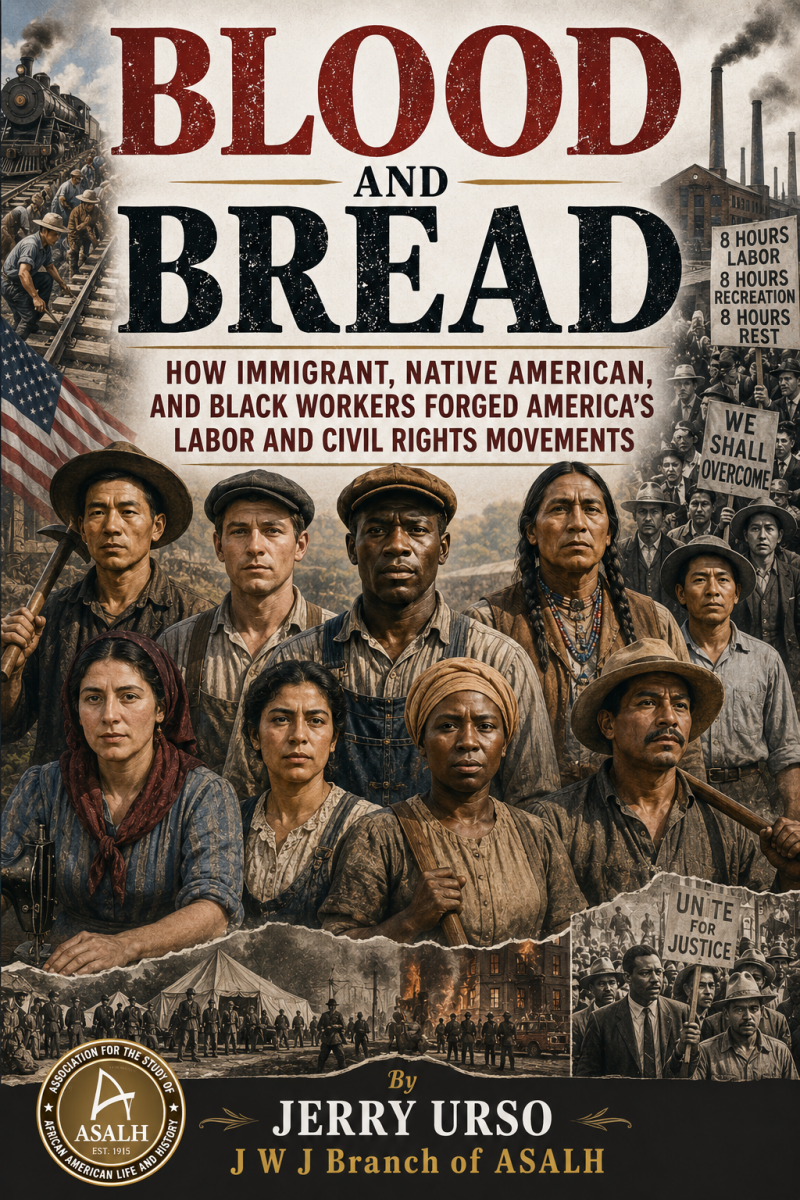
Blood and Bread: How Immigrant, Native American, and Black Workers Forged America's Labor and Civil Rights Movements
By Jerry Urso JWJ Branch of ASALH
Introduction
The history of America's Civil Rights Movement did not begin solely in courtrooms, legislatures, or on the streets of Montgomery, Birmingham, and Selma. Long before marches challenged segregation and lawsuits dismantled Jim Crow, another struggle was unfolding in coal mines, railroad camps, cotton fields, sugar plantations, steel mills, textile factories, and industrial cities across the nation. There, workers from every corner of the world fought not only for better wages but for the fundamental right to live and work with dignity. Their demands—for safe workplaces, fair compensation, reasonable hours, equal treatment, and the freedom to organize—would become the foundation upon which many later civil rights victories were built.
The American workforce reflected the diversity of the nation itself. Irish immigrants laid railroads across mountains and valleys. Chinese laborers blasted tunnels through the Sierra Nevada to complete the Transcontinental Railroad. African Americans, emerging from slavery, sought economic independence in fields, factories, and on the docks. Greek, Italian, Jewish, Polish, Slovak, Lithuanian, Mexican, Japanese, Filipino, and countless other immigrant communities supplied the labor that fueled America's rapid industrial growth. Native Americans also labored in mines, logging camps, ranches, and agricultural fields while simultaneously struggling to preserve their own sovereignty and culture.
Despite their differences in language, religion, and nationality, these workers encountered remarkably similar obstacles. Powerful corporations refused to recognize unions, hired private detectives and armed guards to suppress organizing, enlisted local sheriffs and state militias to break strikes, and frequently relied upon courts that favored business interests over working people. In many cases, labor disputes escalated into armed confrontations, mass arrests, deportations, lynchings, and massacres. Workers were imprisoned, blacklisted, and killed not because they had committed crimes, but because they sought rights that are now considered fundamental in every modern workplace.
Ironically, the same forces that attempted to divide workers by race and ethnicity ultimately revealed their common cause. Whether Irish coal miners in Pennsylvania, Chinese miners in Wyoming, Black sharecroppers in Arkansas, Greek coal miners in Colorado, Italian cigar workers in Florida, or Filipino farm laborers in Hawaii, each community confronted systems that denied them equal protection under the law. Their collective struggle transformed labor rights into civil rights, proving that economic justice and human dignity could never be separated.
The following stories span more than a century of American history. Some ended in victory, many ended in tragedy, and nearly all were written in blood. Together they reveal that the rights millions of Americans now enjoy—the eight-hour workday, safer workplaces, collective bargaining, child labor protections, and legal safeguards against discrimination—were purchased through extraordinary sacrifice. The American labor movement was more than a fight for wages; it became one of the nation's earliest and most enduring civil rights movements.
The Irish: America's First Industrial Workforce
Duffy's Cut Mass Grave
Malvern, Pennsylvania – August 1832
The first great wave of immigrant labor in the United States came from Ireland. Fleeing poverty decades before the Great Famine, thousands of Irish immigrants found work constructing canals, railroads, and public works that connected a growing nation. They accepted dangerous jobs few others would perform, blasting rock, laying track, and carving transportation routes through wilderness. Their labor helped build America's industrial future, yet they were often viewed with suspicion because of their Catholic faith, poverty, and immigrant status.
In the summer of 1832, contractor Philip Duffy hired 57 Irish immigrants, most recently arrived from Counties Donegal, Tyrone, and Derry, to construct a section of the Philadelphia and Columbia Railroad known today as Duffy's Cut. Within weeks, a cholera epidemic swept through the isolated railroad camp. Company officials quarantined the workers, while frightened local residents feared the disease would spread into nearby communities.
For generations, the official explanation maintained that all fifty-seven workers simply died of cholera. Yet modern archaeological excavations beginning in the early 2000s uncovered evidence that challenged that account. Several recovered skulls displayed blunt-force trauma and possible gunshot wounds, suggesting that at least some workers may have been beaten or shot while attempting to flee the quarantine in search of food or medical care. Whether every death resulted from disease or violence remains debated, but the evidence paints a disturbing picture of desperate men abandoned during a public health crisis and buried in unmarked graves.
Outcome: Duffy's Cut stands as one of America's earliest examples of the vulnerability of immigrant labor. It reminds us that many who built the nation's infrastructure received neither protection nor justice, their sacrifices remaining forgotten for more than 170 years.
The Molly Maguires Executions
Pennsylvania Anthracite Coal Region – 1877–1879
By the 1870s, Irish immigrants dominated the dangerous anthracite coal fields of northeastern Pennsylvania. Coal fueled America's factories, railroads, and cities, but the miners who extracted it labored under brutal conditions. Cave-ins, explosions, and deadly accidents were common. Wages remained low, company stores kept families in perpetual debt, and anti-Irish prejudice excluded many workers from equal opportunity. Frustration gave rise to labor organizing and, according to mine owners, a secret Irish society known as the Molly Maguires, accused of intimidation, sabotage, and violence against oppressive mine officials.
Determined to destroy both the alleged secret society and organized labor, the Philadelphia and Reading Railroad hired the Pinkerton National Detective Agency. Detective James McParlan infiltrated the Irish community for years before testifying against dozens of accused miners. His testimony, combined with disputed confessions and trials heavily influenced by coal company attorneys, led to a wave of convictions.
On June 21, 1877, remembered as "Black Thursday," ten Irish miners were led to the gallows in Pottsville and Mauch Chunk and hanged within hours of one another. Over the following two years, twenty Irishmen were executed. Families watched fathers, husbands, and sons marched to the scaffold while heavily armed deputies surrounded the prisons. Many historians now argue that the trials were deeply compromised, with non-Irish juries, corporate influence over prosecutors, and evidence that would likely not withstand modern judicial scrutiny.
Outcome: Whether every condemned man belonged to the Molly Maguires remains debated, but the executions shattered early Irish labor activism in the coal fields and demonstrated how corporations could use both private detectives and the legal system to suppress organized labor. The trials became a lasting symbol of the struggle between industrial power and workers seeking justice.
Chinese Americans: Building the West While Facing Exclusion
The Rock Springs Massacre
Rock Springs, Wyoming Territory – September 2, 1885
Chinese laborers played an indispensable role in building the American West. During the construction of the Transcontinental Railroad, thousands blasted tunnels through the granite of the Sierra Nevada, laid hundreds of miles of track, and performed some of the most dangerous work in the nation. After the railroad was completed, many found employment in mining, agriculture, and manufacturing. Despite their contributions, they faced intense discrimination, restrictive immigration laws, and growing resentment from white workers and labor organizations that viewed them as economic competitors.
By 1885, the Union Pacific Coal Department employed both white and Chinese miners at Rock Springs, Wyoming. The company deliberately used Chinese workers to undermine labor demands, paying them less and employing them during labor disputes. This strategy inflamed racial tensions among white miners, many of whom were themselves immigrants struggling against dangerous working conditions and stagnant wages. Rather than confronting the company that exploited both groups, resentment increasingly focused on the Chinese workforce.
On the afternoon of September 2, 1885, a disagreement inside Mine No. 6 escalated into one of the deadliest acts of anti-Chinese violence in American history. Armed white miners gathered in large numbers and marched toward the Chinese quarter of Rock Springs. Although some Chinese residents were told they had an hour to leave, the mob quickly ignored the warning. Gunfire erupted as armed men opened fire on fleeing miners. Homes were looted before being set ablaze. Men attempting to escape were shot in the streets, while others burned alive inside their houses. Survivors fled into the surrounding desert without food, water, or shelter, hiding for days from armed pursuers.
When the violence finally ended, at least twenty-eight Chinese miners lay dead, though some estimates placed the number even higher because many bodies were burned beyond recognition in the fires that consumed the settlement. Another fifteen workers were seriously wounded, and nearly every Chinese home had been destroyed. Hundreds of terrified survivors wandered the Wyoming wilderness until federal troops escorted them back to Rock Springs under military protection.
Despite overwhelming evidence of the attack, a local grand jury refused to indict anyone, claiming that no participants could be positively identified. No one was ever convicted for the massacre.
Outcome: The Rock Springs Massacre exposed the deadly consequences of racial division within the labor movement. By exploiting ethnic tensions instead of improving working conditions, employers successfully diverted worker anger away from corporate practices and toward fellow laborers. The massacre strengthened anti-Chinese sentiment across the nation and reinforced the exclusionary policies that denied Chinese immigrants equal protection under American law.
Polish, German, Slovak, and Eastern European Workers: The Fight for the Eight-Hour Day
The Bay View Massacre
Milwaukee, Wisconsin – May 5, 1886
By the 1880s, Milwaukee had become one of America's fastest-growing industrial cities. Thousands of Polish, German, Bohemian, and other Eastern European immigrants labored in steel mills, foundries, breweries, and manufacturing plants, often working twelve to fourteen hours a day for meager wages. Inspired by a growing national movement demanding an eight-hour workday, workers throughout Milwaukee walked off their jobs during the spring of 1886. Much of the city's labor movement centered around the Polish community of St. Stanislaus Parish, whose members helped organize one of the largest strikes in Wisconsin history.
The strike succeeded in shutting down nearly every major employer except the North Chicago Rolling Mills in Bay View. Determined to keep the mill operating, Governor Jeremiah M. Rusk mobilized the Wisconsin National Guard and reportedly instructed the troops to "shoot to kill" if strikers attempted to enter the property.
On May 5, 1886, hundreds of unarmed workers, accompanied by women and children, marched peacefully toward the rolling mill. Before reaching the gates, they were confronted by armed militia companies. Without warning, soldiers raised their rifles and fired directly into the crowd. Panic swept through the marchers as bullets tore through the unarmed demonstrators. Some victims collapsed instantly while others attempted to carry the wounded to safety amid continuing gunfire.
Seven people were killed, including Frank Kunkel, Frank Nowarczyk, Martin Jankowiak, Michael Ruchalski, and several others whose names became symbols of Wisconsin's labor movement. Many additional workers suffered gunshot wounds, while countless families witnessed the deaths of relatives only yards away.
No soldiers or government officials were prosecuted for the killings.
Outcome: Although the immediate strike collapsed, the Bay View Massacre became one of the defining events of the national eight-hour movement. The deaths of immigrant workers transformed them into martyrs for organized labor and demonstrated the willingness of state governments to use military force against peaceful workers demanding basic workplace reforms.
Polish, Slovak, Lithuanian, and Eastern European Miners: Marching Under the American Flag
The Lattimer Massacre
Lattimer, Pennsylvania – September 10, 1897
By the closing years of the nineteenth century, Pennsylvania's anthracite coal fields had become home to thousands of newly arrived immigrants from Poland, Slovakia, Lithuania, Hungary, and other parts of Eastern Europe. Drawn to America by the promise of opportunity, they instead found themselves laboring deep underground under some of the harshest working conditions in the nation. Miners routinely endured ten to twelve-hour shifts, dangerous explosions, cave-ins, black lung disease, and wages reduced by company-imposed deductions for housing, tools, powder, and transportation. Non-citizen workers were also subjected to discriminatory taxes and often treated as expendable labor by both mine operators and local officials.
Frustrated by unsafe conditions and unequal treatment, thousands joined the United Mine Workers of America (UMW) during the summer of 1897. On September 10, approximately 400 unarmed miners began a peaceful march toward the Lattimer Mine to encourage fellow workers to join the strike. Many carried American flags, believing they were exercising the rights promised by their adopted country. Witnesses later recalled that the marchers walked quietly, singing and talking among themselves, with no evidence of violence or armed resistance.
Waiting for them outside the mining village was Luzerne County Sheriff James Martin and a heavily armed posse of nearly one hundred deputies. Most carried Winchester rifles and revolvers. The sheriff ordered the marchers to disperse. When they continued forward, insisting they had broken no law, deputies suddenly opened fire at point-blank range.
The first volley ripped through the front ranks of the march. Panic erupted as unarmed miners turned and fled across nearby fields. Rather than cease firing, the deputies continued shooting into the backs of retreating workers. Later medical examinations revealed that many victims had been struck from behind, confirming they had been running away when they were killed.
When the gunfire ended, nineteen immigrant miners lay dead, while more than thirty others were wounded, many suffering life-altering injuries. The victims included Polish, Slovak, Lithuanian, and German immigrants who had come to America seeking a better life only to die carrying the American flag in defense of their right to organize. Families searching for husbands, fathers, and brothers found bodies scattered across fields stained with blood.
Sheriff Martin and his deputies were charged with murder but were acquitted by an all-white jury. No one was ever held criminally responsible for the massacre.
Outcome: Rather than destroying organized labor, the Lattimer Massacre became a turning point for the United Mine Workers. Public outrage spread across the nation, and thousands of immigrant miners joined the union. The massacre demonstrated that constitutional rights meant little when local authorities sided with powerful corporations, but it also proved that shared sacrifice could unite workers from dozens of different nations into one of America's most powerful labor organizations.
African Americans: Labor Rights as the Next Step After Emancipation
The Thibodaux Massacre
Thibodaux, Louisiana – November 23, 1887
For African Americans, emancipation ended slavery but did not bring economic freedom. Across the South, former slaves became sharecroppers, tenant farmers, and agricultural laborers tied to plantations through debt, company stores, and crop liens that often left families little better off than before the Civil War. Plantation owners paid workers in company scrip instead of cash, forcing them to purchase food and supplies from overpriced plantation stores while remaining trapped in a cycle of poverty.
During the fall harvest of 1887, more than 10,000 Black sugar cane workers organized through the Knights of Labor, demanding payment in cash, higher wages, and an end to the exploitative company store system. Their strike threatened Louisiana's multimillion-dollar sugar industry at the most critical moment of the harvest. Alarmed plantation owners appealed to Governor Samuel D. McEnery, who dispatched the Louisiana militia to restore order while local white planters organized armed vigilante groups known as "Regulators."
As violence spread across the countryside, hundreds of Black families sought refuge in the town of Thibodaux. White vigilantes established armed checkpoints around the community, effectively trapping those inside. On November 23, 1887, following reports of gunfire whose origins remain disputed, the Regulators launched a coordinated assault on the Black community.
For the next three days, armed posses moved from house to house and plantation to plantation, shooting Black workers wherever they found them. Men were dragged from their homes and executed. Others were hunted through sugar cane fields and swamps. Women and children attempting to flee were caught in the indiscriminate violence. Eyewitnesses described bodies left unburied along roadsides and in irrigation ditches as terrified families hid wherever they could escape the gunfire.
Modern historians estimate that between thirty and sixty African Americans were murdered, although some contemporary accounts suggested the number exceeded one hundred. The overwhelming majority were unarmed laborers or members of their families rather than participants in any armed conflict.
No member of the militia, the Regulators, or the plantation owners was prosecuted.
Outcome: The Thibodaux Massacre completely crushed the sugar workers' strike and effectively destroyed Black agricultural unionism across much of Louisiana for decades. It also demonstrated that in the post-Reconstruction South, demands for fair wages and economic independence by African Americans were often met with the same organized racial violence used to suppress their political rights, making labor justice inseparable from the emerging struggle for civil rights.
African Americans: Labor Rights as the Next Step After Emancipation
The Elaine Massacre
Elaine, Arkansas – September 30–October 1, 1919
In the decades following Reconstruction, African Americans throughout the Mississippi Delta remained trapped in a system that closely resembled economic servitude. Although slavery had ended, most Black families worked as sharecroppers, cultivating cotton on land owned by white planters. At harvest time, plantation owners controlled the books, the cotton gins, the credit system, and the final settlement. Black farmers rarely knew the true market value of their crops and often found themselves deeper in debt after an entire year of labor. Those who questioned the system risked eviction, violence, or death.
Seeking economic justice, Black sharecroppers in Phillips County, Arkansas, organized the Progressive Farmers and Household Union of America in 1919. Their purpose was simple: to hire legal counsel, collectively market their cotton, and demand fair payment from white landowners who had long manipulated prices and accounts. Their efforts represented one of the earliest large-scale attempts by African American agricultural workers to unionize in the Deep South.
On the night of September 30, 1919, approximately one hundred Black farmers gathered inside the Hoop Spur Church near Elaine to discuss their legal strategy. Armed guards had been posted outside because organizers feared interference. Late that evening, a car carrying white men stopped near the church. Exactly what happened next remains disputed, but gunfire erupted, leaving one white man dead and another wounded.
Almost immediately, rumors spread across eastern Arkansas that Black sharecroppers had launched a massive insurrection against the white population. Newspapers exaggerated reports of a "Negro uprising," prompting hundreds of armed white posses from neighboring counties to converge on Phillips County. Governor Charles H. Brough requested federal assistance, and nearly 600 soldiers of the U.S. Army arrived from nearby Camp Pike.
Instead of restoring peace, many members of the white posses began a campaign of indiscriminate killing. For two days they rode through plantations, fields, and rural communities shooting African Americans on sight. Black men working in cotton fields were gunned down where they stood. Others attempting to flee were hunted through woods and drainage ditches. Women and children were caught in the violence as homes were invaded and families terrorized. Numerous eyewitnesses later described wagons hauling away bodies while survivors hid in swamps and forests, afraid to return home.
When the violence finally subsided, five white men had been killed, but historians estimate that between one hundred and two hundred African Americans had lost their lives, making Elaine one of the deadliest racial massacres in American history. Most victims had never fired a weapon. Their only "crime" had been participating in a labor organization seeking fair compensation for their crops.
The injustice did not end with the killings. More than one hundred Black residents were arrested, many beaten and tortured until they signed false confessions. Twelve union members, later known as the "Elaine Twelve," were convicted of murder by all-white juries after trials lasting only minutes and sentenced to death.
Their convictions eventually reached the United States Supreme Court. In Moore v. Dempsey (1923), the Court overturned the convictions, ruling that federal courts could intervene when mob influence denied defendants due process under the Constitution. The decision became a landmark civil rights ruling and significantly expanded federal protection of constitutional rights in state criminal proceedings.
Outcome: The Elaine Massacre crushed the sharecroppers' union and preserved the plantation system for years to come. Yet the Supreme Court's decision in Moore v. Dempsey transformed a local labor tragedy into a national civil rights victory. It established that state courts could not ignore constitutional protections simply because racial prejudice or mob violence demanded convictions, creating an important legal foundation for the modern Civil Rights Movement.
Italian and Sicilian Americans: Organizing the Cigar Industry
The Tampa Cigar Makers' Strike and Lynching
Tampa, Florida – September 20, 1910
By the beginning of the twentieth century, Ybor City and West Tampa had become the cigar-manufacturing capital of the world. Thousands of Cuban, Spanish, Sicilian, and Italian immigrants rolled cigars by hand in enormous factories that supplied international markets. The cigar industry developed one of the nation's strongest labor traditions, with workers organizing through the Cigar Makers' International Union to demand fair wages, improved working conditions, and recognition of their union.
In June 1910, union members launched a massive strike against Tampa's cigar manufacturers. Factory owners refused to negotiate and instead received support from influential business leaders who formed a secret vigilante organization known as the Citizens' Committee. Its purpose extended beyond strikebreaking. Members intended to destroy the union by intimidating immigrant workers through violence and fear.
Tensions escalated after J. Frank Esterling, a bookkeeper employed by the Bustillo Brothers and Diaz Cigar Company, was seriously wounded during a confrontation connected to the strike. In the days that followed, authorities arrested two Sicilian cigar workers—Angelo Albano and Castenzio (Castenego) Ficarrotta—accusing them of involvement despite little evidence linking them to the shooting.
On September 20, 1910, deputies transported the prisoners by wagon from the West Tampa jail toward the county jail. Before reaching their destination, the wagon was intercepted by twenty-five to thirty armed masked men. Remarkably, the deputies offered virtually no resistance as the mob removed the handcuffed prisoners and disappeared into nearby woods.
Hours later, the bodies of Albano and Ficarrotta were discovered hanging from a tree.
The murders were not merely executions—they were acts of calculated terror. Castenzio Ficarrotta had a pipe forced into his mouth before or after death, a grotesque attempt to mock and humiliate the victim. A handwritten warning was pinned to Angelo Albano's clothing declaring:
"Beware! Others take note or go the same way. We know seven more. We are watching you. If any more citizens are molested, look out—Justice."
The message made clear that the killings were directed not simply at two men but at every union member in Tampa's cigar industry.
The lynching sent shockwaves throughout Ybor City. Workers feared they would be the next targets. Because Albano remained an Italian citizen, the Kingdom of Italy formally protested the murders through diplomatic channels, accusing local authorities of failing to protect the prisoners and suggesting official complicity in the lynching. Despite investigations by both state and federal authorities, no member of the Citizens' Committee or the lynch mob was ever arrested or prosecuted.
Outcome: The lynching of Angelo Albano and Castenzio Ficarrotta dealt a devastating psychological blow to Tampa's labor movement and exposed the willingness of powerful business interests to employ extrajudicial violence against immigrant workers. The case also became an international embarrassment for the United States, illustrating that attacks on organized labor could quickly become matters of global concern and reinforcing the connection between labor rights, due process, and civil rights.
Greek Americans: Martyrs of the Western Coalfields
The Bingham Canyon Strike
Bingham Canyon, Utah – September 1912
By the early twentieth century, thousands of Greek immigrants had settled in the mining camps of the American West. Leaving behind poverty and political instability, they found employment in the copper mines of Utah, Nevada, and Colorado. Although their labor helped fuel America's electrical and industrial revolution, Greek miners often endured dangerous working conditions, long hours, low wages, and discrimination from both employers and the broader community. Many were forced to obtain work through the padrone system, in which labor contractors controlled hiring and demanded kickbacks from workers simply to keep their jobs.
In September 1912, nearly 5,000 miners employed by the Utah Copper Company walked off their jobs demanding higher wages, improved working conditions, and an end to the corrupt labor contracting system dominated by Greek labor boss Leonidas Skliris. More than 1,000 Greek miners joined workers from numerous nationalities in what became one of the largest labor uprisings in the American West.
Mining companies refused negotiations and instead hired armed guards while local officials deputized civilians to suppress the strike. As tensions escalated, the hills surrounding Bingham Canyon became the scene of repeated armed confrontations between company guards and striking miners.
During one of these confrontations, Greek striker John (Yiannis) Borlas was shot and killed by a company guard while standing on a hillside overlooking the mining camp. Other workers were wounded as guards fired repeatedly into groups of strikers attempting to maintain their picket lines. The heavily armed presence of deputies, private guards, and strikebreakers gradually overwhelmed the movement.
Although the strike ultimately failed, public outrage forced the Utah Copper Company to dismantle much of the padrone system and remove Leonidas Skliris from his position of influence.
Outcome: The Bingham Canyon Strike exposed the exploitation of immigrant labor through the padrone system while demonstrating the willingness of corporations to rely upon armed force rather than collective bargaining. For Greek immigrants, the strike marked an important step toward ending one of the most abusive labor practices in western mining.
The McGill Strike Shootings
McGill, Nevada – October 17, 1912
Only weeks after the violence at Bingham Canyon, another confrontation erupted in the copper industry. The Nevada Consolidated Copper Company, which dominated the company town of McGill, employed large numbers of Greek and Italian immigrants in its smelters and mines. Workers sought higher wages, union recognition, and improved safety in an industry where industrial accidents and toxic working conditions claimed lives with alarming frequency.
Company officials rejected the workers' demands and requested military assistance from state authorities. Armed guards patrolled company property while state police and militia prepared to suppress the strike if necessary.
On October 17, 1912, a crowd of striking workers gathered near the company store. When ordered to disperse, they refused, insisting upon their right to protest peacefully. Without meaningful negotiations, company guards and armed officers opened fire into the crowd.
George Youles, a Greek worker, and Emilio Marchetti, an Italian immigrant, were killed almost instantly. Several additional workers suffered serious gunshot wounds as panicked miners fled through the streets of the company town. The arrival of state militia quickly ended organized resistance. Strike leaders were arrested, many workers were dismissed from their jobs, and others were forced back to work under military occupation.
Outcome: The McGill shootings demonstrated the extraordinary power exercised by company towns, where employers frequently controlled housing, commerce, local government, and law enforcement. The deaths of George Youles and Emilio Marchetti became symbols of the sacrifices made by immigrant workers seeking the basic right to bargain collectively.
The Ludlow Massacre
Ludlow, Colorado – April 20, 1914
Among all the tragedies in American labor history, none better illustrates the human cost of industrial conflict than the Ludlow Massacre. Thousands of miners employed by Colorado Fuel and Iron Company, owned by John D. Rockefeller Jr., struck in September 1913 under the banner of the United Mine Workers of America. Their demands included recognition of the union, enforcement of mine safety laws, payment in lawful currency instead of company scrip, and freedom from the company-controlled towns where employers dictated nearly every aspect of daily life.
When the strike began, the company evicted workers and their families from company housing. Entire communities moved into canvas tent colonies erected on public land. The largest stood at Ludlow, where nearly 1,200 men, women, and children lived through the winter under the leadership of Greek immigrant Louis Tikas, born Elias Spantidakis on the island of Crete.
At dawn on April 20, 1914, the Colorado National Guard, supported by company guards, positioned machine guns on the hills overlooking the tent colony. Throughout the day, troops fired hundreds of rounds into the camp. Mothers grabbed their children and hid in crude underground pits dug beneath the tents while bullets ripped through the canvas above them. Men attempting to protect their families exchanged gunfire with militia forces, but they were hopelessly outgunned.
As evening approached, militia units advanced into the camp and deliberately set the tents on fire. Flames swept rapidly through the colony, trapping families who remained hidden beneath the burning structures. When rescuers entered the ruins the following morning, they discovered the bodies of two women and eleven children huddled together inside one underground cellar. Unable to escape the fire, they had suffocated as smoke filled their shelter.
Union leader Louis Tikas survived the fighting and surrendered peacefully. Witnesses reported that militia officers brutally beat him with rifle butts, fracturing his skull, before shooting him multiple times in the back and leaving his body beside the railroad tracks.
In total, at least twenty-one people were killed, including miners, women, and children. Scores of others suffered gunshot wounds, burns, and permanent injuries.
News of the massacre ignited outrage across the nation. Armed miners throughout southern Colorado launched a ten-day uprising known as the Colorado Coalfield War, attacking mine properties and exchanging gunfire with militia units before federal troops restored order.
Outcome: The Ludlow Massacre became an international symbol of corporate violence against organized labor. The horrifying deaths of women and children shocked public opinion and accelerated demands for labor reform, mine safety legislation, and greater accountability for both corporations and state governments. The name Louis Tikas endures as one of the most revered martyrs in American labor history, representing the sacrifices made by immigrant workers in pursuit of dignity, justice, and the right to organize.
Jewish and Italian Immigrant Women: Tragedy That Reformed America's Factories
The Uprising of the 20,000
New York City – November 1909 to February 1910
By the beginning of the twentieth century, New York City's garment industry employed tens of thousands of immigrant women, the overwhelming majority of them young Jewish and Italian immigrants. Many had fled poverty, political oppression, and religious persecution in Eastern and Southern Europe, only to find themselves working twelve to fourteen hours each day inside overcrowded sweatshops. Factory owners locked doors to prevent theft and unauthorized breaks, ignored fire hazards, and paid wages barely sufficient for survival.
In November 1909, after years of abuse, approximately 20,000 garment workers launched what became known as the Uprising of the 20,000, one of the largest strikes by women in American history. Led in part by young Jewish immigrant Clara Lemlich, workers demanded shorter hours, improved wages, union recognition, and safer working conditions.
Rather than negotiate, many factory owners hired private detectives, strikebreakers, and gangs of hired thugs to intimidate picketers. Police officers routinely arrested women on fabricated charges of disorderly conduct while ignoring assaults committed against them. Women carrying picket signs were punched, kicked, dragged through the streets, and clubbed with nightsticks. Others were thrown into patrol wagons after attempting only to speak with replacement workers entering the factories.
Although the strike ended with mixed success, thousands of workers secured improved wages and shorter working hours. More importantly, the strike exposed to the nation the dangerous conditions inside New York's garment factories.
Outcome: The Uprising of the 20,000 proved that immigrant women could organize on a massive scale despite violence, discrimination, and public ridicule. Their courage laid the groundwork for sweeping labor reforms that would soon follow.
The Triangle Shirtwaist Factory Fire
New York City – March 25, 1911
Only one year after the Uprising of the 20,000, tragedy struck the very industry those women had attempted to reform.
On the afternoon of March 25, 1911, fire erupted on the eighth floor of the Triangle Shirtwaist Factory in Manhattan's Asch Building. Within minutes, flames spread rapidly through piles of highly flammable fabric, wooden tables, paper sewing patterns, and oil-soaked machinery. Workers rushed toward the exits only to discover that one of the principal doors had been locked by management, a practice intended to prevent theft and unauthorized breaks.
Panic spread through the factory. Women crowded against locked doors while smoke and flames engulfed the workrooms. Others attempted to escape by climbing onto overloaded fire escapes that collapsed beneath their weight, sending workers plunging nearly one hundred feet to the pavement below. Many found themselves trapped against windows with no avenue of escape.
As horrified crowds gathered below, young women began leaping from the upper floors rather than face death by fire. Witnesses described bodies striking sidewalks with such force that rescue nets instantly tore apart. Firefighters arrived quickly, but their ladders reached only the sixth floor—far below the trapped workers.
When the fire was finally extinguished, 146 people were dead, including 123 women and girls and 23 men. Most victims were between 14 and 23 years old. The majority were Jewish and Italian immigrants who had come to America believing it offered opportunity and safety.
Factory owners Max Blanck and Isaac Harris were tried for manslaughter but acquitted. Although they later paid modest civil damages, many believed justice had never been served.
Outcome: The Triangle Shirtwaist Factory Fire became one of the deadliest industrial disasters in American history and fundamentally transformed workplace safety. Public outrage led directly to sweeping fire codes, factory inspections, building regulations, and labor legislation across New York and eventually the nation. The deaths of 146 immigrant workers demonstrated that workplace safety was not merely a labor issue—it was a matter of human rights.
Mexican and Japanese Workers: Unity Across Cultures
The Oxnard Strike
Oxnard, California – March 23, 1903
At the turn of the twentieth century, California's booming sugar beet industry depended heavily upon immigrant labor. Thousands of Mexican and Japanese workers planted, cultivated, and harvested crops under grueling conditions while labor contractors and large agricultural corporations controlled wages, housing, and employment. Workers were often forced to purchase supplies through company stores, and arbitrary wage reductions left many families living in poverty despite exhausting physical labor.
In 1903, workers employed by the Western Agricultural Contracting Company organized one of the most remarkable labor movements in American history. Rejecting efforts to divide them by race or nationality, Mexican and Japanese laborers formed the Japanese-Mexican Labor Association (JMLA), one of the first successful interracial labor unions in the United States.
The strike quickly brought the sugar beet harvest to a standstill. Determined to crush the movement, company officials employed armed guards and recruited strikebreakers under police protection. On March 23, 1903, tensions reached a breaking point when a peaceful group of strikers attempted to display a union banner near a warehouse.
Without warning, armed guards confronted the workers. As the crowd refused to disperse, gunfire erupted.
Luis Vasquez, a Mexican laborer, and Charles Sandstrom, an Irish-American labor supporter, were struck by bullets. Sandstrom later died from his wounds, becoming one of the earliest martyrs of California's agricultural labor movement. Other workers suffered gunshot injuries as the crowd scattered under continued fire.
Rather than weakening the strike, the violence generated widespread public sympathy for the workers. Community support increased, and pressure mounted against the Western Agricultural Contracting Company.
Outcome: The Japanese-Mexican Labor Association ultimately secured many of its wage demands, proving that solidarity across racial and ethnic lines could overcome employer efforts to divide workers. The Oxnard Strike became a landmark in American labor history because it demonstrated that economic justice could unite communities that society expected to remain separated by race and nationality.
Jewish and Italian Immigrant Women: Tragedy That Reformed America's Factories
The Uprising of the 20,000
New York City – November 1909 to February 1910
By the beginning of the twentieth century, New York City's garment industry employed tens of thousands of immigrant women, the overwhelming majority of them young Jewish and Italian immigrants. Many had fled poverty, political oppression, and religious persecution in Eastern and Southern Europe, only to find themselves working twelve to fourteen hours each day inside overcrowded sweatshops. Factory owners locked doors to prevent theft and unauthorized breaks, ignored fire hazards, and paid wages barely sufficient for survival.
In November 1909, after years of abuse, approximately 20,000 garment workers launched what became known as the Uprising of the 20,000, one of the largest strikes by women in American history. Led in part by young Jewish immigrant Clara Lemlich, workers demanded shorter hours, improved wages, union recognition, and safer working conditions.
Rather than negotiate, many factory owners hired private detectives, strikebreakers, and gangs of hired thugs to intimidate picketers. Police officers routinely arrested women on fabricated charges of disorderly conduct while ignoring assaults committed against them. Women carrying picket signs were punched, kicked, dragged through the streets, and clubbed with nightsticks. Others were thrown into patrol wagons after attempting only to speak with replacement workers entering the factories.
Although the strike ended with mixed success, thousands of workers secured improved wages and shorter working hours. More importantly, the strike exposed to the nation the dangerous conditions inside New York's garment factories.
Outcome: The Uprising of the 20,000 proved that immigrant women could organize on a massive scale despite violence, discrimination, and public ridicule. Their courage laid the groundwork for sweeping labor reforms that would soon follow.
The Triangle Shirtwaist Factory Fire
New York City – March 25, 1911
Only one year after the Uprising of the 20,000, tragedy struck the very industry those women had attempted to reform.
On the afternoon of March 25, 1911, fire erupted on the eighth floor of the Triangle Shirtwaist Factory in Manhattan's Asch Building. Within minutes, flames spread rapidly through piles of highly flammable fabric, wooden tables, paper sewing patterns, and oil-soaked machinery. Workers rushed toward the exits only to discover that one of the principal doors had been locked by management, a practice intended to prevent theft and unauthorized breaks.
Panic spread through the factory. Women crowded against locked doors while smoke and flames engulfed the workrooms. Others attempted to escape by climbing onto overloaded fire escapes that collapsed beneath their weight, sending workers plunging nearly one hundred feet to the pavement below. Many found themselves trapped against windows with no avenue of escape.
As horrified crowds gathered below, young women began leaping from the upper floors rather than face death by fire. Witnesses described bodies striking sidewalks with such force that rescue nets instantly tore apart. Firefighters arrived quickly, but their ladders reached only the sixth floor—far below the trapped workers.
When the fire was finally extinguished, 146 people were dead, including 123 women and girls and 23 men. Most victims were between 14 and 23 years old. The majority were Jewish and Italian immigrants who had come to America believing it offered opportunity and safety.
Factory owners Max Blanck and Isaac Harris were tried for manslaughter but acquitted. Although they later paid modest civil damages, many believed justice had never been served.
Outcome: The Triangle Shirtwaist Factory Fire became one of the deadliest industrial disasters in American history and fundamentally transformed workplace safety. Public outrage led directly to sweeping fire codes, factory inspections, building regulations, and labor legislation across New York and eventually the nation. The deaths of 146 immigrant workers demonstrated that workplace safety was not merely a labor issue—it was a matter of human rights.
Mexican and Japanese Workers: Unity Across Cultures
The Oxnard Strike
Oxnard, California – March 23, 1903
At the turn of the twentieth century, California's booming sugar beet industry depended heavily upon immigrant labor. Thousands of Mexican and Japanese workers planted, cultivated, and harvested crops under grueling conditions while labor contractors and large agricultural corporations controlled wages, housing, and employment. Workers were often forced to purchase supplies through company stores, and arbitrary wage reductions left many families living in poverty despite exhausting physical labor.
In 1903, workers employed by the Western Agricultural Contracting Company organized one of the most remarkable labor movements in American history. Rejecting efforts to divide them by race or nationality, Mexican and Japanese laborers formed the Japanese-Mexican Labor Association (JMLA), one of the first successful interracial labor unions in the United States.
The strike quickly brought the sugar beet harvest to a standstill. Determined to crush the movement, company officials employed armed guards and recruited strikebreakers under police protection. On March 23, 1903, tensions reached a breaking point when a peaceful group of strikers attempted to display a union banner near a warehouse.
Without warning, armed guards confronted the workers. As the crowd refused to disperse, gunfire erupted.
Luis Vasquez, a Mexican laborer, and Charles Sandstrom, an Irish-American labor supporter, were struck by bullets. Sandstrom later died from his wounds, becoming one of the earliest martyrs of California's agricultural labor movement. Other workers suffered gunshot injuries as the crowd scattered under continued fire.
Rather than weakening the strike, the violence generated widespread public sympathy for the workers. Community support increased, and pressure mounted against the Western Agricultural Contracting Company.
Outcome: The Japanese-Mexican Labor Association ultimately secured many of its wage demands, proving that solidarity across racial and ethnic lines could overcome employer efforts to divide workers. The Oxnard Strike became a landmark in American labor history because it demonstrated that economic justice could unite communities that society expected to remain separated by race and nationality.
Filipino Americans: Fighting for Equality in the Fields
The Hanapepe Massacre
Hanapepe, Kauai, Territory of Hawaii – September 9, 1924
By the early twentieth century, Hawaii's sugar industry had become one of the most profitable agricultural enterprises in the United States. Plantation owners relied heavily on immigrant labor recruited from Asia and the Pacific, including thousands of Filipino workers, many of whom had recently arrived from the Visayan Islands. They endured exhausting ten-to-twelve-hour workdays beneath the tropical sun, received some of the lowest wages in the territory, and lived in overcrowded plantation camps owned by the very companies that employed them.
In 1924, labor leader Pablo Manlapit organized the High Wages Movement, demanding a modest increase of one dollar per day, improved living conditions, and an eight-hour workday. More than 8,000 Filipino sugar workers joined what became an eight-month strike that threatened Hawaii's powerful sugar industry.
Plantation owners refused negotiations and instead enlisted local authorities, armed deputies, and privately employed guards to protect company interests. Tensions reached a breaking point on September 9, 1924, near the town of Hanapepe, when striking workers detained two non-striking laborers in an effort to persuade them to join the strike. Plantation officials portrayed the incident as a hostage situation and dispatched armed police and deputies to recover the men.
As officers confronted hundreds of strikers gathered near the Hanapepe River, a violent struggle erupted. Within moments, both sides opened fire. Workers armed with clubs, rocks, and a handful of firearms attempted to defend themselves while deputies unleashed repeated volleys into the crowd. As Filipino laborers fled through nearby sugar fields and banana groves, armed posses pursued them, continuing to fire upon retreating workers.
When the shooting ended, sixteen Filipino laborers lay dead, while four law enforcement officers had also been killed. Dozens of additional workers suffered gunshot wounds, many receiving little or no medical treatment. More than one hundred Filipino workers were arrested, strike leaders were prosecuted, and Pablo Manlapit was eventually forced into exile.
Outcome: The Hanapepe Massacre crushed Hawaii's largest Filipino labor movement for a generation. Yet it also exposed the harsh realities of plantation life and became a defining moment in Hawaiian labor history, inspiring later generations of agricultural workers to continue the struggle for equality and collective bargaining.
The Watsonville Riots
Watsonville, California – January 19–23, 1930
By 1930, Filipino immigrants had become an essential part of California's agricultural economy. They harvested lettuce, strawberries, apples, and other crops under difficult conditions while receiving wages few others would accept. As the Great Depression deepened, economic anxiety and racial prejudice intensified throughout California. White supremacist organizations and anti-Asian groups portrayed Filipino workers as threats to both employment and the existing social order.
Large public rallies denounced Filipino laborers, accusing them of taking jobs from white workers and encouraging violence against immigrant communities. Newspapers often fueled these tensions with inflammatory headlines, creating an atmosphere in which attacks against Filipinos became increasingly common.
On the evening of January 19, 1930, mobs of armed white men began roaming through the Watsonville area searching for Filipino workers. Over the next four nights, hundreds of vigilantes attacked labor camps, boarding houses, restaurants, and community gathering places. Buildings were vandalized and firebombed while workers attempting to escape were beaten with clubs, iron bars, and fists. Police intervention was often slow and, in some instances, ineffective in protecting the Filipino community.
During one of the attacks, the mob surrounded a labor camp where workers had barricaded themselves inside. As frightened laborers hid beneath their beds and behind furniture, gunfire erupted. Fermin Tobera, a 22-year-old Filipino farmworker, was lying in his bunk attempting to avoid the violence when bullets ripped through the walls of the building. He was struck and killed almost instantly.
Dozens of other Filipino workers were injured during the riots, many suffering severe beatings and gunshot wounds. Hundreds fled the region in fear for their lives.
Despite the widespread violence, few meaningful prosecutions followed. The riots instead intensified anti-Filipino sentiment and contributed to political efforts that culminated in restrictive immigration legislation only a few years later.
Outcome: The Watsonville Riots demonstrated how economic competition, racial prejudice, and labor conflict could combine into organized mob violence. The murder of Fermin Tobera became an enduring symbol of the sacrifices made by Filipino farmworkers seeking dignity and opportunity in America.
When Workers Stood Together: The Rise of Multiethnic Labor Solidarity
The Homestead Strike
Homestead, Pennsylvania – July 6, 1892
As the nineteenth century drew to a close, America's steel industry depended upon workers representing dozens of nationalities. Irish, German, Welsh, Slovak, Hungarian, Italian, Polish, and other immigrant laborers worked side by side inside Andrew Carnegie's vast steel mills. Despite differences in language and culture, dangerous working conditions and declining wages forged a common identity among workers.
When negotiations between Carnegie Steel and the Amalgamated Association of Iron and Steel Workers collapsed in 1892, company chairman Henry Clay Frick locked out more than 3,800 workers, surrounded the Homestead plant with a three-mile fence topped by barbed wire, and hired approximately 300 armed Pinkerton detectives to seize the mill by force.
Before dawn on July 6, 1892, two barges carrying Pinkerton agents approached the mill along the Monongahela River. Thousands of workers and local residents gathered along the shoreline to prevent them from landing. Although historians continue to debate who fired the first shot, the confrontation quickly erupted into an all-day battle.
For nearly twelve hours, rifles cracked from both sides of the river. Pinkerton agents fired from the barges while workers returned fire from behind railroad embankments and factory buildings. An old iron cannon was brought to the riverbank and fired toward the barges. Flaming railcars and burning oil were pushed toward the trapped vessels in desperate attempts to drive the Pinkertons away.
By late afternoon, the Pinkertons surrendered.
As they disembarked, angry crowds attacked the defeated detectives with fists, clubs, stones, and makeshift weapons. Many were severely beaten before deputies finally escorted them away.
The battle claimed ten lives—seven striking workers (John E. Morris, Silas Wain, Peter Farris, Joseph Sotak, Thomas Weldon, Henry Striegel, and George Rutter) and three Pinkerton agents (J. W. Klein, Frederick Heinde, and Edward Connors). Scores of others suffered gunshot wounds and serious injuries.
The workers' victory proved temporary. Within days, 8,500 Pennsylvania National Guardsmen occupied Homestead under orders from the governor. Protected by the militia, Carnegie Steel imported thousands of strikebreakers, crushed the strike, and effectively destroyed union representation in the steel industry for nearly forty years.
Outcome: The Homestead Strike revealed the enormous alliance between corporate wealth and government authority during the Gilded Age. Although the union suffered defeat, Homestead became one of the defining symbols of labor's struggle against concentrated industrial power and demonstrated that workers from many nations could unite in pursuit of common rights despite overwhelming opposition.
Workers Without Borders: When Unity Threatened Industrial America
The Centralia Massacre
Centralia, Washington – November 11, 1919
The end of the First World War did not bring peace to America's labor movement. Instead, the nation entered the First Red Scare, a period in which union organizers, socialists, and members of the Industrial Workers of the World (IWW) were increasingly portrayed as enemies of the nation. Unlike many labor organizations of the era, the IWW welcomed workers regardless of race, ethnicity, nationality, or skill level. Lumberjacks, miners, longshoremen, immigrants, African Americans, and Native Americans found common cause within the organization, making it one of the most inclusive unions in American history. That inclusiveness also made it one of the most feared by powerful business interests.
The lumber industry of the Pacific Northwest had long opposed the IWW's efforts to organize logging camps. Union halls had been repeatedly raided, members beaten, and organizers jailed. Expecting another attack, IWW members in Centralia, Washington, fortified their union hall before the town's Armistice Day Parade on November 11, 1919.
As the parade passed the union hall, a group of American Legion members, many of them recently returned veterans, broke ranks and charged toward the building. Whether acting spontaneously or according to a prearranged plan remains disputed, but witnesses agreed that they attempted to force entry into the hall. Union members, believing another violent raid had begun, opened fire in self-defense.
Within moments, downtown Centralia erupted into chaos. Gunfire echoed through the streets as frightened spectators scattered for cover. By the time the shooting ended, four American Legion members had been killed.
The violence, however, had only begun.
One of the IWW organizers, Wesley Everest, himself a decorated World War I veteran, fled the scene but was captured after a gun battle. He was beaten severely before being taken to jail. That night, a mob of businessmen, vigilantes, and Legion members stormed the jail with little resistance from authorities. Everest was dragged into the streets, where he endured hours of torture. Contemporary accounts reported that he was beaten unconscious, mutilated, and castrated before being taken to a nearby bridge over the Chehalis River. There, a rope was placed around his neck, and he was hanged from the bridge. Afterward, his body was riddled with bullets before being cut down.
Despite the obvious participation of dozens of men, no member of the lynch mob was ever prosecuted.
Instead, authorities focused their attention on surviving members of the IWW. Seven union organizers were convicted of murder and sentenced to lengthy prison terms, despite widespread questions regarding the fairness of the trials.
Outcome: The Centralia Massacre became one of the defining episodes of the First Red Scare, demonstrating how fears of radicalism could eclipse constitutional protections. It also revealed that interracial and multiethnic labor organizations faced not only corporate opposition but public hostility fueled by nationalism and political fear.
The Battle of Blair Mountain
Logan County, West Virginia – August 25–September 2, 1921
The largest armed labor uprising in American history unfolded in the rugged mountains of southern West Virginia.
For decades, coal companies controlled nearly every aspect of miners' lives. Workers lived in company-owned towns, rented company-owned houses, purchased food from company-owned stores using company-issued scrip, and could be evicted immediately if they supported unionization. Attempts to organize through the United Mine Workers of America were met with intimidation, blacklisting, evictions, and violence carried out by private detectives employed by the Baldwin-Felts Detective Agency.
The conflict intensified after the assassination of pro-union Sheriff Sid Hatfield on the courthouse steps in Welch, West Virginia, on August 1, 1921. Hatfield's murder convinced thousands of miners that peaceful organization had become impossible.
Nearly 10,000 armed miners, many of them veterans of World War I and representing dozens of ethnic backgrounds—including Irish, Italian, Hungarian, Polish, Slovak, Greek, African American, and Appalachian-born workers—began marching toward Logan County to free imprisoned union members and organize the nonunion coalfields.
Waiting for them was an army assembled by anti-union Sheriff Don Chafin, financed largely by coal operators. Chafin commanded nearly 3,000 deputies, company guards, and volunteers entrenched along Blair Mountain with machine guns and fortified defensive positions.
For nearly a week, the mountains echoed with rifle and machine-gun fire. Trenches were dug into the hillsides as miners advanced through forests under constant attack. In one of the first uses of aerial bombardment against American civilians, privately hired airplanes dropped homemade bombs and surplus military explosives onto miner positions. Although the bombs caused limited military damage, they demonstrated the extraordinary lengths to which coal operators were willing to go to defeat organized labor.
When federal troops arrived under orders from President Warren G. Harding, many miners, unwilling to fire upon United States soldiers, laid down their weapons.
The battle left at least sixteen people dead, although historians believe the true number may have exceeded one hundred because many bodies were never recovered from the mountains. Hundreds more were wounded.
Following the battle, more than one thousand miners were arrested and charged with crimes ranging from murder to treason against the State of West Virginia. Although many were eventually acquitted, the financial burden of defending themselves crippled the union movement throughout the region.
Outcome: Blair Mountain marked the end of large-scale armed labor conflict in the United States. Yet it also demonstrated the extraordinary solidarity that had emerged among miners of different races, nationalities, and backgrounds. Their willingness to march together under a common cause showed that labor identity could transcend ethnic divisions in ways that threatened both corporate power and political authority.
Conclusion: How Labor Shaped the American Civil Rights Movement
From the railroad camps of 1832 to the coalfields of 1921, and later to the sanitation workers' strike in Memphis in 1968, American workers repeatedly discovered that economic justice and civil rights were inseparable. Irish railroad builders, Chinese miners, Polish steelworkers, Black sharecroppers, Italian cigar makers, Greek coal miners, Jewish garment workers, Mexican and Japanese farm laborers, Filipino plantation workers, Native Americans, and countless others entered different industries, spoke different languages, and practiced different religions. Yet they encountered remarkably similar systems of exploitation.
Again and again, workers organized for higher wages, safer workplaces, shorter hours, and recognition of their unions. Employers frequently answered those demands not with negotiation but with lockouts, private detectives, armed guards, vigilante committees, biased courts, state militias, and, at times, the United States military. Men and women were beaten, imprisoned, deported, lynched, burned alive, machine-gunned, and hanged. Children died in burning tent colonies and factory fires. Entire communities were terrorized to preserve systems of economic control.
Yet these tragedies also reshaped the nation.
Public outrage over industrial disasters led to workplace safety regulations. The sacrifice of miners strengthened the United Mine Workers. The deaths of garment workers transformed factory inspection laws. Black labor organizing produced landmark constitutional decisions such as Moore v. Dempsey and later fueled the Civil Rights Movement through organizations like the Brotherhood of Sleeping Car Porters and the Memphis sanitation workers. Multiethnic unions demonstrated that solidarity could overcome barriers of race, nationality, language, and religion, laying the foundation for broader struggles against discrimination in American society.
Many rights now considered fundamental—the eight-hour workday, collective bargaining, workers' compensation, child labor restrictions, workplace safety standards, anti-discrimination protections, and legal recognition of the right to organize—were not freely granted by employers or governments. They were secured through generations of sacrifice by workers whose names are too often forgotten.
The history of American labor is therefore not merely a story of strikes and unions. It is one of the nation's greatest civil rights narratives. It reminds us that the struggle for dignity in the workplace has always been inseparable from the struggle for equality before the law, and that the freedoms enjoyed by millions of Americans today were purchased with the courage, perseverance, and, far too often, the blood of those who came before them.
