
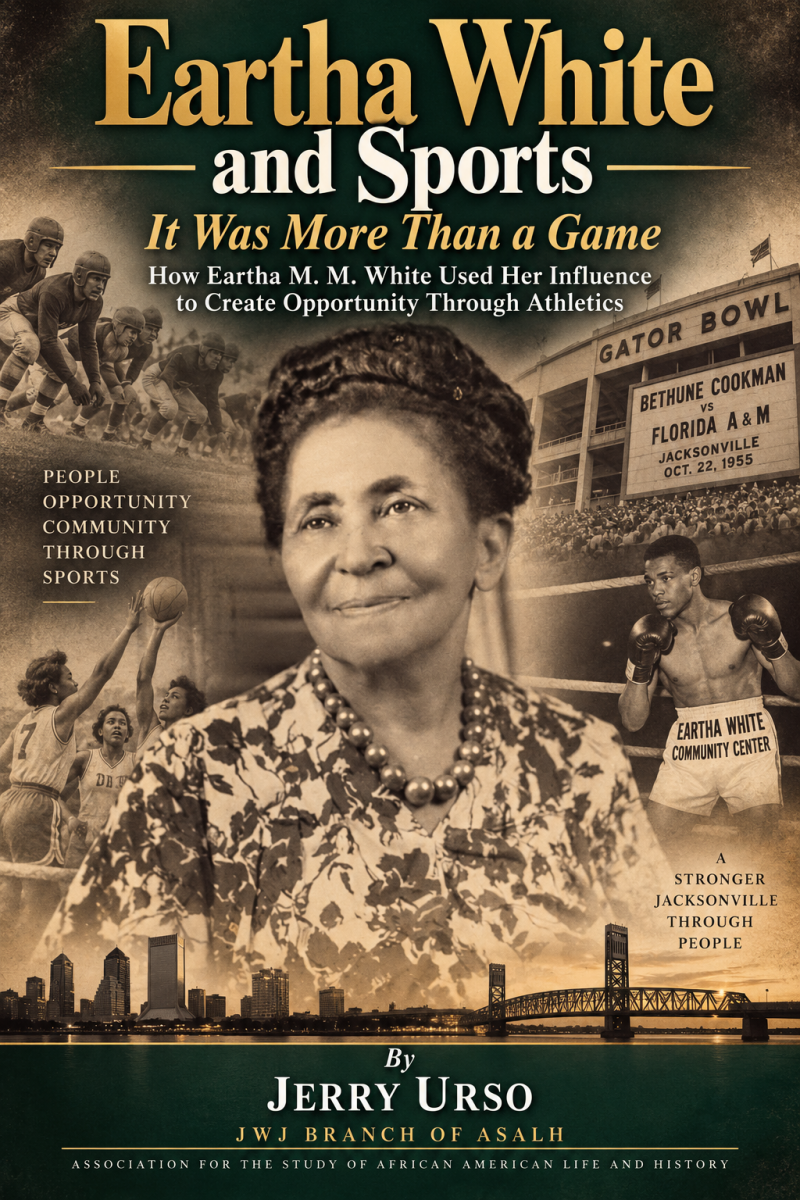
Eartha White and SportsIt Was More Than a GameHow Eartha M. M. White Used Her Influence to Create Opportunity Through Athletics
By Jerry Urso
Eartha M. M. White is remembered as an educator, businesswoman, humanitarian, and institution builder, but there is another thread running through her long life of service that has received far less attention. From the opening years of the twentieth century until she was in her nineties, sports repeatedly appeared alongside her community work. Football, women’s basketball, Black college football, community recreation, and boxing were all connected in some way to the institutions, organizations, and opportunities she helped create. When these episodes are placed together rather than treated as unrelated newspaper notices, they reveal something important about how Eartha White exercised influence.
Her involvement with athletics was not simply about raising money. Fundraising certainly mattered, particularly when Jacksonville’s Black institutions were forced to build and sustain themselves with limited resources, but Eartha understood that sports could accomplish something else. Athletics created opportunities for people to participate, compete, develop confidence, represent an institution, and become visible before their community. Eartha did not need to be the person carrying the football, shooting the basketball, or stepping into the boxing ring. Her contribution was often creating the circumstances that allowed someone else to do those things.
That approach was already visible before sports entered the surviving record. In 1899, Eartha persuaded Bartolo Genovar to provide land and lumber for a school serving Black children in Bayard.[1] The episode demonstrates something that would characterize much of her life. When Eartha encountered people who needed an opportunity, she looked for resources and for people who possessed them. She learned how to connect the two. Her influence was not simply something she accumulated for herself. She repeatedly converted it into opportunities for other people.
Football, an Oakland Store, and a Community Building Itself
By 1903, Eartha was deeply involved in efforts to establish an Old Folks Home for Jacksonville’s Black residents. In February, the Union Benevolent Association, Helping Hand Society, and Colored Citizens Protective League met together at LaVilla Chapel to establish a home for aged and infirm people. Eartha served as secretary of the joint committee. By March, construction was underway in Campbell’s Addition, seven carpenters had donated their labor, and Eartha was identified as president of the Colored Citizens Protective League.[2][3]
Against that background, a small newspaper announcement from September 1903 takes on much greater significance. The Jacksonville Journal announced charity football activity benefiting the Orphan Home and Old Folks Home. Teams wishing to issue challenges were instructed to leave them at Miss Eartha White’s store in Oakland.[4]
At first glance, this appears to be simply another fundraising activity. The football games benefited charitable institutions, including one Eartha had spent that year helping establish. But the notice tells us something more. Eartha’s store was functioning as part of the organizational structure of Black athletics. Teams needed a way to find opponents, issue challenges, arrange games, and communicate with one another. Eartha made a business she controlled available to that network.
The importance was therefore not limited to the money collected at a football game. Black Jacksonville was creating institutions for itself during segregation, and sports were part of that institution building. Eartha's Oakland store became one of the places where that activity could be organized. The same woman working to provide elderly Black residents with a home was helping provide younger Black residents with an organized avenue for athletic competition. Charity and opportunity existed together.
Creating Space for Young Black Women
Eleven years later, another sport brings Eartha back into the record. In December 1914, she served as president of the young ladies’ basketball team of Bethel Baptist Church. An oyster supper supporting the organization was held at Eartha’s home.[5]
The surviving evidence does not tell us that Eartha played basketball, and there is no reason to make her an athlete when the documentary record establishes something equally significant. She was providing leadership and support for young Black women who were participating in organized basketball. Her home itself became part of the support structure surrounding their team.
That matters when the period is considered. Organized athletics for young Black women required much more than finding a ball and a court. A team needed community support, leadership, fundraising, social legitimacy, and institutions willing to stand behind the women who participated. Bethel Baptist Church provided an institutional setting, and Eartha White provided leadership. Her home became a place where the community could gather to support the team.
This episode also anticipated the much larger role Eartha would play in organizing women. During World War I, she became State Chairman of the Colored Division of the Woman’s Committee and helped organize Black women throughout Florida. She also served as president of Jacksonville’s City Federation of Colored Women’s Clubs and participated in the wartime Food Pledge campaign.[6][7] The basketball team therefore belongs within a much broader history of Eartha creating organized spaces in which Black women could participate, lead, and contribute to community life.
Her Influence Became Her Currency
As the decades passed, Eartha's influence expanded far beyond the institutions of her youth. The woman who once operated a store in Oakland became connected to Jacksonville’s educational, business, religious, charitable, and civic leadership. She developed relationships with important figures across Florida, including Mary McLeod Bethune. Their association grew through education, women's organizations, and community service, and Clara White Mission historical memory preserves Bethune staying with Eartha when she visited Jacksonville.[8]
Eartha also continued investing in opportunities for young people. In 1939, she donated land for a proposed East Jacksonville home for Black girls.[9] During World War II, the Clara White Mission maintained practical training programs that included cooking, canning, typing, ceramics, and Braille while continuing its work among homeless residents and released prisoners.[10]
These activities may seem far removed from sports, but they help explain Eartha's philosophy. She was constantly trying to create places where people could learn, develop skills, receive support, and move forward. She understood that opportunity required infrastructure. Someone had to obtain the building, find the money, organize the committee, persuade the influential person, open the door, or attach a respected name to the project. Over decades of work, Eartha became increasingly capable of doing exactly that.
By the 1950s, her greatest resource may have been something that could not be purchased. It was her clout.
Bringing FAMU and Bethune Cookman to Jacksonville
In 1955, football returned to Eartha White's story on a scale that would have been difficult to imagine when teams were leaving challenges at her Oakland store half a century earlier. The Florida Times-Union documented Eartha serving on the citizens committee preparing for an October 22 football game between Florida A&M University and Bethune Cookman College at Jacksonville's Gator Bowl. Contemporary coverage anticipated approximately 25,000 spectators.[11]
Florida A&M and Bethune Cookman already had a football rivalry extending back to 1925, so the 1955 contest was not their first meeting.[12] The historical series records, however, place the earlier games in Tallahassee and Daytona Beach before listing Jacksonville as the site of the October 22, 1955 meeting. The game therefore appears to have been the first meeting between the two schools played in Jacksonville. Florida A&M won 32 to 0.[13]
That distinction gives Eartha's role greater historical importance. She was not merely attending another football game. She was part of the citizens committee preparing Jacksonville to host these two major Black educational institutions and their football rivalry for the first documented time in the city.[11][13]
The 1955 game should not be confused with the beginning of the modern Florida Classic. The FAMU and Bethune Cookman rivalry was already decades old, and the neutral site event that became the modern Florida Classic began in Tampa in 1978.[14] Eartha's involvement in Jacksonville therefore occurred twenty three years before the beginning of that modern Classic.
What happened at the Gator Bowl was important in its own right. Black college athletes were taking the field in a major Jacksonville venue. Their institutions, alumni, supporters, bands, students, and families could gather around an event expected to attract thousands of spectators. Eartha was among the local citizens helping make that gathering possible.
The contrast with 1903 is striking. When Eartha was a young woman, she could offer football players her store as a place through which challenges could be arranged. Fifty two years later, she could offer something different. She possessed decades of relationships and a reputation built through service. Her presence on the citizens committee demonstrates that her name and influence had become resources themselves.
From Providing Opportunity to Having Athletes Carry Her Name
The final chapter of Eartha White's sports story brings us to boxing, and it should not be treated as an afterthought. In many ways, boxing completes the story that began with those football challenges left at her store in 1903.
By 1968, Eartha was ninety one years old. Young athletes were no longer merely participating in activities she supported. They were competing as members of a team carrying her name.
On March 31, 1968, the Eartha White Community Center boxing team competed in the Florida state AAU boxing tournament at Snyder National Guard Armory. The team won the Novice Division championship and finished second in the Open Division.[15]
The following day's Jacksonville Journal captured the accomplishment with the headline “Eartha White Wins Tourney.”[15] The headline was figurative, of course. Eartha White did not climb into the ring and win the championship. Young boxers did that. Yet the headline unintentionally captured something important about what her name had come to represent.
Those athletes belonged to the Eartha White Community Center. They had a place from which to train, a team with which to identify, and an institution they could represent in statewide amateur competition. They were not simply occupying their time with recreational boxing. Their success demonstrates that the program produced athletes capable of competing successfully at the Florida AAU level.
That is opportunity made tangible. A young person could walk into a community institution, become part of a boxing program, train, compete, and eventually represent that institution at a state championship. The story had progressed from Eartha making her business available to athletes to athletes carrying Eartha's name into the ring.
A Sixty Five Year Story
When these episodes are placed together, the continuity is remarkable. In 1903, Eartha's Oakland store helped connect football teams while games supported the Orphan Home and Old Folks Home.[4] In 1914, she served as president of Bethel Baptist Church's young ladies’ basketball team and opened her home to support the organization.[5] In 1955, after decades of accumulating civic influence, she served on the citizens committee preparing for the first documented Jacksonville meeting between FAMU and Bethune Cookman at the Gator Bowl.[11][13] In 1968, the Eartha White Community Center boxing team won a Florida state AAU championship.[15]
Those events span approximately sixty five years. The sports changed from football to basketball, back to football, and finally to boxing. Eartha's own position changed even more dramatically. She went from a young businesswoman making her store available to local football teams to an established civic leader whose name itself had become attached to an athletic institution.
What remained constant was her willingness to use whatever she possessed at that moment in her life. When she had a store, she used the store. When she had a home, she opened the home. When she had organizational skills, she organized. When she developed relationships with powerful institutions and community leaders, she used those relationships. When decades of service gave her a respected name, that name became another resource capable of opening doors.
That is the larger meaning of Eartha White's connection with sports. She did not accumulate influence simply to possess influence. She converted influence into opportunity.
It Was More Than a Game
Eartha White's sports story is therefore not primarily the biography of an athlete. It is the story of an institution builder who understood what athletics could mean to a community that had to fight for access to nearly every avenue of American life.
The football games of 1903 could help support an orphan or an elderly resident while providing Black athletes with organized competition. The Bethel basketball team could give young Black women a place to participate together at a time when their opportunities were sharply limited. The 1955 FAMU and Bethune Cookman game could place Black college athletes and Black institutions before thousands of spectators at Jacksonville's Gator Bowl. The Eartha White Community Center could give young boxers a place to train until they were capable of becoming Florida AAU champions.
None of those things happened simply because Eartha loved sports. The surviving sources do not require us to make that claim. They tell a richer story. Eartha recognized sports as another part of community life through which people could be organized, supported, developed, and given opportunities.
She knew how to use what she had so someone else could have a chance.
That was true when the resource was land for a school. It was true when it was an Oakland store where football challenges could be left. It was true when her home supported a women's basketball team. It was true when her civic reputation helped support a major HBCU football event at the Gator Bowl. And it was still true when young men entered a boxing ring carrying the name Eartha White across their uniforms and their community behind them.
For Eartha M. M. White, sports were never merely about the final score. They were about what could happen when someone was finally given a field on which to play, a court on which to compete, a stadium in which to be seen, or a ring in which to prove himself.
It was more than a game. It was opportunity.
References
[1] University of North Florida, Thomas G. Carpenter Library, Special Collections and Archives, Eartha M. M. White Collection, biographical, manuscript, photographic, and organizational materials.
[2] “Old Folks Home,” Jacksonville Journal (Jacksonville, Florida), February 23, 1903, p. 6. Meeting held February 20, 1903, at LaVilla Chapel.
[3] Jacksonville Journal (Jacksonville, Florida), March 25, 1903, p. 6. Construction of the Old Folks Home in Campbell’s Addition; Eartha White identified as president of the Colored Citizens Protective League.
[4] Jacksonville Journal (Jacksonville, Florida), September 10, 1903, p. 7. Charity football notice directing challenges to Eartha White’s store in Oakland.
[5] Jacksonville Journal (Jacksonville, Florida), December 12, 1914, p. 9. Bethel Baptist Church young ladies’ basketball team.
[6] Jacksonville Journal (Jacksonville, Florida), November 17, 1917, p. 5; University of North Florida, Eartha M. M. White Collection, World War I organizational and United War Work materials.
[7] “Miss Eartha White Is Commended,” Jacksonville Journal (Jacksonville, Florida), November 29, 1917, p. 9.
[8] Clara White Mission and Eartha M. M. White Collection materials concerning Mary McLeod Bethune, women's organizations, and the Service Laundry Company.
[9] “Launch Drive to Raise Funds for Delinquent Negro Girls,” Jacksonville Journal (Jacksonville, Florida), December 12, 1939, p. 8.
[10] Clara White Mission institutional history and archival materials concerning World War II training and community service programs.
[11] The Florida Times-Union (Jacksonville, Florida), September 18, 1955, p. 2. Planning for the October 22 Bethune Cookman College and Florida A&M University football game at the Gator Bowl.
[12] Bethune Cookman University Athletics, historical material concerning the FAMU and Bethune Cookman football series, beginning in 1925.
[13] Bethune Cookman University Athletics, football series history identifying the October 22, 1955 FAMU victory, 32 to 0, as the first meeting in the chronology played in Jacksonville.
[14] Florida A&M University Athletics, historical material concerning the Florida Classic, established as a neutral site rivalry game in Tampa in 1978.
[15] “Eartha White Wins Tourney,” Jacksonville Journal (Jacksonville, Florida), April 1, 1968, p. 21. Eartha White Community Center boxing team, Florida state AAU tournament
