
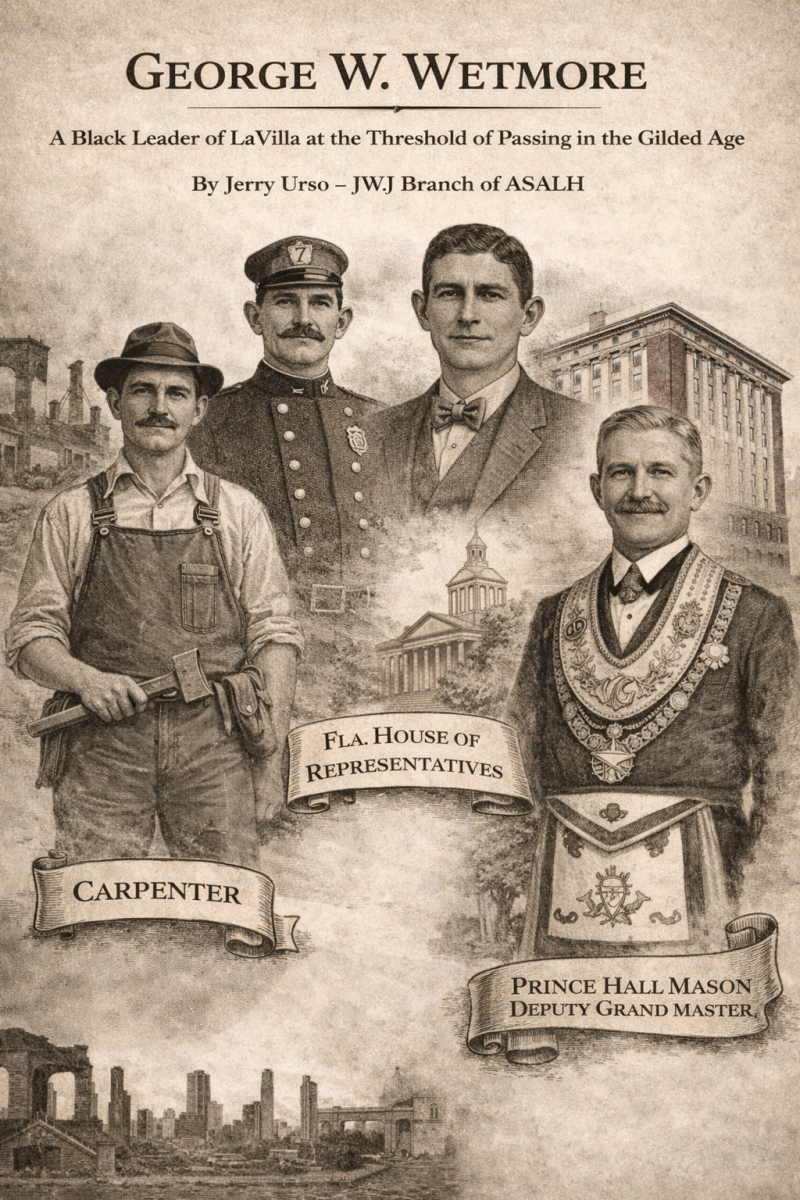
George W. Wetmore
A Black Leader of LaVilla at the Threshold of Passing in the Gilded Age
Reconstruction Legislator, Prince Hall Deputy Grand Master, and Property Builder in the Making of Black Jacksonville
By Jerry Urso — JWJ Branch of ASALH
Few figures in the early civic history of Jacksonville illustrate the complexity of race, leadership, and community authority in the late nineteenth century more clearly than George W. Wetmore. By the opening decade of the twentieth century, federal census enumerators recorded him as white. Yet the documentary record surrounding his life demonstrates decades of continuous leadership inside Jacksonville’s African American institutional world. He served as a Republican member of the Florida House of Representatives from Duval County, carried federal authority as a United States postal letter carrier, exercised municipal responsibility as a Jacksonville police officer, supervised neighborhood housing as a collector of rental property, invested directly in LaVilla real estate, and rose to the office of Deputy Grand Master of the Most Worshipful Union Grand Lodge of Florida, Prince Hall Affiliation—the second highest office in the jurisdiction. No individual occupying such positions could plausibly have stood outside the civic structure of the community he represented. [1][2][3][4][5]
Wetmore’s life therefore must be understood not as a story of disappearance into racial ambiguity but as a case study in the instability of classification during the Gilded Age South. Administrative racial labeling could shift even while institutional identity remained constant. His career unfolded in full view of Jacksonville’s Black churches, political networks, fraternal organizations, and neighborhoods, especially LaVilla, where he lived, worked, and invested for decades. [6][7]
To understand this paradox properly, one must begin not with the census entry that later puzzled observers, but with the Reconstruction-era Jacksonville in which Wetmore emerged as one of the early builders of Black civic life.
Born in Florida Before Emancipation
According to the 1910 United States Census, George W. Wetmore was born in Florida about 1848, placing his childhood within slavery and his adulthood squarely within the Reconstruction era transformation of citizenship in the South. [8]
This generation of native-born Black Floridians formed the first stable cohort of post-emancipation civic leadership in Jacksonville. Unlike later migrants who arrived during railroad expansion decades, men of Wetmore’s generation carried lived memory of bondage into the first experiments in political participation and institutional development. Their authority within emerging communities rested not only on education or officeholding but on continuity of presence across the transition from slavery to freedom. [8]
Wetmore’s later public career must therefore be understood as part of the earliest generation of Black Floridians who helped translate emancipation into municipal structure.
Building LaVilla with Skilled Labor
Before he entered state politics or federal service, Wetmore worked as a carpenter, a skilled occupation documented in the Jacksonville city directory of 1887, which placed him residing off Panama Road beyond Ninth Street South inside the developing LaVilla settlement corridor. [9]
Carpenters occupied a central role in Reconstruction Black communities. They constructed churches that doubled as political meeting halls, framed schoolhouses that anchored literacy campaigns, and built residences that marked the transition from plantation dependency to neighborhood independence. In Jacksonville, where LaVilla emerged rapidly as a center of African American residence and enterprise after the Civil War, skilled builders like Wetmore helped shape the physical landscape of freedom itself. [9]
This early familiarity with neighborhood land patterns later supported his transition into property oversight and real-estate leadership within the same community.
Election to the Florida House of Representatives
Wetmore entered statewide political leadership through election as a Republican representative from Duval County to the Florida House of Representatives, serving from 1883 to 1885. His election placed him among the early generation of African American lawmakers who helped shape Florida’s Reconstruction political framework and represented Black voters during a period when public education, municipal authority, and civil rights protections remained subjects of active legislative debate. [2][10]
Newspaper reporting from the period confirms his identification with Republican leadership circles in Jacksonville, demonstrating that his legislative service formed part of a broader network of political engagement linking local ward organization with statewide governance. [3]
His legislative career established him as one of LaVilla’s recognized representatives not only socially but politically.
Federal Appointment as United States Letter Carrier
The Jacksonville city directory of 1884 lists Wetmore as a letter carrier, confirming his appointment within the United States postal system during the Reconstruction political era. [1]
Postal employment represented one of the most respected federal appointments available to African Americans in the late nineteenth-century South. Letter carriers moved daily through residential wards delivering correspondence that connected families, churches, and political organizations across the city. In newly emancipated communities where literacy itself represented advancement, the presence of a Black postal employee symbolized both trustworthiness and federal recognition of citizenship status. [1]
Wetmore’s service along postal routes extended his familiarity with LaVilla households and strengthened the relationships that later supported his transition into neighborhood property management.
Municipal Authority as Jacksonville Police Officer
In addition to federal employment, Wetmore later served as a Jacksonville police officer, placing him within the municipal structure of governance at a time when African American participation in city authority represented one of the clearest practical expressions of Reconstruction citizenship. [10]
Because his earlier work as carpenter and postal carrier had already brought him into daily contact with LaVilla residents, his municipal authority rested upon familiarity rather than distance. He protected streets he already knew and neighborhoods whose institutions he had helped build.
This continuity reinforced his standing as a trusted representative figure within Jacksonville’s African American civic structure.
Republican Leadership in Duval County During Reconstruction’s Aftermath
George W. Wetmore’s service in the Florida House of Representatives did not occur in isolation from local political organization. Contemporary newspaper reporting identified him among Republican leadership figures in Duval County during the Reconstruction and post-Reconstruction transition period, placing him inside the network of ward-level political organizers who sustained African American electoral participation in Jacksonville even as statewide conditions became increasingly hostile to Black officeholding. [3]
During the 1880s, the Republican Party in Jacksonville functioned not merely as a political affiliation but as one of the primary institutional vehicles through which African American citizens defended access to education, municipal employment, and representation. Leaders like Wetmore operated simultaneously at the neighborhood and state level, translating local concerns from LaVilla into legislative advocacy in Tallahassee. His election between 1883 and 1885 therefore reflects both personal credibility and the confidence of Black voters in Duval County who recognized him as a reliable representative of their interests. [2][3]
That trust extended beyond legislative service. Wetmore remained visible within Jacksonville’s civic structure long after his House term ended, demonstrating the continuity of leadership typical of Reconstruction-era officeholders who later transitioned into fraternal, municipal, and property-based authority within their communities.
A Household Anchored in Education and Community Stability
Leadership in Reconstruction Jacksonville frequently emerged through families rather than individuals alone, and the Wetmore household reflected that pattern clearly. The Jacksonville city directory of 1888 identified Mrs. George W. Wetmore as a teacher, placing the family directly inside the educational infrastructure that supported literacy and advancement within the African American community during the late nineteenth century. [11]
Teachers occupied central roles in post-emancipation neighborhoods like LaVilla. School buildings doubled as meeting spaces, lecture halls, and political organizing sites, while educators themselves served as community advisors whose influence extended well beyond the classroom. A household combining legislative service, federal employment, municipal authority, and educational leadership stood near the center of Jacksonville’s emerging Black middle class.
Such families helped stabilize neighborhoods during decades when institutional continuity remained fragile across much of the South.
The Wetmore residence therefore functioned not simply as a private household but as part of the civic framework through which LaVilla’s leadership class emerged.
From Skilled Builder to Property Overseer: Collector of Houses (1901)
By the opening year of the twentieth century, Wetmore’s occupational designation had shifted from skilled construction labor to neighborhood property supervision. The Jacksonville city directory of 1901 listed him as a collector of houses, confirming his movement into a role that required both financial trust and detailed knowledge of residential occupancy patterns across LaVilla. [12]
The position of house collector represented a transitional stage between artisan labor and real-estate investment. Collectors supervised rental payments, monitored tenant relationships, and acted as intermediaries between property owners and residents. In rapidly expanding neighborhoods like LaVilla—where home construction accelerated during the late nineteenth century—such responsibilities placed individuals at the center of community economic life.
Wetmore’s earlier experience as a carpenter had given him familiarity with the physical layout of the neighborhood. His service as a postal carrier had introduced him to households throughout the ward. His role as a police officer had strengthened his standing as a trusted municipal representative. These overlapping forms of experience prepared him naturally for work supervising residential property across the community he had helped build decades earlier.
The transition from carpenter to collector therefore did not represent occupational change alone. It marked entry into the property-management class that shaped the residential stability of Black Jacksonville at the turn of the century.
The Emergence of a Real-Estate Leader in LaVilla
Within a year of his listing as a collector of houses, Wetmore’s professional designation advanced again. Beginning in the Jacksonville city directory of 1902, he appears as a real-estate agent, a title that remained attached to his name across multiple directory listings over the next decade and a half. [13]
The continuity of this designation across directories issued in 1902, 1906, 1913, 1916, and 1918 confirms that real-estate work formed a sustained professional identity rather than a temporary occupation. [13]
This development reflected a broader pattern visible among Reconstruction-era skilled workers who used knowledge of neighborhood land patterns to enter property investment during the Gilded Age. Builders understood where streets expanded first. Postal carriers understood where families settled permanently. Municipal officers understood where stability emerged within wards undergoing demographic change. Wetmore possessed all three forms of knowledge simultaneously.
As a result, his transition into real-estate work represented not departure from earlier community roles but the culmination of them.
Within LaVilla he had helped construct houses, deliver correspondence between households, enforce municipal order, represent voters in Tallahassee, and supervise rental property. By the early twentieth century he was participating directly in the ownership and transfer of neighborhood land itself.
Such authority placed him firmly within the class of African American property leaders who shaped Jacksonville’s Black residential geography during the decades between Reconstruction and the First World War.
Homeownership and Long-Term Residence at 405 West 11th Street
By the opening decade of the twentieth century, George W. Wetmore had become not simply a participant in LaVilla’s development but a permanent property holder within it. The 1910 United States Census recorded him residing at 405 West 11th Street in Jacksonville’s Ward 6 and identified him as the owner of his home free of mortgage, an important indicator of both financial stability and neighborhood permanence during an era when property ownership represented one of the strongest measures of civic standing within African American communities of the South. [8]
Ownership without encumbrance carried particular significance. In LaVilla, where residential expansion during the late nineteenth century had produced a mixture of renters, craftsmen, laborers, and emerging professional households, outright ownership signaled entry into the community’s leadership class. Property holders shaped the residential continuity of the neighborhood and provided stability during years when economic opportunity remained uneven across the city.
Wetmore’s address on West 11th Street placed him squarely within the geographic center of Jacksonville’s most important African American settlement district during the period between Reconstruction and the First World War. Unlike some political figures whose influence carried them away from their original constituencies, Wetmore remained rooted inside the neighborhood he had helped construct decades earlier as a carpenter and municipal officer. [8][9]
This continuity of residence reinforced his authority as a representative figure within LaVilla’s civic structure and prepared the ground for his later recognition within statewide fraternal leadership.
Election as Deputy Grand Master of the Most Worshipful Union Grand Lodge of Florida
Wetmore’s influence extended beyond Jacksonville through his elevation to the office of Deputy Grand Master of the Most Worshipful Union Grand Lodge of Florida, one of the highest positions within Florida’s Prince Hall Masonic jurisdiction. Proceedings of the Grand Lodge confirm his service in this role, placing him immediately beneath the Grand Master in the organizational hierarchy of the state’s largest African American fraternal institution. [5]
Within Prince Hall Masonry, the office of Deputy Grand Master represented far more than ceremonial distinction. The position required oversight of subordinate lodges, participation in jurisdictional governance, and representation of the Grand Lodge across the state. In communities where fraternal organizations provided burial insurance, educational support, mutual aid, and leadership training, election to such an office reflected recognition from lodge members throughout Florida rather than from a single neighborhood constituency.
Prince Hall Masonry in the late nineteenth century functioned as one of the primary institutional frameworks through which African American communities organized collective advancement. Lodges sponsored schools, supported widows and orphans, provided burial assistance, and created communication networks linking towns across the state. Leadership within the Grand Lodge therefore carried both administrative responsibility and symbolic authority inside Black civic life.
Wetmore’s election as Deputy Grand Master confirmed that his reputation extended well beyond Jacksonville. It also demonstrated that his leadership remained firmly anchored inside African American institutional networks at precisely the historical moment when census classification later introduced ambiguity into the documentary record of his racial identification.
No individual serving as second-ranking officer within Florida Prince Hall Masonry could plausibly have stood outside the community whose institutional life the organization represented.
Prince Hall Leadership as Evidence of Community Identification
The significance of Wetmore’s elevation to Deputy Grand Master becomes even clearer when considered alongside his earlier roles in Jacksonville’s political and municipal structure. Reconstruction legislators often maintained influence through fraternal leadership after leaving elective office, and Prince Hall Masonry served as one of the principal arenas through which that continuity occurred.
Within Florida, the Most Worshipful Union Grand Lodge of Florida functioned not only as a fraternal organization but as a statewide communication network linking African American leadership across cities and counties. Through its annual proceedings, subordinate lodge representation, and jurisdictional committees, the Grand Lodge created an institutional framework that paralleled—and often replaced—the political networks weakened by the rollback of Reconstruction-era reforms.
Wetmore’s presence within this structure demonstrates that his leadership remained publicly recognized across Florida’s African American communities even after his formal legislative service had concluded. His authority therefore did not diminish with time. It shifted from electoral representation to institutional governance.
This transition from political officeholder to fraternal executive followed a pattern visible among many Reconstruction-era leaders whose influence endured through lodge structures long after their legislative careers ended.
Stability, Property, and Authority in the LaVilla Leadership Class
By the early twentieth century, the combined evidence of directory listings, census documentation, municipal service, and fraternal leadership reveals Wetmore as a member of LaVilla’s established leadership class rather than a transient participant in its development. He had entered the neighborhood as a skilled builder during the Reconstruction period, represented its residents in the Florida House of Representatives during the 1880s, served as a federal postal employee and municipal officer during the city’s expansion years, supervised residential property during the transition into the new century, and ultimately participated directly in the ownership and transfer of neighborhood land as a real-estate agent across multiple decades. [1][2][8][9][12][13]
Such continuity of service across occupational categories reflected the layered structure of African American civic leadership in Jacksonville during the period between Reconstruction and the Progressive Era. Political authority, municipal employment, property investment, and fraternal leadership did not exist as separate spheres. They reinforced one another.
Wetmore’s career illustrates how those forms of authority combined within a single individual to produce neighborhood stability across generations.
Standing at the Threshold of Passing in the Gilded Age
By 1910, when federal census enumerators recorded George W. Wetmore as white while he remained a homeowner at 405 West 11th Street in Jacksonville’s Ward 6, the entry introduced a documentary paradox that has shaped how later readers encounter his life. Yet when placed alongside the full institutional record of his career—his legislative service, municipal employment, federal appointment, real-estate activity, and elevation to Deputy Grand Master of the Most Worshipful Union Grand Lodge of Florida—the classification cannot reasonably be interpreted as evidence that he had withdrawn from the African American civic world in which his leadership had been formed and sustained for decades. [5][8]
Instead, the record places Wetmore at what may best be described as the threshold of passing during the Gilded Age: a moment when bureaucratic racial labeling could shift even while social identity, neighborhood affiliation, and institutional leadership remained unchanged.
In Jacksonville, as in many southern cities during the late nineteenth and early twentieth centuries, census enumeration did not always reflect stable community classification. Enumerators frequently relied upon appearance, neighborhood assumptions, or prior entries rather than consistent genealogical knowledge. As a result, classification could change across census decades without indicating a corresponding shift in social identity. Wetmore’s continued residence in LaVilla, his sustained professional activity within the neighborhood’s real-estate structure, and his jurisdictional office within Prince Hall Masonry all demonstrate continuity rather than withdrawal from Black institutional life. [8][13][5]
Equally important is the timing of the 1910 enumeration itself. By that date Wetmore had already completed his legislative career, established his reputation within Duval County Republican leadership circles, and entered the upper ranks of Florida’s Prince Hall Masonic jurisdiction. The classification therefore occurred after the leadership record had been firmly established rather than before it.
For this reason, the census entry cannot define the trajectory of his career. Instead, it marks a moment within it—one that reveals how fluid racial documentation could become during the decades following Reconstruction even among individuals whose public roles remained clearly rooted within African American civic institutions.
Wetmore’s life therefore illustrates a larger historical truth about the Gilded Age South. Passing did not always occur as a dramatic break from community affiliation. In some cases, it appeared instead as a documentary ambiguity layered over a lifetime of continuous public identification within Black institutional leadership.
Continuity of Leadership in LaVilla’s Civic Structure
The evidence of Wetmore’s residence, occupational progression, and fraternal authority demonstrates that his leadership within LaVilla extended across multiple phases of Jacksonville’s development—from Reconstruction through the Progressive Era transition that followed the Great Fire of 1901. Directory listings documenting his progression from carpenter to collector of houses and ultimately to real-estate agent confirm that his authority within the neighborhood evolved alongside its physical expansion. [9][12][13]
Unlike many Reconstruction-era officeholders whose influence diminished after leaving elective office, Wetmore remained active inside Jacksonville’s civic structure through municipal employment, property supervision, and fraternal governance. His career therefore represents continuity rather than decline during the decades when African American political representation narrowed across much of the South.
This continuity helps explain why his elevation to Deputy Grand Master carried such significance. Prince Hall Masonry functioned as one of the principal institutional frameworks through which African American leadership networks maintained communication and mutual support across Florida during the late nineteenth century. Election to the second-highest office within that jurisdiction confirmed recognition from lodge members throughout the state rather than from a single local constituency. [5]
His leadership therefore remained visible not only within LaVilla but across Florida’s broader Black civic structure.
A Bridge Between Reconstruction Leadership and the Professional Generation That Followed
Perhaps the clearest measure of George W. Wetmore’s historical significance lies in the generational transition represented by his household itself. Within the residence he established at 405 West 11th Street, Wetmore created the conditions from which emerged his son, J. Douglas Wetmore, who would become one of Jacksonville’s most important African American attorneys and civil-rights advocates during the early twentieth century.
The younger Wetmore’s career did not arise independently of the institutional structure built by his father’s generation. Instead, it rested upon decades of neighborhood stability created through skilled labor, legislative representation, municipal authority, property investment, and fraternal leadership. By the time the next generation entered professional life, LaVilla already possessed the civic infrastructure required to support lawyers, educators, ministers, and business leaders whose work would shape Jacksonville during the Progressive Era and beyond.
In this sense, George W. Wetmore stands as a bridge figure between the Reconstruction leadership class that first translated emancipation into citizenship and the professional generation that later expanded African American influence within the legal and institutional life of the city.
Conclusion: Leadership Without Withdrawal
Taken together, the documentary record of George W. Wetmore’s life reveals a pattern of sustained civic engagement that stretches from the Reconstruction legislature through federal employment, municipal service, neighborhood property leadership, and statewide Prince Hall Masonic authority. His residence within LaVilla remained continuous. His professional roles remained public. His institutional affiliations remained rooted within African American civic networks.
The census classification that later recorded him as white therefore represents not a departure from that world but a reminder of how unstable racial documentation could become during the Gilded Age South.
Wetmore did not disappear from Jacksonville’s Black leadership structure.
He helped build it.
And through legislative service, municipal authority, property investment, and fraternal governance, he helped ensure that the neighborhood he served—LaVilla—would remain one of the central foundations of African American civic life in the city for generations to come.
References
[1] Jacksonville City Directory (Jacksonville, FL), 1884.
[2] Canter Brown Jr., Florida’s Black Public Officials, 1867–1924.
[3] Florida Times-Union (Jacksonville), Republican leadership reporting referencing George W. Wetmore.
[4] Jacksonville municipal service listing identifying George W. Wetmore as police officer.
[5] Proceedings of the Most Worshipful Union Grand Lodge of Florida (Prince Hall Affiliation), listing George W. Wetmore as Deputy Grand Master.
[6] Jacksonville civic reporting identifying Wetmore among LaVilla community leadership figures.
[7] Duval County Republican organizational reporting referencing Wetmore.
[8] 1910 United States Census, Jacksonville Ward 6, Duval County, Florida.
[9] Jacksonville City Directory (Jacksonville, FL), 1887.
[10] Legislative service documentation confirming Florida House representation from Duval County, 1883–1885.
[11] Jacksonville City Directory (Jacksonville, FL), 1888.
[12] Jacksonville City Directory (Jacksonville, FL), 1901.
[13] Jacksonville City Directories (Jacksonville, FL), 1902; 1906; 1913; 1916; 1918.
