
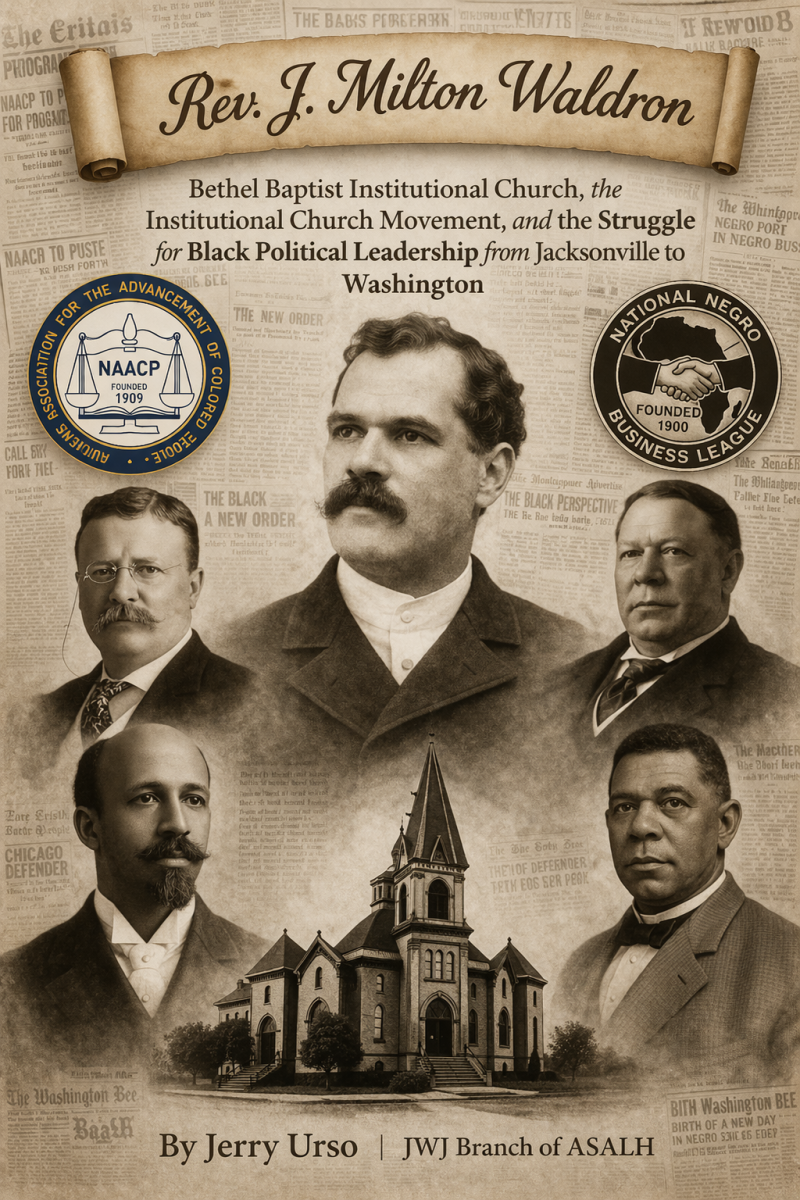
Rev. J. Milton Waldron (1863–1931)
Institutional Church Builder, Niagara Movement Treasurer, and Architect of Black Civic Infrastructure in Jacksonville and Washington
By Jerry Urso
JWJ Branch of ASALH
Early Life and Educational Formation (1863–1889)
Rev. J. Milton Waldron emerged from the generation of African American clergy whose lives were shaped by the closing years of the Civil War and the educational opportunities created during Reconstruction. Born on May 19, 1863, in Lynchburg, Virginia, Waldron entered the world at the very moment when emancipation was transforming the legal and social condition of formerly enslaved people across the South. His life would come to reflect the aspirations of that first generation of Black leaders educated after slavery and committed to building institutions capable of sustaining freedom through education, church organization, and civic leadership. [1]
Like many of the most influential Black ministers of the late nineteenth century, Waldron pursued higher education within the emerging network of historically Black colleges that prepared clergy for leadership not only in congregations but also in schools, newspapers, reform organizations, and political movements. He enrolled at Lincoln University in Pennsylvania, one of the nation’s oldest institutions dedicated to the higher education of African American men. Founded before the Civil War and strengthened during Reconstruction, Lincoln University became a major training ground for ministers, educators, and intellectual leaders who shaped Black public life across the United States in the late nineteenth and early twentieth centuries. Waldron graduated from Lincoln University in 1886, entering the ministry at a time when educated clergy were expected to function as community builders as well as spiritual leaders. [2]
Following his graduation from Lincoln, Waldron continued his theological training at Newton Theological Institution in Massachusetts, one of the most respected Baptist seminaries in the United States. Newton prepared ministers for pastoral leadership within a tradition that emphasized both doctrinal training and practical engagement with social reform concerns. During the decades after the Civil War, the presence of African American students in northern seminaries reflected the determination of Black churches to develop an educated clergy capable of leading expanding congregations and establishing schools and institutions across the South. Waldron completed his studies at Newton in 1889, entering ministry equipped with both theological preparation and the institutional vision that would later characterize his work in Jacksonville and Washington. [3]
This combination of training at Lincoln University and Newton Theological Institution placed Waldron within a national network of educated Black Baptist clergy who viewed the church not only as a place of worship but also as the central organizing structure of African American civic advancement. Ministers shaped by this educational tradition frequently became founders of schools, editors of newspapers, organizers of mutual-aid societies, and advocates for civil rights. Waldron’s later leadership at Bethel Baptist Institutional Church in Jacksonville and Shiloh Baptist Church in Washington would reflect the influence of this formative intellectual and theological preparation, which emphasized both spiritual authority and institutional responsibility within Black community life. [4]
Arrival in Jacksonville and the Transformation of Bethel Baptist Institutional Church (1892)
When Rev. J. Milton Waldron accepted the pastorate of Bethel Baptist Institutional Church in 1892, he entered one of the most important centers of African American religious and civic life in Florida. Founded in 1838, Bethel was already the oldest Black Baptist congregation in Jacksonville and one of the most historically significant African American churches in the state. By the time Waldron arrived, however, the congregation stood at a turning point. Like many southern Black churches in the decades following Reconstruction, Bethel faced the challenge of adapting to the rapidly changing conditions of urban growth, segregation, and the expanding educational needs of the Black community. Waldron’s pastorate would transform the church into one of the leading examples of the institutional church movement in the South. [5]
The institutional church model represented a new approach to ministry emerging in the late nineteenth century among African American clergy who believed that churches must serve not only as centers of worship but also as engines of social uplift, education, and community organization. Under Waldron’s leadership, Bethel began developing programs that addressed literacy, youth training, and practical social needs within Jacksonville’s Black population. These efforts reflected a broader national movement among Black Protestant leaders to expand the role of the church beyond Sunday services and into weekday educational and civic life. Waldron quickly positioned Bethel as a central site of this transformation in Florida. [6]
Among the earliest expansions of Bethel’s work during Waldron’s pastorate were programs designed to provide structured educational opportunities for children and young adults. The church established classroom instruction, reading-room access, and youth development activities that helped prepare a generation of students for leadership in a segregated society that restricted access to public educational resources. These programs placed Bethel among the leading southern congregations adopting the institutional model already visible in northern Black churches and in a growing number of urban congregations across the South. Waldron’s work demonstrated that Jacksonville could support a church-based educational infrastructure comparable to those developing in cities such as Atlanta and Washington. [7]
Equally significant was Waldron’s emphasis on practical community services. Bethel expanded its facilities to include spaces that addressed everyday needs within the surrounding neighborhood, including reading rooms, organized youth programming, and social-service activities designed to strengthen family and community life. Such efforts reflected Waldron’s conviction that religious leadership required engagement with the full range of social conditions facing African Americans during the era of Jim Crow segregation. In this respect, Bethel became not simply a congregation but a coordinating center for Black civic life in Jacksonville’s LaVilla district, linking religious instruction with educational opportunity and community organization. [8]
Waldron’s leadership at Bethel also positioned the church as a platform for broader institutional partnerships that would soon reshape Black education in Jacksonville. Within only a few years of his arrival, Bethel’s facilities and congregational support would become closely connected with the work of the Florida Baptist Academy, strengthening the church’s role as a foundation institution in the educational development of the city’s African American population. This collaboration would become one of the defining achievements of Waldron’s Jacksonville pastorate and one of the most enduring contributions of Bethel Baptist Institutional Church to the history of Black education in Florida. [9]
Florida Baptist Academy and the Educational Mission of Bethel Baptist Institutional Church
One of the most important developments during Rev. J. Milton Waldron’s pastorate at Bethel Baptist Institutional Church was the deepening relationship between the congregation and the Florida Baptist Academy. Founded through the leadership of Sarah Ann Blocker and supported by the earlier work of Matthew Gilbert, the Academy represented one of the earliest sustained efforts to provide secondary-level education for African American students in Florida during the era of segregation. Its survival and expansion during the 1890s depended heavily on institutional support from Jacksonville’s Black churches, and under Waldron’s leadership Bethel became one of the most important centers sustaining that effort. [10]
When the Academy relocated to Jacksonville after the racial violence that disrupted its earlier operations in Live Oak in 1892, Bethel Baptist Institutional Church provided both physical space and community infrastructure that helped stabilize the school during its most vulnerable years. Classes were conducted in the church basement, and the congregation’s educational resources—including access to meeting rooms, instructional support networks, and reading materials—were made available to students and teachers. This arrangement reflected the institutional church model that Waldron promoted, in which the church functioned as the central platform through which education, religious instruction, and civic leadership were coordinated within the African American community. [11]
Waldron’s cooperation with Blocker and Gilbert helped ensure that Florida Baptist Academy maintained a curriculum that balanced academic instruction with practical training suited to the conditions facing Black students in the Jim Crow South. Like similar institutions across the region, the Academy sought to prepare students not only for college study but also for teaching, ministry, and skilled employment. Bethel’s support strengthened the Academy’s ability to operate continuously during a period when educational opportunities for African Americans in Florida remained severely limited by segregation and underfunding in public schools. [12]
The relationship between Bethel and Florida Baptist Academy also brought national attention to Jacksonville’s Black educational leadership. In 1905 the Academy hosted a visit from Theodore Roosevelt, an event that drew thousands of attendees and demonstrated the importance of the institution within the wider landscape of African American education in the South. Waldron’s role as pastor of Bethel placed him at the center of this moment of national visibility, reinforcing the connection between the institutional church movement in Jacksonville and broader educational initiatives supported by Black Baptist leaders throughout the region. [13]
The partnership between Bethel Baptist Institutional Church and Florida Baptist Academy represented more than a temporary arrangement for classroom space. It reflected a shared vision that education formed the foundation of African American advancement in the decades following Reconstruction. The Academy would later become part of the institutional lineage of Florida Memorial University, ensuring that the educational work supported by Waldron and the Bethel congregation continued to influence generations of students long after his departure from Jacksonville. Through this collaboration, Waldron helped secure Bethel’s place as one of the foundational institutions in the history of Black education in Florida. [14]
Economic Self-Help and the Institutional Church Movement in Jacksonville
During Rev. J. Milton Waldron’s pastorate at Bethel Baptist Institutional Church, the church’s educational and religious programs were closely linked with a broader effort to strengthen the economic foundations of Jacksonville’s African American community. In the closing years of the nineteenth century and the opening decade of the twentieth, Black ministers frequently served as organizers of mutual-aid institutions that provided insurance protection, employment networks, and financial stability in a segregated economy that denied African Americans equal access to banks and commercial credit. Waldron’s leadership in Jacksonville reflected this wider institutional-church philosophy, which treated economic organization as an essential component of community advancement rather than a separate sphere from religious life. [15]
One of the most important expressions of this work was Waldron’s participation in the organization of the Afro-American Life Insurance Company in 1901. At the turn of the twentieth century, insurance companies formed one of the earliest and most effective instruments of Black economic cooperation in the South. They provided burial protection, encouraged savings habits, and created employment opportunities within African American communities at a time when conventional financial institutions largely excluded Black customers. Waldron’s involvement in the creation of this company demonstrates how Bethel’s leadership extended beyond religious instruction into the practical work of building financial infrastructure capable of supporting Black families during the era of segregation. [16]
Closely related to this effort was Waldron’s service as secretary of the Afro-American Industrial and Benefit Association, an organization designed to promote cooperative assistance and financial security among African Americans in Jacksonville. Mutual-aid societies of this type were central to Black community life throughout the South, offering structured systems of assistance during illness, death, and economic hardship. By helping to organize and administer such institutions, Waldron participated in a tradition of leadership in which ministers served as both spiritual guides and architects of collective self-help networks. [17]
These efforts also placed Waldron within the broader economic uplift movement associated with the ideas of Booker T. Washington and the work of the National Negro Business League. Although Waldron would later participate in civil-rights organizations that pursued a more direct protest strategy, his Jacksonville pastorate demonstrates clear alignment with the late nineteenth-century emphasis on institution-building through education, savings, and cooperative enterprise. The insurance and mutual-aid organizations he helped establish reflected a widely shared belief among Black church leaders that economic independence formed an essential foundation for long-term civic advancement. [18]
Through these initiatives, Bethel Baptist Institutional Church became more than a religious center; it functioned as a coordinating institution for education, social services, and economic cooperation within Jacksonville’s African American community. Waldron’s leadership in these efforts illustrates how the institutional church movement in Florida contributed to the development of durable community structures that supported Black families during one of the most restrictive periods of the Jim Crow era. [19]
Rev. J. Milton Waldron as Editor and Builder of Black Public Opinion in Jacksonville
In addition to his pastoral leadership and institutional work at Bethel Baptist Institutional Church, Rev. J. Milton Waldron played an important role in shaping public opinion within Jacksonville’s African American community through his service as editor of the Florida Standard. During the late nineteenth and early twentieth centuries, Black newspapers served as essential instruments of leadership within segregated southern cities. They provided forums for political discussion, promoted educational advancement, encouraged economic cooperation, and defended the civil rights of African American citizens at a time when white-controlled newspapers rarely represented Black perspectives fairly. Waldron’s editorial work placed him within a tradition of minister-editors who used religious authority to influence civic discourse beyond the walls of the church. [20]
The minister-editor occupied a particularly influential position within African American communities of the South. Because clergy were among the most highly educated leaders available to Black congregations during the era of segregation, they frequently assumed responsibility for newspapers that connected churches with broader networks of teachers, business leaders, and reform advocates. Through the Florida Standard, Waldron participated in this expanding communications network, helping to articulate the concerns and aspirations of Jacksonville’s Black citizens during a period marked by rapid urban growth and increasing racial restriction. His editorial leadership complemented the educational and institutional programs he directed at Bethel, reinforcing the church’s role as a center of civic as well as religious life. [21]
Waldron’s involvement in publishing extended beyond newspaper work. He also helped incorporate the Florida Evangelist Publishing Company, an enterprise that reflected the growing importance of print culture within the institutional church movement. Religious publishing companies supported the circulation of sermons, devotional literature, and educational materials that strengthened connections between congregations and reinforced shared strategies for community advancement. Through this work Waldron contributed to the development of a regional communications infrastructure that linked Jacksonville’s Black churches with wider Baptist and educational networks across Florida and the South. [22]
Taken together, Waldron’s editorial leadership and publishing activity demonstrate that his influence in Jacksonville extended well beyond pastoral administration. By shaping the printed voice of the community, he helped define the relationship between church leadership and civic engagement during a period when African American newspapers functioned as one of the principal vehicles for collective organization and political expression. His work as editor of the Florida Standard therefore formed an essential part of the institutional framework through which Bethel Baptist Institutional Church exercised leadership within Jacksonville’s African American community at the turn of the twentieth century. [23]
The Visit of President Theodore Roosevelt and the National Visibility of Florida Baptist Academy (1905)
One of the most remarkable moments in the history of Florida Baptist Academy during Rev. J. Milton Waldron’s pastorate at Bethel Baptist Institutional Church occurred in 1905 with the visit of Theodore Roosevelt to Jacksonville. Presidential visits to African American educational institutions in the South during the Jim Crow era were rare and politically significant events. Roosevelt’s appearance at the Academy demonstrated that the school—and the network of churches supporting it—had achieved a level of regional and national recognition unusual for Black institutions operating under segregation. Waldron’s leadership at Bethel placed him within the circle of Jacksonville’s Black ministers whose cooperation helped make the visit possible and ensured the success of the event. [24]
The visit drew a large audience from Jacksonville and surrounding communities, reflecting the importance of Florida Baptist Academy as a center of secondary education for African American students in the state. At a time when public educational opportunities for Black youth remained severely restricted, the Academy represented one of the few institutions capable of preparing students for teaching, ministry, and professional advancement. Roosevelt’s presence affirmed the school’s reputation and highlighted the significance of the educational work being carried forward through the combined efforts of Baptist leaders, teachers, and congregations across Florida. [25]
For Waldron and the congregation of Bethel Baptist Institutional Church, the event underscored the success of the institutional church model he had worked to develop since his arrival in Jacksonville in 1892. By providing classroom space, instructional support networks, and community backing for Florida Baptist Academy, Bethel had helped secure the stability of one of the most important Black educational institutions in the region. Roosevelt’s visit therefore served not only as recognition of the Academy itself but also as acknowledgment of the broader system of church-based educational cooperation that made such institutions possible in the segregated South. [26]
The significance of the visit extended beyond the immediate moment. It demonstrated that African American churches in Jacksonville were capable of sustaining educational institutions that attracted national attention and commanded respect across denominational and regional boundaries. Waldron’s participation in this achievement reflects the degree to which Bethel Baptist Institutional Church functioned as a foundation institution for Black education in Florida at the opening of the twentieth century, strengthening the legacy of the Academy that would later continue through the institutional lineage of Florida Memorial University. [27]
The Relationship with Booker T. Washington and the Economic Uplift Movement
During the closing years of the nineteenth century and the opening decade of the twentieth, Rev. J. Milton Waldron’s leadership in Jacksonville placed him within the expanding national network of ministers and educators associated with the economic uplift philosophy promoted by Booker T. Washington. Washington’s program emphasized education, institutional development, savings, and cooperative enterprise as the foundations of African American advancement in the era following Reconstruction. Waldron’s work at Bethel Baptist Institutional Church reflected many of these priorities, particularly through his involvement in educational initiatives, mutual-aid organizations, and church-based industrial training programs designed to strengthen the economic stability of Black families in Jacksonville. [28]
Waldron’s participation in the organization of the Afro-American Life Insurance Company and his service with the Afro-American Industrial and Benefit Association placed him squarely within the practical institutional framework that characterized Washington’s approach to racial advancement. These organizations promoted habits of thrift, provided burial protection, and created opportunities for employment and cooperative assistance within the African American community at a time when access to conventional banking and insurance services remained severely restricted. Such work reflected a widely shared conviction among Black ministers that economic independence formed an essential foundation for civic progress during the Jim Crow era. [29]
Waldron’s reputation as a leader in the institutional church movement also attracted the attention of Washington himself. In a contemporary assessment of Waldron’s ministry, Washington identified him as one of the most capable pastors working in the South, praising his ability to meet the needs of African American congregations through educational and institutional programming that extended beyond traditional religious instruction. This recognition placed Waldron among a select group of ministers whose churches were understood as models of the institutional approach to community development that Washington encouraged throughout the South. [30]
At the same time, Waldron’s career illustrates the complexity of relationships among African American leaders during the early twentieth century. Although his Jacksonville pastorate reflected close alignment with the economic uplift strategy associated with Washington and the National Negro Business League, his later participation in protest-oriented movements in Washington, D.C., including leadership roles in organizations connected with the emerging civil-rights campaign of the new century, demonstrates that his work cannot be understood solely within the framework of accommodationist politics. Instead, Waldron’s career reflects the transitional character of a generation of ministers who combined institution-building with an increasing willingness to support organized resistance to racial discrimination as conditions in the United States changed during the first decade of the twentieth century. [31]
The Washington School Controversy and the Break with Accommodationist Leadership
Although Rev. J. Milton Waldron’s work in Jacksonville reflected clear alignment with the institutional and economic uplift strategies associated with Booker T. Washington, his move to Washington, D.C., in 1907 placed him at the center of one of the most significant educational controversies affecting African American leadership in the early twentieth century. The dispute surrounding the removal of Anna J. Cooper from her position as principal of M Street High School became a defining moment in the development of protest-oriented civil-rights leadership in the nation’s capital and marked an important turning point in Waldron’s own public role. [32]
The controversy centered on competing visions of African American education at a time when Washington, D.C., held one of the strongest public high schools for Black students in the United States. Cooper and her supporters defended a rigorous academic curriculum designed to prepare students for college study and professional leadership. Opponents of this approach favored greater emphasis on industrial training, reflecting educational priorities associated with the program advanced by Booker T. Washington and his allies. The dispute quickly became a national issue within African American leadership circles and exposed deep divisions over the future direction of Black education. [33]
Rev. Waldron joined with Francis J. Grimké and other Washington ministers in organizing public protest meetings in support of Cooper and the preservation of academic standards at M Street High School. These indignation meetings represented one of the earliest coordinated efforts by Black clergy in the capital to challenge federal educational policy affecting African American students. Waldron’s participation demonstrated his willingness to support direct public advocacy on behalf of Black educational rights at a moment when many leaders still favored quieter negotiation strategies. [34]
The controversy also produced sharp reactions within African American newspapers in Washington. Editorial campaigns appeared in the Washington Bee criticizing ministers who supported Cooper and the academic program at M Street High School. Contemporary observers understood these editorials as part of a broader effort by Washington-aligned leadership networks to influence the outcome of the dispute. Among those associated with this campaign was Melvin Jack Chisum, whose writings reflected the tensions that emerged within Black political and educational leadership during the controversy. Waldron’s position placed him on the opposite side of this debate from those advocating accommodationist educational policies. [35]
Participation in the M Street High School protest movement marked a significant transition in Waldron’s public leadership. While his earlier institutional work in Jacksonville reflected strong connections with the economic uplift philosophy associated with Washington and the National Negro Business League, his involvement in the defense of Cooper’s academic program demonstrated an increasing willingness to support organized protest strategies in response to federal educational decisions affecting African American students. This shift would soon be reflected more clearly in his leadership role within the Niagara Movement, where he served as treasurer during a critical period in the development of early twentieth-century civil-rights organization. [36]
Treasurer of the Niagara Movement and Entrance into National Civil-Rights Leadership
Rev. J. Milton Waldron’s participation in the controversy surrounding Anna J. Cooper and M Street High School marked a turning point in his public leadership and prepared the way for his involvement in one of the most important civil-rights organizations of the early twentieth century, the Niagara Movement. Founded in 1905 under the leadership of W. E. B. Du Bois and other prominent African American intellectuals and ministers, the Niagara Movement represented the first sustained national effort to organize opposition to segregation, disfranchisement, and racial discrimination through coordinated protest and political advocacy. Waldron’s election as Treasurer of the organization placed him within its executive leadership circle during a critical stage in its development. [37]
As Treasurer, Waldron assumed responsibility for maintaining membership records, collecting dues, managing accounts, and supervising expenditures associated with the organization’s publications and meetings. Surviving correspondence from the period confirms that he handled financial reports and membership communications on behalf of the movement and worked directly with Du Bois in maintaining the organization’s operational structure. These responsibilities required a high level of trust and administrative skill, particularly in an organization that depended heavily on voluntary contributions and nationwide correspondence networks to sustain its activities. Waldron’s role therefore extended beyond symbolic participation and reflected active involvement in the organizational life of the movement. [38]
Documents from Waldron’s treasury office further demonstrate that he exercised authority within the internal governance procedures of the Niagara Movement. Correspondence directed to him from Du Bois indicates that he was entrusted with maintaining financial continuity during leadership transitions and with preparing reports for the Executive Committee concerning membership and organizational resources. In at least one instance, he was instructed to participate in the nomination process for candidates to fill the office of General Secretary, illustrating the extent to which his responsibilities included participation in decisions affecting the movement’s administrative direction. Such duties placed him among the small group of officers responsible for sustaining the national structure of the Niagara Movement during its most active years. [39]
Waldron’s service as Treasurer also brought him into close working contact with the wider network of ministers, educators, and reform leaders who formed the leadership core of the Niagara Movement. The organization drew support from clergy who believed that the defense of civil rights required more direct public advocacy than had been typical of earlier accommodationist approaches to racial advancement. Waldron’s acceptance of treasury responsibilities demonstrates that his leadership had moved decisively into this emerging protest tradition, linking his earlier institutional work in Jacksonville with a new phase of national civil-rights organization centered in Washington and other major cities. [40]
His participation in the Niagara Movement marked the clearest expression of the transition already visible in his support for the defense of academic education during the Washington school controversy. Through his treasury office, Waldron helped sustain one of the earliest national organizations dedicated to challenging segregation and protecting the civil rights of African Americans in the decades following Reconstruction. This work would soon carry forward into his participation in the early organizing efforts that produced the National Association for the Advancement of Colored People, ensuring that his leadership remained closely connected with the developing national civil-rights movement of the early twentieth century. [41]
Early Leadership in the NAACP and the Expansion of Civil-Rights Advocacy in Washington
Rev. J. Milton Waldron’s service as Treasurer of the Niagara Movement placed him within the leadership circle of the earliest sustained national protest organization of the twentieth century, and this experience naturally positioned him to participate in the emerging work of the National Association for the Advancement of Colored People when it was organized in the years that followed. The transition from Niagara Movement activism into NAACP leadership represented a continuation rather than a departure from Waldron’s developing role as a minister committed to organized civil-rights advocacy. In Washington, D.C., where federal policy decisions directly affected the educational and civic life of African Americans across the country, his position as pastor of Shiloh Baptist Church placed him at the center of one of the most important Black political communities in the United States. [42]
Within this environment Waldron became associated with early NAACP organizing networks that included ministers, educators, and reform leaders working to challenge discrimination through legal action, public protest, and national publicity campaigns. Evidence from the period indicates that he later served as president of the Washington branch of the NAACP, a position that reflected both his standing among the city’s clergy and his experience in earlier national reform organizations. Leadership of the Washington branch carried particular importance because the city functioned as a testing ground for federal educational policy, employment practices, and housing regulation affecting African Americans throughout the nation. Waldron’s role in the branch therefore placed him within a strategic center of early twentieth-century civil-rights activity. [43]
His participation in NAACP work also brought him into continuing contact with members of the organization’s founding generation, including reform leaders such as Mary White Ovington and associates of John E. Milholland, whose efforts helped sustain the organization during its formative years. These connections illustrate the degree to which Waldron’s earlier work in the Niagara Movement formed part of a broader transition into the permanent national civil-rights structures that emerged in the opening decades of the twentieth century. His leadership in Washington demonstrates that the institutional church movement and early civil-rights activism were closely intertwined through networks of ministers who combined pastoral authority with public advocacy. [44]
Waldron’s involvement in the NAACP also reflected the continuing evolution of his relationship to earlier economic uplift strategies associated with Booker T. Washington. While his Jacksonville pastorate had included substantial participation in cooperative economic institutions consistent with Washington’s program, his work in Washington increasingly emphasized organized protest, public advocacy, and the defense of educational and civic rights through national organizations. In this respect, his leadership within the NAACP demonstrates how ministers shaped by the institutional church movement helped bridge the transition from late nineteenth-century strategies of economic self-help to the more direct civil-rights campaigns that defined the opening decades of the twentieth century. [45]
Political League Leadership and Independent Black Political Organization
Rev. J. Milton Waldron’s expanding role in national civil-rights leadership during his Washington pastorate also included participation in efforts to strengthen independent African American political organization during a period when federal policy decisions continued to shape the daily lives of Black citizens across the United States. Among the organizations with which he became associated was the National Negro American Political League, an organization created to encourage coordinated political action among African Americans at a time when disfranchisement laws and segregation policies were spreading throughout the South. Waldron’s leadership within this organization reflected his growing conviction that the defense of civil rights required not only educational and religious institution-building but also direct participation in organized political advocacy. [46]
The Political League sought to provide African American voters and community leaders with a framework for collective political engagement independent of the limitations imposed by segregation-era party structures. Ministers frequently played important roles in these efforts because churches remained among the most stable institutions available for organizing civic activity within Black communities. Waldron’s participation in the League therefore continued the pattern already visible in his work with the Niagara Movement and the National Association for the Advancement of Colored People, linking church leadership with national political advocacy during a period of rapid change in African American public life. [47]
The organization later became known as the National Independent Political League, reflecting its emphasis on strengthening independent political strategy among African Americans confronting the erosion of voting rights in the South and discrimination in federal employment in Washington. Waldron’s association with this organization demonstrates the breadth of his engagement with early twentieth-century political reform networks that sought to defend the civil status of African Americans through coordinated national action. His leadership within the League formed part of a wider movement among Black ministers who believed that religious authority carried with it a responsibility to participate actively in the shaping of public policy affecting their congregations and communities. [48]
Correspondence from this period further indicates that Waldron’s political work brought him into communication with national reform figures beyond the immediate circle of Black church leadership. Among those with whom he corresponded was Eugene V. Debs, whose advocacy on questions of labor rights and social reform intersected with concerns shared by African American leaders seeking broader protections for working people during the Progressive Era. Although Waldron’s primary commitments remained rooted in church-based and civil-rights organizations, this correspondence illustrates the extent to which his leadership operated within a wider national reform environment in which questions of race, labor, and citizenship were increasingly understood as interconnected issues. [49]
Through his work with the National Negro American Political League and its successor organization, Waldron extended the institutional vision that had shaped his earlier ministry in Jacksonville into a new arena of national political advocacy. His participation in these organizations demonstrates that his leadership during the Washington years combined pastoral authority with active engagement in efforts to secure political recognition and protection for African Americans during one of the most restrictive periods of the Jim Crow era.
Housing Reform Advocacy and Congressional Engagement in Washington
Rev. J. Milton Waldron’s leadership in Washington extended beyond church administration and civil-rights organization into one of the most urgent urban reform issues affecting African American residents of the nation’s capital in the early twentieth century: housing conditions in the city’s alley-dwelling neighborhoods. During this period, thousands of African American families lived in densely crowded interior court settlements known as alley dwellings, where inadequate sanitation, limited access to clean water, and overcrowding created serious public-health concerns. Waldron became active in efforts to address these conditions through cooperation with reform organizations seeking federal action to improve housing standards in Washington. His participation in these campaigns demonstrated that his ministry at Shiloh Baptist Church extended into the practical work of urban social reform as well as religious leadership. [50]
Among the organizations with which Waldron became associated was the Alley Improvement Association, one of the principal reform bodies working to address unsafe living conditions in the capital’s interior residential courts. Reformers involved in this effort sought legislative action to improve sanitation, regulate overcrowding, and expand access to healthier housing alternatives for working families. African American ministers played a particularly important role in these campaigns because they served as intermediaries between reform organizations and the communities most directly affected by these conditions. Waldron’s participation reflected the broader institutional church tradition in which clergy combined pastoral leadership with advocacy for social improvements affecting the daily lives of their congregations. [51]
Waldron also represented concerns related to African American housing conditions through his connection with the Emergency Housing Association, an organization that worked to bring attention to the shortage of adequate housing available to Black residents of Washington during periods of rapid population growth. Through cooperation with such organizations, ministers like Waldron helped communicate the needs of African American communities to policymakers responsible for regulating housing conditions in the capital. His participation in these reform efforts demonstrates the extent to which church leadership in Washington functioned as a bridge between local community concerns and federal policy discussions affecting urban life. [52]
These housing reform activities formed part of a broader pattern of engagement by African American clergy in Progressive Era social policy debates. For Waldron, involvement in organizations addressing sanitation and housing conditions represented a continuation of the institutional church philosophy that had shaped his earlier work in Jacksonville. Just as Bethel Baptist Institutional Church had served as a center for educational and economic cooperation in Florida, his ministry at Shiloh Baptist Church extended into advocacy for improved living conditions in the nation’s capital. Through this work he helped ensure that the concerns of African American residents of Washington were represented within reform movements seeking to reshape the physical and social environment of the city during the early twentieth century.
Housing Reform Advocacy and Congressional Engagement in Washington
Rev. J. Milton Waldron’s leadership in Washington extended beyond church administration and civil-rights organization into one of the most urgent urban reform issues affecting African American residents of the nation’s capital in the early twentieth century: housing conditions in the city’s alley-dwelling neighborhoods. During this period, thousands of African American families lived in densely crowded interior court settlements known as alley dwellings, where inadequate sanitation, limited access to clean water, and overcrowding created serious public-health concerns. Waldron became active in efforts to address these conditions through cooperation with reform organizations seeking federal action to improve housing standards in Washington. His participation in these campaigns demonstrated that his ministry at Shiloh Baptist Church extended into the practical work of urban social reform as well as religious leadership. [50]
Among the organizations with which Waldron became associated was the Alley Improvement Association, one of the principal reform bodies working to address unsafe living conditions in the capital’s interior residential courts. Reformers involved in this effort sought legislative action to improve sanitation, regulate overcrowding, and expand access to healthier housing alternatives for working families. African American ministers played a particularly important role in these campaigns because they served as intermediaries between reform organizations and the communities most directly affected by these conditions. Waldron’s participation reflected the broader institutional church tradition in which clergy combined pastoral leadership with advocacy for social improvements affecting the daily lives of their congregations. [51]
Waldron also represented concerns related to African American housing conditions through his connection with the Emergency Housing Association, an organization that worked to bring attention to the shortage of adequate housing available to Black residents of Washington during periods of rapid population growth. Through cooperation with such organizations, ministers like Waldron helped communicate the needs of African American communities to policymakers responsible for regulating housing conditions in the capital. His participation in these reform efforts demonstrates the extent to which church leadership in Washington functioned as a bridge between local community concerns and federal policy discussions affecting urban life. [52]
These housing reform activities formed part of a broader pattern of engagement by African American clergy in Progressive Era social policy debates. For Waldron, involvement in organizations addressing sanitation and housing conditions represented a continuation of the institutional church philosophy that had shaped his earlier work in Jacksonville. Just as Bethel Baptist Institutional Church had served as a center for educational and economic cooperation in Florida, his ministry at Shiloh Baptist Church extended into advocacy for improved living conditions in the nation’s capital. Through this work he helped ensure that the concerns of African American residents of Washington were represented within reform movements seeking to reshape the physical and social environment of the city during the early twentieth century.
Progressive Reform Networks and the Anti-Saloon League
Rev. J. Milton Waldron’s public leadership during his Washington pastorate also extended into the wider reform environment of the Progressive Era, where African American ministers frequently participated in national campaigns addressing moral legislation, public health, and civic improvement. Among the organizations with which he became associated during this period was the Anti-Saloon League, one of the most influential reform organizations in the United States during the early twentieth century. Waldron’s service on the organization’s District of Columbia headquarters committee demonstrates the extent to which his ministry intersected with national reform movements that sought to address social conditions affecting urban communities across the country. [53]
The Anti-Saloon League functioned not simply as a temperance society but as a coordinated political organization capable of influencing legislation at local, state, and national levels. Its campaigns were closely connected with broader Progressive Era concerns about public health, family stability, and the social consequences of alcohol consumption in rapidly growing industrial cities. African American ministers participated in the League’s work because temperance advocacy had long formed part of the moral reform tradition within Black churches. Waldron’s involvement reflected this tradition and illustrates how church leaders in Washington contributed to national reform coalitions addressing conditions affecting both Black and white communities during this period. [54]
Participation in the Anti-Saloon League also brought Waldron into contact with a network of reformers whose interests extended beyond temperance into education, housing, and civic administration. Conferences associated with these reform movements frequently included ministers, educators, and public intellectuals working together to address the challenges created by urbanization and industrial expansion. Waldron’s presence in these circles demonstrates that his leadership at Shiloh Baptist Church connected him not only with African American institutional networks but also with interracial reform efforts characteristic of the Progressive Era. Such cooperation reflected the growing recognition among many religious leaders that social reform required coordinated action across denominational and community boundaries. [55]
Waldron’s participation in national reform coalitions during these years illustrates the breadth of his public influence and reinforces the connection between the institutional church movement and wider Progressive Era initiatives. Just as his earlier leadership in Jacksonville had linked Bethel Baptist Institutional Church with educational and economic institutions serving the African American community, his work in Washington placed him within reform organizations seeking to address the moral and social conditions shaping life in the nation’s capital. Through this involvement he demonstrated how Black church leaders contributed to national conversations about public policy during a period of rapid change in American urban society.
Baptist Denominational Leadership and the Reconstruction of Institutional Work After the Jacksonville Fire
Rev. J. Milton Waldron’s leadership at Bethel Baptist Institutional Church unfolded within a wider network of Baptist denominational cooperation that helped sustain educational and church-building initiatives across the South during the late nineteenth and early twentieth centuries. Among the organizations supporting this work was the American Baptist Home Mission Society, which played a critical role in assisting African American congregations in the decades following Reconstruction by supporting schools, ministerial training, and church construction projects throughout the region. Waldron’s ministry in Jacksonville developed in close connection with these broader denominational networks, which provided financial assistance and institutional coordination for expanding educational and religious programs within Black Baptist communities. [56]
The importance of this denominational support became especially clear after the Great Fire of 1901, which destroyed much of Jacksonville and reshaped the city’s physical and institutional landscape. African American churches were among the institutions that faced the challenge of rebuilding in the aftermath of the disaster. Under Waldron’s leadership, Bethel Baptist Institutional Church participated in this process of reconstruction, drawing upon the cooperative structures developed through Baptist mission organizations and regional church networks. Assistance from the American Baptist Home Mission Society and related denominational partners helped ensure that Bethel’s educational and institutional programs could continue during a period of uncertainty following the destruction caused by the fire. [57]
Waldron’s participation in the work of the Florida Baptist State Convention further strengthened the connection between Bethel Baptist Institutional Church and the wider network of Black Baptist congregations throughout the state. The Convention served as an important coordinating body for educational initiatives, ministerial training, and mission work among African American Baptists in Florida during the decades following Reconstruction. Through cooperation with the Convention, Waldron contributed to the development of statewide strategies designed to expand educational opportunities and strengthen church-based institutional programs serving African American communities. [58]
These denominational relationships formed an essential foundation for the institutional church model that Waldron developed during his Jacksonville pastorate. By linking Bethel Baptist Institutional Church with regional and national Baptist organizations committed to education and community development, he helped ensure that the congregation’s programs were supported by a broader network of cooperation extending beyond Jacksonville itself. This connection between local leadership and denominational partnership reflects the extent to which African American churches functioned as part of a coordinated institutional system supporting education, ministry, and civic advancement throughout the South at the opening of the twentieth century.
Ministerial Lectures, National Reputation, and Influence Within the Black Baptist Leadership Network
By the early twentieth century, Rev. J. Milton Waldron had become widely recognized not only as a pastor and organizer of institutional programs but also as a lecturer whose experience in both southern and northern church leadership gave him authority within national Baptist and educational circles. His addresses before ministerial audiences reflected the growing expectation that Black clergy serve as educators, administrators, and community organizers as well as preachers. Through these lectures, Waldron contributed to the development of a generation of ministers who understood the church as the principal institutional foundation of African American civic life in the decades following Reconstruction. [59]
Among the institutions with which Waldron was connected during this period was Howard University, where he delivered lectures addressing the practical responsibilities of ministers working within rapidly expanding urban congregations. Such lectures formed part of a broader pattern of cooperation between historically Black colleges and leading pastors whose experience in institutional church administration provided models for younger clergy preparing to assume leadership roles across the country. Waldron’s participation in these educational activities demonstrates the extent to which his influence extended beyond his own congregation to shape ministerial training within the nation’s capital. [60]
These lectures emphasized what Waldron described as the “practical side of the pastor’s life,” a theme consistent with his long-standing commitment to the institutional church model. Ministers trained under this approach were expected to oversee educational programs, support mutual-aid organizations, promote literacy, and participate in civic reform initiatives affecting their congregations. Waldron’s experience in Jacksonville and Washington provided a concrete example of how such responsibilities could be integrated into pastoral leadership. His reputation as a lecturer therefore reflected not only personal recognition but also the broader influence of the institutional church movement within Black Baptist leadership during the early twentieth century. [61]
Through his lecture work and participation in ministerial training networks, Waldron helped transmit the institutional strategies he had developed at Bethel Baptist Institutional Church and later refined at Shiloh Baptist Church to ministers working in other cities. This role as a teacher of clergy strengthened his position within national Baptist leadership circles and ensured that the educational and civic programs he helped establish continued to influence African American church life beyond the immediate boundaries of his own congregations.
Later Years, Continuing Influence, and Death (1907–1931)
Following his transition from Jacksonville to Washington, Rev. J. Milton Waldron’s long pastorate at Shiloh Baptist Church became the central platform from which he continued his work in civil-rights advocacy, church-based institutional leadership, and national reform activity during the opening decades of the twentieth century. Serving approximately twenty-two years as pastor of Shiloh, Waldron guided one of the capital’s most influential African American congregations during a period when Washington functioned as a major center of Black political organization and intellectual leadership. His ministry there extended the institutional church philosophy he had earlier developed in Jacksonville and placed him within the leadership circle of ministers shaping public policy discussions affecting African Americans nationwide. [62]
During these years Waldron remained connected with networks formed through his earlier work in the Niagara Movement and the National Association for the Advancement of Colored People. Correspondence from the later period of his life demonstrates continued association with individuals connected to the founding generation of the NAACP, including reform leaders working to preserve the memory and institutional legacy of early twentieth-century civil-rights organization. These relationships illustrate that Waldron’s influence extended beyond his years of active administrative leadership within the Niagara Movement and remained part of the continuing development of national civil-rights networks in Washington. [63]
Waldron’s long service in the nation’s capital also reinforced his position within the broader community of African American ministers who helped shape the transition from the institutional church movement of the late nineteenth century to the more direct civil-rights advocacy strategies of the twentieth century. Through his leadership at Shiloh Baptist Church and his participation in national reform organizations, he contributed to the development of a model of ministry that combined religious instruction with educational advocacy, housing reform activity, and political organization. His career therefore reflects the continuity between southern institution-building efforts during the post-Reconstruction period and the expanding national civil-rights movement that followed in the early decades of the new century. [64]
Rev. J. Milton Waldron died on November 20, 1931, in Washington, D.C., after more than four decades of service as a pastor, educator, editor, and civil-rights leader. His death marked the passing of a minister whose career linked the institutional foundations of African American church leadership in Jacksonville with the national reform networks that shaped civil-rights advocacy in the nation’s capital. Through his work in education, economic organization, publishing, political reform, and national civil-rights leadership, Waldron helped establish a legacy that connected the institutional church movement of the late nineteenth century with the emerging civil-rights strategies of the twentieth century. [65]
References
[1] Newton Theological Institution, Catalogue of Newton Theological Institution, Massachusetts, 1889.
[2] Lincoln University, Catalogue of Lincoln University, 1886.
[3] Virginia Union University (formerly Richmond Institute), student registers and alumni listings, 1880s.
[4] U.S. Federal Census, 1870, Lynchburg, Virginia — household listing of John Milton Waldron.
[5] U.S. Federal Census, 1880, Richmond, Virginia — student listing for J. Milton Waldron.
[6] Bethel Baptist Institutional Church, church anniversary publications and institutional history pamphlets documenting Waldron pastorate (1892–1907).
[7] Matthew Gilbert, references in Florida Baptist Convention educational proceedings regarding relocation of the Florida Baptist Academy (1892).
[8] Florida Baptist Academy early institutional records and denominational reports.
[9] Sarah Ann Blocker, Florida Baptist Academy founding documentation in Florida Baptist Convention proceedings.
[10] Florida Baptist Convention, Annual Proceedings, 1890s–1900s.
[11] Jacksonville city directories, 1892–1907, listing Rev. J. Milton Waldron as pastor of Bethel Baptist Church.
[12] Florida Times-Union (Jacksonville), coverage of Bethel Baptist Church rebuilding following the Great Fire of 1901.
[13] The Jacksonville Metropolis, reconstruction coverage of LaVilla churches after the 1901 fire.
[14] Jacksonville Great Fire Relief Commission reports, 1901 reconstruction records referencing Bethel Baptist rebuilding.
[15] Duval County property and building reconstruction permits referencing Bethel Baptist Institutional Church construction phase following the fire.
[16] Afro‑American Life Insurance Company early corporate formation records (originating as Afro-American Industrial Insurance Society).
[17] Abraham Lincoln Lewis papers and Afro-American Life Insurance Company founding histories.
[18] Florida State Archives, Afro-American Life Insurance Company incorporation materials.
[19] National Baptist Convention USA annual proceedings referencing institutional church development programs.
[20] J. Rosamond Johnson and James Weldon Johnson, Florida Baptist Academy faculty references in Edward Waters College institutional histories.
[21] Lift Ev’ry Voice and Sing first performance documentation, Florida Baptist Academy, Jacksonville, 1900.
[22] James Weldon Johnson, Along This Way (New York: Viking Press, 1933).
[23] Edward Waters College historical bulletins referencing Florida Baptist Academy relocation and Jacksonville educational activity.
[24] Florida Memorial University historical publications documenting institutional origins in Florida Baptist Academy.
[25] Jacksonville educational board reports referencing Black school development during Waldron pastorate.
[26] Washington Bee, Washington, D.C., coverage of Rev. J. Milton Waldron’s arrival at Shiloh Baptist Church.
[27] Shiloh Baptist Church church anniversary histories documenting Waldron pastorate (1907–1929).
[28] District of Columbia city directories listing Rev. J. Milton Waldron as pastor of Shiloh Baptist Church.
[29] Alley Improvement Association reports, Washington, D.C., early housing reform activity involving Black clergy leadership.
[30] Washington housing reform committee proceedings referencing clergy participation including Waldron.
[31] Niagara Movement proceedings (1905–1907).
[32] W.E.B. Du Bois, Niagara Movement membership correspondence.
[33] National Association for the Advancement of Colored People Washington Branch formation records.
[34] NAACP early Washington branch leadership listings.
[35] Francis J. Grimké papers referencing cooperation with Rev. J. Milton Waldron.
[36] Anna Julia Cooper dismissal controversy documentation, M Street High School (1906).
[37] District of Columbia Board of Education records, M Street High School leadership dispute (1906).
[38] Evening Star (Washington), reporting on M Street High School administrative controversy.
[39] Washington Bee, editorial coverage of teacher dismissal controversy.
[40] Ministerial indignation meeting resolutions supporting Anna Julia Cooper.
[41] Melvin Jack Chisum correspondence referenced in Booker T. Washington Papers.
[42] Booker T. Washington, The Booker T. Washington Papers, University of Illinois Press.
[43] Tuskegee Machine correspondence files referencing Washington political strategy in Washington, D.C.
[44] Negro Business League convention proceedings referencing Waldron participation.
[45] National Negro Business League proceedings and membership references.
[46] Booker T. Washington correspondence regarding Washington D.C. clergy leadership relationships.
[47] Washington Bee editorials reflecting factional divisions within Black political leadership.
[48] Slocum Massacre protest appeal documentation submitted to President William Howard Taft (1910).
[49] Ministerial protest committee correspondence following Slocum Massacre.
[50] William Howard Taft presidential correspondence files referencing appeals from Black clergy delegations.
[51] National Negro American Political League records.
[52] National Independent Political League organizational reports.
[53] Eugene V. Debs correspondence and commentary regarding the “Negro Question.”
[54] Socialist Party publications referencing exchanges with African American clergy leaders.
[55] Howard University ministerial lecture programming records referencing visiting clergy speakers.
[56] Newton Theological Institution alumni registers referencing Waldron pastoral assignments.
[57] National Baptist Convention leadership proceedings referencing institutional church strategy.
[58] Washington ministerial alliance records referencing Waldron participation.
[59] National Baptist Convention proceedings documenting institutional church leadership influence.
[60] Howard University extension lecture records involving Black clergy leadership training.
[61] Newton Theological Institution alumni catalogues documenting Waldron ministry influence.
[62] Shiloh Baptist Church anniversary publications documenting Waldron’s pastorate.
[63] NAACP Washington Branch early leadership correspondence.
[64] Niagara Movement membership documentation.
[65] District of Columbia death records, Rev. J. Milton Waldron (Nov. 20, 1931).
[66] Harmony Cemetery burial register, Washington, D.C.
[67] Washington Bee, obituary notices for Rev. J. Milton Waldron (1931).
