
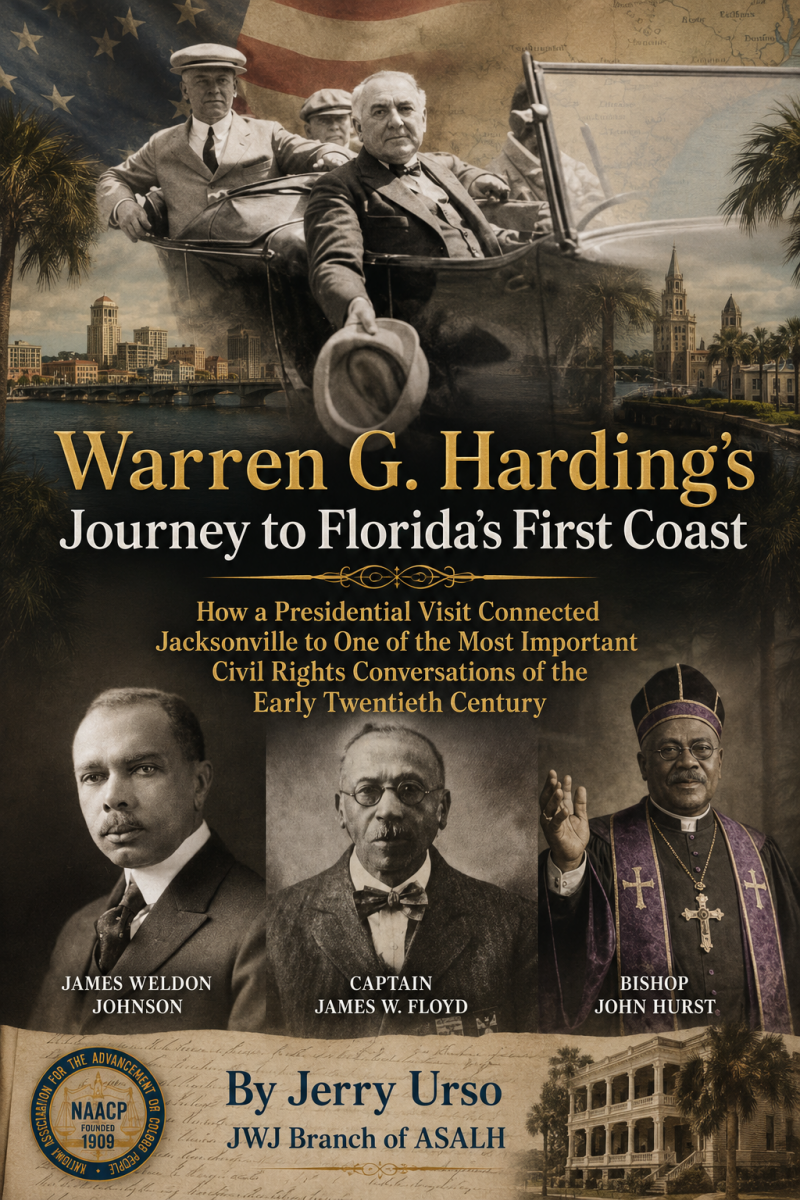
Warren G. Harding's Journey to Florida's First Coast
How a Presidential Visit Connected Jacksonville to One of the Most Important Civil Rights Conversations of the Early Twentieth Century
By Jerry Urso
JWJ Branch of ASALH
Introduction
In the winter of 1921, the nation stood at a crossroads. The First World War had ended, but America remained deeply divided by economic uncertainty, labor unrest, political upheaval, and escalating racial violence. Across the South, lynchings continued with alarming frequency, while African Americans faced disfranchisement, segregation, and unequal protection under the law. For the National Association for the Advancement of Colored People (NAACP), the election of Warren G. Harding presented an opportunity unlike any it had experienced in years.
Rather than waiting until Harding assumed office, the NAACP began educating the President-elect immediately after his nomination. Through a carefully planned series of meetings beginning in Marion, Ohio, continuing in St. Augustine, Florida, and later at the White House, the organization sought to influence the incoming administration before federal policy had been established. Among those participating in this historic effort was Captain James W. Floyd, representing the Jacksonville Branch of the NAACP, whose presence placed Jacksonville at the center of one of the earliest presidential dialogues on civil rights during the twentieth century.[1]
Today, Captain Floyd is remembered primarily as one of Jacksonville's leading African American civic figures. Yet his participation in the NAACP's efforts to educate President-elect Harding demonstrates that his influence extended far beyond Northeast Florida. As a representative of the Jacksonville NAACP, Floyd helped carry the concerns of Black Floridians directly to the future President of the United States.
America After the Election of 1920
Warren Gamaliel Harding entered the 1920 presidential campaign promising what he famously described as a "return to normalcy." Americans weary of war, inflation, and political conflict overwhelmingly embraced his message, electing him by one of the largest popular vote margins in American history.
For African Americans, however, the election raised an entirely different question. Would the new President address the epidemic of racial violence sweeping the nation?
Historian Megan Ming Francis notes that Harding has often been overlooked in discussions of presidential civil rights leadership. Yet surviving correspondence, archival records, and NAACP papers demonstrate that Harding proved unusually receptive to hearing directly from African American leaders. Unlike many previous presidents, he did not simply ignore their concerns. Instead, he granted interviews, listened carefully, and sought additional information regarding racial conditions throughout the country.[2]
Francis argues that Harding's willingness to engage with the NAACP represented an important turning point. Rather than merely demanding public condemnations of lynching, the organization adopted a broader strategy designed to educate the incoming President and influence the development of federal policy before it was fully formed.[3]
The NAACP Changes Its Strategy
The NAACP understood that convincing Harding required a different approach than the one previously used with President Woodrow Wilson.
According to Francis, the organization recognized that Harding lacked detailed knowledge of the realities confronting African Americans. James Weldon Johnson later observed that Harding "knows absolutely nothing about the race question," explaining that the President-elect's understanding appeared based largely upon limited experiences in Marion, Ohio.[4]
Rather than criticizing Harding for his lack of knowledge, Johnson viewed it as an opportunity. If the President-elect could be educated before taking office, perhaps his administration would prove more responsive than those of his predecessors.
The effort began shortly after Harding secured the Republican nomination.
James Weldon Johnson Meets Harding in Marion
The NAACP's campaign to educate Warren G. Harding began long before he entered the White House. Shortly after Harding secured the Republican presidential nomination in 1920, James Weldon Johnson, the NAACP's Field Secretary, and Harry E. Davis, a Cleveland physician and member of the NAACP Board of Directors, traveled to Marion, Ohio, to meet with the Republican nominee at his home.[5]
The meeting was more than a courtesy call. Johnson and Davis arrived with a carefully prepared agenda outlining the issues they believed demanded immediate presidential attention. Johnson later reported that they presented Harding with seven major concerns affecting African Americans, including the growth of anti-Black violence, disfranchisement, discrimination in federal employment, conditions in Haiti, equal educational opportunities, greater appointment of African Americans to federal office, and justice within the armed forces.[6]
Johnson explained each issue individually, emphasizing why they mattered not simply to African Americans but to the nation as a whole. Harding listened attentively and agreed with many of the proposals. Johnson later recalled that Harding accepted nearly every point except one involving federal aid to education, explaining that constitutional concerns prevented him from making such a commitment during the campaign.[7]
Although the meeting produced no dramatic public announcement, it established something far more important. Johnson concluded that Harding possessed a genuine willingness to listen. Rather than dismissing the concerns presented by the NAACP, he invited continued discussion and demonstrated an openness that Johnson believed could be developed after the election.
Building a Relationship
Following the Marion conference, Johnson remained in regular contact with Harding's campaign.
Francis notes that Johnson became convinced Harding's favorable impression could be strengthened through continued communication. Harding's willingness to grant repeated interviews also demonstrated that he viewed the NAACP as a serious national organization rather than merely another political pressure group. Johnson later observed that Harding granted him interviews when many other requests for appointments were declined, confirming the growing respect between the Republican nominee and the NAACP leadership.[8]
During these months, Johnson carefully avoided treating Harding as an adversary. Instead, he sought to educate him. Francis argues that this represented one of the NAACP's most important strategic decisions. Rather than demanding immediate public statements, Johnson concentrated on ensuring that Harding understood the realities confronting African Americans before assuming the presidency.[9]
This approach reflected Johnson's belief that effective policy began with knowledge. If Harding fully understood the conditions under which Black Americans lived, Johnson believed meaningful reform might follow.
Preparing for a New Administration
As Harding's election became increasingly certain, the NAACP shifted from campaign advocacy to presidential transition planning.
Francis explains that Johnson viewed the period between the election and the inauguration as a rare opportunity. Cabinet appointments had not yet been completed, administrative priorities remained under development, and the President-elect was still determining the direction his administration would take. It was during this transition period that the NAACP sought to place racial justice on Harding's agenda before other national issues overshadowed it.[10]
Harding himself appeared interested in continuing the conversations. Johnson later recalled that after one of their meetings Harding invited him to return after the inauguration so they could continue discussing racial conditions in greater detail. This invitation suggested that Harding regarded the discussions as the beginning of an ongoing relationship rather than a single political interview.[11]
President-Elect Harding Comes to Florida
Before traveling to Washington for his inauguration, Harding journeyed to St. Augustine, Florida, where he spent several weeks resting while also conducting transition business and meeting with visitors.
Although remembered by many as a vacation, Harding's stay in St. Augustine functioned as a temporary transition headquarters. Political leaders, journalists, business representatives, and private delegations traveled to Florida seeking audiences with the President-elect.
Recognizing this unique opportunity, the NAACP arranged another meeting. According to the 1921 NAACP Annual Report, a delegation visited Harding in St. Augustine to continue the dialogue that had begun months earlier in Marion. Representing the Jacksonville Branch of the NAACP was Captain James W. Floyd, joined by Bishop John Hurst and other distinguished African American leaders.[12]
For Jacksonville, Floyd's participation represented a remarkable moment in local history. Acting on behalf of the Jacksonville NAACP, he carried the concerns of one of the South's largest African American communities directly to the future President before Harding had even taken the oath of office.
The conversations that began in Marion were now continuing on Florida's First Coast.
The St. Augustine Meeting
By February 1921, the relationship between Warren G. Harding and the NAACP had progressed well beyond a single campaign interview. Harding had been elected President but had not yet taken the oath of office. Before traveling to Washington for the inauguration, he established temporary headquarters in St. Augustine, Florida, where he rested, met with political advisers, received visitors, and continued assembling his administration.[13]
Recognizing that Harding remained accessible during this transition period, the NAACP arranged another personal interview. Unlike the meeting in Marion, this conference took place with Harding as President-elect, making it one of the final opportunities to influence his thinking before he assumed executive authority.
According to the 1921 NAACP Annual Report, the delegation included Captain James W. Floyd, representing the Jacksonville Branch of the NAACP, together with Bishop John Hurst and other distinguished African American leaders. Their purpose was clear: to continue educating Harding about the realities confronting African Americans throughout the South and to encourage federal leadership on racial justice.[14]
The significance of the meeting cannot be overstated. Rather than waiting until the new administration had established its priorities, the NAACP sought to place civil rights before the President-elect while those priorities were still being formed. It was a calculated effort to ensure that racial justice became part of Harding's agenda from the very beginning of his presidency.
Captain James W. Floyd Represents Jacksonville
Captain James W. Floyd's presence at the St. Augustine meeting represented both a personal distinction and an important milestone in Jacksonville history.
As the representative of the Jacksonville Branch of the NAACP, Floyd carried the concerns of one of the South's largest African American communities directly to the incoming President. Jacksonville had become a center of Black political, religious, educational, and business leadership, and Floyd stood among its most respected civic figures.
His selection also reflected the confidence the national NAACP placed in Jacksonville's leadership. The organization could have chosen representatives from any number of Southern cities, yet it entrusted Floyd with helping present its concerns during one of the most important presidential transition meetings of the era.
This was not simply a ceremonial appearance. Floyd participated in an effort to influence federal policy before it was written.
Bishop John Hurst and a Distinguished Delegation
Joining Floyd was Bishop John Hurst, together with other nationally respected African American leaders representing churches, civic organizations, and the NAACP.
Their presence demonstrated that the struggle for civil rights extended far beyond courtroom litigation. Black ministers, educators, physicians, businessmen, and civic leaders all understood that lasting change required direct engagement with the federal government.
The delegation's discussions centered upon lynching, racial violence, unequal educational opportunities, discrimination within federal employment, and the constitutional rights guaranteed to African Americans. Rather than presenting isolated grievances, they offered Harding a comprehensive picture of conditions throughout the South.
Historian Megan Ming Francis observes that these meetings formed part of the NAACP's broader strategy of educating Harding rather than merely demanding symbolic public statements. The organization recognized that meaningful reform required a President who understood both the facts and the human consequences of racial injustice.[15]
Harding Continues Listening
Francis notes that Harding responded differently than Woodrow Wilson had. Rather than avoiding discussion, Harding demonstrated a willingness to continue listening and learning.
Following the Florida meeting, Harding indicated that he wished to continue these conversations after entering office. Johnson later recalled that Harding expressed concern over conditions in the South and acknowledged that he needed a better understanding of the issues before determining what action might be appropriate.
The St. Augustine meeting therefore became more than a single conference. It served as the bridge between the campaign discussions in Marion and the more extensive White House meetings that followed after March 4, 1921.[16]
Jacksonville Welcomes the President-Elect
Only days after meeting with the NAACP delegation in St. Augustine, Harding traveled north to Jacksonville.
The Florida Times-Union reported that thousands welcomed the President-elect during one of the largest civic receptions of his southern tour. Harding attended a luncheon at the Windsor Hotel before addressing crowds from the hotel's famous front porch. During his remarks he praised Jacksonville's patriotism, describing the city as the "true daughter of America." The newspaper emphasized the enthusiastic public response and the importance local leaders attached to the visit.[17]
Few among the cheering crowds realized that Harding had already spent part of his Florida stay in serious discussions with African American leaders, including Jacksonville's own Captain James W. Floyd, about lynching, civil rights, and the responsibilities that awaited him as President.
The Dialogue Continues in Washington
When Warren G. Harding took the oath of office on March 4, 1921, the conversations that had begun in Marion and continued in St. Augustine did not end. Instead, they entered a new phase.
James Weldon Johnson recognized that the President had demonstrated a genuine willingness to learn. Rather than allowing that opportunity to fade, the NAACP immediately resumed its efforts to educate the new administration.
Johnson later recalled that Harding invited him to the White House for another private conference shortly after the inauguration. During one meeting, the President invited Johnson to ride with him through Washington, allowing the two men to continue their discussion away from the formality of the Oval Office. Johnson deliberately altered his strategy. Instead of requesting another public condemnation of lynching, he urged Harding to appoint a National Interracial Commission to conduct a comprehensive study of racial conditions throughout the United States.[18]
Johnson believed such a commission would accomplish far more than another presidential statement. It could investigate lynching, examine discrimination in education and employment, improve communication between Black and white Americans, and provide the federal government with reliable recommendations for reform.
Harding responded favorably. According to Johnson, the President admitted that he still had much to learn and expressed an interest in gathering accurate information before reaching final decisions. Johnson later recalled that Harding described the proposal as "a novel idea worth considering," and the meeting ended with the President inviting him to continue bringing information to the White House.[19]
Walter White Adds Firsthand Evidence
Recognizing Harding's continued interest, Johnson arranged another conference approximately one month into the new administration. This time he was joined by Walter White, the NAACP's Assistant Secretary and one of the organization's most courageous investigators of racial violence.
White had personally investigated numerous lynchings throughout the South, frequently risking his own life by traveling into hostile communities while passing as white. His reports provided detailed evidence concerning mob violence, failures of local law enforcement, and the inability of African Americans to obtain justice in Southern courts.
During the meeting, Harding listened carefully while White and Johnson described individual cases and broader patterns of racial oppression. Rather than accepting vague generalizations, the President repeatedly questioned the men, seeking additional facts about conditions throughout the South.[20]
Johnson later wrote that Harding appeared genuinely troubled by what he heard and indicated that he wished to continue studying the issues before determining what action the federal government might take.
From Education to Federal Policy
The NAACP's objective extended well beyond persuading Harding to issue another public statement.
Francis argues that Johnson's greatest achievement was placing racial justice upon the President's policy agenda. Rather than treating lynching as an isolated criminal issue, Johnson urged Harding to view racial violence as a national constitutional crisis requiring federal leadership.
The proposed National Interracial Commission became the centerpiece of that strategy. Johnson envisioned a permanent body capable of gathering evidence, hearing testimony, recommending legislation, and helping prevent future racial violence through informed federal policy.[21]
Although political realities prevented the commission from being fully established as Johnson envisioned, the proposal itself demonstrates how the NAACP sought long-term structural reform rather than short-term political victories.
Harding Speaks in Birmingham
The influence of these meetings became increasingly evident during Harding's first year in office.
On October 26, 1921, speaking before a segregated audience in Birmingham, Alabama, President Harding delivered one of the most remarkable presidential speeches on race made between Reconstruction and the Truman administration.
Harding publicly declared that justice under the Constitution belonged equally to Black and white Americans. He condemned lynching, defended equal educational opportunity, and argued that no democracy could endure while denying equal protection to a portion of its citizens.
Although Harding accepted segregation as an existing social reality in many parts of the country, he insisted that equality before the law and equal opportunity were constitutional principles that could not be denied.
For many African American leaders, the speech represented the clearest evidence that the dialogue begun in Marion, continued in St. Augustine, and expanded in the White House had influenced the President's understanding of race relations.
Captain James W. Floyd's Place in History
Captain James W. Floyd did not write the Birmingham Address, nor did he serve within Harding's administration. His contribution came earlier.
As the representative of the Jacksonville Branch of the NAACP, Floyd helped ensure that the concerns of Black Floridians reached the President-elect before the administration's policies had been established. His participation in the St. Augustine delegation demonstrates that Jacksonville's African American leadership was engaged in national advocacy at one of the most important moments of presidential transition in modern American history.
His role also illustrates the remarkable network of leadership centered in Jacksonville. Floyd was not only a respected civic leader and NAACP representative, but also the father of Nora Ethel Floyd, who married J. Rosamond Johnson in London in 1913. Through that marriage, Floyd became the father-in-law of the celebrated composer and educator and part of the extended Johnson family that included James Weldon Johnson, the NAACP's Executive Secretary and one of America's foremost civil rights leaders.
The connection symbolized more than family. It reflected the close relationships among Jacksonville's civic, cultural, religious, and political leaders who worked together to advance civil rights both locally and nationally.
Legacy
History often remembers the famous speeches while overlooking the conversations that made them possible.
Before President Warren G. Harding addressed the nation on civil rights, before he condemned lynching in Birmingham, and before he considered creating a National Interracial Commission, he listened. That education began in Marion, continued on Florida's First Coast in St. Augustine with a delegation that included Captain James W. Floyd representing the Jacksonville Branch of the NAACP, and carried forward through a series of White House meetings led by James Weldon Johnson and Walter White.
For Jacksonville, Floyd's participation represents an extraordinary chapter in local history. It demonstrates that the city's Black leadership did not simply react to national events. They helped shape them.
Captain James W. Floyd carried the voice of Jacksonville into the presidential transition of 1921, ensuring that the struggle for justice in Florida became part of a national conversation that reached the highest office in the United States.
References
[1] The St. Augustine Record (St. Augustine, Florida), February 11, 1921, p. 1.
[2] The Florida Times-Union (Jacksonville, Florida), February 26, 1921, p. 13.
[3] National Association for the Advancement of Colored People. Twelfth Annual Report of the National Association for the Advancement of Colored People for the Year 1921. New York: National Association for the Advancement of Colored People, 1921.
[4] Francis, Megan Ming. The Strange Career of the NAACP: From Jim Crow to Political Power. New York: Cambridge University Press, 2014.
[5] Johnson, James Weldon. Along This Way: The Autobiography of James Weldon Johnson. New York: Viking Press, 1933.
[6] Johnson, James Weldon. "Report of the Field Secretary on Interview with Senator Warren G. Harding," August 9, 1920. James Weldon Johnson Papers, Manuscript Division, Library of Congress.
[7] Library of Congress. James Weldon Johnson Papers. Manuscript Division, Washington, D.C.
[8] Harding, Warren G. Public Papers of the Presidents of the United States: Warren G. Harding, 1921–1923. Washington, D.C.: United States Government Printing Office.
[9] Harding, Warren G. "Address at Birmingham, Alabama," October 26, 1921. In Public Papers of the Presidents of the United States: Warren G. Harding, 1921–1923.
[10] University of North Florida Digital Commons. Eartha M. M. White Collection.
[11] Marriage Announcement, "Capt. & Mrs. James W. Floyd announce the marriage of their daughter Nora Ethel Floyd to Mr. J. Rosamond Johnson," London, England, July 3, 1913. Eartha M. M. White Collection, University of North Florida Digital Commons.
[12] Johnson, James Weldon. Along This Way: The Autobiography of James Weldon Johnson. New York: Viking Press, 1933.
[13] Francis, Megan Ming. The Strange Career of the NAACP: From Jim Crow to Political Power. New York: Cambridge University Press, 2014.
[14] National Association for the Advancement of Colored People. Twelfth Annual Report of the National Association for the Advancement of Colored People for the Year 1921. New York: National Association for the Advancement of Colored People, 1921.
[15] Johnson, James Weldon. Along This Way: The Autobiography of James Weldon Johnson. New York: Viking Press, 1933.
[16] Francis, Megan Ming. The Strange Career of the NAACP: From Jim Crow to Political Power. New York: Cambridge University Press, 2014.
[17] Johnson, James Weldon. Along This Way: The Autobiography of James Weldon Johnson. New York: Viking Press, 1933.
[18] National Association for the Advancement of Colored People. Twelfth Annual Report of the National Association for the Advancement of Colored People for the Year 1921. New York: National Association for the Advancement of Colored People, 1921.
[19] Harding, Warren G. Public Papers of the Presidents of the United States: Warren G. Harding, 1921–1923. Washington, D.C.: United States Government Printing Office.
[20] Francis, Megan Ming. The Strange Career of the NAACP: From Jim Crow to Political Power. New York: Cambridge University Press, 2014.
[21] Johnson, James Weldon. Along This Way: The Autobiography of James Weldon Johnson. New York: Viking Press, 1933.
[22] Johnson, James Weldon. Along This Way: The Autobiography of James Weldon Johnson. New York: Viking Press, 1933.
