
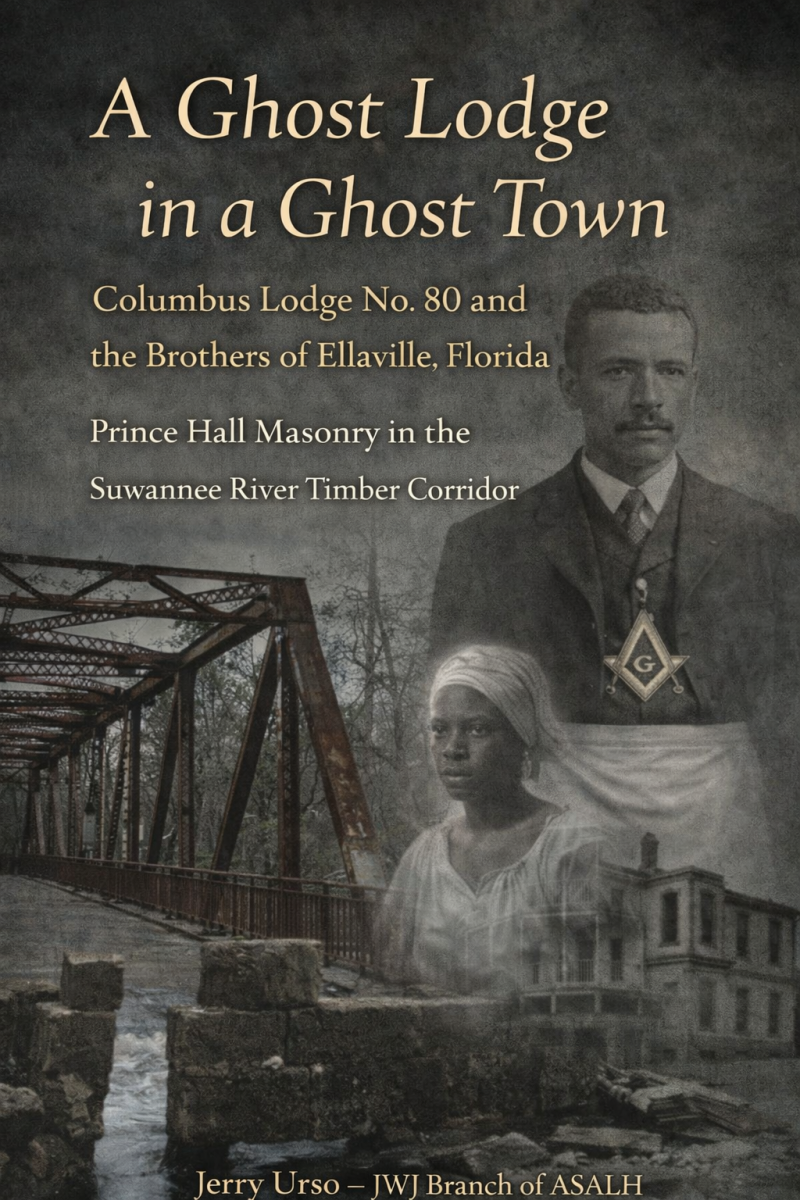
Columbus Lodge No. 80 and the Brothers of Ellaville, Florida
Prince Hall Masonry in the Suwannee River Timber Corridor
By Jerry Urso — JWJ Branch of ASALH
Ella and the Naming of Ellaville
At the meeting place of the Suwannee and Withlacoochee Rivers, where timber floated southward toward Gulf ports and rail lines crossed the pine forests of interior North Florida, there once stood a settlement whose life rose and fell with the lumber frontier. That settlement became Ellaville, Florida. It began in 1861 as a steam-powered mill community established by lumber industrialist and future governor George F. Drew during the expansion of his Suwannee River timber operations. [1][2]
Unlike many industrial settlements of the nineteenth century, Ellaville preserved in its very name the memory of an African American woman. Local historical tradition records that Drew named the town in honor of Ella, a Black woman associated with his household during the earliest years of the settlement’s formation. Her remembered presence reflects a deeper truth about the community itself. Ellaville did not grow in isolation from the lives of African American workers. It grew because of them. [1]
The mills required labor. The river landings required crews. The forests required men who could cut timber and move it toward market. The households that sustained the settlement depended upon domestic labor that rarely appeared in official records but shaped daily life within frontier communities. Ella’s name endured because her presence endured in memory long after the sawmill whistles ceased and the town itself faded from the map.
During the decades following its founding, Ellaville developed quickly into one of the most active lumber-processing centers in the Suwannee River corridor. Rail connections linked the mills to inland pine forests, while steamboats moved freight downriver toward Gulf ports. Families settled along the ridges above the floodplain. Churches formed. Schools opened. A commissary supplied goods to workers and their households. By the 1870s the settlement approached one thousand residents and stood among the most important working communities in the interior pine belt between Madison County and the Suwannee River basin. [2][3]
Yet Ellaville was never only a mill town.
From its earliest years, African American families established homes there that extended beyond wage labor. Some cultivated land along the higher ground above the river crossings where seasonal flooding did not threaten crops. Others worked seasonally in timber while maintaining agricultural independence the rest of the year. Women anchored households whose stability allowed churches and schools to emerge. Ministers traveled between settlements strengthening congregational networks that connected families across the Suwannee corridor. Children attended local schools that represented the first generation born into freedom after emancipation.
Within that environment, institutional life began to take root.
Church came first.
Then came the lodge.
And together they shaped the structure of Black community life in Ellaville.
Building a Black Community in a Lumber Frontier Settlement
Ellaville’s Black residents were never simply a transient labor force attached to a lumber operation. From the earliest years of the settlement, African American families established households that anchored the community along the ridges above the Suwannee and Withlacoochee river crossings. These families combined agricultural independence with seasonal timber labor, creating a pattern of settlement that allowed institutions—not just mills—to take root in the pine belt interior of North Florida. [2][3]
The geography of the region shaped their lives. The river crossing that made Ellaville valuable to the timber trade also made it vulnerable to flooding. Families therefore settled strategically along higher ground where farms could survive seasonal water and still remain close enough to the mills and rail lines to participate in wage labor when timber production intensified. This combination of farming and industrial employment became a defining feature of Black settlement throughout the Suwannee River corridor during the late nineteenth century.
Church life formed the earliest structure of permanence within this environment. Congregations connected Ellaville to nearby settlements across Madison and Suwannee Counties and along the rail corridors that linked interior timber camps to market towns. Ministers traveled between districts strengthening relationships among families who depended on one another for mutual support in regions where formal civic protections remained limited after Reconstruction. Revivals, conferences, and visiting ministers brought together residents from Pine Lake, Watertown, and surrounding communities, reinforcing the sense that Ellaville stood within a wider regional network rather than at the edge of one.
These same networks would later appear in the newspaper record through the work of Joseph J. Thornhill, whose repeated participation in district religious meetings across Madison and Suwannee Counties between 1900 and 1919 demonstrates how Ellaville’s church leadership remained connected to the broader institutional life of North Florida’s rural Black communities. Those appearances confirm that Ellaville’s ministers were not isolated figures but participants in a regional system of cooperation that linked church, school, and fraternal organization together. [8][9][10][11][12][13][14]
Within communities like Ellaville, the church provided spiritual structure and educational encouragement, but another institution soon followed wherever congregations achieved stability.
Across Reconstruction-era Florida, Prince Hall lodges appeared wherever Black settlement became permanent enough to sustain them. These lodges served functions that extended well beyond ceremony. They organized burial protection in places where commercial insurance remained inaccessible to African American families. They trained officers in parliamentary procedure and financial responsibility. They provided leadership experience for men who would later serve their congregations, schools, and civic associations. Most importantly, they connected isolated rural settlements into a statewide network of cooperation under the authority of the Most Worshipful Union Grand Lodge of Florida. [4]
Ellaville followed this pattern.
By the 1880s the settlement had reached the level of stability required to sustain not only churches and schools but a permanent fraternal institution as well. Families had remained long enough to establish farms. Ministers had organized congregations that linked Ellaville to surrounding districts. Rail and river connections had transformed the crossing into a working center of the Suwannee timber corridor. Within that environment, the conditions existed for the creation of a Prince Hall lodge that would anchor the civic life of Ellaville’s Black residents for a generation.
On December 10, 1887, that step was taken.
Ellaville Lodge No. 80 entered the rolls of Prince Hall Masonry in Florida.
The Founding of Ellaville Lodge No. 80
By the 1880s the settlement at Ellaville had reached the level of stability required to sustain not only churches and schools but a permanent fraternal institution as well. Families had remained long enough to establish farms along the ridges above the river crossings. Ministers had organized congregations that connected the settlement to surrounding districts across Madison and Suwannee Counties. Rail and river connections had transformed Ellaville into a working center within the Suwannee River timber corridor. Within that environment, the conditions existed for the creation of a Prince Hall lodge that would anchor the civic life of Ellaville’s Black residents for a generation.
On December 10, 1887, Black Master Masons living in Ellaville petitioned the Most Worshipful Union Grand Lodge of Florida for authority to establish a lodge within their settlement. Their request was granted during the administration of Grand Master Tilman Valentine, one of the principal founders of the jurisdiction and a veteran of the Civil War whose leadership helped shape the structure of Prince Hall Masonry across North Florida during the Reconstruction era.
Under his authority the charter for Ellaville Lodge No. 80 was issued, and the lodge entered the rolls of Prince Hall Masonry in Florida under the leadership of Worshipful Master J. B. Burnett. The establishment of the lodge connected Ellaville’s Black residents directly to the statewide institutional network that Valentine and his generation had worked to build in the decades following emancipation. [4]
The chartering of Ellaville Lodge No. 80 marked an important moment in the development of Black institutional life within the Suwannee River timber corridor. Lodges in rural settlements such as Ellaville did not exist only for ceremony. They served as centers of order in communities where formal authority rarely protected African American citizens equally. They supported widows and orphans. They taught parliamentary procedure and financial responsibility. They strengthened expectations of discipline among members whose leadership responsibilities extended beyond the lodge room into church life and family life.
Through the charter issued under Grand Master Valentine’s administration, Ellaville’s residents joined a statewide network of Prince Hall Masonry that connected river settlements, railroad communities, and agricultural districts throughout Florida.
Among those men stood one figure whose leadership would come to define the lodge’s role within the Suwannee River corridor.
His name was Joseph J. Thornhill.
Joseph J. Thornhill and the Stability of Land, Church, and Lodge
Among the men who helped give Ellaville Lodge No. 80 its enduring place within the Suwannee River corridor, none stood more centrally within the institutional life of the community than Joseph J. Thornhill. His life illustrates how leadership in rural Prince Hall Masonry grew not from isolated authority within the lodge room alone, but from the combined foundations of landholding, church service, family stability, and regional trust.
Joseph Johnson Thornhill was born in February 1865 at the close of the Civil War, entering adulthood at the very moment when newly freed Black communities across North Florida were organizing the institutions that would sustain them after emancipation. By the end of the nineteenth century he had established himself as a farmer in the Ellaville district, a role that carried particular significance in a timber frontier settlement where many laborers depended upon seasonal employment tied to the fortunes of the mills. Farming represented permanence. It meant continuity of residence, responsibility for land, and the ability to support a household whose stability extended beyond fluctuations in the lumber economy. [5]
The census record of 1900 reveals Thornhill not as a transient worker attached to a mill camp but as the head of a substantial household rooted in Ellaville itself. Living with him were his wife Florida Thornhill and their children Charlie J., Maggie A., Amanda J., Carry M., and Rosa L. Thornhill, together forming a family structure that reflected the stability necessary for leadership within both church and lodge. The presence of a lodger within the household further reflects the cooperative social arrangements common in rural Black communities of the Suwannee River corridor during this period. [5]
By 1910 Thornhill’s household had expanded into a broader kinship network that included married children and extended relatives. Daughter Mamie Dixon and her husband Jim Dixon were living within the household, along with members of the Pierce family, including Thornhill’s sister Lula Pierce and her sons Jessie and John Pierce. The census further recorded that Thornhill owned his farm free of mortgage, a powerful indicator of economic independence in a region where land ownership often marked the dividing line between temporary residence and community leadership. [6]
Such stability formed the foundation of his rise within Prince Hall Masonry.
Within Ellaville Lodge No. 80 Thornhill served as Worshipful Master, guiding the lodge during a period when the settlement itself stood at the height of its development as a working center within the Suwannee River timber corridor. His leadership did not remain local. In time he was appointed District Deputy Grand Master for Suwannee County under the authority of the Most Worshipful Union Grand Lodge of Florida, serving as the Grand Lodge’s representative across a jurisdiction that included multiple rural settlements connected only by wagon roads, river crossings, and rail corridors.
District deputies occupied one of the most important positions within the structure of Prince Hall Masonry in rural Florida. They supervised subordinate lodges, encouraged the organization of new ones, maintained ritual discipline, and strengthened communication between local communities and the Grand Lodge itself. Thornhill’s appointment to this office demonstrates both his personal reputation and the importance of Ellaville Lodge No. 80 within the jurisdictional network established under the leadership of Grand Master Tilman Valentine. [7]
Yet Thornhill’s influence extended beyond the lodge room.
The surviving newspaper record between 1900 and 1919 places him repeatedly within the religious life of the wider Suwannee–Madison corridor, confirming his role as a pastor whose leadership connected Ellaville to surrounding settlements across North Florida. Reports in the Florida Times-Union identified Rev. J. J. Thornhill among ministers participating in district church appointments as early as February 1900 and again in February 1903, demonstrating his continuing pastoral responsibilities within the regional circuit structure that linked Ellaville congregations to neighboring communities. [8][9]
His presence continued to appear in conference and educational reporting across the following decade. A December 1907 notice in the Jacksonville Journal placed Thornhill among participants in district proceedings connected with church education and organizational work within the St. Augustine district structure. By December 1913 he was again listed within ministerial circuit assignments connected with Pine Lake and surrounding communities, confirming the geographic reach of his pastoral responsibilities beyond Ellaville itself. [10][11]
During the First World War era his leadership remained visible across the same regional network. A June 1917 report recorded his participation within Calhoun district missionary activity connected with church support structures associated with educational institutions such as Edward Waters College, demonstrating his continued role within the institutional life of Black North Florida at a time when wartime pressures reshaped both rural labor patterns and congregational organization. [12]
The newspaper record from 1919 shows Thornhill still active within the same network of congregations that had long connected Ellaville to neighboring settlements. Reports from January and July of that year place him within sacred music programs and church events at Mt. Zion A.M.E. Church and Tru Vine Baptist Church in the Watertown district, confirming that his ministry extended across denominational lines in ways typical of rural Black clergy serving dispersed populations. Later that same year he appeared again in connection with cornerstone observances associated with Mt. Pisgah A.M.E. Church, reinforcing his role within the ceremonial and institutional life of the region’s congregations. [13][14]
Taken together, these records show Thornhill not as a leader confined to a single congregation or a single lodge but as a figure whose authority moved along the same transportation corridors that defined Ellaville itself—across rail lines, river crossings, and farming districts that tied together the pine-belt settlements of Madison and Suwannee Counties.
Under leaders like Thornhill, Ellaville Lodge No. 80 became more than a fraternal meeting place.
It became one of the institutional centers through which stability entered the life of a timber-frontier community.
The Brothers of Ellaville Lodge No. 80
When Ellaville Lodge No. 80 received its charter on December 10, 1887, under the administration of Grand Master Tilman Valentine of the Most Worshipful Union Grand Lodge of Florida, it did not appear suddenly in an empty landscape. It emerged from relationships already formed among farmers, timber workers, ministers, and heads of households whose families had made Ellaville a permanent settlement rather than a temporary lumber camp. The lodge reflected a community that had already achieved stability through land ownership, church organization, and kinship networks stretching across Madison and Suwannee Counties. [4]
These men were not strangers meeting for ceremony alone. They worked together in the mills along the Suwannee River crossing. They hauled timber from surrounding pine forests. They cultivated small farms along the ridges above the floodplain where seasonal waters could not reach their crops. They worshipped together in district churches that connected Ellaville to Pine Lake, Watertown, and neighboring settlements across the corridor that linked rail, river, and road travel through interior North Florida. In joining together under the charter of Ellaville Lodge No. 80, they formalized relationships that already structured their daily lives.
Prince Hall Masonry strengthened those relationships in ways especially important within rural communities where formal civic protections were uneven. The lodge provided burial support for families who otherwise faced hardship at times of loss. It trained officers in parliamentary procedure and financial accountability. It reinforced expectations of discipline among men whose responsibilities extended into church leadership and family life. Through lodge membership these brothers entered a statewide network that connected Ellaville to other settlements shaped by the same timber economy that defined the Suwannee River basin. [4]
Within this structure, leadership did not belong to one man alone. While figures such as Joseph J. Thornhill provided jurisdictional continuity as Worshipful Master and later District Deputy Grand Master, the strength of the lodge rested equally upon the farmers who maintained households year after year along the ridge roads above the river crossings, the timber workers whose wages supported their families during peak production seasons, and the church officers who sustained congregational life across the district.
Together these brothers created the institutional framework that allowed Ellaville’s Black community to endure beyond the uncertainties of the lumber frontier.
Their lodge functioned as a coordinating center linking church, school, and household life across the settlement. When families faced illness or death, the lodge stood beside them. When congregations organized district meetings, lodge members helped host visiting ministers and delegates. When younger men entered adulthood, the lodge provided instruction in responsibility and public conduct expected of community leaders. In this way Ellaville Lodge No. 80 became part of the same institutional structure that shaped Black settlement patterns across Reconstruction-era Florida wherever communities achieved permanence sufficient to sustain both church and lodge together.
The existence of the lodge also signaled something more.
It demonstrated that Ellaville’s Black residents intended to remain.
Lodges did not form in places expected to disappear within a few seasons of timber cutting. They formed where families believed they could build futures. The chartering of Ellaville Lodge No. 80 therefore marked a declaration of permanence by the community itself—an announcement that the settlement at the meeting place of the Suwannee and Withlacoochee Rivers had become not merely a mill site, but a town with institutions strong enough to sustain its people through the changing fortunes of the timber economy.
Farmers, Timber Workers, and Church Officers
The strength of Ellaville Lodge No. 80 rested not only in its charter or its officers, but in the lives of the men who gathered within its walls. They were farmers who worked land along the higher ridges above the Suwannee and Withlacoochee River crossings, timber workers whose labor fed the mills that gave the town its economic purpose, and church officers whose leadership sustained congregations across Madison and Suwannee Counties. Together they formed the social structure that made Ellaville more than a sawmill settlement. They made it a community.
In lumber-frontier towns like Ellaville, Florida, stability depended on the ability of families to balance industrial employment with agricultural independence. Timber work followed the rhythm of the forests. When cutting intensified, men entered the woods or worked along the river landings and rail connections that moved lumber toward market. When production slowed, those same men returned to farms that ensured their households could remain rooted in the district. This combination of wage labor and landholding created a settlement pattern strong enough to support institutions such as churches, schools, and Prince Hall lodges. [2][3]
Within this environment, members of Ellaville Lodge No. 80 occupied positions that extended beyond the lodge room. Many served as trustees and officers within district congregations that linked Ellaville to Pine Lake, Watertown, and neighboring settlements across the Suwannee corridor. Ministers traveled between these communities conducting revivals and conferences that strengthened ties among families living miles apart but connected through shared institutions. It was through these same networks that leaders such as Joseph J. Thornhill appeared repeatedly in regional church reporting between 1900 and 1919, demonstrating how Ellaville’s leadership participated in a wider system of cooperation across North Florida’s rural Black communities. [8][9][10][11][12][13][14]
Education also formed part of this institutional structure. Even in a timber settlement whose prosperity depended on forests that would eventually be exhausted, families supported schools that prepared their children for lives beyond seasonal labor. Lodge members often stood among those responsible for maintaining those schools, encouraging attendance, and supporting visiting teachers whose presence represented opportunity for the next generation born after emancipation.
Prince Hall Masonry reinforced these same relationships in another setting. Lodge meetings brought together men whose responsibilities extended across farms, churches, and workplaces. Within the lodge they practiced parliamentary order, financial accountability, and ceremonial discipline that prepared them for leadership within the wider community. In regions where African American political authority remained constrained after Reconstruction, the lodge provided one of the few structured environments in which Black leadership could develop and operate with continuity under the authority of the Most Worshipful Union Grand Lodge of Florida. [4]
Through this combination of landholding, church service, and fraternal organization, the brothers of Ellaville Lodge No. 80 created a framework strong enough to support families through the shifting fortunes of the lumber economy that surrounded them.
For a time, that framework grew as the town itself grew.
And as Ellaville entered its years of greatest prosperity, the lodge rose with it.
A Lodge That Grew with the Town
During the closing decades of the nineteenth century, Ellaville, Florida stood at the height of its development as one of the most active working communities in the interior timber belt of North Florida. Its location at the meeting place of the Suwannee and Withlacoochee Rivers made it a natural transportation center where river traffic, rail movement, and forest extraction converged. Logs cut deep within the surrounding pine lands moved through Ellaville toward market, while freight, supplies, and labor passed in the opposite direction along the same routes that sustained the town’s growth. Within this environment churches strengthened their congregations, schools continued instruction for the children of freed families, and Ellaville Lodge No. 80 expanded alongside the settlement that supported it. [2][3]
The commissary served workers and their households. Rail connections extended the reach of the lumber industry into surrounding forests. Steamboats carried freight southward along the Suwannee River toward Gulf ports. Families remained in the district long enough to establish permanent homes rather than temporary camps. These were the conditions under which Prince Hall lodges flourished across rural Florida, and Ellaville followed the same pattern seen in other timber-frontier communities where Black settlement achieved institutional stability.
Ellaville Lodge No. 80 grew as these networks expanded. Its members were not isolated from the life of the town—they were the life of the town. Farmers maintained land that allowed families to remain through seasonal fluctuations in timber employment. Ministers strengthened congregations that connected Ellaville to Pine Lake, Watertown, and neighboring districts. Lodge officers maintained communication with the Most Worshipful Union Grand Lodge of Florida, ensuring that the settlement remained part of the wider structure of Prince Hall Masonry that linked river crossings, railroad communities, and agricultural districts throughout the state. [4]
Within this period of expansion, leadership from figures such as Joseph J. Thornhill helped ensure that Ellaville Lodge No. 80 remained connected not only to its immediate community but to the broader jurisdictional life of Prince Hall Masonry in North Florida. As Worshipful Master and later District Deputy Grand Master, Thornhill represented the lodge within a regional system of supervision and cooperation that tied together rural lodges separated by distance but united through shared ritual authority and organizational structure. [7]
The lodge’s growth mirrored the confidence of the settlement itself. Institutions formed only where families expected to remain. Churches did not expand in communities preparing to disappear. Schools did not operate where children would soon scatter. And Prince Hall lodges did not take root in places without a future.
For a time, Ellaville possessed that future.
But like many timber-frontier settlements of the Suwannee River corridor, its prosperity depended upon forests that could not last forever.
The turning point came with fire.
Fire, Flood, and the Beginning of Decline
Like many timber-frontier communities of the late nineteenth century, Ellaville, Florida owed its existence to the forests that surrounded it and the transportation routes that carried lumber outward toward regional markets. Yet the same forces that created the town also shaped its vulnerability. When those forests began to thin and the infrastructure that sustained the mills weakened, the foundations of the settlement itself began to change.
One of the most significant turning points in Ellaville’s history came with the mill fire of 1898. The destruction of major industrial facilities weakened the economic structure upon which the town depended and marked the beginning of a gradual transition from expansion to uncertainty. Lumber communities often recovered from fire when surrounding timber resources remained plentiful, but by the closing years of the nineteenth century the pine lands nearest Ellaville were already entering a period of depletion. The fire therefore struck at a moment when the settlement’s economic base could no longer recover with the same strength that had characterized earlier decades. [2][3]
At the same time, the rivers that had once made Ellaville an ideal transportation crossing increasingly complicated daily life within the settlement. Seasonal flooding along the Suwannee River and its tributaries reshaped travel routes and affected agricultural patterns on nearby lowlands. Families who had long depended on a balance between farming and timber employment now faced new uncertainty about both sources of stability. Some households began relocating to nearby districts where rail connections offered more dependable access to work. Others remained but adjusted their livelihoods as the character of the region’s economy slowly shifted.
Through these changes, Ellaville Lodge No. 80 continued to serve as a stabilizing institution within the community. Prince Hall lodges in rural Florida often became especially important during periods of transition, providing continuity when economic conditions forced families to reconsider where they would live and work. The lodge remained connected to the wider jurisdictional structure of the Most Worshipful Union Grand Lodge of Florida, and through leaders such as Joseph J. Thornhill it continued to participate in the regional networks that linked congregations and settlements across Madison and Suwannee Counties. [7]
Newspaper references from the early twentieth century confirm that Thornhill’s pastoral work continued across this same corridor even as Ellaville itself entered a period of gradual contraction. Reports in the Florida Times-Union and the Jacksonville Journal placed him repeatedly within district appointments, missionary activity, and church gatherings between 1900 and 1919, demonstrating that Ellaville’s leadership remained active within regional institutional networks long after the settlement’s early industrial peak had passed. [8][9][10][11][12][13][14]
As the twentieth century progressed, however, the combined effects of industrial loss, shifting transportation priorities, and repeated flooding continued to reshape the settlement. Families relocated. Employment patterns changed. Rail and river traffic that once defined Ellaville’s importance diminished. By the early decades of the twentieth century the town that had once stood at the center of the Suwannee River timber corridor entered a long and gradual decline that would eventually leave only foundations, cemetery traces, and scattered remnants marking its former presence. [2][3]
Yet even as Ellaville itself began to fade, the institutional life created by its churches and its lodge did not disappear immediately.
For a time, the brothers carried it with them.
The Lodge in Its Final Years
As the twentieth century advanced and the lumber frontier that had created Ellaville, Florida began to recede, Ellaville Lodge No. 80 entered the most difficult period of its history. Rural Prince Hall lodges across Florida often followed the same pattern during these years. Their strength depended upon stable settlement, regular employment, and the continued presence of families able to sustain both church and fraternal life. When the economic foundations of a town weakened, the lodge felt the change immediately.
Ellaville’s decline did not come suddenly. It unfolded gradually as timber resources diminished, transportation routes shifted, and repeated flooding reshaped patterns of settlement along the Suwannee River crossing that had once made the town a center of regional activity. Families who had lived for decades along the ridge roads above the river began relocating toward communities where rail connections and agricultural opportunities offered more dependable stability. Churches adjusted their circuits as congregations dispersed across the district. Schools closed or consolidated as enrollment declined. Within this changing landscape the membership of Ellaville Lodge No. 80 inevitably grew smaller. [2][3]
Yet during these years the lodge did not disappear at once.
Leadership from men such as Joseph J. Thornhill helped sustain continuity within the jurisdiction even as the settlement that had produced the lodge slowly contracted. As District Deputy Grand Master for Suwannee County under the authority of the Most Worshipful Union Grand Lodge of Florida, Thornhill represented not only Ellaville Lodge No. 80 but the wider structure of Prince Hall Masonry across surrounding rural districts. His responsibilities required travel between communities linked by wagon roads, rail corridors, and church circuits that had long connected Ellaville to Pine Lake, Watertown, and neighboring settlements. [7]
Newspaper reports from the early twentieth century confirm that even as Ellaville itself declined, Thornhill’s leadership continued to appear across the wider region. Between 1900 and 1919 he remained active in church appointments, educational meetings, missionary activity connected with institutions such as Edward Waters College, sacred concerts, and cornerstone observances associated with congregations throughout the Suwannee–Madison corridor. These appearances demonstrate that Ellaville’s institutional leadership did not vanish with the weakening of the mills. Instead, it moved outward along the same transportation and church networks that had first supported the lodge’s creation. [8][9][10][11][12][13][14]
For rural Prince Hall lodges, survival depended upon community density. As families relocated and congregations reorganized across wider territories, maintaining regular meetings became increasingly difficult. Records were harder to preserve. Officers moved to neighboring districts. Membership shifted along with the agricultural and transportation patterns that shaped daily life in North Florida’s pine belt interior.
In time Ellaville Lodge No. 80 followed the path taken by many lodges formed within timber-frontier settlements.
Its meetings ceased.
Its records were scattered.
Its members carried its traditions into neighboring communities where Prince Hall Masonry continued under new local conditions.
But the lodge itself—like the town that had given it life—eventually passed into history.
What remained was memory.
And a foundation stone among the ruins.
Legacy: A Lodge Remembered Among the Ruins of Ellaville
Today the site of Ellaville, Florida rests quietly within the boundaries of Suwannee River State Park, where only scattered foundations, cemetery traces, and fragments of brick mark the outline of what was once one of the most active working communities in the interior timber belt of North Florida. The sawmill whistles are silent. The rail crossing that once carried lumber outward from the pine forests no longer serves the settlement that depended upon it. The commissary that supplied families has disappeared. What remains instead is the landscape—and the memory of the people who built institutions there. [2][3]
Among those remaining traces lies a foundation long remembered locally as the place where Ellaville Lodge No. 80 once stood.
It is a modest physical remnant of what had once been one of the most important institutions serving the town’s Black residents. Within that structure farmers, timber workers, ministers, and community leaders gathered under the authority of the Most Worshipful Union Grand Lodge of Florida to create stability in a settlement whose prosperity depended upon forests that would not last forever. [4]
The lodge did not stand apart from the life of Ellaville. It stood at its center. It supported burial arrangements when families faced loss. It reinforced discipline among men responsible for sustaining households along the ridge roads above the river crossings. It strengthened the same church networks that connected Ellaville to Pine Lake, Watertown, and surrounding districts across Madison and Suwannee Counties. Through its officers and members, it linked the settlement to the wider jurisdictional structure of Prince Hall Masonry across North Florida.
When the mills weakened after the fire of 1898, when timber resources gradually declined across the surrounding forests, and when repeated flooding reshaped settlement patterns along the Suwannee River crossing, families began relocating across the region. Churches adjusted their circuits. Schools consolidated or closed. The population that had once supported Ellaville Lodge No. 80 slowly dispersed. By 1942 the closure of the post office marked the effective end of Ellaville as a functioning town. [2][3]
Like the town itself, the lodge eventually disappeared.
Its records were scattered.
Its meeting place vanished.
Its membership moved outward into neighboring communities.
Yet its work endured through the men it formed.
Through leaders such as Joseph J. Thornhill—farmer, pastor, Worshipful Master, and District Deputy Grand Master—the institutional life of Ellaville’s Black community continued along the same transportation and church corridors that had first made the settlement possible. The lodge had already done what rural Prince Hall lodges across the Suwannee timber frontier were created to do. It had trained leaders. It had strengthened congregations. It had supported families. It had anchored a community during the difficult decades that followed emancipation and extended into the early twentieth century.
Today visitors walking the quiet grounds of the old settlement may pass the remaining foundation stones without realizing what once stood there.
But that place marks more than the site of a vanished building.
It marks the presence of a brotherhood that helped transform a remote timber crossing into a structured Black community sustained by church, school, land, and lodge.
The town named for Ella has passed into history.
The lodge that served her community has passed with it.
But the men who built it—and the institutions they strengthened across the Suwannee River corridor—remain part of the larger story of Prince Hall Masonry and Black community leadership in North Florida.
References
[1] Florida State historical summaries of the founding of Ellaville and the Drew lumber operations, including the naming tradition connecting the town to Ella, preserved in regional heritage interpretations and State Archives contextual material.
[2] Riverbend News. “Ellaville: From Boomtown to Ghost Town.”
https://riverbendnews.org/ellaville-from-boomtown-to-ghost-town/
[3] Tallahassee Democrat. “Florida Ghost Towns: Where is Ellaville, Florida?” January 7, 2025.
https://www.tallahassee.com/story/news/2025/01/07/florida-ghost-towns-where-ellaville-florida/77427597007/
[4] Proceedings of the Most Worshipful Union Grand Lodge of Florida, Prince Hall Affiliation. Grand Lodge Session (1887). Charter issued for Ellaville Lodge No. 80 during the administration of Grand Master Tilman Valentine; Worshipful Master J. B. Burnett recorded.
[5] 1900 United States Federal Census, Madison County, Florida (Ellaville district). Household of Joseph J. Thornhill, farmer; wife Florida Thornhill; children Charlie J., Maggie A., Amanda J., Carry M., Rosa L.
[6] 1910 United States Federal Census, Madison County, Florida (Ellaville). Household of Joseph J. Thornhill; wife Florida (Marida) Thornhill; daughter Mamie Dixon; son-in-law Jim Dixon; sister Lula Pierce; nephews Jessie J. Pierce and John Pierce.
[7] Proceedings of the Most Worshipful Union Grand Lodge of Florida, Prince Hall Affiliation (1907). Portrait and listing of Joseph J. Thornhill as District Deputy Grand Master, Suwannee County, residence Ellaville, Florida.
[8] Florida Times-Union (Jacksonville), February 20, 1900, p. 3. Rev. J. J. Thornhill listed among regional church leadership connected with Ellaville district appointments.
[9] Florida Times-Union (Jacksonville), February 13, 1903, p. 10. Rev. J. J. Thornhill listed within Madison County pastoral circuit structure.
[10] Jacksonville Journal, December 26, 1907, p. 3. Rev. J. J. Thornhill participating in district educational and conference proceedings.
[11] Jacksonville Journal, December 24, 1913, p. 17. Rev. J. J. Thornhill listed within Pine Lake circuit ministerial assignments.
[12] Jacksonville Journal, June 16, 1917, p. 15. Rev. J. J. Thornhill participating in Calhoun district missionary activity connected with regional church educational work.
[13] Jacksonville Journal, January 25, 1919, p. 17. Rev. J. J. Thornhill participating in sacred concert program at Mt. Zion A.M.E. Church, Watertown district.
[14] Jacksonville Journal, July 3, 1919, p. 15; and October 25, 1919, p. 21. Rev. J. J. Thornhill participating in Tru Vine Baptist Church program and later cornerstone observance associated with Mt. Pisgah A.M.E. Church.
