
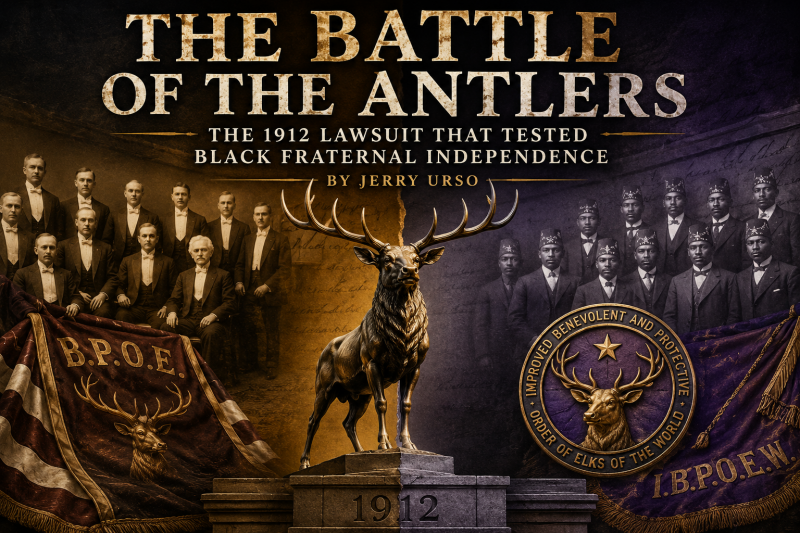
The Battle of the Antlers
The 1912 Lawsuit That Tested Black Fraternal Independence
By Jerry Urso JWJ Branch of ASALH
In the spring of 1912, a legal battle reached the highest court in New York that would become one of the most significant fraternal lawsuits in American history. On one side stood the Benevolent and Protective Order of Elks, a nationally known white fraternal organization. On the other stood the Improved Benevolent and Protective Order of Elks of the World, a rapidly growing African American fraternity founded by men who had been denied admission to the white order because of their race.[1][2]
At first glance, the dispute appeared to be a technical argument over names, insignia, and corporate identity. Yet beneath the legal language lay a much larger question. Could African Americans, excluded from white institutions during the Jim Crow era, create organizations that possessed the same dignity, prestige, and influence as those from which they had been barred?
The answer would not be decided solely in a courtroom.
A Brotherhood Born from Exclusion
The story began in Cincinnati, Ohio, in 1897. Benjamin Franklin Howard and Arthur J. Riggs sought admission into the Benevolent and Protective Order of Elks but were rejected because they were Black.[2] Rather than accept exclusion, they established a separate fraternity dedicated to the same principles of brotherhood, charity, and mutual aid.
The new organization became known as the Improved Benevolent and Protective Order of Elks of the World. Like many African American fraternal organizations of the period, it drew inspiration from an existing white order while creating an institution that served the needs of Black communities. The organization quickly spread across the nation, establishing lodges, charitable programs, educational initiatives, and social networks that became pillars of African American civic life.[2]
Its success, however, brought attention from the white Elks.
As the Black Elks expanded, the Benevolent and Protective Order of Elks argued that the use of the word "Elks," along with similar insignia and ceremonial traditions, infringed upon its corporate identity and created confusion among the public.[3]
The stage was set for a courtroom confrontation.
The Lawsuit
The Benevolent and Protective Order of Elks filed suit in New York seeking an injunction against the Black organization. The white Elks contended that they possessed exclusive rights to the Elks name and that the continued use of a similar title by the African American fraternity constituted unfair competition and misrepresentation.[4]
The litigation eventually reached the New York Court of Appeals, the highest court in the state.
The court acknowledged that the defendant organization had been legally incorporated and had established branches throughout the country. Nevertheless, the judges concluded that the names of the two organizations were sufficiently similar to create confusion and therefore justified judicial intervention.[4]
The case was formally decided as Benevolent and Protective Order of Elks v. Improved Benevolent and Protective Order of Elks of the World, 205 N.Y. 459 (1912).[4]
The Court Speaks
On May 24, 1912, the New York Court of Appeals ruled in favor of the white Elks.[4]
The court affirmed an injunction prohibiting the Black organization from using the name "Improved Benevolent and Protective Order of Elks of the World" within New York and from adopting badges, buttons, and colors substantially similar to those used by the plaintiff organization.[4]
The opinion included a remark by Judge Willard Bartlett that would become famous in both legal and fraternal circles:
"If the members desired the name of an animal there is a long list of beasts, birds, fishes which have not yet been appropriated for such a purpose."[4]
To the court, the solution appeared simple: choose another name.
To the Black Elks, however, the issue involved far more than a corporate title.
Importantly, the court did not dissolve the organization itself. The ruling addressed the use of the disputed name and insignia, but it did not destroy the fraternity that Howard and Riggs had built.[4]
The Response of Black America
African American newspapers immediately recognized the importance of the decision.
The New York Age reported extensively on the ruling and the uncertainty that followed as leaders of the Black Elks evaluated their legal options.[3] The newspaper's headline, "Elks Puzzled Over Decision," reflected the concern felt throughout the organization.[3]
The Afro-American likewise placed the story prominently before its readers under the headline "Courts Decide Against Elks."[5] The newspaper carefully explained that the ruling affected the use of the name while emphasizing the continuing existence of the organization.[5]
The widespread coverage reveals how African Americans understood the controversy. This was not merely a trademark dispute. It was viewed as a challenge to a successful Black institution that had emerged because African Americans were denied equal participation in white fraternal life.
The lawsuit became a test of Black organizational independence.
The Black Elks Endure
Despite the court's decision, the Improved Benevolent and Protective Order of Elks of the World survived.
The organization adjusted certain insignia and continued operating. Lodges remained active. Members continued their charitable work. New lodges were organized. Educational programs expanded. Community service projects continued.[6]
Rather than disappearing, the Black Elks grew into one of the largest African American fraternal organizations in the United States.
Its members supported schools, assisted widows and orphans, provided burial benefits, sponsored scholarships, and helped develop generations of civic leaders. The order became a powerful force within African American communities across the nation.[6]
The courtroom victory achieved by the white Elks did not prevent the Black Elks from fulfilling their mission.
From Exclusion to Acceptance
When the New York Court of Appeals ruled against the Black Elks in 1912, Jim Crow segregation was deeply entrenched throughout American society. Racial exclusion was accepted by many courts, governments, and private organizations.
Yet history rarely remains fixed.
The Black Elks continued to grow through the decades that followed. They weathered two world wars, the Great Depression, and the struggles of the Civil Rights Movement. While the white Elks sought protection through litigation, the Black Elks demonstrated that African Americans could build a successful national institution capable of enduring without white approval.
The social and legal transformations of the mid-twentieth century gradually undermined the foundations of racial exclusion. Court decisions, federal legislation, and changing public attitudes challenged segregation throughout American life.
In 1972, the Benevolent and Protective Order of Elks officially removed its whites-only membership requirement and opened membership to African Americans and other minorities.[7]
The irony was profound.
The organization that had gone to court in 1912 to prevent Black men from identifying themselves as Elks ultimately abandoned the racial restrictions that had made the lawsuit possible.
The Black Elks never won the case.
But they survived.
They grew.
And they endured long enough to witness the transformation of the institution that had once excluded them.
The Battle of the Antlers was never really about a name. It was about dignity, perseverance, and the determination of African Americans to create institutions capable of surviving even when the law stood against them.
In the end, the courtroom delivered one verdict.
History delivered another.
References
[1] Improved Benevolent and Protective Order of Elks of the World, official organizational history.
[2] History of the founding of the Improved Benevolent and Protective Order of Elks of the World by Benjamin Franklin Howard and Arthur J. Riggs.
[3] The New York Age (New York, New York), May 30, 1912, p. 1.
[4] Benevolent and Protective Order of Elks v. Improved Benevolent and Protective Order of Elks of the World, 205 N.Y. 459 (N.Y. Court of Appeals, May 24, 1912).
[5] The Afro-American (Baltimore, Maryland), June 1, 1912, p. 1.
[6] The Washington Bee (Washington, District of Columbia), July 20, 1918, p. 2.
