
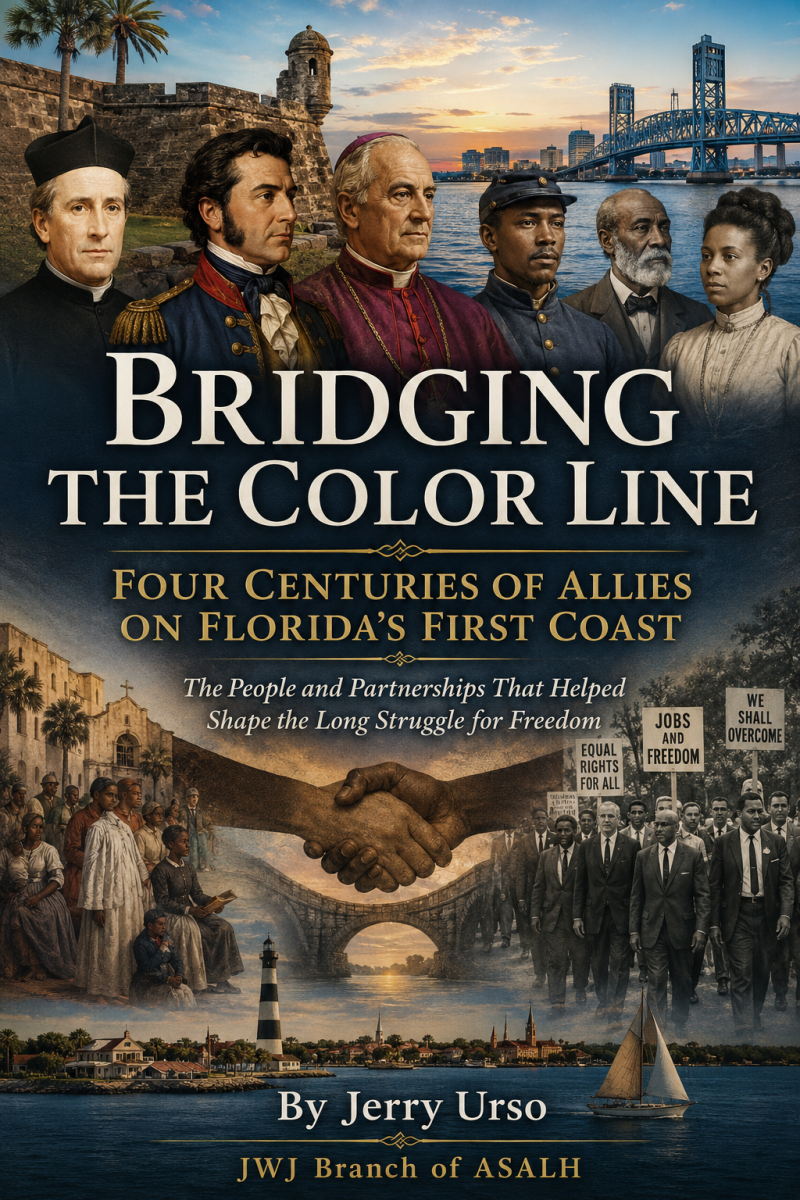
Bridging the Color Line
Four Centuries of Allies on Florida's First Coast
The People and Partnerships That Helped Shape the Long Struggle for Freedom
By Jerry Urso
JWJ Branch of ASALH
Introduction
The history of the American civil rights movement has traditionally been told through the courageous men and women who challenged segregation, demanded equal justice, and transformed the nation during the twentieth century. On Florida's First Coast, that story rightly belongs first and foremost to African Americans whose determination, sacrifice, and leadership carried the movement forward. From the earliest days of Spanish Florida through Reconstruction, the Jim Crow era, and the modern Civil Rights Movement, Black Floridians remained the driving force behind every major struggle for freedom, equality, education, voting rights, and human dignity.
Yet no great movement for justice succeeds alone.
Throughout the history of Florida's First Coast, individuals from many different backgrounds made the conscious decision to stand beside their African American neighbors in the pursuit of liberty and equality. Native American leaders offered sanctuary to people escaping slavery. Spanish governors created legal pathways to freedom that challenged the institution of slavery decades before the American Revolution. Minorcan settlers, Catholic clergy, and merchants helped preserve communities where race was not always the defining measure of citizenship. White Unionists risked execution during the Civil War by remaining loyal to the United States. During Reconstruction, white governors, judges, lawyers, and members of Congress worked alongside newly elected Black officials to build one of the South's first interracial governments. During the darkest years of Jim Crow, educators, ministers, attorneys, labor leaders, journalists, and ordinary citizens quietly preserved the ideals of equality until a new generation of activists emerged to challenge segregation in the streets.
By the 1960s, these alliances became more visible than ever before. White college students joined lunch-counter demonstrations. Jewish rabbis traveled to Florida to stand with Dr. Martin Luther King Jr. and local activists. Protestant ministers crossed long-standing racial barriers in search of reconciliation. White attorneys argued civil rights cases before federal courts, while courageous judges enforced constitutional protections despite fierce political opposition. Business leaders recognized that justice and economic prosperity were inseparable, and labor organizations demonstrated that working men and women shared common interests regardless of race. Some of these individuals became nationally known; many others quietly performed acts of courage that history has largely forgotten.
This article is not intended to diminish the leadership of African Americans in the long struggle for civil rights. Quite the opposite. It recognizes that Black leadership inspired others to challenge their own communities, confront their own prejudices, and risk their own reputations in pursuit of a more just society. The men and women profiled here did not lead the movement—they answered its call. They crossed racial, religious, ethnic, political, and cultural boundaries because they believed that equality before the law was not simply an African American cause but an American obligation.
The history presented here stretches across more than four centuries, beginning with the founding of St. Augustine in 1565 and continuing into the present day. It reveals that the First Coast has long been a place where diverse peoples met, often in conflict but sometimes in cooperation. Those moments of cooperation—whether between Spaniards and free Africans at Fort Mose, Seminoles and Black Seminoles in the Florida wilderness, Unionists and formerly enslaved citizens during Reconstruction, or Black and white activists during the modern Civil Rights Movement—form a continuous thread running through the region's history.
Many of the names that follow are familiar. Others have been overlooked despite their extraordinary contributions. Some risked public ridicule, economic ruin, imprisonment, violence, or even death because they refused to accept injustice as inevitable. Others used their positions as lawyers, judges, educators, clergy, soldiers, business leaders, or public officials to quietly expand opportunities for those denied equal treatment under the law. Together, they remind us that progress has always depended upon individuals willing to place principle above popularity and conscience above convenience.
This article serves as the historical foundation for the First Coast Civil Rights Museum. Each person and organization included here represents a bridge across the color line—a reminder that while the struggle for freedom was led by African Americans, it was strengthened by allies from many walks of life who understood that the rights of one people could never be permanently separated from the rights of all people. Their collective story is the story of Florida's First Coast, and it is a story that deserves to be remembered, preserved, and shared with future generations.
Spanish Florida: Where the First Bridges Were Built
Long before the words civil rights entered the American vocabulary, Florida's First Coast became the setting for one of the earliest experiments in interracial cooperation in North America. When Spanish Admiral Pedro Menéndez de Avilés founded St. Augustine on September 8, 1565, he established more than the oldest continuously occupied European settlement in what would become the United States. He established a frontier society where survival often depended upon cooperation among people of different races, cultures, and nationalities. Over the next 256 years of Spanish rule, Spaniards, Africans, Native Americans, Minorcans, Greeks, Italians, free people of color, and mixed-race families lived, worked, worshipped, and defended the colony together. While Spanish Florida was far from a society free of slavery or discrimination, it developed under legal and religious traditions that differed dramatically from those later imposed by the United States.
Unlike the English colonies to the north, Spain governed Florida through a legal system rooted in Roman law and Catholic doctrine. Enslaved Africans remained subject to bondage, yet they possessed certain legal rights denied to enslaved people under English common law. They could marry with the approval of the Church, petition authorities under specific circumstances, accumulate property, and in some cases purchase their freedom through the legal process known as coartación. Free people of African descent could own land, operate businesses, bear arms in defense of the colony, and serve in the Spanish militia. These rights did not establish racial equality, but they recognized the humanity and legal identity of Africans in ways almost unknown elsewhere in colonial North America.
The Catholic Church also played a significant role in shaping the colony's social structure. Parish records from St. Augustine reveal Spaniards, Africans, Native Americans, and people of mixed ancestry participating in the same sacramental life. Baptisms, marriages, confirmations, and burials frequently crossed racial and ethnic boundaries. Black and white parishioners sometimes served as godparents for one another's children, creating relationships that extended beyond simple religious ceremony. Priests occasionally intervened on behalf of enslaved individuals suffering extreme abuse, while church records later became valuable legal documents protecting free Black families from efforts to reduce them to slavery after Florida became an American territory.
Spain's military needs also encouraged cooperation across the color line. Florida was a sparsely populated frontier province constantly threatened by English expansion from Carolina and Georgia. Every able-bodied defender mattered. Africans served as soldiers, laborers, translators, craftsmen, and scouts. Native allies provided knowledge of the landscape that proved indispensable during military campaigns. Rather than viewing race as the sole measure of loyalty or ability, Spanish officials frequently judged individuals by their service to the Crown. That policy, born of necessity rather than modern ideals of equality, nevertheless created opportunities for interracial cooperation that would profoundly influence the history of the First Coast.
Perhaps the most revolutionary Spanish policy came in 1693, when King Charles II issued a royal proclamation declaring that enslaved men and women escaping from the English colonies could obtain their freedom by reaching Spanish Florida, accepting the Catholic faith, and pledging loyalty to Spain. The decree served several purposes. It weakened England's plantation economy, strengthened Florida's military defenses, and encouraged settlement in a colony that desperately needed population. Yet for hundreds of enslaved Africans living under brutal conditions in Carolina and Georgia, the proclamation represented something far more important. It offered the first government-sanctioned path to freedom in what would later become the United States.
Over the following decades, that promise transformed St. Augustine into a beacon of hope for freedom seekers throughout the Southeast. Escaped slaves risked capture, punishment, and death as they traveled south through forests, rivers, and swamps in search of Spanish territory. Some arrived individually, while others traveled in small groups. Once they reached St. Augustine, Spanish officials evaluated their claims, and many were granted sanctuary rather than returned to their enslavers. These men and women would soon help establish one of the most extraordinary communities in American history—a settlement whose story would forever change the understanding of freedom on the First Coast.
That settlement was Gracia Real de Santa Teresa de Mose, known today as Fort Mose. Established in 1738, it became the first legally recognized free Black community in what is now the United States. There, formerly enslaved Africans built homes, raised families, cultivated the land, and served in the Spanish militia under their own commander. Fort Mose was more than a military outpost; it became living proof that people once held in bondage could govern themselves, defend their communities, and contribute to the security of an entire colony. It would also become one of the earliest and most enduring symbols of interracial cooperation in North American history.
The story of Fort Mose begins with the remarkable leadership of one man—Captain Francisco Menéndez—whose courage, military skill, and devotion to freedom made him one of the First Coast's earliest civil rights pioneers.
King Charles II of Spain: The King Who Opened the First Door to Freedom
The story of civil rights on Florida's First Coast cannot begin with a governor, a soldier, or even a settlement. It begins with a king whose decision fundamentally altered the history of North America. In 1693, King Charles II of Spain issued a royal decree that transformed Spanish Florida into the first government in what would become the United States to offer legal sanctuary to enslaved people escaping bondage. More than seventy years before the American Revolution proclaimed that "all men are created equal," the Spanish Crown had already established a policy recognizing that freedom could be earned rather than denied solely because of race.
King Charles II ruled over a vast empire stretching across Europe, the Caribbean, Central America, South America, and portions of North America. By the late seventeenth century, Spain's hold on Florida had become increasingly fragile. English colonists from Carolina were expanding southward, raiding Spanish settlements, enslaving Native Americans, and threatening St. Augustine, Spain's oldest and most important city in North America. Florida remained sparsely populated and difficult to defend. The Crown desperately needed loyal settlers and capable soldiers willing to protect the colony from foreign invasion.
Rather than relying solely upon reinforcements from Europe, Charles II adopted an innovative strategy. His royal proclamation declared that enslaved Africans fleeing from the English colonies would be granted freedom if they reached Spanish Florida, accepted the Catholic faith, and pledged loyalty to the Spanish Crown. The decree served both humanitarian and military purposes. Every person escaping from an English plantation weakened Britain's labor force while simultaneously strengthening Spain's defenses. Formerly enslaved men could become soldiers, laborers, farmers, and settlers dedicated to protecting the colony that had given them their freedom.
The decree represented a remarkable departure from English colonial policy. Throughout Britain's North American colonies, enslaved people who escaped were hunted relentlessly, returned to their owners, and often subjected to brutal punishment intended to discourage future attempts. Under Spanish law, however, freedom seekers who successfully reached Florida were no longer viewed as property to be reclaimed. Instead, they became potential citizens and defenders of the Spanish Empire. Although they were required to embrace Catholicism and swear allegiance to Spain, they were offered something almost unimaginable elsewhere in North America—the opportunity to build new lives as free men and women.
News of the royal proclamation spread quickly through enslaved communities in Carolina and Georgia. Plantation owners soon found themselves confronting a new and unexpected challenge. Men and women began disappearing into the forests, rivers, and swamps leading south toward Florida. The journey was extraordinarily dangerous. Escapees faced starvation, disease, attacks by slave catchers, and the constant threat of recapture. Yet the possibility of freedom proved stronger than the fear of failure. For many, the Spanish border became a beacon of hope, offering an alternative to a lifetime of bondage.
The consequences of Charles II's decision extended far beyond the individuals who successfully reached Florida. His proclamation established the legal and moral foundation for what would become Fort Mose, the first legally recognized free Black community in what is now the United States. Without the king's decree, Captain Francisco Menéndez and hundreds of other formerly enslaved Africans would never have received their freedom, military commissions, or land grants. The community that eventually emerged outside the walls of St. Augustine became a powerful symbol that people of African descent could own property, govern themselves, serve as soldiers, and contribute to the defense of their adopted homeland.
King Charles II almost certainly did not envision his proclamation as an early civil rights document. His primary objective was protecting Spain's imperial interests. Nevertheless, history often produces unintended consequences. A policy designed to strengthen a distant frontier colony instead created one of the earliest legal recognitions of freedom for enslaved Africans in North America. In doing so, it challenged the prevailing assumption that slavery was permanent and that race alone determined a person's place in society.
The king's decree also established the first bridge across the color line on Florida's First Coast. By extending freedom to people whom neighboring colonies regarded only as property, Charles II opened the door to interracial cooperation that would shape the history of the region for centuries. The alliances that later developed at Fort Mose, among the Seminoles and Black Seminoles, during Reconstruction, and throughout the Civil Rights Movement all traced part of their origin to that remarkable decision issued from the Spanish court in 1693. In many respects, the First Coast's long journey toward civil rights began with a royal signature that declared freedom was possible for those courageous enough to seek it.
Governor Manuel de Montiano: Turning Royal Policy into Opportunity
History often remembers the monarchs who issue decrees, but lasting change is usually accomplished by the men and women who put those policies into practice. While King Charles II established the legal foundation for offering sanctuary to enslaved people fleeing the English colonies, it was Governor Manuel de Montiano who transformed that royal policy into one of the most remarkable communities in colonial North America. His administration did not abolish slavery or create racial equality, but it did provide opportunities for freedom that were virtually unknown elsewhere in Britain's mainland colonies.
When Manuel de Montiano became Royal Governor of Spanish Florida in 1737, he inherited one of Spain's most vulnerable colonies. St. Augustine stood as the northern frontier of the Spanish Empire, surrounded by increasingly aggressive British settlements in Carolina and the newly established colony of Georgia. The population was small, military resources were limited, and the colony remained under constant threat of invasion. Every governor understood that Florida's survival depended upon finding loyal settlers and capable soldiers willing to defend Spain's northern border.
Montiano approached that challenge with practical realism rather than ideological reform. Spain remained a slaveholding empire, and slavery continued throughout its colonies. Neither the governor nor the Spanish Crown questioned the institution itself. Instead, Montiano recognized that formerly enslaved Africans escaping from British plantations possessed valuable military experience, knowledge of the region, and an extraordinary incentive to defend the colony that had granted them freedom. By integrating these freedom seekers into Florida's defenses, he could strengthen Spain's military position while weakening Britain's plantation economy. It was a strategic decision rooted in imperial necessity rather than modern concepts of civil rights.
In 1738, Montiano authorized the establishment of Gracia Real de Santa Teresa de Mose, known today as Fort Mose, approximately two miles north of St. Augustine. The settlement became the first legally recognized free Black community in what would become the United States. The residents were granted land to build homes, raise families, and cultivate crops, but they also accepted serious responsibilities. Every able-bodied man was expected to serve in the militia and defend Spanish Florida against British attack. Freedom at Fort Mose was therefore not unconditional; it was tied to loyalty to the Spanish Crown, acceptance of the Catholic faith, and a willingness to bear arms in defense of the colony.
One of Montiano's most significant decisions was appointing Captain Francisco Menéndez, himself a formerly enslaved African from South Carolina, to command the Fort Mose militia. The appointment was extraordinary for its time. Across most of colonial North America, men of African descent were denied positions of military leadership. Under Montiano's administration, however, Menéndez commanded an officially recognized military company charged with protecting Spain's northern frontier. His leadership reflected the governor's belief that ability, loyalty, and experience could serve the interests of the Crown regardless of a man's origins.
That confidence was tested during the War of Jenkins' Ear. In 1740, British General James Oglethorpe invaded Spanish Florida with the objective of capturing St. Augustine and eliminating Spain's refuge for escaped slaves. After British forces occupied Fort Mose, Montiano worked closely with Captain Menéndez and Spanish military officers to organize a daring counterattack. Before dawn on June 26, 1740, Spanish regulars, Black militiamen from Fort Mose, free Black volunteers, and Native American allies launched a coordinated assault that overwhelmed the British position in what became known as the Battle of Bloody Mose. The victory forced Oglethorpe to abandon his campaign and secured the survival of Spanish Florida. It also demonstrated that soldiers of different races and cultures could fight effectively under unified leadership more than a century before integrated military service became common in the United States.
It is important, however, to understand Montiano's accomplishments within the context of his own era. He was not a modern civil rights advocate, nor did he seek to dismantle the racial hierarchy of the Spanish Empire. Slavery continued to exist throughout Spanish America, Native peoples remained subject to colonial authority, and freedom was extended only under carefully defined conditions. Yet history is often shaped by unintended consequences. Policies adopted for military and political reasons sometimes create opportunities far beyond their original purpose.
By implementing Spain's sanctuary policy, recognizing Black military leadership, and establishing Fort Mose, Governor Manuel de Montiano helped create a community that challenged prevailing assumptions about race, citizenship, and military service in eighteenth-century North America. His administration demonstrated that formerly enslaved Africans could become property owners, soldiers, community leaders, and trusted defenders of the colony. Though limited by the realities of his time, Montiano's decisions established one of the earliest examples on Florida's First Coast of government expanding opportunity rather than restricting it.
For the First Coast Civil Rights Museum, Manuel de Montiano represents an important historical truth: progress is rarely absolute. It often emerges gradually, within imperfect societies and under imperfect leaders. His legacy reminds us that while freedom in Spanish Florida was incomplete and conditional, it nevertheless offered possibilities unavailable elsewhere in colonial North America and laid the foundation for later generations who would continue the long struggle to bridge the color line.
Captain Francisco Menéndez: From Enslaved Man to Defender of Freedom
Few individuals better embody the theme of Bridging the Color Line than Captain Francisco Menéndez. Born into slavery in the English colony of South Carolina during the late seventeenth century, Menéndez transformed his own quest for freedom into a lifetime of military service and leadership. His remarkable journey from enslaved laborer to commander of the first free Black militia in what is now the United States challenged deeply held assumptions about race, citizenship, and military leadership more than a century before the Civil War.
Like thousands of enslaved Africans living in the English colonies, Menéndez endured a system that regarded him as property rather than a human being. The royal proclamation issued by King Charles II of Spain in 1693, offering sanctuary to those who escaped to Spanish Florida, provided a glimmer of hope that freedom might be possible. At great personal risk, Menéndez fled South Carolina and made the dangerous journey south to St. Augustine. Had he been captured, he almost certainly would have faced severe punishment or death. Instead, after reaching Spanish territory, he accepted Catholicism, pledged loyalty to the Spanish Crown, and began a new life as a free man.
Freedom, however, did not mean an easy life. Spanish Florida remained a dangerous frontier where every resident was expected to contribute to the colony's survival. Menéndez quickly distinguished himself through discipline, courage, and loyalty. Spanish officials recognized his leadership abilities, and when Governor Manuel de Montiano established Fort Mose in 1738, he appointed Menéndez commander of its Black militia. The appointment was extraordinary for its time. Throughout most of the colonial world, men of African descent were excluded from positions of military authority. Under Spanish rule, however, Menéndez commanded an officially recognized company responsible for defending the northern approaches to St. Augustine.
As commander of Fort Mose, Menéndez supervised both the military defense and daily life of the settlement. The community consisted of formerly enslaved Africans and their families who had escaped from plantations in Carolina and Georgia seeking freedom under Spanish law. They built homes, cultivated crops, raised livestock, worshipped together, and trained as soldiers. Fort Mose was neither a utopian society nor a place of complete equality. Its residents owed military service to Spain and remained subject to colonial authority. Nevertheless, they exercised freedoms that were almost unimaginable elsewhere in British North America. They owned property, established families, governed many aspects of their community, and defended the colony that had granted them liberty.
Menéndez's leadership was tested during the War of Jenkins' Ear. In 1740, British General James Oglethorpe launched a major invasion of Spanish Florida. One of his primary objectives was to destroy Fort Mose, both because it defended St. Augustine and because its very existence encouraged enslaved people to flee British plantations. After British troops occupied the settlement, Governor Manuel de Montiano organized a counteroffensive. Before dawn on June 26, 1740, Captain Menéndez led his Black militia alongside Spanish regulars and Native American allies in a surprise attack remembered today as the Battle of Bloody Mose.
The assault proved decisive. Fighting hand-to-hand in darkness, the combined Spanish, African, and Native forces overwhelmed the British garrison and reclaimed the settlement. The victory forced Oglethorpe to abandon his campaign against St. Augustine and preserved Spain's northern frontier. Just as importantly, it demonstrated that formerly enslaved Africans could lead soldiers with distinction and courage. Long before Black Americans earned recognition for their service in the Revolutionary War, the Civil War, or the World Wars, Captain Francisco Menéndez had already established a record of military leadership that commanded the respect of colonial authorities.
Menéndez's significance extends far beyond the battlefield. He represented one of the earliest examples on the First Coast of a Black leader exercising authority that crossed racial boundaries. White Spanish officers trusted his judgment. Colonial governors relied upon his leadership. Native allies fought beside his militia. His life illustrated that competence, loyalty, and courage could challenge prevailing assumptions about race even within the limitations of an eighteenth-century colonial empire.
It is important to place Menéndez within the context of his own time. He did not fight to abolish slavery throughout the Spanish Empire, nor did he advocate universal civil rights in the modern sense. Spain remained a slaveholding society, and the freedoms enjoyed at Fort Mose were limited and conditional. Yet within those historical realities, Menéndez accomplished something extraordinary. He transformed the opportunity offered by Spanish policy into a thriving community that stood as a living challenge to the institution of perpetual slavery.
Today, Captain Francisco Menéndez occupies a place of honor in the history of Florida's First Coast. His leadership at Fort Mose reminds us that the struggle for freedom in America began long before the founding of the United States and that people of African descent were not merely passive participants in history but active leaders who shaped the destiny of an entire region. As the first known Black military commander of a free Black settlement in what would become the United States, Francisco Menéndez stands as one of the earliest individuals to bridge the color line, proving through his actions that courage, leadership, and patriotism recognize no race.
Fort Mose: America's First Free Black Community
While individuals often shape history, there are places that become symbols of hope for generations to come. On Florida's First Coast, no place better represents the earliest bridge across the color line than Gracia Real de Santa Teresa de Mose, known today as Fort Mose. Established in 1738 under the administration of Governor Manuel de Montiano, Fort Mose became the first legally recognized free Black community in what is now the United States. More than a military outpost, it was a living declaration that people once held in bondage could become property owners, soldiers, community leaders, and defenders of their own freedom.
The creation of Fort Mose was the culmination of nearly half a century of Spanish policy. Following King Charles II's royal decree of 1693, enslaved Africans escaped from plantations in South Carolina and Georgia, risking everything to reach Spanish Florida. Those who survived the journey and pledged loyalty to the Spanish Crown were granted freedom under conditions established by colonial authorities. By the late 1730s, the growing number of freedom seekers convinced Governor Manuel de Montiano that they should be organized into a permanent settlement capable of strengthening the colony's northern defenses. Rather than dispersing these families throughout St. Augustine, he established a community where they could build homes, farm the surrounding land, and serve as a military buffer protecting the city from British attack.
The residents of Fort Mose were pioneers in every sense of the word. Many had been born into slavery and had endured unimaginable hardship before making the dangerous journey to Spanish territory. Others had been born free after their parents reached Florida. Together they transformed an isolated frontier settlement into a thriving community. Families built modest homes, cultivated corn, beans, vegetables, and livestock, raised children, and worshipped together under the Catholic faith. Daily life centered upon both agriculture and military preparedness, for every able-bodied man understood that the freedom they had gained could only be preserved through vigilance and service.
Unlike plantation communities elsewhere in the South, Fort Mose was not governed by slave owners. It was led by its own Black militia under the command of Captain Francisco Menéndez, a formerly enslaved man who had earned the confidence of Spanish officials through courage and loyal service. Menéndez answered to the Spanish governor, but within the settlement he exercised military authority and helped oversee the community's defense. His leadership represented one of the earliest documented examples in North America of a Black officer commanding an officially recognized military unit.
It is important to understand Fort Mose within its historical context. The settlement did not exist because Spain believed in universal human equality. Spanish Florida remained part of a colonial empire where slavery continued to exist, Native peoples lived under colonial authority, and freedom often depended upon loyalty to the Crown, acceptance of Catholicism, and military service. The residents of Fort Mose did not receive unrestricted rights, nor were they considered equal in every respect to white Spanish colonists. Their liberty was conditional, and they lived with the constant threat of British invasion or recapture.
Yet when viewed against the realities of eighteenth-century North America, Fort Mose represented something truly revolutionary. At a time when British law regarded escaped slaves as property to be returned to their owners, Spanish Florida recognized them as free settlers capable of defending the colony. They owned homes, cultivated land, established families, and served in uniform alongside Spanish soldiers. For those still enslaved in the English colonies, Fort Mose became a beacon of hope—a place where freedom, though imperfect and conditional, could become a reality.
That hope carried a price. During the War of Jenkins' Ear, British General James Oglethorpe understood that Fort Mose threatened not only British military ambitions but also the institution of slavery itself. As long as the settlement existed, enslaved people would continue fleeing south in search of liberty. In 1740, British forces captured the fort during their invasion of Spanish Florida. Governor Manuel de Montiano responded by organizing a combined force of Spanish regulars, Black militiamen from Fort Mose, and Native American allies. Before dawn on June 26, 1740, they launched the surprise attack remembered as the Battle of Bloody Mose, driving the British from the settlement and helping save St. Augustine from conquest.
The victory at Fort Mose carried significance far beyond the battlefield. It demonstrated that Black, white, and Native soldiers could fight together under unified command in defense of a common purpose. More than a century before integrated military service became accepted in the United States, the defenders of Fort Mose had already proven that courage and leadership transcended race. Their success challenged stereotypes that would persist for generations and provided one of the earliest examples on the First Coast of diverse communities uniting against oppression.
Although Fort Mose eventually disappeared after Spain ceded Florida to Great Britain in 1763, its legacy endured. Historians today recognize the settlement as the birthplace of the first legally sanctioned free Black community in the nation and one of the earliest examples of interracial cooperation in American history. It reminds us that the struggle for freedom did not begin with the American Revolution, the Civil War, or the Civil Rights Movement. On Florida's First Coast, that struggle had already begun generations earlier through a community of courageous men and women who transformed the promise of liberty into a living reality.
For the First Coast Civil Rights Museum, Fort Mose represents the beginning of a tradition that would continue for more than four centuries. It was here that people of different races, cultures, and backgrounds first demonstrated that freedom could be defended not by one group alone, but through cooperation built upon shared purpose, mutual respect, and the universal desire to live free.
The Minorcan Community of St. Augustine: Building Bridges Through Shared Experience
When discussing the allies who helped shape the history of Florida's First Coast, the Minorcan community occupies a unique place. Unlike later civil rights activists who consciously challenged segregation, the Minorcans did not organize political movements for racial equality. Instead, their contribution was more subtle but equally significant. Through shared hardship, daily interaction, and centuries of living alongside free Blacks, Spaniards, Native Americans, and other ethnic communities, they helped create one of the most culturally diverse societies in colonial North America. Their story reminds us that bridges between people are often built not only through protest but through the ordinary experiences of work, faith, family, and community.
The Minorcans arrived in Florida under tragic circumstances. In 1768, British entrepreneur Dr. Andrew Turnbull recruited more than 1,400 indentured laborers from the Mediterranean, including Minorcans, Greeks, Italians, and Corsicans, to establish the agricultural colony of New Smyrna. Promised prosperity and opportunity, they instead encountered disease, hunger, physical abuse, and brutal working conditions. Historians estimate that hundreds died during the first years of the settlement from overwork, malnutrition, and tropical illnesses. For nearly a decade, the colonists endured conditions so severe that many later compared their treatment to slavery.
In 1777, the surviving colonists could endure no more. Led by Father Pedro Camps, nearly six hundred men, women, and children abandoned New Smyrna and made the seventy-mile journey north to St. Augustine, where they appealed directly to British Governor Patrick Tonyn for protection. Tonyn investigated their complaints, released them from their indentures, and permitted them to settle within the city. That decision transformed St. Augustine forever. The Minorcans quickly became the largest civilian population in the community and helped shape the city's language, cuisine, religion, commerce, and culture for generations.
Unlike the plantation societies developing throughout the American South, St. Augustine was a compact colonial town where daily life required constant interaction among diverse peoples. Minorcans lived beside Spaniards, free Blacks, Native Americans, soldiers, merchants, craftsmen, and mixed-race families. They attended many of the same Catholic churches, conducted business with one another, and frequently appeared together in parish registers, legal proceedings, and commercial transactions. The community that emerged was far from free of prejudice, but its social structure differed significantly from the rigid racial hierarchy that later characterized much of the American South.
The Minorcans' own experience as exploited indentured laborers gave many an appreciation for the hardships endured by others living on society's margins. While they did not become organized abolitionists, historical records reveal numerous examples of Minorcans serving as witnesses in legal proceedings involving free people of color, participating in shared religious ceremonies, and maintaining commercial relationships that crossed racial boundaries. Catholic parish records document Minorcans and free Black residents standing together as godparents, witnesses, and neighbors, reflecting a level of social interaction uncommon in many other colonial communities.
When Florida returned to Spanish rule in 1784, and later became an American territory in 1821, many Minorcan families remained in St. Augustine. As American officials introduced increasingly restrictive racial laws, the city's long-established multicultural traditions did not disappear overnight. Families who had lived together for generations continued many of their personal and commercial relationships despite changing political circumstances. The transition to American rule undoubtedly hardened racial divisions, yet the shared history of the community preserved memories of a more diverse colonial society where daily cooperation had often taken precedence over rigid racial separation.
It is important to understand the Minorcan experience within its historical context. They were not civil rights activists in the modern sense, nor did they seek to dismantle the institution of slavery. Many eventually became successful property owners and participated in the economic life of a society where slavery remained legal. Yet their history demonstrates another important truth: communities that experience hardship together often develop relationships that transcend ethnic and racial divisions. The Minorcans' own struggle for justice at New Smyrna and their integration into the multicultural life of St. Augustine contributed to an environment where cooperation among different peoples became not merely possible but necessary.
For the First Coast Civil Rights Museum, the Minorcan community represents an early example of how shared adversity can create lasting connections across cultural boundaries. Their story broadens our understanding of what it means to bridge the color line. Not every bridge was built in a courtroom, on a battlefield, or during a public protest. Some were built over generations through neighborhoods, churches, marketplaces, and families that learned to live together despite their differences. Those quiet relationships became part of the cultural foundation upon which later generations would build the more visible struggles for equality that followed.
Spanish Law, the Catholic Church, and the Meaning of Freedom
To understand why Florida's First Coast became the birthplace of America's first legally recognized free Black community, one must first understand the legal and religious traditions that shaped Spanish Florida. Neither Spanish law nor the Catholic Church sought to abolish slavery. Both accepted slavery as a lawful institution, as did nearly every European power of the seventeenth and eighteenth centuries. Yet within that system existed legal principles and religious beliefs that recognized enslaved people as human beings possessing souls, families, and, under certain circumstances, limited legal rights. Those distinctions created opportunities unavailable in the neighboring British colonies and profoundly influenced the history of the First Coast.
Spanish law, derived from Roman legal traditions and codified in the Siete Partidas, viewed enslaved individuals as property but also as persons with defined legal protections. Unlike English common law, which generally treated enslaved people solely as chattel, Spanish law permitted enslaved men and women to marry with the approval of the Church, maintain family relationships, seek protection from extraordinary abuse, and in some cases acquire property. Perhaps most significantly, the legal doctrine of coartación allowed certain enslaved individuals to purchase their freedom through installment payments or with financial assistance from others. While the process was often lengthy and available only under specific circumstances, it established the important legal principle that slavery was not always permanent.
The Catholic Church reinforced many of these protections through its teachings and sacramental practices. Church leaders accepted the baptism of Africans and Native Americans, recognized the validity of their marriages, and maintained parish records documenting births, baptisms, marriages, and deaths. Those records often became more than religious documents. They served as legal evidence establishing identity, family relationships, and free status, particularly during periods of political transition when ownership and citizenship were challenged.
Parish registers from St. Augustine reveal a colonial society far more complex than the rigid racial hierarchy that later developed under American rule. Spaniards, free Blacks, Native Americans, Minorcans, and people of mixed ancestry frequently appeared together as witnesses, godparents, neighbors, and members of the same congregations. These records do not suggest racial equality. Social distinctions remained significant, and opportunities were far from equal. They do, however, demonstrate that everyday interactions across racial and ethnic lines were far more common than in many English colonies, where churches themselves often reflected sharper racial divisions.
Spanish clergy occasionally found themselves serving as advocates for vulnerable members of their communities. Priests witnessed manumission documents, verified family relationships, recorded marriages that slave owners might otherwise ignore, and preserved legal records that later protected free people of color from attempts to re-enslave them. Their role was usually administrative rather than political, yet these actions often had profound consequences for individuals struggling to preserve their freedom. In an era when written documentation could determine whether a person lived as a free citizen or as property, the careful recordkeeping of the Church became an important safeguard.
It is important not to romanticize either Spanish law or the Catholic Church. Neither institution challenged the existence of slavery itself. Spanish colonists owned slaves, participated in the Atlantic slave trade, and benefited economically from enslaved labor. Native peoples often suffered under colonial policies, and legal protections varied widely depending upon local officials and individual circumstances. Freedom remained limited, conditional, and far from universal. The experience of an enslaved person in Spanish Florida was still one of bondage, uncertainty, and restricted opportunity.
Yet historical significance is measured not only by perfection but also by comparison. When viewed alongside the English colonies of the same period, Spanish Florida offered legal pathways and social opportunities that were exceptional for the time. The ability to petition authorities, purchase one's freedom, maintain legally recognized marriages, and seek sanctuary from another colonial power represented meaningful, if limited, alternatives to perpetual hereditary slavery. Those differences explain why hundreds of enslaved people risked their lives traveling south rather than north in search of liberty.
The legal and religious traditions established during Spanish rule also left a lasting imprint on Florida's First Coast. Long after Spain transferred Florida to the United States in 1821, church records, land grants, family histories, and legal precedents continued to shape local communities. They preserved evidence of free Black families, documented interracial relationships, and reminded later generations that another model of society had once existed on the First Coast—one that, while deeply imperfect, recognized possibilities beyond the rigid racial system that would later define the American South.
For the First Coast Civil Rights Museum, Spanish law and the Catholic Church represent an important historical lesson. Progress rarely begins with sweeping declarations of equality. More often, it begins with small legal protections, the recognition of shared humanity, and institutions willing to preserve dignity within an imperfect world. Those early foundations did not end injustice, but they created spaces in which freedom could take root. From those spaces emerged Fort Mose, the Seminole alliance, and eventually the generations of men and women who continued the long work of bridging the color line on Florida's First Coast.
The Seminoles and Black Seminoles: Florida's Greatest Alliance for Freedom
When the United States acquired Florida from Spain in 1821, it inherited far more than a sparsely populated frontier. It inherited a complex society shaped by more than two centuries of Spanish law, multicultural communities, and shifting alliances between Europeans, Native Americans, and Africans. American officials, however, viewed Florida through a very different lens. They envisioned a territory dominated by cotton plantations, enslaved labor, and the expansion of Southern political power. Standing in the way of those ambitions were the Seminoles and their Black allies.
No alliance in the history of Florida lasted longer, proved more resilient, or more directly challenged the institution of slavery than the partnership between the Seminole Nation and the Black Seminoles. For nearly seventy years—from the closing years of Spanish Florida through the end of the Third Seminole War—Native Americans and people of African descent lived, farmed, fought, negotiated, and died together. Their relationship was not one of perfect equality, nor should it be viewed through the lens of modern civil rights. Yet within the context of nineteenth-century America, it represented one of the most extraordinary examples of interracial cooperation anywhere in the South.
The origins of this alliance stretched back into the eighteenth century. As enslaved Africans escaped plantations in Georgia and the Carolinas, many found refuge among Seminole towns scattered across North and Central Florida. Some established independent farming villages that supplied crops and livestock to Seminole communities. Others married into Seminole families, became interpreters, blacksmiths, hunters, guides, and warriors. While obligations existed between the two communities, Black Seminoles generally enjoyed a level of autonomy unknown on Southern plantations. They owned livestock, cultivated their own fields, built families, and participated in the political and military life of the Seminole Nation.
To slaveholders across the South, these settlements represented far more than isolated communities of freedom seekers. They were living proof that enslaved people could escape bondage, build prosperous lives, and successfully resist attempts to return them to slavery. Every successful escape encouraged others to flee. Plantation owners repeatedly demanded that the federal government recover what they considered stolen property, while American officials increasingly portrayed the Seminoles as harboring runaway slaves. The resulting conflict became as much a war over slavery as it was a struggle over land.
For the Seminoles, however, the issue was fundamentally different. The Black Seminoles had become trusted neighbors, military allies, interpreters, and members of the broader community. They contributed food, labor, military service, and diplomatic skill to a nation constantly threatened by outside expansion. The Seminoles understood that surrendering their Black allies would not satisfy American demands. It would only invite further interference into their own independence. Consequently, when the United States demanded the return of Black Seminoles to slavery, many Seminole leaders refused, choosing instead to defend both their homeland and the people who had become part of it.
The alliance reached its greatest significance during the First, Second, and Third Seminole Wars. Black Seminoles fought beside Seminole warriors against overwhelming American military forces, serving not only as soldiers but also as interpreters, diplomats, scouts, and military advisers. Leaders such as Abraham, Chief Micanopy, John Horse, Osceola, and Wild Cat would become nationally known for their resistance, demonstrating that freedom could unite people across racial and cultural boundaries despite enormous political and military pressure.
Although the United States ultimately removed most Seminoles and Black Seminoles from Florida, their alliance left an enduring legacy. Long before the Civil War, they demonstrated that Native Americans and African Americans could form lasting partnerships built upon mutual dependence, shared sacrifice, and a common determination to preserve freedom. Their story stands as one of the earliest and most powerful examples of people choosing cooperation over division—a tradition that would continue to shape the history of Florida's First Coast for generations to come.
The story of this remarkable alliance begins with one of its most influential figures: Abraham, the Black Seminole diplomat whose wisdom, courage, and political skill made him one of the most important interpreters and advisers in Seminole history.
Abraham: The Diplomat Who Bridged Two Worlds
Among all the individuals who appear in the history of the Seminole Wars, few are as important—or as overlooked—as Abraham, often referred to in nineteenth-century military correspondence as "the Negro Abraham." To American military officers he was an interpreter. To many government negotiators he was an obstacle to federal policy. To the Seminoles, however, Abraham was far more. He was a trusted adviser, diplomat, strategist, and one of the principal architects of the alliance between the Seminole Nation and the Black Seminoles. His life demonstrates that leadership is not always exercised from the battlefield. Sometimes history is shaped by the man who sits beside the chief, offering counsel that determines the future of an entire people.
Little is known about Abraham's early life with certainty. Most historians believe he was born into slavery in Georgia or another Southern state during the closing years of the eighteenth century. Like many Black Seminoles, he eventually escaped into Spanish Florida, where he found refuge among the Seminoles. Unlike many other freedom seekers, however, Abraham possessed an extraordinary gift for languages and diplomacy. He became fluent in English, Spanish, Creek, and several Native dialects, allowing him to move comfortably between cultures that often struggled to understand one another. These abilities soon made him indispensable to Seminole leadership.
By the 1820s and 1830s, Abraham had become one of the closest advisers to Chief Micanopy, the principal chief of the Seminole Nation. Although American officials frequently dismissed him as merely an interpreter, military correspondence reveals a very different reality. United States Army officers repeatedly complained that meaningful negotiations could not proceed without Abraham's participation because Micanopy relied heavily upon his advice. During treaty councils, Abraham did far more than translate words. He explained American intentions, interpreted legal concepts unfamiliar to many Seminole leaders, and helped formulate the Seminole response to increasingly aggressive federal demands.
American military leaders soon recognized Abraham's influence. General Thomas Sidney Jesup, one of the principal commanders during the Second Seminole War, frequently referred to Abraham in official correspondence, acknowledging both his intelligence and his political importance. Jesup believed that Abraham exercised enormous influence over Seminole policy, particularly regarding the status of the Black Seminoles. To American negotiators seeking the return of escaped slaves, Abraham represented one of their most formidable opponents because he consistently argued that many Black Seminoles were no longer fugitives but free people who had lived among the Seminoles for years, cultivated their own farms, and earned their place within the nation.
Abraham understood that the conflict between the United States and the Seminoles extended far beyond questions of land. He recognized that federal officials intended not only to remove the Seminoles from Florida but also to return hundreds of Black Seminoles to slavery. The destruction of the alliance would restore valuable human property to Southern slaveholders while eliminating one of the greatest symbols of Black independence in the American South. Throughout treaty negotiations, Abraham worked tirelessly to preserve the freedom of his people, insisting that they should not be separated from the Seminole communities with whom they had lived for generations.
His influence also reflected something remarkable about Seminole society. Unlike the plantation culture surrounding them, the Seminoles judged Abraham primarily by his ability rather than his ancestry. Although distinctions remained between Seminoles and Black Seminoles, Abraham rose to become one of the nation's most respected political advisers because of his wisdom, diplomacy, and loyalty. His relationship with Micanopy demonstrated that trust could transcend racial differences when communities were united by common interests and mutual respect. It was one of the earliest examples on Florida's First Coast of a Black leader exercising political influence within an interracial alliance.
Despite Abraham's skill as a negotiator, the overwhelming military and political power of the United States eventually prevailed. Years of warfare devastated Seminole communities, and many Black Seminoles were forced westward with the tribes they had long called family. Others faced renewed threats of enslavement despite decades of freedom in Florida. Yet Abraham's legacy survived. He had shown that diplomacy could be as powerful as military force and that education, intelligence, and political insight could become instruments of resistance against oppression.
It is important to understand Abraham within the context of his own era. He was not a civil rights activist in the modern sense, nor did he advocate democratic equality as later generations would define it. His primary loyalty was to the Seminole Nation and to the preservation of freedom for the Black Seminoles. Nevertheless, his life's work represented one of the earliest sustained efforts on the First Coast to defend an interracial community against a government determined to destroy it. By standing beside Chief Micanopy and refusing to abandon either his people or his principles, Abraham helped preserve one of the most remarkable alliances in American history.
For the First Coast Civil Rights Museum, Abraham stands as one of Florida's earliest bridge builders. He connected cultures, languages, and peoples during one of the most turbulent periods in the region's history. Through diplomacy rather than violence, wisdom rather than rhetoric, he demonstrated that leadership often belongs to those capable of bringing different worlds together. His story reminds us that the struggle for freedom has always required interpreters—not simply of language, but of justice itself.
Chief Micanopy: The Leader Who Refused to Abandon His Allies
Throughout American history, great leaders are often remembered for the battles they fought. Chief Micanopy, principal chief of the Seminole Nation during the Second Seminole War, should be remembered for something equally important—the people he refused to betray. Faced with overwhelming military pressure from the United States, Micanopy consistently defended the alliance between the Seminoles and the Black Seminoles, even when doing so prolonged the conflict and threatened the survival of his own nation. His leadership demonstrated that loyalty to one's allies could become as powerful as any military victory.
Born around 1780, Micanopy emerged from one of the Seminoles' most respected families and eventually became the acknowledged principal chief of the nation. By the time Florida became a United States territory in 1821, he found himself leading a people caught between two worlds. American settlers poured into Florida seeking fertile land for cotton plantations, while slaveholders demanded the return of hundreds of Black Seminoles whom they claimed as escaped property. Federal officials insisted that removal west of the Mississippi River was the only solution. Micanopy recognized that accepting those demands would not simply cost the Seminoles their homeland—it would also destroy families and communities that had lived together for generations.
The relationship between the Seminoles and the Black Seminoles was rooted in decades of shared experience. Black farmers cultivated their own fields, raised livestock, served as interpreters, and fought beside Seminole warriors. Leaders such as Abraham had become trusted advisers whose counsel influenced decisions affecting the entire nation. To Micanopy, these men and women were not bargaining chips to be exchanged during treaty negotiations. They were allies whose loyalty had been proven repeatedly through years of cooperation and sacrifice.
American officials struggled to understand this relationship. To plantation owners and many government leaders, the Black Seminoles remained escaped slaves whose legal owners deserved their return. Military correspondence frequently referred to them as property rather than as members of an established community. Micanopy rejected that view entirely. He repeatedly resisted federal demands to separate Black Seminoles from the Seminole Nation, understanding that such concessions would violate both personal honor and the obligations of leadership. His refusal became one of the central issues driving the Second Seminole War.
Throughout years of negotiations, Micanopy relied heavily upon the counsel of Abraham, whose understanding of American politics and law helped guide Seminole diplomacy. Together they attempted to preserve both Seminole independence and Black freedom through negotiation rather than war. Yet each treaty proposal presented by the United States demanded greater concessions. Federal officials insisted upon removal from Florida and increasingly sought assurances that Black Seminoles could be claimed by former owners after relocation. Micanopy understood that such promises would condemn many of his allies to slavery despite decades of freedom.
When war finally erupted in 1835, Micanopy became both military leader and symbol of Seminole resistance. Although younger leaders such as Osceola often captured greater public attention, Micanopy remained the nation's principal chief throughout much of the conflict. He directed military operations, consulted with other chiefs, maintained alliances with Black Seminole leaders, and attempted to preserve unity among increasingly scattered communities facing one of the largest military campaigns ever undertaken by the United States before the Civil War.
Like many Native leaders of his era, Micanopy eventually became the victim of deception during peace negotiations. American commanders repeatedly used flags of truce and promises of safe conduct to secure meetings with Seminole leaders, only to arrest them once discussions began. The capture of Micanopy weakened organized resistance and marked a turning point in the war. He was ultimately transported west to Indian Territory, where he spent the remainder of his life far from the homeland he had struggled so long to protect.
It is important to understand Micanopy within the realities of the nineteenth century. He was not advocating civil rights in the modern constitutional sense, nor was he attempting to create a society based upon complete racial equality. He was a Native leader defending the independence of his nation and the integrity of the alliances upon which its survival depended. Yet those alliances carried profound historical significance. At a time when the United States increasingly defined race through the institution of slavery, Micanopy judged his Black allies by loyalty, service, and shared purpose rather than by the color of their skin.
For the First Coast Civil Rights Museum, Chief Micanopy represents one of the earliest examples of moral leadership on Florida's First Coast. Faced with overwhelming political and military pressure, he refused to abandon those who had stood beside his people. His partnership with Abraham and the Black Seminoles demonstrated that genuine alliances are measured not when circumstances are easy, but when sacrifice is required. In choosing loyalty over expediency, Micanopy helped create one of the most enduring examples of interracial cooperation in American history, reminding future generations that freedom is often preserved by those willing to defend the rights of others as fiercely as their own.
Osceola: A Warrior Who Fought for More Than Land
Few figures in Florida history are as recognizable as Osceola, yet his story is often misunderstood. Popular history remembers him as a fearless warrior who resisted the forced removal of the Seminoles from their homeland. While that legacy is well deserved, it overlooks another important aspect of his leadership. Osceola also fought to preserve the alliance between the Seminoles and the Black Seminoles, understanding that the struggle against removal and the struggle against slavery had become inseparable. His resistance was not simply a fight for land—it was a fight to preserve a community composed of Native Americans and people of African descent who had lived, worked, and defended one another for generations.
Born around 1804 near present-day Alabama, Osceola came of age during a period of enormous upheaval. As American settlers expanded into the Southeast, Native nations faced relentless pressure to surrender their lands and move west of the Mississippi River. Florida became the final refuge for many Seminoles determined to remain in their ancestral homeland. At the same time, hundreds of Black Seminoles—many of them formerly enslaved men and women who had escaped from plantations in Georgia and the Carolinas—had established farming communities allied with the Seminole Nation. Together they created a society that directly challenged the expanding plantation system of the American South.
The United States viewed this alliance as unacceptable. Federal officials insisted that the Seminoles relocate to Indian Territory under the Treaty of Payne's Landing (1832) and later agreements. Southern slaveholders demanded something more. They insisted that Black Seminoles accompanying the tribes west be returned to slavery or placed where former owners could reclaim them. For Osceola, these demands struck at the heart of Seminole independence. Removing his people from Florida was one injustice; abandoning trusted allies to slavery was another entirely. To him, the issues could not be separated.
Although Chief Micanopy remained the principal chief of the Seminole Nation, Osceola emerged as the most determined opponent of removal. His charisma, courage, and uncompromising commitment inspired younger warriors to continue resisting despite overwhelming odds. He worked closely with leaders including Abraham, whose diplomatic efforts complemented Osceola's military resistance. Together they represented two sides of the same struggle—one seeking justice through negotiation, the other preparing for war when negotiation failed.
When the Second Seminole War erupted in 1835, Osceola became its most recognizable military leader. Using Florida's dense forests, rivers, and swamps to his advantage, he led highly mobile attacks that frustrated one of the largest military campaigns ever mounted by the United States before the Civil War. Black Seminoles fought alongside Seminole warriors as guides, scouts, interpreters, and soldiers. Their knowledge of the Florida wilderness repeatedly allowed them to evade larger and better-equipped American forces. To United States commanders, destroying the alliance became just as important as defeating Seminole resistance itself.
Osceola's determination won admiration even among some of his enemies. Army officers who fought against him frequently acknowledged his courage, intelligence, and tactical skill. Yet the federal government ultimately chose deception over battlefield victory. In October 1837, while responding to an invitation to negotiate under a flag of truce near Fort Peyton, south of St. Augustine, Osceola was seized by General Thomas Sidney Jesup's forces. His capture under a white flag generated controversy throughout the United States and Europe. Many newspapers, politicians, and military officers condemned the action as dishonorable, arguing that it violated one of the oldest traditions of civilized warfare.
Following his capture, Osceola was imprisoned first at Fort Marion (the Castillo de San Marcos) in St. Augustine and later transferred to Fort Moultrie in Charleston, South Carolina. There he died of illness on January 30, 1838, at only thirty-four years of age. Although his life was cut short, his resistance had already become legendary. Artists painted his portrait, writers celebrated his courage, and his name became synonymous with the Seminole struggle for freedom and independence.
It is important to understand Osceola within the historical realities of his time. He was not a civil rights activist in the constitutional sense, nor did he leave behind written philosophies advocating universal equality. He was a Seminole leader fighting to preserve his homeland, his nation's sovereignty, and the alliances that had become essential to its survival. Yet those alliances carried profound significance. By refusing to separate the fate of the Seminoles from that of the Black Seminoles, Osceola rejected the racial assumptions upon which American slavery depended. He judged his allies by loyalty, shared sacrifice, and common purpose rather than by ancestry.
For the First Coast Civil Rights Museum, Osceola represents more than a symbol of Native resistance. He reminds us that the struggle for justice often requires defending the rights of others alongside one's own. His willingness to stand with the Black Seminoles, despite overwhelming political and military pressure, strengthened one of the most remarkable interracial alliances in American history. Though the United States ultimately prevailed militarily, Osceola's example endures as a testament to the power of loyalty, courage, and shared commitment in the long effort to bridge the color line on Florida's First Coast.
John Horse: The Freedom Fighter Who Refused to Return to Slavery
If Abraham was the diplomat and Osceola the warrior, then John Horse became the guardian of his people's freedom. For more than three decades, John Horse dedicated his life to protecting the Black Seminoles from a threat that continued even after the Seminole Wars had ended—the constant danger of being forced back into slavery. His story demonstrates that the struggle for civil rights did not end when the fighting stopped. For many African Americans, the greatest battle was preserving the freedom they had already won.
John Horse, known among the Seminoles as Juan Caballo or Gopher John, was born around 1812 in Spanish Florida. His ancestry reflected the multicultural world of the First Coast. His mother was a Black Seminole, while his father is believed to have been of African descent. Raised among the Seminoles, John Horse grew up in communities where Black families farmed their own land, raised livestock, and participated in the military and political life of the Seminole Nation. Although their status differed from that of the Seminoles themselves, Black Seminoles enjoyed a degree of independence and self-government that stood in sharp contrast to the plantation system expanding across the American South.
As a young man, John Horse witnessed the growing conflict between the United States and the Seminoles. American officials insisted that the Seminoles relocate west of the Mississippi River under the Indian Removal Act of 1830, while Southern slaveholders demanded the return of Black Seminoles whom they claimed as escaped property. The federal government attempted to separate the two communities, but Seminole leaders refused to abandon their longtime allies. During the Second Seminole War, John Horse emerged as one of the principal Black Seminole leaders, serving as a soldier, guide, interpreter, and adviser. His courage and leadership earned the respect of both Seminoles and American military officers.
Following years of devastating warfare, many Seminoles and Black Seminoles were forced west to Indian Territory, present-day Oklahoma. The journey did not bring peace. Instead, it introduced a new crisis. Slaveholders from neighboring states argued that Black Seminoles remained legally enslaved despite decades of freedom in Florida. Some attempted to seize Black Seminole families and sell them into slavery, while others pressured federal officials to recognize their claims. For John Horse, removal had merely exchanged one battlefield for another.
Rather than accept the loss of his people's freedom, John Horse organized one of the most remarkable migrations in North American history. In 1849, he led hundreds of Black Seminoles and Seminole families out of Indian Territory and across the Rio Grande into Mexico, where slavery had been abolished twenty years earlier. The journey covered hundreds of dangerous miles through hostile territory. Men, women, and children endured hunger, disease, and constant threats from raiders and pursuing slave catchers. Yet John Horse believed no sacrifice was too great if it guaranteed that future generations would never again live under the threat of bondage.
The Mexican government welcomed the refugees, granting them land in exchange for military service protecting the northern frontier from raids. Once again, the pattern established at Fort Mose more than a century earlier repeated itself. A government seeking loyal defenders offered freedom and land to people willing to serve. John Horse and his followers established new communities where they farmed, raised families, and defended their adopted homeland while preserving much of the Seminole culture they had carried from Florida.
John Horse's leadership extended beyond military affairs. He became the principal spokesman for the Black Seminoles, negotiating with American, Mexican, and later United States officials on behalf of his people. During the years following the Civil War, some Black Seminoles returned to the United States, eventually settling in Texas, where their descendants continued serving as scouts for the United States Army. Others remained in Mexico, preserving traditions that can still be traced to the Seminole communities of nineteenth-century Florida.
It is important to place John Horse within the historical context of his own era. His goal was not to reform American society or abolish slavery throughout the United States. His mission was more immediate and deeply personal—to ensure that the men, women, and children who had lived as free people in Florida would never again be reduced to human property. In pursuing that goal, he repeatedly crossed political boundaries, negotiated with multiple governments, and led his people across international borders in search of lasting security.
For the First Coast Civil Rights Museum, John Horse represents one of the clearest examples of perseverance in the face of injustice. He refused to accept that freedom granted by one generation could be taken away by the next. His leadership reminds us that civil rights are meaningful only when they can be protected and preserved. Long after the Seminole Wars ended, John Horse continued bridging the color line by proving that Native Americans and African Americans could remain united in the pursuit of liberty, even when forced to leave the homeland they had defended together for generations.
Wild Cat (Coacoochee): The Warrior Who Chose Unity Over Division
Among the leaders of the Seminole Nation, Wild Cat, known to his people as Coacoochee, stands as one of the most determined defenders of the alliance between the Seminoles and the Black Seminoles. While Osceola became the best-known symbol of Seminole resistance, Wild Cat carried the struggle forward after Osceola's capture and death. His leadership demonstrated extraordinary military skill, political courage, and an unwavering commitment to protecting both his own people and their Black allies. In an era when the United States sought to divide Native Americans and African Americans for political and economic gain, Wild Cat refused to allow that alliance to be broken.
Born around 1807, Wild Cat grew up during a period of increasing conflict between the Seminoles and the expanding United States. By the time he reached adulthood, American officials had begun demanding that all Seminoles leave Florida under the Indian Removal Act of 1830. At the same time, slaveholders insisted that Black Seminoles be separated from the Seminole Nation and returned to slavery. These twin demands convinced Wild Cat that removal and slavery were inseparable parts of the same federal policy. To surrender one community would ultimately destroy the other.
During the Second Seminole War, Wild Cat became one of the Seminoles' most effective military commanders. His intimate knowledge of Florida's rivers, swamps, and dense forests enabled his warriors to outmaneuver larger American forces repeatedly. Black Seminoles served beside Seminole warriors as scouts, interpreters, guides, and soldiers. Together they conducted highly mobile campaigns that frustrated United States commanders for years. Military reports from the period repeatedly acknowledged the effectiveness of these combined forces, whose understanding of Florida's landscape made them extraordinarily difficult to defeat.
Like many Seminole leaders, Wild Cat eventually became the victim of federal deception. In 1837, while attending what he believed would be peaceful negotiations under a flag of truce, he was captured by United States forces and imprisoned at Fort Marion in St. Augustine. The arrest generated widespread criticism because it violated accepted customs of diplomacy. Imprisonment, however, failed to break his spirit. In one of the most celebrated episodes of the Seminole Wars, Wild Cat escaped Fort Marion with several other Seminole prisoners by squeezing through a narrow opening in the fortress wall and lowering themselves to the ground with improvised ropes. The daring escape embarrassed federal authorities and restored hope to Seminole resistance throughout Florida.
Following his escape, Wild Cat returned immediately to the fight. For nearly two more years he continued leading resistance against American forces while maintaining close cooperation with Black Seminole communities. As military pressure increased, however, he gradually recognized that continued warfare threatened the survival of everyone involved. Unlike some leaders who accepted removal only for their own people, Wild Cat insisted that any agreement must also address the safety of the Black Seminoles who had fought beside the Seminoles throughout the conflict.
After his removal to Indian Territory, Wild Cat quickly discovered that his concerns had been justified. Slaveholders immediately attempted to reclaim Black Seminoles as escaped property despite decades of freedom in Florida. Refusing to accept this injustice, Wild Cat joined forces with John Horse, helping organize the migration of Seminoles and Black Seminoles to Mexico during the late 1840s. Together they led hundreds across the Rio Grande, where the Mexican government had abolished slavery and offered land in exchange for military service along the northern frontier.
This decision reflected Wild Cat's deepest principles. Although he had lost his Florida homeland, he refused to abandon the people who had shared its defense. By accompanying the Black Seminoles into Mexico, he demonstrated that the alliance forged generations earlier in Florida remained stronger than the political boundaries imposed by the United States. Their partnership continued protecting freedom long after the Seminole Wars had officially ended.
It is important to understand Wild Cat within the context of his own time. He was not attempting to establish a modern democracy or advocate constitutional civil rights. His foremost responsibility remained the preservation of the Seminole Nation. Yet he understood that the freedom of his people and that of the Black Seminoles had become inseparable. The willingness to defend allies whose race, language, and ancestry differed from his own represented an extraordinary act of leadership in nineteenth-century America, where governments increasingly sought to divide communities along racial lines.
For the First Coast Civil Rights Museum, Wild Cat illustrates that genuine leadership is measured not simply by military victories but by fidelity to one's principles. He escaped imprisonment, returned to defend his homeland, and later chose exile rather than abandon his Black allies to slavery. His story reminds us that some of history's strongest bridges across the color line were built not through political speeches or legislation but through shared sacrifice, mutual trust, and an unwavering commitment to one another's freedom.
Quiet Resistance Before the Civil War (1821–1861)
The transfer of Florida from Spain to the United States in 1821 marked one of the most dramatic turning points in the history of the First Coast. For more than two centuries, Spanish law had created a society that, while far from equal, recognized limited rights for free people of color and offered sanctuary to those escaping slavery. American rule brought an entirely different legal and political philosophy. Florida was rapidly transformed into a Southern slaveholding territory governed by laws designed to strengthen the institution of slavery, encourage plantation agriculture, and reinforce racial divisions.
The changes were swift and profound. Territorial lawmakers adopted slave codes modeled after those of Georgia and the Carolinas. The rights previously enjoyed by many free people of color were steadily restricted. New plantations spread across Northeast Florida, bringing with them thousands of enslaved men, women, and children forced to cultivate Sea Island cotton and other cash crops. Public criticism of slavery became increasingly dangerous. White citizens who openly questioned the institution risked social isolation, financial ruin, violence, or accusations of disloyalty to their community.
Unlike Northern states, Florida developed no organized abolitionist societies during the antebellum period. The risks were simply too great. Yet the absence of public organizations did not mean the absence of opposition. Throughout the First Coast existed a small but significant number of individuals who quietly challenged slavery, questioned secession, assisted freedom seekers, or maintained relationships that crossed racial boundaries. Some were lawyers. Others were merchants, mariners, ministers, plantation managers, or ordinary citizens whose names rarely appeared in history books. Their resistance was often private rather than public, expressed through personal decisions instead of political speeches.
Many of these men and women occupied difficult positions within Southern society. Some came from slaveholding families but grew increasingly uncomfortable with the moral and economic consequences of slavery. Others believed secession would destroy Florida's future and remained loyal to the Union long before doing so became politically acceptable. Still others quietly assisted enslaved people seeking freedom through the First Coast's rivers, marshes, and Atlantic coastline. Because survival depended upon secrecy, much of their work left only scattered traces in letters, court records, military correspondence, and family papers.
These quiet acts of conscience rarely changed public policy during the antebellum years. They did, however, preserve an alternative vision of Florida's future. When Union forces occupied Jacksonville in 1862, many of these same individuals emerged from years of silence to work openly with newly emancipated African Americans in rebuilding civil government, establishing schools, protecting refugees, and restoring the rule of law. Their actions during the Civil War did not arise suddenly; they had been shaped by convictions formed years earlier during a period when expressing those beliefs openly could have cost them everything.
The men and women who follow represent different backgrounds, occupations, and motivations. Some opposed slavery because of religious conviction. Others believed it hindered economic progress. Still others simply believed that every person deserved justice under the law. They did not always agree with one another, and few would have described themselves as civil rights activists in the modern sense. Yet each, in his or her own way, helped preserve the idea that the color line dividing the American South was neither natural nor permanent.
The story begins with one of the most remarkable women in Florida history—Anna Madgigine Jai Kingsley, whose extraordinary life connected Africa, the Caribbean, Spanish Florida, and the American South while challenging nearly every assumption nineteenth-century society held about race, freedom, and citizenship.
Anna Madgigine Jai Kingsley: A Woman Between Two Worlds
Few individuals better illustrate the complexities of race, freedom, and identity on Florida's First Coast than Anna Madgigine Jai Kingsley. Her life cannot be viewed through the simple lens of hero or victim. Instead, it reflects the contradictions of an era when freedom and slavery existed side by side, and when individuals often navigated imperfect systems in search of security for themselves and their families. While Anna Kingsley was not a civil rights advocate in the modern sense, her life challenged prevailing ideas about race and demonstrated that African women could exercise remarkable influence in a colonial society that sought to limit their opportunities.
Anna Madgigine Jai was born around 1793 in what is now Senegal. Historical evidence suggests she came from a prominent Wolof family before being captured during the Atlantic slave trade and transported through Havana, Cuba. In 1806, she was purchased by Zephaniah Kingsley Jr., a wealthy merchant, planter, and slave trader who soon brought her to Spanish Florida. Within a short time, Kingsley freed Anna, married her according to Spanish custom, and acknowledged their children as his legal heirs. Under Spanish law, interracial marriage and the manumission of enslaved persons were legally recognized, creating opportunities that would have been virtually impossible in many parts of the United States.
After obtaining her freedom, Anna became far more than the wife of a successful planter. She managed large portions of the Kingsley plantation on Fort George Island, supervised agricultural production, directed business affairs during her husband's frequent absences, and raised a family that occupied a unique place within Florida's multicultural society. Contemporary records demonstrate that she possessed considerable business ability and earned the respect of those who worked with her. Her position challenged the rigid racial assumptions that increasingly defined the American South, proving that a formerly enslaved African woman could become a respected landowner and estate manager.
Anna's life also illustrates the uncomfortable contradictions of history. Like many free people of color living in slave societies, she became part of an economic system that continued to depend upon enslaved labor. She herself owned enslaved people and managed plantation operations. These facts cannot be ignored or softened. They remind us that historical figures often lived within systems they did not create but nevertheless participated in. Judging Anna solely by modern standards risks overlooking the extraordinary obstacles she overcame, while ignoring her participation in slavery would distort the historical record. Both truths exist simultaneously and must be acknowledged honestly.
When Florida became a United States territory in 1821, the legal protections that had made Anna's life possible began disappearing. American racial laws increasingly rejected the more flexible traditions of Spanish Florida. Free people of color faced growing legal restrictions, interracial relationships came under greater scrutiny, and the rights of mixed-race families were steadily threatened. Recognizing these dangers, Zephaniah Kingsley publicly criticized the racial policies developing under American rule, arguing that Spain's more tolerant legal system had produced greater stability and economic prosperity. After his death, Anna spent years defending her family's inheritance and legal rights against repeated challenges under the new American legal system.
Perhaps Anna Kingsley's greatest legacy lies in what her life revealed about the possibilities that had once existed on the First Coast. She became living evidence that race alone did not always determine a person's legal status, economic opportunity, or social influence in colonial Florida. Her experiences highlighted the profound differences between Spanish and American systems of law and demonstrated how rapidly those opportunities disappeared after 1821. In many respects, her story marks the transition from the relative flexibility of Spanish Florida to the increasingly rigid racial order of the antebellum South.
For the First Coast Civil Rights Museum, Anna Madgigine Jai Kingsley represents one of history's most important lessons: the past is rarely simple. Her life challenges visitors to confront the complexities of race, gender, slavery, freedom, and power without reducing history to heroes and villains alone. She bridged cultures, languages, and continents while navigating a world filled with contradictions. In doing so, she became one of the First Coast's earliest examples of a woman whose very existence questioned the boundaries that others sought to impose between races, classes, and cultures.
Kingsley Beatty Gibbs: A Plantation Manager Caught Between Two Floridas
The life of Kingsley Beatty Gibbs illustrates the difficult choices faced by many white Floridians as Spanish Florida disappeared and the American South emerged. Unlike outspoken Northern abolitionists, Gibbs left no fiery speeches condemning slavery and never became a public reformer. Yet his life reflects the quiet unease that existed among some members of Florida's planter class who questioned whether slavery, secession, and extremism offered the best future for the territory. His relationships, business dealings, and later associations place him among the individuals who quietly bridged the divide between the old multicultural traditions of Spanish Florida and the turbulent years leading to the Civil War.
Born in 1812, Kingsley Beatty Gibbs belonged to one of Florida's most influential families. He was closely connected to Zephaniah Kingsley Jr. and Anna Madgigine Jai Kingsley, whose plantation on Fort George Island had become one of the most unusual communities in Spanish Florida. Growing up within that environment exposed Gibbs to a society unlike the rigid racial order that increasingly characterized the American South. He witnessed free people of color managing businesses, interracial families recognized under Spanish law, and a legal system that, while still permitting slavery, acknowledged rights and opportunities that would later disappear under American rule.
As an adult, Gibbs managed portions of the Kingsley plantation and became responsible for supervising agricultural operations, livestock, and business affairs. His surviving journals and correspondence provide historians with one of the most valuable firsthand accounts of plantation life in antebellum Florida. They reveal a man deeply concerned with agriculture, economics, weather, and daily management rather than political ideology. At the same time, they document the growing uncertainty surrounding Florida's future as sectional tensions intensified throughout the 1850s.
Unlike many of his contemporaries, Gibbs occupied a world shaped by competing influences. On one hand, he belonged to a prosperous planter family whose wealth depended upon enslaved labor. On the other, he inherited the legacy of Zephaniah and Anna Kingsley, whose lives had demonstrated that Florida had once operated under a more flexible racial system than the one emerging after American annexation. While no evidence suggests that Gibbs sought to abolish slavery, historians have noted his connections with individuals who later opposed secession and supported the Union. These relationships indicate that his political outlook may have been considerably more moderate than that of many of Florida's fire-eaters who demanded immediate disunion.
The significance of Gibbs becomes even clearer during the Civil War. As Union forces occupied Jacksonville and much of the First Coast, a surprising number of businessmen, merchants, attorneys, and civic leaders who had quietly questioned secession emerged as supporters of the restored Union government. Although Gibbs himself remains a complex figure whose personal political beliefs cannot always be stated with certainty, his social and business network overlapped with many of these future Unionists. His life reminds us that Florida society was never as politically unified as later generations sometimes assumed. Beneath the public enthusiasm for secession existed men who recognized the enormous economic and human cost that war would bring.
It is essential to understand Kingsley Beatty Gibbs within the historical realities of his own time. He was neither an abolitionist nor a civil rights advocate. He participated in a plantation economy built upon slavery and lived within a society that accepted racial hierarchy as a matter of law. Yet history is often shaped not only by outspoken reformers but also by individuals whose moderation prevented extremism from becoming universal. Gibbs belonged to a generation that had known both Spanish Florida and the American South, giving him a perspective unavailable to many younger Floridians raised entirely under American rule.
For the First Coast Civil Rights Museum, Kingsley Beatty Gibbs represents the complexity of the antebellum First Coast. His story reminds visitors that history is rarely divided neatly between heroes and villains. Instead, it is filled with individuals navigating changing political, economic, and moral landscapes. By examining his life honestly, we gain a deeper understanding of the society that existed immediately before the Civil War—a society where quiet doubts, inherited traditions, and personal relationships sometimes crossed the color line long before public opinion was ready to do the same.
His story also serves as a bridge to the next generation of First Coast allies—white Unionists, attorneys, and civic leaders who would eventually move beyond quiet skepticism and openly risk their careers, property, and lives in defense of the Union and the promise of a more just Florida during the Civil War and Reconstruction.
Jonathan Walker: The Branded Hand That Exposed the Evil of Slavery
If the Seminoles and Black Seminoles represented organized resistance to slavery on Florida's First Coast, Captain Jonathan Walker demonstrated that individual conscience could also challenge an unjust system. Unlike many of the quiet allies who concealed their beliefs, Walker openly risked his livelihood, his freedom, and his reputation to help enslaved men escape bondage. His punishment became one of the most infamous episodes in antebellum America, transforming an obscure sea captain into an international symbol of resistance against slavery.
Jonathan Walker was born in 1799 in Harwich, Massachusetts, and spent much of his early life at sea. Like many New England mariners, he traveled extensively along the Atlantic coast and eventually settled for a time in Pensacola, Florida, then part of the expanding American South. Walker was a skilled shipbuilder, merchant, and sailor, but he was also deeply troubled by slavery, which he witnessed firsthand while living in Florida. Unlike many white Southerners who accepted slavery as an unavoidable institution, Walker believed that no human being should be treated as property.
In 1844, Walker made a decision that would forever change his life. He agreed to help seven enslaved men escape from Florida by sea. Their destination was the Bahamas, where slavery had been abolished throughout the British Empire a decade earlier. The voyage represented more than a simple escape. It challenged federal law, the economic interests of slaveholders, and the growing national effort to protect slavery through increasingly aggressive legislation. Had Walker succeeded, seven men would have exchanged slavery for freedom. Instead, before reaching British waters, the vessel was intercepted, and everyone aboard was arrested.
Walker was prosecuted in federal court under laws protecting slave property. The trial attracted widespread attention because the government sought to make an example of him. Convicted of assisting enslaved people in their escape, he was fined, imprisoned, and subjected to one of the most shocking punishments ever imposed by an American court. Following his conviction, officials branded the palm of his right hand with the letters "SS," meaning "Slave Stealer." The branding was intended to mark him permanently as a criminal and discourage others from assisting those seeking freedom.
The punishment achieved exactly the opposite effect.
News of the branding spread rapidly throughout the United States and Europe. Newspapers condemned the sentence as barbaric, while abolitionists embraced Walker as a hero whose scarred hand exposed the moral bankruptcy of slavery more effectively than any political speech. Poet John Greenleaf Whittier immortalized Walker in his poem "The Branded Hand," celebrating a man who accepted suffering rather than abandon his principles. Walker himself later displayed his branded palm during public lectures, transforming an instrument of shame into a badge of honor. Wherever he spoke, audiences saw physical evidence of how far the government would go to protect slavery—and how much courage it required to oppose it.
Although Walker's famous case occurred in West Florida, its significance reached every port along the First Coast. Jacksonville, Fernandina, and St. Augustine were all connected by the same coastal shipping routes that linked Florida to the Northern states, the Caribbean, and the Bahamas. His trial placed Florida's maritime escape routes under intense public scrutiny and reminded slaveholders that sympathetic sailors, merchants, and ship captains could become powerful allies for those seeking freedom. It also demonstrated that opposition to slavery existed even within the South, despite the enormous personal risks involved.
Jonathan Walker's actions also helped expose an important truth often overlooked in discussions of the Underground Railroad. In Florida, escape did not always mean traveling north. For many enslaved people, the sea offered the quickest route to liberty. British colonies in the Caribbean, particularly the Bahamas, represented destinations where slavery had already been abolished. Walker's attempted voyage highlighted the critical role that Florida's rivers, harbors, and Atlantic coastline played in this lesser-known maritime network to freedom.
It is important to place Walker within the context of his own era. He was an outspoken abolitionist at a time when such views invited hostility, violence, and legal punishment. Unlike many individuals featured in this exhibit, Walker deliberately challenged the institution of slavery rather than quietly working within existing systems. His actions represented one of the clearest examples of moral resistance to slavery in antebellum Florida and inspired countless others who believed that obedience to conscience outweighed obedience to unjust laws.
For the First Coast Civil Rights Museum, Jonathan Walker reminds us that bridging the color line sometimes required extraordinary personal sacrifice. He was willing to lose his freedom so that others might gain theirs. The letters burned into his hand were intended to disgrace him. Instead, they became one of the enduring symbols of the abolitionist movement and a lasting reminder that justice often advances because ordinary people choose principle over personal safety. His story bridges the era of quiet resistance and the coming Civil War, proving that even a single act of courage can leave an indelible mark on history.
David G. Ambler: A Unionist Who Chose Country Over Confederacy
When the Civil War erupted in 1861, most of Florida's political leaders embraced secession and pledged their loyalty to the Confederacy. Yet beneath the appearance of unanimous support existed a small number of white Floridians who believed the state had made a tragic mistake. Among the most respected of these men was David G. Ambler, a Jacksonville businessman, civic leader, and unwavering Unionist whose loyalty to the United States made him one of the First Coast's earliest white allies in the struggle that would eventually reshape Florida.
Born in 1816, David Gamble Ambler settled in Jacksonville during the city's formative years and quickly established himself as a successful merchant and businessman. He became deeply involved in the economic development of Northeast Florida, recognizing that Jacksonville's future depended upon commerce, transportation, and trade with the broader nation. Like many moderate businessmen, Ambler viewed political extremism with increasing concern as sectional tensions escalated during the 1850s. While many of Florida's leading politicians demanded immediate secession, Ambler believed disunion would devastate the state's economy and isolate Florida from the commercial relationships upon which its prosperity depended.
When Florida seceded from the Union on January 10, 1861, Ambler refused to abandon his allegiance to the United States. His decision required considerable courage. Throughout the South, Unionists faced accusations of treason, public harassment, confiscation of property, and, in some cases, imprisonment or violence. Remaining loyal to the Union in Confederate Florida was not simply a political opinion—it was a dangerous act of conscience.
The importance of Ambler became evident after Union forces occupied Jacksonville in March 1862. As Confederate officials and many secessionist citizens fled the city, Ambler emerged as one of the civilian leaders willing to cooperate with federal authorities in restoring civil government. His knowledge of Jacksonville's business community, transportation network, and civic institutions made him an invaluable adviser to Union commanders attempting to stabilize the occupied city. Unlike Northern officials unfamiliar with local conditions, Ambler understood both the opportunities and the challenges facing the First Coast during wartime.
Perhaps most significantly, Ambler became part of the emerging coalition that included white Unionists, Northern military officials, missionaries, and newly emancipated African Americans working together to rebuild Jacksonville. Thousands of formerly enslaved men, women, and children poured into Union lines seeking protection and freedom. Refugee camps, schools, hospitals, churches, and relief organizations rapidly appeared throughout the city. Ambler and other loyal Unionists recognized that rebuilding Jacksonville required cooperation across racial and political boundaries. Although his surviving papers do not portray him as a modern civil rights advocate, his willingness to support the Union occupation helped create the conditions under which emancipation, Black education, and Reconstruction government could begin.
Ambler's influence extended beyond wartime administration. Following the Civil War, he continued contributing to Jacksonville's economic recovery and civic development during one of the city's most difficult periods. While many former Confederates sought to restore the racial and political order that had existed before the war, Unionists like Ambler remained committed to rebuilding Florida under the restored Constitution of the United States. Their support proved essential to the early years of Reconstruction, when interracial cooperation briefly flourished under leaders such as Governor Ossian B. Hart, Jonathan C. Gibbs, and Josiah T. Walls.
It is important to understand David G. Ambler within the context of his own era. He did not publicly campaign for racial equality as later civil rights leaders would. His primary commitment was preserving the Union and restoring constitutional government. Yet those principles carried profound consequences. By rejecting secession and supporting the federal government, Ambler also supported the political transformation that made emancipation, Black citizenship, and constitutional rights possible. Without white Unionists willing to stand against the Confederacy, Reconstruction on the First Coast could never have taken root.
David G. Ambler reminds us that history often turns on decisions made long before their full consequences become apparent. His loyalty to the Union was not merely an act of patriotism; it became an investment in a different future for Florida. While others chose division, he chose national unity. While others defended a society built upon slavery, he supported a government that would eventually recognize freedom and citizenship for millions of formerly enslaved Americans.
For the First Coast Civil Rights Museum, David G. Ambler represents an often-forgotten group of allies—Southern Unionists who risked reputation, business, and personal safety because they believed the nation was stronger united than divided. Their courage provided an essential bridge between the quiet resistance of the antebellum years and the interracial partnerships that would emerge during Reconstruction, proving that some of the first steps toward civil rights began with the simple but difficult decision to remain loyal to the Union.
Florida Unionists: Quiet Patriots Who Waited for the Right Moment
When Americans think of the Civil War, they often imagine a South united behind the Confederacy and a North united behind the Union. The reality was far more complicated. Throughout Florida—and especially along the First Coast—a small but determined minority of white citizens never accepted secession. They remained loyal to the United States despite intense political pressure, social isolation, and the constant threat of violence. These men became known simply as Florida Unionists, and although their numbers were small, their influence on the future of the First Coast proved enormous.
Remaining loyal to the Union in Confederate Florida required extraordinary courage. After Florida seceded on January 10, 1861, public support for the Confederacy became both a political expectation and, in many communities, a test of personal loyalty. Citizens suspected of opposing secession could lose their businesses, be driven from their homes, imprisoned without trial, or become targets of vigilante violence. Newspapers routinely denounced Union sympathizers as traitors, and local authorities closely monitored those believed to harbor pro-Union sentiments. Under such conditions, many Unionists remained silent, revealing their true convictions only to trusted friends and family members.
The First Coast produced a number of influential Unionists drawn from its merchant class, professional community, and business leadership. Men such as David G. Ambler understood that Florida's prosperity depended upon commerce with the rest of the United States rather than political isolation. Others opposed secession because they believed it violated the Constitution they had sworn to uphold. Still others rejected the growing extremism surrounding slavery and feared that war would destroy both the state's economy and countless lives. Though motivated by different reasons, they shared one conviction: Florida's future remained with the Union.
When Union naval forces entered Jacksonville in March 1862, these hidden loyalties suddenly became visible. While Confederate officials retreated inland, Unionists emerged to assist federal authorities in restoring civil administration. They provided intelligence concerning Confederate troop movements, identified loyal citizens, advised military commanders on local conditions, and helped reopen commercial activity under Union occupation. Some joined organizations such as the Florida Union Club, which supported the restoration of federal authority and encouraged loyalty among local residents. Others quietly assisted refugees, missionaries, and relief workers caring for the thousands of formerly enslaved people arriving within Union lines.
Perhaps their greatest contribution came through their willingness to work alongside newly emancipated African Americans. Before the war, such cooperation would have been politically unthinkable for most white Floridians. Wartime necessity, however, created new partnerships. Unionists joined Black ministers, Northern teachers, military officers, and relief organizations in establishing schools, churches, hospitals, and refugee settlements. These efforts laid the foundation for the interracial governments that would emerge during Reconstruction under leaders such as Ossian B. Hart, Jonathan C. Gibbs, Josiah T. Walls, and Joseph E. Lee.
The Unionists also played an important role in recruiting loyal Floridians for federal military service. White Union volunteers enlisted in Union regiments, while many assisted in organizing African American units such as the United States Colored Troops. These combined efforts demonstrated that loyalty to the nation could transcend the racial divisions that had long defined Southern society. Although prejudice certainly remained, the practical cooperation forged during the war created relationships that continued into Reconstruction.
It is important not to overstate the size or influence of Florida's Unionist movement. Most white Floridians supported the Confederacy, and Unionists remained a small minority throughout the conflict. Many did not oppose slavery itself, and few would have described themselves as advocates of racial equality. Their principal goal was preserving the United States. Yet history often turns on the actions of minorities willing to stand against prevailing opinion. By refusing to embrace secession, Florida's Unionists preserved an alternative vision for the state's future—one grounded in constitutional government rather than rebellion.
Their importance became especially clear after the war ended. Reconstruction governments required experienced white leaders willing to cooperate with African Americans and the federal government. Without the foundation established by wartime Unionists, many of the remarkable interracial partnerships that followed would have been impossible. Men like Ossian B. Hart, Horatio Gates Bisbee Jr., and other loyal Floridians built upon networks that had first developed during the difficult years of Confederate rule.
For the First Coast Civil Rights Museum, the Florida Unionists represent an essential bridge between the antebellum South and Reconstruction. They remind us that even during periods of overwhelming public conformity, individuals can choose conscience over popularity. Their loyalty to the Union did not, by itself, create civil rights, but it preserved the constitutional framework through which emancipation, citizenship, voting rights, and equal protection would eventually become possible. In standing against secession, they helped prepare the way for the next generation of Floridians who would begin the difficult work of building an interracial democracy on the First Coast.
Civil War and Reconstruction: Building an Interracial Democracy (1861–1877)
The outbreak of the Civil War marked the end of one chapter in the history of Florida's First Coast and the beginning of another. For generations, bridges across the color line had been built quietly through Spanish law, Native American alliances, personal relationships, and isolated acts of conscience. The war transformed those scattered efforts into a public struggle over the future of the nation itself. The questions that had lingered for decades—whether slavery would survive, whether African Americans would become citizens, and whether interracial cooperation could exist in American government—were no longer matters of philosophical debate. They became matters decided on the battlefield and ultimately written into the Constitution.
When Florida seceded from the Union on January 10, 1861, the state committed itself to preserving a society built upon slavery. Yet the First Coast soon became one of the earliest regions of the Confederacy to experience Union occupation. On March 12, 1862, Union gunboats entered the St. Johns River, and federal troops occupied Jacksonville. Although Confederate forces would temporarily reclaim the city before additional Union occupations, Jacksonville increasingly became a refuge for freedom seekers, Union loyalists, Northern missionaries, and military personnel determined to rebuild the region under the authority of the United States.
The occupation changed the city almost overnight. Hundreds, and eventually thousands, of enslaved men, women, and children escaped plantations throughout Northeast Florida and crossed into Union lines. Entire families traveled through forests, swamps, and along the St. Johns River seeking the protection of federal troops. Refugee camps quickly appeared around Jacksonville, creating one of the largest communities of formerly enslaved people anywhere in Florida. Union officers, Northern relief organizations, Black churches, and white Unionists suddenly found themselves working together to provide food, shelter, medical care, education, and employment for people beginning new lives in freedom.
Perhaps nowhere on the First Coast was interracial cooperation more visible than in the creation of schools. Northern missionary societies, particularly the American Missionary Association, dispatched teachers to Jacksonville almost immediately after Union occupation. Working alongside Black ministers and community leaders, they established classrooms where formerly enslaved children and adults learned to read and write for the first time. Education became both a practical necessity and a declaration of freedom. Those early schools laid the foundation for Florida's future public education system and produced many of the African American leaders who would shape Reconstruction.
Military service also transformed relationships across the color line. African American men enlisted in the United States Colored Troops, proving through their courage and discipline that they deserved the full rights of citizenship. White Union officers commanded many of these regiments, but increasingly recognized the leadership abilities of the men they served beside. Their wartime experiences challenged long-held racial assumptions and created professional relationships that continued after the war ended. The shared sacrifices of military service became one of the strongest arguments for African American suffrage and equal protection under the law.
As the Confederacy collapsed in 1865, Florida entered one of the most remarkable—and controversial—periods in its history. Reconstruction attempted nothing less than the creation of a new Southern society built upon constitutional equality rather than slavery. African American men voted, held public office, served on juries, founded schools, established businesses, and participated in every level of government. They did not achieve these accomplishments alone. A diverse coalition of Black leaders, white Unionists, Northern educators, lawyers, judges, ministers, businessmen, and elected officials worked together to build what became one of the South's earliest experiments in interracial democracy.
The men and women who emerged during Reconstruction came from vastly different backgrounds. Some had been born into slavery; others had been born into privilege. Some were lifelong Floridians; others arrived with the Union Army or Northern missionary societies. Together they attempted to create institutions based upon citizenship rather than race, expanding public education, strengthening the courts, protecting voting rights, and rebuilding local government under the Constitution of the United States.
The experiment ultimately faced fierce resistance. White supremacist organizations, political violence, economic intimidation, and the eventual withdrawal of federal protection in 1877 undermined many of Reconstruction's achievements. Yet the accomplishments of those twelve years should not be measured solely by their immediate political outcome. Reconstruction proved that Black and white Floridians could govern together, serve together, administer justice together, and build public institutions that benefited the entire community. It established precedents that later generations of civil rights leaders would invoke during the twentieth century.
The story of Reconstruction on the First Coast is best understood through the lives of the extraordinary individuals who made that experiment possible. Their names deserve to be remembered not simply because they held public office, but because they chose cooperation over division during one of the most difficult periods in American history.
Among the first of those leaders was Governor Ossian Bingley Hart, a white Floridian who remained loyal to the Union during the Civil War and, as governor, demonstrated that interracial government was not only possible but essential to Florida's future.
Governor Ossian Bingley Hart: A Southern Unionist Who Helped Build an Interracial Florida
Few white Floridians better illustrate the possibility of personal transformation than Governor Ossian Bingley Hart. Born into privilege, raised in a slaveholding family, and educated in the political culture of the antebellum South, Hart could easily have followed the path taken by many of his contemporaries. Instead, experience, conscience, and an unwavering belief in the Constitution led him in another direction. During the Civil War he refused to support secession, and during Reconstruction he became one of the principal white architects of a new Florida built upon public education, equal justice under the law, and cooperation between Black and white citizens.
Ossian Bingley Hart was born on January 17, 1821, near present-day Jacksonville. He was the son of Isaiah David Hart, one of the founders of Jacksonville, a prominent merchant, landowner, and slaveholder. Growing up along the St. Johns River, young Ossian witnessed both the opportunities and contradictions of frontier Florida. His father's success helped establish Jacksonville as an important commercial center, but it also rested upon an economy sustained by enslaved labor. Like most young men of his generation, Hart accepted slavery as part of the society into which he had been born. Nothing in his early life suggested that he would one day become one of Reconstruction Florida's most respected Unionists.
Hart studied law privately, was admitted to the Florida Bar in the early 1840s, and practiced in Fort Pierce, Key West, and eventually Tampa. His legal career exposed him to every level of Florida society, from wealthy planters to laborers, merchants, sailors, and enslaved people caught within the legal system. Colleagues quickly recognized his integrity, careful preparation, and respect for the rule of law. Unlike many attorneys who viewed the law primarily as an instrument of power, Hart believed that justice depended upon fair procedures and constitutional principles regardless of political pressure.
One case would profoundly alter the course of his life.
In 1859, Hart agreed to defend an enslaved man named Adam, who had been accused of a serious crime in Tampa. Hart successfully obtained a new trial after exposing significant legal errors in the original proceedings. Before the courts could hear the case again, however, a white mob seized Adam from custody and lynched him. The murder denied Adam his constitutional right to due process and demonstrated that mob violence had become more powerful than the law itself. Hart never forgot the lesson. The lynching convinced him that when courts surrender to public passion, justice itself becomes a victim. Historians have long regarded the Adam case as a defining moment in Hart's moral and political development.
When Florida seceded from the Union in January 1861, Hart faced the greatest test of his convictions. Unlike many of his friends and professional associates, he refused to embrace secession. He believed the Constitution created a perpetual Union and that disagreements between states should be resolved through law rather than rebellion. Remaining loyal to the United States isolated him politically and personally. In Confederate Florida, Unionists risked public condemnation, economic retaliation, and accusations of treason. Hart nevertheless refused to abandon the principles that had guided his legal career.
Following the Union victory, Hart emerged as one of the leading figures of Florida's Reconstruction government. In 1868, he became the first native-born Floridian appointed to the Florida Supreme Court, where he helped restore confidence in a judicial system shattered by war. The same year, Florida adopted a new constitution extending citizenship and voting rights to African American men, creating the foundation for one of the South's first interracial governments. Hart welcomed these constitutional changes, believing that loyalty to the nation required equal protection of the laws for every citizen.
Elected Florida's tenth governor in 1872 and inaugurated on January 7, 1873, Hart became the first native-born governor of Florida. His administration worked closely with some of the most accomplished African American leaders in the state's history, including Jonathan C. Gibbs, Robert Meacham, Josiah T. Walls, John Wallace, and the emerging generation of Black attorneys and civic leaders that included Joseph E. Lee. Together they expanded public education, strengthened state institutions, promoted economic recovery, and attempted to build a government in which citizenship rather than race determined a person's rights and responsibilities.
Hart's administration was not free from political conflict, nor did it eliminate the racial prejudice deeply rooted in Florida society. Reconstruction governments faced relentless opposition from white supremacist organizations, political violence, and economic instability. Hart himself governed during one of the most difficult periods in Florida history, attempting to balance reconciliation with justice while defending the constitutional rights of newly emancipated citizens. His belief in the rule of law placed him at odds with extremists on both sides, yet he remained committed to the idea that government should protect all citizens equally under the Constitution.
Governor Hart's promising career ended abruptly when he died of pneumonia on March 18, 1874, only fourteen months after taking office. He was fifty-three years old. His death deprived Reconstruction Florida of one of its most principled leaders at a moment when the state's experiment in interracial democracy remained fragile. Within only a few years, many of the reforms he championed would come under sustained attack as Reconstruction collapsed across the South.
For the First Coast Civil Rights Museum, Ossian Bingley Hart represents an important truth about the long struggle for civil rights. Progress often depends upon individuals willing to challenge the assumptions of the society in which they were raised. Born into a slaveholding family, Hart chose constitutional principle over sectional loyalty, law over mob violence, and cooperation over division. He did not become a modern civil rights activist, but he became something equally significant for his own generation: a Southern governor who believed that the future of Florida depended upon building a government in which Black and white citizens could participate together under the rule of law. His life formed one of the strongest bridges across the color line during Reconstruction and left a legacy that later generations would continue to pursue.
Horatio Gates Bisbee Jr.: The Lawyer Who Believed Justice Should Know No Color
The history of civil rights on Florida's First Coast was shaped not only by elected officials and military leaders but also by lawyers who understood that lasting change depended upon the rule of law. Among the most influential was Horatio Gates Bisbee Jr., a Union veteran, attorney, congressman, and one of Reconstruction Florida's most respected legal minds. Throughout his career, Bisbee demonstrated that the courtroom could become a bridge across the color line, where constitutional principles mattered more than race and justice depended upon equal treatment under the law.
Horatio Gates Bisbee Jr. was born on January 8, 1839, in Canton, New York. Educated in the North, he studied law before the outbreak of the Civil War interrupted his legal career. Like many young Northern professionals, Bisbee volunteered for military service, joining the Union Army and serving with distinction throughout the conflict. His wartime experience strengthened his commitment to preserving the Union and convinced him that the sacrifices made on the battlefield demanded more than military victory. They demanded a nation rebuilt upon constitutional liberty for all its citizens.
After the Civil War, Bisbee settled in Jacksonville, where opportunities for rebuilding Florida attracted lawyers, businessmen, educators, and veterans from across the North. Rather than returning home after Reconstruction began, Bisbee chose to make Florida his permanent home. He quickly established himself as one of Jacksonville's leading attorneys, earning respect for his legal scholarship, integrity, and careful preparation. Unlike many lawyers who viewed Reconstruction as a temporary political assignment, Bisbee invested his future in Florida, believing the state could emerge from war stronger and more prosperous if governed by the rule of law instead of political violence.
Bisbee soon became deeply involved in Reconstruction politics. He supported the new Florida Constitution of 1868, which recognized the citizenship and voting rights of African American men and sought to rebuild state government upon principles of equal protection. Elected to the United States House of Representatives in 1872, Bisbee became one of Florida's most influential Republican voices in Washington. Throughout his public career, he consistently defended the legitimacy of Reconstruction governments and opposed efforts to dismantle the constitutional rights newly guaranteed to formerly enslaved Americans.
One of the most remarkable aspects of Bisbee's career was his professional relationship with Joseph E. Lee, Florida's first African American attorney. During an era when racial segregation increasingly divided every aspect of Southern life, Bisbee treated Lee not as an exception but as a respected colleague within the legal profession. Surviving correspondence between the two men reveals mutual respect, professional cooperation, and genuine friendship. They exchanged letters discussing legal matters, judicial appointments, recommendations, and issues affecting Florida's courts. Their relationship provides rare documentary evidence of interracial professional cooperation during Reconstruction and the early years of Jim Crow.
Those letters carry significance far beyond their immediate legal subjects. They demonstrate that the practice of law could create common ground where character and ability outweighed racial prejudice. At a time when many white attorneys refused even to acknowledge Black professionals as equals, Bisbee recognized Joseph Lee's talent, sought his opinions, and maintained a relationship that endured long after Reconstruction had ended. Their correspondence stands as one of the earliest documented examples on the First Coast of Black and white lawyers working together as professional equals.
Bisbee's commitment to justice also extended into the courtroom. He defended constitutional government during a period when political intimidation and racial violence threatened to replace legal institutions throughout Florida. Like Governor Ossian Bingley Hart, Bisbee believed that the Constitution protected all citizens and that courts must remain independent of political pressure. Although he lived in an era when many Americans still accepted racial inequality, he consistently supported the legal framework that made African American citizenship, voting rights, and participation in government possible.
As Reconstruction gave way to the rise of Jim Crow, many of its white supporters abandoned the South or retreated from public life. Bisbee remained in Jacksonville, continuing his legal practice and civic service while maintaining professional relationships across racial lines. Even as political conditions deteriorated and many Reconstruction reforms were reversed, his friendship with Joseph E. Lee endured as a reminder that the ideals of equal justice had not entirely disappeared from Florida's legal community.
It is important to place Horatio Gates Bisbee Jr. within the context of his own generation. He was not a twentieth-century civil rights attorney challenging segregation through federal litigation. His work occurred decades before landmark decisions such as Brown v. Board of Education. Nevertheless, he belonged to the generation that laid the constitutional foundation upon which those later victories would be built. By defending Reconstruction, supporting African American citizenship, and recognizing Black lawyers as professional colleagues, Bisbee helped preserve principles that would guide future generations of civil rights advocates.
For the First Coast Civil Rights Museum, Horatio Gates Bisbee Jr. represents the enduring power of the legal profession to bridge racial divides. His friendship with Joseph E. Lee reminds us that meaningful change often begins with mutual respect between individuals willing to judge one another by integrity and ability rather than prejudice. Together, Bisbee and Lee demonstrated that justice could become common ground, even in a society increasingly divided by race. Their partnership remains one of the finest examples of interracial professional cooperation in the history of Florida's First Coast.
The Bisbee–Lee Correspondence: A Friendship That Defied the Color Line
The end of the Civil War brought constitutional freedom to millions of formerly enslaved Americans, but it did not erase generations of racial prejudice. Throughout Reconstruction, Black attorneys, judges, and elected officials often found themselves isolated within professions that had long excluded them. In that environment, every professional relationship built upon mutual respect rather than race carried extraordinary significance. Few better illustrate this reality than the enduring friendship between Horatio Gates Bisbee Jr., one of Florida's leading white attorneys and former Union officer, and Joseph E. Lee, Florida's first African American lawyer.
Their relationship was forged during Reconstruction, when Florida attempted to build a government based upon the principles established by the Thirteenth, Fourteenth, and Fifteenth Amendments to the United States Constitution. While many white attorneys refused to acknowledge African Americans as professional equals, Bisbee viewed Joseph E. Lee differently. Lee was not simply a Black lawyer; he was a respected member of the Florida Bar whose legal ability earned admiration from colleagues across the state. Bisbee recognized that ability and treated Lee accordingly.
The surviving correspondence between the two men reveals far more than routine legal business. Their letters demonstrate genuine professional respect, mutual trust, and personal friendship during a period when such relationships were becoming increasingly uncommon in the South. They discussed legal matters, judicial appointments, political developments, and the administration of justice. Bisbee frequently recommended Lee for positions of responsibility, while Lee sought Bisbee's advice on matters affecting Florida's legal community. Their exchanges reflect two attorneys who judged one another by character and competence rather than the racial divisions surrounding them.
Perhaps most remarkable is what these letters reveal about the legal profession during Reconstruction. The courtroom became one of the few places where constitutional principles demanded that justice be administered equally, regardless of race. Both men understood that the rule of law could survive only if lawyers respected one another as officers of the court. Their friendship therefore represented more than personal affection. It symbolized a shared belief that the legal system should remain above the prejudices of the day.
The relationship also provided practical benefits for African Americans seeking justice. As Florida's first Black attorney, Joseph E. Lee faced enormous obstacles. Many judges, juries, and opposing counsel still questioned whether an African American belonged in the courtroom at all. Having respected white attorneys such as Bisbee acknowledge his ability helped strengthen Lee's professional standing at a time when credibility often determined whether justice could be achieved. Their cooperation demonstrated that interracial partnerships within the legal profession could help open doors that had previously remained closed.
Their friendship extended beyond individual cases. Both men believed that Reconstruction offered Florida an opportunity to build stronger public institutions based upon constitutional government rather than political violence. They supported an independent judiciary, respected legal procedure, and understood that citizenship carried responsibilities as well as rights. Although they came from vastly different backgrounds—Bisbee a white Union veteran from New York, Lee an African American attorney who had built his career in postwar Florida—they shared a commitment to the idea that justice should never depend upon the color of a person's skin.
The collapse of Reconstruction and the rise of Jim Crow made friendships like theirs increasingly rare. As segregation hardened throughout the South, many interracial professional relationships quietly disappeared under social and political pressure. Yet the correspondence between Bisbee and Lee survived as documentary evidence that another path had once existed. Their letters remind historians that even during periods of intense racial division, individuals could choose cooperation over prejudice and professional respect over social convention.
It is important to understand this relationship within the context of the nineteenth century. Neither Bisbee nor Lee could completely escape the limitations of the society in which they lived. Reconstruction remained politically fragile, racial equality remained incomplete, and many of the constitutional protections they defended would later be undermined. Nevertheless, their friendship demonstrated that the ideals of equal justice could be practiced long before they became widely accepted.
For the First Coast Civil Rights Museum, the Bisbee–Lee correspondence represents one of the most powerful examples of bridging the color line through the legal profession. Their letters show that civil rights are advanced not only through landmark court decisions but also through everyday acts of respect, mentorship, and professional partnership. In a time when many sought to divide Americans by race, Horatio Gates Bisbee Jr. and Joseph E. Lee chose instead to build a bridge founded upon integrity, mutual confidence, and an unwavering belief in the rule of law.
White Missionaries and Northern Educators: Teaching Freedom One Classroom at a Time
The Civil War ended slavery, but it did not end the centuries of educational deprivation imposed upon African Americans. Throughout the South, millions of newly freed men, women, and children emerged from bondage unable to read or write, not because they lacked intelligence, but because the law had often made literacy a crime. Across Florida's First Coast, Black churches immediately established schools, hired teachers, and built classrooms wherever they could. They led the movement for education. Yet they did not stand alone. Joining them were hundreds of white missionaries, educators, and religious leaders from the North who believed that education was essential to preserving freedom.
Many arrived in Florida almost immediately after Union forces occupied Jacksonville in 1862. Others came following the Civil War through organizations such as the American Missionary Association, the Freedmen's Bureau, the Methodist Episcopal Church, the American Baptist Home Mission Society, and the Presbyterian Board of Missions. They entered a region devastated by war, where school buildings were scarce, books were almost nonexistent, and many white communities fiercely opposed educating African Americans. Despite disease, poverty, political violence, and social hostility, they remained committed to their mission.
These educators did not create Black education in Florida. African Americans themselves demanded schools, raised money, donated land, built classrooms, and recruited students. The Northern teachers became partners in that effort. Working beside Black ministers, community leaders, and parents, they established some of the first permanent schools for freed people on the First Coast. Many taught in abandoned buildings, military barracks, churches, or simple wooden structures built by local congregations. They often received little pay and lived under difficult frontier conditions, yet they continued their work because they believed education was fundamental to citizenship.
Among the most important institutions to emerge from these partnerships was the Cookman Institute, established in Jacksonville in 1872 by the Methodist Episcopal Church. Supported by Northern Methodist missionaries and educators, the school quickly became one of the leading educational institutions for African Americans in the South. White church leaders secured financial support, recruited qualified faculty, and provided administrative assistance, while Black educators and ministers transformed the institution into a center of scholarship, leadership, and community development. Decades later, the Cookman Institute would merge with the Florida Baptist Academy, eventually becoming Bethune-Cookman College, one of the nation's most respected Historically Black Colleges and Universities.
These partnerships reflected an important principle that would reappear throughout the civil rights movement. The most successful efforts occurred when white allies supported Black leadership rather than attempting to replace it. African American churches determined the educational needs of their communities. Black parents filled the classrooms. Black educators became principals, professors, and administrators. White missionaries provided resources, teaching experience, and access to Northern financial networks, but the long-term goal remained preparing African Americans to lead their own institutions.
The work was often dangerous. Throughout Reconstruction and the decades that followed, schools serving African Americans became targets of intimidation and violence. Teachers received threats, churches were attacked, and local officials sometimes attempted to cut funding or discourage attendance. Nevertheless, these educators persisted. Many remained in Florida for years, forming lasting friendships with Black families whose children would later become ministers, lawyers, physicians, teachers, and civic leaders. Their influence extended far beyond the classroom.
Their efforts also created enduring interracial partnerships. Governors such as Ossian Bingley Hart and educational leaders like Jonathan C. Gibbs understood that Florida's future depended upon an educated citizenry. Together with Black churches, Northern denominations, and local communities, they built the foundation of a statewide public education system that outlived Reconstruction itself. While later generations would continue fighting for equal schools, these early partnerships proved that education could become common ground where people of different races worked together toward a shared purpose.
It is important to view these missionaries and educators within the context of the nineteenth century. Like many reformers of their era, some carried paternalistic attitudes that reflected the society in which they had been raised. They did not always view African Americans as complete equals in the modern sense. Yet they willingly crossed racial boundaries at a time when doing so invited criticism, hostility, and sometimes violence. More importantly, they recognized Black communities as worthy of investment, education, and opportunity when much of the nation argued the opposite.
For the First Coast Civil Rights Museum, these Northern educators and missionaries represent another important bridge across the color line. They remind us that the struggle for civil rights was fought not only in legislatures and courtrooms but also in classrooms where children first learned to read, write, and dream of futures previously denied to them. By working alongside African American churches and community leaders, they helped build institutions that would educate generations of civil rights leaders and ensure that the promise of freedom extended beyond emancipation into knowledge, opportunity, and hope.
White Judges and the Federal Courts: Upholding the Constitution When It Was Unpopular
Throughout the history of the First Coast, some of the most important bridges across the color line were built not in churches or on public streets, but inside courtrooms. Judges occupy a unique place in American society. Unlike elected officials, they are sworn to interpret the Constitution rather than follow public opinion. During Reconstruction and again during the modern Civil Rights Movement, several white judges accepted that responsibility even when their decisions made them deeply unpopular. Their rulings did not end racism, but they reaffirmed an essential principle—that justice under the law must apply to every citizen.
The first generation of these jurists emerged during Reconstruction. White judges appointed under the restored Union government faced enormous political pressure as Florida attempted to redefine citizenship following the Civil War. They were required to interpret the newly adopted Thirteenth, Fourteenth, and Fifteenth Amendments, which abolished slavery, established equal protection under the law, and protected African American voting rights. Applying those constitutional principles in communities still deeply divided by race often required considerable personal courage.
Among the most respected legal figures of Reconstruction was Governor Ossian B. Hart, who served on the Florida Supreme Court before becoming governor. Although remembered primarily as Florida's first native-born governor, Hart believed that the judiciary should remain independent of politics and that constitutional protections belonged to all citizens. His judicial philosophy influenced a generation of lawyers, including Horatio Gates Bisbee Jr. and Joseph E. Lee, both of whom viewed the courts as essential instruments for preserving civil rights after the war.
As Reconstruction gave way to Jim Crow, many of its legal achievements were steadily undermined by state governments throughout the South. Segregation became law, African American voting rights were systematically suppressed, and racial violence often replaced legal process. For decades, the courts frequently failed to protect the constitutional guarantees established after the Civil War. Yet even during these difficult years, a small number of judges continued insisting that the Constitution remained the supreme law of the land.
That tradition reached its greatest importance during the modern Civil Rights Movement. In Florida and throughout the South, federal judges increasingly became the last line of defense for constitutional rights when local governments refused to enforce them. Among the most influential was Judge Bryan Simpson of the United States District Court in Jacksonville. Appointed to the federal bench in 1961, Simpson presided over numerous civil rights cases affecting North Florida. His courtroom became a place where African American citizens could seek relief when local officials ignored or violated federal law.
Judge Simpson's decisions reflected a simple but powerful principle: the Constitution applied equally to every citizen regardless of race. He issued orders requiring compliance with federal civil rights laws, enforced school desegregation, and expected local governments to obey decisions of the federal courts even when those rulings proved politically controversial. His willingness to uphold constitutional rights earned criticism from segregationists but also strengthened public confidence that justice could still be found through the legal system.
Simpson was not alone. Across the South, judges such as Richard T. Rives, Elbert P. Tuttle, John Minor Wisdom, and John R. Brown—often remembered collectively as the "Fifth Circuit Four"—transformed the federal judiciary into one of the Civil Rights Movement's most important allies. Serving on the United States Court of Appeals for the Fifth Circuit, whose jurisdiction included Florida, they issued landmark decisions enforcing school desegregation, protecting voting rights, and requiring Southern states to comply with the Constitution. Their rulings directly affected communities throughout the First Coast and provided legal support for local civil rights organizations challenging segregation.
The courage of these judges should not be underestimated. Their decisions frequently provoked political attacks, public criticism, and personal threats. Segregationists accused them of abandoning Southern traditions, while some elected officials openly questioned the legitimacy of the federal judiciary itself. Yet these judges consistently maintained that their oath required loyalty to the Constitution rather than to popular opinion. They understood that the independence of the judiciary existed precisely to protect minority rights when majorities sought to deny them.
It is important to place these judges within their historical context. They did not lead marches, organize demonstrations, or deliver civil rights speeches. Their role was different but equally essential. They ensured that constitutional rights recognized by Congress and the Supreme Court became meaningful in the daily lives of ordinary citizens. Without judges willing to enforce federal law, many of the victories achieved by local activists would have remained symbolic rather than practical.
For the First Coast Civil Rights Museum, these jurists represent another vital bridge across the color line. Working alongside courageous attorneys, Black community leaders, and civil rights organizations, they demonstrated that the courtroom could become an instrument of justice rather than oppression. Their decisions remind us that democracy depends not only upon those who demand change in the streets but also upon those who faithfully uphold the Constitution from the bench, even when doing so requires standing against the prevailing opinions of their own time.
The Freedmen's Bureau: The First Federal Partner in Civil Rights
When the Civil War ended in 1865, freedom arrived before the institutions necessary to sustain it. Across Florida's First Coast, thousands of formerly enslaved men, women, and children suddenly found themselves legally free but without land, employment, schools, medical care, or legal protection. Freedom alone could not guarantee survival. Recognizing this crisis, the United States Congress established the Bureau of Refugees, Freedmen, and Abandoned Lands, better known as the Freedmen's Bureau, creating the first federal agency in American history dedicated to protecting the civil rights of formerly enslaved people.
The Bureau arrived in Florida during one of the state's most uncertain periods. Confederate government had collapsed, local courts functioned unevenly, and many former slaveholders refused to recognize emancipation. Violence against freedmen remained common, labor contracts were frequently abused, and countless African American families searched desperately for relatives separated by slavery. Bureau officers entered this environment with an enormous responsibility and very limited resources.
On the First Coast, Bureau officials quickly discovered that lasting progress required cooperation across racial lines. Rather than attempting to rebuild communities alone, they partnered with local Black churches, African American community leaders, Northern missionaries, white Unionists, physicians, attorneys, and educators. These partnerships became the foundation upon which Reconstruction Florida was built.
One of the Bureau's first priorities was protecting African Americans in the courts. Bureau agents regularly intervened when freedmen were denied fair hearings, cheated out of wages, assaulted, or illegally arrested. Working with white Union attorneys and judges committed to constitutional government, they sought to ensure that formerly enslaved people received equal treatment before the law. Although success was often limited by local resistance, the Bureau established the revolutionary principle that the federal government had both the authority and responsibility to protect the civil rights of its citizens.
Education became another cornerstone of the Bureau's work. Bureau officials worked closely with organizations such as the American Missionary Association, the Methodist Episcopal Church, Black ministers, and local congregations to establish schools throughout Northeast Florida. Bureau funds helped construct school buildings, pay teachers, and provide books and supplies. African American communities supplied land, labor, and eager students. Together they created educational opportunities that slavery had denied for generations.
The Bureau also played an essential role in rebuilding families torn apart by slavery. Agents helped locate missing relatives, legalized marriages that slave law had refused to recognize, recorded births, negotiated labor agreements, and provided emergency food and medical assistance. These services may appear routine today, but for families emerging from generations of bondage, they represented recognition of their humanity by the federal government.
The Bureau's work depended heavily upon interracial cooperation. White military officers worked beside Black ministers. Northern teachers collaborated with local church leaders. White physicians treated freedmen in Bureau hospitals. Lawyers from different backgrounds attempted to build a legal system based upon constitutional equality rather than race. These partnerships demonstrated that rebuilding Florida required cooperation rather than domination.
Not everyone welcomed the Bureau's presence. Many former Confederates viewed it as federal interference in local affairs, while white supremacist organizations frequently targeted Bureau officials, teachers, and African American leaders for intimidation and violence. Funding remained inadequate, personnel were scarce, and political support in Washington steadily declined. Despite these obstacles, the Bureau accomplished far more than its brief existence might suggest. During the few years it operated in Florida, it helped establish schools, strengthen courts, reunite families, and create institutions that continued long after the agency itself disappeared.
The Freedmen's Bureau officially ceased operations in 1872, but its influence endured. Many of the schools it helped establish evolved into permanent educational institutions. The legal principles it defended became incorporated into later civil rights legislation. Most importantly, it demonstrated that government could serve as an ally in protecting individual rights rather than merely enforcing existing social customs.
For the First Coast Civil Rights Museum, the Freedmen's Bureau represents a pivotal bridge across the color line. It brought together Black communities determined to build new lives and white allies committed to constitutional government, education, and justice. Though its mission lasted only a few years, it established a model of interracial cooperation and federal protection that would reappear nearly a century later during the modern Civil Rights Movement, when another generation looked once again to the federal government to enforce the promises of the Constitution.
Judge Thomas Settle: A Federal Judge Who Protected the Rights of Freedmen
The promise of Reconstruction depended upon more than new constitutional amendments. It required judges willing to enforce those amendments in communities where many local officials openly resisted them. Among those federal jurists was Judge Thomas Settle, whose service in the federal judiciary helped protect the rights of African Americans during one of the most violent and politically unstable periods in Southern history. Although he served in neighboring jurisdictions as well as Florida, his decisions and the authority of the federal courts directly affected the First Coast, where Reconstruction governments struggled to survive against organized resistance.
Thomas Settle was born on January 23, 1831, in Rockingham County, North Carolina. Unlike many Southern politicians of his generation, Settle remained loyal to the Union during the Civil War. His Unionist views placed him at odds with much of North Carolina's political establishment, but they also established his reputation as a lawyer committed to constitutional government rather than sectional politics. After the war, he became active in Reconstruction, believing that the Union victory carried with it an obligation to protect the constitutional rights of formerly enslaved Americans.
President Ulysses S. Grant appointed Settle to the federal bench during Reconstruction, where he became part of a growing judiciary responsible for enforcing the newly adopted Thirteenth, Fourteenth, and Fifteenth Amendments. Federal judges like Settle were often called upon to hear cases involving voting rights, election fraud, political intimidation, and violations of federal civil rights laws. These cases rarely attracted national headlines, yet they determined whether African Americans could safely vote, hold office, serve on juries, and enjoy the protections promised by the Constitution.
The work of judges such as Settle had direct consequences for Florida. Reconstruction governments on the First Coast depended upon federal courts willing to enforce national law when local authorities refused. African American leaders including Josiah T. Walls, Jonathan C. Gibbs, John Wallace, and others operated within a legal framework sustained by federal judges who recognized that constitutional rights could not depend upon local prejudice. Although Settle did not work personally alongside these Florida leaders, his decisions reinforced the broader federal commitment that made their public service possible.
Like many Reconstruction judges, Settle faced fierce criticism. White supremacist organizations and Democratic political leaders frequently accused federal judges of interfering in local affairs simply because they enforced the Constitution. Threats, political attacks, and public hostility became common features of judicial service throughout the South. Settle nevertheless maintained that a judge's responsibility was not to reflect popular opinion but to uphold federal law impartially. That commitment distinguished the Reconstruction judiciary from many local courts, where African Americans often found little protection.
Settle also understood that the courtroom represented one of the few institutions where newly freed citizens could seek justice on equal legal footing. While prejudice remained widespread, federal courts increasingly became places where constitutional arguments could prevail over local custom. This principle would later become one of the cornerstones of the twentieth-century Civil Rights Movement, when federal judges again assumed responsibility for enforcing constitutional rights against state resistance.
It is important to understand Thomas Settle within the context of the nineteenth century. He was not a modern civil rights advocate, nor did he lead public demonstrations or political campaigns. His contribution came through faithful application of the law. By insisting that the Constitution protected African American citizens as fully as white citizens, he helped preserve the legal foundations of Reconstruction during years when those foundations were under constant assault.
For the First Coast Civil Rights Museum, Judge Thomas Settle represents another example of how the federal judiciary became an essential ally in the struggle for equal justice. Alongside judges such as Charles Swayne, he demonstrated that independent courts could provide protection when local governments failed to do so. His career reminds us that bridges across the color line were often built quietly—in courtrooms where judges honored their oath to the Constitution, even when doing so required standing against the political winds of their own time.
Judge Charles Swayne: A Federal Judge Who Defended the Rule of Law
As Reconstruction transformed the South, the success of the new constitutional amendments depended upon more than legislatures and governors. Their promises required judges willing to enforce federal law even when local opinion opposed it. On Florida's First Coast, Judge Charles Swayne became one of the most important representatives of that new federal authority. Although he rarely sought public attention, his courtroom represented a place where the Constitution—not local politics—was expected to govern.
Charles Swayne was born on June 16, 1842, in Newark, Delaware, into one of America's most respected legal families. His father, Noah Haynes Swayne, served as an Associate Justice of the United States Supreme Court after being appointed by President Abraham Lincoln. Raised in a household that valued constitutional government and the preservation of the Union, Charles Swayne entered public service with a deep respect for the independence of the federal judiciary.
In 1889, President Benjamin Harrison appointed Swayne as United States District Judge for the Northern District of Florida, headquartered in Jacksonville. For nearly two decades, he presided over federal cases affecting North Florida during a period when Reconstruction had ended but the struggle over civil rights continued through the courts. His jurisdiction included the First Coast, where disputes involving voting rights, federal authority, interstate commerce, and constitutional questions regularly appeared before the federal bench.
Unlike local courts, which often reflected the political attitudes of individual communities, federal judges were sworn to enforce the Constitution regardless of local sentiment. That responsibility became increasingly important as Florida entered the era of segregation and disfranchisement. African Americans, attorneys, and civic leaders seeking relief under federal law frequently found that the federal courts offered a more impartial forum than many state courts.
Judge Swayne's courtroom became part of the legal foundation upon which later civil rights litigation would be built. Although he did not lead political movements or participate in public demonstrations, his work reinforced the principle that federal law remained supreme over state action whenever constitutional rights were involved. This concept would later become central to twentieth-century civil rights litigation, when federal courts ordered school desegregation, protected voting rights, and enforced equal protection under the law.
Swayne also represented another important bridge across the color line—the professional independence of the federal judiciary. Lawyers appearing before his court, regardless of race or political affiliation, were officers of the court entitled to present their cases under established rules of law. During a period when racial discrimination increasingly shaped public life, the federal courtroom remained one of the few places where constitutional procedure offered the possibility of equal treatment.
Like every nineteenth-century judge, Charles Swayne was a man of his own time. He did not describe himself as a civil rights advocate, nor did he seek to become a public reformer. His contribution was different. By maintaining the independence of the federal judiciary and insisting upon the supremacy of the Constitution, he helped preserve one of the institutions that later generations of civil rights attorneys would rely upon to challenge segregation and discrimination throughout Florida.
For the First Coast Civil Rights Museum, Judge Charles Swayne illustrates an important truth about the long struggle for civil rights. Progress depends not only upon courageous activists but also upon independent judges willing to uphold the Constitution without regard to political pressure. His service on the federal bench helped preserve the rule of law during an era when many Americans questioned whether equal justice could truly exist. In doing so, he strengthened one of the essential institutions upon which future generations would continue building bridges across the color line.
Judge Bryan Simpson: The Federal Judge Who Enforced Civil Rights on the First Coast
Nearly a century separated Reconstruction from the modern Civil Rights Movement, but one truth remained unchanged: constitutional rights meant little unless judges were willing to enforce them. On Florida's First Coast, no federal judge played a more important role during the turbulent 1960s than Judge Bryan Galbraith Simpson. At a time when demonstrations filled Jacksonville's streets, school desegregation divided communities, and local governments struggled to comply with federal law, Simpson became one of the judiciary's strongest defenders of the Constitution.
Bryan Simpson was born on May 30, 1903, in Jacksonville, Florida. Unlike many federal judges who came from outside the South, Simpson was a native Floridian. He understood the customs, traditions, and tensions that shaped life on the First Coast. After earning his law degree from the University of Florida, he established a successful legal practice in Jacksonville and gained a reputation as a careful, thoughtful attorney who believed deeply in the rule of law. His professional integrity eventually led to his appointment to the federal bench.
In 1961, President John F. Kennedy appointed Simpson as a United States District Judge for the Middle District of Florida. His appointment came at one of the most volatile moments in American history. Across the South, African Americans were challenging segregation through the courts, lunch-counter sit-ins, freedom rides, voter registration campaigns, and peaceful demonstrations. Jacksonville was no exception. Organizations such as the NAACP, under the leadership of Rutledge Pearson, pressed local government and businesses to dismantle segregation, while many white citizens resisted change with increasing hostility.
Unlike elected officials, Simpson was insulated from political pressure by lifetime appointment. His responsibility was not to satisfy public opinion but to enforce the Constitution as interpreted by the United States Supreme Court. That responsibility frequently placed him in direct conflict with local governments reluctant to implement federal civil rights decisions.
Throughout the 1960s, Simpson presided over numerous cases involving school desegregation, public accommodations, voting rights, and the enforcement of federal civil rights statutes. His courtroom became one of the principal arenas where constitutional principles confronted the realities of segregation. Local school boards, municipal officials, and public agencies were required to justify their actions under federal law rather than long-standing custom.
One of Judge Simpson's most important contributions was his insistence that constitutional rights could not be delayed indefinitely. Following the Supreme Court's decision in Brown v. Board of Education (1954), many Southern school districts attempted to postpone meaningful integration through legal maneuvering and gradual compliance. Simpson consistently reminded public officials that constitutional rights belonged to citizens immediately, not at some undefined point in the future. His orders helped move North Florida toward compliance with federal desegregation requirements despite intense public opposition.
His courtroom also became a place where civil rights attorneys found an impartial hearing. Lawyers representing the NAACP Legal Defense Fund, local African American plaintiffs, and community organizations appeared before Simpson knowing that their arguments would be judged according to the Constitution rather than local political pressures. While not every ruling favored civil rights plaintiffs, Simpson's commitment to judicial independence strengthened confidence that federal courts remained open to every citizen regardless of race.
Like the Reconstruction judges who preceded him nearly a century earlier, Simpson understood that the judiciary served a unique constitutional function. Legislatures could enact laws, governors could announce policies, and citizens could organize protests, but only independent courts could compel governments to obey the Constitution. That principle proved especially important on the First Coast during the years following Ax Handle Saturday in 1960, when Jacksonville struggled to reconcile its traditions with the demands of a changing nation.
Judge Simpson never described himself as a civil rights activist. He saw himself as something equally important—a federal judge faithfully carrying out the oath he had taken to support and defend the Constitution of the United States. By enforcing federal law without regard to public opinion, he helped ensure that the victories won by peaceful demonstrators and civil rights attorneys became more than symbolic achievements. They became enforceable rights.
For the First Coast Civil Rights Museum, Judge Bryan Simpson represents the continuing importance of an independent judiciary in America's long struggle for equality. From Reconstruction through the modern Civil Rights Movement, federal judges repeatedly served as essential allies in protecting constitutional rights when local institutions failed to do so. Simpson's service reminds us that bridges across the color line are sometimes built not through public speeches or demonstrations, but through the quiet, steady application of justice under the law.
Judge Elbert Parr Tuttle: The Southern Judge Who Changed the South
While local judges shaped individual communities, some of the most important civil rights victories on Florida's First Coast were secured hundreds of miles away in the courtroom of the United States Court of Appeals for the Fifth Circuit. During the 1950s and 1960s, the Fifth Circuit had jurisdiction over Florida, Georgia, Alabama, Mississippi, Louisiana, and Texas—the heart of the segregated South. Among its most influential members was Judge Elbert Parr Tuttle, whose decisions helped dismantle legal segregation throughout the region, including Northeast Florida.
Born on July 24, 1897, in Calhoun, Georgia, Tuttle served in the United States Army during the First World War before earning his law degree and establishing a successful legal practice in Atlanta. A lifelong Republican in a region dominated by Democratic politics, he developed a deep respect for constitutional government and judicial independence. Those principles would define his career when President Dwight D. Eisenhower appointed him to the United States Court of Appeals for the Fifth Circuit in 1954.
Only weeks after Tuttle joined the court, the United States Supreme Court issued its landmark decision in Brown v. Board of Education, declaring racial segregation in public education unconstitutional. The ruling changed American law, but it did not automatically change Southern society. Throughout the South, governors, legislators, and local school boards resisted integration through delay, political obstruction, and outright defiance. The burden of enforcing the Supreme Court's decision fell largely upon the federal courts—and few judges accepted that responsibility more firmly than Elbert Tuttle.
As Chief Judge of the Fifth Circuit, Tuttle became one of the principal architects of judicial enforcement of the Civil Rights Movement. His court heard appeals involving school desegregation, voting rights, jury discrimination, public accommodations, and equal protection. Every federal district court in Florida, including those serving Jacksonville and the First Coast, operated under the legal precedents established by the Fifth Circuit. When local officials resisted federal law, Judge Tuttle's opinions frequently became the final authority governing their actions.
The impact of those decisions was felt throughout Northeast Florida. School districts attempting to delay integration, municipalities enforcing segregation, and state officials challenging federal authority all found themselves subject to the constitutional standards articulated by Tuttle and his colleagues. Their rulings strengthened the legal work of organizations such as the NAACP Legal Defense Fund, providing attorneys with powerful precedents that could be used in local courtrooms across Florida.
Judge Tuttle also understood that constitutional rights required timely enforcement. Many Southern officials argued that integration should proceed slowly or only when local communities were ready. Tuttle rejected that reasoning, emphasizing that constitutional rights were not privileges to be granted at the convenience of public officials. They were guarantees that courts had an obligation to protect immediately. His opinions repeatedly reminded lower courts that justice delayed often became justice denied.
The significance of Tuttle's work extended beyond legal doctrine. His leadership encouraged federal district judges throughout the South—including judges serving Florida—to apply the Constitution faithfully despite intense political pressure. Many of those judges faced criticism, public demonstrations, and even personal threats for enforcing civil rights decisions. Tuttle's steady leadership from the appellate bench provided both legal guidance and moral support during one of the judiciary's most difficult periods.
Although he rarely appeared in newspaper photographs beside civil rights demonstrators, Judge Tuttle became one of the movement's most important allies. Leaders such as Thurgood Marshall, Constance Baker Motley, and countless local civil rights attorneys understood that victories won in trial courts could survive only if appellate judges remained committed to constitutional principles. Tuttle's court repeatedly affirmed those principles, ensuring that the promises of the Constitution reached communities like Jacksonville.
For the First Coast Civil Rights Museum, Judge Elbert Parr Tuttle represents an essential but often overlooked bridge across the color line. He reminds us that the Civil Rights Movement succeeded not only because courageous citizens marched in the streets but also because principled judges enforced the Constitution from the bench. His decisions reached every courtroom in Florida and helped transform constitutional ideals into enforceable rights for generations of Americans.
Judge John Minor Wisdom: A Southern Judge Who Redefined Equal Justice
If Judge Elbert Parr Tuttle provided the leadership that guided the Fifth Circuit through the Civil Rights Movement, Judge John Minor Wisdom supplied many of its most influential constitutional opinions. Born and raised in the Deep South, Wisdom became one of the nation's strongest defenders of equal protection under the law. His decisions profoundly affected every federal court in Florida, including those serving Jacksonville and the First Coast, where local officials increasingly found themselves required to comply with the Constitution rather than the traditions of segregation.
John Minor Wisdom was born on May 17, 1905, in New Orleans, Louisiana. Educated at Tulane University, he established a successful legal practice before serving in the United States Navy during the Second World War. Like many Southern professionals of his generation, Wisdom initially accepted much of the region's traditional social order. Yet his understanding of constitutional law gradually convinced him that equal justice could not coexist with legalized racial discrimination. His willingness to follow the Constitution rather than popular opinion would define his judicial career.
President Dwight D. Eisenhower appointed Wisdom to the United States Court of Appeals for the Fifth Circuit in 1957. His appointment came as Southern resistance to school desegregation reached its peak. States across the South—including Florida—developed increasingly sophisticated legal strategies to delay or avoid compliance with Brown v. Board of Education. Many local governments argued that segregation could continue indefinitely under the doctrine of "gradualism." Wisdom rejected that argument completely.
Working closely with Chief Judge Elbert Parr Tuttle and fellow judges Richard Rives and John R. Brown, Wisdom helped transform the Fifth Circuit into the nation's most influential civil rights court. His opinions consistently held that constitutional rights could not be postponed because of political opposition or public resistance. Again and again, he reminded lower courts that federal judges existed to protect constitutional liberties, especially when those liberties proved unpopular.
The impact of Wisdom's decisions reached directly into Florida. Every federal district court, including those hearing cases from Jacksonville and the First Coast, was bound by Fifth Circuit precedent. Attorneys representing the NAACP Legal Defense Fund, local African American plaintiffs, and civil rights organizations frequently relied upon Wisdom's opinions when challenging segregated schools, discriminatory voting practices, unequal jury selection, and violations of federal civil rights laws. His constitutional reasoning strengthened countless lawsuits brought by ordinary citizens seeking equal treatment under the law.
One of Wisdom's greatest contributions was his insistence that the Fourteenth Amendment represented more than a promise—it imposed an affirmative constitutional obligation upon state governments to provide equal protection to every citizen. His opinions rejected attempts to preserve segregation through administrative delay or procedural technicalities. Whether addressing education, voting, or public accommodations, Wisdom consistently emphasized that constitutional rights belonged equally to Black Americans and white Americans alike.
Although Wisdom never marched with civil rights demonstrators, his courtroom became one of the movement's most powerful allies. Leaders such as Thurgood Marshall, Constance Baker Motley, and attorneys representing local civil rights organizations understood that victories achieved in trial courts depended upon appellate judges willing to defend constitutional principles. Wisdom repeatedly affirmed those principles, ensuring that lower courts throughout the South—including Florida—could not simply ignore federal law.
His work also strengthened the authority of district judges such as Bryan Simpson, who relied upon Fifth Circuit precedent when issuing decisions affecting North Florida. Together, the appellate and district courts formed a judicial partnership that gradually dismantled the legal structure of segregation. While local officials often criticized these decisions as federal interference, Wisdom maintained that judges had only one client—the Constitution of the United States.
It is important to understand John Minor Wisdom within the context of his own time. He did not consider himself a political activist, nor did he seek public recognition as a civil rights leader. He believed his duty was far simpler and far more demanding: to interpret and apply the Constitution faithfully. That commitment often placed him in direct opposition to powerful political interests throughout the South, but he never retreated from the oath he had taken as a federal judge.
For the First Coast Civil Rights Museum, Judge John Minor Wisdom represents another essential bridge across the color line. His opinions reached every courtroom in Florida, providing the constitutional framework that protected the work of local civil rights organizations, attorneys, educators, and community leaders. Through careful legal reasoning and unwavering fidelity to the Constitution, Wisdom helped ensure that the promise of equal justice became a practical reality for citizens on Florida's First Coast and throughout the American South.
Stetson Kennedy: Jacksonville's Native Son Who Exposed the Ku Klux Klan
By the middle of the twentieth century, the struggle for civil rights on Florida's First Coast had entered a new and dangerous phase. The legal victories of Reconstruction had long since been replaced by the harsh realities of Jim Crow. Segregation was enforced not only through law but through intimidation, economic retaliation, and racial violence. Among the organizations responsible for maintaining that system, none wielded greater fear than the Ku Klux Klan. While many white Floridians remained silent, one Jacksonville native chose a different path. Stetson Kennedy dedicated his life to exposing the secrecy, hatred, and violence that sustained white supremacy throughout Florida and the South.
Born November 5, 1916, in Jacksonville, Stetson Kennedy grew up witnessing the rigid racial divisions that defined the First Coast. As a young man, he worked for the Federal Writers' Project during the Great Depression, traveling throughout Florida documenting the lives of ordinary people. His interviews with African Americans, poor whites, immigrants, laborers, and folklife communities gave him a rare understanding of how racism and economic inequality affected every corner of Southern society. Rather than accepting segregation as a normal part of life, Kennedy increasingly came to view it as a system maintained through fear rather than justice.
Following the Second World War, Kennedy undertook the work for which he would become internationally known. Believing that the Ku Klux Klan derived much of its power from secrecy, he secretly infiltrated several Klan organizations operating in Florida and Georgia. Risking his own safety, Kennedy attended meetings under assumed identities, collected membership information, documented initiation rituals, and exposed plans for racial intimidation and violence. His objective was not simply to embarrass the Klan but to weaken its ability to terrorize African Americans, Jews, Catholics, labor organizers, and anyone else who challenged white supremacy.
One of Kennedy's most remarkable contributions involved his cooperation with journalists, law enforcement officials, and civil rights organizations. He secretly provided information about Klan operations to state authorities and to the Anti-Defamation League, helping investigators understand how the organization recruited members and coordinated acts of intimidation. Realizing that exposing the Klan's rituals publicly would rob it of much of its mystique, Kennedy also supplied information that eventually found its way into the nationally popular Superman radio program. Millions of American children suddenly heard fictional superheroes ridiculing the secret passwords, ceremonies, and titles that the Klan had carefully guarded for decades. Membership declined as the organization's image shifted from fearsome to absurd.
Although much of Kennedy's investigative work occurred throughout the South, he never lost sight of his hometown. Jacksonville remained one of Florida's largest centers of segregation, and Klan influence continued to affect politics, law enforcement, labor disputes, and civil rights organizing throughout the First Coast. Kennedy publicly condemned racial violence, exposed extremist organizations, and supported efforts to dismantle segregation at a time when many white Floridians refused to speak openly. His writings and investigations helped create a climate in which civil rights activists could challenge injustice armed with facts rather than rumor.
Kennedy also developed friendships and working relationships with many leaders of the modern Civil Rights Movement. He supported organizations working for racial equality and remained a vocal advocate for justice long after many of his contemporaries had retired from public life. His investigations into white supremacist violence provided valuable information to journalists, attorneys, and civil rights organizations attempting to expose the networks responsible for terrorizing African American communities throughout the South.
Unlike many white allies who entered the movement during the 1960s, Kennedy's opposition to racism began decades earlier and continued throughout his lifetime. He understood that the greatest weapon possessed by organizations such as the Ku Klux Klan was public silence. By exposing their activities to public scrutiny, he stripped away the secrecy upon which much of their power depended. In doing so, he demonstrated that one determined individual could weaken an organization that had intimidated entire communities for generations.
It is important to understand Stetson Kennedy within the context of his own era. He was not simply a journalist, folklorist, or author. He became an investigator who willingly placed himself in personal danger because he believed democracy could not survive where terror ruled. His work challenged not only the Ku Klux Klan but also the culture of silence that allowed racial violence to flourish. In many ways, he represented a new generation of white allies who believed that neutrality in the face of injustice ultimately strengthened oppression.
For the First Coast Civil Rights Museum, Stetson Kennedy stands as one of Jacksonville's most important white allies in the long struggle for civil rights. Long before many Americans were willing to confront organized racism openly, Kennedy chose to expose it at its source. His courage helped weaken one of the nation's most notorious hate organizations and demonstrated that bridges across the color line are often built by individuals willing to risk their own safety in defense of the rights and dignity of others.
Richard "Dick" Parker: The White Student Who Stood with Jacksonville's Youth
By 1960, the modern Civil Rights Movement had reached Florida's First Coast. Inspired by the student sit-ins that had begun earlier that year in Greensboro, North Carolina, Jacksonville's NAACP Youth Council, under the leadership of Rutledge Pearson, organized peaceful demonstrations challenging segregation at downtown lunch counters. The movement was led by courageous African American students, but it also attracted a small number of white allies willing to cross the color line despite enormous personal risk. None paid a higher price than Richard Charles "Dick" Parker.
Parker was a 25-year-old Florida State University graduate student when he traveled to Jacksonville during the summer of 1960. Unlike many white Southerners of his generation, Parker believed segregation violated both the Constitution and basic principles of human dignity. He understood that joining Black demonstrators would almost certainly make him a target, yet he believed remaining silent would make him complicit in injustice. His decision reflected the growing conviction among a small but courageous number of white students that civil rights was not simply a Black issue but an American one.
On August 27, 1960, Parker joined members of Jacksonville's NAACP Youth Council as they peacefully entered downtown department store lunch counters reserved exclusively for white customers. Their purpose was simple: to request service and peacefully challenge segregation through nonviolent protest. The demonstrations had been carefully organized, with participants instructed not to respond to insults or violence.
What followed became one of the darkest days in Jacksonville history.
As peaceful demonstrators walked through downtown streets, hundreds of white men armed with ax handles, baseball bats, chains, and clubs attacked them without warning. The violence, later remembered as Ax Handle Saturday, unfolded in full public view. African American students were beaten unconscious while police officers initially failed to intervene. The mob quickly identified Richard Parker as a white man marching alongside Black demonstrators. To many segregationists, his actions represented the ultimate betrayal. White allies were often despised even more intensely than Black protesters because they challenged the myth that segregation reflected the unanimous will of white Southerners.
Parker became one of the mob's principal targets. He was chased through downtown Jacksonville by men determined to kill him. His life was saved only through the actions of members of The Boomerangs, a local Black youth group and neighborhood street gang that had initially remained outside the nonviolent demonstrations. Witnessing the attacks and realizing that police protection was virtually nonexistent, members of the Boomerangs intervened. They surrounded Parker, fought back against members of the mob, and escorted him to safety. Without their intervention, historians believe Parker likely would have been beaten to death.
The irony of the day was impossible to ignore. A white student had come to Jacksonville to support African Americans seeking equal treatment under the law, and it was young Black men—often dismissed by society as delinquents—who risked their own lives to save his. Their actions became one of the most remarkable examples of interracial solidarity in the history of the First Coast. The bridge across the color line ran in both directions.
Parker's ordeal did not end with his rescue. Days later, rather than treating him as a victim of mob violence, local authorities arrested him on charges related to the demonstrations. While confined in the Duval County Jail, Parker was brutally assaulted by another inmate. The attack left him with a broken jaw, shattered teeth, and serious facial injuries requiring extensive medical treatment. Once again, he paid a personal price for refusing to accept segregation.
Despite his injuries, Parker never expressed regret for joining the movement. He believed the violence had exposed the true nature of segregation more effectively than any speech or newspaper editorial could have done. His willingness to stand beside Jacksonville's Black students demonstrated that the movement for civil rights was beginning to attract allies across racial lines, even in the Deep South.
For decades, Parker's role in Jacksonville's civil rights history received far less attention than it deserved. Yet historians now recognize his actions as an important reminder that meaningful change often requires individuals willing to reject the expectations of their own communities. He crossed the color line not for personal recognition but because he believed justice demanded it.
For the First Coast Civil Rights Museum, Richard "Dick" Parker represents the courage of white allies who understood that neutrality in the face of injustice only strengthens oppression. His partnership with the students of the NAACP Youth Council—and the extraordinary rescue carried out by the Boomerangs during Ax Handle Saturday—demonstrates that some of the strongest bridges across the color line were built when ordinary people risked everything for one another. Their story remains one of the most powerful examples of interracial courage in Jacksonville's history.
Jacksonville's White Clergy: Ministers Who Chose Reconciliation Over Segregation
The struggle for civil rights on Florida's First Coast was fought not only in courtrooms and on city streets but also from the pulpit. During the 1950s and 1960s, many white churches in Jacksonville remained silent or openly defended segregation as part of the Southern way of life. Yet a smaller group of ministers believed their Christian faith demanded something different. Quietly, and often away from public attention, they reached across the color line to meet with African American ministers, support peaceful dialogue, and help guide Jacksonville through one of the most volatile periods in its history.
The violence of Ax Handle Saturday on August 27, 1960, became a turning point. The brutal attacks against peaceful demonstrators shocked much of the nation and damaged Jacksonville's reputation. While politicians debated responsibility and many civic leaders hesitated to act, ministers from both Black and white congregations recognized that continued violence threatened not only the city's future but also its moral foundation. They began meeting privately to discuss ways to reduce tensions and encourage peaceful integration.
Among the most respected African American voices in those discussions was Rutledge Pearson, teacher, coach, NAACP leader, and one of Jacksonville's most influential advocates of nonviolent protest. Pearson believed that lasting change required dialogue as well as demonstration. Although he never compromised his commitment to equal rights, he remained willing to meet with white ministers who sincerely sought peaceful solutions. Those conversations gradually created relationships that would prove critical in the months that followed.
Several white ministers quietly joined those efforts despite knowing that many members of their own congregations opposed integration. Among them were Rev. Claude Yates, Rev. Charles Seymour, and Rev. William H. Bryant, whose churches became places where honest conversations could occur away from the cameras and the crowds. They rejected the argument that Christianity could be reconciled with racial hatred and instead emphasized the biblical principles of justice, reconciliation, and the dignity of every human being.
These meetings rarely appeared in newspaper headlines. There were no dramatic speeches or public ceremonies. Instead, ministers gathered in church offices, private homes, and community meeting rooms, discussing how Jacksonville might avoid the violence consuming other Southern cities. They listened to one another's fears, frustrations, and hopes while searching for common ground. Their efforts demonstrated that meaningful progress often begins through personal relationships built long before public agreements are announced.
The clergy also served as trusted intermediaries between the city's business community and civil rights leadership. Following Ax Handle Saturday, many downtown merchants realized that continued racial violence threatened Jacksonville's economic future. White ministers who had established relationships with Black clergy helped facilitate conversations that political leaders often could not. Through these quiet negotiations, many of Jacksonville's major lunch counters and public accommodations began integrating without the massive confrontations witnessed elsewhere in the South.
The ministers who participated in these discussions paid a price within their own communities. Some faced criticism from church members who believed they had gone too far by meeting with African American leaders. Others received angry letters, lost financial support, or found themselves accused of betraying Southern traditions. Yet they continued because they believed the Gospel required reconciliation rather than division.
Their work also reflected an important truth about the Civil Rights Movement on the First Coast. While demonstrations brought national attention to injustice, reconciliation often occurred through quieter conversations among people willing to trust one another despite profound disagreements. Ministers possessed a unique ability to speak both the language of faith and the language of community responsibility, making them effective bridge builders during moments when political dialogue had largely broken down.
It is important to understand these ministers within the context of their own time. They did not always agree with every tactic employed by the Civil Rights Movement, nor did they become public activists themselves. Their contribution lay elsewhere. They opened doors that had long remained closed, established relationships across racial lines, and demonstrated that religious conviction could unite rather than divide a community.
For the First Coast Civil Rights Museum, Jacksonville's white clergy represent an often-overlooked group of allies whose quiet leadership helped move the city toward peaceful desegregation. Working alongside Rutledge Pearson and other African American ministers, they proved that bridges across the color line could be built not only through protest but also through faith, dialogue, and the courage to stand for justice when doing so carried personal and professional risk.
Jacksonville's White Clergy: Ministers Who Chose Reconciliation Over Segregation
The struggle for civil rights on Florida's First Coast was fought not only in courtrooms and on city streets but also from the pulpit. During the 1950s and 1960s, many white churches in Jacksonville remained silent or openly defended segregation as part of the Southern way of life. Yet a smaller group of ministers believed their Christian faith demanded something different. Quietly, and often away from public attention, they reached across the color line to meet with African American ministers, support peaceful dialogue, and help guide Jacksonville through one of the most volatile periods in its history.
The violence of Ax Handle Saturday on August 27, 1960, became a turning point. The brutal attacks against peaceful demonstrators shocked much of the nation and damaged Jacksonville's reputation. While politicians debated responsibility and many civic leaders hesitated to act, ministers from both Black and white congregations recognized that continued violence threatened not only the city's future but also its moral foundation. They began meeting privately to discuss ways to reduce tensions and encourage peaceful integration.
Among the most respected African American voices in those discussions was Rutledge Pearson, teacher, coach, NAACP leader, and one of Jacksonville's most influential advocates of nonviolent protest. Pearson believed that lasting change required dialogue as well as demonstration. Although he never compromised his commitment to equal rights, he remained willing to meet with white ministers who sincerely sought peaceful solutions. Those conversations gradually created relationships that would prove critical in the months that followed.
Several white ministers quietly joined those efforts despite knowing that many members of their own congregations opposed integration. Among them were Rev. Claude Yates, Rev. Charles Seymour, and Rev. William H. Bryant, whose churches became places where honest conversations could occur away from the cameras and the crowds. They rejected the argument that Christianity could be reconciled with racial hatred and instead emphasized the biblical principles of justice, reconciliation, and the dignity of every human being.
These meetings rarely appeared in newspaper headlines. There were no dramatic speeches or public ceremonies. Instead, ministers gathered in church offices, private homes, and community meeting rooms, discussing how Jacksonville might avoid the violence consuming other Southern cities. They listened to one another's fears, frustrations, and hopes while searching for common ground. Their efforts demonstrated that meaningful progress often begins through personal relationships built long before public agreements are announced.
The clergy also served as trusted intermediaries between the city's business community and civil rights leadership. Following Ax Handle Saturday, many downtown merchants realized that continued racial violence threatened Jacksonville's economic future. White ministers who had established relationships with Black clergy helped facilitate conversations that political leaders often could not. Through these quiet negotiations, many of Jacksonville's major lunch counters and public accommodations began integrating without the massive confrontations witnessed elsewhere in the South.
The ministers who participated in these discussions paid a price within their own communities. Some faced criticism from church members who believed they had gone too far by meeting with African American leaders. Others received angry letters, lost financial support, or found themselves accused of betraying Southern traditions. Yet they continued because they believed the Gospel required reconciliation rather than division.
Their work also reflected an important truth about the Civil Rights Movement on the First Coast. While demonstrations brought national attention to injustice, reconciliation often occurred through quieter conversations among people willing to trust one another despite profound disagreements. Ministers possessed a unique ability to speak both the language of faith and the language of community responsibility, making them effective bridge builders during moments when political dialogue had largely broken down.
It is important to understand these ministers within the context of their own time. They did not always agree with every tactic employed by the Civil Rights Movement, nor did they become public activists themselves. Their contribution lay elsewhere. They opened doors that had long remained closed, established relationships across racial lines, and demonstrated that religious conviction could unite rather than divide a community.
For the First Coast Civil Rights Museum, Jacksonville's white clergy represent an often-overlooked group of allies whose quiet leadership helped move the city toward peaceful desegregation. Working alongside Rutledge Pearson and other African American ministers, they proved that bridges across the color line could be built not only through protest but also through faith, dialogue, and the courage to stand for justice when doing so carried personal and professional risk.
Jacksonville's Business Leaders: Choosing Progress Over Division
The violence of Ax Handle Saturday on August 27, 1960, did more than expose the brutality of segregation. It exposed the economic cost of racial hatred. Photographs of white mobs attacking peaceful demonstrators with ax handles and baseball bats appeared in newspapers across the United States and around the world. Jacksonville, known as the "Gateway to Florida," suddenly became identified with racial violence. Tourism declined, conventions questioned whether to meet in the city, and national businesses began expressing concern about Jacksonville's public image.
Many of Jacksonville's leading businessmen had not actively supported the Civil Rights Movement. Some had accepted segregation as part of Southern life, while others simply avoided becoming involved in controversial political issues. Yet the events of Ax Handle Saturday convinced many that continued violence threatened not only the city's economy but also its future. They understood that a modern city could not attract investment, conventions, military contracts, and new industries while images of racial terror dominated national headlines.
Quietly, prominent members of Jacksonville's business community began meeting with white ministers, civic leaders, and representatives of the African American community. These meetings were rarely publicized. Unlike demonstrations in the streets, negotiations required privacy, patience, and trust. The goal was not political victory but practical solutions that would prevent additional violence and allow the city to move forward.
Among the principal African American representatives in these discussions was Rutledge Pearson, whose leadership of the NAACP Youth Council had helped organize Jacksonville's peaceful sit-in movement. Pearson understood that demonstrations alone could not permanently change public accommodations. Business owners ultimately controlled many of the facilities targeted by the protests. Through conversations facilitated by clergy and moderate civic leaders, channels of communication gradually opened between downtown merchants and civil rights representatives.
These discussions produced tangible results. During the months following Ax Handle Saturday, many of Jacksonville's downtown department stores, lunch counters, and public accommodations quietly began serving African American customers. Unlike some Southern cities where integration occurred only after prolonged federal litigation or repeated public confrontations, much of Jacksonville's desegregation took place through negotiated agreements reached outside public view. The transition was not immediate, nor was it universally accepted, but it marked a significant turning point in the city's history.
For many business leaders, the decision was motivated by a combination of moral reflection, economic reality, and civic responsibility. They recognized that maintaining segregation through violence damaged the entire community regardless of race. Integrated commerce promised a stronger downtown economy, improved national reputation, and a more stable business climate. While not all participants embraced the broader goals of the Civil Rights Movement, they increasingly accepted that peaceful integration served the long-term interests of Jacksonville.
The willingness of these business leaders to negotiate also reflected the growing influence of interracial partnerships throughout the First Coast. White ministers helped build trust. African American leaders demonstrated discipline through nonviolent protest. Civic organizations encouraged dialogue rather than confrontation. Together they created conditions under which compromise became possible without sacrificing the principle of equal treatment.
It is important to understand these negotiations within their historical context. Many of the businessmen involved were not lifelong civil rights advocates. Some changed only after witnessing the consequences of violence. Others acted primarily from economic concerns rather than philosophical commitment to racial equality. Yet history often advances because individuals respond to changing circumstances with courage and practical wisdom. By choosing negotiation over continued conflict, they helped Jacksonville avoid the prolonged unrest experienced in many other Southern cities.
For the First Coast Civil Rights Museum, Jacksonville's business leaders represent another important bridge across the color line. Their willingness to sit at the same table with African American leaders following one of the city's darkest days demonstrated that reconciliation often begins when communities recognize their shared future. Working alongside ministers, educators, and civil rights activists, they helped transform Jacksonville from a symbol of division into a city capable of moving—however imperfectly—toward greater equality.
Mayor Tommy Hazouri: A Mayor Who Chose Reconciliation Over Silence
The struggle for civil rights did not end with the passage of federal legislation in the 1960s. While segregation laws disappeared, communities were still left with the difficult work of confronting painful memories and acknowledging historical injustice. On Florida's First Coast, one of the most important allies in that effort was Mayor Tommy Hazouri, whose willingness to publicly recognize Jacksonville's civil rights history helped bring long-overdue healing to a city that had spent decades avoiding one of its darkest chapters.
Born in Jacksonville on September 11, 1944, Tommy Hazouri grew up during the years when segregation shaped nearly every aspect of life in Northeast Florida. Like many white residents of his generation, he witnessed a divided city where Black and white citizens often lived, worshipped, attended school, and conducted business separately. By the time Hazouri entered public service, Jacksonville had changed dramatically, yet many of the events that defined the Civil Rights Movement—including Ax Handle Saturday—remained largely absent from public discussion. For years, the city rarely acknowledged what had happened on August 27, 1960, when peaceful demonstrators were attacked by a white mob in downtown Jacksonville.
As Mayor of Jacksonville from 1987 to 1991, and later as a member of the Jacksonville City Council, Hazouri believed that reconciliation required honesty. He understood that communities could not build a shared future while ignoring the injustices of the past. Rather than viewing civil rights history as something that divided Jacksonville, he saw it as an opportunity to educate future generations and strengthen the city's identity.
One of Hazouri's most significant relationships developed with Rodney L. Hurst Sr., a young member of the NAACP Youth Council who had survived Ax Handle Saturday and later became one of Jacksonville's leading historians of the Civil Rights Movement. Hurst devoted decades to documenting the events of 1960, preserving the stories of those who had risked their lives in the struggle for equality. Hazouri recognized the importance of that work and became one of its strongest supporters within city government.
Working with Hurst, community leaders, historians, and former civil rights activists, Hazouri supported efforts to ensure that Ax Handle Saturday would no longer remain hidden from public memory. Those efforts eventually led to official recognition of the event through historical interpretation, educational programming, and public memorialization in downtown Jacksonville. For many survivors, this represented the first meaningful acknowledgment by city leadership that the violence they endured had become part of Jacksonville's official history.
Hazouri also encouraged broader conversations about race, inclusion, and civic responsibility. Rather than allowing history to be forgotten, he believed it should become a tool for education and reconciliation. His administration and later public service emphasized bringing diverse communities together through dialogue, neighborhood engagement, and historic preservation. In doing so, he demonstrated that local government could play an active role in healing historical divisions rather than simply administering municipal affairs.
Unlike many earlier allies featured in this exhibit, Tommy Hazouri did not confront segregation through courtroom battles or street demonstrations. His contribution came decades later by helping Jacksonville publicly acknowledge its own past. That work required political courage. There were still many who preferred that the events of 1960 remain unmentioned, believing such discussions reopened old wounds. Hazouri took the opposite view. He believed genuine reconciliation could occur only when communities confronted history honestly and respectfully.
His partnership with Rodney Hurst stands as one of the finest modern examples of bridging the color line on the First Coast. One was a white mayor; the other, an African American civil rights veteran. Together they demonstrated that preserving history is itself an act of justice. Their collaboration ensured that future generations would understand both the tragedy of Ax Handle Saturday and the courage of those who stood against hatred.
For the First Coast Civil Rights Museum, Tommy Hazouri represents an important truth about civil rights history: the work of building bridges does not end when laws change. It continues through education, remembrance, and the willingness of leaders to acknowledge difficult chapters of the past. By standing beside Rodney Hurst and supporting the preservation of Jacksonville's civil rights story, Mayor Tommy Hazouri helped ensure that one of the city's darkest days would also become one of its greatest lessons in courage, reconciliation, and hope.
White Students Who Crossed the Color Line
One of the most remarkable developments of the modern Civil Rights Movement was the emergence of young white Americans who rejected the racial beliefs with which many had been raised. While their numbers remained relatively small on Florida's First Coast, their willingness to stand publicly beside African American students challenged one of segregation's most fundamental assumptions—that all white Southerners supported racial separation. By crossing the color line voluntarily, these students demonstrated that justice could unite young people despite the divisions of the past.
The student movement that developed in Jacksonville during 1960 was led by the NAACP Youth Council under the direction of Rutledge Pearson. The young men and women who organized the lunch-counter sit-ins understood that their demonstrations would likely provoke violence, arrests, and public ridicule. They committed themselves to the principles of nonviolence, accepting that they would not strike back even if physically attacked. Their discipline attracted the attention of students beyond Jacksonville who believed the movement deserved their support.
The best-known of these allies was Richard Charles "Dick" Parker, whose participation during Ax Handle Saturday nearly cost him his life. Yet Parker represented a broader movement of white college students who increasingly questioned segregation after witnessing events throughout the South. Students from institutions including Florida State University, Jacksonville University, and other colleges quietly volunteered, attended meetings, observed demonstrations, and offered assistance to local civil rights organizers. Some provided transportation, others served as observers, and still others helped communicate the movement's goals to audiences that African American leaders often could not easily reach.
For these students, crossing the color line carried significant consequences. Many were accused of betraying their race, their families, and even their religion. Some lost friendships, faced harassment on their campuses, or were threatened by segregationists who believed that white participation in the movement represented a greater danger than Black protest itself. The term "race traitor" became a common insult directed toward white students who refused to accept segregation. Despite these pressures, many continued participating because they believed equality under the law was a constitutional principle rather than a racial issue.
The presence of white students also challenged the public narrative promoted by segregationists. Local officials often attempted to portray the Civil Rights Movement as the work of outside agitators or a movement representing only African Americans. Every time a white student stood beside Black demonstrators, that narrative weakened. Their participation demonstrated that opposition to segregation crossed racial, religious, and geographic boundaries. It became increasingly difficult to dismiss the movement as the concern of only one community.
Perhaps equally important were the friendships that developed during those years. Young people who marched together, attended meetings together, and faced hostility together frequently formed lifelong relationships built upon mutual respect rather than racial identity. Those experiences produced future teachers, attorneys, ministers, physicians, public officials, and business leaders whose understanding of race had been transformed through direct participation in the movement. The bridges they built as students often continued influencing Jacksonville long after the demonstrations ended.
Not every white student became a civil rights activist, nor should history suggest otherwise. Most remained silent, and many opposed integration altogether. Yet social change is rarely measured solely by numbers. Small groups of determined individuals often inspire broader transformation by demonstrating that another path is possible. The courage displayed by these young allies encouraged others to question long-standing assumptions about race and justice.
For the First Coast Civil Rights Museum, the white students who stood beside Jacksonville's African American youth represent another powerful example of bridging the color line. Their willingness to risk reputation, safety, and acceptance in pursuit of equality reminds us that the Civil Rights Movement belonged not only to those who suffered discrimination directly, but also to those who recognized injustice and chose to stand beside their neighbors in the pursuit of a more perfect union.
Labor Unions: Where Economic Survival Began Bridging the Color Line
Long before many public schools integrated and years before city government embraced civil rights, another institution on the First Coast quietly demonstrated that cooperation across racial lines was possible—the labor movement. While organized labor was far from free of discrimination, the realities of Jacksonville's waterfront, rail yards, and shipping industry often forced workers of different races to cooperate in ways that challenged the rigid customs of Jim Crow. Economic survival frequently became the first step toward racial understanding.
Jacksonville's position as one of the South's busiest ports made the city heavily dependent upon longshoremen, railroad workers, warehouse employees, and maritime laborers. The movement of cargo through the Port of Jacksonville required skilled workers regardless of race. Employers often attempted to divide workers along racial lines, believing segregation weakened organized labor and reduced demands for higher wages. Yet workers themselves increasingly recognized that poverty, unsafe working conditions, and unfair treatment affected all laborers, even if those burdens fell most heavily upon African Americans.
The International Longshoremen's Association, particularly Local 1408, became one of the First Coast's most influential examples of interracial cooperation. Although Local 1408 was a predominantly African American union, many of its negotiations required cooperation with white union officials, shipping companies, railroad representatives, and federal mediators. White labor leaders who chose negotiation rather than racial division discovered that stable labor relations benefited both workers and the regional economy.
Among the figures who helped shape this history were labor organizers such as Isaac Matthew "Ike" Grayson, one of the early leaders associated with Local 1408, and white maritime officials willing to recognize African American labor organizations as legitimate bargaining partners. These relationships were not always easy. Discrimination remained widespread, and many unions throughout the South continued excluding Black workers altogether. Nevertheless, Jacksonville's waterfront increasingly demonstrated that mutual respect at the bargaining table could accomplish what prejudice often prevented elsewhere.
Labor also became a meeting ground where immigrant communities worked beside African Americans. Greek, Italian, Minorcan, Irish, Jewish, and Eastern European immigrants all contributed to the commercial life of Jacksonville's docks and warehouses. Many had themselves experienced discrimination because of language, religion, or national origin. While racial prejudice certainly existed within these communities, shared experiences as working people often created opportunities for cooperation that crossed ethnic and racial boundaries.
During the Civil Rights Movement, labor organizations became increasingly important allies. National union leaders supported federal civil rights legislation, while local labor activists encouraged fair employment practices and equal access to skilled trades. African American dockworkers, railroad employees, and industrial workers understood that civil rights and labor rights were inseparable. Equal opportunity meant little if discrimination continued to deny access to good-paying jobs.
The partnership between labor and civil rights became especially evident during voter registration campaigns and efforts to expand economic opportunity throughout the First Coast. Union halls frequently served as meeting places where discussions extended beyond wages and working conditions to include education, housing, voting rights, and equal employment. These conversations helped broaden the Civil Rights Movement from a struggle against segregation into a broader movement for economic justice.
It is important to recognize that organized labor's history was not without contradiction. Many unions remained segregated well into the twentieth century, and African American workers often had to fight for full membership and equal representation. Yet Jacksonville's waterfront also produced important examples of cooperation where practical necessity overcame long-standing prejudice. Those relationships demonstrated that people who worked together every day often found common interests stronger than racial divisions.
For the First Coast Civil Rights Museum, the history of organized labor reminds us that bridges across the color line were built not only in legislatures and churches but also on the docks, railroads, and waterfronts where ordinary men earned their living. By recognizing one another as fellow workers deserving of dignity and fair treatment, labor leaders and union members helped lay the economic foundation upon which later civil rights victories would be built. Their story demonstrates that equality is strengthened whenever people discover that justice in the workplace benefits an entire community rather than a single race.
Journalists and Photographers: Bringing Jacksonville's Civil Rights Struggle to the Nation
One of the greatest allies of the Civil Rights Movement on Florida's First Coast was not a politician, judge, or minister. It was the power of a camera and the courage of reporters willing to document what others hoped the world would never see. Throughout American history, injustice has often depended upon secrecy. During Jacksonville's struggle for civil rights, journalists and photographers shattered that secrecy by placing the city's racial conflicts before a national audience.
Before the age of television news, local officials often controlled the public narrative surrounding racial violence. Incidents involving African Americans frequently received little coverage, and when they did, reports often reflected the perspective of those in power rather than the experiences of those who suffered discrimination. Civil rights leaders understood that exposing injustice required more than peaceful protest. It required witnesses who could document events honestly and allow the public to judge for itself.
That reality became unmistakable on August 27, 1960.
As members of Jacksonville's NAACP Youth Council peacefully demonstrated at downtown lunch counters, reporters and photographers recorded what unfolded on the city's streets. Images of white mobs carrying ax handles, baseball bats, and clubs as they brutally attacked unarmed demonstrators quickly appeared in newspapers throughout the United States. Americans who had never heard of Jacksonville suddenly saw photographs of racial violence taking place in one of Florida's largest cities. Those images contradicted claims that segregation remained peaceful or that civil rights demonstrations created the violence.
Among the journalists who helped preserve this history was Pat Watters of the Florida Times-Union. Although reporting on race during the Civil Rights Movement often subjected journalists to criticism from every direction, Watters and others documented events that otherwise might have faded into rumor or denial. Their reporting created a permanent historical record that later generations could examine, debate, and understand.
National publications also carried Jacksonville's story. The images and reports appearing in newspapers, magazines, and television broadcasts severely damaged the city's national reputation. Business leaders, elected officials, and civic organizations suddenly realized that racial violence could no longer remain a local matter. Public opinion across the country increasingly demanded change, placing additional pressure on Jacksonville's leadership to address segregation through negotiation rather than continued confrontation.
Journalists also provided an important measure of protection for demonstrators. Civil rights workers understood that violence became more difficult to conceal when cameras were present. Reporters could not prevent attacks, but their presence ensured that the truth reached audiences far beyond Northeast Florida. Every photograph published and every story printed made it harder for officials to deny what had occurred or to blame the victims for the violence inflicted upon them.
The relationship between the press and the Civil Rights Movement was not always simple. Some local newspapers initially reflected the cautious attitudes of the communities they served, while African American newspapers often provided more complete coverage of civil rights activities ignored elsewhere. Over time, however, the growing body of photographic evidence and eyewitness reporting transformed national understanding of segregation. Facts became more difficult to dispute when they appeared in print accompanied by unmistakable images.
For the First Coast Civil Rights Museum, the journalists and photographers who documented Jacksonville's struggle represent another essential bridge across the color line. They remind us that truth itself can become an ally of justice. By recording events honestly and preserving them for history, they ensured that the courage of peaceful demonstrators—and the brutality they endured—would never be forgotten. Their work transformed local events into national history and helped move the First Coast one step closer to equality under the law.
Harriet Beecher Stowe: The Author Who Used Her Voice to Build a New Florida
Few individuals brought greater national attention to the First Coast during Reconstruction than Harriet Beecher Stowe. Already famous throughout the world as the author of Uncle Tom's Cabin, Stowe could have remained a distant observer of the changes taking place in the postwar South. Instead, she chose to make Northeast Florida her winter home and became an active supporter of education, economic development, and interracial cooperation. At a time when many Northern reformers returned home after the Civil War, Stowe invested her time, influence, and reputation in helping Florida rebuild.
Harriet Beecher Stowe first visited Mandarin, south of Jacksonville along the St. Johns River, in 1867. Captivated by the beauty of the region and encouraged by her brother, Rev. Charles Beecher, she purchased property overlooking the river and spent nearly twenty winters there. Mandarin became far more than a seasonal retreat. It became a place where Stowe observed firsthand the challenges facing formerly enslaved families as they attempted to build new lives during Reconstruction.
Unlike many visitors from the North, Stowe developed close relationships with both Black and white residents of the First Coast. She attended local churches, visited schools, encouraged agricultural development, and frequently welcomed neighbors to her home. She believed Florida's future depended upon cooperation rather than continued division. Her writings described the region's natural beauty while also encouraging Northerners to invest in Florida, establish businesses, and support the education of freedmen.
Education remained one of Stowe's greatest concerns. She understood that emancipation alone could not secure freedom if African Americans remained denied opportunities to learn. Throughout her years in Mandarin, she supported schools established for formerly enslaved children and encouraged Northern churches and philanthropic organizations to continue sending teachers and financial assistance to Florida. She believed that public education represented the surest path toward economic independence and responsible citizenship.
Stowe also became an important public voice for reconciliation. Through articles published in national magazines and newspapers, she presented a vision of Florida very different from the one many Americans imagined. Rather than portraying the South as a place beyond hope, she argued that communities like those on the First Coast could become examples of cooperation between Black and white citizens if education, opportunity, and justice were allowed to flourish. Her national reputation gave credibility to those arguments in ways few local leaders could match.
Her influence extended beyond literature. Visitors traveled to Mandarin hoping to meet the woman whose novel had helped awaken Northern opposition to slavery before the Civil War. Those visitors often returned home carrying a new understanding of Reconstruction Florida and the opportunities emerging on the First Coast. In this way, Stowe became an unofficial ambassador for Northeast Florida, using her international fame to encourage investment, immigration, and educational support during one of the state's most fragile periods.
Harriet Beecher Stowe did not lead political campaigns in Jacksonville, nor did she hold public office. Her contribution came through influence rather than authority. She used her voice to encourage reconciliation, supported schools serving African American children, promoted economic opportunity for all Floridians, and demonstrated that national figures could become genuine partners in the rebuilding of local communities.
For the First Coast Civil Rights Museum, Harriet Beecher Stowe represents a different kind of ally. She understood that changing laws alone would never change hearts. Through education, literature, public advocacy, and personal involvement in the life of the First Coast, she helped build bridges across the color line during Reconstruction and reminded the nation that the work of freedom required teachers, writers, neighbors, and friends as surely as it required soldiers and politicians.
Governor William Marvin: Guiding Florida from War Toward Reconstruction
When the Civil War ended in 1865, Florida faced a challenge unlike any in its history. The Confederate government had collapsed, slavery had been abolished, and thousands of formerly enslaved men and women were beginning life as free citizens. The state lacked functioning civil institutions, its economy lay in ruins, and uncertainty filled nearly every community. Before Reconstruction governments were established, one man was charged with guiding Florida through this difficult transition—William Marvin, Florida's Provisional Governor.
William Marvin was born on April 14, 1808, in Fairfield, New York, and moved to Key West in the 1830s after being appointed a federal judge by President Andrew Jackson. During nearly three decades on the federal bench, Marvin earned a reputation for fairness, moderation, and unwavering respect for the Constitution. Unlike many Southern political leaders, his loyalty remained with the United States throughout the Civil War, making him a trusted choice when President Andrew Johnson sought a leader capable of restoring civil government in Florida.
On July 13, 1865, President Johnson appointed Marvin Provisional Governor of Florida. His assignment was extraordinarily difficult. He was responsible for reorganizing state government, restoring the civil courts, preparing Florida for readmission to the Union, and overseeing the transition from slavery to freedom. Every decision carried enormous consequences, and every action was scrutinized by former Confederates, Union officials, and newly emancipated African Americans alike.
Although Marvin's authority was limited and his tenure brief, he recognized that emancipation had permanently changed Florida. He met with military officials, representatives of the Freedmen's Bureau, Union officers, and community leaders throughout the state to address questions involving labor contracts, public order, and the legal status of freedmen. While he did not advocate full political equality in the way later Reconstruction leaders would, he insisted that African Americans were entitled to the protection of the law as free people. At a time when many former Confederates sought to preserve as much of the old system as possible, Marvin repeatedly urged moderation and obedience to federal authority.
His work also helped prepare the way for the interracial governments that would soon emerge during Congressional Reconstruction. By restoring civil administration and cooperating with federal officials, Marvin created the governmental framework within which leaders such as Ossian B. Hart, Jonathan C. Gibbs, Josiah T. Walls, and Joseph E. Lee would later serve. His administration represented the first step away from Confederate rule and toward a constitutional government based upon the Union.
Marvin frequently warned Florida's political leaders that continued resistance to federal policy would only delay the state's recovery. He believed reconciliation required acceptance of the Civil War's outcome and a willingness to rebuild rather than reopen old conflicts. While his moderate approach drew criticism from both former Confederates and Radical Republicans, Marvin remained committed to restoring stability through law rather than revenge.
Although he served as provisional governor for less than five months, William Marvin's influence reached well beyond his term in office. The orderly restoration of Florida's judiciary, local governments, and constitutional processes provided a foundation upon which Reconstruction would be built. Without that transitional period, the challenges facing later governors and legislators would have been even greater.
It is important to understand William Marvin within the context of 1865. He was not a modern civil rights advocate, nor did he embrace every goal later pursued during Reconstruction. His contribution was different. He accepted the Union victory, recognized that slavery had ended forever, cooperated with federal authorities, and sought to establish a government governed by law rather than violence. Those actions helped create the environment in which broader civil rights reforms could later emerge.
For the First Coast Civil Rights Museum, William Marvin represents an essential bridge between two eras of Florida history. He stood between war and peace, between slavery and freedom, and between Confederate government and Reconstruction. His steady leadership during one of the state's most uncertain moments reminds us that lasting change often depends upon individuals willing to guide communities through difficult transitions with patience, integrity, and respect for the rule of law.
General Rufus Saxton: The Union Officer Who Helped Turn Freedom into Opportunity
The end of slavery created an enormous challenge across the South. Freedom had been won on the battlefield, but millions of formerly enslaved Americans still lacked land, schools, employment, legal protection, and medical care. The transition from slavery to citizenship required more than military victory—it required leadership. One of the most important allies in that effort was General Rufus Saxton, whose work throughout the Department of the South helped shape Reconstruction on Florida's First Coast.
Born on October 19, 1824, in Greenfield, Massachusetts, Rufus Saxton graduated from the United States Military Academy at West Point in 1849. Even before the Civil War, Saxton opposed the expansion of slavery and believed the nation would eventually be forced to confront its greatest moral contradiction. When war came, he remained loyal to the Union and quickly distinguished himself as both a capable military officer and a committed advocate for formerly enslaved people.
Saxton first gained national recognition while serving in South Carolina, where he supervised thousands of formerly enslaved families who had come under Union protection. Unlike many military officers who viewed emancipation solely as a military necessity, Saxton believed the federal government had a moral obligation to help freedmen establish independent lives. He encouraged education, promoted fair labor practices, supported land ownership whenever possible, and worked closely with missionaries and Black community leaders to build schools and churches.
His responsibilities soon expanded throughout the Department of the South, a military command that included Florida. The First Coast, particularly Jacksonville, became one of the Department's most important centers for Union operations after its occupation. As thousands of freedom seekers entered Union lines, Saxton's policies influenced the military officers, educators, and Freedmen's Bureau personnel responsible for caring for refugee communities throughout Northeast Florida.
One of Saxton's greatest contributions was his unwavering support for Black education. He believed literacy represented the foundation of citizenship and encouraged Northern missionary societies to establish schools wherever Union forces maintained control. Teachers arriving in Jacksonville, Fernandina, and other First Coast communities often worked within systems that Saxton had helped organize. His cooperation with church organizations, military authorities, and African American leaders demonstrated that education required partnerships crossing racial, religious, and regional boundaries.
Saxton also became one of the strongest advocates for African American military service. He supported the organization of Black regiments and insisted that formerly enslaved men deserved the opportunity to fight for their own freedom. Many of the United States Colored Troops serving in Florida benefited from policies that Saxton helped implement throughout the Department of the South. Their service strengthened the argument that citizenship belonged to those willing to defend the nation regardless of race.
Not everyone welcomed Saxton's efforts. Former Confederates accused him of favoring freedmen, while political opponents criticized his support for Black education and civil rights. Yet Saxton remained convinced that the success of Reconstruction depended upon giving formerly enslaved Americans genuine opportunities rather than merely legal freedom. His willingness to challenge long-standing racial assumptions earned him the respect of many African American leaders throughout the South.
Although much of his work occurred outside Jacksonville itself, its influence was deeply felt on the First Coast. Schools established under military protection, relief provided to refugee communities, cooperation with the Freedmen's Bureau, and support for Black military service all became essential elements of Reconstruction in Northeast Florida. The partnerships Saxton encouraged between federal officials, Northern educators, and local African American communities helped lay the groundwork for institutions that would continue serving the region long after military occupation ended.
For the First Coast Civil Rights Museum, General Rufus Saxton represents one of the earliest examples of a federal leader using both military authority and personal conviction to advance civil rights. Working alongside Black ministers, educators, soldiers, and community leaders, he demonstrated that freedom required more than emancipation—it required opportunity. His commitment to education, justice, and equal citizenship helped build lasting bridges across the color line and influenced the course of Reconstruction throughout the First Coast.
General John G. Foster: Securing Jacksonville as a City of Freedom
The Union occupation of Jacksonville transformed the First Coast into one of the most important centers of freedom in the Confederate South. Thousands of enslaved men, women, and children risked their lives reaching Union lines along the St. Johns River, believing that the American flag represented safety and a new beginning. Helping turn that hope into reality was Major General John Gray Foster, whose leadership made Jacksonville one of Florida's principal Union strongholds during the Civil War.
Born on May 27, 1823, in Whitefield, New Hampshire, Foster graduated near the top of his class at West Point in 1846. Before the Civil War, he earned distinction as an engineer, designing coastal fortifications and military installations throughout the United States. When war erupted in 1861, Foster quickly rose through the ranks because of his organizational ability and calm leadership under fire.
In 1864, Foster assumed command of the Department of the South, which included Florida. Under his leadership, Jacksonville became far more than a military outpost. It became a sanctuary for freedom seekers escaping plantations throughout Northeast Florida. Union forces under Foster's command strengthened the city's defenses, secured transportation along the St. Johns River, and protected refugee camps where thousands of formerly enslaved people sought shelter behind Union lines.
Foster understood that military occupation carried responsibilities beyond defeating Confederate forces. His command worked closely with the Freedmen's Bureau, Northern missionary societies, Union chaplains, physicians, and local Unionists to provide food, medical care, employment, and education for refugee communities. These efforts created one of the earliest large-scale experiments in rebuilding Southern society on the First Coast. Military officers, teachers, ministers, and African American leaders frequently worked side by side to establish schools, churches, hospitals, and labor systems capable of supporting a free population.
One of Foster's most significant contributions was his support for African American military service. Jacksonville became an important recruiting and supply center for the United States Colored Troops, whose courage challenged long-standing myths about race and citizenship. Foster recognized the military value of Black soldiers and ensured they received opportunities to serve the Union cause. Their participation strengthened the argument that men willing to fight for the United States deserved the full rights of American citizenship after the war.
Foster also maintained productive relationships with loyal Floridians who opposed the Confederacy. White Unionists, local merchants, attorneys, and civic leaders found in Foster's administration a military command willing to work with those committed to restoring constitutional government. Those relationships later helped ease the transition into Reconstruction, as former Union supporters joined African American leaders in rebuilding local institutions.
Unlike some Union commanders who viewed occupation solely through a military lens, Foster recognized that lasting peace required rebuilding communities as well as defeating armies. His policies encouraged cooperation between federal authorities and local citizens, laying important groundwork for the Reconstruction governments that followed. Although political conflict continued after the war, Jacksonville emerged as one of Florida's strongest centers of Union loyalty because of the institutions established during the occupation.
For the First Coast Civil Rights Museum, General John G. Foster represents one of the earliest federal allies in the region's long struggle for civil rights. By protecting freedom seekers, supporting Black military service, cooperating with educators and ministers, and encouraging partnerships between loyal white Floridians and newly emancipated African Americans, Foster helped transform Jacksonville into a place where freedom became more than a military victory. It became the beginning of a new society built upon opportunity, citizenship, and hope.
General Oliver Otis Howard: The Soldier Who Built the First Federal Civil Rights Agency
When the Civil War ended in 1865, freedom came suddenly to nearly four million formerly enslaved Americans. Yet emancipation alone could not provide food, education, employment, medical care, or legal protection. Across the South, communities struggled to transform freedom into citizenship. No federal official played a greater role in that effort than Major General Oliver Otis Howard, whose leadership of the Freedmen's Bureau reached every corner of the former Confederacy, including Florida's First Coast.
Born on November 8, 1830, in Leeds, Maine, Howard graduated from the United States Military Academy at West Point in 1854. During the Civil War, he distinguished himself as one of the Union Army's most respected commanders, losing his right arm at the Battle of Fair Oaks in 1862. Despite this devastating wound, he returned to active service and became one of General William T. Sherman's most trusted officers during the Atlanta Campaign and the March to the Sea.
In May 1865, President Andrew Johnson appointed Howard as Commissioner of the newly created Bureau of Refugees, Freedmen, and Abandoned Lands, commonly known as the Freedmen's Bureau. It became the first federal agency in American history specifically created to protect the rights of formerly enslaved people. Although headquartered in Washington, the Bureau quickly established operations throughout Florida, including Jacksonville, Fernandina, and other First Coast communities where thousands of formerly enslaved people had gathered under Union protection.
Howard believed that freedom required opportunity. Under his direction, Bureau agents worked closely with Union officers, Northern missionaries, Black churches, educators, physicians, and local Unionists to establish schools, negotiate fair labor contracts, reunite families separated by slavery, provide emergency medical care, and ensure that freedmen received protection within the courts. These partnerships represented one of the earliest large-scale examples of interracial cooperation sponsored by the federal government.
The First Coast became one of Florida's most important centers for this work. Jacksonville's refugee communities depended heavily upon Bureau assistance during the difficult years immediately following the war. Howard's policies encouraged cooperation rather than paternalism. While federal agents provided resources and legal protection, African American ministers, teachers, veterans, and community leaders directed much of the work within their own neighborhoods. The Bureau became successful because it partnered with Black leadership instead of replacing it.
Howard also recognized education as the foundation of citizenship. Under his leadership, the Bureau worked with organizations such as the American Missionary Association, the Methodist Episcopal Church, and local Black congregations to establish schools throughout Northeast Florida. Many of the institutions that later educated generations of African American leaders traced their origins to partnerships made possible by Howard's vision of Reconstruction.
Perhaps Howard's greatest legacy was his belief that the federal government had a moral responsibility to protect constitutional rights when states refused to do so. That principle would later become one of the cornerstones of the twentieth-century Civil Rights Movement. The same federal authority Howard exercised through the Freedmen's Bureau would eventually be used to enforce school desegregation, protect voting rights, and uphold equal protection under the law nearly one hundred years later.
Howard's commitment to education continued long after Reconstruction. In 1867, he helped establish Howard University in Washington, D.C., one of the nation's premier Historically Black Universities, reflecting his lifelong belief that education offered the surest path toward equality and citizenship.
For the First Coast Civil Rights Museum, General Oliver Otis Howard represents one of the earliest federal allies in America's long civil rights struggle. His leadership transformed military victory into practical opportunity by supporting schools, protecting legal rights, and encouraging partnerships between Black communities and white allies. Although he rarely walked the streets of Jacksonville himself, his policies shaped the lives of thousands of First Coast residents and helped establish a model of federal civil rights protection that continues to influence American society today.
Mary McLeod Bethune and Her White Allies: Building Bridges Through Education
The struggle for civil rights on Florida's First Coast did not end with Reconstruction or the passage of new constitutional amendments. As the twentieth century unfolded and Jim Crow tightened its grip across the South, African American educators faced enormous obstacles in providing opportunities for Black students. Among the most influential was Dr. Mary McLeod Bethune, whose work demonstrated that lasting progress often required partnerships between determined Black leadership and committed white allies willing to invest in education.
Although Bethune founded her school in Daytona Beach in 1904, her influence reached throughout Northeast Florida. The eventual merger of her institution with Jacksonville's historic Cookman Institute in 1923 created Bethune-Cookman College, forever linking the educational histories of Daytona Beach and Jacksonville. That merger represented more than an administrative decision; it united two institutions built through interracial cooperation, church support, philanthropy, and a shared belief that education offered the strongest path toward equality.
Bethune possessed an extraordinary ability to build relationships across racial, political, and religious boundaries. While she never compromised her commitment to African American advancement, she understood that successful institutions required financial support, political influence, and partnerships extending beyond the Black community. Throughout her career, she worked with white ministers, Methodist church leaders, philanthropists, educators, business leaders, and elected officials who recognized the importance of educating African American students.
Among her earliest supporters were members of the Methodist Episcopal Church, many of whom provided financial assistance, teachers, and administrative guidance during the difficult years of building what would become one of the nation's leading Historically Black Colleges and Universities. White businessmen and philanthropists also contributed land, buildings, equipment, and scholarship funds, believing that education strengthened both individual lives and the broader community. Bethune welcomed their assistance while insisting that African Americans remain responsible for directing their own educational institutions.
Her relationships extended to national leaders as well. Bethune advised Presidents Calvin Coolidge, Herbert Hoover, Franklin D. Roosevelt, and Harry S. Truman, becoming one of the most influential African American women in American history. She also developed friendships with First Lady Eleanor Roosevelt, whose public support helped bring national attention to the educational and economic challenges facing African Americans throughout the South. Their relationship demonstrated how mutual respect across racial lines could influence national policy while strengthening local institutions such as Bethune-Cookman.
Bethune frequently visited Jacksonville, where she worked with churches, civic organizations, educators, and alumni connected to Cookman Institute. She encouraged interracial cooperation whenever it advanced educational opportunity without compromising dignity or self-determination. Her leadership inspired both Black and white Floridians who believed education could become common ground where future generations would learn not only academic subjects but also the responsibilities of citizenship.
For the First Coast Civil Rights Museum, Mary McLeod Bethune reminds us that some of history's strongest bridges across the color line were built in classrooms rather than courtrooms. Working with white allies who respected her leadership and shared her commitment to education, she helped create institutions that transformed thousands of lives. Her partnership with Jacksonville's Cookman Institute and the community that supported it demonstrates that lasting change is often achieved when people of different backgrounds unite around a common purpose—the education of future generations.
Governor Reubin Askew: A Governor Who Opened the Doors of State Government
By the time Reubin O'Donovan Askew became Governor of Florida in 1971, many of the great legislative victories of the Civil Rights Movement had already been won. The Civil Rights Act of 1964 and the Voting Rights Act of 1965 had outlawed segregation and protected the ballot box, but equal opportunity remained far from reality. Throughout Florida, including the First Coast, African Americans continued facing barriers in education, employment, housing, and public service. Askew believed that government should do more than obey the law—it should actively ensure that every citizen had an opportunity to participate.
Born on September 11, 1928, in Pensacola, Askew served in the United States Army before graduating from Florida State University and its College of Law. Entering politics during the final years of legal segregation, he developed a reputation for honesty, moderation, and an unusual willingness to challenge long-standing political traditions. Unlike many Southern politicians of his generation, Askew recognized that Florida's future depended upon embracing diversity rather than resisting it.
During his two terms as governor from 1971 to 1979, Askew worked to make state government more representative of the people it served. He appointed African Americans to state boards, commissions, and judicial positions in numbers unprecedented in Florida history. Many of these appointments opened doors that had remained closed since the end of Reconstruction. Qualified Black professionals from communities such as Jacksonville found opportunities to serve at the highest levels of state government because Askew judged applicants by their ability rather than the color of their skin.
Education remained one of Askew's highest priorities. His administration supported equal educational opportunity, encouraged compliance with federal desegregation orders, and expanded access to higher education throughout Florida. Institutions serving the First Coast benefited from policies that promoted broader participation in public education while recognizing the importance of Historically Black Colleges and Universities. Askew understood that education remained the strongest foundation upon which lasting equality could be built.
Askew also strengthened Florida's commitment to voting rights and open government. His administration aggressively enforced election laws designed to protect every citizen's right to vote, regardless of race. These efforts proved especially important in counties throughout North Florida, where the legacy of voter intimidation and discrimination had persisted long after passage of the Voting Rights Act. By supporting fair elections and transparent government, Askew reinforced constitutional principles first advanced during Reconstruction.
Perhaps equally important was Askew's willingness to acknowledge the contributions of African Americans to Florida history. His administration encouraged greater recognition of Black leaders, educators, veterans, and public servants whose accomplishments had too often been overlooked. This broader understanding of Florida's past helped create an environment in which communities like Jacksonville increasingly embraced the preservation of African American history through museums, historical markers, and educational programs.
Askew's leadership earned the respect of civil rights organizations throughout Florida. While he did not lead marches or participate in demonstrations, he understood that meaningful progress required more than symbolic support. It required appointing qualified African Americans to positions of authority, enforcing laws fairly, and ensuring that state government reflected the diversity of its citizens. Those practical decisions improved opportunities for generations of Floridians, including many on the First Coast.
For the First Coast Civil Rights Museum, Governor Reubin Askew represents an important evolution in the story of allies. Earlier generations fought to end slavery, preserve the Union, establish schools, and dismantle segregation. Askew belonged to the generation responsible for making equality work within the everyday operations of government. Through appointments, education, voting rights, and honest public service, he helped ensure that the bridges built by earlier civil rights pioneers remained open for future generations.
Mayor Jake Godbold: Preserving Jacksonville's History for Future Generations
Civil rights history is preserved not only by those who lived it but also by those who ensure that future generations remember it. On Florida's First Coast, Mayor Jake M. Godbold became one of the civic leaders who recognized that Jacksonville could not fully understand its future without honestly confronting its past. Through his support of historic preservation, neighborhood revitalization, and public history, Godbold helped create an environment where the stories of African American achievement and the Civil Rights Movement could finally receive the recognition they deserved.
Born in Jacksonville on November 28, 1937, Jake Godbold spent his life watching the city evolve from the era of legal segregation into a more inclusive community. He understood that Jacksonville possessed one of the richest African American histories in the South, yet many of those stories remained unknown outside the neighborhoods where they occurred. During his years in public office, he increasingly recognized that preserving those stories was not simply an historical exercise but an investment in the city's future.
Serving as Mayor of Jacksonville from 1978 until 1987, Godbold championed historic preservation throughout the city. His administration supported efforts to preserve neighborhoods such as LaVilla, one of the nation's most important African American cultural centers. While urban renewal had already erased many historic structures, Godbold encouraged greater recognition of Jacksonville's Black heritage through preservation initiatives, historical interpretation, and partnerships with local historians and community organizations.
Godbold also worked with civic leaders representing every part of Jacksonville. He believed that economic development and historic preservation could complement one another rather than compete. His administration supported museums, cultural organizations, and neighborhood projects that celebrated the diverse communities contributing to Jacksonville's identity. Those efforts helped create opportunities for African American history to receive broader public attention within city government.
Throughout his career, Godbold maintained productive relationships with historians, educators, preservationists, and African American community leaders working to document Jacksonville's past. He understood that preserving civil rights history required cooperation between government and citizens. Rather than allowing difficult chapters to disappear, he encouraged the study and interpretation of the city's complex racial history as an essential part of Jacksonville's identity.
His leadership also helped lay the foundation for later efforts to commemorate events such as Ax Handle Saturday, preserve historic African American neighborhoods, and recognize the contributions of Black educators, ministers, business leaders, and veterans. Those later achievements built upon an environment in which city government increasingly viewed African American history as an integral part of Jacksonville's story rather than a separate narrative.
Jake Godbold never claimed the title of civil rights activist. His contribution came through public stewardship. By supporting historic preservation, encouraging cultural partnerships, and recognizing the importance of Jacksonville's diverse heritage, he helped ensure that the stories of those who bridged the color line would remain visible to future generations.
For the First Coast Civil Rights Museum, Mayor Jake Godbold represents another important kind of ally. He reminds us that preserving history is itself an act of justice. Communities cannot learn from the past if the past is forgotten. Through his commitment to preserving Jacksonville's historic places and supporting the interpretation of its diverse heritage, Godbold helped keep the city's civil rights story alive for generations yet to come.
Father Francisco López de Mendoza Grajales: The First Bridge Across the Color Line
The story of bridging the color line on Florida's First Coast does not begin with the Civil War or even with the founding of the United States. It begins more than three centuries earlier, on September 8, 1565, when Spanish settlers landed at what would become St. Augustine, establishing the oldest continuously occupied European city in the continental United States. Standing beside Admiral Pedro Menéndez de Avilés that day was Father Francisco López de Mendoza Grajales, the chaplain of the expedition and the priest who celebrated the first recorded Catholic Mass in what is now the United States. His ministry helped establish a community whose earliest foundations were remarkably diverse for the sixteenth century.
When Menéndez came ashore, he was accompanied not only by Spanish soldiers and settlers but also by free and enslaved Africans, sailors from across the Spanish Empire, and Native peoples who soon became allies of the new settlement. Following the celebration of Mass, the Spanish shared a communal meal with the local Timucua under the leadership of Chief Seloy. Historians often describe this gathering as America's first recorded Thanksgiving. More importantly, it symbolized an early effort to build relationships among people of different cultures, languages, and backgrounds through diplomacy, faith, and mutual respect rather than conquest alone.
Father López de Mendoza Grajales viewed the church as serving every soul living within the new colony. His ministry extended beyond Spanish soldiers to settlers, Indigenous peoples, and Africans who formed part of the growing community. Although sixteenth-century Spanish society was far from free of inequality, Spanish law and Catholic teaching recognized the humanity of Indigenous peoples and Africans in ways that differed significantly from the racial caste systems that later developed under British rule. Baptism, marriage, and participation in the sacraments created opportunities for people of different ethnic backgrounds to become part of the same religious community.
His influence helped shape the character of St. Augustine during its earliest years. The city evolved into one of the most ethnically diverse settlements in North America, where Europeans, Africans, Native Americans, and later Minorcans, Greeks, and other Mediterranean immigrants contributed to a shared civic and religious life. This multicultural foundation distinguished Spanish Florida from many later English colonies, where racial separation increasingly became embedded in law and custom.
Father López de Mendoza Grajales also established an enduring tradition in which the Catholic Church served not only as a religious institution but also as a place where cultural differences could be bridged. The parish became a center of community life where people from different backgrounds gathered for worship, celebration, and mutual support. That tradition would continue for centuries, influencing later Catholic leaders who established missions, schools, and charitable institutions serving diverse populations throughout Florida.
It is important to understand Father López de Mendoza Grajales within the context of the sixteenth century. He lived in a world shaped by empire, colonization, and social hierarchies that differed greatly from modern understandings of equality. Yet his ministry reflected a belief that all people possessed inherent spiritual worth and were entitled to receive the sacraments of the Church. In an age when much of Europe remained divided by religion, nationality, and class, that principle provided an important foundation for the multicultural society emerging on Florida's First Coast.
For the First Coast Civil Rights Museum, Father Francisco López de Mendoza Grajales represents the earliest bridge across the color line in the region's history. Long before the language of civil rights existed, he helped establish a community where people from different continents and cultures worshipped together under one faith. His legacy reminds us that the story of cooperation across racial and cultural boundaries on the First Coast did not begin in the nineteenth or twentieth centuries—it began on the very day St. Augustine was founded, making the pursuit of human dignity one of the oldest traditions in American history.
Francisco Xavier Sánchez: Defending Freedom Through a Multiracial Community
Nearly 250 years after the founding of St. Augustine, another First Coast leader demonstrated that the defense of the city depended upon cooperation across racial lines. During the Patriot War (1812–1814), Francisco Xavier Sánchez, military commander of St. Augustine and one of Spanish Florida's most respected civic leaders, defended the city against invading forces seeking to annex East Florida to the United States. In doing so, he relied not only upon Spanish regulars but also upon Free Black militia, Black soldiers, Minorcans, Native American allies, and local citizens who united in defense of their community.
Born in 1743 in St. Augustine, Sánchez belonged to one of Florida's oldest Spanish families. Throughout his public career he served as soldier, militia commander, and civic leader, earning a reputation for integrity and steadfast loyalty to Spanish Florida. By the time of the Patriot War, he commanded a city whose population reflected centuries of cultural diversity. Spaniards, Minorcans, Greeks, free Blacks, enslaved Africans, Native Americans, and mixed-race families all called St. Augustine home. Sánchez understood that protecting the city meant protecting every resident who remained loyal to the Spanish Crown.
When American-backed Patriots crossed into East Florida in 1812, they expected St. Augustine to fall quickly. Instead, Sánchez organized one of the most diverse defensive forces in North America. Free Black militiamen stood shoulder to shoulder with Spanish soldiers, Minorcan volunteers, and local citizens to defend the ancient city against invasion. Their service demonstrated a reality often overlooked in American history: long before the Civil War, men of different races fought together in defense of a common community on the First Coast.
Among Sánchez's greatest strengths was his ability to command the loyalty of this diverse population. Spanish Florida had long recognized the military service of free Black citizens, and Sánchez continued that tradition. He valued discipline, courage, and loyalty above race. Free Black soldiers performed vital military duties, guarded the city, manned defensive positions, and helped ensure that St. Augustine remained under Spanish control. Their contributions earned Sánchez's confidence and reflected the comparatively broader opportunities available to free Blacks under Spanish rule than in neighboring Georgia and the expanding United States.
Sánchez also worked closely with Native American allies, recognizing that the security of East Florida depended upon cooperation rather than division. The alliances between Spanish officials, Black militia, and Indigenous communities created one of the most unusual defensive coalitions in early American history. Although each group maintained its own identity and traditions, they shared a common interest in resisting outside forces that threatened their homes and freedoms.
The successful defense of St. Augustine carried consequences far beyond the battlefield. The city's continued survival preserved Florida as a refuge for free Blacks escaping slavery in the American South and delayed the expansion of slaveholding interests into East Florida for nearly another decade. Communities such as Fort Mose, founded decades earlier as the first legally sanctioned free Black settlement in what is now the United States, reflected the same Spanish tradition of military service and freedom that Sánchez defended during the Patriot War.
It is important to understand Francisco Xavier Sánchez within the context of Spanish colonial society. He remained a loyal servant of the Spanish Crown and lived in a world that accepted social hierarchies unfamiliar to modern Americans. Yet his leadership demonstrated that loyalty, military service, and citizenship could transcend racial boundaries in ways rarely seen elsewhere in North America during the early nineteenth century. His willingness to command a multiracial force reflected a practical understanding that communities are strongest when every citizen has a stake in their defense.
For the First Coast Civil Rights Museum, Francisco Xavier Sánchez represents another early bridge across the color line. More than fifty years before the Civil War and nearly a century before the modern Civil Rights Movement, he led a community where Spaniards, free Blacks, Minorcans, Greeks, and Native Americans united in defense of their shared home. His story reminds us that cooperation across racial and cultural boundaries has deep roots on the First Coast and that the defense of freedom has often depended upon people willing to stand together despite their differences.
Bishop Augustin Verot: From Defender of the Old South to Builder of a New Future
History is rarely a story of heroes and villains alone. Some of the most important bridges across the color line were built by individuals whose views changed as the world around them changed. Few figures better illustrate that complexity than Bishop Augustin Verot, the first Bishop of St. Augustine. While remembered for controversial writings defending slavery before the Civil War, Verot also became one of Florida's strongest advocates for educating freedmen and expanding Catholic ministry among African Americans after emancipation. His life reminds us that reconciliation often begins when individuals choose to move beyond the limitations of their own era.
Born on May 23, 1805, in Le Puy-en-Velay, France, Augustin Verot was ordained a Catholic priest in 1830 before traveling to the United States as a missionary. He served first in Louisiana, where slavery shaped both society and the Catholic Church. Like many clergy of his time, Verot distinguished between the institution of slavery as recognized under civil law and the moral obligation to treat enslaved people with dignity and provide for their spiritual welfare. In 1861, he published A Defense of Slavery, a work arguing that Scripture did not condemn slavery as it existed under law. Today, those views are rightly recognized as deeply flawed and reflective of the racial assumptions of the nineteenth century.
Yet Verot's story did not end there.
In 1858, Pope Pius IX appointed him the first Bishop of the newly created Diocese of St. Augustine, giving him responsibility for Catholics throughout Florida. When the Civil War ended and slavery was abolished, Verot accepted the permanence of emancipation and turned his attention toward rebuilding a divided society. Rather than resisting the new social order, he redirected the energies of the Catholic Church toward education, charity, and pastoral care for all Floridians, including the thousands of newly freed African Americans seeking opportunity and stability.
One of Verot's greatest contributions to the First Coast was his commitment to education. Recognizing that freedom without education offered little hope for lasting progress, he encouraged the establishment of Catholic schools throughout Florida and actively supported educational opportunities for African Americans. Religious orders invited to the state under his leadership worked among freedmen, established missions, opened classrooms, and provided instruction to children who had been denied education under slavery. These efforts complemented the work already being undertaken by Black churches, Northern missionaries, and the Freedmen's Bureau.
Verot also believed that the Catholic Church had a responsibility to minister to every member of society regardless of race. During Reconstruction, priests and religious sisters under his direction served both Black and white congregations throughout the First Coast. While segregation remained a reality in much of Southern society, Verot emphasized the Church's mission to care for souls rather than reinforce political divisions. His encouragement of ministry among African Americans helped expand Catholic education and charitable work across Florida for generations to come.
His evolving leadership reflected the changing realities of postwar America. The questions facing Florida after 1865 were no longer whether slavery would continue, but how a free society could educate its citizens, reduce poverty, and rebuild communities shattered by war. Verot increasingly devoted his attention to those challenges. Though he never completely escaped the worldview of his generation, his later ministry demonstrated a willingness to invest in institutions that benefited African Americans and contributed to the long-term development of the First Coast.
It is important to understand Bishop Verot honestly and completely. His early defense of slavery cannot be ignored or excused. It remains part of his historical legacy. At the same time, his later commitment to education, missionary work, and service among Florida's freedmen reveals a more complex figure than simple labels allow. The transformation of his ministry after the Civil War illustrates that people can grow, adapt, and contribute positively even after holding beliefs that history has rejected.
For the First Coast Civil Rights Museum, Bishop Augustin Verot represents one of history's most complicated bridges across the color line. His life reminds us that reconciliation is not always led by those who begin on the right side of history. Sometimes it is advanced by individuals who recognize a changing world and choose to devote their remaining years to building schools, serving communities, and creating opportunities for those once denied them. His story challenges us to view history in its full complexity while recognizing that the work of justice often requires both honesty about the past and hope for the future.
Conclusion: The Bridge Endures
The history of Florida's First Coast is often told as a story of conflict—of conquest, slavery, segregation, and struggle. Those chapters deserve to be remembered honestly. Yet they do not tell the entire story. Running alongside that history is another narrative, one too often overlooked: the story of people who chose cooperation over division and conscience over convention. Across more than four centuries, individuals from different races, religions, cultures, and political beliefs built bridges that challenged the barriers of their own time.
The journey began in 1565, when Father Francisco López de Mendoza Grajales celebrated the first Mass in St. Augustine before a congregation that included Europeans, Africans, and Native Americans. It continued through Spanish Florida, where Francisco Xavier Sánchez relied upon free Black militia, Minorcans, and Native allies to defend their shared community. During Reconstruction, leaders such as Governor Ossian B. Hart, Horatio Gates Bisbee Jr., William Marvin, General John G. Foster, General Oliver O. Howard, General Rufus Saxton, and countless teachers, missionaries, and soldiers worked beside newly freed African Americans to transform emancipation into citizenship.
As the decades passed, new generations accepted the responsibility. Harriet Beecher Stowe and Rev. Charles Beecher promoted education and reconciliation. Federal judges such as Charles Swayne and Bryan Simpson upheld constitutional principles when local politics often failed to do so. Stetson Kennedy exposed the Ku Klux Klan, Richard "Dick" Parker risked his life marching beside Jacksonville's Black students, Tommy Hazouri helped the city acknowledge the painful truth of Ax Handle Saturday, and ministers, rabbis, educators, journalists, business leaders, labor organizers, and ordinary citizens quietly worked together to create a more just First Coast.
None of these individuals was perfect. Some challenged injustice from the beginning. Others, like Bishop Augustin Verot, evolved with time and chose to use their influence to educate, serve, and uplift communities they had once viewed differently. Their stories remind us that history is not simply about where people begin—it is also about where they choose to go. The courage to change, to listen, and to build relationships across lines of race, religion, and culture has shaped the First Coast as surely as any battle, election, or court decision.
The bridges described in these pages were never built by one race alone. African American leaders carried the burden of demanding justice, often at tremendous personal cost. White, Hispanic, Minorcan, Greek, Jewish, Native American, and other allies did not replace that leadership; they strengthened it. Together they demonstrated that lasting progress is achieved when people recognize one another's shared humanity and work toward a common purpose.
Today, those bridges remain unfinished. Every generation must decide whether it will reinforce them or allow them to weaken. The responsibility belongs not only to public officials or historians but to teachers, students, clergy, business owners, neighbors, and families. The lessons of the First Coast remind us that ordinary people, acting with extraordinary courage, can change the course of a community.
The exhibits of the First Coast Civil Rights Museum honor those bridge builders. Some are well known. Many have been forgotten. Together they reveal that the struggle for civil rights has never been the story of one people alone. It is the shared history of individuals who believed that justice grows stronger whenever people choose understanding over fear, partnership over prejudice, and hope over hatred.
Their legacy is not merely the past.
It is the foundation upon which the future of the First Coast—and America itself—continues to be built.
