
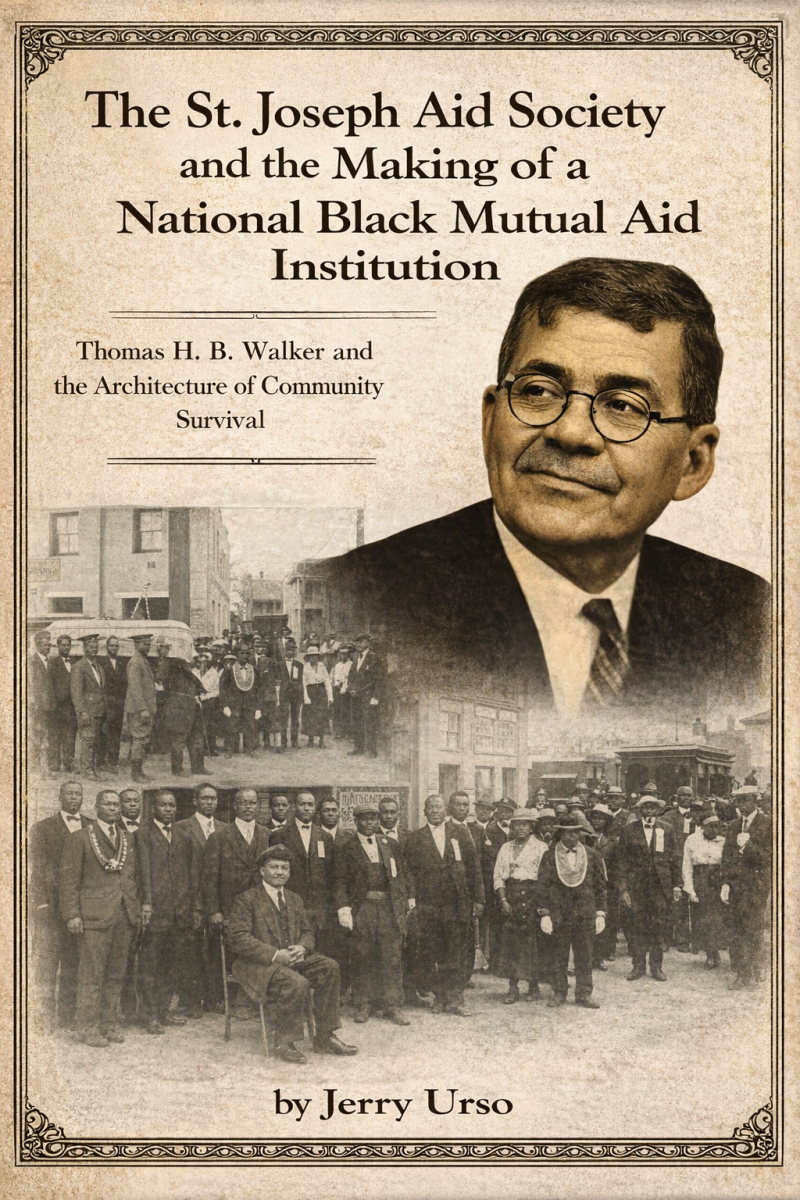
The St. Joseph Aid Society and the Making of a National Black Mutual Aid Institution
Thomas H. B. Walker and the Architecture of Community Survival
Introduction: Building Protection in an Unprotected World
At the turn of the twentieth century, African Americans confronted a social order designed to deny them security. Jim Crow segregation restricted access to public services, white-controlled insurance companies routinely excluded Black clients, and racial violence made illness or death not merely personal tragedies but economic catastrophes. In this environment, African American communities did not wait for relief. They organized it themselves [1].
Mutual aid societies emerged as one of the most important survival strategies of the era. These institutions provided sickness benefits, burial insurance, funeral rites, and financial assistance at moments of crisis. They also cultivated discipline, collective responsibility, and institutional trust. Among the most ambitious and successful of these organizations was the St. Joseph Aid Society, a Black-led fraternal and benevolent institution that developed from a Southern initiative into a national system spanning multiple regions of the United States [2].
At its height in the early 1920s, contemporary reporting identified the St. Joseph Aid Society as having more than 100,000 members nationwide, supported by substantial cash reserves and a structured hierarchy of officers and lodges [3]. This scale places the Society among the largest African American mutual aid institutions of its time.
Practical Christianity and Institutional Vision
The guiding force behind the St. Joseph Aid Society was Thomas H. B. Walker, a clergyman, novelist, and organizational architect whose leadership blended religious authority with economic strategy. Walker believed that Christianity demanded practical expression. Faith, in his view, was incomplete if it did not shield families from sickness, poverty, and death [4].
Walker articulated this philosophy not only from the pulpit but also through literature. His 1913 novel Bebbly, or the Victorious Preacher emphasized moral discipline, self-help, and communal responsibility—principles that became foundational to the Society’s governance [5]. Members were expected to pay dues regularly, attend meetings, and uphold standards of conduct. Benefits were not acts of charity; they were earned through participation in a collective covenant.
By the 1920s, Walker served as Supreme Chief of the St. Joseph Aid Society, presiding over a national hierarchy that included state-level Grand Chiefs, subordinate lodges, and auxiliary bodies [6]. His leadership style reflected a belief in centralized standards combined with local administration—a model that allowed the Society to expand without losing cohesion.
Walker’s wife, Rosa G. Holmes Walker, was also active in Jacksonville’s civic and fraternal life, reflecting the family-centered nature of many Black mutual aid institutions. Governance was not isolated from community life; it was embedded within it [7].
Florida: The Foundational State and Administrative Heart
Florida, and particularly Jacksonville, was the birthplace and enduring center of the St. Joseph Aid Society. Jacksonville’s African American population had grown rapidly after the Civil War, producing strong churches, newspapers, fraternal orders, and commercial districts. It was within this environment that the Society took root in the late nineteenth century, with national reporting later confirming 1896 as its founding year [8].
By the first decade of the twentieth century, Jacksonville newspapers regularly reported on St. Joseph Aid Society meetings, lodge events, and public activities. These notices document a mature organization with officers, committees, and ritual practice already in place by 1906 [9]. The Society’s primary functions in Florida were sick relief and burial insurance, services of critical importance in a segregated health system that routinely denied African Americans adequate care.
One of the most significant markers of the Society’s strength was its accumulation of real estate. According to Walker’s own historical account, the St. Joseph Aid Society owned an entire city block at Broad Street and State Street in Jacksonville, a central corridor of Black commerce [10]. Ownership of this property provided meeting space, offices, rental income, and, most importantly, permanence.
Florida also served as the Society’s administrative command center. Charters for subordinate lodges were issued from Jacksonville, ritual standards were set there, and correspondence flowed constantly between Supreme leadership and distant lodges. Even as the Society expanded northward, Florida remained its symbolic and operational heart [11].
Georgia: Southern Expansion and the Church Corridor
Georgia represented the St. Joseph Aid Society’s first sustained expansion beyond Florida. Savannah, with its large Black population rooted in churches, skilled labor, and port employment, provided fertile ground for the Society’s model [12].
Savannah lodges closely mirrored those in Jacksonville. Clergymen frequently served as officers, reinforcing Walker’s belief that religious authority could discipline economic behavior. Meetings were often held in church-adjacent spaces, and recruitment flowed through congregational networks [13].
Georgia lodges emphasized collective responsibility. Members were reminded that dues were obligations to one another, not merely payments for individual benefit. This ethic proved particularly attractive to workers whose incomes fluctuated and to migrants preparing for movement northward. The Society functioned as a portable safety net, allowing members to maintain institutional protection even as they crossed state lines [14].
Georgia thus became a transitional state, linking the Society’s Southern origins to its emerging Midwestern and Northern presence. Through Georgia, the St. Joseph Aid Society refined its methods of expansion and tested its ability to operate beyond its founding region.
The St. Joseph Aid Society and the Making of a National Black Mutual Aid Institution
Indiana: Burial, Ritual, and the Discipline of Respectability
Indiana represents one of the clearest windows into the daily operational seriousness of the St. Joseph Aid Society. By 1913, lodges in Evansville were sufficiently established to issue formal “Resolutions on Death,” which were printed in mainstream newspapers and signed by officers acting in an official corporate capacity [12].
These resolutions were not ceremonial excess. They were public declarations that the Society had fulfilled its contractual obligation to a deceased member. The language was formal, measured, and dignified, emphasizing duty, honor, and collective responsibility. In a society that routinely denied African Americans public respect, such declarations functioned as assertions of humanity and institutional legitimacy.
Indiana lodges reveal the Society at its most ritually disciplined. Funerals followed prescribed formats, officers appeared in regalia, and processions were organized with precision. These public rituals reinforced the idea that membership in the Society guaranteed dignity in death—an outcome of immense importance in Black communities facing exclusion from white cemeteries, funeral homes, and insurers.
Administratively, Indiana lodges demonstrate the Society’s maturity. Officers kept records, communicated with Supreme leadership, and ensured that dues and benefits were reconciled properly. The consistency of these practices across distance suggests a standardized system rather than improvisation. Members trusted the Society because it behaved predictably, even far from its Florida base [11].
Indiana also illustrates the Society’s ability to follow migration. African Americans moving north retained institutional protection rather than losing it. This continuity explains the Society’s durability during the Great Migration and its appeal to working families seeking stability amid constant movement.
Kentucky: Philanthropy, Women’s Labor, and Institutional Expansion
Kentucky, particularly Lexington, reveals a different dimension of the St. Joseph Aid Society’s evolution. Here, the Society moved beyond its foundational role as a burial and sickness insurer and increasingly engaged in institutional philanthropy. Newspaper coverage from the 1920s documents chapel campaigns, hospital fundraising efforts, and organized appeals conducted under the Society’s auspices [13].
These activities indicate a broadening vision. Burial insurance addressed immediate crises, but health institutions addressed long-term vulnerability. Hospitals and chapels symbolized permanence, care, and intergenerational investment. In Kentucky, the Society positioned itself not merely as a safety net, but as a builder of community infrastructure.
Women’s auxiliaries were central to this work. Although often unnamed in headlines, women organized benefits, coordinated logistics, visited the sick, and ensured funerals were carried out properly. Their labor was constant, skilled, and largely uncompensated. Without it, the Society’s insurance promises would have been impossible to sustain [13].
Kentucky lodges thus reveal the Society as a family-centered institution. While men frequently held titled offices, women stabilized the organization during periods of economic stress, illness, and male migration. Their work transformed abstract ideals of sympathy and universal kinship into lived practice.
Kentucky also demonstrates adaptability. The Society did not impose a rigid model but adjusted to local needs while maintaining core principles. This flexibility allowed it to expand without fragmenting.
Illinois: Chicago and the Test of National Power
Chicago was the ultimate proving ground for the St. Joseph Aid Society. By the 1910s, Chicago had become one of the largest Black cities in the United States, shaped by the Great Migration and crowded with fraternal orders, churches, political clubs, and mutual aid societies. To survive in this environment required scale, discipline, and credibility.
Coverage in both the Chicago Tribune and the Chicago Defender places the Society squarely within this competitive institutional ecosystem [14][15]. Lodges held meetings, sponsored events, and maintained visibility alongside Prince Hall Masonry, the Odd Fellows, and the Knights of Pythias. The Society was not marginal; it was one of the recognized pillars of Black associational life.
Chicago forced the Society to operate at full institutional capacity. Large memberships required efficient administration. Diverse migrant populations required flexibility. Public scrutiny demanded accountability. The Society met these challenges by emphasizing its strengths: reliable burial benefits, disciplined ritual life, and transferable membership across state lines.
Chicago also served as a convention city. Regional gatherings allowed officers to coordinate strategy, reaffirm loyalty to Supreme leadership, and standardize practices. These meetings reinforced national identity and prevented local lodges from drifting into autonomy.
In Chicago, the Society proved it could function not just as a regional organization, but as a national institution capable of surviving in the most demanding environment Black America had to offer [16].
Migration, Membership, and the Road to 100,000
Indiana, Kentucky, and Illinois together reveal how the St. Joseph Aid Society grew toward its peak membership of over 100,000 individuals. Migration did not weaken the Society; it strengthened it. Each move north expanded the pool of potential members while reinforcing the Society’s relevance.
The Society’s success lay in its ability to convert migration into institutional continuity. Members moving from Jacksonville to Savannah, from Savannah to Evansville, or from Evansville to Chicago did not abandon protection. They carried it with them. This portability distinguished the Society from purely local benevolent clubs and positioned it as a national system of care.
By the early 1920s, when national newspapers reported the Society’s scale and financial reserves, that achievement rested on decades of disciplined expansion across precisely these states. The Society did not grow overnight. It grew lodge by lodge, funeral by funeral, family by family.
New York and Brooklyn: National Visibility and Institutional Confidence
New York represented the moment when the St. Joseph Aid Society moved from regional strength to national recognition. Activity in Brooklyn and New York City placed the Society within the most scrutinized Black public sphere in the United States. Early coverage in the Brooklyn Eagle confirms lodge activity and charitable engagement as early as 1912, indicating that the Society’s northern reach preceded the peak years of the Great Migration [16].
New York was not simply another expansion city. It was a proving ground where legitimacy mattered. Black institutions in New York operated under intense observation from journalists, reformers, and competing organizations. For the St. Joseph Aid Society to function openly in this environment required confidence in its governance, finances, and reputation.
That confidence was publicly affirmed in 1921, when The New York Age reported that the Society was founded in 1896, had exceeded 100,000 members nationwide, and maintained $50,000 in active cash reserves [3]. Such disclosure was rare. Few Black-led institutions of the era were willing to publish membership totals and financial figures so plainly.
This moment marked the Society’s arrival as a national economic actor. The reporting confirmed not only size but durability. An organization that had survived for more than two decades, expanded across multiple regions, and accumulated substantial reserves had demonstrated institutional maturity. New York recognition did not create the Society’s stature, but it publicly validated it.
Michigan: Executive Leadership and Federal-Style Governance
Michigan’s significance lies less in expansion and more in governance. Organizational publications identify Dr. Holton as Grand Chief of Michigan, confirming the Society’s adoption of a federal-style structure in which state-level leadership operated under the authority of the Supreme Chief [17].
This model was essential for managing scale. As membership grew into the tens of thousands, centralized control alone became impractical. State Grand Chiefs coordinated lodge activity, enforced ritual standards, reconciled dues, and reported upward. This structure balanced local autonomy with national cohesion.
Michigan’s leadership demonstrates that the Society was preparing—consciously or not—for leadership transition. By distributing authority, the Society reduced dependence on any single individual, including its founder. This capacity for succession planning distinguishes mature institutions from charismatic movements.
Michigan lodges also helped coordinate northern operations, linking Chicago, Indiana, and New York within a coherent administrative framework. The Society was no longer simply expanding; it was governing at scale.
Supreme Leadership and Administrative Discipline
At the center of this national system stood Thomas H. B. Walker, whose role as Supreme Chief combined moral authority with executive oversight. Walker’s leadership was not ceremonial. He presided over chartering decisions, ritual standardization, and organizational direction, as reflected in contemporary accounts and his own historical writing [6][10].
Walker’s philosophy of practical Christianity shaped the Society’s administrative culture. Members were expected to be punctual, disciplined, and accountable. Officers were held to standards of conduct and recordkeeping. Benefits were distributed according to rules, not favoritism.
This discipline was essential to sustaining trust among a membership base that included working-class families, migrants, widows, and the elderly. The Society functioned because members believed—based on repeated experience—that it would honor its obligations. That belief was reinforced through ritual, transparency, and consistent practice.
Walker’s leadership style also reflected an understanding of scale. As the Society grew, he supported the development of intermediate leadership rather than attempting to control every lodge directly. This balance between central authority and distributed administration allowed the Society to function across state lines without fracturing.
Ritual, Identity, and the Meaning of Belonging
Across every state, ritual served as the connective tissue of the St. Joseph Aid Society. Degree systems, regalia, oaths, and formal language transformed financial participation into moral commitment. Members did not merely pay dues; they entered a covenant rooted in sympathy and universal kinship.
Ritual instruction emphasized loyalty, secrecy, and mutual responsibility. These values reinforced insurance compliance by framing economic participation as ethical duty. To neglect dues was not merely to risk benefits; it was to violate communal trust.
Ritual also structured death. Funerals followed prescribed formats, officers appeared in official capacity, and memorial resolutions were issued publicly. These practices ensured dignity and consistency regardless of location. A member buried in Indiana or New York received the same institutional recognition as one buried in Florida.
This predictability mattered deeply. In a society that routinely denied African Americans dignified treatment in life and death, ritual continuity provided psychological security. The Society guaranteed not only burial expenses, but recognition, memory, and respect.
The Society at Its Height: One Hundred Thousand Members
By the early 1920s, the St. Joseph Aid Society stood at the height of its influence. With over 100,000 members, documented activity in Florida, Georgia, Indiana, Kentucky, Illinois, New York, and Michigan, and substantial financial reserves, it functioned as a national Black welfare system before the existence of federal social insurance [3].
This scale was the product of decades of disciplined growth. The Society expanded along migration routes, anchored itself in churches, standardized its rituals, and maintained administrative control. It converted movement into stability and diversity into cohesion.
At its height, the Society was not marginal. It operated alongside the most powerful Black fraternal orders of the era and addressed needs that neither the state nor the market would meet. It insured the sick, buried the dead, supported institutions, and taught economic discipline to thousands of families.
The St. Joseph Aid Society demonstrates that African Americans did not merely endure Jim Crow America; they built parallel systems capable of sustaining life with dignity.
Citations / References
[1] Woodson, Carter G. The History of the Negro Church. Washington, D.C.: Associated Publishers, 1921.
[2] Walker, Juliet E. K. The History of Black Business in America: Capitalism, Race, Entrepreneurship. New York: Twayne Publishers, 1998.
[3] The New York Age (New York, NY), September 3, 1921. Article reporting on the St. Joseph Aid Society’s founding date (1896), national membership exceeding 100,000, and reported cash reserves of approximately $50,000.
[4] Walker, Thomas H. B. Organizational philosophy and leadership references cited in the National Negro Blue Book, North Florida Edition, 1926.
[5] Walker, Thomas H. B. Bebbly, or the Victorious Preacher. Jacksonville, Florida, 1913.
[6] National Negro Blue Book. North Florida Edition. Jacksonville, Florida, 1926. Section: “The Story of the Negro in Jacksonville: From the Pioneer Days to the Present,” by Thomas H. B. Walker.
[7] Ibid. References to Rosa G. Holmes Walker and Jacksonville civic and fraternal leadership.
[8] Jacksonville Journal (Jacksonville, FL), February–June 1906. Notices documenting St. Joseph Aid Society lodge meetings, officers, and public activities.
[9] Jacksonville Journal (Jacksonville, FL), September 1912; August 1919. Continued coverage of St. Joseph Aid Society operations and events.
[10] Walker, Thomas H. B. “The Story of the Negro in Jacksonville: From the Pioneer Days to the Present.” In National Negro Blue Book, North Florida Edition, 1926.
[11] Chicago Defender (Chicago, IL), Savannah, Georgia coverage, 1910s–1920s. Reports on St. Joseph Aid Society lodge activity and regional expansion.
[12] Evansville Journal (Evansville, IN), April 9, 1913. “Resolutions on Death” issued by the St. Joseph Aid Society.
[13] Lexington Herald-Leader (Lexington, KY), February 6 and July 31, 1927. Coverage of St. Joseph Aid Society chapel and hospital fundraising campaigns.
[14] Chicago Tribune (Chicago, IL), November 5, 1916. Reference to St. Joseph Aid Society meetings and activities.
[15] Chicago Defender (Chicago, IL), October 10, 1931. Coverage of St. Joseph Aid Society lodges, auxiliaries, and community programs.
[16] Brooklyn Eagle (Brooklyn, NY), April 13, 1912. Early reference to St. Joseph Aid Society charitable and lodge activity.
[17] St. Joseph Aid Society organizational publication, circa 1922. Reference identifying Dr. Holton as Grand Chief of Michigan.
[18] Skocpol, Theda. Protecting Soldiers and Mothers: The Political Origins of Social Policy in the United States. Cambridge, MA: Harvard University Press, 1992.
[19] Frazier, E. Franklin. The Negro Family in the United States. Chicago: University of Chicago Press, 1939.
[20] Contemporary analyses of fraternal benefit societies and mutual insurance systems in early twentieth-century America, including insurance trade literature.
[21] Contextual reference to the Social Security Act of 1935 and its impact on fraternal and mutual aid organizations.
