
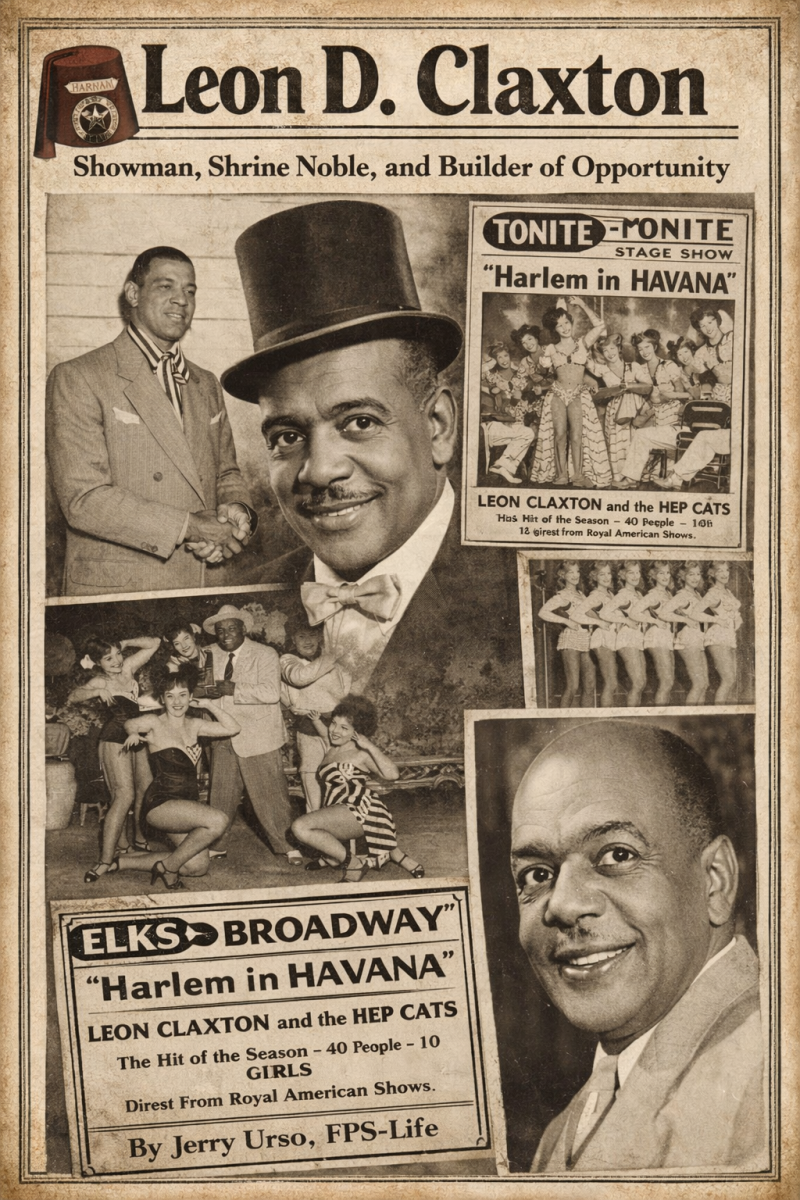
Leon D. Claxton: Showman, Shrine Noble, and Builder of Opportunity
By Jerry Urso, FPS-Life, Grand Historian, Most Worshipful Union Grand Lodge of Florida, PHA
Prelude: A Builder in the Spotlight
When the curtains lifted on Harlem in Havana, the crowd rose to its feet. The spectacle was dazzling—dancers, jazz bands, Afro-Cuban rhythms—but the true marvel was the man who built it: Leon Dunkins Claxton, an African American showman, entrepreneur, and Prince Hall Mason whose imagination helped reshape entertainment during segregation.[1][2]
Claxton’s life was more than applause and spectacle. He was a builder—of opportunity, of dignity, and of community. Every stage he raised and every performance he produced was an act of uplift, offering Black artists and audiences a reflection of their own excellence.
Early Life and Apprenticeship in the Arts
Leon D. Claxton was born April 5, 1902, in Memphis, Tennessee, to Overton “O.C.” Claxton, a drummer who once played with W.C. Handy, the “Father of the Blues.”[9] Surrounded by rhythm and movement, young Leon developed an early fascination with performance.
At age twelve, he joined the Ringling Bros. and Barnum & Bailey Circus as a water boy for the elephants. Before long, he became a contortionist and sideshow performer, mastering the stagecraft of timing, precision, and audience connection.[1]
By his teens, Claxton was touring in vaudeville, where he learned to produce and manage acts. These experiences gave him a unique combination of artistic vision and business skill—qualities that would later define his career as a producer.[9]
From Performer to Producer
In 1934, Claxton produced the Cotton Club Showboat for Chicago’s Century of Progress World’s Fair, featuring an all-Black cast during an era of strict segregation.[1] His success led him to join the Royal American Shows, one of North America’s largest traveling carnivals.
By 1936, he launched his signature production that would eventually be titled Harlem in Havana— a vibrant revue blending Black American jazz, Latin rhythms, and variety theater.[1][2] Touring for nearly thirty years across the United States and Canada, it became one of the most successful Black-produced traveling shows in history.
Harlem in Havana employed hundreds of Black and Afro-Cuban performers, offering steady work, fair pay, and exposure in a segregated industry.[2][4] For many, Claxton’s stage was a gateway to larger careers in music, comedy, and dance. His revue became an ambassador of African American artistry—cosmopolitan, proud, and irresistible.
A Florida Lineage of Genius
Claxton’s creative spirit drew from the same current that produced Florida’s Black artistic pioneers—Pat Chappelle, the Jacksonville impresario who founded The Rabbit’s Foot Company; James Weldon Johnson and John Rosamond Johnson, composers of “Lift Every Voice and Sing”; Zora Neale Hurston, whose writings captured the soul of the South; and Carrie Law Morgan Figgs, whose plays elevated education and womanhood.[10][11]
Although there is no evidence that Claxton met these figures, his work continued their legacy—using performance as a platform for cultural pride and social progress. He transformed the carnival stage into a space where Black performers could shine on their own terms, extending Florida’s lineage of artistic excellence across the continent.
Tampa’s Renaissance Man
By the 1940s, Claxton had established Tampa, Florida, as his home and headquarters.[3] From there, his Harlem in Havana tours launched each year, while his business ventures strengthened the local economy.
In 1965, he opened Claxton Manor on Cypress Street in West Tampa—a modern, Black-owned hotel that offered elegant accommodations to traveling entertainers, athletes, and Masonic dignitaries during segregation.[3][5] Guests included Duke Ellington, Dinah Washington, and Nat King Cole, among others who found comfort and dignity at Claxton’s establishment.[3][7]
In recognition of his contributions to civic life and business development, Claxton was named Tampa’s Citizen of the Year in 1959—an honor rare for a Black entrepreneur of his era.[3][7][9]
A Prince Hall Mason and Shrine Noble
Brother Claxton was an active member of Hillsborough Lodge No. 242, under the Most Worshipful Union Grand Lodge of Florida, F.&A.M., Prince Hall Affiliation, and a Noble of Harem Temple No. 23, Ancient Egyptian Arabic Order Nobles of the Mystic Shrine (PHA).[5][6]
His Masonic life reflected the same purpose as his art—service to others. He supported youth initiatives, donated to hospital charities, and hosted traveling Brothers at Claxton Manor, ensuring they found fraternity and welcome.[5][6]
Claxton also stood in the proud tradition of African American cultural entrepreneurs such as Pat Chappelle, who merged entertainment, education, and self-determination. Like Chappelle, Claxton proved that leadership and enterprise could coexist with artistry—that a show could be both commerce and community.[11]
Home (Tampa Residence & Winter Quarters)
Leon D. Claxton’s Tampa home served as the quiet command center of his enterprise. From this residence, he coordinated bookings, travel logistics, and seasonal staffing for Harlem in Havana. It doubled as a winter-quarters hub where trusted performers and crew met, planned, and auditioned, and where Claxton extended private hospitality to visiting artists, civic leaders, and fraternal brothers.[1][2][3]
Why it mattered in the Jim Crow era: Hotels and public venues often denied access or imposed humiliating conditions on Black professionals. A private home base allowed Claxton to plan tours, manage payroll, and negotiate contracts with privacy and dignity; it anchored his company in Tampa’s Black civic life, fostering mentorship and mutual aid when mainstream institutions shut Black artists out.[2][3]
Claxton Manor Motel (West Tampa)
Opened in 1965 on Cypress Street, Claxton Manor was more than a modern, Black-owned motel—it was a statement. During segregation, when Black entertainers and travelers were routinely denied lodging or steered to substandard facilities, Claxton Manor offered first-class accommodations and professional courtesy. Its lobby and dining room became a living salon of culture, business, and brotherhood; its rooms, a reliable refuge between engagements for touring musicians, athletes, entrepreneurs, and Masonic visitors.[3][5][7]
Why it mattered in the Jim Crow era: The Manor guaranteed clean, safe, and respectful lodging amid widespread discrimination; it provided operational stability for a traveling revue; it circulated revenue through a Black-owned business; and it functioned like a Green-Book-era safe harbor where information on friendly venues and safe routes could be exchanged—often reinforced by fraternal ties through Prince Hall lodges and the Shrine.[2][3][5]
A Builder of Light
Claxton’s life was a testament to Masonic virtue applied in the world beyond the lodge. He provided opportunities for others, employed talent that segregation excluded, and used his success to empower his race.
When he passed on November 14, 1967, the lights of his stage dimmed, but the brightness of his example endured. Tampa lost a businessman and benefactor; American culture lost a visionary who had built his own door to the stage and invited others to walk through it.[1][2][3][5]
Legacy and Commemoration
Today, Claxton’s story is preserved in the documentary JIG SHOW: Leon Claxton’s Harlem in Havana, produced by his granddaughter Leslie Cunningham, completed and released as an eight-part docuseries (2025) available publicly online.[2] The series follows Claxton’s journey from Memphis and Chicago to Tampa, exploring his role as a producer, mentor, and community leader—making his life accessible to new generations of artists and scholars.
He was also recently celebrated through an exhibition, Brown Skin Showgirls: The Leon Claxton Revue, 1930s–1960s, at the Burlesque Hall of Fame in Las Vegas in early 2025.[4]
Leon D. Claxton stands as both artist and architect—a man who built light where there was none, who turned a tent into a temple, and whose name remains etched in the cultural and fraternal history of Florida.
Navigating Jim Crow, Claxton built a protective infrastructure around his art. Through careful routing, trusted venue relationships, and Green‑Book‑style waypoints—including Black‑owned hotels like his own—he kept performers safe while sustaining integrated audiences where possible. Fraternal ties and community partners provided the soft power to negotiate fair treatment on the road, turning a precarious itinerary into a repeatable circuit.[2][3][7] In doing so, Claxton helped define a modern pipeline for Black entertainment: training and steady employment for artists; a touring model that fused Black American jazz with Afro‑Cuban rhythms; and a brand that proved excellence could flourish even within segregation’s limits—leaving an imprint that later stages, festivals, and revues would emulate.[2][4]
Sources
- Harlem in Havana Project, Leslie Cunningham, Producer.
- JIG SHOW | Leon Claxton’s Harlem in Havana, ITVS Documentary / 8-Part Docuseries, 2021–2025 (official website & YouTube channel).
- 'Leon Claxton, Tampa’s Black Variety Show Producer Is Featured in New Documentary,' Tampa Bay Times, February 24, 2022.
- Brown Skin Showgirls Exhibition: The Leon Claxton Revue, 1930s–1960s, Burlesque Hall of Fame, Las Vegas (early 2025).
- Proceedings, Most Worshipful Union Grand Lodge of Florida, F.&A.M., PHA—Hillsborough Lodge No. 242 (Tampa), 1940s–1960s archives.
- Harem Temple No. 23 (A.E.A.O.N.M.S., PHA), Tampa Shrine Records, 1950–1967.
- The Florida Sentinel Bulletin (Tampa), civic archives and obituaries, 1959–1967.
- Encyclopedia of African American Business Leaders and Entrepreneurs, Greenwood Press, 2003.
- Trav S.D., 'Leon Claxton: The Showman of Chicago and Tampa,' Travalanche (blog), April 5, 2023.
- The Works of James Weldon Johnson, Paul Laurence Dunbar, Zora Neale Hurston, and Carrie Law Morgan Figgs (Florida Literary Archives).
- The Rabbit’s Foot Company Records, Jacksonville, Florida—Pat Chappelle Collection, State Archives of Florida.
