
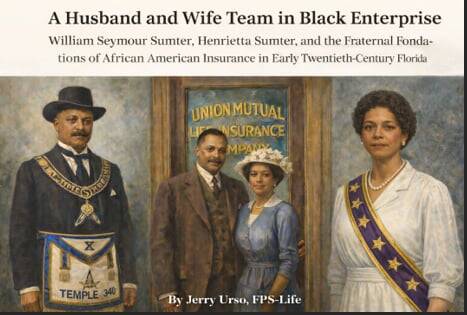
African American Insurance and Mutual Aid in the Early 1900s
By Jerry Urso FPS-Life
African American insurance companies did not emerge fully formed as corporations. They evolved from a much older culture of mutual responsibility. Long before incorporation papers and state licenses, Black communities relied on collective systems to ensure dignified burial, emergency medical assistance, and support for widows and orphans. These systems were organized through churches, fraternal orders, and neighborhood associations and were governed by trust rather than profit [3].
As state regulation expanded in the late nineteenth and early twentieth centuries, many of these informal systems reorganized into licensed insurance companies capable of operating across cities and counties. This transition marked one of the most important developments in African American economic history. Black insurance companies provided not only protection for families, but also employment, managerial training, and opportunities for Black leadership in finance at a time when such opportunities were otherwise closed [4].
Jacksonville emerged as one of Florida’s most important centers for this transformation. Its Black business district, churches, newspapers, and fraternal lodges formed an ecosystem capable of sustaining complex institutions. The Jacksonville Journal regularly reported on African American insurance firms and aid societies, documenting meetings, officers, benefits, and community engagement throughout the 1900s and 1910s [5].
William Seymour Sumter: Mutual Aid, Insurance, and Masonry
Born in South Carolina in 1873, William Seymour Sumter was living in Jacksonville by the early 1900s and working in the insurance field by at least the first decade of the century. The 1910 U.S. Census records him as an insurance agent, head of household, property owner, and employer of a domestic servant—markers of stability and respectability within Jacksonville’s Black middle class [6].
By 1908 and 1911, newspaper notices identify Sumter as a central figure in the Union Mutual Aid Association of America, serving as its president and general manager. These notices are critical because they demonstrate that Sumter’s work began not with corporate insurance, but with community-based mutual aid. Union Mutual Aid was a functioning institution providing burial and sickness benefits, operated from Jacksonville offices and sustained by the confidence of its members rather than speculative capital [7][8].
As the decade progressed, Union Mutual Aid did not disappear. Instead, it existed alongside the expanding Union Mutual Insurance Company, reflecting a common African American institutional strategy of the era: preserving mutual aid traditions while building regulated insurance structures capable of broader reach and permanence [8].
William Seymour Sumter served as president and one of the founders of Union Mutual Insurance Company, which contemporary advertisements described as one of the fastest-growing Black-owned insurance firms in Florida. These advertisements emphasized prompt payment of claims, liberal policies, and ethical administration—assurances directed toward communities that could not afford institutional failure [2][9].
Sumter’s authority extended beyond business. Lodge records confirm his membership as a Prince Hall Master Mason of Temple Lodge No. 340, under the Most Worshipful Union Grand Lodge of Florida [10]. In Black Florida, such affiliation mattered profoundly. Prince Hall lodges were training grounds for leadership, systems of moral accountability, and networks of trust. Insurance led by a Mason carried the weight of fraternal obligation.
Family Partnership and Shared Institutional Labor
William Seymour Sumter did not build alone. His marriage to Henrietta Sumter, solemnized in the mid-1890s, formed the backbone of a family-centered enterprise [6]. Together they raised children, managed property, and lived within the same social and fraternal world that sustained Black insurance and mutual aid in Jacksonville.
Henrietta Sumter’s later leadership did not arise suddenly in 1918. Newspaper references prior to her husband’s death place her within Jacksonville’s civic and fraternal circles, including Eastern Star–connected community life documented in the Jacksonville Journal’s “Among Colored People in the City and State” columns [5][11]. Like many African American women of the era, her labor was largely invisible in formal records until circumstances demanded that it become visible.
Illness, Death, and Institutional Crisis
By 1918, William Seymour Sumter had endured months of serious illness. On August 28, 1918, the Jacksonville Journal reported his death, describing him as a well-known businessman, founder, and president of Union Mutual Insurance Company [12]. His Florida death certificate lists cardiac dilatation as the primary cause of death, with chronic nephritis as a contributing condition, confirming a prolonged medical decline rather than sudden catastrophe [13].
For many Black enterprises of the era, the death of a founder meant collapse. Insurance companies were especially vulnerable, dependent as they were on trust, continuity, and personal reputation. Union Mutual faced this moment of reckoning in 1918.
Henrietta Sumter: A Woman at the Helm
What followed was extraordinary. Newspaper advertisements and corporate notices from 1919 onward identify Mrs. W. S. Sumter (Henrietta Sumter) as President of Union Mutual Insurance Company [14]. This was not honorary language. It was executive authority, printed plainly in public advertisements listing her alongside officers and managers.
In the early twentieth century, very few women in the United States—Black or white—held such positions in the insurance industry. For an African American woman in segregated Florida, it was exceptional. Henrietta Sumter’s leadership ensured continuity at a moment when policyholders might easily have lost confidence in the institution [14][15].
Her authority was reinforced through fraternal life. Henrietta Sumter was a member of Bethlehem Grand Chapter, Order of the Eastern Star, an organization deeply intertwined with Prince Hall Masonry and central to Black institutional continuity. Eastern Star chapters provided organizational discipline, moral authority, and stability for families connected to fraternal leadership [5].
Henrietta Sumter and African American Women Entrepreneurs
To fully appreciate Henrietta Sumter’s significance, she must be placed within the broader history of African American women’s entrepreneurship in the early twentieth century. This was a period in which Black women were routinely excluded from formal economic power, denied access to capital, and constrained by both racial segregation and rigid gender expectations. Yet despite these barriers, African American women built businesses that reshaped Black economic life.
Most Black women entrepreneurs of the era found opportunity in sectors considered extensions of domestic labor, such as hair care, dressmaking, boarding houses, and food service. Figures like Madam C. J. Walker and Annie Turnbo Malone built national enterprises in beauty culture. What distinguishes Henrietta Sumter from many of her contemporaries is the sector in which she exercised authority.
Insurance was among the most complex and heavily regulated industries of the era. It required administrative rigor, financial discipline, and sustained public trust. Even white women rarely held executive roles in insurance during this period. For an African American woman in segregated Florida to assume the presidency of an insurance company was extraordinary.
Henrietta Sumter’s leadership therefore places her within a far smaller category than most early Black women entrepreneurs. She was not operating on the margins of the economy, but at its institutional core. As president of Union Mutual Insurance Company, she bore responsibility for safeguarding the financial futures of thousands of Black families. Her authority was public, sustained, and unambiguous.
Mutual Aid and Insurance as a Unified Vision
The historical record makes clear that Union Mutual Aid Association and Union Mutual Insurance Company were not competing enterprises, but expressions of a single vision. Mutual aid remained a living practice even as insurance became formalized. Officers, agents, and community leaders moved between the two, reinforcing trust and shared purpose [7][8].
This dual structure reflects a broader pattern in African American economic history. Black insurance companies did not abandon mutual aid; they institutionalized it [3][4].
Conclusion: Fraternity, Family, and Financial Dignity
The story of William Seymour Sumter and Henrietta Sumter is ultimately a story of continuity. It is about how African American families transformed necessity into institution, how fraternity reinforced trust, and how women stepped into authority when history demanded it.
As a Prince Hall Mason of Temple Lodge No. 340, William Seymour Sumter anchored Black insurance within Jacksonville’s fraternal world [10]. As a member of Bethlehem Grand Chapter, Order of the Eastern Star, Henrietta Sumter ensured that the institution survived loss and uncertainty [5]. Together, they built an enterprise that reflected Black values, protected Black families, and endured beyond the life of its founder.
In an era when African Americans were denied financial dignity, the Sumters helped create it—policy by policy, lodge by lodge, and family by family.
References
[1] Jacksonville Journal, coverage of Union Mutual Insurance Company and Union Mutual Aid Association, 1908–1920.
[2] Jacksonville Journal, Dec. 22, 1919, p. 13, “Union Mutual—A Big Success.”
[3] W. E. B. Du Bois, Economic Co-operation Among Negro Americans (Atlanta University, 1907).
[4] Robert E. Weems Jr., Black Business in the Black Metropolis (Indiana University Press, 1996).
[5] Jacksonville Journal, “Among Colored People in the City and State,” multiple issues, 1908–1916.
[6] 1910 U.S. Census, Jacksonville Ward 7, Duval County, Florida, household of William Sumter.
[7] Jacksonville Journal, Aug. 2, 1911, Union Mutual Aid Association notice.
[8] Jacksonville Journal, June 18, 1908, references to Union Mutual Aid and insurance activity.
[9] Jacksonville Journal, advertisements for Union Mutual Insurance Company, 1916–1919.
[10] Temple Lodge No. 340 roster, Most Worshipful Union Grand Lodge of Florida, Prince Hall Affiliated.
[11] Jacksonville Journal, civic and fraternal references to Henrietta Sumter, pre-1918.
[12] Jacksonville Journal, Aug. 28, 1918, p. 9, “W. S. Sumter Dead.”
[13] Florida State Board of Health, Certificate of Death for William S. Sumter, Aug. 28, 1918.
[14] Jacksonville Journal, Nov. 29, 1919, advertisement listing Mrs. W. S. Sumter as President.
[15] Jacksonville Journal, Feb. 2, 1920, Union Mutual Insurance Company notices.
