
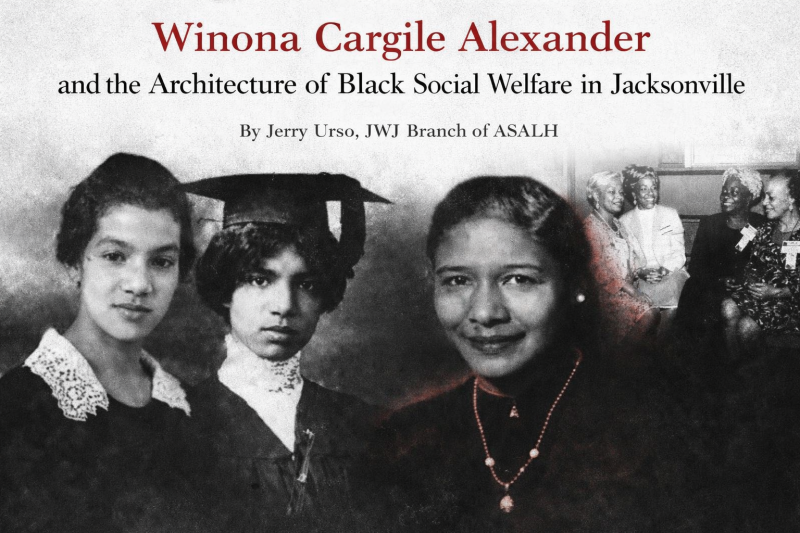
Winona Cargile Alexander and the Architecture of Black Social Welfare in Jacksonville
By Jerry Urso
Sacred Origins and Institutional Formation
Winona Cargile Alexander was born June twenty one eighteen ninety three in Columbus Georgia in the parsonage of Saint John African Methodist Episcopal Church [1]. Her birth within a church residence was not incidental. In the late nineteenth and early twentieth centuries the Black parsonage functioned as an institutional headquarters where religious authority education political organizing and welfare coordination converged [2].
Her father Reverend Charles H Cargile served as pastor of Saint John AME Church and was educated at Howard University preparing him for leadership within the national AME structure [3]. Her mother Sarah Frances Fannie Sloan Cargile represented the tradition of Black women whose authority operated through church governance education and community service rather than formal political office [1]. Raised as the second of four daughters Alexander grew up in an environment where service was not framed as charity but as obligation.
This upbringing shaped her lifelong understanding that Black survival depended upon institutions rather than individuals. Churches schools and welfare organizations were not supplemental to Black life. They were its foundation.
Education and Early Leadership Development
The Cargile family later relocated to Macon Georgia where Winona attended Ballard Normal High School a private college preparatory institution established for African American students during the Jim Crow era [4]. Ballard Normal existed precisely because public education for Black students was underfunded and intentionally restricted. Schools like Ballard trained students not only academically but institutionally preparing them for leadership roles within segregated society.
Alexander distinguished herself academically graduating as salutatorian in nineteen ten [1]. Contemporary accounts identify her as disciplined articulate and civically engaged traits that would later define her professional career.
In the fall of nineteen ten she entered Howard University in Washington District of Columbia joining a national Black intellectual network that trained ministers teachers lawyers physicians and administrators [5]. While at Howard she held leadership roles across campus organizations including vice president of her class and membership in literary academic and civic groups [1]. These activities reflect early preparation for organizational leadership rather than purely personal advancement.
Founding Delta Sigma Theta and the Logic of Service
In January nineteen thirteen while still an undergraduate Alexander became one of the twenty two founders of Delta Sigma Theta Sorority Incorporated at Howard University [6]. The founding of Delta Sigma Theta represented a deliberate institutional intervention by educated Black women who sought to formalize public service scholarship and civic engagement.
The organization was not conceived as a social ornament. Its founders emphasized structured service public reform and professional responsibility at a time when Black women were excluded from most formal power structures [6]. Alexander’s participation in the founding of Delta Sigma Theta reflects her early commitment to institution building as the pathway to collective advancement.
She graduated cum laude from Howard University in nineteen fourteen with a Bachelor of Arts degree in English [1]. Her academic record combined intellectual achievement with organizational leadership.
Professional Breakthrough in Social Work
Following graduation Alexander initially worked as a high school English teacher in Sedalia Missouri one of the limited professional avenues available to educated Black women at the time [1]. However her ambition extended beyond classroom instruction.
In nineteen fifteen she became the first African American admitted to the New York School of Philanthropy later Columbia University School of Social Work [7]. Newspaper and institutional records confirm that she received a graduate fellowship and completed her degree in nineteen sixteen [7].
This achievement placed her at the forefront of professional social work at a moment when the field was emerging nationally. Social work addressed urban poverty housing instability public health and family welfare issues that disproportionately affected African American communities excluded from public services [8].
After completing her studies Alexander became the first African American hired as a professional social worker in New York City working with New York City and New York County Charities [7]. This appointment marked a national first and established her professional identity as an administrator trained in systematic casework documentation and inter agency coordination.
Marriage and Return to the South
In nineteen seventeen Alexander married attorney Edward L Alexander and the couple later relocated to Florida where he established a law practice near Jacksonville [1]. They had two sons Edward L Alexander Junior and James S Alexander. Four daughters died during childbirth a tragic reality reflecting the severe maternal and infant mortality rates faced by Black families during this period [1].
Marriage did not remove Alexander from public life. Instead it marked a transition from national professional training to regional application. When she settled in Jacksonville she carried with her elite education professional credentials and a philosophy of service grounded in institutional accountability. By the time she entered Jacksonville civic life Winona Cargile Alexander was uniquely prepared to shape Black social welfare systems within a segregated Southern city.
Arrival in Jacksonville and the Geography of Black Survival
When Winona Cargile Alexander arrived in Jacksonville in the late nineteen teens she entered a city defined by growth mobility and rigid racial separation. Jacksonville was Florida’s largest city and a major transportation center connecting rail lines shipping routes and regional labor markets [9]. For African Americans this growth did not translate into equal access. Segregation governed housing employment education health care and public services.
Black survival depended on the creation of parallel institutions. Churches schools businesses fraternal bodies and welfare organizations operated as replacements rather than supplements to white controlled systems. These institutions concentrated heavily in LaVilla a neighborhood west of downtown that functioned as Jacksonville’s Black civic center.
LaVilla developed as a densely organized African American district containing hotels restaurants boarding houses churches newspapers theaters schools and fraternal halls [10]. It also served as the primary entry point for African Americans arriving from rural Florida Georgia and the Carolinas seeking employment or permanent settlement. Alexander entered this environment not as a volunteer reformer but as a trained professional social worker prepared to apply national methods to local conditions.
The Central Hotel and Institutional Space in LaVilla
One of the most significant physical anchors within LaVilla was the Central Hotel located at six zero five West Beaver Street. Completed in nineteen twelve the building served as a commercial lodging and institutional hub within the Black district [11]. Although developed by white investors the Central Hotel rapidly became a Black serving institution. It provided lodging for African American travelers barred from white hotels and office space for Black businesses and organizations [11]. In a segregated city hotels such as the Central were essential to mobility safety and communication.
Newspaper accounts and historic preservation records establish that the Central Hotel functioned as more than a commercial structure. It served as a site where welfare organizations civic groups and service agencies operated in proximity allowing coordination across institutions [11]. This spatial concentration of services would later prove critical to the development of organized Black social welfare in Jacksonville.
Associated Charities and the Colored Auxiliary
By nineteen eighteen Winona Cargile Alexander had entered Jacksonville’s formal welfare structure through Associated Charities a citywide organization responsible for coordinating relief services. Due to segregation African Americans operated through a separate Colored Auxiliary within this framework.
A Jacksonville Journal article dated February second nineteen eighteen identifies Alexander as secretary and reporter of the Colored Auxiliary of Associated Charities charged with presenting reports on the organization’s work [12]. This role placed her at the administrative center of Black welfare coordination in the city.
A second Jacksonville Journal listing dated May twentieth nineteen twenty identifies her as Winona L Cargile Associated Charities within a broader public health and welfare context [13]. These notices confirm her professional standing and continued leadership. The Colored Auxiliary addressed poverty illness housing instability unemployment and family crises within the African American community. Alexander’s responsibilities included record keeping coordination reporting and inter agency communication. These were not ceremonial duties. They were core functions of professional social work. Her involvement demonstrates that Black welfare in Jacksonville operated with structure discipline and professional standards even within segregated constraints.
Professional Social Work Under Jim Crow
Alexander’s work with Associated Charities reflects the adaptation of Progressive Era social work principles to a segregated Southern city. Her graduate training emphasized systematic casework documentation and cooperation across agencies.
In Jacksonville these methods had to operate within a racially restricted environment that denied African Americans equal access to municipal services. Rather than abandoning professional standards Alexander applied them strategically through Black controlled auxiliaries while maintaining necessary coordination with citywide efforts.
This approach allowed African American communities to receive organized assistance without surrendering autonomy. It also challenged stereotypes that portrayed Black welfare work as informal or unsophisticated. Newspaper documentation confirms that her work was recognized publicly placing her among the city’s professional welfare leadership rather than marginal volunteers [12][13].
Migration Mobility and Welfare Demand
Jacksonville’s status as a transportation hub intensified the need for organized welfare services. African Americans arrived daily by rail and road seeking work in rail yards shipyards domestic service and port labor [9]. Many arrived without family support or housing. Others passed through Jacksonville en route to other destinations. LaVilla institutions including churches hotels and welfare offices served as first points of contact.
Alexander’s position within Associated Charities placed her within this system of first response. Her work addressed immediate needs while connecting individuals to longer term resources. This experience would later directly inform her leadership within Travelers Aid an organization specifically focused on assisting people in transit.
The Jacksonville Negro Welfare League and Organized Black Relief
By the mid nineteen twenties Jacksonville’s African American community required a more formal and centralized welfare structure. In response the Jacksonville Negro Welfare League was organized in nineteen twenty five with support from the Community Chest [14]. The League was created to coordinate advice assistance and referrals for Black residents navigating poverty housing employment health care and family crises.
Newspaper and institutional records establish that the League operated out of offices within LaVilla including space associated with the Central Hotel complex along North Broad Street [15]. This location placed the organization at the heart of Black civic life and near transportation corridors used by migrants and laborers.
The League’s mission emphasized organized assistance rather than charity alone. Its stated purpose was to secure advice and help in meeting the needs of Negro people enabling them to become healthy stable and law abiding members of the community [14]. This language reflected Progressive Era welfare philosophy adapted to segregated conditions.
By nineteen forty six the Jacksonville Negro Welfare League had eighty nine African American members serving on its governing board and employed two paid staff members including an executive secretary and an office secretary [16]. These figures demonstrate the scale and seriousness of the organization.
Although Alexander’s direct administrative title within the League is not explicitly listed in surviving newspapers her professional trajectory places her within the same institutional network. Her earlier leadership within Associated Charities and her later work with Travelers Aid and Brewster Hospital positioned her as part of the League’s professional ecosystem.
Veterans Reintegration and Postwar Welfare Needs
Following World War Two the Jacksonville Negro Welfare League expanded its focus to include returning African American veterans. Newspaper and Community Chest records document that the League provided counseling and referrals related to employment housing education and veterans benefits during the immediate postwar years [16].
Black veterans faced widespread discrimination despite military service. Welfare organizations operating within LaVilla served as intermediaries helping veterans navigate federal and local systems that frequently excluded them.
The League also functioned as a coordinating body for Community Chest and Red Cross campaigns within the African American community [16]. It provided office space bookkeeping and clerical services for other major Black social organizations including the Sunshine Day Nursery the Old Folks Home and the Clara White Mission [15].
This cooperative model reflected the architecture of Black survival in Jacksonville. Institutions did not operate in isolation. They overlapped shared resources and reinforced one another.
Transition to Travelers Aid Leadership
After the death of her husband Edward L Alexander in nineteen forty three Winona Cargile Alexander returned to Jacksonville permanently and resumed full time professional work in social welfare [17].
She assumed an administrative role with Travelers Aid a national organization dedicated to assisting individuals and families in transit. Travelers Aid focused on migrants job seekers stranded travelers women children and veterans arriving in unfamiliar cities without resources.
Local Travelers Aid records and newspaper references confirm that Alexander served as an administrator within the Jacksonville operation [18]. Her responsibilities included intake assessment coordination with housing employment agencies and referral to medical and welfare services.
This work directly built upon her earlier experience with migration-related welfare through Associated Charities. Jacksonville’s transportation infrastructure continued to produce constant movement and Travelers Aid served as a stabilizing force. Alexander’s leadership ensured that African Americans arriving in Jacksonville were not left to navigate the city alone. Travelers Aid provided immediate intervention reducing vulnerability to exploitation homelessness and illness.
Travelers Aid and Institutional Coordination
Travelers Aid did not function independently. It coordinated closely with churches, hospitals, welfare boards and civic organizations. Alexander’s simultaneous familiarity with Duval County welfare systems LaVilla institutions and national social work standards positioned her uniquely to manage this coordination.
Newspaper accounts from the mid nineteen forties reference Travelers Aid as a key organization assisting displaced persons and returning veterans in Jacksonville [18]. Alexander’s role placed her at the intersection of mobility welfare and institutional response. Her work reinforced a central principle of Black social welfare in Jacksonville. Stability required organization. Mobility required structure. Care required institutions.
Brewster Hospital and Black Health Care Administration
By the early nineteen fifties Winona Cargile Alexander transitioned into health care administration at Brewster Hospital in Jacksonville. Brewster Hospital was the first hospital established to serve African Americans in the city and functioned as a critical institution within LaVilla during segregation [19].
Hospital records and newspaper documentation confirm that Alexander served as an admissions officer at Brewster Hospital from nineteen fifty through nineteen sixty [19]. This position placed her at the gateway of Black medical care during a period when access to hospitals remained racially restricted.
As admissions officer Alexander was responsible for intake evaluation patient placement coordination with physicians and liaison work between families and hospital staff. These responsibilities required administrative precision sensitivity and institutional authority. Brewster Hospital treated patients who were frequently denied care elsewhere or delayed due to segregation and poverty.
Her work at Brewster represented a continuation of her welfare philosophy. Health care was inseparable from social stability. Illness unemployment housing insecurity and family disruption overlapped and required coordinated response.
Brewster Hospital also functioned as a training site for Black nurses and medical professionals further reinforcing its role as an institution of community advancement rather than mere treatment [19].
Duval County Welfare Board and Public Assistance
In addition to her hospital work Alexander maintained professional involvement with the Duval County Welfare Board providing assistance to individuals and families experiencing poverty [20]. Welfare board records confirm that African American casework operated under segregated conditions with limited resources and heightened demand.
Alexander’s role focused on connecting families to relief services employment referrals and emergency assistance. Her work reflected a professional approach that emphasized dignity documentation and long term stability rather than temporary charity.
Newspaper references to welfare programming in Duval County during this period consistently place trained social workers at the center of relief efforts particularly for Black residents excluded from many municipal programs [20].
Her involvement reinforced the interconnected nature of Jacksonville’s Black welfare system. Welfare boards hospitals Travelers Aid and community organizations functioned as a network rather than isolated agencies.
Religious Leadership and Civic Governance
Alongside her professional work Alexander remained deeply engaged in religious and civic leadership. Church records confirm her long standing membership and service as an ordained elder at Laura Street Presbyterian Church later known as Woodlawn Presbyterian Church [21].
As an elder she participated in church governance education programs and community outreach. The Black church functioned as both spiritual center and social service institution and Alexander’s leadership bridged religious and professional spheres.
She also served on the Board of Directors of the YWCA and Methodist Hospital in Jacksonville [22]. Board membership reflected recognition of her administrative expertise and ethical judgment.
These civic roles extended her influence beyond Black specific institutions placing her within broader citywide frameworks while maintaining commitment to African American advancement.
Delta Sigma Theta and Local Institutional Continuity
Alexander’s identity as a founder of Delta Sigma Theta Sorority Incorporated remained central throughout her life. After returning permanently to Jacksonville she established the Jacksonville Alumnae Chapter of Delta Sigma Theta [23].
This chapter served as a vehicle for organized service scholarship and leadership development among educated Black women. Newspaper announcements and sorority records document the chapter’s involvement in educational support civic engagement and charitable initiatives [23].
Through Delta Sigma Theta Alexander ensured that institutional knowledge and service commitments were transmitted across generations. The organization functioned as both a national network and a local engine of community action.
Legacy and the Architecture of Black Social Welfare in Jacksonville
The legacy of Winona Cargile Alexander is not defined by a single organization or title but by the continuity of institutions she helped strengthen across more than five decades of service. Her work demonstrates that Black advancement in Jacksonville was sustained through disciplined administration coordinated care and institutional permanence rather than momentary reform.
Across welfare health care migration assistance religious leadership and women’s civic organization Alexander consistently operated within systems designed to endure. From Associated Charities to the Jacksonville Negro Welfare League from Travelers Aid to Brewster Hospital from church governance to Delta Sigma Theta she functioned as an institutional bridge linking professional standards with community needs [12][14][18][19].
Her leadership illustrates a central truth of Black urban survival under segregation. Dignity required organization. Stability required institutions. Care required trained administrators willing to work within constrained systems without surrendering purpose.
Alexander’s career also clarifies the central role of Black women in governing everyday life during periods when political power was restricted. While men often occupied visible fraternal or electoral positions women like Alexander managed the systems that sustained families migrants veterans the sick and the poor [21][22].
Importantly the historical record is clear about what her legacy includes and what it does not include. Contemporary newspapers institutional files and obituaries document her involvement in social welfare church leadership health care administration and women’s organizations. They do not document membership in the Order of the Eastern Star. This absence confirms that her historical significance rests on verified service rather than assumed affiliation [3].
Public recognition of her life came late but decisively. In twenty eighteen the City of Jacksonville proclaimed June nine as Winona Cargile Alexander Memorial Day acknowledging her lifetime of service to the community [4]. A historical marker in Columbus Georgia further situates her as a national figure in Black institutional history [17].
Winona Cargile Alexander lived through the transition from post Reconstruction retrenchment to the aftermath of the civil rights era. Across these decades she remained committed to the belief that freedom is not only demanded but administered. Her legacy endures in the architecture of care she helped construct an interconnected system of institutions that allowed Black Jacksonville to survive adapt and advance under conditions designed to prevent exactly that.
References
[1] Biographical Database of Black Woman Suffragists. Biographical Sketch of Winona Cargile Alexander. Written by Jean Bowling.
[2] African Methodist Episcopal Church Records. Saint John AME Church Columbus Georgia.
[3] Florida Times Union Jacksonville Florida October seventeen nineteen eighty four. Obituary of Winona Cargile Alexander.
[4] City of Jacksonville Office of the Mayor. Proclamation Declaring June Nine as Winona Cargile Alexander Memorial Day. Twenty eighteen.
[5] Howard University Archives. Early Twentieth Century Student Records and Campus Organization Listings.
[6] Delta Sigma Theta Sorority Incorporated. Founders Records and Early Proceedings. Nineteen thirteen.
[7] New York School of Philanthropy now Columbia University School of Social Work. Admissions Fellowship and Graduation Records nineteen fifteen to nineteen sixteen.
[8] New York City and New York County Charities. Employment Records identifying Winona Cargile Alexander as professional social worker.
[9] Jacksonville Journal Jacksonville Florida. Transportation and labor reporting late nineteen teens.
[10] Jacksonville Historic Preservation Office. LaVilla Neighborhood Documentation.
[11] Jacksonville Historic Preservation Office. Central Hotel Landmark Designation Report LM ninety five nine.
[12] Jacksonville Journal Jacksonville Florida February two nineteen eighteen page twenty one.
[13] Jacksonville Journal Jacksonville Florida May twenty nineteen twenty page fifteen.
[14] Community Chest of Jacksonville Records. Jacksonville Negro Welfare League files nineteen twenty five to nineteen forty seven.
[15] Jacksonville Historic Preservation Office. Records of welfare organizations operating from Central Hotel complex.
[16] Community Chest United Fund Planning Board Records nineteen forty six.
[17] Historic Chattahoochee Commission. Winona Cargile Alexander historical marker Columbus Georgia erected twenty eighteen.
[18] Travelers Aid Society Jacksonville Chapter Records nineteen forties.
[19] Brewster Hospital Jacksonville Florida. Admissions office employment records nineteen fifty to nineteen sixty.
[20] Duval County Welfare Board Records Jacksonville Florida.
[21] Laura Street Presbyterian Church now Woodlawn Presbyterian Church Jacksonville Florida. Membership and elder records.
[22] YWCA Jacksonville and Methodist Hospital Board of Directors Records.
[23] Delta Sigma Theta Sorority Incorporated. Jacksonville Alumnae Chapter Records.
