
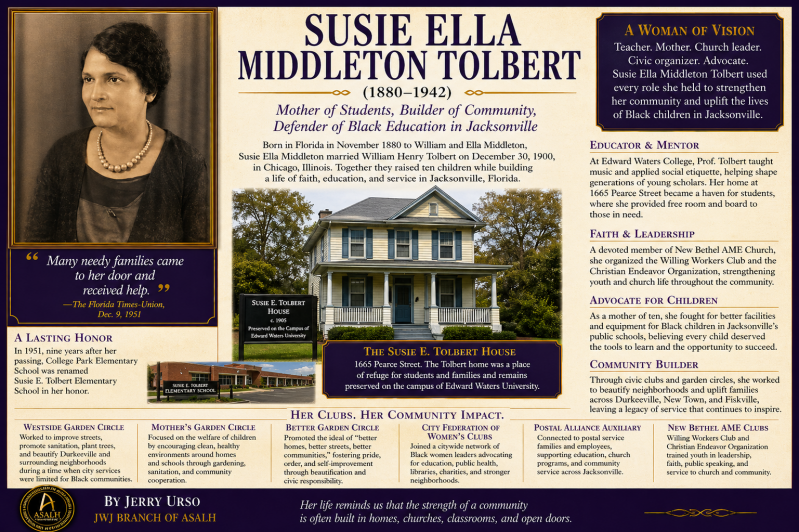
Susie Ella Middleton Tolbert (1880–1942)
Professor, Clubwoman, Church Builder, and Mother of Students in Jacksonville’s Durkeeville Community
By Jerry Urso, JWJ Branch of ASALH
A Childhood Between the Post-Reconstruction South and Chicago
Susie Ella Middleton was born in November 1880, the daughter of William Middleton and Ella A. Middleton, both natives of South Carolina whose lives began in the closing years of slavery and matured during Reconstruction.¹ Their generation carried the responsibility of building stability through education, migration, and church-centered community life.
Although she was born in Florida, Susie Middleton grew up in Chicago, where her family became part of a northern Black community shaped by migration networks that connected southern families across regions decades before the Great Migration reached its peak. In 1900, she was living with her parents and siblings on Aberdeen Street, already literate and working as a houseworker as she prepared to begin her adult life.²
That same year, on December 30, 1900, she married William Henry Tolbert, beginning a partnership that soon carried her south again to Jacksonville at a moment when the city itself was rebuilding after the devastation of the Great Fire of 1901.³
She arrived in Jacksonville at a time when churches, schools, and neighborhoods were being rebuilt by a generation determined to strengthen the institutional life of Black Florida.
A Marriage That Helped Anchor an Educational Household in Durkeeville
Her husband, William Henry Tolbert, was born in Virginia in the early 1870s and established himself in Jacksonville during the city’s reconstruction years. Early census records list him working as a house painter, a skilled trade closely connected to rebuilding homes across Jacksonville after the fire.⁴
Within a decade he secured employment as a clerk with the United States Post Office, one of the most stable and respected positions available to African American men during segregation.⁵ Postal employment provided the kind of reliability that allowed families to purchase homes, support churches, and maintain long-term residence near institutions like Edward Waters College.
William Henry Tolbert also contributed to Jacksonville’s religious cultural life as a violinist, participating in church musical services that formed an essential part of worship tradition within New Bethel African Methodist Episcopal Church and the surrounding Durkeeville community.⁶
Together, Susie and William Tolbert raised ten children, creating one of the most respected educational households surrounding Edward Waters College in the early twentieth century.⁷
Professor Tolbert and the Leadership Mission of Edward Waters College
Within the neighborhood surrounding Edward Waters College, she became known simply as Professor Tolbert.
Founded in 1866 by the African Methodist Episcopal Church, Edward Waters College stood as Florida’s oldest institution of higher learning for African Americans and one of the principal training centers for teachers, ministers, and civic leaders across the state. During the early twentieth century its graduates shaped classrooms, congregations, and community organizations throughout Florida and the wider South.
Professor Tolbert taught music and applied social etiquette, subjects central to the college’s leadership mission. Music shaped worship services, civic ceremonies, and commencement exercises across Jacksonville’s Black neighborhoods. Instruction in deportment prepared students to represent themselves—and their communities—with dignity in a segregated society structured to deny them equal opportunity.⁸
Her influence extended far beyond the classroom itself.
The Pearce Street Residence as Part of the Educational Infrastructure of Edward Waters
Standing within walking distance of Edward Waters College, the Tolbert residence at 1665 Pearce Street became known throughout the campus community as a place where students could find assistance when continuing their education became difficult.
Meals were shared there. Encouragement was given there. Sometimes lodging was provided there.
Families from the surrounding neighborhood also came to her door when hardship threatened daily life.⁹
Before institutions established student-support offices or residence programs, educators’ homes frequently served as the safety net that allowed students to remain enrolled. The Tolbert residence functioned as one of those essential places where education continued beyond classroom walls.
Today the house remains preserved on the campus of Edward Waters University, standing as a reminder of the domestic spaces that helped sustain Black higher education in Jacksonville.
Leadership at New Bethel African Methodist Episcopal Church
Much of Professor Tolbert’s leadership unfolded through New Bethel African Methodist Episcopal Church, one of the most important centers of religious and civic organization in Jacksonville’s Durkeeville community during the early twentieth century.
Within that congregation she organized the Willing Workers Club, part of a long-standing tradition within AME churches in which women’s auxiliary societies provided the operational strength behind congregational life. These organizations raised funds for building maintenance, supported missionary work, assisted families experiencing hardship, and coordinated youth participation in church programs at a time when church institutions served as primary centers of social support in Black communities.¹⁰
She also helped establish the Christian Endeavor Organization, part of a national youth movement that trained young people in leadership, scripture study, public speaking, and service responsibility. Within Black churches across the South, Christian Endeavor societies functioned as early leadership academies where future teachers, ministers, and civic organizers gained experience conducting meetings, planning programs, and speaking before audiences.¹⁰
Her influence within New Bethel remained strong even after her passing. Years later the church maintained the Susie E. Tolbert Missionary Society, ensuring her name remained part of its continuing ministry.¹¹
Leadership in Jacksonville’s Garden Club Movement
Professor Tolbert also played an important role in Jacksonville’s network of women’s civic improvement organizations. She worked through the Westside Garden Circle, part of a regional movement through which Black women reshaped neighborhoods during segregation by organizing sanitation campaigns, planting shade trees, improving sidewalks, and encouraging property maintenance in areas where municipal investment remained limited.⁹
Her participation in the Mother’s Garden Circle reflected another dimension of this work. Organizations with “Mother’s” in their titles often focused specifically on improving environments surrounding homes and schools where children lived and learned. Members promoted sanitation practices, planted trees near school grounds, and encouraged cooperative responsibility for child welfare within neighborhoods.⁹
Through the Better Garden Circle, she participated in a movement promoting “better homes” and “better communities,” emphasizing beautification as an expression of dignity and citizenship during a period when Black neighborhoods often received little public investment.⁹
These organizations transformed neighborhood environments while strengthening community pride across Jacksonville’s westside.
The City Federation of Women’s Clubs and Citywide Civic Leadership
Professor Tolbert’s participation in the City Federation of Women’s Clubs connected her to Jacksonville’s most important network of organized Black women’s civic leadership. Federations coordinated the work of multiple neighborhood organizations and supported advocacy in education, sanitation, charity work, youth development, and community improvement across the city.⁹
Through federated organizations, Black women strengthened schools, supported libraries, organized relief efforts, and shaped neighborhood safety long before municipal governments responded equally to such concerns.
Participation in the federation placed Professor Tolbert within a generation of women shaping Jacksonville’s civic future.
Work with the Postal Alliance Auxiliary
Her involvement in the Postal Alliance auxiliary reflected the Tolbert household’s connection to one of the most stable African American middle-class employment networks in early twentieth-century Jacksonville. Postal Alliance organizations supported education initiatives, church fundraising efforts, and neighborhood assistance campaigns while strengthening cooperation among families connected through federal employment.⁵⁹
Through this organization the Tolbert household participated in a broader civic network that helped sustain Durkeeville institutions during segregation.
Advocacy for Better Schools for Black Children
As both a teacher and the mother of ten children, Professor Tolbert understood clearly what Black schools in Jacksonville lacked. She worked persistently for improved facilities and better equipment for students during segregation, joining a generation of Black women educators whose leadership strengthened public education decades before desegregation reshaped the school system.¹²
She spoke with authority rooted in experience.
She spoke as a teacher.
She spoke as a mother.
A School Named in Her Honor
When Professor Susie Ella Middleton Tolbert died in 1942, Jacksonville lost one of the quiet builders of its educational and church communities.¹³
Nine years later the city honored her legacy by renaming College Park Elementary School as Susie E. Tolbert Elementary School, ensuring that generations of children would continue to learn the name of a teacher whose influence had already shaped their neighborhood.⁹
Legacy
Professor Susie Ella Middleton Tolbert belonged to a generation of Black women educators whose leadership shaped Jacksonville not through public office but through classrooms, churches, and neighborhood organizations. Her work strengthened Edward Waters College, expanded youth leadership opportunities at New Bethel AME Church, improved living conditions through garden-club networks, and supported students whose education depended upon the quiet assistance she provided from her Pearce Street home.
The preservation of the Susie E. Tolbert House on the campus of Edward Waters University stands as recognition of the role educator households played in sustaining historically Black colleges during segregation. The naming of Susie E. Tolbert Elementary School ensured that her influence extended beyond her lifetime into the educational landscape of Jacksonville itself.
Together, these recognitions reflect a life devoted to strengthening the institutional foundations of the Durkeeville community and to preparing generations of students for leadership across Florida and beyond.
Her legacy survives not only in buildings and institutions, but in the educational traditions she helped sustain.
References
- 1900 United States Census, Cook County, Illinois, household of William Middleton
- 1900 United States Census, Chicago Ward 31 residence listing Susie Middleton
- Cook County Marriage Records, William Henry Tolbert and Susie Ella Middleton, Dec 30, 1900
- 1910 United States Census, Jacksonville Ward 8, Duval County
- 1920 United States Census, Jacksonville Ward 6, U.S. Post Office clerk listing
- Florida Times-Union church program notices identifying W. H. Tolbert as violinist
- Tolbert household listings across 1910–1930 census enumerations
- Edward Waters institutional history materials documenting teaching role
- Florida Times-Union, Dec 9, 1951 dedication biography of Susie E. Tolbert Elementary School
- New Bethel AME Church auxiliary organization references
- Florida Times-Union missionary society references, 1944
- Modern Cities Project interpretation of the Susie E. Tolbert House
- Florida Death Records, Duval County, 1942
