
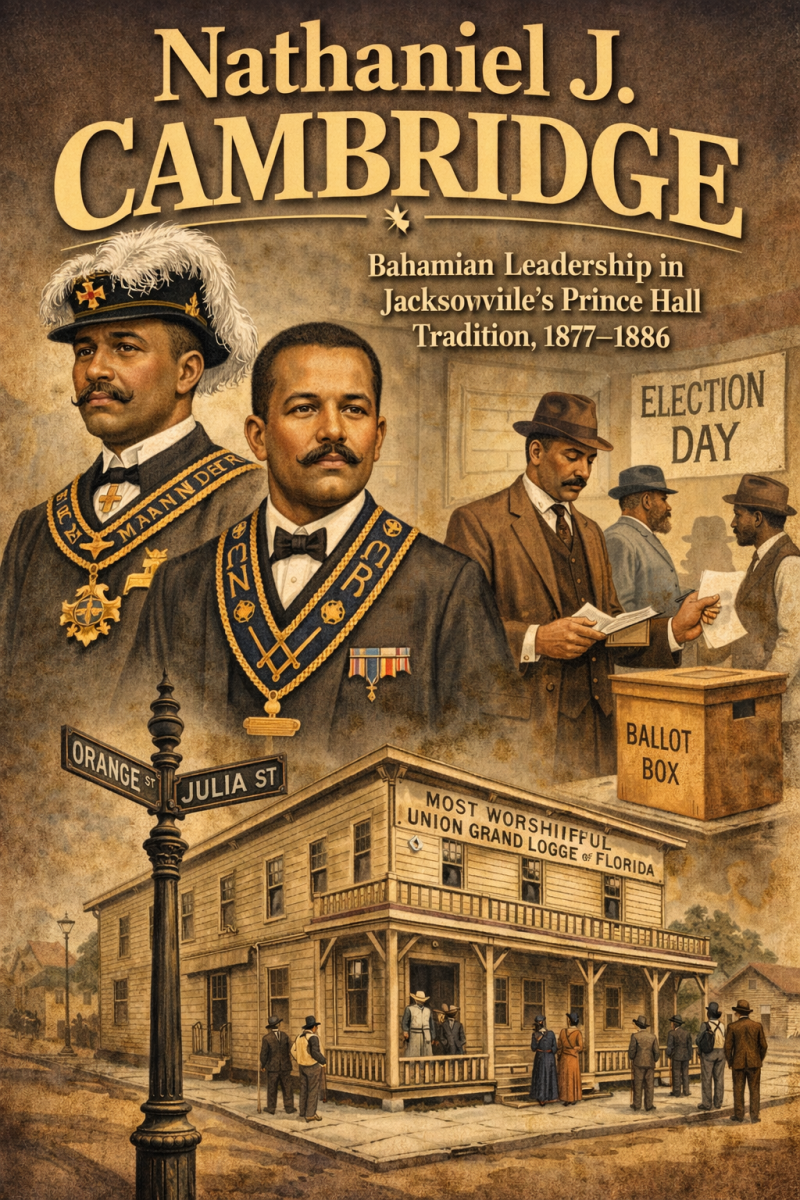
Nathaniel J. Cambridge
Grand Senior Warden of Florida Prince Hall Masonry, Eminent Commander of Gethsemane Commandery No. 4, and a Bahamian Leader in Jacksonville and LaVilla After the Compromise of 1877
By Jerry Urso — JWJ Branch of ASALH
A Bahamian Leader in Jacksonville’s Western Political Corridor After Reconstruction
By the early 1880s the political landscape of Jacksonville had entered a new and more difficult phase. The federal protections that had supported African American political participation during Reconstruction had weakened following the Compromise of 1877, and across Florida Black officeholding declined rapidly as elections became increasingly contested and local political authority shifted toward structures less receptive to African American participation. In this altered environment, ward-level leadership in cities like Jacksonville became one of the most important remaining avenues through which Black citizens could continue to exercise civic influence.
It was within this narrowing but still active political space that Nathaniel J. Cambridge emerged as a recognized figure in Jacksonville’s Third Ward, a district closely connected with the growing neighboring settlement of LaVilla, where African American residents were building churches, fraternal institutions, and residential communities that would soon become one of the most important Black municipalities in Florida. Newspaper coverage from the period repeatedly identified Cambridge as a participant in ward political organization, election supervision, and meetings addressing contested representation, confirming that his leadership operated within the working structure that sustained African American civic participation in the years immediately following Reconstruction.[1][3][5]
At the time of his death in May 1886 the Florida Times-Union described him as
“a political leader of considerable local distinction,”
a statement that reflected his established role within Jacksonville’s ward political community during one of the most challenging decades for Black political organization in the post-Reconstruction South.[9]
Bahamian Migration and the Rise of an Educated Leadership Class in Jacksonville and LaVilla
Nathaniel J. Cambridge was born about 1849 in Nassau, New Providence, in the Bahamas. The 1885 Florida State Census confirms that both he and his parents were natives of Nassau and that his wife shared the same birthplace, placing the Cambridge household clearly within the Afro-Bahamian migration stream that played a defining role in shaping Jacksonville’s western neighborhoods during the late nineteenth century.[14]
During the decades following the Civil War, migrants from the Bahamas formed one of the most influential and institutionally active segments of Jacksonville’s African American population. Bahamian communities carried with them strong traditions of literacy, church organization, skilled labor participation, and civic discipline that distinguished them within the developing urban environment of northeast Florida. Their arrival coincided with the expansion of residential settlement west of Jacksonville’s original municipal center and contributed directly to the growth of neighborhoods that connected the city with the independent town of LaVilla.
Because of their educational background and institutional experience, Bahamian migrants frequently emerged as leaders within churches, fraternal organizations, and ward political structures during the 1870s and 1880s. Cambridge’s rise within Prince Hall Masonry and his repeated appearance in municipal political reporting reflect this broader pattern in which Bahamian residents helped sustain the civic framework of Jacksonville’s Black community during the years immediately following Reconstruction.
His later funeral from St. John’s Episcopal Church further reflects the strong association between Bahamian migrants and Episcopal congregations within Jacksonville’s African American institutional life during this period.[8]
A Household Established in the Third Ward Community Linking Jacksonville and LaVilla
The 1885 Florida State Census recorded Nathaniel J. Cambridge living in Jacksonville with his wife A. W. Cambridge, daughter A. B. F. Cambridge, and infant son O. J. Cambridge, confirming that he maintained a family household within the western portion of the city at a time when residential development in neighborhoods adjoining LaVilla was expanding rapidly.[14]
This census record demonstrates that his public leadership roles were grounded in a stable household within the same corridor where Black churches, fraternal halls, and political meetings shaped the civic life shared by residents of Jacksonville and LaVilla during the early 1880s. Newspaper reporting identifying him as a property holder further confirms his established position within this community landscape and helps explain the opening of probate proceedings following his death the following year.[9][15]
Within the western districts of Jacksonville, property ownership carried particular importance for African American civic leaders because it anchored participation in ward organization and supported the institutional stability of churches and fraternal bodies serving both the city and the neighboring municipality of LaVilla.
Third Ward Political Leadership in the Years After the Compromise of 1877
Following the withdrawal of federal enforcement protections in the South after 1877, African American political leadership increasingly depended on local ward organization rather than statewide officeholding. In Jacksonville, the Third Ward became one of the principal locations where Black civic participation continued to operate through neighborhood representation structures that connected voters with municipal political processes.
The Florida Times-Union identified Cambridge as a Third Ward delegate, confirming that he participated directly in the organizational framework through which representation was coordinated within Jacksonville’s Republican political structure.[1]
He was later appointed election inspector for Ward Three, a role that placed him within the supervision of polling activity at a time when elections across Florida were frequently contested and local leadership positions required both community confidence and personal reliability.[3]
Additional reporting placed his name among participants connected with municipal ticket organization associated with the office of City Marshal, demonstrating that he was recognized within the circle of men considered for positions tied to the enforcement structure of city authority.[2][4]
Taken together, these newspaper references show that Cambridge’s political activity formed part of the continuing effort by African American ward leaders to maintain representation within Jacksonville’s municipal system during the years immediately following Reconstruction, when the political environment throughout the South had become increasingly difficult and uncertain.
Prince Hall Lodge No. 2 and Leadership Within Jacksonville’s Fraternal Framework 🔷
Nathaniel J. Cambridge was a member of Prince Hall Lodge No. 2 of Jacksonville, one of the principal subordinate lodges within the Most Worshipful Union Grand Lodge of Florida during the late nineteenth century.[13]
Prince Hall Lodge No. 2 functioned as one of the central organizational anchors of African American institutional life in Jacksonville’s western districts during the early 1880s. Its membership included men who participated not only in lodge governance but also in church leadership, ward political representation, and civic development within neighborhoods extending toward LaVilla. Cambridge’s advancement through this lodge into jurisdictional office reflects the way subordinate lodge leadership frequently intersected with municipal influence during this period.
His rise within this lodge therefore represents more than a fraternal milestone; it places him within a leadership structure that supported the institutional stability of Jacksonville’s Black community at a time when local organization remained essential to preserving civic participation after Reconstruction.
Grand Senior Warden of the Most Worshipful Union Grand Lodge of Florida
Proceedings of the Most Worshipful Union Grand Lodge of Florida confirm that in 1886 Nathaniel J. Cambridge held the office of Grand Senior Warden, placing him among the senior officers of the jurisdiction at the time of his death.[11]
The office of Grand Senior Warden carried responsibilities that connected subordinate lodges across the state with the administrative structure of the Grand Lodge. Jurisdictional officers helped maintain communication between lodges and participated directly in the governance procedures that sustained the organization’s statewide framework. Cambridge’s election to this office indicates that his leadership had already been recognized beyond Jacksonville and that his influence extended into the wider network of Florida Prince Hall Masonry.
Within the Jacksonville–LaVilla civic corridor, such jurisdictional leadership strengthened institutional continuity at a time when fraternal organizations remained among the most stable structures supporting African American community life during the early 1880s.
Service on the Committee on Returns and Credentials
During the same Grand Lodge session Cambridge served on the Committee on Returns and Credentials, a committee responsible for verifying representation and determining the eligibility of delegates participating in Grand Lodge proceedings.[12]
Committees of this kind played an essential role in maintaining the integrity of jurisdictional governance. Their work ensured that subordinate lodges were properly represented and that voting authority rested with legitimate delegates. Appointment to such a committee reflected confidence in a member’s judgment and reliability, and Cambridge’s inclusion among its members demonstrates the level of trust placed in him within the administrative structure of the jurisdiction.
Because subordinate lodges in Jacksonville and the surrounding western settlements—including those connected socially and institutionally with LaVilla—participated in Grand Lodge proceedings through these representation systems, committee service of this type linked Cambridge directly to the broader governance framework of Prince Hall Masonry in Florida.
Eminent Commander of Gethsemane Commandery No. 4
Funeral notices published in the Florida Times-Union at the time of his death in May 1886 identified Nathaniel J. Cambridge as Eminent Commander of Gethsemane Commandery No. 4, confirming that he held the highest office within Jacksonville’s Prince Hall Knights Templar body at the close of his life.[7] Because Commandery officers were named by title in funeral reporting only when serving in active leadership roles, this notice establishes that Cambridge remained in command of the organization at the time of his passing rather than being remembered as a former officer.
Based on the presently surviving newspaper and jurisdictional record associated with the Commandery, Cambridge appears to be the earliest documented Eminent Commander of Gethsemane Commandery No. 4, placing him among the first identifiable leaders of Prince Hall York Rite Templar activity in the Jacksonville area during the early 1880s. His leadership of the Commandery coincided with the expansion of fraternal institutions across the western portion of the city and the adjoining settlement of LaVilla, where Prince Hall Masonry formed part of the institutional framework supporting church life, political organization, and community stability during the difficult post-Reconstruction years following the Compromise of 1877.
Commanderies occupied a particularly visible place in nineteenth-century African American civic life because they participated prominently in funerary observances and public ceremonial processions. The identification of Cambridge by his Commandery title in contemporary reporting therefore reflects not only his standing within York Rite Masonry but also his broader recognition within the Jacksonville–LaVilla civic community during the final years of Reconstruction-era municipal leadership in northeast Florida.
Funeral Observances and Public Recognition in the Jacksonville–LaVilla Community
When Nathaniel J. Cambridge died in May 1886, the Florida Times-Union reported that funeral services were conducted from St. John’s Episcopal Church with participation by Gethsemane Commandery No. 4, where he served as Eminent Commander at the time of his death.[7][8] The same newspaper observed that his funeral was one of the largest attended in the community, a detail that provides important evidence of the breadth of his standing within Jacksonville’s Third Ward political structure and the western neighborhoods connected socially and institutionally with LaVilla during the early 1880s.
Large funerals in nineteenth-century Jacksonville’s African American community were typically associated with ministers, jurisdictional fraternal officers, and recognized civic leaders whose influence extended across church, lodge, and ward organization. The scale of Cambridge’s funeral therefore reflects the combined significance of his leadership as a Prince Hall jurisdictional officer, Commandery commander, and participant in municipal political organization during a period when neighborhood representation remained one of the primary avenues through which African American residents could continue to exercise influence following the Compromise of 1877.
At the time of his death the Florida Times-Union further described him as
“a political leader of considerable local distinction,”
confirming that his reputation extended beyond fraternal leadership into the working structure of Jacksonville’s ward political environment at a time when election supervision, representation disputes, and municipal ticket organization required experienced local leadership in communities linking Jacksonville with the adjoining settlement of LaVilla.[9]
His service as a Third Ward delegate and later as an election inspector must be understood within this post-Reconstruction political climate. Across Florida during the early 1880s elections were frequently contested and increasingly shaped by efforts to restrict African American political participation. Within this environment, ward officers and election inspectors played an especially important role in maintaining neighborhood representation and preserving the practical functioning of municipal political organization in districts where Black voters remained numerous and politically active.[1][3]
The unusually large attendance at his funeral therefore reflects not only personal respect but the recognition of a leadership role exercised within one of the most important remaining arenas of African American civic participation in Jacksonville during the years immediately preceding the annexation era that would reshape the relationship between the city and LaVilla later in the decade.
Jurisdictional Memorial Recognition in the Proceedings of the Grand Lodge
The importance of Nathaniel J. Cambridge’s leadership within Florida Prince Hall Masonry is further confirmed in the 1887 Proceedings of the Most Worshipful Union Grand Lodge of Florida, where he was formally recorded among the deceased officers of the jurisdiction and remembered in language reserved for senior leadership figures. In that memorial notice the Grand Lodge referred to him as
“our long remembered and much cherished Senior Grand Warden,”[13]
a phrase that reflects the esteem attached to his service within the governing structure of the jurisdiction at the time of his death in May 1886.
Memorial language of this kind in nineteenth-century Grand Lodge proceedings was not routine obituary formality. It signaled that the loss being recorded was that of an officer whose work had affected the administration of the jurisdiction itself rather than that of a local lodge member alone. Cambridge’s position as Grand Senior Warden at the time of his death therefore placed him among the recognized leadership circle responsible for maintaining communication and institutional continuity across Florida Prince Hall Masonry during the early 1880s.[11]
Because Jacksonville served as one of the principal centers of Prince Hall activity in the state and because the western districts of the city—including neighborhoods connected with LaVilla—formed part of the institutional environment in which subordinate lodges operated, Cambridge’s jurisdictional office linked local leadership in the Jacksonville–LaVilla corridor with the broader structure of Prince Hall Masonry throughout Florida.
Legacy
Nathaniel J. Cambridge belonged to the generation of African American civic leaders who helped sustain Jacksonville’s western neighborhoods during the difficult years that followed the collapse of Reconstruction. In the political atmosphere that emerged after the Compromise of 1877, ward leadership became one of the most important surviving structures through which Black citizens continued to exercise influence in municipal affairs. Contemporary reporting in the Florida Times-Union repeatedly identified Cambridge as a Third Ward delegate, meeting chairman, and election inspector, confirming that he stood among the trusted neighborhood representatives responsible for maintaining organized participation in local elections during a period when contested voting and intimidation increasingly shaped political life across Florida.[1][3][5]
His influence extended beyond ward meetings into the statewide structure of Prince Hall Masonry. By 1886 he had been elected Grand Senior Warden of the Most Worshipful Union Grand Lodge of Florida, one of the highest offices in the jurisdiction, demonstrating the confidence placed in him by the leadership of Florida Prince Hall Masonry during a formative period in its institutional development.[11] His service on the Committee on Returns and Credentials further confirms that he participated directly in the administrative work of the Grand Lodge itself.[12]
At the York Rite level, Cambridge appears in contemporary reporting as Eminent Commander of Gethsemane Commandery No. 4, making him the earliest presently documented commander of that Commandery in Jacksonville. Because Commanderies played visible roles in public ceremony, funerary observances, and fraternal procession culture in nineteenth-century Black communities, this office placed him among the most publicly recognized fraternal leaders operating in the western districts of the city during the early 1880s.[7]
Cambridge’s Bahamian birth placed him within a migration community that produced many of the teachers, craftsmen, clergy, and ward organizers who helped shape the institutional life of Jacksonville and LaVilla in the decades after emancipation. His funeral from St. John’s Episcopal Church reflects his connection to one of the congregations most closely associated with Bahamian settlement patterns in the city’s western neighborhoods during this period.[8]
The probate record created after his death further confirms the central place of Masonry in his life. Among the items listed in his estate inventory were Masonic regalia, evidence that his fraternal identity formed part of his recognized household property and public standing at the time of his passing.[16]
Perhaps the clearest indication of his community reputation appears in the Florida Times-Union report describing his funeral as one of the largest attended in the community, a distinction normally reserved for ministers, jurisdictional officers, and widely respected civic leaders whose influence crossed church, fraternal, and political boundaries.[7][9] That recognition continued after his burial when the Proceedings of the Most Worshipful Union Grand Lodge of Florida (1887) recorded his death in language reserved for senior jurisdictional leadership, referring to him as
“our long remembered and much cherished Senior Grand Warden,”[13]
a tribute reflecting the esteem attached to his service within Florida Prince Hall Masonry at the time of his passing.
Taken together, these records place Nathaniel J. Cambridge among the ward-level organizers and jurisdictional officers who helped preserve African American institutional continuity in Jacksonville’s western districts during the uncertain years between Reconstruction and the municipal restructuring that followed later in the decade. His career also preserves the earliest surviving documentary evidence of Commandery-level York Rite leadership connected with the Prince Hall tradition in Jacksonville and the LaVilla corridor during the 1880s.
References
[1] Florida Times-Union (Jacksonville), 1880s notice identifying Nathaniel J. Cambridge as Third Ward delegate, municipal political meeting coverage.
[2] Florida Times-Union (Jacksonville), ward political organization report referencing Third Ward representation and neighborhood leadership structure in western Jacksonville districts connected with LaVilla.
[3] Florida Times-Union (Jacksonville), election reporting identifying N. J. Cambridge serving as election inspector in municipal voting supervision.
[4] Florida Times-Union (Jacksonville), public meeting coverage referencing ward-level leadership participation by Cambridge during contested municipal representation discussions.
[5] Florida Times-Union (Jacksonville), late-Reconstruction political meeting notice identifying Cambridge as chairman of ward meeting proceedings.
[6] Florida Times-Union (Jacksonville), civic meeting notice documenting continued ward-level political activity in western Jacksonville neighborhoods overlapping LaVilla’s leadership corridor.
[7] Florida Times-Union (Jacksonville), May 1886 obituary notice identifying Nathaniel J. Cambridge as Eminent Commander of Gethsemane Commandery No. 4 and reporting one of the largest attended funerals in the community.
[8] Florida Times-Union (Jacksonville), May 1886 funeral notice confirming services held at St. John’s Episcopal Church.
[9] Florida Times-Union (Jacksonville), extended funeral coverage confirming large public attendance and community prominence at burial observances.
[10] St. John’s Episcopal Church (Jacksonville), parish funeral record context confirming Episcopal affiliation consistent with Bahamian community settlement patterns in western Jacksonville.
[11] Proceedings of the Most Worshipful Union Grand Lodge of Florida, 1886 Annual Communication — listing Nathaniel J. Cambridge as Grand Senior Warden.
[12] Proceedings of the Most Worshipful Union Grand Lodge of Florida, 1886 — Committee assignments listing Cambridge on the Committee on Returns and Credentials.
[13] Proceedings of the Most Worshipful Union Grand Lodge of Florida, 1887 — memorial section referring to Cambridge as
“our long remembered and much cherished Senior Grand Warden.”
[14] Florida Times-Union (Jacksonville), Commandery-level fraternal reporting confirming Gethsemane Commandery No. 4 activity within Jacksonville Prince Hall York Rite structure.
[15] Duval County civic directory and ward-structure reporting (1880s Jacksonville municipal framework) confirming Third Ward geographic overlap with western neighborhoods connected to LaVilla’s political leadership zone.
[16] Duval County Probate Record, Estate of Nathaniel J. Cambridge (1886) — inventory listing Masonic regalia among personal estate effects, confirming fraternal status at time of death.
