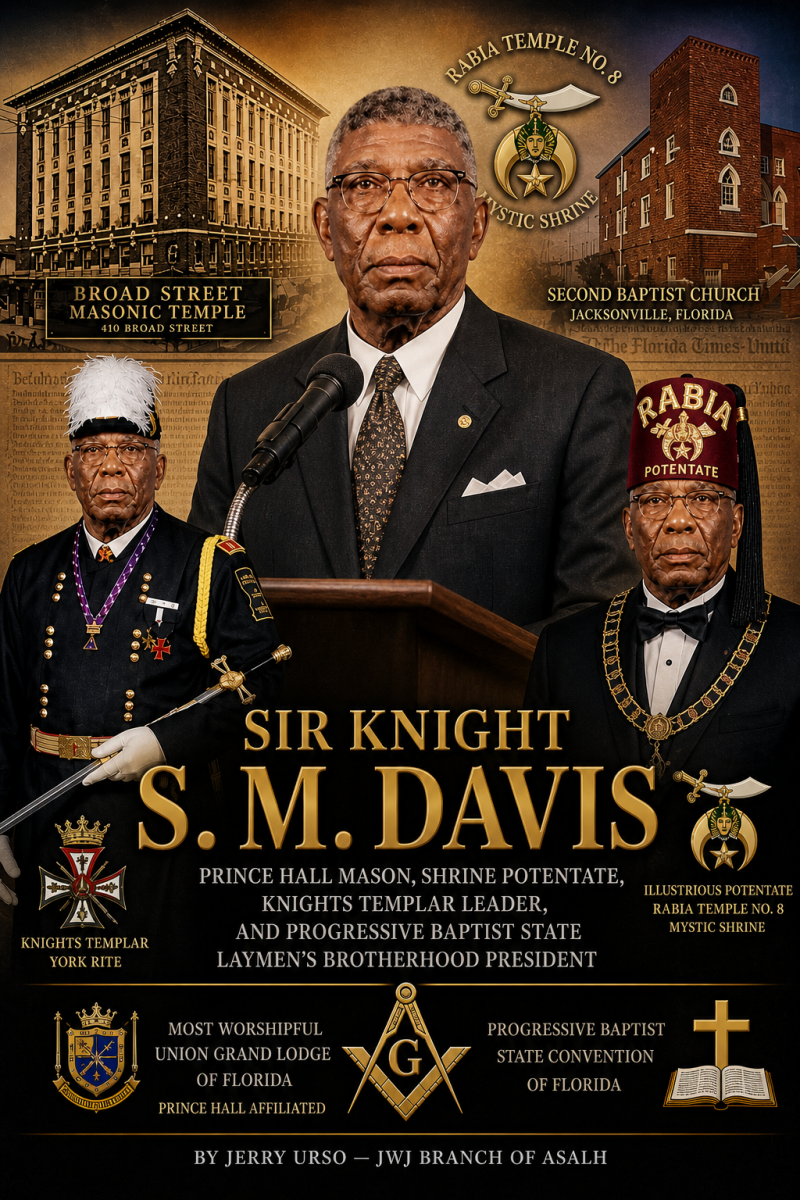
Sir Knight Samuel. M. Davis: Prince Hall Mason, Shrine Potentate, Knights Templar Leader, and Progressive Baptist State Laymen’s Brotherhood President
By Jerry Urso — JWJ Branch of ASALH
Introduction: A Lay Leader at the Intersection of Church and Prince Hall Masonry in Mid-Century Jacksonville
During the middle decades of the twentieth century, the strength of Jacksonville’s religious and fraternal institutions depended heavily upon disciplined lay leadership operating across church, lodge, and convention structures. Among the most active of these institutional builders was Sir Knight S. M. Davis, whose work connected Second Baptist Church, the Progressive Baptist State Convention of Florida, and multiple branches of Prince Hall Masonry into a unified network of service and leadership.
Unlike ministers whose authority rested primarily in the pulpit, Davis’s influence emerged through the structured leadership system of the Laymen’s Brotherhood, the organized auxiliary responsible for mobilizing non-ordained men within the Baptist church for education, missionary support, youth mentorship, and convention participation. His election as president of the Progressive Baptist State Laymen’s Brotherhood placed him among the most visible lay officers within Florida’s Baptist associational structure and positioned him to preside over statewide sessions and deliver annual convention addresses to delegates representing churches across the state.[1]
His responsibilities extended beyond Florida. Jacksonville newspaper notices documented his participation in delegations traveling to sessions of the National Baptist Convention of America, confirming his role within the broader denominational framework that linked local congregations such as Second Baptist Church to national Baptist leadership networks.[2]
At the same time, Davis maintained a parallel record of leadership within Jacksonville’s Prince Hall Masonic system. He served as a Past Master and long-time secretary of North Jacksonville Lodge No. 387, F. & A. M., an office he held across multiple election cycles, demonstrating both administrative trust and long-term institutional continuity within one of the city’s active mid-century lodges.[3]
His leadership extended further into the York Rite, where he appeared as Commander of St. Johns Commandery No. 9, later as treasurer of Gethsemane Commandery No. 1, Eminent Commander of S.M. Davis Commandery #99, and ultimately as District Deputy of Knights Templar for Duval and adjacent counties, a jurisdictional assignment reflecting regional authority within the commandery structure.[4]
Equally significant was his election as Illustrious Potentate of Rabia Temple No. 8, the Jacksonville Shrine temple operating within the Ancient Egyptian Arabic Order Nobles of the Mystic Shrine (Prince Hall affiliation). As Potentate, Davis stood at the head of one of the most visible ceremonial and charitable branches of Prince Hall Masonry in the city and participated in temple meetings, jubilee observances, and Divan leadership activity centered at the Broad Street Masonic Temple.[5]
His work also extended into the women’s auxiliary structure of the Masonic family through his service as Worthy Patron of Victoria Chapter No. 1, Order of the Eastern Star, where he served alongside Worthy Matron Tessie Anderson Davis, reflecting the cooperative household leadership patterns common within Prince Hall fraternal families of the period.[6]
Taken together, these roles reveal a pattern characteristic of Jacksonville’s most effective mid-century institutional leaders. Through his work in the Laymen’s Brotherhood, Prince Hall Masonry, the York Rite commandery system, Rabia Temple No. 8, and the Order of the Eastern Star, S. M. Davis functioned as a bridge figure linking church leadership, fraternal governance, and statewide Baptist convention organization into a single structure of coordinated service.
Early Life and Vocation
The surviving documentary record of Sir Knight S. M. Davis begins not with a formal biographical profile, but with repeated appearances in Jacksonville’s religious and fraternal life during the early 1950s. Like many mid-twentieth-century Black institutional leaders whose work centered in church auxiliaries and Prince Hall Masonry rather than electoral office, his early years were rarely recorded in narrative form in the press. Instead, his public life emerges through notices of meetings, convention delegations, lodge elections, and church programs that collectively document a steady rise into positions of confidence and responsibility across several interconnected organizations.
By the early 1950s Davis was already functioning as a recognized leader within Jacksonville’s Baptist associational structure. Newspaper notices placed him among speakers and participants in missionary society programming and Laymen’s Brotherhood observances involving Second Baptist Church and cooperating congregations across the city. These appearances demonstrate that he was already trusted to represent his church in inter-congregational settings where visiting speakers were typically selected from among experienced lay officers and convention workers rather than casual participants.[1]
During this same period he began to appear with increasing frequency in reports connected to the organized activities of the Laymen’s Brotherhood, the auxiliary body responsible for coordinating the work of non-ordained men within Baptist congregations. Participation in Laymen’s Brotherhood programs often marked the beginning of statewide leadership careers within the Progressive Baptist convention structure, since district-level service frequently preceded election to state offices. Davis’s repeated presence in these settings indicates that his leadership responsibilities within Second Baptist Church had already expanded beyond local committee participation into associational work that linked Jacksonville congregations to broader convention networks.[2]
At the same time that his church work was becoming more visible, Davis also entered the recorded leadership structure of Jacksonville’s Prince Hall Masonic system. By the early 1950s he appears in officer listings of North Jacksonville Lodge No. 387, Free and Accepted Masons, serving as assistant secretary, a position requiring both administrative reliability and sustained involvement in lodge governance. Election to this office across multiple years reflects the confidence placed in him by the membership and signals his emergence as one of the lodge’s dependable working officers rather than a ceremonial participant.[3]
His early fraternal service did not remain confined to the Blue Lodge. Notices from the same decade soon placed him within the leadership circle of Rabia Temple No. 8, the Jacksonville Shrine temple of the Ancient Egyptian Arabic Order Nobles of the Mystic Shrine (Prince Hall Affiliation), where he would ultimately serve as Illustrious Potentate. Election to the Divan of a Shrine temple represented one of the most visible forms of recognition available within the Prince Hall Masonic family and marked his transition from local lodge officer to city-wide fraternal leader.[4]
Together, these early appearances in Laymen’s Brotherhood programming and Prince Hall lodge administration illustrate the institutional pathway through which Davis’s later statewide Baptist leadership and regional Knights Templar authority developed. Long before he presided over state Laymen’s Brotherhood sessions or served as District Deputy within the York Rite commandery structure, he had already established himself as a reliable organizer within the cooperative network linking Second Baptist Church, North Jacksonville Lodge No. 387, and Rabia Temple No. 8.[5]
Second Baptist Church, Jacksonville
Throughout the 1950s and 1960s, S. M. Davis appeared repeatedly in the pages of the Florida Times-Union as a recognized leader connected with Second Baptist Church of Jacksonville, one of the city’s most important historic Black Baptist congregations and a central institutional pillar in the religious life of the community. His work there reflects the role of a senior lay officer functioning within the organized auxiliary structure of the church rather than a pulpit assignment, and his leadership activities consistently centered on Laymen’s Brotherhood programs, district observances, and convention-related cooperation between congregations.
One of the earliest documented notices placing Davis within this institutional framework identified him as a guest participant representing Second Baptist Church in a missionary program sponsored by the Home Missionary Society of Mt. Ararat Baptist Church, an event that brought together cooperating churches in support of mission education and associational fellowship across Jacksonville’s Baptist community.[1] Participation in missionary society programming was one of the primary ways experienced lay leaders supported the cooperative work of the district association, and invitations of this type reflected recognition beyond the boundaries of a single congregation.
Second Baptist Church’s Laymen’s Brotherhood programs formed another important setting in which Davis’s leadership appeared regularly. Newspaper notices listed him among participants in organized Laymen’s Brotherhood services held at the church, gatherings that brought together clergy, deacons, and lay officers from across Jacksonville to strengthen the role of men’s auxiliary leadership within the Baptist convention structure.[2] These programs were not merely devotional exercises; they functioned as training environments for convention workers and as forums for strengthening cooperation between churches aligned with the Progressive Baptist State Convention of Florida.
Davis also appeared in connection with St. John Day observances hosted at Second Baptist Church, where he delivered greetings representing the Knights Templar branch of Prince Hall Masonry during a service that brought together members of the wider Masonic family. Such observances were among the most important ceremonial intersections between the church and the Prince Hall fraternal structure and demonstrate the degree to which Second Baptist served as a meeting ground for religious and fraternal leadership within Jacksonville’s Black institutional network.[3]
Additional notices documented his participation in Laymen’s Brotherhood panel discussions and organized programs at the church during the later 1950s. These events typically featured speakers drawn from both clergy and lay leadership circles and were designed to strengthen the cooperative relationship between congregations participating in district and state convention work.[4] Davis’s repeated inclusion in these programs confirms that he functioned as one of the congregation’s principal representatives within the Laymen’s Brotherhood system rather than as a casual participant.
His role extended beyond local programming into association-level cooperation as well. During convention-related welcome services involving visiting church leaders and students from Bethune-Cookman College, Davis appeared among the participants assisting with the reception of delegates and guests, further demonstrating his place within the network of Second Baptist Church leaders responsible for representing Jacksonville congregations during statewide religious gatherings.[5]
Together, these appearances establish that Davis’s leadership at Second Baptist Church rested within the structured auxiliary framework through which Baptist lay officers organized missionary education, district cooperation, convention participation, and inter-church fellowship. His repeated presence in Laymen’s Brotherhood observances, St. John Day services, missionary programs, and convention welcome events illustrates the central role he played in linking the congregation to the broader associational life of the Progressive Baptist State Convention of Florida.
Progressive Baptist State Laymen’s Brotherhood Leadership
Among the most significant areas of S. M. Davis’s public service was his leadership within the Laymen’s Brotherhood of the Progressive Baptist State Convention of Florida, where he rose from district-level participation to statewide authority. Within the structure of the Black Baptist convention movement, the Laymen’s Brotherhood functioned as one of the principal organizational arms through which non-ordained men supported missionary education, youth development, church administration, and convention coordination. Election to state leadership within this body reflected both confidence from local congregations and recognition across the statewide associational network.
By the early 1960s Davis had been elected president of the Progressive Baptist State Laymen’s Brotherhood, a position that placed him at the head of one of the convention’s most important auxiliary organizations. In this role he presided over annual sessions attended by delegates representing churches from across Florida and delivered the principal address during the organization’s eighteenth annual session held at First Baptist Church in Lakeland, where he appeared in his official capacity as presiding officer of the statewide Laymen’s Brotherhood Union.[1]
His responsibilities extended beyond ceremonial leadership. Notices from Jacksonville newspapers documented his continued participation in district-level organizational meetings connected with the Laymen’s Brotherhood structure, including sessions held under the auspices of the East Florida and Bethany Baptist Association, where he assisted in planning and coordinating Brotherhood programs designed to strengthen cooperation between churches within the regional convention framework.[2] These district gatherings formed the working foundation of statewide Laymen’s Brotherhood activity, linking local congregations to the broader administrative structure of the Progressive Baptist convention system.
Davis’s leadership also carried him into the national arena. Reports identified him among members of a Jacksonville delegation traveling to attend sessions of the National Baptist Convention of America, one of the principal denominational bodies serving African American Baptist congregations throughout the United States. Participation in these delegations reflected the role of state Laymen’s Brotherhood officers in representing Florida churches within national convention proceedings and demonstrated that his influence extended beyond the boundaries of the state convention structure.[3]
Additional notices confirmed that Davis continued to exercise authority within the Laymen’s Brotherhood at the district level even after his statewide service, appearing as president of the District Laymen’s Brotherhood during planning sessions connected with association-wide meetings hosted at Jacksonville churches. These meetings were responsible for coordinating educational programming, strengthening missionary cooperation, and preparing delegates for participation in annual convention sessions.[4]
His work within the Laymen’s Brotherhood also intersected with educational initiatives supported by the convention structure. Reports connected him with meetings addressing statewide education board activity and Brotherhood coordination sessions designed to support the training of lay leadership within participating congregations. Through these efforts, he helped sustain one of the most important institutional pathways through which Black Baptist churches in Florida organized leadership development during the mid-twentieth century.[5]
Taken together, these notices establish that S. M. Davis served not merely as a local church auxiliary officer but as a statewide leader within the Progressive Baptist convention structure, presiding over sessions, organizing district activity, and representing Jacksonville churches in national denominational gatherings. His leadership within the Laymen’s Brotherhood formed the central religious foundation upon which his parallel service in Prince Hall Masonry and related fraternal organizations would rest.
North Jacksonville Lodge No. 387, Free and Accepted Masons (Most Worshipful Union Grand Lodge of Florida, Prince Hall Affiliated)
Alongside his statewide Baptist Laymen’s Brotherhood leadership, S. M. Davis maintained a sustained record of service within North Jacksonville Lodge No. 387, Free and Accepted Masons, operating under the jurisdiction of the Most Worshipful Union Grand Lodge of Florida, Prince Hall Affiliated. His repeated appearance in officer election notices across multiple years establishes that he was not simply a member of the lodge but a trusted working officer responsible for administrative continuity within one of Jacksonville’s active mid-twentieth-century Prince Hall lodges.
Newspaper reports identified Davis as serving as assistant secretary of North Jacksonville Lodge No. 387, a position requiring literacy, organizational reliability, and direct responsibility for maintaining lodge correspondence, membership records, and communication with Grand Lodge reporting structures. His election to this office across successive years demonstrates the confidence placed in him by the membership and confirms his long-term participation in the governance of the lodge.[1][2][3][4]
Service as assistant secretary represented one of the most important administrative assignments within the Blue Lodge structure of the Most Worshipful Union Grand Lodge of Florida, where continuity of records and communication between subordinate lodges and the Grand Lodge office formed an essential part of maintaining jurisdictional order. Officers entrusted with this work were typically selected from among dependable members whose presence ensured stability in lodge operations from year to year.
Davis’s connection with North Jacksonville Lodge No. 387 also appears in reports describing public cornerstone-laying ceremonies conducted under Prince Hall authority in the Jacksonville area. During one such ceremony at St. Mark Baptist Church in Mayport, he participated alongside officers of the Most Worshipful Union Grand Lodge of Florida, including Most Worshipful Grand Master C. A. Tillis and Grand Secretary P. A. Mitchell, while serving in his concurrent capacity as Illustrious Potentate of Rabia Temple No. 8. His participation illustrates the cooperative relationship between subordinate lodge officers and other branches of the Prince Hall Masonic family during public ceremonial observances of institutional importance.[5]
Additional election notices again listed Davis among the officers selected for service within North Jacksonville Lodge No. 387 in subsequent years, reinforcing the consistency of his administrative role and confirming his place among the dependable working officers responsible for maintaining the lodge’s operations during the mid-century period.[6]
Through this sustained service within North Jacksonville Lodge No. 387, Davis established the Blue Lodge foundation upon which his later leadership within the York Rite commandery structure and Rabia Temple No. 8 would rest, linking his administrative responsibilities in the Most Worshipful Union Grand Lodge of Florida to his broader record of service across the Prince Hall Masonic family in Jacksonville.
York Rite Masonry: Commandery Leadership within the Most Worshipful Union Grand Lodge of Florida
Alongside his administrative service in North Jacksonville Lodge No. 387, S. M. Davis emerged as a prominent leader within the Knights Templar branch of the York Rite system operating under the Most Worshipful Union Grand Lodge of Florida, Prince Hall Affiliated. His repeated appearance in commandery officer notices across the 1950s and 1960s confirms a sustained record of leadership extending from local commandery governance to regional jurisdictional responsibility.
Newspaper reports identified Davis as serving as Eminent Commander of Gethsemane Commandery No. 1, one of the Jacksonville-area Knights Templar bodies operating within the York Rite structure associated with the Union Grand Lodge jurisdiction. Election to the office of Eminent Commander placed him at the head of the commandery’s ceremonial and administrative operations, including oversight of drill instruction, religious observances, officer coordination, and participation in public Masonic services connected with the wider Prince Hall fraternal family.[1]
His leadership within the commandery structure extended beyond a single office. Additional notices recorded his service as treasurer of Gethsemane Commandery No. 1, demonstrating continued responsibility within the financial and administrative framework of the organization and reflecting the confidence placed in him by fellow Sir Knights in successive officer elections.[2]
Davis also appeared in reports identifying him as Commander of St. Johns Commandery No. 9, further illustrating his standing within Jacksonville’s York Rite leadership network. Service as commander within multiple commandery bodies was a distinction reserved for experienced Sir Knights whose reliability and organizational ability were already well established within the jurisdiction.[3]
His responsibilities later expanded beyond local commandery leadership when he was appointed District Deputy of Knights Templar for Duval and adjacent counties, a jurisdictional assignment that placed him in a supervisory role supporting commanderies across a broader regional territory within the York Rite system aligned with the Most Worshipful Union Grand Lodge of Florida. In this capacity he issued meeting calls, coordinated commandery participation in ceremonial observances, and maintained communication between subordinate commanderies and the jurisdictional leadership structure.[4]
Davis also represented the Knights Templar branch of Prince Hall Masonry during public religious observances connected with St. John Day services, where he delivered greetings on behalf of the commandery during programs hosted at Second Baptist Church that brought together members of the wider Masonic family. These services reflected the longstanding relationship between Knights Templar observances and Baptist congregational life within Jacksonville’s Prince Hall institutional network.[5]
The lasting recognition of his leadership within the York Rite system is reflected in the later establishment of S. M. Davis Commandery No. 99, a commandery named in his honor within the jurisdiction associated with the Most Worshipful Union Grand Lodge of Florida. The naming of a commandery after a Sir Knight represented a significant acknowledgment of service and placed his legacy permanently within the structure of Knights Templar Masonry in Florida.
Through his service as Eminent Commander, commandery officer, district deputy, and ceremonial representative of the Knights Templar branch of Prince Hall Masonry, S. M. Davis helped sustain the York Rite commandery system that formed one of the central pillars of fraternal leadership within Jacksonville’s mid-twentieth-century African American institutional life.
Rabia Temple No. 8: Illustrious Potentate within the Prince Hall Shrine Structure of the Most Worshipful Union Grand Lodge of Florida
Among the most visible positions held by S. M. Davis within Jacksonville’s fraternal community was his service as Illustrious Potentate of Rabia Temple No. 8, the Prince Hall Shrine temple operating within the jurisdictional network associated with the Most Worshipful Union Grand Lodge of Florida, Prince Hall Affiliated. Election to the office of Potentate represented one of the highest honors available within the Shrine branch of the Prince Hall Masonic family and placed Davis at the head of one of Jacksonville’s most active ceremonial and charitable fraternal bodies during the mid-twentieth century.
Notices published in the Florida Times-Union repeatedly identified Davis as Illustrious Potentate of Rabia Temple No. 8, confirming his leadership role within the temple’s governing Divan and establishing his position as the presiding officer responsible for coordinating meetings, ceremonial observances, and public Shrine activities centered at the Broad Street Masonic Temple.[1][2] These announcements demonstrate that his leadership was not temporary or honorary but formed part of a sustained administrative presence within the temple’s executive structure.
His role as Potentate also placed him at the center of Rabia Temple’s annual ceremonial calendar. Reports connected him with temple jubilee observances and organizational gatherings that brought together Nobles of the Mystic Shrine from across Jacksonville’s Prince Hall Masonic network. Jubilee services were among the most important Shrine events of the year and typically involved coordination between Blue Lodge officers, York Rite bodies, Eastern Star chapters, and auxiliary organizations associated with the broader Masonic family.[3]
Davis’s leadership extended beyond internal temple meetings into public ceremonial activity conducted under Prince Hall authority in the Jacksonville area. During cornerstone-laying ceremonies held at St. Mark Baptist Church in Mayport, he participated alongside officers of the Most Worshipful Union Grand Lodge of Florida, including Most Worshipful Grand Master C. A. Tillis and Grand Secretary P. A. Mitchell, while serving in his capacity as Illustrious Potentate of Rabia Temple No. 8. His presence at these ceremonies illustrates the cooperative relationship between Shrine leadership and subordinate lodges during public observances representing the jurisdiction.[4]
Additional reports again listed Davis among the officers of the Rabia Temple Divan participating in organizational meetings connected with temple entertainment committees and ceremonial planning activity. Divan membership represented the executive leadership core of the Shrine temple, and inclusion within this group confirms his standing among Jacksonville’s senior Prince Hall Shrine officers during the early 1950s.[5]
Service as Illustrious Potentate placed Davis within one of the most visible branches of the Prince Hall Masonic family, where Shrine temples functioned not only as ceremonial organizations but also as coordinating centers for public fraternal observances and charitable initiatives connected with the broader jurisdiction of the Most Worshipful Union Grand Lodge of Florida. Through his leadership of Rabia Temple No. 8, Davis helped sustain the ceremonial life and institutional presence of the Prince Hall Shrine in Jacksonville during a period when the Broad Street Masonic Temple served as one of the central meeting places of African American fraternal leadership in the city.
Victoria Chapter No. 1, Order of the Eastern Star: Worthy Patron
In addition to his leadership within the Blue Lodge, York Rite commandery structure, Rabia Temple No. 8, and the Progressive Baptist State Laymen’s Brotherhood, S. M. Davis also served within the women’s auxiliary branch of the Prince Hall Masonic family as Worthy Patron of Victoria Chapter No. 1, Order of the Eastern Star, operating within the jurisdictional structure associated with the Most Worshipful Union Grand Lodge of Florida, Prince Hall Affiliated.
A Florida Times-Union notice documented S. M. Davis serving as Worthy Patron alongside Worthy Matron Tessie Anderson Davis, confirming their joint leadership within the chapter during the mid-1950s. In Prince Hall Eastern Star structure, the Worthy Patron functioned as the senior male officer of the chapter and worked in partnership with the Worthy Matron to guide ceremonial observances, support chapter administration, and maintain the fraternal relationship between the chapter and its corresponding lodge and York Rite bodies.[1]
Service as Worthy Patron typically reflected both Masonic seniority and recognized standing within the broader fraternal community. In Jacksonville’s Prince Hall institutional network, Eastern Star chapters frequently operated in close coordination with subordinate lodges, commanderies, and Shrine temples, and leadership roles within the chapter often paralleled responsibilities held in those related branches. Davis’s concurrent service as an officer of North Jacksonville Lodge No. 387, Eminent Commander within the Knights Templar structure, and Illustrious Potentate of Rabia Temple No. 8 placed him in a position to represent the cooperative relationship that historically linked the Order of the Eastern Star with the wider Prince Hall Masonic family.
His partnership with Tessie Anderson Davis as Worthy Matron and Worthy Patron also reflects a pattern frequently found within mid-twentieth-century Prince Hall households in which husbands and wives shared leadership responsibilities across parallel fraternal organizations. Through this cooperative service within Victoria Chapter No. 1, Davis contributed to sustaining one of Jacksonville’s active Prince Hall Eastern Star chapters during a period when auxiliary organizations played an essential role in supporting charitable programs, ceremonial observances, and the social life of the jurisdiction associated with the Most Worshipful Union Grand Lodge of Florida.
Victoria Chapter No. 1, Order of the Eastern Star: Worthy Patron
In addition to his leadership within the Blue Lodge, York Rite commandery structure, Rabia Temple No. 8, and the Progressive Baptist State Laymen’s Brotherhood, S. M. Davis also served within the women’s auxiliary branch of the Prince Hall Masonic family as Worthy Patron of Victoria Chapter No. 1, Order of the Eastern Star, operating within the jurisdictional structure associated with the Most Worshipful Union Grand Lodge of Florida, Prince Hall Affiliated.
A Florida Times-Union notice documented S. M. Davis serving as Worthy Patron alongside Worthy Matron Tessie Anderson Davis, confirming their joint leadership within the chapter during the mid-1950s. In Prince Hall Eastern Star structure, the Worthy Patron functioned as the senior male officer of the chapter and worked in partnership with the Worthy Matron to guide ceremonial observances, support chapter administration, and maintain the fraternal relationship between the chapter and its corresponding lodge and York Rite bodies.[1]
Service as Worthy Patron typically reflected both Masonic seniority and recognized standing within the broader fraternal community. In Jacksonville’s Prince Hall institutional network, Eastern Star chapters frequently operated in close coordination with subordinate lodges, commanderies, and Shrine temples, and leadership roles within the chapter often paralleled responsibilities held in those related branches. Davis’s concurrent service as an officer of North Jacksonville Lodge No. 387, Eminent Commander within the Knights Templar structure, and Illustrious Potentate of Rabia Temple No. 8 placed him in a position to represent the cooperative relationship that historically linked the Order of the Eastern Star with the wider Prince Hall Masonic family.
His partnership with Tessie Anderson Davis as Worthy Matron and Worthy Patron also reflects a pattern frequently found within mid-twentieth-century Prince Hall households in which husbands and wives shared leadership responsibilities across parallel fraternal organizations. Through this cooperative service within Victoria Chapter No. 1, Davis contributed to sustaining one of Jacksonville’s active Prince Hall Eastern Star chapters during a period when auxiliary organizations played an essential role in supporting charitable programs, ceremonial observances, and the social life of the jurisdiction associated with the Most Worshipful Union Grand Lodge of Florida.
Rabia Temple No. 8 and the Broad Street Masonic Temple Network in Jacksonville
One of the most visible positions held by Sir Knight S. M. Davis within Jacksonville’s Prince Hall fraternal structure was his service as Illustrious Potentate of Rabia Temple No. 8, the local temple of the Ancient Egyptian Arabic Order Nobles of the Mystic Shrine (Prince Hall Affiliated) operating within the institutional network associated with the Most Worshipful Union Grand Lodge of Florida. Election to the office of Potentate placed Davis at the head of one of the most publicly recognizable branches of the Prince Hall Masonic family in Jacksonville during the early 1950s.
Notices published in the Florida Times-Union repeatedly identified Davis as Illustrious Potentate of Rabia Temple No. 8, confirming his role as presiding officer of the temple and a member of its governing Divan, the executive leadership body responsible for directing ceremonial work, coordinating temple programs, and supervising Shrine activities connected with the broader Masonic family in the city.[1][2]
His leadership is further documented through announcements connected with Rabia Temple jubilee observances, which formed part of the annual ceremonial calendar of the Prince Hall Shrine. Jubilee services typically brought together members of the Blue Lodge, York Rite commanderies, Eastern Star chapters, and Shrine auxiliaries in coordinated gatherings that reinforced the unity of the Prince Hall fraternal structure centered at Jacksonville’s Broad Street Masonic Temple.[3]
During his term as Potentate, Davis also appeared in reports describing meetings of the Rabia Temple Divan and temple entertainment committees, demonstrating his continued administrative role in directing temple programming beyond ceremonial observances alone. Divan membership represented the operational leadership core of the temple, and service within this body confirmed his standing among Jacksonville’s senior Shrine officers of the period.[4]
His service as Illustrious Potentate also intersected with jurisdictional ceremonial activity conducted under the authority of the Most Worshipful Union Grand Lodge of Florida. During cornerstone-laying ceremonies at St. Mark Baptist Church in Mayport, Davis participated alongside Most Worshipful Grand Master C. A. Tillis and Grand Secretary P. A. Mitchell, illustrating the close cooperation that existed between subordinate lodges and Shrine leadership during public Masonic observances throughout the Jacksonville area.[5]
Rabia Temple No. 8 functioned during this period as one of the principal ceremonial arms of Jacksonville’s Prince Hall Masonic network, and its activities were closely connected with meetings and events held at the Masonic Temple at 410 Broad Street, which served as a central gathering place for the jurisdiction’s subordinate bodies. Through his leadership as Illustrious Potentate, Davis occupied one of the most visible fraternal offices available within the local Prince Hall structure and contributed directly to sustaining the ceremonial life of the Shrine within the broader institutional framework of the Most Worshipful Union Grand Lodge of Florida.
Public Religious Programs, Convention Representation, and Associational Leadership Across Jacksonville’s Baptist Network
Beyond his formal offices within the Progressive Baptist State Laymen’s Brotherhood and the Prince Hall Masonic system, S. M. Davis appeared repeatedly in Jacksonville’s religious press record as a representative participant in district programs, association meetings, missionary events, and convention-related observances that linked local congregations to the broader structure of Black Baptist institutional life in Florida. These appearances illustrate the practical work performed by senior lay officers who supported church administration and convention organization outside the pulpit while helping sustain the cooperative framework connecting congregations across the region.
Notices from the Florida Times-Union documented Davis participating in missionary society programming involving cooperating churches across Jacksonville’s Baptist network. One such event placed him among visiting speakers representing Second Baptist Church during a program sponsored by the Home Missionary Society of Mt. Ararat Baptist Church, reflecting his role within the circle of lay leaders frequently called upon to assist with missionary education and inter-congregational cooperation.[1]
His leadership also appeared in association-level welcome programs connected with statewide Baptist gatherings hosted in Jacksonville. During one such session involving visiting delegates and students connected with Bethune-Cookman College, Davis was listed among the participants assisting with the reception of convention guests and supporting the program arrangements that accompanied the meeting. Participation in these welcome services formed part of the responsibilities often assigned to Laymen’s Brotherhood officers during major associational events.[2]
Additional notices documented his participation in district Laymen’s Brotherhood panels and organized discussion programs held at Second Baptist Church, gatherings designed to strengthen cooperation between congregations participating in Progressive Baptist State Convention activity. These meetings typically addressed topics such as missionary support, youth development, church education, and convention preparation and were essential to maintaining communication between district and state leadership structures.[3]
Davis also appeared among representatives participating in sessions connected with the Progressive Baptist State Convention and the East Florida and Bethany Baptist Association, where Laymen’s Brotherhood officers assisted in coordinating educational programming and preparing delegates for annual convention activity. Such meetings formed the operational backbone of the statewide Laymen’s Brotherhood system and demonstrate his continued role in sustaining its organizational structure at both district and association levels.[4]
His participation extended further into convention coordination connected with statewide education initiatives supported by the Progressive Baptist structure. Reports identified him among leaders assisting with Laymen’s Brotherhood sessions addressing education board activity and convention programming responsibilities, reflecting the role of Brotherhood officers in supporting denominational schools and training institutions associated with the convention network.[5]
Taken together, these appearances show that S. M. Davis functioned as a reliable representative of Jacksonville’s Baptist lay leadership within missionary programs, associational meetings, convention welcome services, and district Laymen’s Brotherhood panels, strengthening the cooperative relationships that connected Second Baptist Church and its partner congregations to the broader structure of the Progressive Baptist State Convention of Florida during the mid-twentieth century.
Public Religious Programs, Convention Representation, and Associational Leadership Across Jacksonville’s Baptist Network
Beyond his formal offices within the Progressive Baptist State Laymen’s Brotherhood and the Prince Hall Masonic system, S. M. Davis appeared repeatedly in Jacksonville’s religious press record as a representative participant in district programs, association meetings, missionary events, and convention-related observances that linked local congregations to the broader structure of Black Baptist institutional life in Florida. These appearances illustrate the practical work performed by senior lay officers who supported church administration and convention organization outside the pulpit while helping sustain the cooperative framework connecting congregations across the region.
Notices from the Florida Times-Union documented Davis participating in missionary society programming involving cooperating churches across Jacksonville’s Baptist network. One such event placed him among visiting speakers representing Second Baptist Church during a program sponsored by the Home Missionary Society of Mt. Ararat Baptist Church, reflecting his role within the circle of lay leaders frequently called upon to assist with missionary education and inter-congregational cooperation.[1]
His leadership also appeared in association-level welcome programs connected with statewide Baptist gatherings hosted in Jacksonville. During one such session involving visiting delegates and students connected with Bethune-Cookman College, Davis was listed among the participants assisting with the reception of convention guests and supporting the program arrangements that accompanied the meeting. Participation in these welcome services formed part of the responsibilities often assigned to Laymen’s Brotherhood officers during major associational events.[2]
Additional notices documented his participation in district Laymen’s Brotherhood panels and organized discussion programs held at Second Baptist Church, gatherings designed to strengthen cooperation between congregations participating in Progressive Baptist State Convention activity. These meetings typically addressed topics such as missionary support, youth development, church education, and convention preparation and were essential to maintaining communication between district and state leadership structures.[3]
Davis also appeared among representatives participating in sessions connected with the Progressive Baptist State Convention and the East Florida and Bethany Baptist Association, where Laymen’s Brotherhood officers assisted in coordinating educational programming and preparing delegates for annual convention activity. Such meetings formed the operational backbone of the statewide Laymen’s Brotherhood system and demonstrate his continued role in sustaining its organizational structure at both district and association levels.[4]
His participation extended further into convention coordination connected with statewide education initiatives supported by the Progressive Baptist structure. Reports identified him among leaders assisting with Laymen’s Brotherhood sessions addressing education board activity and convention programming responsibilities, reflecting the role of Brotherhood officers in supporting denominational schools and training institutions associated with the convention network.[5]
Taken together, these appearances show that S. M. Davis functioned as a reliable representative of Jacksonville’s Baptist lay leadership within missionary programs, associational meetings, convention welcome services, and district Laymen’s Brotherhood panels, strengthening the cooperative relationships that connected Second Baptist Church and its partner congregations to the broader structure of the Progressive Baptist State Convention of Florida during the mid-twentieth century.
Legacy within Jacksonville’s Prince Hall Masonic and Baptist Institutional Leadership Network
The public record of S. M. Davis reveals a leadership career that moved with unusual consistency across the major institutional pillars of mid-twentieth-century African American community life in Jacksonville: the Progressive Baptist State Convention of Florida, Second Baptist Church, the Most Worshipful Union Grand Lodge of Florida, the York Rite commandery structure, the Prince Hall Shrine, and the Order of the Eastern Star. Taken together, these roles demonstrate a pattern characteristic of the city’s most effective lay leaders—men whose influence rested not on a single office but on sustained service across interconnected organizations that shaped religious education, fraternal governance, and community stability.
Within the Baptist convention structure, Davis’s election as president of the Progressive Baptist State Laymen’s Brotherhood placed him among the most visible lay officers in Florida’s Black Baptist associational network. In this capacity he presided over statewide sessions, coordinated district-level activity, and represented Jacksonville congregations in delegations attending meetings of the National Baptist Convention of America, linking local church leadership to national denominational organization.[1] His continued service at the district level in subsequent years further illustrates his long-term commitment to the Laymen’s Brotherhood as one of the principal training and coordination arms of the convention system.[2]
At the same time, his work within North Jacksonville Lodge No. 387, Free and Accepted Masons, under the jurisdiction of the Most Worshipful Union Grand Lodge of Florida, Prince Hall Affiliated, established the Blue Lodge foundation upon which his broader fraternal leadership developed. His repeated election as assistant secretary confirms his role as a dependable administrative officer responsible for maintaining the lodge’s internal continuity during a period when subordinate lodges functioned as important centers of civic organization within Jacksonville’s African American community.[3]
His advancement within the York Rite Knights Templar structure further reflects the confidence placed in his leadership by fellow Sir Knights across the jurisdiction. Service as Eminent Commander of Gethsemane Commandery No. 1, leadership within St. Johns Commandery No. 9, and later appointment as District Deputy of Knights Templar for Duval and adjacent counties placed him in positions of authority extending beyond a single commandery and into the regional coordination of Knights Templar activity aligned with the Union Grand Lodge system.[4] The later establishment of S. M. Davis Commandery No. 99 in his honor stands as a lasting institutional acknowledgment of his contribution to the York Rite structure within the jurisdiction.
Equally significant was his election as Illustrious Potentate of Rabia Temple No. 8, one of Jacksonville’s principal Prince Hall Shrine bodies operating within the institutional network associated with the Most Worshipful Union Grand Lodge of Florida. As Potentate he presided over temple observances, coordinated Divan leadership activity, and participated in ceremonial programs that linked the Shrine with Blue Lodge, commandery, and Eastern Star organizations centered at the Broad Street Masonic Temple.[5]
His service extended further into the women’s auxiliary structure of the Prince Hall Masonic family through his role as Worthy Patron of Victoria Chapter No. 1, Order of the Eastern Star, where he served alongside Worthy Matron Tessie Anderson Davis. This partnership reflects a common pattern within mid-century Prince Hall households in which husbands and wives shared parallel leadership responsibilities across related fraternal organizations.[6]
Taken together, these roles establish S. M. Davis as a representative figure within Jacksonville’s generation of mid-twentieth-century institutional lay leaders whose work sustained both church and fraternal networks at the same time. Through his leadership in the Progressive Baptist State Laymen’s Brotherhood, his administrative service within North Jacksonville Lodge No. 387, his authority within the Knights Templar commandery structure, his tenure as Illustrious Potentate of Rabia Temple No. 8, and his service as Worthy Patron of Victoria Chapter No. 1, Davis helped maintain the cooperative framework that linked Jacksonville’s Baptist congregations with the Prince Hall Masonic system under the jurisdiction of the Most Worshipful Union Grand Lodge of Florida during one of the most active periods of institutional development in the city’s twentieth-century religious and fraternal life.
References
[1] Florida Times-Union, March 14, 1963, p. 2 — S. M. Davis identified as President, Progressive Baptist State Laymen’s Brotherhood, presiding over the 18th annual session at First Baptist Church, Lakeland.
[2] Florida Times-Union, September 1, 1963, p. 1 — S. M. Davis listed among Jacksonville delegation attending National Baptist Convention of America session (Dallas).
[3] Florida Times-Union, January 21, 1953, p. 1 — S. M. Davis listed as Assistant Secretary, North Jacksonville Lodge No. 387, F. & A. M.
[4] Florida Times-Union, April 14, 1959, p. 1 — S. M. Davis identified as Eminent Commander, Gethsemane Commandery No. 1.
[5] Florida Times-Union, May 24, 1951, p. 1 — S. M. Davis identified as Illustrious Potentate, Rabia Temple No. 8.
[6] Florida Times-Union, December 15, 1956, p. 1 — S. M. Davis listed as Worthy Patron, Victoria Chapter No. 1, Order of the Eastern Star, serving with Worthy Matron Tessie Anderson Davis.
[7] Florida Times-Union, February 23, 1966, p. 2 — S. M. Davis identified as President, District Laymen’s Brotherhood, East Florida and Bethany Association session planning.
[8] Florida Times-Union, February 25, 1962, p. 1 — S. M. Davis listed among ministers and leaders participating in Progressive Baptist State Convention welcome program, Belle Glade.
[9] Florida Times-Union, January 14, 1952, p. 1 — Rev. S. M. Davis listed as speaker representing Second Baptist Church at Home Missionary Society program, Mt. Ararat Baptist Church.
[10] Florida Times-Union, October 18, 1953, p. 4 — S. M. Davis listed among program participants during Second Baptist Church district observance.
[11] Florida Times-Union, July 18, 1956, p. 1 — S. M. Davis listed among leaders participating in Laymen’s Brotherhood program, Second Baptist Church.
[12] Florida Times-Union, June 22, 1957, p. 4 — S. M. Davis listed as participant in Laymen’s Brotherhood panel discussion, Second Baptist Church.
[13] Florida Times-Union, March 4, 1964, p. 1 — Rev. S. M. Davis listed among participants assisting with convention welcome program involving Bethune-Cookman College students.
[14] Florida Times-Union, June 7, 1951, p. 3 — Noble S. M. Davis identified as Illustrious Potentate, Rabia Temple No. 8 jubilee service announcement.
[15] Florida Times-Union, June 20, 1951, p. 3 — S. M. Davis listed as Illustrious Potentate, Rabia Temple No. 8 meeting notice.
[16] Florida Times-Union, July 2, 1951, p. 1 — S. M. Davis listed as Illustrious Potentate, Rabia Temple No. 8 Divan leadership reference.
[17] Florida Times-Union, February 19, 1952, p. 2 — S. M. Davis again identified as Illustrious Potentate, Rabia Temple No. 8 meeting notice.
[18] Florida Times-Union, September 24, 1951, p. 1 — S. M. Davis participated as Illustrious Potentate during cornerstone ceremony at St. Mark Baptist Church, Mayport, alongside M.W.G.M. C. A. Tillis and Grand Secretary P. A. Mitchell.
[19] Florida Times-Union, January 9, 1958, p. 1 — S. M. Davis listed as Assistant Secretary, North Jacksonville Lodge No. 387.
[20] Florida Times-Union, January 11, 1962, p. 1 — S. M. Davis listed as Assistant Secretary, North Jacksonville Lodge No. 387 officer election notice.
[21] Florida Times-Union, January 24, 1963, p. 1 — S. M. Davis listed as Assistant Secretary, North Jacksonville Lodge No. 387 officer election notice.
[22] Florida Times-Union, January 9, 1964, p. 1 — Sir Knight S. M. Davis listed as Treasurer, Gethsemane Commandery No. 1.
[23] Florida Times-Union, April 7, 1959, p. 1 — S. M. Davis listed as Commander, St. Johns Commandery No. 9.
[24] Florida Times-Union, July 15, 1965, p. 1 — Sir Knight S. M. Davis listed as District Deputy Knights Templar, Duval and adjacent counties.
[25] Florida Times-Union, June 22, 1956, p. 1 — D.M.C.S. S. M. Davis delivered greetings for Knights Templar during St. John Day observance, Second Baptist Church.
[26] Florida Times-Union, February 19, 1956, p. 3 — Meeting of Bricklayers Auxiliary No. 2 held at residence of Mr. and Mrs. S. M. Davis.
[27] Florida Times-Union, February 13, 1966, p. 3 — S. M. Davis listed among leadership connected with East Florida Baptist Association / Bethany Mission Board session.
[28] Florida Times-Union, July 14, 1965, p. 1 — S. M. Davis listed in connection with Laymen’s Brotherhood coordination and education board session planning.
