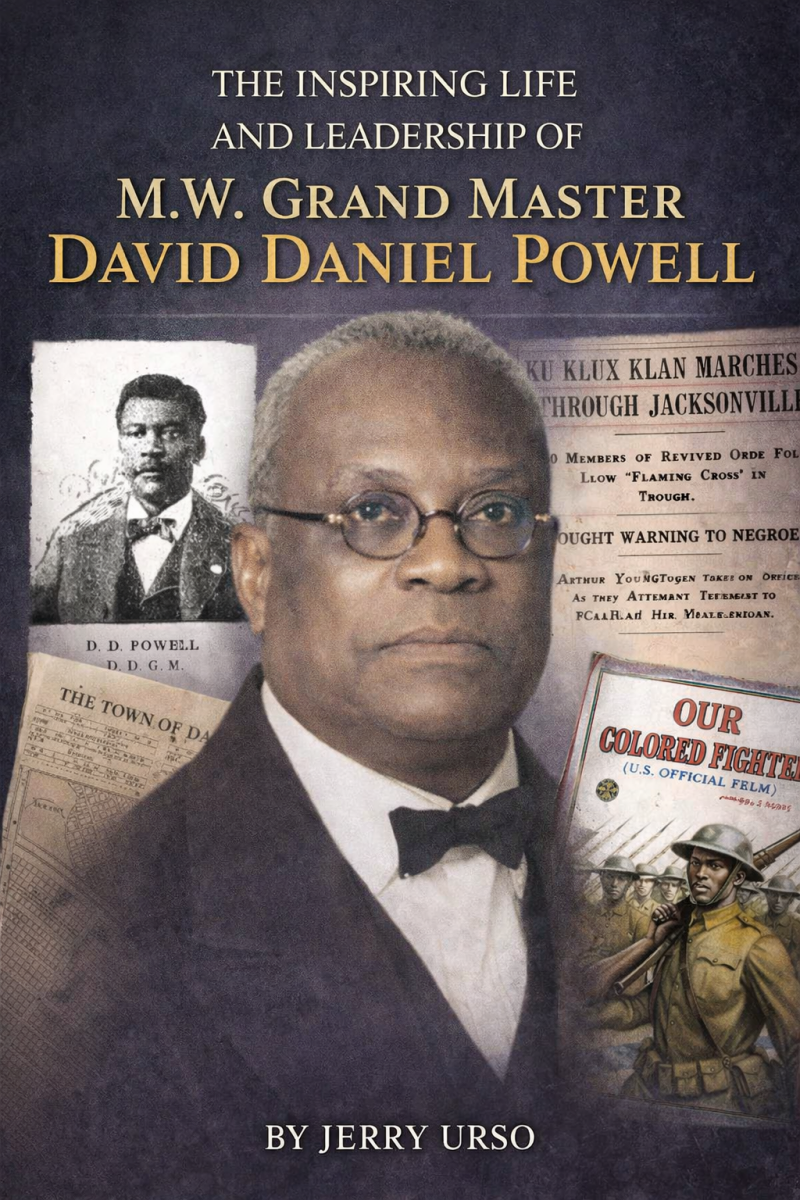
M.W. Grand Master David Daniel Powell
By Hon. Jerry Urso, FPS
Grand Historian of the Most Worshipful Union Grand Lodge of Florida, PHA
“Do not follow where the path may lead. Go instead where there is no path and leave a trail.”
—Ralph Waldo Emerson
Crisis Magazine, February 1942
Abstract
Of the twenty-five Grand Masters who have served the two Grand Lodges that now comprise the Most Worshipful Union Grand Lodge of Florida, it was David Daniel Powell who guided the jurisdiction fully into the twentieth century. Powell assumed leadership at the height of the Great Schism, inheriting a fractured Grand Lodge while navigating one of the most volatile racial climates in Florida’s history.
A successful farmer by trade, Powell understood endurance. He had weathered droughts, hurricanes, freezes, and economic upheaval, maintaining his crops through forces that ruined many of his contemporaries. His financial success positioned him for upward mobility and involvement in a wide range of business ventures. Those early trials—survival amid calamity—prepared him for leadership during some of the most turbulent decades in American history. His tenure as Grand Master would be defined not by comfort, but by crisis management, institution-building, and disciplined resolve.
Early Life
David Daniel Powell was born in North Carolina in May 1868, though the identities of his parents and the exact date of his birth remain unknown. He emerged in Jacksonville, Florida, as a successful truck farmer in the Panama Park section of the city. By 1910, Powell owned both his farm and homestead, a rare achievement for an African American farmer in the post-Reconstruction South [1][2].
Powell married Lillie Powell, and together they raised three children: Harmon, Mercedes, and Gertrude. His agricultural success occurred against daunting odds. African American farmers routinely received lower compensation for crops than their white counterparts and were systematically excluded from federal agricultural decision-making. From its inception in 1862, the United States Department of Agriculture was governed exclusively by white administrators, with African Americans confined largely to the Negro Extension Service and denied meaningful influence over policy [3].
The Great Freeze of 1895 was particularly devastating. On December 29, 1895, Jacksonville received warnings of frost, but temperatures plunged far below expectations, destroying crops across Florida. The freeze bankrupted countless Black farmers who lacked access to capital or relief. Even Josiah T. Walls, Florida’s first African American congressman, was forced to sell his land and accept a teaching position at the Florida State Normal and Industrial College for Colored Students (later Florida A&M University). Powell’s ability to survive this period marked him as exceptional, demonstrating both agricultural acumen and resilience under extreme pressure.
Introduction to Masonry
Proceedings of the Most Worshipful Union Grand Lodge of Florida document that in the mid-1890s, Sons of Solomon Lodge No. 166 was organized under a U.D. charter. David Daniel Powell served as its first Worshipful Master [4]. His initiation into Freemasonry placed him in direct contact with the leading figures of Florida’s Black civic, religious, and professional life.
Among Powell’s contemporaries were Rev. Ruben Brooks of the African Methodist Episcopal Church; James Weldon Johnson, attorney, author, and later the first African American secretary of the NAACP; and A. L. Lewis, widely recognized as Florida’s first African American millionaire and one of the most influential Black businessmen in the state.
By 1902, Powell had risen into the Council of District Deputy Grand Masters and served on multiple Grand Lodge committees. His organizational discipline and administrative skill propelled him rapidly through the ranks. Masonry became not merely a fraternal affiliation, but a platform through which Powell would exercise leadership, coordinate relief efforts, and shape institutional responses to crisis across Florida’s Black communities.
The Great Fire of 1901
In 1901, Jacksonville was a city built largely of wood—wooden structures, wood-shingled roofs, and wooden sidewalks—made dangerously vulnerable by a prolonged drought. The city’s buildings were dry and fire-prone, and residents had grown accustomed to small, manageable blazes that were quickly extinguished. That sense of routine proved disastrous.
At noon on Friday, May 3, 1901, workers at the Cleveland Fiber Factory at Beaver and Davis Streets left for lunch. Shortly thereafter, sparks from a nearby chimney ignited Spanish moss laid out to dry. Workers attempted to extinguish the fire with buckets of water, as they had on previous occasions. This time, however, a brisk wind from the east quickly shifted northwest, and the fire spread from structure to structure “with the rapidity that a man could walk” [5].
Within eight hours, the fire consumed 146 city blocks, destroyed more than 2,367 buildings, and rendered nearly 10,000 residents homeless. Contemporary accounts reported that the glow of the flames was visible in Savannah, Georgia, while smoke plumes could be seen as far away as Raleigh, North Carolina [6]. Entire neighborhoods vanished. LaVilla, the center of Black life and enterprise in Jacksonville, lay directly in the fire’s path.
The MWUGL of Florida and the Relief Effort
The Most Worshipful Union Grand Lodge of Florida responded immediately. Under the leadership of Grand Master Rev. John H. Dickerson, the Grand Lodge organized a coordinated relief effort. The Grand Lodge building itself stood among the last structures north of the fire to be destroyed.
As District Deputy Grand Master of the Jacksonville District, David Daniel Powell played a central role in organizing relief for displaced members and their families. Recognizing the scale of the catastrophe, Grand Master Dickerson issued a worldwide appeal to Masonic bodies for aid.
Appeal of Grand Master Dickerson to Masons
“TO THE MASONIC FRATERNITY OF THE UNITED STATES AND ALL THE WORLD:
Friday, May 3, 1901, a great fire originated in the northwestern part of the city and in a mattress factory conducted by whites. This factory was in a colored community. The wind was high, and the houses dry, and a great conflagration swept in its path more than 150 solid blocks or more than two thousand acres, leaving homeless 20,000 people and destroying nearly $25,000,000 worth of property.
Whereas there is hardly an inhabitant of the great metropolis of the State of Florida who has not lost his home, business, or employment, and in many cases all; and among the victims being those who would under other circumstances be the first to contribute to the relief of the distressed; and whereas, being unable to help ourselves; and whereas, seven Lodges have been made homeless and our great Temple destroyed; therefore we issue this appeal to the Masonic fraternity wherever dispersed around the globe.
Send anything. Not only were houses burned, but their contents. Even women and children did not escape the destructive flames. Send provisions, shoes, apparel, money—anything not perishable.
All contributions should be addressed to Rev. John H. Dickerson, G.M., 1332 W. Adams Street, Jacksonville, Fla. Prof. John G. Riley, D.G.M.; Rev. R. B. Brooks, G.S.W.; Hon. John Jackson, G.J.W.; A. J. Junius, G. Treasurer; Dr. D. W. Gillislee, G. Chaplain; Rev. R. E. Robinson, G. Lecturer.
Attest: E. I. Alexander, G. Secretary, 1520 Clay Street, Jacksonville, Fla.” [7]
The appeal underscored the scale of destruction suffered by Black Jacksonville and positioned the Grand Lodge as both a fraternal and humanitarian institution during crisis.
Trolley Car Boycott
Later in 1901, Jacksonville enacted an ordinance segregating the city’s streetcar system. The African American community responded swiftly and decisively, initiating a boycott of the entire system until the ordinance could be overturned.
In response, African Americans organized an independent transportation company, secured a bond, and constructed an alternative trolley line extending from LaVilla to Panama Park—where David Daniel Powell resided. The boycott became both a practical and symbolic assertion of Black autonomy.
Police arrested Andre Patterson for refusing to surrender his seat on a segregated trolley car. Attorneys J. Douglas Wetmore and Lawrence Purcell challenged the ordinance, ultimately defeating streetcar segregation in Patterson v. Florida through habeas corpus proceedings [8].
The boycott was led by prominent Black clergy, including Rev. Ruben Brooks, and argued before the Florida Supreme Court by Wetmore and Purcell—both members of the Grand Lodge. The legal victory strengthened Powell’s standing within Masonic circles and elevated his stature as a leader in Jacksonville’s Black community. The campaign demonstrated that disciplined organization, legal strategy, and collective resolve could produce tangible victories even in Jim Crow Florida.
Out of the Ashes
In the years following the Great Fire of 1901, Grand Master John H. Dickerson advanced an ambitious and controversial vision: the construction of a permanent, modern headquarters for the Most Worshipful Union Grand Lodge of Florida. The proposed Masonic Temple would serve not only as a fraternal center but as a commercial, civic, and economic anchor for Black Jacksonville.
The site selected was the corner of Duval and Broad Streets, with Broad Street serving as the principal artery through LaVilla, the heart of African American enterprise in the city. Construction commenced in 1911, and the building’s grand opening occurred on August 22, 1913. The dedication unfolded over a fifteen-day celebration and included a parade attended by approximately 15,000 citizens. The cost of the structure totaled $100,000.00, a staggering sum for any organization—particularly a Black institution operating under Jim Crow constraints [9].
The six-story structure was unprecedented in scale and ambition. It contained four floors of office and retail space, a fifth-floor auditorium capable of hosting large assemblies, and a sixth-floor lodge room serving the jurisdiction’s lodges and chapters. The building quickly became known as the “Grand East,” symbolizing both direction and aspiration.
The Great Schism
The aggressive building program ignited deep internal conflict. A substantial faction within the Grand Lodge believed the expense of constructing the Grand East placed an unbearable financial burden on the membership. Others opposed the location, arguing that Orlando—more centrally situated within the state—should have been selected as the seat of the Grand Lodge [10].
This disagreement escalated into a full schism. The opposition was led by two prominent figures whose lineage carried symbolic weight within Florida Masonry: Rev. C. C. Manigault and John R. Scott Jr., president of Edward Waters College and sons of founding members of the Grand Lodge. Rev. Manigault departed with a copy of the Prince Hall Charter and organized what became the Most Worshipful Prince Hall Grand Lodge of Florida [11].
Legal battles followed. Competing Grand Lodges published public statements in newspapers such as the Evening Metropolis, each asserting Masonic legitimacy. The schism fractured relationships, strained finances, and exhausted leadership. The jurisdiction stood divided at precisely the moment it sought to project unity and permanence.
Chairman of the Building Committee
David Daniel Powell served as chairman of the building committee during this turbulent period. The committee’s leadership included some of the most influential African American figures in Florida: A. L. Lewis; W. A. Glover; Rev. Joseph C. Lee; A. J. Junius; and Inez T. Alston [12].
Powell’s role required financial discipline, negotiation, and resolve. He balanced architectural ambition against fiscal reality while mediating among factions increasingly hardened in their positions. His steady hand during construction—amid lawsuits, public criticism, and internal dissent—cemented his reputation as a stabilizing force within the Grand Lodge.
The Grand East was completed, occupied, and operational. Yet the cost of that success was division, fatigue, and lingering resentment—conditions that would shape the next phase of leadership.
Election of Grand Master
Several factors converged to elevate David Daniel Powell to the office of Grand Master in 1916. Grand Master John H. Dickerson’s health had begun to fail, and the jurisdiction had grown weary from years of conflict. Dickerson himself survived three assassination attempts during his tenure, a stark indicator of the hostility surrounding Grand Lodge leadership during this era [14].
The endless disputes over finances, legitimacy, and authority exacted a toll on both the man and the institution. By contrast, Powell had cultivated broad support across the jurisdiction. He had grown his local lodge to more than one hundred members, demonstrating both organizational capacity and popular appeal. His reputation for steadiness, fiscal responsibility, and effective leadership assured him the necessary votes when the time came [13].
Powell’s election marked a transition. He inherited not a unified body, but one scarred by division—yet still standing. The task before him was not expansion alone, but reconciliation, survival, and endurance.
World War I
On April 6, 1917, the United States declared war on Germany, entering what would become the First World War. African American veterans of the Spanish-American War were among the first to enlist, and soon many brethren of the Most Worshipful Union Grand Lodge of Florida answered the call to serve their country. For Black servicemen, patriotism was complicated by reality. Many were relegated to labor battalions and support roles, denied the opportunity to fight as equals despite their willingness to serve.
Some members of the Grand Lodge were deployed overseas, including assignments in France, where several were decorated for valor. Yet returning soldiers were met with hostility and resentment upon their return to Florida. The sight of a Black man in uniform was intolerable to many white southerners. At the same time, labor shortages disrupted agricultural life. Sharecroppers lost their farms, families went bankrupt, and many were unable to pay poll taxes, effectively stripping them of the right to vote.
During his 1918 Grand Master’s Address, David Daniel Powell called upon the membership to pray for brethren fighting overseas and for victory for the American forces. His remarks reflected both patriotic commitment and sober awareness of the unequal burdens placed upon Black citizens during wartime [15].
The Spanish Flu Epidemic of 1918
The outbreak of the Spanish Influenza in 1918 presented Grand Master Powell with one of the most difficult decisions of his tenure. For the protection of the membership, he ordered the closure of lodge meetings—a move that disrupted the daily operations of the Grand Lodge but placed human life above ritual or routine.
African American communities entered the epidemic already burdened by poverty, Jim Crow segregation, and limited access to medical care. Hospitals were often closed to Black patients, leaving families to rely on home care and the small but growing corps of Black nurses. According to medical historian Vanessa Northington Gamble, African Americans faced the pandemic amid “racist theories of Black biological inferiority, racial barriers in medicine and public health, and poor health status” [18].
Despite these obstacles, Black professionals mobilized. Dr. Daniel Webster Roberts, the Grand Lodge’s medical advisor based in St. Augustine, played a critical role in combating the epidemic. He treated patients directly and shared medical knowledge with fellow physicians across Florida. According to historian David Nolan, Dr. Roberts was reputed to have never lost a patient to the flu. The disease did not discriminate by race, and neither did Dr. Roberts [19].
Powell’s leadership during the epidemic underscored his priorities: preservation of life, disciplined governance, and trust in professional expertise. The Grand Lodge endured the crisis through restraint rather than bravado, emerging intact at a moment when many institutions faltered.
Political Engagement
David Daniel Powell’s election as Grand Master elevated him to the leadership of Florida’s most prominent African American organization. His position made him a natural figure of interest to the Republican Party, which still sought Black political participation despite growing internal divisions.
The passage of the Nineteenth Amendment reshaped the political landscape, expanding the electorate and drawing African Americans—particularly Black women—into more direct engagement with party politics. At the same time, the Woodrow Wilson administration had nearly eliminated African American representation from federal appointments, creating both resentment and urgency among Black leaders.
In May 1920, Powell was elected a delegate to the Republican National Convention, joining seven other African Americans alongside twenty members of the “Lily White” Republican faction [20]. His presence signaled that despite systematic exclusion, Black political agency had not vanished—it had adapted and persisted through alternative power structures, including fraternal leadership.
The 1920 Presidential Election
In accepting the Republican presidential nomination in Marion, Ohio, Warren G. Harding declared his belief that Black citizens were entitled to the full measure of rights and opportunity guaranteed by American citizenship, earned through sacrifice on the battlefield and contribution to the nation’s life [21].
Harding’s remarks energized African American voters in Florida. In response, Grand Master Powell launched a statewide voter registration drive. In Ocoee, Florida, Black landowners and business owners prepared to vote despite escalating intimidation. Three days before the election, white citizens marched through Orlando in a campaign of terror designed to suppress Black turnout.
On November 2, 1920, Mose Norman and other African Americans attempted to vote. Norman was pursued by a mob and sought refuge at the home of July Perry. When the mob stormed Perry’s home, Perry shot two intruders, allowing Norman to escape. Perry was captured, transported to Orlando, lynched, and his body desecrated for three days as a warning to the Black community. Martin Blackshear was also murdered. More than twenty-five homes, two churches, and Ocoee Lodge No. 166 were burned. July Perry and Martin Blackshear were members of the Grand Lodge and registered voters [22].
The Sisters and the Ballot
Powell’s voter registration campaign included the Sisters of the Bethlehem Grand Chapter of the Order of the Eastern Star. Eartha White, a Jacksonville philanthropist and prominent Eastern Star leader, organized Black women voters and resisted Ku Klux Klan intimidation, including a Klan parade staged on Election Day.
Despite these efforts, between 3,000 and 4,000 Black voters were turned away from the polls. Nevertheless, the campaign marked a defining moment in Florida’s Black political resistance, demonstrating coordinated action across fraternal, civic, and gender lines [23].
The Legal Battles
The Square and Compass Case
In January 1921, forces hostile to Black fraternal power attempted to strip the Most Worshipful Union Grand Lodge of Florida of its most visible and symbolic emblem: the Square and Compass. When the Grand East was completed in 1913, a prominent illuminated Square and Compass had been installed on the southeast corner of the building. The symbol was intentionally bold. The Grand East stood as the finest African American–owned structure anywhere in the South, a physical declaration of permanence, legitimacy, and authority.
The building also included a concealed escape tunnel leading from the alley to the neighboring Richmond Hotel—an architectural acknowledgment of the dangers facing Black leadership in Jim Crow Florida. Efforts to remove the Square and Compass constituted a direct assault on the identity of the Order itself.
A three-way legal battle ensued involving the Grand Lodge of Florida (white), the Most Worshipful Prince Hall Grand Lodge of Florida, and the Most Worshipful Union Grand Lodge of Florida. Grand Legal Advisor Daniel Webster Perkins successfully defended the Union Grand Lodge’s right to the symbol, restoring it as a lawful and protected emblem of the fraternity. Powell navigated these proceedings with precision, maintaining unity and morale amid legal and political pressure [24].
Shrine Litigation and National Impact
Further legal challenges soon followed. The Desert of Florida (white) initiated suit against the Desert of Florida (Colored) in an effort to prohibit the Ancient Egyptian Arabic Order Nobles of the Mystic Shrine from using its rituals, symbols, and intellectual property. Daniel Webster Perkins again mounted a defense, this time relying on precedent established in earlier Knights of Pythias litigation against white counterparts.
Perkins secured a second consecutive legal victory, positioning him among the nation’s leading civil rights attorneys of the era. As a result of these triumphs, Perkins was appointed to the Imperial Legal Team of the Ancient Egyptian Arabic Order Nobles of the Mystic Shrine. At the time, Grand Master Powell simultaneously held the positions of Grand Master and Imperial Deputy of the Desert of Florida. Their partnership elevated both men to national prominence within fraternal and legal circles [25].
Powell collaborated closely with Grand Master Charles Wesley Dobbs of the Grand Lodge of Georgia through the Conference of Grand Masters. Together, Dobbs and Powell spearheaded fundraising initiatives to support the national litigation between the Ancient Arabic Order Nobles of the Mystic Shrine and the Ancient Egyptian Arabic Order of the Mystic Shrine [26].
On June 30, 1929, Justice Willis Van Devanter delivered the opinion of the United States Supreme Court in Ancient Egyptian Arabic Order Nobles of the Mystic Shrine v. Ancient Arabic Order Nobles of the Mystic Shrine, 279 U.S. 737 (1929), affirming the rights of the Black Shrine organization. The decision represented a landmark victory for African American fraternal autonomy nationwide [27].
The Perry Race Riot
In December 1922, racial violence again erupted—this time in Perry, Taylor County, Florida. The catalyst was the murder of Ruby Hendry, a young white schoolteacher whose body was discovered near railroad tracks north of town. Newspaper coverage described the killing in graphic terms and emphasized its brutality, though investigators admitted that the perpetrators were unknown at the time [28].
Despite the lack of evidence, suspicion quickly fell upon African American residents. Charlie Wright, a twenty-one-year-old escaped convict, was accused without substantiation. An angry mob from Florida, Georgia, and South Carolina seized Wright, tortured him for hours, and ultimately lynched him on December 15, 1922. Conflicting accounts later emerged as to whether Wright confessed, but all agree that he was denied due process and killed by mob violence.
On the same day, Perry Lodge was burned to the ground for the second time in a decade [29]. In the aftermath, Grand Master Powell assisted the membership of Perry Lodge with financial aid raised both locally and through the Grand Lodge. Despite terror and destruction, the lodge was rebuilt, reaffirming the fraternity’s resolve in the face of racial violence [30].
Rosewood Massacre
Barely two weeks after the Perry riot, violence erupted again—this time in Rosewood, Florida. On January 1, 1923, Fannie Coleman Taylor, a white woman from Sumner, Florida, claimed she had been assaulted by a Black man. Her account was accepted without investigation or corroboration.
Her husband, James Taylor, a foreman at the Cummer & Sons sawmill, organized an armed mob and enlisted tracking dogs. Reinforcements arrived from neighboring counties, including Ku Klux Klan members who had just concluded a rally in Gainesville. The white mob terrorized Rosewood, killing residents and destroying homes.
Levy County Sheriff Elias “Bob” Walker intervened repeatedly, preventing the execution of Aaron Carrier, a prominent Rosewood citizen and husband of schoolteacher Mahulda “Gussie” Brown Carrier. Walker worked nearly continuously for four days to save lives. For his actions, he is remembered as a hero of Rosewood [31].
Magnolia Lodge was burned to the ground. Brother Sam Carter and Past Master James Carrier were killed. Surviving members dispersed, with Aaron Carrier later affiliating with lodges in Jacksonville and DeLand. During the Perry and Rosewood massacres, Grand Master Powell was affiliated with the NAACP, the Negro Welfare League, and the National Negro Business League, reinforcing the intersection of fraternal leadership and civil rights advocacy.
National outrage reached the Oval Office during the administrations of Presidents Harding and Coolidge. Both urged the creation of national bodies to improve race relations. Coolidge proposed a “Negro Industrial Commission” to foster mutual understanding and economic advancement [32].
Financial Success
The prosperity of the 1920s marked the height of David Daniel Powell’s financial and institutional influence. His success extended well beyond agriculture and Masonry into insurance, real estate, recreation, and large-scale cooperative enterprise. Powell emerged as one of the principal Black financial architects in Florida during the Jim Crow era.
He became Chairman of the Board of the Peoples Industrial Insurance Company, with Captain James Floyd serving as president. At a time when African Americans were routinely denied access to mainstream insurance, such institutions provided burial coverage, financial stability, and dignity to working-class families. Powell also served as Vice President of the Lincoln Golf and Country Club, with A. L. Lewis as president. The club functioned as a segregated resort for African Americans, featuring a nine-hole golf course, tennis courts, and a swimming pool. It became a social and recreational haven during an era of exclusion, drawing prominent visitors including Joe Louis [33].
Powell also served on the board of American Beach, the famed African American beach community founded by A. L. Lewis. American Beach attracted visitors from across the Northeast and became a symbol of Black leisure, ownership, and self-determination.
The Town of David City
In 1925, the Masonic Benefit Association purchased nearly 140 acres of land in Putnam County, Florida. The acquisition was accompanied by a printed advertising broadside proposing the creation of an all–African American town. The plat map laid out a grid of approximately 1,500 residential lots, each measuring 50 by 100 feet, on either side of the Atlantic Coast Railroad line. The land was owned by the “Most Worshipful Union Grand Lodge of Free and Accepted Masons of the State of Florida, Inc.” and intended to be deeded exclusively to members of the Craft [34].
The proposed town included designated parkland and communal space, reflecting both civic planning and social vision. The broadside bore the names of M.W. David D. Powell, Grand Master; A. L. Lewis, Secretary and Treasurer of the Masonic Benefit Association; and P. A. Mitchell, Grand Secretary. The town was named David City in honor of Powell, an acknowledgment of his leadership and national stature.
David City represented one of the most ambitious attempts at Black self-governance and economic autonomy in Florida. Though the project ultimately succumbed to external pressures and infrastructural displacement—later becoming known as Sisco, Florida—it stands as evidence of the scale of Powell’s imagination and the institutional reach of the Grand Lodge.
Insurance, Business, and National Networks
A. L. Lewis, Powell’s longtime collaborator, organized Afro-American Life Insurance Company, described in The Crisis as “the first old-line legal reserve insurance company established in the South for colored people.” Lewis also founded the Afro-American Pension Bureau in 1903 and assisted Booker T. Washington in establishing the National Negro Business League in 1904. Both men were featured in The Crisis, January 1942, highlighting their national significance [35].
The Masonic Orphanage and Home, associated with David City, was later destroyed to make way for the construction of State Highway 17. The town itself faded into history, leaving behind maps, records, and memory—its name preserved as a testament to Powell’s legacy.
The Great Depression
The Great Depression devastated African American communities nationwide. Unemployment among Black Americans doubled and, in some regions, tripled that of whites. By 1932, Black unemployment approached fifty percent [36]. Entry-level jobs once held by African Americans were increasingly claimed by whites displaced by economic collapse.
Despite these conditions, Powell and the Grand Lodge endured. Their responsibilities expanded rather than diminished. Widows, orphans, and the destitute turned to the fraternity for aid. Across Ashley Street from the Grand Lodge, Sister Eartha White and the Clara White Mission struggled to feed overwhelming numbers of hungry residents. Members of the Grand Lodge donated food, money, and supplies. A. L. Lewis and Captain James Floyd personally contributed funds to sustain relief efforts.
Powell’s leadership during the Depression reaffirmed the Grand Lodge’s role as both fraternal and social welfare institution at a moment when public systems failed Black citizens entirely.
World War II
World War II again mobilized the membership of the Most Worshipful Union Grand Lodge of Florida. Brothers enlisted in large numbers, while Sisters supported the war effort on the home front. Under the leadership of Grand Worthy Matron Inez T. Alston Boyer, tin drives were organized, and women entered industrial and service roles vacated by enlisted men.
Many members were employed at Naval Air Station Jacksonville, Cecil Field, Naval Station Mayport, and the Naval Submarine Base at Kings Bay, Georgia. Sister Alston devoted her time to the USO and the Red Cross.
Brother Walter Armwood, respected across racial lines, was appointed Supervisor of Negro Economics for Florida. His son, Walter Armwood Jr., later served in the Army during World War II and trained with the famed Tuskegee Airmen [38].
When the war ended, LaVilla erupted in celebration. Parades marched along Broad Street to honor returning veterans. On July 26, 1948, President Harry S. Truman signed Executive Order 9981, mandating the desegregation of the United States military—a milestone that fulfilled, in part, the sacrifices of Black servicemen [39].
Legacy
Through nearly three decades of leadership, David Daniel Powell transformed endurance into doctrine. During his twenty-eight-year tenure as Grand Master, he did what few leaders in any era could accomplish under far less hostile conditions: he stabilized a fractured jurisdiction, preserved its legitimacy through relentless legal assault, and secured its financial independence.
Powell presided over the retirement of the Grand Lodge mortgage and conducted the first mortgage-burning ceremony in 1921. In the years that followed, he paid off more than $250,000.00 on a second mortgage in less than fifteen years—despite losses sustained during the Great Depression and the costs associated with litigation, relief work, and large-scale investments. Few African American institutions in the Jim Crow South could claim such fiscal discipline or resilience.
On February 25, 1946, Grand Master Powell passed away and was interred at Greenlawn Cemetery. His funeral was among the largest held in Jacksonville since that of Dr. Alexander Hanson Darnes. Mourners filled the streets, representing every sphere Powell had touched: agriculture, business, education, fraternal life, civil rights, and faith.
Powell guided the Grand Lodge through two world wars, repeated racial pogroms, economic collapse, and the social upheaval brought by industrialization. He stood at the intersection of Masonry and modern Black civic leadership. In an interview with W. E. B. Du Bois, Powell spoke with pride of the Grand East and its members, recognizing the building not as a monument to ambition, but as evidence of disciplined collective effort.
Beyond Masonry, Powell personally knocked on doors across Florida to raise funds for Florida Baptist Academy—now Florida Memorial University—helping secure more than $100,000.00 for the institution. He understood that education, fraternal unity, and economic independence were inseparable pillars of survival.
By the time of his passing, David Daniel Powell had redefined the meaning of rest. He labored until there was nothing left undone.
“Of all those who have served in the East of this Grand Lodge, D. D. Powell is the Dean of Grand Masters.”
—M.W.P.G.M. Anthony T. Stafford
References
[1] Ancestry.com
[2] 1910 United States Census
[3] Pete Daniel, Dispossession: Discrimination Against African American Farmers in the Age of Civil Rights (2013)
[4] Proceedings of the Most Worshipful Union Grand Lodge of Florida, 1893, 1902, 1906, 1907
[5] Ennis Davis, “The Great Jacksonville Fire of 1901,” Metro Jacksonville
[6] Jessie-Lynne Kerr, “Like the Phoenix, Jacksonville Rose from the Ashes after the Great Fire,” May 2, 1999
[7] Pacific Appeal, May 1901
[8] Wetmore and Purcell, Writ of Habeas Corpus, Florida v. Patterson, 50 Fla.
[9] Evening Metropolis, August 20, 1913
[10] Proceedings of the MWUGL of Florida, 1909–1910
[11] Anthony T. Stafford, A Living Schism
[12] Cornerstone Records, MWUGL of Florida
[13] The Crisis, February 1942
[14] The Journal (Huntsville, Alabama), January 26, 1905, p. 2
[15] CFC Report, MWUGL of Florida
[16] Matt Soergel, Jacksonville.com
[17] Rodney A. Brooks, History.com
[18] Vanessa Northington Gamble, “The African American Experience of the 1918 Influenza Pandemic,” History.com
[19] David Nolan, “Dr. Daniel Webster Roberts,” Visit St. Augustine
[20] The Tampa Times, May 6, 1920
[21] Harding Presidential Library
[22] Equal Justice Initiative, Ocoee Massacre Timeline
[23] City of Jacksonville Civil Rights Timeline
[24] Brooklyn Daily Eagle, January 27, 1921
[25] Phoenix Tribune (Phoenix, AZ), July 1, 1922
[26] Conference of Grand Masters, Alton Rountree
[27] Ancient Egyptian Arabic Order Nobles of the Mystic Shrine v. Ancient Arabic Order Nobles of the Mystic Shrine, 279 U.S. 737 (1929)
[28] History Engine, University of Richmond
[29] History Engine, University of Richmond
[30] Real Rosewood Foundation
[31] Lizzie Robinson Jenkins, Real Rosewood Foundation
[32] Calvin Coolidge Foundation, Essays and Addresses
[33] The Jaxson Magazine, “Lost History: Lincoln Golf and Country Club”
[34] Betweenthecovers.com, Broadside Map of David City
[35] The Crisis, January 1942, Vol. 49, No. 1
[36] History.com, “Last Hired, First Fired: How the Great Depression Affected African Americans”
[37] Encyclopedia Britannica, World War II
[38] Fold3.com, Oral History of the Armwood Family, Carl Norton Jr.
[39] National Park Service, Executive Order 9981
