
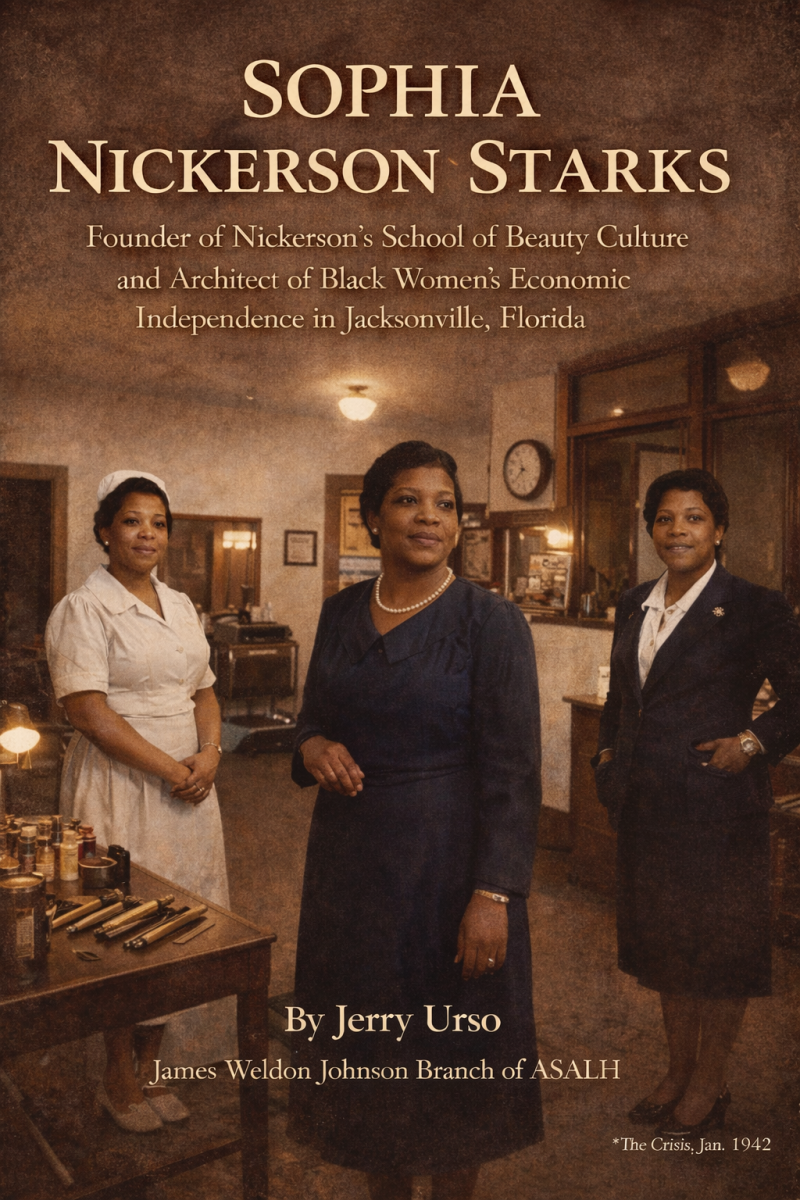
Sophia Nickerson Starks
Founder of Florida’s First Licensed Beauty School and Architect of Black Women’s Economic Independence in Jacksonville
By Jerry Urso, FPS-Life
Sophia Nickerson Starks stands as one of the most consequential yet underrecognized Black women institution builders in Jacksonville, Florida. Through education, disciplined vocational training, and commercial leadership, she transformed beauty culture into a structured pathway for economic independence at the heart of one of the most prosperous Black commercial corridors in the South.
She was born in January 1890 in Jacksonville, Florida, and appears in the 1900 United States Census as a ten-year-old student residing on Pippin Street in Ward Three with her parents, David and Margaret Nickerson [1]. The census confirms that she could read and write and had attended school for six months that year [1]. Literacy for a Black girl in 1900 Jacksonville represented both family stability and commitment to advancement during the tightening years of segregation.
By 1927, Sophia Nickerson had entered the official municipal record as a business operator. The Jacksonville City Directory listed her occupation as “Beauty Shoppe,” confirming her status as a commercial proprietor prior to her marriage and well before national recognition [2]. This entry establishes that her beauty enterprise was publicly registered and operating within the city’s formal business structure.
In 1929, the Florida Times-Union recorded her marriage to Wesley Starke in its Daily Record section [3]. Despite marriage, her professional identity remained tied to the Nickerson name, under which her school continued to operate. This continuity reflects deliberate brand and institutional stability.
The formal structure of her enterprise is preserved in the surviving brochure of Nickerson’s School of Beauty Culture. The document identifies “Sophia Nickerson Starks — Founder and President” and lists the school’s location at 1503 North Myrtle Avenue, Jacksonville, Florida [4]. The brochure outlines a comprehensive 1,000-hour training program, including instruction in hygiene, sterilization, anatomy, physiology, electricity used in beauty work, hair construction, shop management, and salesmanship [4]. Students were required to meet educational standards, present health certificates, and wear green uniforms with white collars and cuffs [4]. The tuition structure allowed installment payments, making professional training accessible during an era when economic barriers limited opportunity for Black women [4].
Financial documentation confirms that her business operated within formal banking systems during the Great Depression. A November 28, 1931 check drawn on The Citizens Bank of Jacksonville and signed by Eartha M. M. White was made payable to “Nickerson Beauty Shoppe” [5]. This record establishes that the enterprise maintained active banking relationships during one of the most difficult economic periods in American history. The connection to Eartha White further situates Sophia within Jacksonville’s Black civic and institutional leadership network.
The 1940 United States Census places Sophia and Wesley Starke at 1505 Myrtle Avenue, adjacent to the school’s listed address [6]. The census confirms that the home was owned rather than rented [6]. Wesley’s reported employment as a railroad dining car waiter showed no weeks worked and no income for 1939 [6], suggesting that the household’s economic stability likely depended significantly upon Sophia’s enterprise. The Myrtle Avenue proximity between residence and business illustrates the integrated commercial-residential structure common to Black entrepreneurial districts during segregation.
By the early 1940s, her school had achieved national visibility. In January 1942, The Crisis, the official publication of the NAACP, featured Nickerson’s School of Beauty Culture [7]. The magazine, historically associated with W. E. B. Du Bois and national Black intellectual leadership, presented photographs of the school’s reception areas, classrooms, and training floors. The feature contextualized Jacksonville’s Myrtle Avenue corridor as one of the most prosperous Black enclaves in the South, highlighting banks, insurance companies, professional offices, and retail establishments owned and operated by African Americans [7]. The inclusion of her institution in this publication confirmed its reputation beyond Florida and positioned it within a national narrative of Black economic advancement.
Local press reinforced the school’s continued growth. The Jacksonville Journal reported in October 1942 that President Starks announced the largest enrollment in the school’s history [8]. The St. Augustine Record in March 1944 documented a beauty parlor opening whose proprietor had completed training at Nickerson’s Beauty School in Jacksonville [9]. These references confirm both institutional expansion and regional graduate placement.
Throughout the 1950s and into the early 1960s, Sophia Nickerson Starks continued to appear in civic programming and professional gatherings. The Florida Times-Union documented her involvement in community organizations and beautician league events, including her role as a featured speaker at the Orange Blossom Beautician League anniversary celebration in 1961 [10]. Her sustained public presence across decades demonstrates enduring professional authority within Jacksonville’s Black commercial and civic landscape.
The accumulated documentary record establishes a continuous institutional arc from 1900 through the 1960s. It demonstrates literacy, municipal business registration, banking activity, property ownership, national recognition, regional graduate placement, and civic leadership. Within the context of segregated Florida, such continuity represents rare stability.
Sophia Nickerson Starks did more than operate a beauty school. She professionalized a trade, structured economic opportunity for Black women, and anchored her enterprise within one of the South’s most vibrant Black commercial corridors. Her classrooms produced licensed cosmetologists who established independent businesses, reinvested in their communities, and strengthened the economic fabric of Myrtle Avenue.
Her legacy rests not in spectacle but in structure. She built an institution that endured economic depression, segregation, and social change. Through disciplined training and commercial permanence, she contributed materially to the prosperity of Jacksonville’s Black enclave and to the broader professionalization of beauty culture in Florida.
References
[1] 1900 U.S. Census, Jacksonville, Duval County, Florida, Ward 3, Pippin Street, Sophia Nickerson, age 10.
[2] Jacksonville City Directory, 1927, listing for Sophia Nickerson, occupation “Beauty Shoppe.”
[3] Florida Times-Union, June 5, 1929, Daily Record, marriage listing for Wesley Starke and Sophia Nickerson.
[4] Nickerson’s School of Beauty Culture Brochure, Founder and President page; curriculum, tuition, and requirements sections.
[5] Citizens Bank of Jacksonville check, November 28, 1931, payable to “Nickerson Beauty Shoppe,” signed Eartha M. M. White.
[6] 1940 U.S. Census, Jacksonville, Duval County, Florida, 1505 Myrtle Avenue, Westley Starke household.
[7] The Crisis, January 1942 issue, feature on Nickerson’s School of Beauty Culture and Jacksonville’s Black commercial district.
[8] Jacksonville Journal, October 28, 1942, article announcing record enrollment at Nickerson School.
[9] St. Augustine Record, March 23, 1944, announcement of beauty parlor operated by Nickerson graduate.
[10] Florida Times-Union, April 16, 1961, Orange Blossom Beautician League anniversary event featuring Sophia Nickerson Starks.
