
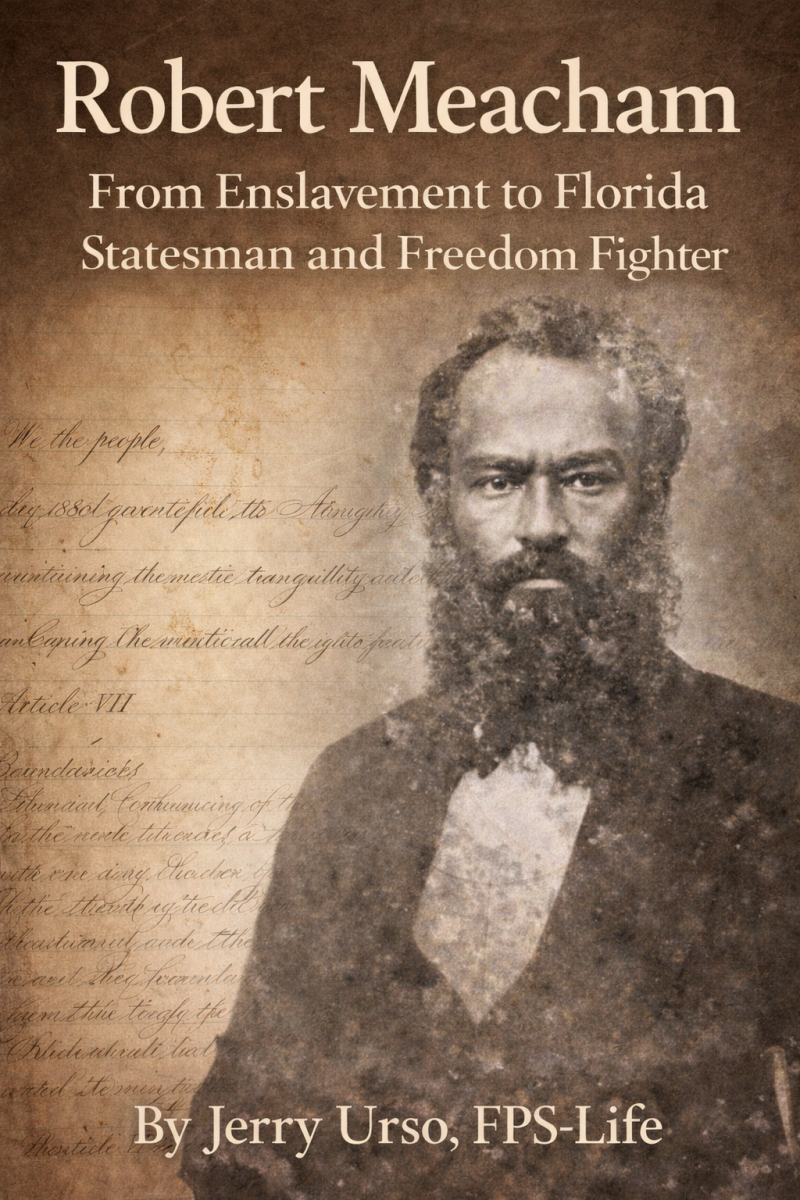
Robert Meacham: From Enslavement to Florida Statesman and Masonic Pioneer
By Jerry Urso, FPS-Life
I. Introduction
Robert Meacham (1835–1902) was a monumental figure in Florida’s history, serving as a bridge between the era of enslavement and the dawn of African American political, religious, and civic agency during Reconstruction [1][2]. His life spanned one of the most volatile transitions in American history—moving from slavery through emancipation and into an era when African Americans briefly exercised real political power, only to face organized and often violent resistance.
Born enslaved in Quincy, Florida, Meacham was one of the sons of his enslaver and received an education from his father [1][3]. This early access to literacy—extraordinary for an enslaved person—would later become one of his most powerful tools. Demonstrating remarkable resolve, Meacham purchased freedom for himself and his mother using money saved from gratuities given to him by his father [3]. That act of self-emancipation marked the beginning of a life devoted to transforming personal freedom into collective advancement.
Meacham’s significance rests not in a single role but in the breadth of his influence. He emerged as a religious leader in the African Methodist Episcopal Church, a constitutional framer during Reconstruction, a long-serving Florida state senator, an architect of Florida’s public education system, a federal appointee, and a founder of Prince Hall Freemasonry in Florida. Few Black leaders of the nineteenth century operated simultaneously across so many institutional arenas—and fewer still did so under constant threat of violence.
II. Early Life and Emancipation
Meacham’s early life under slavery profoundly shaped his worldview. Enslaved yet educated, he occupied a rare and precarious position—able to read and write in a society that criminalized Black literacy, yet denied legal personhood. Literacy allowed him to study scripture, understand legal documents, and observe the mechanics of power in a slave society that depended on Black ignorance for control.
His ability to purchase freedom for himself and his mother before the end of the Civil War placed him among a small number of enslaved Floridians who transitioned into freedom with preparation rather than desperation [1][3]. This early independence allowed Meacham to move quickly into leadership roles after emancipation, while many others were still struggling to secure basic safety.
Importantly, Meacham’s emancipation did not end his vulnerability. Freedom for Black Floridians in the 1860s existed in a landscape of informal control, racial surveillance, and postwar instability. These realities shaped his later insistence on institutional protection—churches, schools, lodges, laws—rather than reliance on goodwill.
III. Spiritual Leadership and the Founding of the AME Church in Florida
Following emancipation, Meacham emerged first as a religious organizer. In 1865, he led 116 freedmen out of the segregated Trinity Methodist Church South in Tallahassee to establish what became Bethel African Methodist Episcopal Church [1]. This was not merely a denominational shift; it was a declaration of autonomy.
The African Methodist Episcopal Church offered African Americans control over doctrine, leadership, education, and community governance. In Florida, the AME Church became one of the earliest institutional platforms through which freedpeople organized politically and socially. Meacham’s leadership placed him at the center of this transformation.
Early services were held beneath a brush arbor at Duval and West Virginia Streets—a temporary structure that nonetheless functioned as a schoolhouse, meeting hall, and organizing space [1]. From this humble beginning, Meacham helped spread the AME Church throughout Florida, using it as a base for what historians describe as Christian Reconstruction—the fusion of faith, literacy, and political mobilization.
This religious work directly fed Meacham’s later political career. Churches became voter-education centers. Ministers became political leaders. Pulpits became platforms for citizenship.
IV. Political Ascendancy and the 1868 Constitutional Convention
In 1868, Meacham was elected as a delegate to Florida’s Constitutional Convention [1][4]. He was one of forty-five signers who finalized the Constitution of the State of Florida on February 25, 1868, placing his name permanently on the document that reshaped Florida law.
In nineteenth-century practice, constitutional “co-authorship” did not mean sole authorship of a document but active participation in drafting, debate, and committee work. Meacham was not a symbolic delegate. He is specifically credited with shaping two of the most transformative sections of the constitution.
First, Meacham emerged as the leading advocate for Article VIII, which mandated the creation of a uniform system of free public schools for all children in Florida, regardless of race [1]. This provision represented a radical break from Florida’s antebellum legal order and laid the groundwork for the modern public education system.
Second, Meacham worked to strengthen the Declaration of Rights, ensuring that African Americans were explicitly recognized as citizens entitled to legal protection. This language completed the legal transformation from enslaved status to civic personhood—something emancipation alone could not achieve.
That same year, Meacham was appointed Clerk of the Circuit Court for Jefferson County, making him one of the earliest African Americans to hold judicial administrative authority in Florida [2][4]. This appointment placed him at the intersection of law, governance, and enforcement during a period when Black authority itself was under challenge.
Legislative Leadership in the Florida Senate (1868–1879)
Robert Meacham’s election to the Florida State Senate in 1868 marked the beginning of one of the longest and most consequential legislative careers held by an African American in Reconstruction-era Florida. He served continuously until 1879, representing Jefferson County and Gadsden County, a decade that spanned the rise, peak, and violent dismantling of Reconstruction governance in the state [1][5][6].
Meacham entered the Senate at a time when Florida’s government was being rebuilt almost from the ground up. Former Confederate elites sought to regain control, newly enfranchised Black voters demanded representation, and federal authority hovered unevenly over state politics. Within this volatile environment, Meacham was not a symbolic presence. He was a working legislator who drafted bills, chaired committees, and shaped policy.
Committee Work and Legislative Scope
Meacham served on multiple Senate committees, most notably rising to become Chairman of the Senate Committee on Education [1]. This position gave him direct influence over the most transformative area of Reconstruction policy: public schooling. Education was not an abstract concern for Meacham; it was the structural defense of freedom. Without literacy, Black citizenship would remain vulnerable.
His legislative work extended beyond education into public administration and local governance. Meacham consistently supported measures that strengthened state oversight, knowing that local authorities—especially in counties hostile to Reconstruction—could not be trusted to enforce civil rights fairly. His approach reflected an acute awareness of how power operated on the ground.
VI. From Constitution to Law: The School Law of 1869
The 1868 Constitution promised a uniform system of free public schools, but Meacham understood that constitutional language alone would not survive political resistance. In 1869, he authored and successfully guided through the legislature what became known as the School Law of 1869 [1].
This statute provided the operational framework necessary to make public education real. It established funding mechanisms, administrative authority, and statewide supervision. In effect, it transformed Article VIII from aspiration into enforceable policy. Without this law, Florida’s public education system would have remained theoretical.
Meacham’s strategy was deliberate. Rather than relying on local discretion, the School Law strengthened state control, limiting the ability of hostile counties to sabotage implementation. This approach reflected lessons Meacham had already learned through church organizing and election work: rights without enforcement were temporary.
As chairman of the education committee, Meacham defended the law repeatedly against attempts to weaken or defund it. He framed education as essential infrastructure for Florida’s recovery—necessary for economic stability, civic order, and democratic participation. This framing allowed him to secure limited biracial support in a deeply divided legislature.
VII. Militia Violence, Election Terror, and Death Threats
Meacham’s legislative service cannot be separated from the organized violence that surrounded it. Reconstruction-era Florida saw the rise of white paramilitary organizations—often described as informal militias—that functioned as enforcement arms of political resistance [1][6]. These groups targeted Black voters, officeholders, and institutions that symbolized Reconstruction authority.
Jefferson County was among the most dangerous regions in the state for Black political leaders. Armed intimidation at polling places, night rides, and direct death threats were common tactics used to suppress African American participation. Meacham, as a visible legislator, election organizer, and education advocate, became a consistent target [1].
On Election Day in 1870, Meacham was fired upon while assisting Black voters in Monticello [1]. The attack occurred amid widespread election violence intended to suppress turnout and intimidate Reconstruction officials. This was not an isolated act of personal hostility, but part of a coordinated pattern of militia-driven terror designed to dismantle Black governance.
Throughout his Senate tenure, Meacham lived under continuous threat of assassination. While no single formal assassination attempt beyond documented shootings survives in the record, historians confirm that Black legislators in Florida routinely operated under armed surveillance and explicit threats to their lives [1]. Meacham’s survival was not evidence of safety, but of constant vigilance.
As federal enforcement weakened during the 1870s, militia activity intensified. White “Redeemer” factions increasingly relied on violence rather than elections to regain political control. That Meacham remained in office until 1879 places him among the last Black legislators to withstand this campaign of terror in Florida [1][6].
VIII. Holding the Line as Reconstruction Collapsed
By the mid-1870s, Reconstruction in Florida was unraveling. Federal support diminished, Republican power eroded, and white supremacist governments reasserted control. In this environment, Meacham’s legislative work shifted from expansion to defense.
He fought to preserve institutions already built: schools already opened, laws already enacted, offices already held by African Americans. His continued presence in the Senate served as a barrier—however fragile—against the complete dismantling of Reconstruction gains.
Meacham’s decade in office was not marked by dramatic victory at the end. Instead, it was defined by endurance. He legislated while the ground beneath him shifted, knowing that much of what he built might be taken away, yet acting as if permanence were still possible.
IX. Superintendent of Common Schools and Educational Administration
In addition to his legislative duties, Robert Meacham played a direct administrative role in building Florida’s public education system. He served as Superintendent of Common Schools, a position that placed him on the front lines of implementing the very laws he had helped draft and pass [2].
This role was not ceremonial. The superintendent was responsible for organizing school districts, overseeing funding distribution, monitoring compliance with state law, and reporting progress to state authorities. In counties openly hostile to Reconstruction, this work was often met with resistance or outright obstruction. Local officials sometimes refused to cooperate, withheld funds, or ignored mandates related to Black education.
Meacham’s experience as a legislator informed his approach. He understood where the law was vulnerable and where enforcement mattered most. His insistence on documentation, reporting, and centralized oversight reflected lessons learned from militia violence and local sabotage. Schools, like elections, required protection.
After serving two years as superintendent, Meacham was appointed Postmaster of Monticello, a federal position that placed him under national authority rather than local control [2]. This appointment removed him from one danger zone but did not end his public service.
In 1871, Meacham returned to the role of superintendent for an additional two-year term, demonstrating continued confidence in his leadership despite the increasingly hostile political climate [2]. His repeated appointments reflected not only competence, but resilience—few Black officials were able to reenter public office once displaced during Reconstruction.
X. Federal Service and Strategic Survival
In 1880, Meacham was appointed Postmaster of Punta Gorda, Florida, extending his public service into South Florida [2]. Federal appointments during this period often functioned as both recognition and refuge. As state governments fell under Redeemer control, federal offices remained one of the few spaces where African Americans could exercise authority with some degree of protection.
Meacham’s postmasterships were not symbolic. The post office was a central institution in nineteenth-century communities—connecting commerce, communication, and governance. Holding such a position placed Meacham at the intersection of local life and federal power, allowing him to continue serving the public even as Reconstruction receded.
This transition from state legislator to federal administrator reflects Meacham’s adaptability. He did not abandon public life when state politics became untenable. Instead, he shifted arenas, preserving influence where possible and survival where necessary.
XI. Masonic Leadership and Institutional Stability
Alongside his political and educational work, Meacham played a foundational role in Black Freemasonry in Florida. In 1868, he co-founded Solomon Lodge No. 7 in Jefferson County, later renumbered Solomon Lodge No. 6, under the jurisdiction of the Most Worshipful Union Grand Lodge of Florida, Prince Hall Affiliated [1][5].
Prince Hall Freemasonry provided African American men with structured leadership training, mutual aid, moral instruction, and organizational discipline. During Reconstruction, lodges often functioned as parallel civic institutions—supporting widows, educating youth, coordinating political action, and offering protection where formal law failed.
Meacham’s involvement in Freemasonry complemented his legislative philosophy. Where the state could not always be trusted to protect Black citizens, fraternal institutions provided continuity, stability, and internal governance. Solomon Lodge became one of the cornerstones of Black civic life in North Florida, helping sustain leadership networks long after Reconstruction collapsed.
XII. Later Years, Violence, and Declining Health
By the mid-1890s, Meacham’s health had begun to decline. In 1896, he relocated to Tampa, seeking relief and medical care [3]. Yet even in retirement, he was not insulated from violence.
That same year, Meacham survived a documented shooting incident, confirming that Black political leaders remained targets long after leaving office [3]. This attack underscores a central reality of his life: danger did not end with resignation. His identity as a former senator, constitutional framer, and public official continued to mark him as a threat to white supremacy.
Despite declining health and persistent risk, Meacham remained a respected figure in Black civic life until his death.
XIII. Death, Burial, and the Lost Grave
Robert Meacham died in 1902 at the age of sixty-six [3]. He was buried in College Hill Cemetery in Tampa, a burial ground serving African American and Cuban communities [6][7].
Over time, the cemetery was subjected to redlining, neglect, and urban redevelopment. Meacham’s grave was lost, and it is now believed to lie beneath a parking lot associated with the Italian Club Cemetery [6][7]. The erasure of his burial site reflects a broader pattern in which Black historic spaces were destroyed or built over without documentation or preservation.
XIV. Family Legacy
Meacham met his wife, Stella, while both were employed as servants in Tallahassee [7]. Their family legacy extended beyond his lifetime.
His daughter-in-law, Christina Meacham (1865–1927), became a prominent educator and school principal in Tampa. Her work in public education continued the Meacham family’s commitment to learning and civic responsibility. The Meacham Early Childhood Center bears her name, preserving that legacy for future generations [7].
XV. Reconstruction in Florida and the Meaning of Meacham’s Career
Robert Meacham’s life cannot be separated from the larger trajectory of Reconstruction in Florida—a period defined by extraordinary possibility followed by deliberate destruction. Between 1865 and the late 1870s, African Americans briefly exercised real political power, built institutions, and reshaped state law. Meacham stood at the center of this transformation.
Florida’s Reconstruction government was among the most ambitious in the South. It produced one of the most progressive constitutions of the era, expanded suffrage, and established public education for the first time. Yet it also faced relentless opposition from white supremacist factions who viewed Black citizenship as an existential threat. Armed militias, election terror, and political assassination were not deviations from the system—they were tools of counterrevolution [1][6].
Meacham’s career traces this arc precisely. He entered public life at Reconstruction’s opening, helped draft its constitutional foundation, spent more than a decade defending its institutions in the legislature, and survived long enough to witness its dismantling. That continuity makes him one of the clearest lenses through which to understand the era.
XVI. Why Meacham Endured When Others Fell
Many Black leaders of Reconstruction were driven out of office, forced into exile, or killed. Meacham endured longer than most. This endurance was not accidental.
First, Meacham understood institutional layering. He did not rely on politics alone. Churches reinforced schools. Schools reinforced voting. Lodges reinforced leadership. Federal appointments provided refuge when state authority collapsed. Each institution supported the others.
Second, Meacham practiced strategic restraint. He framed reforms—especially education—not as racial demands but as civic necessities. This did not eliminate opposition, but it delayed retaliation long enough for structures to take root.
Third, Meacham accepted risk as permanent. He did not treat death threats, militia violence, or election terror as temporary crises. They were conditions of governance. His ability to function within that reality—without illusion—allowed him to continue when others could not [1].
XVII. The Erasure of Memory and the Work of Recovery
The loss of Robert Meacham’s grave is not incidental. It reflects the same forces that dismantled Reconstruction itself. Redlining, urban renewal, and deliberate neglect erased Black cemeteries, churches, and neighborhoods across Florida in the twentieth century. Memory was buried along with bodies [6][7].
That Meacham’s burial site now lies beneath a parking lot is symbolic. A man who helped write Florida’s constitution, establish its schools, and defend its laws was denied even a marked resting place. This absence is part of the historical record.
Recent efforts by historians, journalists, and the NAACP to locate and commemorate Meacham’s burial site represent a second Reconstruction—one rooted in historical truth rather than political power [6]. Recovery of memory becomes an act of justice.
XVIII. Conclusion
Robert Meacham’s life stands as one of the clearest examples of African American statecraft during Reconstruction. Born enslaved, he purchased freedom, founded churches, framed a constitution, built a public school system, served more than a decade in the Florida Senate under militia threat, held federal office, and helped anchor Black Freemasonry in Florida.
He governed while under fire.
He legislated while hunted.
He built institutions knowing they might be attacked.
Reconstruction did not fail because men like Robert Meacham were naïve or ineffective. It failed because it was violently overthrown. What remains—schools, constitutional principles, civic traditions—exists because Meacham and others like him refused to abandon the law even when it could not fully protect them.
He did not simply live through history.
He wrote it, defended it, and paid for it in risk.
Sources
[1] Brown, Canter Jr. “Where Are Now the Hopes I Cherished? The Life and Times of Robert Meacham.” Florida Historical Quarterly, vol. 69, no. 1, 1990.
[2] Florida Memory. “Public Office and Appointment Records, Robert Meacham.”
[3] WTSP News. “Grave of Florida Sen. Robert Meacham Could Be Under Tampa Lot.”
[4] Florida Memory. “Constitution of the State of Florida, 1868.”
[5] ECB Publishing. “Freemasonry and the Solomon Lodge of Jefferson County.”
[6] Tampa Bay Times. “NAACP to Tampa for Juneteenth: Find Robert Meacham.”
[7] Florida Memory. “Christina Meacham.”
