
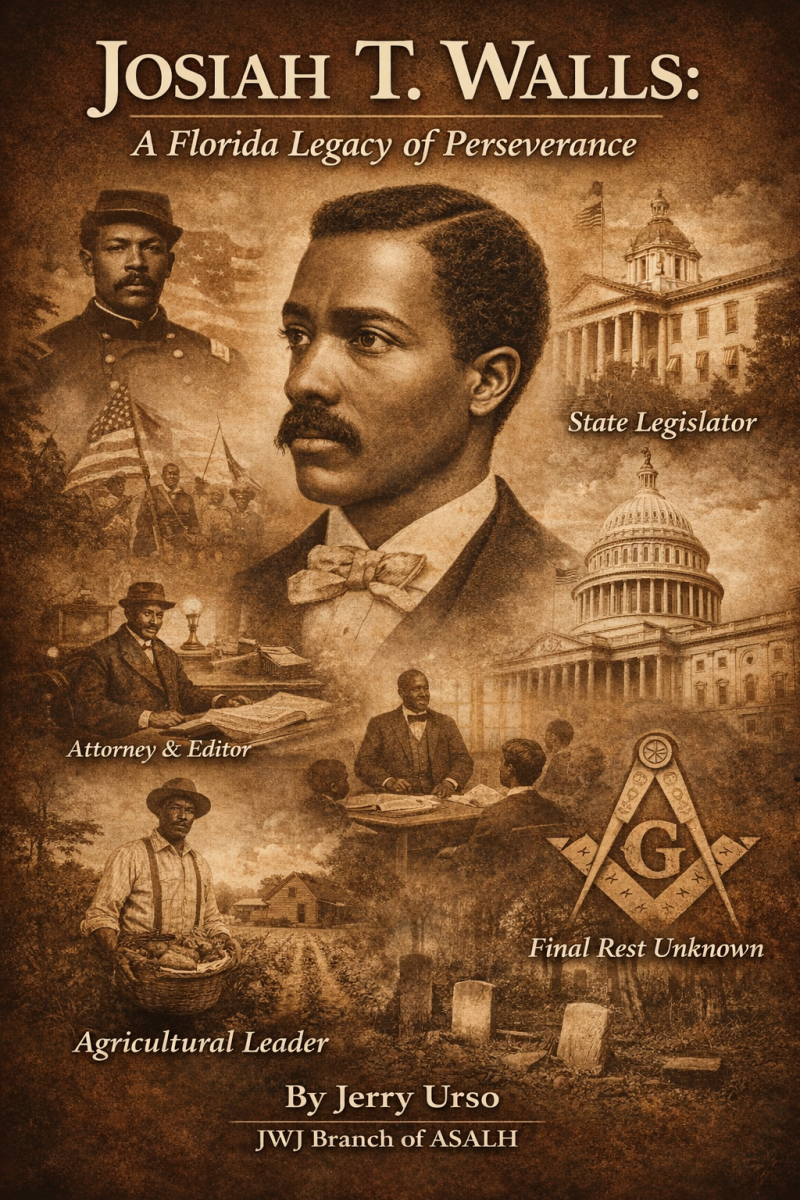
EARLY LIFE
Josiah Thomas Walls was born into bondage in 1842 near Winchester, Virginia, in the Shenandoah Valley — a region that would soon become one of the most contested theaters of the Civil War. He was born enslaved in a society that structured every law, every economic system, and every public institution around the ownership of Black bodies. His early life unfolded in a landscape defined by agricultural wealth, Confederate loyalty, and racial subjugation. Yet even within that system, Walls acquired literacy — an extraordinary fact in itself. Literacy for an enslaved child was not accidental. It implied proximity to white households, exposure to instruction, and an unusual access to intellectual development that would later shape his public life [1].
The Shenandoah Valley was both fertile farmland and military corridor. When war broke out in 1861, Virginia became the heart of the Confederacy. Winchester changed hands more than seventy times during the war. For a young enslaved man like Walls, the war did not arrive as abstract politics — it arrived as marching columns, gunfire, and shifting control. Enslaved men were often conscripted into labor units attached to Confederate forces. Walls, like many young enslaved Virginians, was impressed into Confederate service.
That moment — forced military service for a government defending slavery — would mark the first great contradiction of his life.
He entered the war as enslaved property under Confederate authority. He would leave it as a Union soldier in the United States Colored Troops.
CONFEDERATE SERVICE
When Confederate forces mobilized, enslaved men were routinely compelled into support roles: building fortifications, transporting supplies, maintaining camps, digging trenches, and serving as teamsters. Walls was drawn into this system. The Confederacy did not recognize Black soldiers as soldiers — they were labor assets attached to military units.
As Union armies penetrated the Shenandoah Valley, thousands of enslaved men fled to Union lines. Capture did not always mean punishment — sometimes it meant liberation. At some point during Union operations in the Valley, Walls came under Union control.
That transition changed everything.
Captured by Union forces, Walls was transported north to Harrisburg, Pennsylvania. There he encountered something enslaved Virginians rarely saw: organized Black recruitment into federal military service. After the Emancipation Proclamation and the formation of the Bureau of Colored Troops in 1863, the Union Army began recruiting African American men in earnest. Frederick Douglass himself urged Black men to enlist, arguing that military service would secure citizenship rights.
Walls enlisted in the 3rd United States Colored Infantry (USCT) [2].
This was not symbolic service. The 3rd USCT was an active combat regiment. Black soldiers in USCT units faced not only battlefield dangers but the additional threat that if captured by Confederates they could be executed or returned to slavery. The Confederacy did not treat Black Union soldiers as lawful combatants.
Walls rose to the rank of sergeant — a position requiring literacy, leadership, and discipline [3]. That advancement tells us something critical: he was not merely present; he was trusted with command responsibilities.
UNION ARMY & U.S.C.T. SERVICE
The 3rd USCT served primarily in the Department of the South and later in Florida operations. The regiment was involved in coastal expeditions and security operations in Confederate territory. Black regiments were often assigned to some of the most difficult assignments — guarding supply lines, defending isolated posts, and engaging in direct assaults under severe conditions.
Florida during the Civil War was strategically important because of its cattle, salt works, and supply routes. Union incursions into Florida aimed to disrupt Confederate logistics and reassert federal authority.
By serving in the USCT, Walls was not merely fighting for the Union — he was participating in the redefinition of American citizenship. Black soldiers proved on battlefields from Fort Wagner to Olustee that African Americans would fight for the nation. Their service laid the moral and political groundwork for the 14th and 15th Amendments.
Walls was mustered out in 1865 in Florida [4].
This geographic detail matters. He did not return to Virginia. He remained in Florida — a state that would become central to Reconstruction politics and to his own rise as a civic leader.
In Florida, Union occupation and Freedmen’s Bureau activity created new political space. Black veterans, particularly USCT veterans, became leaders in Reconstruction communities. Military service translated into political credibility.
Walls married Helen Ferguson, a local woman, and settled in Alachua County near Gainesville. The former enslaved Virginian had become a Union veteran in a Southern state under federal reconstruction authority.
FLORIDA MILITIA & RECONSTRUCTION VIOLENCE
When Josiah T. Walls settled in Alachua County after mustering out of the Union Army in 1865, Florida was not a peaceful frontier of opportunity. It was a former Confederate state under military supervision. Federal Reconstruction policy required the reorganization of state governments, the ratification of the 14th Amendment, and the protection of newly freed citizens.
But emancipation did not end white resistance. It intensified it.
Between 1866 and 1871, Florida — like much of the South — became a battleground of organized white terror. The Ku Klux Klan and similar paramilitary groups targeted Black officeholders, Union veterans, teachers, and Republican organizers. Violence was not random; it was political. The objective was to reverse Reconstruction by intimidation.
As a Union veteran and emerging Black civic leader, Walls entered this climate fully aware of the risks.
USCT veterans often formed the backbone of local militias aligned with Republican Reconstruction governments. These militias were legal, state-recognized defense forces intended to suppress insurgent violence and protect Black voters. Walls participated in Florida’s reorganized militia structure during Reconstruction, aligning himself with the Republican state apparatus that sought to enforce new constitutional protections [5].
The very existence of Black-led militia units enraged former Confederates. Armed Black men in uniform represented the collapse of the old racial hierarchy.
Congress responded to escalating Southern violence by passing the Enforcement Acts (1870–71), empowering federal authorities to prosecute Klan conspiracies. Congressional hearings in 1871 documented organized terror across Southern states, including Florida [6]. Though Walls was not yet in Congress at the time of the earliest hearings, the environment those hearings described formed the political atmosphere into which he would soon be elected.
The threats were real. Black legislators across the South were assaulted, threatened, or driven from office. In Florida, intimidation campaigns were designed to suppress Republican turnout. Later, during Walls’ congressional contests, allegations of intimidation would be central to the contested election disputes that repeatedly challenged his seat.
He emerged from this violent crucible not as a retreating figure but as one stepping further into public service.
ATTORNEY & NEWSPAPER MAN
Walls understood that Reconstruction power required not only ballots but institutions.
In Alachua County he entered business, law, and publishing. The 1870 census recorded him as a farmer of modest means [7]. Yet within three years he would purchase substantial acreage and establish himself as a prosperous truck farmer. This economic independence was not incidental. Land ownership gave Black leaders insulation from economic retaliation.
He also studied law and entered practice. Though the formal details of his legal training remain sparse, by 1874 he was practicing law in Florida in partnership with prominent Black political leaders Henry Harmon and William U. Saunders [8]. In Reconstruction Florida, Black attorneys were rare and politically significant. Legal knowledge was a weapon against voter suppression, contract fraud, and discriminatory prosecutions.
But perhaps his most influential civic venture was in journalism.
In 1873 Walls purchased the Gainesville New Era, making it one of Florida’s first Black-owned newspapers [9]. The press was essential to Reconstruction politics. White Democratic papers openly attacked Republican officeholders, frequently deploying racial slurs and incitements. A Black-owned paper provided counter-narrative, political mobilization, and civic instruction.
The hostility of the white press is visible in contemporary coverage. The Palatka Daily News in July 1884 published language referring to Walls in openly racist terms while discussing Republican organizing efforts [10]. Such coverage illustrates the venom directed at him not merely as a politician, but as a Black political actor.
Similarly, the Florida Times-Union frequently referenced Walls in political reporting — sometimes neutrally, often within contentious partisan contexts [11]. By the early 1880s, he was routinely identified as “ex-Congressman Walls” and described as a wealthy planter in Alachua County [12].
These press references reveal two things: first, that Walls remained politically visible long after his congressional service; second, that white political networks viewed him as a continuing threat to Democratic dominance.
Owning a newspaper during Reconstruction was not a passive business decision. It was an act of political resistance.
STATE CONSTITUTIONAL & LEGISLATIVE SERVICE
Walls’ rise into formal political office came swiftly.
Florida was required to draft a new constitution in 1868 to regain full representation in Congress. The Constitutional Convention of 1868 was one of the most consequential political gatherings in Florida history. Black delegates participated alongside white Republicans to construct a new state framework guaranteeing civil rights and public education.
Walls became part of Florida’s Reconstruction political structure and soon won election to the Florida House of Representatives. He later served in the Florida Senate from 1870 to 1872 [13].
The Reconstruction legislature pursued sweeping reforms: establishment of a statewide public school system, expansion of civil rights protections, and internal improvement initiatives. Florida’s new constitution mandated public education for both races — a radical departure from antebellum law.
Walls aligned himself with internal improvements — infrastructure projects designed to stimulate economic development. Railroads, waterways, and harbor improvements were central to Reconstruction economic planning. These early state-level commitments foreshadowed his later federal advocacy for a canal across the Florida peninsula.
His service in the state senate also placed him in direct conflict with Democratic Redeemers who sought to regain control. White supremacist factions accused Reconstruction governments of corruption and illegitimacy. Yet Black legislators like Walls were often among the most financially prudent members, focused on agricultural development and public education.
The racial hostility he faced did not subside after state service. When he later ran for Congress, his opponents were frequently former Confederate officers. His elections were contested repeatedly on allegations of fraud or intimidation — often weaponized to unseat him.
By 1870, however, the Reconstruction electorate in Florida’s Second Congressional District sent him to Washington.
He became Florida’s first Black congressman.
STATE CONSTITUTIONAL & LEGISLATIVE SERVICE
When Josiah T. Walls entered Florida’s political life in the late 1860s, the state was not merely reorganizing government — it was reconstructing its identity. The 1868 Constitutional Convention was a battleground between former Confederates, Northern Republicans, Black delegates, and moderates who sought stability amid social revolution. Florida had to draft a new constitution in order to regain representation in Congress under federal Reconstruction policy.
Walls emerged during this fragile transition. As a Union veteran and literate Black landholder in Alachua County, he represented precisely the type of leadership Reconstruction sought to cultivate: disciplined, property-owning, and civically engaged.
The Constitution of 1868 established Florida’s first statewide public education system, guaranteed civil rights protections, and expanded suffrage to Black men [1]. These were not abstract clauses. They were structural changes that disrupted the antebellum racial order. White resistance was immediate.
Walls entered the Florida House of Representatives soon after and later served in the Florida Senate from 1870 to 1872 [2]. During this period, the legislature faced two intertwined crises: economic stagnation and racial violence.
The Reconstruction legislature attempted to modernize Florida’s economy through internal improvements. Railroads, canals, harbor expansion, and agricultural development were central goals. Florida remained largely rural and underdeveloped compared to other Southern states. Infrastructure meant survival.
Walls aligned himself with this development vision. He supported measures to strengthen transportation and agricultural commerce. These priorities would later define his congressional career.
But governance under Reconstruction was not simply about economic policy. It was about survival.
White paramilitary groups intensified attacks on Black voters and officeholders. Florida’s militia system — reorganized under Republican control — attempted to suppress insurgent violence [3]. The presence of Black legislators like Walls in Tallahassee enraged Redeemer factions who framed Reconstruction governments as illegitimate.
Yet Walls did not retreat from public life. Instead, he expanded his influence — preparing to seek federal office.
FEDERAL CONGRESSIONAL SERVICE
In 1870, voters in Florida’s Second Congressional District elected Josiah T. Walls to the United States House of Representatives. When he took office in 1871 in the 42nd Congress, he joined a small but historically significant cohort of Black legislators serving during Reconstruction [4].
His presence in Washington was itself revolutionary. A man born enslaved in Virginia now debated national policy under the dome of the Capitol.
Walls served on committees concerned with public lands and infrastructure — assignments consistent with Florida’s development needs [5]. He introduced and supported legislation aimed at improving rivers and harbors, securing federal land grants, and encouraging agricultural expansion.
But his tenure was anything but secure.
Former Confederate officer Silas L. Niblack contested his election repeatedly. In 1872, Walls won reelection to the 43rd Congress. In 1874, he was again elected to the 44th Congress — only to have his seat contested and ultimately awarded to his opponent amid claims of intimidation [6].
These contests cannot be understood outside the violent political climate of the 1870s. Democratic Redeemers sought to dismantle Reconstruction by suppressing Black turnout and challenging Republican victories. Allegations of fraud often masked coordinated intimidation campaigns against Black voters.
Congressional debates over his seat reflected national fatigue with Reconstruction enforcement. By the mid-1870s, Northern political will was weakening. The Panic of 1873 shifted focus to economic crisis. Southern Democrats exploited this shift.
Though not the subject of a documented assassination attempt, Walls served during a period when Black congressmen received threats and when Southern political violence was common. Congressional investigations in the early 1870s documented Klan activity across Southern states, including Florida [7]. The pressure on Black officeholders was constant.
Yet within this hostile environment, Walls distinguished himself not through inflammatory rhetoric but through practical legislative advocacy.
THE SHIP CANAL & INTERNAL IMPROVEMENTS
Among Walls’ most forward-looking initiatives was his support for a canal across the Florida peninsula — a project that, if realized in the 1870s, would have transformed national commerce.
At the time, vessels traveling between the Atlantic seaboard and Gulf ports had to navigate the long and dangerous route around the Florida Keys. A canal through central Florida would shorten shipping distances, reduce costs, and open Gulf agricultural regions to expanded markets.
Walls advocated federal support for such a project as part of broader internal improvement policy [8]. In 1874, he delivered testimony supporting canal construction, arguing that the economic future of Florida depended on transportation infrastructure [9].
His advocacy was grounded in lived experience. After leaving Congress, he became one of Alachua County’s most successful truck farmers. By the early 1880s, newspapers described him as shipping thousands of crates of cucumbers and tomatoes daily during peak seasons [10]. Efficient transport meant competitive advantage.
The Buffalo Post in June 1882 referenced his success in “tried farming, and politics,” noting that when Democrats regained ascendancy in the South, Walls turned his attention to raising vegetables in Alachua County [11].
The canal project he envisioned would not be realized in his lifetime. But the idea persisted, eventually resurfacing as the Cross Florida Barge Canal project in the twentieth century.
Walls was advocating infrastructure modernization decades before Florida possessed the industrial capacity to complete it.
GAINESVILLE MAYOR & LOCAL CIVIC LEADERSHIP
After his contested removal from Congress in 1876, Walls returned to Florida politics and agriculture. In 1873, he briefly served as mayor of Gainesville — making him the first Black mayor in the city’s history [12].
Municipal leadership during Reconstruction was fraught with instability. Democratic Redeemers targeted local governments as aggressively as state and federal offices. Black mayors and council members often served short, contested terms.
Yet Walls’ civic stature in Alachua County endured.
By the early 1880s, the Semi-Weekly Times-Union described him as “ex-Congressman Walls,” now a wealthy planter near Archer [13]. The label “ex-Congressman” carried weight. It signaled continued political relevance.
His name appeared frequently in Florida newspapers throughout the 1880s and early 1890s. The Florida Times-Union (July 29, 1882) reported on his political positions [14]. The Weekly Floridian (September 18, 1888) mentioned his continued engagement in Republican organizing [15]. The Florida Times-Union (November 9, 1891) referenced him again in political reporting [16]. The Semi-Weekly Times-Union (August 4, 1892) noted his activity in Republican circles [17].
These citations demonstrate that Walls remained an active political presence long after his congressional service ended.
He did not disappear into obscurity.
Instead, he embodied a different model of leadership: economic independence combined with continued civic engagement.
FARMER, LANDHOLDER, AND ECONOMIC ARCHITECT OF INDEPENDENCE
When the political storms of Washington quieted around him, Josiah T. Walls did not disappear. He did what many of the most resilient Black leaders of Reconstruction did — he returned to the land, not in defeat, but in strategy.
By the early 1880s, the former Congressman had become one of the most substantial agricultural operators in Alachua County. Census data from 1880 reflects the scale of his holdings, but newspapers of the period tell the fuller story. In June 1882, the Buffalo Post reported that Walls, once active in Congress, had “tried farming, and politics,” and that when Democrats regained ascendancy in the South, he turned his efforts toward raising vegetables in Alachua County [18]. The remark was casual — but the implication was profound. Walls had not collapsed after political removal. He had recalibrated.
Florida’s truck-farming boom was underway. Rail lines allowed perishable crops to move north at unprecedented speed. Tomatoes, cucumbers, and early vegetables from Florida could reach markets in New York and Philadelphia before northern fields thawed. Those who mastered timing and logistics could build wealth.
Walls mastered it.
The Semi-Weekly Times-Union in September 1883 referred to him as a “wealthy planter and truck grower” near Archer, Florida [19]. That phrase matters. “Wealthy planter” was language long reserved for white Southern landholders. Its application to a formerly enslaved Black man underscored the economic transformation Reconstruction had briefly made possible.
But this was not simply about prosperity. It was about autonomy.
Land ownership insulated Walls from total political vulnerability. Unlike many Black officeholders who depended on patronage positions, Walls built independent agricultural capital. When newspapers such as the Florida Times-Union (July 29, 1882) referenced his ongoing political presence, they did so in the context of a man who was no longer financially dependent on office [20].
He could engage politics because he did not need politics to survive.
Yet the land that sustained him would also test him.
THE GREAT FREEZE AND THE FRACTURE OF FLORIDA AGRICULTURE
The winter of 1894–1895 descended like a sentence.
Florida’s climate — long its advantage — betrayed its growers. Hard freezes struck repeatedly. Citrus groves turned black. Vegetable crops collapsed. Orchards that had taken years to cultivate died in nights.
The agricultural disaster was statewide and indiscriminate [21].
For men like Walls, whose operations depended on seasonal production and northern shipment, the freeze was catastrophic. Truck farming required capital investment — seed, labor, freight contracts, land preparation. When the freeze destroyed harvest cycles, it wiped out more than crops. It erased revenue streams.
Florida’s agricultural economy staggered. Many white growers relocated further south. Some abandoned farming entirely. Black landowners faced even greater difficulty because access to credit was restricted and discriminatory lending practices intensified under Redemption politics.
Walls absorbed the shock, but the scale of damage altered the trajectory of his life.
The political class that had once removed him from Congress now presided over a state struggling with economic reconstruction of its own. In newspapers through the late 1880s and early 1890s — including the Weekly Floridian (September 18, 1888) and the Florida Times-Union (November 9, 1891) — Walls continued to be referenced in Republican political reporting [22][23]. He remained a recognizable figure. But his center of gravity had shifted.
He would no longer build through acreage alone.
He would build through instruction.
EDUCATOR, AGRICULTURAL MENTOR, AND MASONIC STATESMAN
By the early twentieth century, Josiah T. Walls relocated to Tallahassee and assumed a role at the institution that would become Florida Agricultural and Mechanical University. Established in 1887 as the State Normal College for Colored Students, the school was part of a broader land-grant educational mission designed to equip Black students with practical and industrial skills [24].
Walls became director of the college farm.
This was not symbolic employment for a former Congressman. It was continuity. Agricultural knowledge had shaped his life from Reconstruction onward. He understood soil cycles, market timing, transportation networks, and the vulnerability of monoculture to climate shock. At FAMU, he passed that experience to young Black students preparing to build livelihoods in a segregated economy.
In this phase of his life, Walls represents a pattern visible among several Reconstruction leaders: when federal politics receded, institution-building advanced.
Parallel to his educational service ran another constant — Prince Hall Freemasonry.
Walls’ name appears throughout the Proceedings of the Most Worshipful Union Grand Lodge of Florida during the decades following his congressional service — 1877, 1886, 1887, 1888, 1889, 1891, 1892, 1893, and 1902 [25–33]. But these references are more than attendance notations. They situate him within the structured civic network that sustained Black leadership across North Florida.
Freemasonry during Redemption was not merely ritual. It was governance. Lodges organized charity, burial funds, leadership discipline, and political discussion spaces shielded from hostile scrutiny. For men stripped of federal office, the lodge room remained a chamber of influence.
Walls’ long continuity in Masonic proceedings reveals stability. He did not withdraw from structured civic life. He remained embedded in the fraternity’s administrative fabric for decades after Reconstruction’s fall.
Most telling is the 1906 Proceedings, where his name appears in the Necrology — the formal memorial roll of departed brethren [34]. While newspapers of the period offered limited obituary attention, the Craft recorded him with institutional dignity.
Within the fraternity, his life was neither erased nor diminished.
THE CANAL VISION AND THE COST OF ITS REJECTION
When Josiah T. Walls advocated for a canal across the Florida peninsula during his congressional tenure, he was thinking in structural terms at a time when Florida’s political leadership was largely consumed with racial retrenchment and partisan recovery. His proposal was not rooted in vanity or regional favoritism. It was rooted in geography and economics. Florida was, and remains, a peninsula whose commerce historically depended upon access between two major bodies of water — the Atlantic Ocean and the Gulf of Mexico. In the nineteenth century, vessels traveling between those coasts were forced to navigate around the Florida Keys, adding distance, time, and cost to every shipment.
Walls understood that transportation infrastructure determines economic destiny. As both a legislator and a working agricultural producer, he recognized that internal improvement was not an abstract ideal but a prerequisite for prosperity. In 1874, he delivered testimony advocating improvements to Florida’s rivers and waterways and supported the development of a canal that would connect the state’s coasts [35]. He argued that such a project would shorten shipping routes, stimulate agricultural expansion, and position Florida as a commercial crossroads rather than a peripheral supplier.
This was not speculative thinking. It was practical modernization.
Yet the political climate surrounding him was deteriorating. Reconstruction, once backed by federal enforcement, was losing national support. Democratic Redeemers were regaining power throughout the South. In Florida, former Confederates and their allies sought not merely to defeat Republican candidates but to dismantle the entire governing philosophy associated with Reconstruction. Walls’ congressional seat was repeatedly contested by Silas L. Niblack, a former Confederate officer, and by 1876 Walls was removed from office amid the broader political unraveling of Reconstruction authority [36].
With his removal, Florida lost a sustained federal advocate for infrastructure development.
The canal project did not collapse because it lacked economic merit. It stalled because the political coalition that supported long-term federal investment in Southern modernization was collapsing. Racial politics narrowed legislative imagination. Projects associated with Black Republican leadership were easily dismissed as impractical or excessive. When Reconstruction governments fell, so too did many of their modernization initiatives.
The long-term consequences are difficult to ignore.
Had a trans-Florida canal been constructed in the late nineteenth century, Gulf Coast ports such as Cedar Key and Tampa might have expanded decades earlier. Agricultural producers could have reduced freight costs and increased export volume. Land values along a canal corridor would likely have risen significantly, encouraging industrial clustering and warehouse development. Florida’s internal integration would have matured more rapidly.
Instead, the idea lingered. It resurfaced in the 1930s during New Deal infrastructure planning and again in the 1960s under the Cross Florida Barge Canal project, before being permanently halted in 1971 [37]. Nearly one hundred years separated Walls’ advocacy from serious execution attempts.
That century represents more than engineering delay. It represents deferred economic acceleration.
Walls’ canal vision stands today as evidence that Reconstruction leadership in Florida was thinking not only about civil rights and representation, but about structural modernization. When racial retrenchment removed Black legislators from influence, the state did not simply lose diversity of office. It lost long-term developmental momentum.
The rejection of his vision cost Florida time — and time in economic development is never neutral.
THE AGRICULTURAL EMPIRE AND THE FREEZE THAT SHATTERED IT
Following his removal from Congress, Walls returned to Alachua County and committed himself fully to agricultural enterprise. He did not retreat from public life in despair; instead, he demonstrated the economic independence that Reconstruction had briefly made possible for a small number of Black landholders.
By the early 1880s, contemporary newspapers across Florida documented his success. The Florida Times-Union in July 1882 referenced him as an active and respected figure in state affairs [38]. The Buffalo Post in June 1882 noted that after Democratic ascendancy reduced Republican political control, Walls had focused his energy on vegetable production in Alachua County [39]. The tone of that report suggested both resilience and adaptation.
The Semi-Weekly Times-Union in September 1883 described him as a “wealthy planter and truck grower” near Archer [40]. Such language was significant in a region where the word “planter” had long been reserved for white landholding elites. Walls had not merely survived Redemption; he had built capital within it.
Florida’s truck farming industry during this period was expanding rapidly. Rail connections allowed perishable crops to reach Northern markets before spoilage. Farmers who mastered the timing of winter harvests could command premium prices. Walls’ operations reportedly shipped large volumes of produce northward during peak season, integrating his farms into interstate commerce.
He remained politically visible as well. The Weekly Floridian (September 18, 1888), the Florida Times-Union (November 9, 1891), and the Semi-Weekly Times-Union (August 4, 1892) continued to reference his presence in Republican organizing and state affairs [41][42][43]. Even after federal office was closed to him, he remained a known political actor.
But agriculture, for all its opportunity, remained dependent upon climate.
The winter of 1894–1895 delivered one of the most destructive freezes in Florida’s recorded history [44]. Citrus groves were destroyed. Vegetable crops failed. Entire agricultural investments were wiped out within days. For growers like Walls, whose livelihood depended upon harvest cycles and shipping schedules, the freeze represented not merely seasonal loss but structural damage.
The prosperity built over two decades weakened dramatically.
The freeze reshaped Florida’s agricultural map. Some growers relocated further south. Others left farming entirely. Black landholders faced particular difficulty in recovering due to limited access to credit under the increasingly segregated financial order.
Walls’ economic world narrowed.
Yet he did not disappear.
EDUCATION, FRATERNITY, AND THE QUIET YEARS
In the early twentieth century, Walls relocated to Tallahassee and assumed leadership of the college farm at the institution that would become Florida Agricultural and Mechanical University [45]. Established in 1887 as the State Normal College for Colored Students, the institution embodied the belief that education and industrial training were essential to Black advancement in the Jim Crow South.
Walls brought to the campus decades of experience — legislative debate, agricultural enterprise, and infrastructure planning. As director of the farm, he trained students in practical cultivation, crop management, and agricultural discipline. His role reflected continuity rather than retreat. Where once he had advocated modernization in Congress, he now cultivated it through instruction.
Simultaneously, he remained active within Prince Hall Freemasonry. Proceedings of the Most Worshipful Union Grand Lodge of Florida throughout the late nineteenth century document his sustained participation in the fraternity’s civic life [46–54]. In an era when Black political officeholding was sharply curtailed, fraternal institutions served as stabilizing pillars of community governance and mutual aid.
In 1906, the Proceedings recorded his name in the Necrology, formally acknowledging his passing within the Craft [55]. Within the fraternity, memory was preserved.
Beyond it, recognition was sparse.
FINAL YEARS
Josiah T. Walls died on May 15, 1905.
The state he had once represented in Congress did not rise in public mourning. Newspapers offered limited acknowledgment. The Reconstruction era had long since been reframed by Redemption politics, and leaders associated with that period were rarely elevated in public commemoration.
More troubling still is the uncertainty surrounding his burial. Historical accounts differ regarding the exact location of his grave. For a man who had once stood in the halls of Congress, whose name had been entered into legislative debates and statewide elections, the ambiguity of his final resting place speaks to the depth of Reconstruction’s erasure in the early twentieth century.
Some accounts suggest that personal sorrow — particularly the conviction and institutionalization of his daughter — weighed heavily on him during his final years. Whether those narratives capture the full truth or reflect retrospective interpretation, it is clear that his closing chapter lacked the public stature of his earlier decades.
He died without the ceremony typically afforded to national legislators.
He died without clear documentation of where he was laid to rest.
He died at a moment when Florida had chosen not to remember the men who attempted to reshape it.
LEGACY RESTORED
And yet history does not remain static.
Over time, scholars, legal associations, civic leaders, and community historians have restored Josiah T. Walls to public consciousness. He is now recognized as Florida’s first Black congressman and one of the early African Americans to serve in the United States House of Representatives. Historical markers in Gainesville commemorate his service. The Josiah T. Walls Bar Association bears his name, linking legal advocacy to Reconstruction heritage.
His canal advocacy has been reevaluated as evidence of early economic foresight. His agricultural success stands as proof that Reconstruction leadership included not only political representation but commercial competence. His educational work at FAMU links the aspirations of Reconstruction to the institutional development of the twentieth century.
For one of Florida’s greatest sons, the ending was undeniably somber. The burial site uncertain. The recognition delayed. The public memory muted for decades.
But silence did not prove permanence.
His story is now told — and retold.
Studied.
Taught.
Reexamined.
The obscurity of his death has become part of his historical narrative, illustrating how Reconstruction leaders were first marginalized and later restored.
His grave may be uncertain.
His place in Florida’s history is not.
REFERENCES
[1] Biographical Directory of the United States Congress, “Josiah T. Walls,” U.S. Congress official biography entry.
[2] U.S. War Department, Compiled Military Service Records, 3rd United States Colored Infantry (U.S.C.T.), National Archives.
[3] New York Public Library, Exhibition Archives, “Josiah Thomas Walls,” Reconstruction-era congressional materials.
[4] U.S. House of Representatives, Office of the Historian, Black Americans in Congress, 1870–2007.
[5] Florida Reconstruction Militia Records, State Archives of Florida.
[6] U.S. Congress, Joint Select Committee to Inquire into the Condition of Affairs in the Late Insurrectionary States (Ku Klux Klan Hearings), 1871.
[7] 1870 U.S. Census, Alachua County, Florida, entry for Josiah T. Walls.
[8] Florida Bar admission records and Reconstruction-era legal partnership references (Walls, Harmon, Saunders).
[9] Gainesville New Era, ownership documentation and press references, 1873.
[10] Palatka Daily News, July 19, 1884, political reporting referencing Josiah T. Walls.
[11] Florida Times-Union, July 29, 1882, political reporting mentioning Walls.
[12] Semi-Weekly Times-Union, September 27, 1883, describing Walls as “wealthy planter and truck grower.”
[13] Florida Senate Historical Records, Reconstruction membership rosters.
[14] U.S. Congress, 42nd Congress (1871–1873), Official House Roster.
[15] U.S. Congress, 43rd Congress (1873–1875), Official House Roster.
[16] U.S. Congress, 44th Congress (1875–1876), Contested Election Records: Walls v. Niblack.
[17] Enforcement Acts documentation and Reconstruction political violence reports, 1870–1876.
[18] 1880 U.S. Census, Alachua County Agricultural Schedules.
[19] Buffalo Post, June 6, 1882, article referencing Walls’ agricultural enterprise.
[20] Florida Times-Union, July 29, 1882, political and agricultural reference.
[21] Contemporary Florida agricultural shipping reports, early 1880s vegetable export documentation.
[22] Weekly Floridian, September 18, 1888, Republican organizing report mentioning Walls.
[23] Florida Times-Union, November 9, 1891, political reporting referencing Walls.
[24] State Normal College for Colored Students (later Florida A&M University), founding charter and early administrative records, 1887.
[25] Proceedings of the Most Worshipful Union Grand Lodge of Florida, 1877 Session.
[26] Proceedings of the Most Worshipful Union Grand Lodge of Florida, 1886 Session.
[27] Proceedings of the Most Worshipful Union Grand Lodge of Florida, 1887 Session.
[28] Proceedings of the Most Worshipful Union Grand Lodge of Florida, 1888 Session.
[29] Proceedings of the Most Worshipful Union Grand Lodge of Florida, 1889 Session.
[30] Proceedings of the Most Worshipful Union Grand Lodge of Florida, 1891 Session.
[31] Proceedings of the Most Worshipful Union Grand Lodge of Florida, 1892 Session.
[32] Proceedings of the Most Worshipful Union Grand Lodge of Florida, 1893 Session.
[33] Proceedings of the Most Worshipful Union Grand Lodge of Florida, 1902 Session.
[34] Proceedings of the Most Worshipful Union Grand Lodge of Florida, 1906 Session, Necrology entry for Josiah T. Walls.
[35] U.S. Congressional Record, 43rd Congress (1873–1875), debates and testimony regarding Florida river and harbor improvements and canal advocacy.
[36] U.S. House Committee on Elections, Contested Election Case Files, Walls v. Niblack, 1875–1876.
[37] U.S. Army Corps of Engineers, Historical Documentation of the Cross Florida Barge Canal Project (1930s–1971).
[38] Florida Times-Union, July 29, 1882, reference to Walls’ continued civic engagement.
[39] Buffalo Post, June 6, 1882, commentary on Walls’ agricultural success.
[40] Semi-Weekly Times-Union, September 27, 1883, economic profile of Walls.
[41] Weekly Floridian, September 18, 1888, political reference to Walls.
[42] Florida Times-Union, November 9, 1891, Republican political activity report.
[43] Semi-Weekly Times-Union, August 4, 1892, mention of Walls in party developments.
[44] Florida State Agricultural Reports and contemporary newspaper accounts of the Great Freeze of 1894–1895.
[45] Florida Agricultural and Mechanical University Archives, documentation of Josiah T. Walls serving as director of the college farm, early 1900s.
[46] MWUGL Proceedings, 1877.
[47] MWUGL Proceedings, 1886.
[48] MWUGL Proceedings, 1887.
[49] MWUGL Proceedings, 1888.
[50] MWUGL Proceedings, 1889.
[51] MWUGL Proceedings, 1891.
[52] MWUGL Proceedings, 1892.
[53] MWUGL Proceedings, 1893.
[54] MWUGL Proceedings, 1902.
[55] MWUGL Proceedings, 1906 Necrology.
