
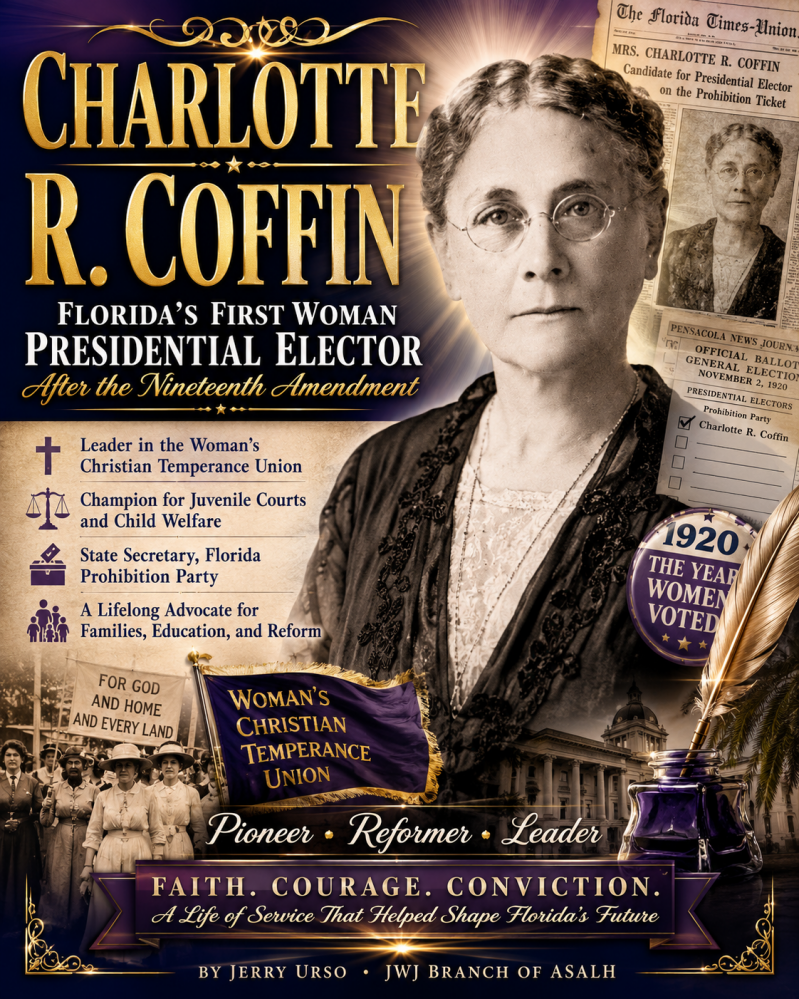
Charlotte R. Coffin
Florida's First Woman Presidential Elector After the Nineteenth Amendment
A Pioneer of the Woman's Christian Temperance Union, the Prohibition Party, and Women's Political Leadership
By Jerry Urso
JWJ Branch of ASALH
Introduction
History often celebrates those who win elections while overlooking those whose work transformed the political landscape long before victory was achieved. Such is the case with Charlotte Rebecca Jones Coffin, one of Florida's most accomplished yet largely forgotten reformers. During an era when women could neither vote nor hold meaningful positions within political parties, Coffin spent decades organizing communities, speaking publicly, advocating legislative reform, and helping build one of the most influential reform movements in American history. Her life intersected with nearly every major Progressive Era cause—temperance, women's suffrage, child welfare, public education, and political reform.[1]
Charlotte Coffin's greatest public achievement came during one of the most significant elections in American history. Following the ratification of the Nineteenth Amendment on August 26, 1920, American women became constitutional voters for the first time. Barely two months later, Florida voters opened their ballots and saw something equally unprecedented. Printed among the candidates for Presidential Elector was the name Charlotte R. Coffin, representing the Prohibition Party.[2] While countless women cast ballots for the first time that November, Charlotte Coffin accomplished something even more remarkable—she stood before the voters herself as a statewide candidate.
The Florida Times-Union, recognizing the importance of the moment, devoted a feature article and portrait to Coffin on October 31, 1920. The newspaper described her years of reform work and identified her as "The First Woman Ever Nominated on the National Ticket as Presidential Elector in the South."[3] Whether viewed from the perspective of women's political history, Florida history, or the national prohibition movement, her nomination represented a milestone that deserves renewed recognition.
Yet Charlotte Coffin's appearance on the ballot did not occur suddenly. It represented the culmination of nearly three decades of public service through three closely related organizations that profoundly influenced American politics: the Woman's Christian Temperance Union (WCTU), the Anti-Saloon League, and the Prohibition Party. Working alongside her husband, John Pingry Coffin, one of Florida's leading prohibition advocates, she became a respected organizer whose influence extended far beyond her rural North Florida community.[4]
To understand Charlotte Coffin's remarkable career, one must first understand the reform movement that shaped her public life. During the closing decades of the nineteenth century, the Woman's Christian Temperance Union emerged as far more than an organization opposed to alcohol. Under the leadership of Frances Elizabeth Willard, it became one of the first national organizations to provide women with practical experience in administration, public speaking, political organization, fundraising, legislative advocacy, and social reform. At a time when women remained excluded from most positions of civic leadership, the WCTU became, in effect, a training ground for an entire generation of female reformers who would later lead campaigns for suffrage, labor reform, education, public health, and child welfare. Willard's famous philosophy of "Do Everything" encouraged members to confront every social problem they believed threatened the American home, transforming the WCTU into one of the largest and most influential women's organizations in the world.
Founded in Cleveland, Ohio, in November 1874, the WCTU sought to create what it described as a "sober and pure world" through abstinence, Christian principles, education, and social reform. Initially focused upon alcohol, the organization rapidly broadened its mission under Willard's leadership to include women's suffrage, prison reform, labor protections, public education, anti-tobacco campaigns, scientific temperance instruction, peace, sanitation, and legislation designed to improve the moral and physical welfare of American families. By the early twentieth century, hundreds of thousands of women belonged to local WCTU chapters throughout the United States and in dozens of countries around the world, making it one of the largest female-led reform organizations in history.
The WCTU's influence extended far beyond moral persuasion. It taught women how to organize conventions, maintain financial records, publish newspapers, lobby legislators, supervise committees, recruit volunteers, and administer statewide organizations. Many historians have argued that these experiences prepared thousands of American women for political participation decades before they received the constitutional right to vote. Charlotte Coffin belonged to this generation. Her years within the WCTU provided the administrative and political skills that later enabled her to serve as a state officer of the Florida Prohibition Party and ultimately become one of Florida's earliest female candidates for statewide office.[5]
Like many reform organizations of the Progressive Era, however, the WCTU reflected the contradictions of the society in which it operated. While it welcomed African American women and created departments devoted to work among Black communities, tensions emerged as national leaders increasingly sought support from white Southern members. African American reformers such as Frances Ellen Watkins Harper, Lucy Thurman, and later Ida B. Wells challenged the organization's willingness to compromise on questions of racial equality. Those debates became some of the most significant internal controversies in the WCTU's history and reveal the complicated relationship between reform, race, and politics in late nineteenth-century America. Charlotte Coffin served within that national organization, and understanding both its achievements and its shortcomings provides important context for evaluating her own career.
Charlotte Rebecca Jones was born on August 16, 1855, in Rushville, Ontario County, New York, the daughter of John Levis Jones. During her lifetime she would witness extraordinary changes in American society. Born only a decade before the Civil War, she lived through Reconstruction, the Gilded Age, the Progressive Era, the adoption of constitutional prohibition, the achievement of woman suffrage, the Great Depression, and the final years of national Prohibition. Few reformers experienced such a sweeping period of American transformation, and fewer still played an active role in shaping it.[6]
Her story is not merely the biography of a prohibition advocate. It is the story of how ordinary women built extraordinary organizations that changed American politics long before they themselves possessed political equality. Charlotte Rebecca Coffin helped open the door through which later generations of women would walk—not simply as voters, but as candidates, party leaders, and public officials. Her life deserves to be remembered as part of the larger story of American democracy.
Early Life, Marriage, and the Road to Florida
Charlotte Rebecca Jones entered the world on August 16, 1855, in the village of Rushville, Ontario County, New York, at a time when the United States stood on the brink of profound social and political change. The daughter of John Levis Jones, she was born into a nation increasingly divided over slavery, states' rights, immigration, industrialization, and the expanding role of women in public life. During her childhood, Americans witnessed the emergence of the Republican Party, the publication of Uncle Tom's Cabin, the Lincoln-Douglas debates, and the election of Abraham Lincoln. Before Charlotte reached her sixth birthday, the nation had descended into civil war.[7]
Growing up in New York exposed Charlotte to an environment where reform movements flourished. The state had become the birthplace of numerous nineteenth-century social movements, including abolitionism, women's rights, prison reform, public education initiatives, and temperance. Only seven years before her birth, Elizabeth Cady Stanton and Lucretia Mott had organized the Seneca Falls Convention less than fifty miles from Rushville, forever altering the course of the American women's movement. Throughout western and central New York, churches and voluntary societies encouraged ordinary citizens to improve society through organized reform. Although no surviving record identifies Charlotte's childhood activities, she matured within a culture where civic responsibility and Christian reform were woven into everyday life.[8]
Like many women of her generation, Charlotte left few written records describing her youth. Instead, her early life must be reconstructed through official documents preserved over more than half a century. Census records consistently identify New York as her birthplace and demonstrate that she belonged to the growing class of literate American women whose education enabled them to assume leadership roles in churches and reform organizations. Each federal census recorded that she could both read and write—skills that would later become indispensable as she organized meetings, maintained official records, prepared reports, and corresponded with reform leaders throughout Florida.[9]
Around 1878, Charlotte married John Pingry Coffin, beginning a partnership that would endure for more than sixty years. The marriage united two individuals whose shared religious convictions and reform ideals would shape the remainder of their lives. Unlike many political marriages of the late nineteenth century, where wives remained largely invisible in public affairs, the Coffins developed parallel careers dedicated to the same cause. John emerged as one of Florida's leading prohibition organizers and political strategists, while Charlotte became one of the state's most respected women reformers through her work with the Woman's Christian Temperance Union. Rather than following separate paths, husband and wife advanced together, each strengthening the other's work.[10]
The Coffins eventually left New York for Florida during a period when thousands of northern families relocated to the rapidly developing South following Reconstruction. Florida's expanding railroad system, growing agricultural economy, and warm climate attracted settlers from across the nation. Communities throughout central and northern Florida welcomed newcomers who brought professional skills, business experience, and civic leadership. Among those who established new lives in the state were John and Charlotte Coffin.
By the opening years of the twentieth century, the family had settled in Eustis, Lake County, where the 1910 United States Census captures a detailed portrait of their household. John A. Coffin, fifty-six years old, headed the family, while Charlotte, then fifty-four, was listed as his wife. The census records that she had given birth to ten children, six of whom were still living—a reminder of the heartbreaking child mortality that touched countless American families before modern medicine. Living in the household were sons Francis, David T., George W., and Warren C., daughter Ruth, seventeen-year-old Susie Kemp, identified as a ward, and Ebben Locke, John's eighty-five-year-old uncle. The census further recorded that both John and Charlotte were literate and that they had been married for thirty-one years.[11]
These census entries reveal more than names and ages. They portray a family rooted in stability, education, and community responsibility. At a time when many rural Americans received only limited schooling, both John and Charlotte possessed the literacy necessary to become leaders within statewide organizations. Charlotte's ability to prepare official reports, maintain organizational records, and speak publicly before audiences reflected educational opportunities unavailable to many women of her generation.
Sometime during the following decade, the Coffins established their permanent home near Lake Butler. The 1920 United States Census, taken only months before Charlotte's historic candidacy as Presidential Elector, lists John P. Coffin, age sixty-five, and Charlotte R. Coffin, age sixty-three, residing in Lake Butler, Bradford County, Florida. Their children had largely established households of their own, allowing the couple to devote increasing attention to statewide reform work and political activity.[12]
An interesting historical footnote often confuses modern researchers. Although later records identify the Coffin residence as being in Union County, the family did not relocate. In 1921, the Florida Legislature created Union County from portions of Bradford County. Consequently, the same Coffin home appears in Bradford County records before 1921 and Union County records afterward. Understanding this boundary change helps explain why different records identify different counties while referring to the same community.[13]
By 1930, John and Charlotte were living in the Johnstown Settlement of Union County. The federal census records them sharing their home with three grandchildren—Charlotte R. Coffin, David P. Coffin, and Gordon E. Coffin—reflecting the close-knit, multigenerational households common in rural Florida during the early years of the Great Depression.[14] Five years later, the 1935 Florida State Census found the Coffins still living in the same community. Now in their late seventies, they shared their home with their son David, granddaughter Charlotte Fish, her husband John S. Fish, grandson Gordon Coffin, and infant great-grandson Preston Fish. The household reflected four generations living under one roof, a testament both to family continuity and to the Coffins' deep roots within Union County.[15]
While these official records document the family's domestic life, they reveal only part of the Coffins' story. Beyond their quiet home in North Florida, John and Charlotte were becoming two of the most recognizable names in the state's prohibition movement. As one newspaper later observed, both husband and wife occupied positions of statewide leadership, each contributing in different but complementary ways to a reform movement that sought nothing less than the moral transformation of American society. Their rise within the Woman's Christian Temperance Union and the Florida Prohibition Party would soon make the Coffin name familiar throughout Florida's reform community.
The Woman's Christian Temperance Union: A School for Leadership
By the time Charlotte Rebecca Coffin emerged as one of Florida's leading reformers, the Woman's Christian Temperance Union (WCTU) had become the largest and most influential organization of women in the world. To many Americans, the WCTU was simply an organization opposed to alcohol. In reality, it was something far greater. It became a training ground where women learned to organize campaigns, manage finances, lobby legislatures, publish newspapers, speak before audiences, administer statewide organizations, and influence public policy decades before they possessed the constitutional right to vote. For thousands of women—including Charlotte Coffin—the WCTU became the doorway into public leadership.[16]
The organization was born from the Women's Temperance Crusade of 1873–1874, one of the most remarkable grassroots reform movements in nineteenth-century America. In towns across Ohio and neighboring states, women left their homes and entered saloons carrying Bibles instead of protest signs. They knelt on tavern floors, prayed with proprietors, sang hymns, and pleaded with owners to close establishments that they believed were destroying families through alcohol abuse. Newspapers throughout the nation carried stories of these unusual demonstrations, inspiring similar efforts across the country. Although many saloon owners ignored the women, others closed their doors permanently, convincing reformers that organized action could produce lasting change.
Recognizing the need for a permanent national organization, delegates gathered in Cleveland, Ohio, in November 1874 to establish the National Woman's Christian Temperance Union. From the beginning, the organization declared that its purpose extended beyond the elimination of alcohol. Its members believed they possessed a Christian obligation to improve every aspect of American society. They adopted the motto "For God and Home and Every Land," reflecting their conviction that strong families, moral citizenship, and Christian service formed the foundation of a healthy republic.
No individual shaped the organization more profoundly than Frances Elizabeth Willard. Elected president of the National WCTU in 1879, Willard transformed what had been primarily a temperance organization into one of the most powerful reform movements in American history. A gifted speaker, educator, and strategist, she believed alcohol represented only one symptom of broader social problems. Families also suffered from poverty, inadequate education, domestic violence, political corruption, unsafe working conditions, child labor, prostitution, and the denial of women's civil rights. Addressing only alcohol, she argued, ignored the deeper causes of social suffering. Under her leadership, the WCTU adopted what became known as the "Do Everything" policy, encouraging local unions to address every issue affecting the welfare of women, children, and the home.[17]
The philosophy revolutionized the organization. Rather than limiting itself to prohibition, the WCTU created dozens of specialized departments devoted to virtually every aspect of Progressive Era reform. Members organized campaigns for women's suffrage, juvenile courts, child welfare, compulsory education, public libraries, scientific temperance instruction in schools, prison reform, labor protections, anti-cigarette legislation, public sanitation, peace, immigration assistance, and care for dependent children. Few organizations in American history attempted such a broad program of social reform.
These departments also created unprecedented leadership opportunities for women. Local presidents learned parliamentary procedure and financial management. County officers coordinated conventions and supervised dozens of local chapters. State superintendents prepared annual reports, organized speaking tours, developed educational programs, and corresponded with national headquarters. Long before women entered legislatures or served as elected executives, they acquired the practical skills necessary to lead large organizations. Historians have frequently described the WCTU as an informal political academy that prepared an entire generation of women for public life.[18]
Charlotte Coffin entered the WCTU during this period of extraordinary expansion. Although the exact date of her membership has not survived, newspaper accounts and official reports demonstrate that by the opening years of the twentieth century she had become one of Florida's most active and respected workers. Her responsibilities steadily increased until she occupied some of the highest leadership positions within the Florida Woman's Christian Temperance Union.
The fullest contemporary description of her work appeared in the Florida Times-Union on October 31, 1920, shortly before the presidential election. Introducing Charlotte to voters throughout the state, the newspaper emphasized that she had already devoted nine years as State Superintendent within the Florida WCTU before assuming leadership of its Juvenile Courts and Child Welfare Department. This was no honorary appointment. Juvenile justice represented one of the organization's most important reform efforts, seeking separate courts for children, protection for neglected youth, improved probation systems, and laws recognizing that children required guidance rather than punishment. Charlotte's work placed her at the center of one of the Progressive Era's most influential social reforms.[19]
Official records of the National WCTU confirm the scope of her work. In her annual report from Johnstown, Florida, Mrs. J. P. Coffin documented an astonishing level of activity during a single reporting period. She reported 529 individuals signing the temperance pledge, 71 public addresses delivered, 441 anti-cigarette pledges secured, and 733 petition signatures forwarded to Congress in support of reform legislation. These figures represent thousands of personal contacts, countless miles of travel, and months of organizational labor carried out largely by volunteers committed to improving their communities. They also demonstrate why Charlotte Coffin became one of Florida's best-known WCTU leaders.[20]
The WCTU's influence reached well beyond church meetings. Members frequently addressed civic organizations, schools, legislative committees, county fairs, teacher institutes, and political conventions. They organized essay contests, established reading rooms, distributed educational literature, visited prisons and hospitals, advocated for playgrounds, and encouraged scientific instruction concerning the effects of alcohol and tobacco. In many rural communities, WCTU women became some of the most visible female public speakers of their generation. Charlotte Coffin belonged to that tradition, carrying the message of reform throughout Florida years before women entered electoral politics in significant numbers.
The administrative experience Charlotte gained within the WCTU proved invaluable. Preparing reports, supervising committees, organizing campaigns, corresponding with local officers, and speaking before large audiences developed precisely the skills later required in partisan politics. When the Florida Prohibition Party sought capable statewide officers, Charlotte already possessed decades of executive experience acquired through the Woman's Christian Temperance Union. Her later election as State Secretary of the Florida Prohibition Party and eventual nomination as Presidential Elector were not accidental honors; they represented the natural progression of a woman whose leadership had already been tested and proven through years of service.
Yet while the WCTU opened unprecedented opportunities for women like Charlotte Coffin, it also struggled with one of the most difficult questions facing American society after Reconstruction—the issue of race. The organization's efforts to expand throughout the South produced internal conflicts that ultimately divided many of its most accomplished reformers. Understanding those controversies is essential to understanding both the strengths and the limitations of the movement in which Charlotte Coffin devoted much of her life.
The Woman's Christian Temperance Union and Race: Reform, Compromise, and Division
No history of the Woman's Christian Temperance Union is complete without confronting one of the most complicated chapters in its history. The organization that trained thousands of women for public leadership and championed reforms for children, education, and women's rights also struggled with the nation's deepest moral failure—race. Like the United States itself during the late nineteenth century, the WCTU found its highest ideals repeatedly tested by the realities of sectional politics, segregation, and white supremacy. Understanding those struggles is essential to understanding the organization in which Charlotte Rebecca Coffin devoted much of her adult life.[21]
African Americans had participated in the temperance movement long before the Woman's Christian Temperance Union existed. During the 1830s and 1840s, free Black churches throughout the North organized temperance societies, believing that sobriety strengthened families, churches, and communities while helping combat racist stereotypes promoted by white society. Ministers frequently preached that temperance represented both a Christian obligation and a practical means of racial advancement. Following emancipation, Black churches throughout the South likewise embraced temperance as part of the broader effort to build schools, establish stable families, and create institutions capable of sustaining newly freed communities.[22]
The end of the Civil War dramatically altered the priorities of African American reformers. Rather than focusing primarily upon temperance, Black men and women concentrated on securing citizenship, education, voting rights, land ownership, and protection from racial violence. The proposed Fifteenth Amendment, guaranteeing voting rights for African American men but not women, created painful divisions within both the women's suffrage movement and Black reform organizations. Many African American women believed they should continue supporting Black male suffrage while also advocating universal suffrage that included women. Others reluctantly postponed the struggle for women's voting rights in order to defend the political gains achieved by African American men during Reconstruction.[23]
Following the ratification of the Fifteenth Amendment in 1870, African American women gradually returned to reform organizations, convinced that prohibition, education, and woman suffrage complemented rather than competed with one another. When the Woman's Christian Temperance Union formed four years later, Black women joined almost immediately, seeing the organization as another avenue through which they could pursue both moral reform and political equality.[24]
One of the earliest and most influential African American members was Lucy Thurman, widely recognized as one of the first Black women to organize local WCTU unions. Her work demonstrated that African American women intended not merely to participate in the organization but to become leaders within it. As Black membership expanded, national officers acknowledged the need for greater representation by establishing the Department of Work Among Colored People in 1880. Ironically, however, the department's first national superintendents were white women rather than African Americans. The Northern Division was placed under Jane Kinney, while Sallie Chapin supervised work in the South. Although well-intentioned, the arrangement reflected the paternalistic assumptions common within many white reform organizations of the period.[25]
The department reached its greatest prominence under Frances Ellen Watkins Harper, one of nineteenth-century America's most accomplished African American intellectuals. Born free in Baltimore in 1825, Harper achieved national recognition as an abolitionist, poet, lecturer, novelist, educator, and advocate for women's rights. After joining the WCTU, she quickly emerged as one of its most respected speakers and in 1883 became the first African American superintendent of the Northern Department of Work Among Colored People.[26]
Harper envisioned the WCTU as far more than an organization dedicated to prohibition. She believed true Christian reform required addressing poverty, unequal education, racial discrimination, political inequality, and the protection of women and children together. In speeches delivered throughout the country, she argued that temperance could not be separated from justice. A sober society still failed morally, she maintained, if African Americans remained denied equal educational opportunities, equal legal protection, and equal political rights.[27]
Initially, Harper found considerable encouragement within the national organization. She traveled extensively organizing local unions, speaking before conventions, and recruiting African American women into the WCTU. Yet as the organization expanded throughout the former Confederate states, increasing tensions emerged between its national ideals and the political realities of the South.[28]
The WCTU desperately sought to increase membership below the Mason-Dixon Line. White Southern women welcomed prohibition but often resisted discussions concerning racial equality. National president Frances Elizabeth Willard, determined to preserve organizational unity and expand the WCTU's influence throughout the South, frequently attempted to avoid direct confrontation over segregation and racial violence. Those compromises deeply disappointed many African American members who believed Christian reform demanded moral leadership on every issue, including race.[29]
The conflict became unmistakable during debates surrounding the Blair Education Bill of 1888. The proposed legislation would have provided federal assistance to public education, particularly benefiting Southern schools where African American children frequently attended severely underfunded institutions. Harper enthusiastically supported the measure, viewing education as essential to both citizenship and racial advancement. During the WCTU's annual convention, however, numerous delegates argued against federal involvement because much of the funding would inevitably benefit Black schools. Although the organization ultimately endorsed the legislation, Harper left the convention profoundly discouraged after witnessing the intensity of opposition expressed by many white members.[30]
The following year Harper publicly appealed for what she described simply as "Christian courtesy" toward African Americans. Her request reflected growing frustration that many white reformers appeared willing to condemn the moral evils of alcohol while remaining silent concerning racial injustice. Relations between Harper and portions of the national leadership steadily deteriorated. Eventually, her position as superintendent disappeared, and for a time the Department of Work Among Colored People itself was eliminated from the WCTU's organizational structure.[31]
Another major challenge came from journalist and anti-lynching crusader Ida B. Wells. During the early 1890s Wells openly criticized statements made by Frances Willard that appeared to reinforce stereotypes linking African Americans with drunkenness and crime. Wells argued that such rhetoric strengthened the very prejudices being used throughout the South to justify lynching and racial violence. Their public disagreement became one of the best-known controversies in the history of the American reform movement and exposed the widening divide between many African American women and the WCTU's national leadership.[32]
Despite these disappointments, African American women never completely abandoned the organization. In 1893, largely through the persistence of Lucy Thurman, delegates voted to restore the Department of Work Among Colored People. Black women continued to organize local unions throughout the United States, although many increasingly devoted their energies to organizations under African American leadership, including the National Association of Colored Women, where racial equality occupied a central rather than secondary place in the reform agenda.[33]
This complex national history formed the backdrop against which Charlotte Rebecca Coffin carried out her work in Florida. Importantly, the surviving documentary record—including newspaper accounts, WCTU reports, convention proceedings, census records, and official political documents—contains no evidence that Charlotte Coffin publicly participated in these national racial controversies or advocated segregationist policies. Instead, every known record of her public career emphasizes her work in child welfare, juvenile courts, temperance education, public speaking, and political organization.[19][20]
As historians, it is important to distinguish between the actions of an organization and the documented actions of an individual member. The Woman's Christian Temperance Union undoubtedly struggled with race, and its national leadership often compromised in ways that alienated many African American women. Those facts belong in the historical record. At the same time, the evidence concerning Charlotte Coffin portrays a reformer whose public service focused on children, families, education, and civic reform. The available sources simply do not support attributing the national organization's racial controversies directly to her personal conduct.
For Charlotte Coffin, the WCTU became the school in which she learned leadership. The next stage of her public life would place those skills into the political arena. Working alongside her husband, John Pingry Coffin, she would help lead the Florida Prohibition Party, collaborate with the Anti-Saloon League, and ultimately become one of the first women in Florida history to appear on a statewide presidential ballot following the ratification of the Nineteenth Amendment.[34]
The Coffins Enter Politics: The Anti-Saloon League, the Prohibition Party, and a Statewide Reform Movement
By the opening years of the twentieth century, Charlotte Rebecca Coffin had become an experienced organizer within the Woman's Christian Temperance Union. She had learned to manage meetings, supervise departments, prepare reports, organize campaigns, and speak before audiences throughout Florida. Those skills soon carried her beyond voluntary reform and into organized politics. Unlike many WCTU members who confined their activities to local unions, Charlotte and her husband, John Pingry Coffin, became leading figures in Florida's statewide prohibition movement, working simultaneously through the Woman's Christian Temperance Union, the Anti-Saloon League, and the Prohibition Party. Together they formed one of the most influential husband-and-wife reform teams in Florida during the Progressive Era.[35]
Although modern readers often confuse these organizations, each served a distinct purpose. The Woman's Christian Temperance Union educated the public and encouraged moral reform through churches, schools, and civic organizations. The Anti-Saloon League functioned as a political lobbying organization, pressuring elected officials to support prohibition regardless of party affiliation. The Prohibition Party, founded nationally in 1869, sought to achieve the same goals through the ballot box by nominating candidates committed to prohibition and other Progressive reforms. Rather than competing with one another, the three organizations worked in concert. Many reformers, including the Coffins, held positions in more than one organization simultaneously, creating a powerful statewide network dedicated to legislative and political change.
The Anti-Saloon League proved especially effective because it rejected traditional party loyalty. Instead of asking voters to support one political party, the League endorsed candidates from any party willing to support prohibition legislation. Churches distributed League literature, ministers preached its message from pulpits, and local committees organized letter-writing campaigns directed at legislators. Through this disciplined strategy, the League became one of the most successful lobbying organizations in American history and played a decisive role in securing passage of the Eighteenth Amendment, establishing national prohibition in 1919.
Florida quickly became an active part of that national campaign. One of the earliest surviving documents linking the Coffins' movement to the broader prohibition cause is a circular issued by the Florida Anti-Saloon League on September 8, 1908. Written by Rev. W. R. Lambert, the League's state superintendent, the circular urged Floridians to support federal legislation preventing the shipment of intoxicating liquor into communities that had voted themselves dry. The document reveals a highly organized statewide movement built upon churches, civic organizations, and volunteer workers. Although Charlotte Coffin's name does not appear in the circular, it describes precisely the network through which both she and her husband would soon rise to prominence.[36]
John Pingry Coffin quickly established himself as one of the movement's principal political organizers. Possessing administrative ability and considerable organizational talent, he became deeply involved in the Florida Prohibition Party, helping coordinate conventions, recruit candidates, and expand local party organizations. Charlotte complemented his work through the Woman's Christian Temperance Union, where she built relationships with local reformers throughout the state. Their partnership allowed ideas developed within the WCTU to move naturally into political action through the Prohibition Party and legislative advocacy through the Anti-Saloon League.
The first newspaper evidence of the Coffins' growing influence appeared in the Palatka News and Advertiser on July 12, 1912, reporting the proceedings of the Florida Prohibition Party Convention. The newspaper identified John P. Coffin among the party's leadership while listing Mrs. J. P. Coffin as a convention delegate.[37] At a time when women still lacked the constitutional right to vote in presidential elections, Charlotte's participation as a delegate reflected the confidence already placed in her judgment by Florida's prohibition leaders. She was not attending merely as the wife of a party official; she was recognized as a leader in her own right.
During the next four years, the Coffins' influence expanded dramatically. The Tallahassee Democrat reported preparations for the state Prohibition convention in June 1916, illustrating the continued growth of the organization throughout Florida as national debate over prohibition intensified.[38] By then, statewide reformers recognized that constitutional prohibition had become an attainable political objective rather than merely a moral aspiration.
That same year marked the Coffins' emergence as the leading husband-and-wife team within the Florida Prohibition Party.
On September 12, 1916, the Jacksonville Journal published the results of the party's state convention under the headline "Approve of All But Two Nominees of the Primary." Among the convention's most important actions was the election of John P. Coffin as State Chairman of the Florida Prohibition Party. Delegates simultaneously elected Charlotte R. Coffin as State Secretary, placing husband and wife in two of the organization's highest offices.[39]
Their election represented far more than symbolic recognition. As State Chairman, John Coffin became responsible for directing the party's statewide political strategy, organizing conventions, coordinating county organizations, and representing the party before the public. As State Secretary, Charlotte assumed responsibility for maintaining official records, preparing correspondence, coordinating communications with local organizations, recording convention proceedings, and helping administer the party's expanding statewide activities. Together, they provided both the political leadership and administrative structure necessary to sustain a third party operating across Florida.
Few married couples occupied comparable positions within any Florida political organization during the Progressive Era. Their partnership reflected a distinctive feature of the prohibition movement itself. Because the campaign for prohibition emerged from church-based reform organizations where women had long exercised leadership, the movement naturally elevated capable women into important administrative and political positions years before the major political parties routinely did so. Charlotte Coffin's election therefore represented not an exception but the logical extension of the leadership she had already demonstrated within the Woman's Christian Temperance Union.
The Coffins' prominence continued to grow as the nation approached the decisive election year of 1920. National prohibition had been secured through ratification of the Eighteenth Amendment, and attention increasingly turned toward enforcing the new law while preparing for another historic constitutional change—the ratification of the Nineteenth Amendment. During this pivotal period, the St. Augustine Record, reporting on the Florida Anti-Saloon League Convention held on July 22, 1920, listed John P. Coffin among the convention delegates participating in the League's deliberations.[40] The article demonstrated that only weeks before Charlotte's historic nomination as Presidential Elector, the Coffins remained firmly at the center of Florida's prohibition leadership.
Neither John nor Charlotte could have known that within a matter of months they would witness one of the greatest constitutional transformations in American history. When the Nineteenth Amendment became law on August 26, 1920, millions of American women gained the right to vote. For Charlotte Rebecca Coffin, however, the amendment would bring not merely the privilege of casting a ballot but the extraordinary opportunity to become one of the first women ever to seek statewide political office in Florida. Her name would soon appear on the official ballot as a candidate for Presidential Elector, forever securing her place in the political history of the Sunshine State.[41]
The Election of 1920: Charlotte Coffin Makes History
The presidential election of 1920 marked one of the greatest turning points in American constitutional history. Within a single year, the nation witnessed the implementation of national Prohibition under the Eighteenth Amendment and the enfranchisement of millions of women through the Nineteenth Amendment. Both amendments represented decades of determined effort by reformers, ministers, educators, and civic organizations. Few individuals had devoted more of their lives to those causes than Charlotte Rebecca Coffin.[42]
When Tennessee ratified the Nineteenth Amendment on August 18, 1920, and Secretary of State Bainbridge Colby certified its adoption eight days later, American women became constitutional voters for the first time. Ironically, Florida was not among the states supporting the amendment. The Florida Legislature had refused to ratify woman suffrage, reflecting the resistance that existed throughout much of the South. Yet constitutional amendments, once approved by three-fourths of the states, became binding upon every state in the Union. Whether Florida lawmakers approved or not, Florida women entered the electorate on equal constitutional footing with men.[43]
For most women, the amendment meant the opportunity to cast a ballot for the first time. For Charlotte Coffin, it opened a far more extraordinary door.
Because of her decades of work within the Woman's Christian Temperance Union and the Florida Prohibition Party, she was already one of the best-known women in the state's reform movement. She had organized local unions, supervised statewide departments, delivered scores of public lectures, maintained official party records, and helped direct one of Florida's most active third parties. When the Florida Prohibition Party assembled its presidential ticket for the general election, Charlotte Coffin represented the obvious choice to serve as one of its Presidential Electors.[44]
To modern readers, the office of Presidential Elector often receives little attention, yet under the United States Constitution it occupies a vital place within the election of the President. Americans do not vote directly for presidential candidates. Instead, they vote for a slate of electors pledged to support a particular party's nominees. Those electors later assemble as the Electoral College to cast the official votes for President and Vice President. Consequently, Charlotte Coffin was not merely endorsing a presidential candidate—she herself became a statewide candidate whose name appeared on Florida's official election ballot.[45]
That historic document survives.
On October 28, 1920, the Pensacola News Journal published the official Florida General Election ballot exactly as voters would encounter it on Election Day. Under the heading "Presidential Electors", the newspaper listed the nominees of each political party. Among the Prohibition Party candidates appeared the name Charlotte R. Coffin, preserved in print as one of the first women ever placed before Florida voters following ratification of the Nineteenth Amendment.[46]
The ballot itself provides indisputable primary evidence of her candidacy. Unlike later historical accounts or secondary summaries, it records precisely what Florida voters saw when they entered the polling place. Charlotte Coffin's name stood beside those of male candidates in an election that fundamentally altered the political participation of American women.
Florida newspapers quickly recognized the novelty of women appearing as candidates.
On October 30, 1920, the Tampa Times published an article under the headline "Names of Eight Women on List." The newspaper observed that only eight women appeared on Florida's statewide ballot and identified Charlotte Coffin as one of only a handful nominated for the office of Presidential Elector. Only weeks after American women secured the constitutional right to vote, a Florida newspaper found it remarkable enough simply to count the number of female candidates appearing before the electorate.[47]
The following morning, the Florida Times-Union devoted an entire illustrated feature to Charlotte Coffin. Accompanied by her portrait, the article introduced readers throughout Florida to the woman who had quietly spent years building one of the state's most influential reform movements. Unlike the brief notices appearing in other newspapers, the Times-Union offered a concise biography that summarized the work of her lifetime.[48]
The newspaper informed its readers that Charlotte had served nine years as State Superintendent within the Florida Woman's Christian Temperance Union before assuming leadership of its Juvenile Courts and Child Welfare Department. It emphasized her extensive work on behalf of children, temperance education, and public welfare rather than focusing exclusively upon prohibition. The portrait presented to Florida voters was not simply that of a political candidate but of an experienced public servant whose qualifications had been earned through decades of civic leadership.[48]
Most remarkably, the article declared Charlotte Coffin to be:
"The First Woman Ever Nominated on the National Ticket as Presidential Elector in the South."[48]
Whether that statement originated with the newspaper, the Prohibition Party, or Charlotte's supporters, it demonstrates how contemporaries understood the significance of her candidacy. The achievement extended beyond Florida. The article presented her nomination as a milestone in Southern political history, occurring only weeks after the Constitution finally recognized women's voting rights.
The timing made her candidacy even more extraordinary. Between the certification of the Nineteenth Amendment and Election Day lay scarcely more than two months. During that brief period election officials revised registration procedures, political parties reorganized campaign strategies, newspapers educated women concerning the voting process, and candidates adjusted to an electorate that had suddenly doubled in size. Charlotte Coffin moved through that historic transition not merely as a new voter but as one of the women helping redefine what political leadership could look like in the American South.[49]
Although the Prohibition Party remained a minor political organization compared with the Republican and Democratic parties, its influence upon American political reform far exceeded its electoral success. Long before either major party embraced woman suffrage, prohibition, direct election of senators, or numerous Progressive reforms, the Prohibition Party had advocated those causes as part of its national platform. Charlotte Coffin's nomination reflected that long-standing commitment. The party did not simply celebrate women's new voting rights; it immediately entrusted women with positions of visible political leadership.[50]
Election returns brought no victory for the Prohibition Party. Like most third parties of the era, it lacked the numerical strength to compete successfully against the major political organizations. Yet electoral defeat did not diminish the historical importance of Charlotte Coffin's candidacy. History often measures significance by office won, but constitutional history is equally shaped by those who first break barriers, establish precedents, and demonstrate what future generations will consider ordinary.
Charlotte Coffin accomplished exactly that.
She helped normalize the presence of women on Florida ballots. She demonstrated that women could occupy positions of statewide political leadership. Most importantly, she transformed the promise of the Nineteenth Amendment into visible political participation. The right to vote had become the right to seek office.
Nor would 1920 mark the end of her political career.
The confidence placed in Charlotte Coffin by Florida prohibition leaders continued throughout the next decade. Newspapers in 1924 and again in 1932 would once more publish her name among the official Presidential Electors of the Florida Prohibition Party, demonstrating that her historic nomination had not been a single symbolic gesture but part of a sustained career in public service spanning more than twenty years.[51]
Final Years and Legacy
The presidential election of 1920 secured Charlotte Rebecca Coffin's place in Florida history, but it did not end her public service. Unlike many reformers whose political activity faded after national Prohibition became law, Coffin remained committed to the principles that had guided her adult life. Throughout the 1920s and early 1930s she continued working within the Florida Prohibition Party and the Woman's Christian Temperance Union, believing that the passage of legislation represented only the beginning of reform rather than its conclusion.[52]
The confidence that Florida prohibition leaders placed in Charlotte Coffin is demonstrated by what happened after the historic election of 1920. Her nomination as a Presidential Elector was not a symbolic gesture designed merely to celebrate the ratification of the Nineteenth Amendment. Instead, it marked the beginning of a continuing role within the party's highest ranks.
During the 1924 presidential election, the Florida Times-Union published Florida's official list of Presidential Electors. Once again, readers found Charlotte R. Coffin among the nominees of the Prohibition Party.[53] Four years had passed since women first voted in a presidential election, yet the party continued to rely upon Charlotte as one of its statewide representatives. Her reappointment demonstrated that party leaders valued her organizational ability, experience, and reputation far beyond the novelty of being one of the first women placed on the ballot.
The pattern repeated itself eight years later.
On September 27, 1932, the Tampa Tribune reported the certification of Florida's Presidential Electors for the upcoming general election. Again, Charlotte R. Coffin appeared on the Prohibition Party ticket.[54] The nomination came during one of the most difficult periods in the movement's history. The nation was in the depths of the Great Depression, unemployment had reached unprecedented levels, and public support for national Prohibition had begun to collapse. Many former supporters now viewed repeal as inevitable.
Yet Charlotte Coffin remained steadfast.
Her continued willingness to represent the Prohibition Party during its years of decline reveals much about her character. She had never pursued public office for personal advancement or political prestige. Instead, her commitment rested upon deeply held religious convictions concerning family life, public morality, education, and civic responsibility. Whether the movement stood at the height of its influence or faced growing public opposition, Charlotte continued the work she believed God had called her to perform.
By this time, however, age had begun to limit the activities of both Charlotte and her husband. Census records portray a quieter life centered upon family and community. The 1930 United States Census recorded John and Charlotte living in the Johnstown Settlement of Union County with three grandchildren, reflecting the close family relationships that had characterized the Coffin household for decades.[55] The 1935 Florida State Census shows an even larger extended family living together, including their son David, granddaughter Charlotte Fish, son-in-law John S. Fish, grandson Gordon Coffin, and infant great-grandson Preston Fish.[56] While Charlotte's public responsibilities gradually diminished, her home remained the center of a family spanning four generations.
On October 25, 1938, Charlotte Rebecca Coffin died at her home near Johnstown, Union County, Florida, at the age of eighty-three.[57] She had lived through one of the most transformative periods in American history—from the years preceding the Civil War to the closing decade of the Great Depression. During those eighty-three years she witnessed emancipation, Reconstruction, industrialization, woman suffrage, constitutional prohibition, and the beginnings of modern social welfare reform.
The following day, the Florida Times-Union announced her death, noting the passing of one of Florida's veteran temperance leaders and listing the members of her surviving family.[58] The newspaper's notice reflected the respect she had earned through decades of public service and reminded readers that her influence extended well beyond Union County.
Funeral services were conducted on October 27, 1938, at Lake Butler Baptist Church, after which Charlotte was laid to rest in Coffin Cemetery near Lake Butler beside members of the family whose name had become closely associated with Florida's prohibition movement.[59] The funeral notice emphasized not political campaigns or party offices but her years of faithful work within the Woman's Christian Temperance Union, recognizing the organization that had shaped both her life and her public career.
Genealogical records preserved additional details of her life. The Find A Grave memorial identifies her as Charlotte Rebecca Jones Coffin, records her birth on August 16, 1855, in Rushville, Ontario County, New York, and confirms her death on October 25, 1938, in Johnstown, Union County, Florida. It also identifies her husband, John Pingry Coffin, together with several of their children and notes her burial in Coffin Cemetery, where her grave remains a tangible reminder of one of Florida's forgotten reform leaders.[60]
Conclusion
Charlotte Rebecca Coffin never served as governor, legislator, or member of Congress. She never occupied the executive offices that traditionally guarantee a place in history books. Yet measuring historical importance solely by elected office overlooks the individuals whose work made political change possible.
For more than thirty years, Charlotte Coffin devoted herself to building organizations rather than personal ambition. Through the Woman's Christian Temperance Union, she organized local unions, promoted education, advocated for juvenile courts, worked for child welfare, delivered public lectures, and encouraged civic responsibility throughout Florida. Through the Florida Prohibition Party, she helped transform those reform ideals into organized political action. Alongside her husband, John Pingry Coffin, she became one of the principal architects of Florida's prohibition movement during the Progressive Era.
Her greatest achievement came not through legislation she passed or elections she won but through the barrier she helped break.
Only weeks after the Nineteenth Amendment guaranteed American women the constitutional right to vote, Charlotte Rebecca Coffin appeared on Florida's official statewide ballot as a Presidential Elector. In doing so, she helped demonstrate that women would not merely participate in American democracy as voters; they would help lead it. Her nomination represented one of the earliest examples of a Florida woman seeking statewide political office after the expansion of women's constitutional rights.
Her life also illustrates the broader story of Progressive Era reform. Organizations such as the Woman's Christian Temperance Union provided women with opportunities that government and political parties denied them. Within those organizations women learned administration, finance, public speaking, legislative advocacy, and political organization. They became experienced leaders long before they possessed the legal right to cast a ballot. Charlotte Coffin's career stands as a testament to that remarkable transformation.
At the same time, the history of the WCTU reminds us that reform movements are rarely without contradiction. The organization achieved extraordinary advances in education, public health, child welfare, and women's leadership while simultaneously struggling with the racial divisions that characterized the United States during the late nineteenth and early twentieth centuries. Recognizing both its accomplishments and its shortcomings allows historians to present a fuller and more honest account of the movement in which Charlotte Coffin dedicated her life.
Today, more than a century after her name first appeared on a Florida ballot, Charlotte Rebecca Coffin has largely disappeared from public memory. Yet the surviving newspapers, census records, political proceedings, WCTU reports, and official election documents tell a different story. They reveal a capable administrator, a gifted organizer, a respected reformer, and a pioneering political leader whose influence reached far beyond the rural community she called home.
History often remembers those who held power. It should also remember those who expanded it.
Charlotte Rebecca Coffin did exactly that.
References
[1] U.S. Constitution. Amendment XIX (Woman Suffrage), ratified August 26, 1920.
[2] "Official Ballot for General Election, Tuesday, November 2, 1920." Pensacola News Journal (Pensacola, Florida), October 28, 1920, p. 8.
[3] "Mrs. Charlotte R. Coffin—Candidate for Presidential Elector on the Prohibition Ticket." The Florida Times-Union (Jacksonville, Florida), October 31, 1920, p. 10.
[4] "Approve of All But Two Nominees of the Primary." Jacksonville Journal (Jacksonville, Florida), September 12, 1916, p. 1.
[5] "Prohibitionists Hold Convention." Palatka News and Advertiser (Palatka, Florida), July 12, 1912, p. 3.
[6] "Prohibition Convention." Tallahassee Democrat (Tallahassee, Florida), June 9, 1916, p. 4.
[7] "Anti-Salooners Are Determining Political Policies." The St. Augustine Record (St. Augustine, Florida), July 22, 1920, p. 1.
[8] "Names of Eight Women on List." The Tampa Times (Tampa, Florida), October 30, 1920, p. 8.
[9] "Florida Taking Much Interest in General Election on Tuesday." The Florida Times-Union (Jacksonville, Florida), November 3, 1924, p. 9.
[10] "Prohibition Party Submits Electors for State Ballot." The Tampa Tribune (Tampa, Florida), September 27, 1932, p. 5.
[11] "Thompson Not Endorsed." The Tampa Times (Tampa, Florida), October 10, 1932, p. 4.
[12] Death Notice, Charlotte Rebecca Coffin. The Florida Times-Union (Jacksonville, Florida), October 26, 1938, p. 7.
[13] "Funeral Services for Mrs. Coffin To Be Held Today." The Florida Times-Union (Jacksonville, Florida), October 27, 1938, p. 6.
[14] 1910 United States Federal Census, Lake County, Florida, Eustis, Enumeration District 70, Sheet 8B, dwelling and household of John A. Coffin.
[15] 1920 United States Federal Census, Bradford County, Florida, Lake Butler, household of John P. Coffin.
[16] 1930 United States Federal Census, Union County, Florida, Johnstown Settlement, Enumeration District 17, household of John P. Coffin.
[17] Florida State Census, 1935, Union County, Precinct 1, p. 40, line 3, household of John P. Coffin.
[18] U.S., Find A Grave® Index, 1600s–Current. Memorial No. 194121185, Charlotte Rebecca Jones Coffin (1855–1938), Coffin Cemetery, Lake Butler, Union County, Florida.
[19] National Woman's Christian Temperance Union. Minutes of the Annual Convention of the Woman's Christian Temperance Union, Department Reports, Report of Mrs. J. P. Coffin (Florida), p. 203.
[20] Florida Anti-Saloon League. Circular Letter issued by Rev. W. R. Lambert, State Superintendent, Gainesville, Florida, September 8, 1908.
Books
[21] Bordin, Ruth. Woman and Temperance: The Quest for Power and Liberty, 1873–1900. Philadelphia: Temple University Press, 1981.
[22] Bordin, Ruth. Frances Willard: A Biography. Chapel Hill: University of North Carolina Press, 1986.
[23] Willard, Frances E. Glimpses of Fifty Years. Chicago: Woman's Temperance Publishing Association, 1889.
[24] Willard, Frances E., and Mary A. Livermore, eds. A Woman of the Century. Buffalo, New York: Charles Wells Moulton, 1893.
[25] Tyrrell, Ian. Woman's World/Woman's Empire: The Woman's Christian Temperance Union in International Perspective, 1880–1930. Chapel Hill: University of North Carolina Press, 1991.
[26] Cherrington, Ernest Hurst. History of the Anti-Saloon League. Westerville, Ohio: American Issue Press, 1913.
[27] Cherrington, Ernest Hurst. Standard Encyclopedia of the Alcohol Problem. Westerville, Ohio: American Issue Publishing Company, various editions.
[28] Flexner, Eleanor. Century of Struggle: The Woman's Rights Movement in the United States. Cambridge, Massachusetts: Harvard University Press, revised edition, 1996.
[29] Terborg-Penn, Rosalyn. African American Women in the Struggle for the Vote, 1850–1920. Bloomington: Indiana University Press, 1998.
[30] Giddings, Paula. When and Where I Enter: The Impact of Black Women on Race and Sex in America. New York: William Morrow, 1984.
[31] Wells, Ida B. The Red Record. Chicago, 1895.
