
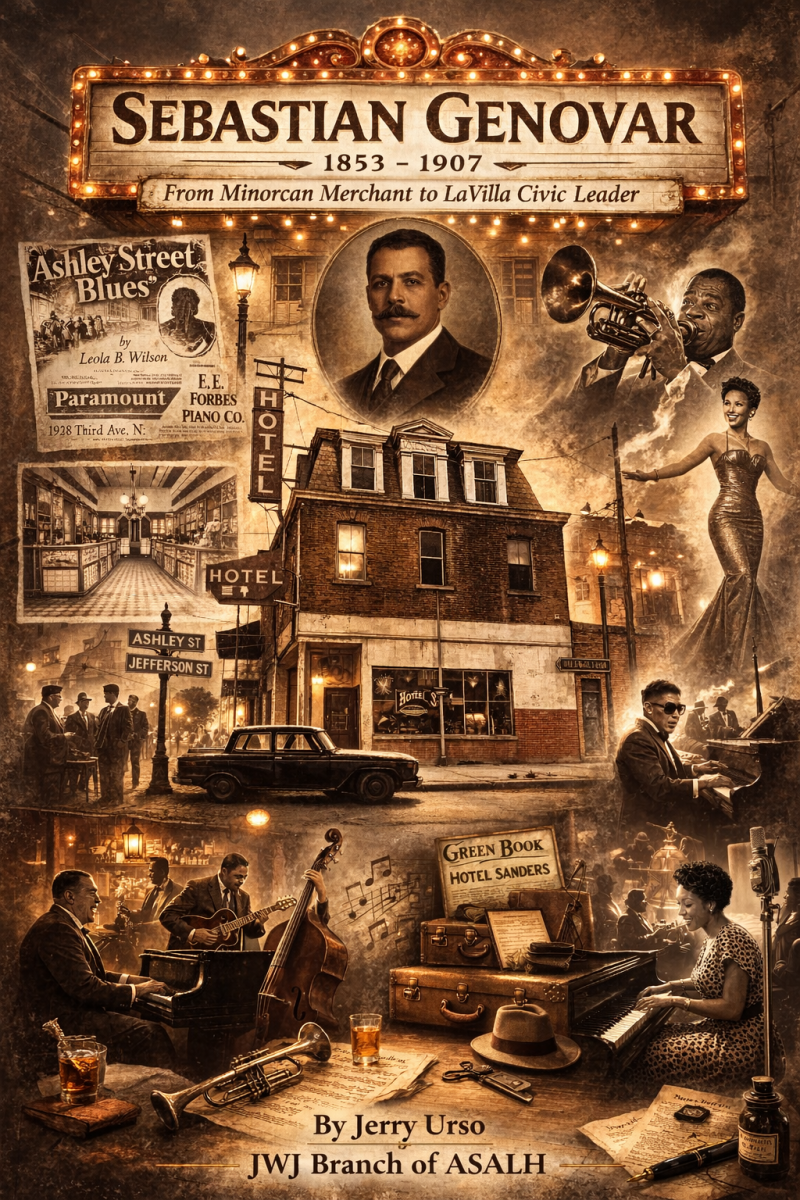
From Minorca to LaVilla
The Mediterranean Lineage and the Many Lives of 644 West Ashley Street
By Jerry Urso
Minorcan Origins and Mediterranean Lineage
The story of Genovar’s Hall begins more than a century before the building itself was constructed. It begins in the Mediterranean world and in one of Florida’s oldest colonial communities.
The Genovar family is classified in Florida history as Minorcan, descendants of the 1768 Mediterranean colony recruited by Dr. Andrew Turnbull for settlement at New Smyrna in British East Florida [1]. That colony was composed primarily of Catholics from the island of Minorca, then under Spanish sovereignty, along with Greeks and Italians. The plantation experiment proved brutal and unsustainable. In 1777, the surviving colonists fled north to St. Augustine and petitioned the British governor for refuge [2]. There, the Minorcan identity solidified as a collective designation for the displaced Mediterranean settlers.
Minorca itself is part of Spain. Thus, ethnically, the Genovars were Spanish Mediterranean. Yet the surname “Genovar” suggests deeper maritime connections. The name likely derives from “Genova,” indicating Italian or Genoese origins prior to the family’s settlement in Minorca [3]. Such layered heritage was common in Mediterranean port societies where Spanish, Italian, and Greek identities intersected through trade and migration.
By the early nineteenth century, descendants of the Minorcan colony were firmly rooted in St. Augustine’s Catholic parish records. On March 11, 1839, Sebastian de Aparicio Nestor Genovar married Maria Laureana Francisca Masters in St. Johns County, Florida [4]. Their marriage occurred during Florida’s territorial period, anchoring the Genovar name in American Florida decades before statehood stabilized the region.
This Mediterranean–Minorcan lineage is not incidental to the later story of 644 West Ashley Street. It represents continuity — a family that survived British rule, Spanish restoration, American annexation, Civil War, and Reconstruction.
From those roots would emerge the man who built Genovar’s Hall.
Migration to Jacksonville and the Rise of Sebastian Genovar
By 1860, members of the Genovar family had relocated from St. Augustine to Jacksonville [5]. The move reflected economic opportunity rather than displacement. Jacksonville, situated on the St. Johns River, was rapidly becoming a commercial hub, particularly after the Civil War.
In the 1870 United States Census, a fourteen-year-old Sebastian Genova appears in Jacksonville, born about 1856 in Florida and attending school [6]. The surname variation is typical of census records. He was living in the household of Sebastian Genova, age fifty-five.
This young Sebastian — likely baptized William Sebastian Genovar — grew up during Reconstruction, when Jacksonville’s economy was reorganizing around railroads, river trade, and expanding neighborhoods. LaVilla, annexed in 1887, became one of the city’s densest and most commercially vibrant districts. Rail lines ran nearby. Boarding houses multiplied. Political organizing flourished.
By the early 1890s, Sebastian Genovar had established himself as a grocery merchant at the southwest corner of Ashley and Jefferson Streets in LaVilla. In 1895, he erected a substantial two-story brick building to house his business [7].
The structure would become known as Genovar’s Hall.
The location was strategic. Ashley Street was a primary east-west corridor. Jefferson Street connected to other ward districts. The building stood across from the Hotel de Dream, once operated by Cora Crane, and near other commercial establishments. It was embedded in LaVilla’s civic heart.
Sebastian Genovar was not merely building a storefront. He was planting a Mediterranean-rooted family name into the commercial and political soil of Jacksonville.
Genovar’s Grocery & Assembly Hall (1895–1907)
From the moment it opened, the building served multiple purposes.
The ground floor operated as Genovar’s grocery and saloon. Upstairs, space was rented for public meetings and entertainment. Newspaper accounts between 1894 and 1899 repeatedly reference Genovar’s Hall as a venue for Citizens’ Club meetings, ward rallies, and campaign assemblies [8].
In June 1895, the Daily Florida Citizen described a “rousing rally” of Seventh Ward citizens at Genovar’s Hall [9]. Speakers addressed working-class voters. Municipal endorsements were announced. The hall functioned as a neighborhood political engine.
Entertainment notices also appear in local newspapers. Drama clubs staged performances there. Holiday concerts and Christmas entertainments filled the space with admission-paying audiences [10]. The building blended commerce, politics, and culture in one structure — a nineteenth-century urban model common in American cities but deeply resonant with Mediterranean traditions of merchant halls doubling as civic centers.
In 1899, Sebastian Genovar entered into a legal confrontation with Duval County authorities after being denied a liquor license [11]. He challenged the ruling in Circuit Court. Judge R. M. Call upheld the denial. Genovar continued selling liquor and was fined $750 after conviction [12]. He appealed, and ultimately received a pardon with the fine remitted.
The episode reveals a determined and assertive businessman who understood both law and risk.
On April 9, 1907, the Florida Times-Union reported that Sebastian Genovar, age fifty-four, died at his residence on Newman Street. He was described as a native of Jacksonville who had conducted his grocery at Ashley and Jefferson for years [13]. He was buried at St. Mary’s Cemetery, reaffirming the family’s Catholic Minorcan roots.
With his death, the original merchant era ended.
But the building did not disappear.
It was about to enter its second life.
Transition and Changing Ownership (1907–1920s)
Following the death of Sebastian Genovar in April 1907, the property entered a period of transition. Guardian sale notices later that year indicate the transfer of his LaVilla holdings, including the brick structure at Ashley and Jefferson [14]. The Minorcan merchant who had anchored the building for over a decade was gone, but the structure itself — solid, adaptable, and strategically located — remained a valuable commercial asset.
The years immediately following 1907 were transformative for Jacksonville. The city was still reshaping itself after the Great Fire of 1901, which had devastated downtown but spared portions of LaVilla. Reconstruction-era civic halls were gradually giving way to more specialized commercial uses. The expansion of rail travel increased transient populations in LaVilla. Boarding houses and small hotels multiplied to serve railroad workers, traveling salesmen, and entertainers.
644 West Ashley Street was ideally suited for such adaptation. Its layout — commercial frontage below, rentable rooms above — allowed it to shift from assembly hall to lodging without structural overhaul. During the 1910s, the building appears in city directories under varying commercial uses, reflecting a fluid transition from merchant-owned hall to multi-purpose property.
LaVilla itself was becoming increasingly associated with African American commerce and entertainment. As segregation hardened across the South, Black neighborhoods developed parallel economic systems — restaurants, theaters, hotels, and music halls — that operated independently of white-owned districts. By the early 1920s, 644 West Ashley Street was poised to enter that emerging cultural network.
The Mediterranean family chapter had closed. The building’s next life would be defined not by ward politics but by music, travel, and performance.
The Wynn Hotel (1920s–1940s)
By the 1920s, the upper floors of the building were operating as the Wynn Hotel under the management of Jack D. Wynn [15]. The shift from merchant hall to hotel represented more than a simple name change — it marked the building’s integration into Jacksonville’s segregated hospitality economy.
During the Jim Crow era, African American travelers and entertainers were routinely barred from white-owned hotels. Touring musicians relied on Black-owned or Black-operated establishments for lodging. The Wynn Hotel emerged as one of those critical safe havens within LaVilla’s entertainment corridor.
LaVilla in the 1920s and 1930s was alive with music. The district contained theaters, clubs, fraternal halls, and restaurants that formed part of what later became known as the Chitlin’ Circuit — the informal network of venues that allowed Black performers to tour the South safely. The Wynn Hotel’s location placed guests within walking distance of performance spaces, rehearsal sites, and after-hours gatherings.
Local accounts and cultural histories note that Louis Armstrong preferred lodging in LaVilla when performing in Jacksonville. Staying near performance venues was both practical and socially vibrant. The Wynn Hotel provided proximity to nightlife and protection from the humiliation of segregated white establishments.
The hotel functioned as silent infrastructure for American music history. Musicians rested there after performances. Contracts were negotiated in its rooms. Instruments were unpacked and repacked within its walls. The building that once hosted municipal ward meetings now housed national performers traveling through the South.
The Wynn era established 644 West Ashley Street as part of Jacksonville’s cultural backbone.
The Lenape Tavern (1930s–1940s)
While the Wynn Hotel operated upstairs, the ground floor became the Lenape Tavern — one of LaVilla’s most important live music venues [16].
By the 1930s, LaVilla rivaled other Southern Black entertainment districts in vibrancy. The Lenape Tavern was intimate yet influential. It attracted local musicians and touring artists alike. Its stage saw performances from artists who would become pillars of twentieth-century music.
Among those associated with the LaVilla circuit and the Lenape era were:
Dizzy Gillespie
Billie Holiday
James Brown
Ray Charles
Ray Charles, born Ray Robinson, spent formative years in Jacksonville and lived nearby at 633 West Church Street. As a young blind pianist seeking opportunity, he gravitated toward LaVilla’s clubs. Musicians gathered outside venues in what became known informally as the “rail of hope,” waiting for a chance to sit in with a band or secure a paid engagement.
Inside the Lenape Tavern, jazz and blues merged into new sounds. Trumpets cut through smoky air. Pianos rolled through rhythm changes. Patrons crowded close to the stage. Music spilled onto Ashley Street late into the night.
The Lenape Tavern era transformed the building into a crucible of American sound. What began as a Minorcan merchant’s hall became part of the national story of jazz.
Yet even as music flourished, structural changes were coming to LaVilla that would reshape the district permanently.
Hotel Sanders and the Green Book Era (1940s)
By the 1940s, the upper floors of 644 West Ashley Street were operating under a new name: Hotel Sanders. The name appears in mid-twentieth-century travel guides, including editions of the Negro Motorist Green Book, which listed safe accommodations for African American travelers navigating the segregated South [17].
The appearance of Hotel Sanders in the Green Book is a crucial marker of the building’s historical role. Published annually beginning in 1936, the Green Book served as a survival guide for Black motorists. It cataloged hotels, restaurants, beauty parlors, gas stations, and entertainment venues where African Americans could expect service without harassment or violence.
To be listed was to be trusted.
Hotel Sanders therefore functioned as more than a lodging establishment. It was part of a national safety network that allowed mobility under Jim Crow. Musicians, traveling salesmen, ministers, athletes, and families relied on such listings to plan safe journeys. The building at Ashley and Jefferson, once a political rally hall, was now embedded in a national infrastructure of Black resilience.
During this era, LaVilla remained a vibrant cultural corridor. Touring musicians continued to perform in nearby clubs and theaters, often staying upstairs at Hotel Sanders after late-night performances. The sounds of jazz, blues, and emerging rhythm-and-blues filtered through the district.
The dual identity of the building — lodging above, entertainment below — made it an integrated node within LaVilla’s ecosystem. Patrons could attend a performance downstairs and retire upstairs without leaving the block. In an era when segregation restricted movement, such spatial proximity was invaluable.
The Hotel Sanders name reflects both continuity and adaptation. The building’s essential function remained: it gathered people, sheltered travelers, and facilitated cultural exchange.
The Green Front Hotel (Late 1940s–1960s)
In the years following World War II, the hotel portion of the building took on yet another name: the Green Front Hotel [18]. Name changes were common in small urban hotels, often reflecting new management, shifting clientele, or attempts at reinvention.
The postwar years brought significant change to Jacksonville and to LaVilla. Veterans returned home. Migration patterns shifted. New housing developments opened in other parts of the city. As segregation remained entrenched, Black neighborhoods like LaVilla continued to sustain parallel commercial systems, but economic pressures mounted.
The Green Front Hotel operated during a period when LaVilla’s entertainment scene was still active but facing competition and demographic shifts. Clubs remained open. Music persisted. Yet the district’s economic base — heavily tied to railroads and nearby industrial labor — began to erode.
The building’s physical fabric during this period likely showed signs of age. Constructed in 1895, its brick exterior remained durable, but interiors would have required maintenance. Small hotels often operated on thin margins, reinvesting minimally in capital improvements.
Still, the Green Front era preserved the building’s identity as a hospitality anchor in LaVilla. It remained a place of arrival and departure, of temporary residence and nightly return.
The Mediterranean merchant’s hall had now survived half a century of transformation.
The Post-War Decline of LaVilla (1950s–1970s)
By the mid-twentieth century, structural forces beyond the building’s control began reshaping LaVilla permanently.
The construction of Interstate 95 carved through Jacksonville, physically dividing neighborhoods and displacing residents. Railroad employment — once a major economic engine in LaVilla — declined sharply. Urban renewal initiatives labeled older districts as “blighted,” often clearing historic structures in the name of progress [19].
As legal segregation began to crumble in the 1960s, African American consumers gained access to previously white-only establishments. Ironically, this desegregation sometimes weakened Black business districts, as spending dispersed across the city rather than remaining concentrated within LaVilla.
The entertainment corridor thinned.
Many historic buildings were demolished during redevelopment campaigns in the 1970s and 1990s. Entire blocks disappeared. Fraternal halls, theaters, and storefronts that had once vibrated with music were razed.
Yet 644 West Ashley Street remained standing.
The building that had been Genovar’s Grocery, Wynn Hotel, Lenape Tavern, Hotel Sanders, and Green Front Hotel survived waves of demolition that erased much of LaVilla’s nineteenth- and early twentieth-century architecture.
Its survival, however, did not guarantee prosperity.
City of Jacksonville Parks and Recreation Center (1973–2010)
By the early 1970s, much of historic LaVilla had been erased. Entire blocks fell to demolition under urban renewal initiatives. Interstate construction had already sliced through the district. What had once been Jacksonville’s most vibrant Black commercial and entertainment corridor was reduced to vacant lots, isolated structures, and fragmented streetscapes.
In 1973, the City of Jacksonville acquired 644 West Ashley Street and repurposed the building for municipal use under the Parks and Recreation Department [20]. This marked yet another transformation in the building’s life. No longer a private commercial venture, it became public infrastructure.
For nearly four decades, the structure served community programming functions. Though far removed from its jazz-era prominence, the building continued to gather people — this time for recreation services, neighborhood activities, and city-supported programming.
Its use during this period likely preserved it from demolition. While many LaVilla structures were cleared, 644 West Ashley Street remained in active use. The building’s brick shell, constructed in 1895, endured into the twenty-first century largely because it still served a municipal purpose.
Yet public use did not necessarily equate to preservation. As maintenance needs increased and budgets tightened, historic structures often received minimal restoration investment. By the late 2000s, the building showed visible signs of age and structural strain.
In 2010, the Parks and Recreation functions ceased.
The building stood vacant.
Abandonment and Failed Redevelopment Efforts (1990s–2010s)
Even before municipal use ended, redevelopment discussions had circulated around the building. By the late 1990s, as Jacksonville began reconsidering downtown revitalization strategies, interest grew in preserving LaVilla’s remaining historic structures.
In 1998, plans materialized for restoration of the building. The Nu Beta Sigma Chapter of Phi Beta Sigma Fraternity proposed converting the structure into a museum and office space. The projected investment approached $750,000, later exceeding $900,000 in public funding commitments [21].
The project ultimately stalled.
Structural challenges, funding complexities, and shifting development priorities left the building partially stabilized but not fully restored. At one point, interior demolition reduced the structure largely to a brick shell. Windows were removed. Interior floors were compromised. The façade remained standing, but the life inside it had been stripped away.
LaVilla’s broader redevelopment struggled during these decades. Ambitious plans were announced, scaled back, revised, or abandoned. Much of the district remained vacant, parking lots replacing historic streetscapes.
Genovar’s Hall — once a grocery, assembly hall, hotel, and jazz venue — became instead an endangered historic shell.
Preservation advocates argued that the building represented one of the last physical connections to LaVilla’s cultural peak. Critics viewed it as blight and questioned the feasibility of restoration.
The debate reflected broader tensions in urban preservation: what to save, how to fund it, and whether historic identity holds economic value in modern redevelopment.
Present Condition and Ongoing Preservation Debate (2010–Present)
Today, 644 West Ashley Street remains standing but deteriorated. Owned by the City of Jacksonville, the building is frequently cited as one of LaVilla’s most historically significant surviving structures.
Its significance is layered:
• It represents one of the few remaining nineteenth-century commercial buildings in LaVilla.
• It connects Jacksonville to the Minorcan colonial lineage through Sebastian Genovar.
• It anchors the memory of LaVilla’s jazz and Chitlin’ Circuit era.
• It appeared in the Green Book during segregation.
• It survived urban renewal when much of the district did not.
Preservationists argue that the building is irreplaceable. Its brick façade and corner presence at Ashley and Jefferson Streets hold spatial memory that cannot be replicated by new construction.
Skeptics point to structural deterioration and redevelopment costs.
Yet if walls could speak, they would recount:
Ward rallies under gaslight in the 1890s.
Merchants debating liquor licenses in courtrooms.
Traveling musicians unpacking trumpets in upstairs rooms.
Young pianists waiting outside for opportunity.
Families consulting Green Book listings for safe lodging.
Children attending Parks and Recreation programs decades later.
Few structures in Jacksonville carry such a continuous narrative arc.
Legacy: The Dreams of Sebastian Genovar
When Sebastian Genovar laid brick upon brick at the corner of Ashley and Jefferson in 1895, he was not simply erecting a grocery store.
He was making a declaration.
He was the son of a Minorcan family that had survived colonial plantation collapse, migration, frontier uncertainty, and Reconstruction upheaval. His father had been born into a Florida still negotiating its identity between Spanish and American rule. Sebastian himself grew up in a Jacksonville rebuilding after Civil War destruction.
To build in 1895 was to believe in permanence.
The Mediterranean merchant tradition from which he descended valued physical presence — storefronts that doubled as community centers, halls that hosted gatherings beyond commerce. Genovar’s Hall reflected that tradition. It was built with enough space to hold people. Enough scale to matter. Enough durability to endure.
His dreams were civic as much as commercial.
The political rallies held in the hall during the 1890s were not accidental. They reflected Sebastian’s willingness to embed himself in ward politics and public life. He rented space for speeches. He opened his doors to working-class voters. He challenged county authorities in court when denied a liquor license. He fought fines and pursued appeals [11][12].
He believed in standing his ground.
There is no record of him describing his aspirations in writing. But the structure itself speaks. A simple grocer could have operated from a wooden storefront. Sebastian chose brick. He chose scale. He chose visibility at a major intersection in a rising district.
He built for the long term.
He could not have imagined that decades later, jazz legends would rest within those walls. He could not have foreseen the Lenape Tavern’s smoky stage or the Wynn Hotel’s role in sheltering musicians barred from white establishments. He never knew that his building would appear in the Negro Motorist Green Book, guiding Black travelers through the dangers of Jim Crow [17].
Yet the building’s endurance is itself an extension of his dream.
From Minorca to St. Augustine.
From St. Augustine to Jacksonville.
From grocery to assembly hall.
From hotel to jazz crucible.
From Green Book listing to municipal recreation center.
From neglect to preservation debate.
Few structures in Jacksonville hold such a complete cross-section of Florida history.
Today, 644 West Ashley Street stands weathered but present. Its brick façade, though scarred, remains upright. It has survived fire, segregation, interstate construction, urban renewal, abandonment, and failed redevelopment.
It survives because Sebastian built it to last.
The building embodies layered dreams:
A Minorcan family’s survival in Florida.
A merchant’s investment in civic space.
A community’s musical flowering.
A segregated city’s parallel hospitality network.
A neighborhood’s struggle against erasure.
Genovar’s Hall is not merely an abandoned structure. It is a physical timeline.
If restored, it could once again gather people — not for ward rallies or jazz nights, but for memory and understanding. If lost, a century of Jacksonville’s Mediterranean, political, and musical history would disappear with it.
Sebastian Genovar’s dream was not just profit.
It was presence.
And 130 years later, that presence still stands.
References
-
National Park Service, Minorcan History, Castillo de San Marcos National Monument.
-
Minorcan Colony Records, British East Florida, 1768–1777.
-
Mediterranean surname etymology studies relating to Genoese migration patterns.
-
Florida Compiled Marriages, St. Johns County, March 11, 1839.
-
1860 U.S. Census, Jacksonville, Duval County, Florida.
-
1870 U.S. Census, Jacksonville, Duval County, Florida.
-
Duval County property records, construction date 1895.
-
Daily Florida Citizen, June 1895 political rally notice.
-
Evening Times-Union, December 1894 entertainment notice.
-
Florida Times-Union, October 31, 1899, liquor license denial report.
-
Florida Times-Union, April 27, 1900, conviction and fine report.
-
Florida Times-Union, April 9, 1907, obituary of Sebastian Genovar.
-
Florida Times-Union, November 1, 1907, guardian sale notice.
-
Jacksonville Journal, November 26, 1934, Wynn Hotel listing.
-
City directories, 1920s–1940s, Wynn Hotel entries.
-
LaVilla entertainment district historical accounts, Lenape Tavern references.
-
Negro Motorist Green Book, 1940s editions, Hotel Sanders listing.
-
Jacksonville city directories, post-war listings, Green Front Hotel.
-
Urban renewal and interstate construction reports, Jacksonville, mid-20th century.
-
City of Jacksonville municipal records, Parks & Recreation use, 1973–2010.
-
Jacksonville redevelopment planning documents, late 1990s restoration proposal.
