
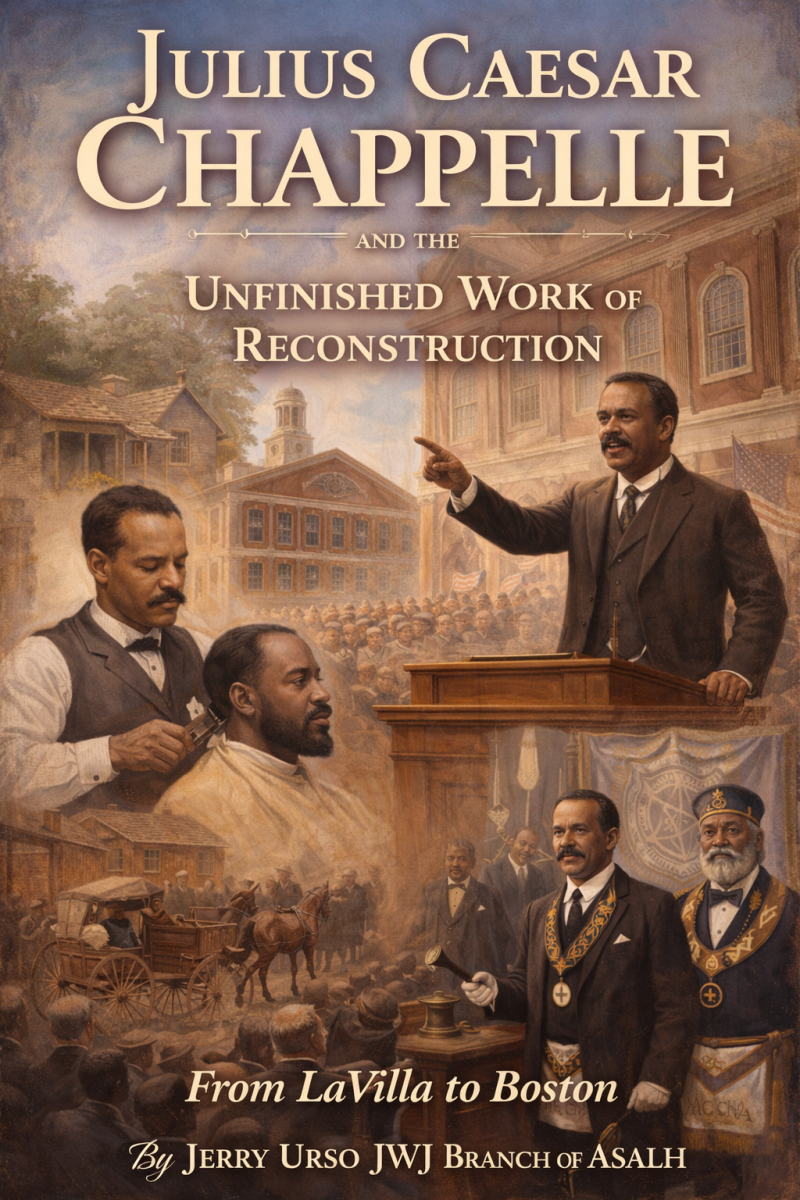
By Jerry Urso, FPS-Life
“If I have seen further it is by standing on the shoulders of giants.”
— Sir Isaac Newton
Abstract
In a time of uncertainty during Reconstruction, Julius Caesar Chappelle found his voice. He took up the mantle from the giants of abolitionism at a moment when many of them were passing from the scene or entering the twilight of their lives. A protégé of Lewis Hayden, Chappelle followed directly in his mentor’s footsteps and rose to election in the Massachusetts House of Representatives.
As the nation struggled to define freedom beyond emancipation, Chappelle emerged as a leading post–Civil War crusader for civil rights. His extraordinary oratory elevated him as one of the most significant African American speakers of his generation, giving voice to the unfinished promises of Reconstruction.
Early Life
Julius Caesar Chappelle was born into slavery in 1852 in Newberry, South Carolina, to Frank and Lettie Chappelle. Following the Civil War, the family relocated to LaVilla, a thriving Black community that would later be consolidated into Jacksonville, Florida. (1) Like many Black families navigating the uncertain terrain of freedom, the Chappelles pursued opportunity through enterprise, civic engagement, and fraternal affiliation.
The family’s rise was most clearly embodied by Julius’s uncle, Mitchell P. Chappelle. A tavern owner and respected community figure, Mitchell entered public life and was elected LaVilla’s Tax Collector, later serving as an Alderman and then Mayor from 1874 to 1876. (2) His leadership extended into fraternal life as well. In June 1870, he served as Past Master of a Masonic convention in Jacksonville that led directly to the formation of the Union Grand Lodge of Florida (Compact), with Harry Henry Thompson elected Grand Master. (3)
The Chappelle family’s influence reached beyond politics. Julius Caesar Chappelle’s nephew, Patrick Henry Chapelle, would later gain national prominence as the founder of The Rabbit’s Foot touring company. Celebrated as the “Pioneer of Negro Vaudeville” and often called the “Black P. T. Barnum,” Patrick Henry Chapelle was the only African American of his era to fully own and operate large traveling shows composed entirely of Black performers, shaping Black popular culture on a national scale. (4)
Move to Boston
In 1870, Julius Caesar Chappelle joined the stream of African Americans leaving the postwar South, settling in Boston’s Beacon Hill neighborhood. Massachusetts, though imperfect, offered a political and social environment where Black leadership could still take root. Boston in particular remained a center of abolitionist memory and Black civic life.
It was here that Chappelle encountered elder statesmen of the movement—Frederick Douglass, William Lloyd Garrison, and most importantly, Lewis Hayden. Hayden became both mentor and guide, teaching Chappelle the mechanics of politics while grounding him in the moral traditions of abolitionism.
Hayden’s own life embodied the bridge between slavery and political power. Born enslaved in Kentucky, he escaped to Canada before settling in Boston, where he became a central figure in the Underground Railroad. As an executive of the Boston Vigilance Committee, he and his wife Harriet provided shelter, food, and clothing to freedom seekers. Hayden openly defied the Fugitive Slave Laws, fought for school integration, and, alongside William Cooper Nell, helped recruit African American soldiers for the Massachusetts 54th Regiment. (5)
Initiation into Politics
Lewis Hayden personally introduced Chappelle to Republican Party politics, beginning with the essential work of registering African American voters. Chappelle proved adept at the task, combining discipline with charisma. During this period, he also learned the barber’s trade while living in Chelsea, Massachusetts, cultivating the polished appearance and public confidence that would later complement his commanding oratory.
Hayden himself served a term in 1873 as a representative of Ward 9 in Suffolk County in the Massachusetts General Court and championed the movement to erect a statue honoring Crispus Attucks. (6) Chappelle absorbed from Hayden not only political strategy, but also the importance of historical memory as a form of resistance.
Election to the General Court
In 1883, Chappelle was elected to the Massachusetts General Court, serving in the House of Representatives until 1886. His elections were hard fought and often contested, reflecting both Democratic opposition and racial hostility within the Republican Party itself. Recounts became a recurring feature of his political life, mirroring the broader struggle of African Americans to hold office in the post-Reconstruction North.
In the election for the 1884–1885 legislative session, Chappelle defeated Democrat Charles Albert Prince by a margin of 31 votes for the Ward 9 seat. After repeated recounts, the Aldermen briefly awarded the seat to Prince. The Boston Globe sharply condemned the decision, accusing Republican leaders of hypocrisy and racism in its article “A Sample of Meanness.” Chappelle was ultimately reinstated to his rightful seat. (7)
The Globe wrote with rare candor:
“How contemptibly false and hypocritical are these assumptions was never better illustrated than in a case which has just occurred in the Great and General Court.” (8)
The Lodge Bill and National Advocacy
Chappelle’s influence extended beyond Massachusetts. In 1890, he emerged as a powerful advocate for the Lodge Bill, also known as the Federal Elections Bill. Drafted by Henry Cabot Lodge and supported by President Benjamin Harrison, the bill sought to protect Black voting rights in federal elections.
Speaking before a packed audience at Faneuil Hall, Chappelle delivered one of the most forceful speeches of his career. The New York Age reported his words as both indictment and warning:
“The vote of the Negro must be counted with as much honesty in South Carolina as any white man’s in Massachusetts.” (9)
Though the bill was ultimately defeated by filibuster, Chappelle’s speech resonated nationwide, affirming his role as a national voice for voting rights.
Legislative Advocacy and Oratory
Throughout his legislative career, Chappelle remained focused on the lived realities of African Americans. He introduced resolutions opposing the Southern convict-lease system, recognizing it as a continuation of slavery under another name. He also campaigned vigorously against the Prohibition Party, whose moral rhetoric masked deep ties to the Ku Klux Klan. (10)
In 1884, Chappelle introduced groundbreaking legislation prohibiting life insurance companies from using race as a factor in determining coverage and rates. Despite fierce opposition, the bill passed and inspired similar laws in nine other states, marking one of the most tangible policy victories of his career. (11)
Chappelle’s reputation as an orator only grew. A member of the prestigious Massachusetts Club, he frequently delivered memorial addresses for prominent leaders, including former Governor Roger Wolcott and Edward G. Walker, one of the first African American legislators and attorneys in Massachusetts. (12)
Prince Hall Masonry
Prince Hall Masonry formed the quiet but enduring architecture beneath Chappelle’s public life. While it remains unclear whether he was initiated in Jacksonville alongside his uncle and cousin or later in Boston, his ascent within the fraternity is unmistakable. In 1890, Chappelle was elected Grand Master of the Prince Hall Grand Lodge of Massachusetts, and he was re-elected in 1892. (13)
His Masonic circle mirrored his political one. Lewis Hayden, William Cooper Nell, and Edward G. Walker were not only fellow Masons but fellow travelers in the long struggle for Black citizenship. Through family ties, Chappelle remained connected to Florida Masonry as well, linking the Union Grand Lodge of Florida to the Prince Hall Grand Lodge of Massachusetts through shared lineage, ideology, and leadership. Masonry provided Chappelle with an intergenerational network that reinforced discipline, moral authority, and national reach.
Personal Life and Death
On August 14, 1878, Julius Caesar Chappelle married Eugenia E. Chappelle in Boston. (14) The couple welcomed a daughter, Lillian E. Chappelle, the following year. In addition to politics, Chappelle built economic stability through entrepreneurship, operating his own janitorial business and holding patronage positions, including employment at the Boston Custom House.
He died on January 27, 1904, in Roxbury, Massachusetts. His obituary in the Boston Daily Globe captured his stature succinctly, noting that outside of Lewis Hayden, John J. Smith, and Edward G. Walker, he was among the most widely known African American men in the Commonwealth. (15)
Legacy
Time has softened Julius Caesar Chappelle’s public memory, yet during his lifetime his words traveled widely. T. Thomas Fortune chronicled his work in the New York Age, while papers such as the Pacific Appeal, Pittsburgh Courier, and Christian Recorder amplified his speeches and political battles across the nation.
Faneuil Hall is called the “Cradle of Liberty,” and it was there that Chappelle delivered his most enduring addresses. The echoes of his voice remain alongside those of Adams, Hancock, and Revere. Where John Adams proclaimed, “Let freedom reign,” Julius Caesar Chappelle advanced the principle further and without apology: let freedom reign for all.
References
[1] 1870 U.S. Census, LaVilla, Duval County, Florida.
[2] Canter Brown Jr., Florida’s Black Public Officials, 1867–1924.
[3] Proceedings of the Most Worshipful Union Grand Lodge of Florida, 1877.
[4] The Colored American (Washington, D.C.), p. 1, August 3, 1901.
[5] James Oliver Horton and Lois E. Horton, Black Bostonians: Family Life and Community Struggle in the Antebellum North.
[6] James Oliver Horton and Lois E. Horton, Black Bostonians: Family Life and Community Struggle in the Antebellum North.
[7] Boston Globe, 1884, coverage of Ward 9 election and recount proceedings.
[8] Boston Globe, 1885, “A Sample of Meanness.”
[9] New York Age, 1890, report on Julius Caesar Chappelle’s Faneuil Hall address.
[10] Massachusetts State Library Blog, “Julius Caesar Chappelle and Black Boston,” 2020.
[11] Philadelphia Inquirer, November 29, 2022, historical analysis of racial discrimination in life insurance.
[12] Massachusetts State Library Blog, “Julius Caesar Chappelle and Black Boston,” 2020.
[13] Proceedings of the Prince Hall Grand Lodge of Massachusetts.
[14] Massachusetts, U.S., Marriage Records, 1840–1915.
[15] Boston Daily Globe, January 28, 1904, p. 7.
