
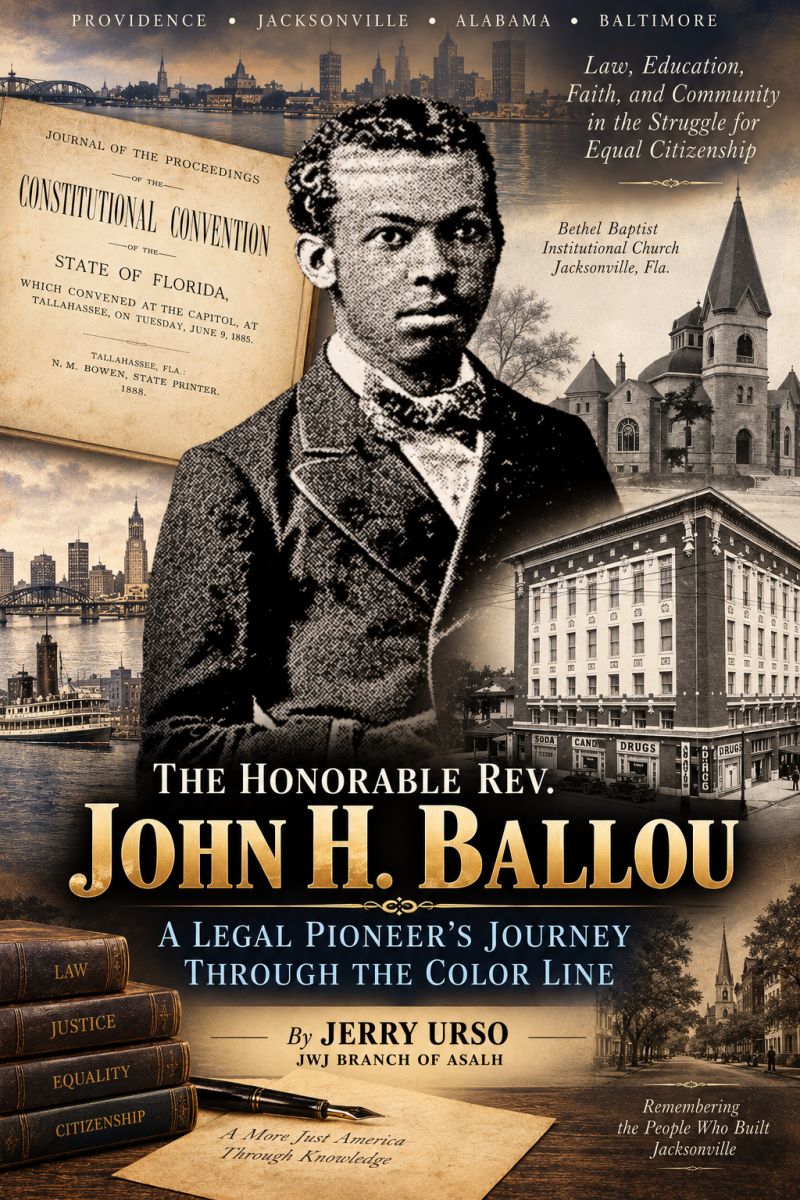
Jacksonville Pioneer Attorney and Judge: The Honorable Rev. John Henry Ballou
A Legal Pioneer’s Journey Through the Color Line
By Jerry Urso, FPS
A Life Between Two Worlds
John Henry Ballou’s life stretched across two very different Americas. He was born into the free Black community of Providence, Rhode Island, before the Civil War and came of age in a city where African Americans had established churches, schools, businesses, and organizations while continuing to confront racial discrimination. He would eventually carry the education and legal training he received in Providence south to Jacksonville, Florida, where the promises of Reconstruction were rapidly colliding with the developing system of Jim Crow.
During a career spanning more than half a century, Ballou became a lawyer, judge, educator, journalist, publisher, writer, businessman, civic organizer, religious leader, and Mason. He participated in the struggle for civil rights in Rhode Island as a young man and later confronted racial inequality in Florida's courts. He taught at Cookman Institute, helped develop Jacksonville's Black press, participated in politics, won election to judicial office, worked with Black business organizations, and maintained his law office in Jacksonville's Masonic Temple.[1][2]
Ballou's story is particularly important because his life connects the political possibilities available to Black Americans after emancipation with the restrictions imposed as white supremacy regained control of Southern government. He witnessed both worlds. He lived long enough to see Black men hold political and judicial authority in Jacksonville and then to see many of those gains stripped away. Yet Ballou continued practicing law and serving Black institutions even as the color line became more firmly embedded in American life.
Providence and the Making of John Henry Ballou
John Henry Ballou was born in Providence, Rhode Island, on June 9, 1853, the son of David N. Ballou and Anna R. Uchee Ballou. Both of his parents were free people of color, meaning Ballou entered the world eight years before the Civil War and a decade before emancipation transformed the legal status of millions of African Americans in the South.[1]
His education began within Providence's segregated school system. Ballou attended the Meeting Street School, an institution with deep importance in the history of Black education in Providence. He continued his education at Schofield's Commercial College and pursued additional studies connected with Brown University.[1][2] Education became one of the foundations of his life, but the young Ballou was already moving toward the profession that would define much of his public career: the law.
Ballou received private legal instruction from attorney Edward C. Ames. On June 5, 1874, at only twenty-one years old, he was admitted to practice law in Rhode Island, becoming the first African American lawyer admitted to the Rhode Island bar.[2] His achievement was remarkable not simply because of his age but because the legal profession remained overwhelmingly closed to African Americans. Ballou had entered one of the institutions through which laws governing race, citizenship, property, and political rights were interpreted and enforced.
His education continued to be recognized long after he left Providence. In 1892, Selma University in Alabama conferred upon him the degree of LL.D.[1] By then, the young Providence attorney had already carried his legal training into the South and begun building a career that would eventually place him among Jacksonville's pioneering Black attorneys and judges.
Law, Civil Rights, and the Black Press
Ballou did not enter the law simply to establish a profession. Civil rights became part of his work while he was still a young attorney in Rhode Island. He worked with the prominent Black activist George T. Downing in the campaign that helped secure the repeal of Rhode Island's prohibition against interracial marriage.[1] The issue went directly to the meaning of citizenship. A government that dictated whom people could marry based upon race was using law to maintain the color line, and Ballou was confronting that principle at the beginning of his career.
He also participated as a Rhode Island delegate to a Civil Rights Convention, connecting the young attorney to the broader nineteenth-century movement demanding equal treatment for African Americans.[1] These experiences preceded Ballou's arrival in Florida and are essential to understanding the man who later challenged racial exclusion in Jacksonville. His concern with equal citizenship did not begin when he encountered Southern segregation. It was already part of his legal and political formation in Providence.
Ballou also understood the power of the printed word. He became associated with the Eastern Review, part of Rhode Island's developing African American press.[1][3] Newspapers provided Black communities with something that mainstream publications frequently denied them: the ability to describe their own institutions, debate political questions, defend their leaders, challenge discrimination, and preserve their own history.
The combination that would characterize much of Ballou's life was therefore already visible before he came South. Law, education, civil rights, journalism, and organized Black community life were not separate pursuits for John Henry Ballou. They were different ways of confronting the same color line. That foundation would travel with him when his journey brought him from Providence to Jacksonville.
Jacksonville and a New Field of Opportunity
By the early 1880s, John Henry Ballou had turned his attention southward. Jacksonville offered possibilities that would have been almost unimaginable for Black Floridians before the Civil War. Emancipation and Reconstruction had produced a generation of Black voters, officeholders, teachers, ministers, businessmen, and professionals who were building institutions of their own. Black attorneys were practicing in the city's courts, Black political leaders were competing for public office, and schools and churches were helping create an educated professional class. Ballou entered Jacksonville during this extraordinary period of possibility, but also at a moment when the political ground beneath Black Floridians was beginning to shift.
Ballou later stated under oath that he had practiced in Florida's courts since 1881, while other records place his formal admission to practice in Florida in the early 1880s.[4] His legal work was soon joined by education. During the 1883–1884 academic year, Ballou taught physics and mathematics at Cookman Institute, one of Jacksonville's most important institutions for the education of African Americans.[1] His presence there connected the young attorney with a community that understood education as essential to the advancement of a people only a generation removed from slavery.
Jacksonville also became the place where Ballou established his family. He married Carrie B. Sampson, a woman whose own life was deeply connected to education and Black Jacksonville.[1] Ballou was no longer simply the young attorney who had broken a racial barrier in Rhode Island. In Jacksonville he was becoming part of a growing Black professional community whose lawyers, educators, ministers, businessmen, journalists, and fraternal leaders were helping shape the city.
Carrie Sampson Ballou and a Family Rooted in Education
Carrie B. Sampson Ballou deserves more than a passing mention as the wife of a prominent man. She was the daughter of W. W. Sampson, was born in Cleveland, Ohio, and came to Jacksonville while still a girl. Education became an important part of her life, just as it had for John Henry Ballou. Carrie taught for eleven years at Stanton School, placing her within one of the most important institutions in the history of Black education in Jacksonville.[6]
Their marriage united two people whose lives reflected the importance Black families placed upon education during the decades following emancipation. John taught at Cookman Institute while building his legal career, and Carrie taught generations of children at Stanton. Their household was therefore connected not only to Jacksonville's legal and political world but also to the educational institutions through which Black Jacksonville prepared its next generation.
John and Carrie Ballou raised a family that included Ella E. Butler, Dr. Edgar S. Ballou, Mamie A. Ballou, and Serena D. Ballou.[1] The appearance of a physician among their children is another indication of the professional aspirations surrounding the family. Their home belonged to a Black Jacksonville in which education was being transformed into professional advancement, property ownership, political participation, and community leadership.
Carrie's life also helps us see John Henry Ballou more completely. His public record is filled with courtrooms, newspapers, political meetings, churches, businesses, and fraternal organizations, but behind that public career stood a household deeply connected to the same educational movement he championed. The Ballous were participants in the building of a Black professional class in Jacksonville, and Carrie was part of that work in her own right.[6]
Building a Black Voice in Jacksonville
Ballou brought another skill with him from Providence: an understanding of the power of the press. In August 1883, Black Jacksonville was attempting to revive the Southern Review, and Ballou stood at the center of the effort. Plans were being developed for a publishing company that could provide the newspaper with a stronger institutional foundation, and Ballou emerged as one of the principal figures behind the movement.[5]
For Black Jacksonville, control of the printed word mattered. Political power could be challenged at the ballot box, Black testimony could be discounted in public debate, and the white press could define African Americans through its own assumptions. A Black newspaper created a different kind of space. It allowed Black citizens to discuss politics, defend institutions, promote businesses, announce church and fraternal activities, debate leadership, and speak directly to one another about the future of their community.
Ballou understood that power because he had already worked within the Black press in Providence. Jacksonville gave him an opportunity to apply that experience in a Southern city where the political future of African Americans was being fiercely contested. His legal career and newspaper work therefore developed side by side. In the courtroom he could argue within the law; through the press he could participate in the larger public argument over citizenship, leadership, and racial progress.
His relationship with the Southern Review also demonstrated that Ballou valued responsibility in Black journalism. By 1890, a bitter political controversy had developed around the paper. Ballou publicly separated himself from an editorial titled “House Bill No. 4” and rejected the use of abusive personal attacks against Joseph E. Lee, even though Ballou and Lee could disagree politically.[7] For Ballou, disagreement did not require the destruction of another Black leader's character. That distinction reveals something important about the principles he carried into public life: Black political debate could be vigorous, but the institutions and leadership of the community were too important to be weakened merely for the sake of personal attack.
By the middle of the 1880s, Ballou had therefore established himself in several of the worlds that would define his Jacksonville career. He was practicing law, teaching, raising a family with an accomplished educator, participating in journalism, and entering the city's political life. The next great test would come in 1885, when Florida gathered to write a new constitution and the struggle over the future of Black citizenship moved directly into Jacksonville's political arena.[8]
At the Door of the 1885 Constitutional Convention
In 1885, Florida prepared to rewrite its constitution. The convention would become a turning point in the state's history, helping establish the political framework under which Black voting power would be steadily weakened. Jacksonville's citizens understood the importance of what was approaching, and on May 1, 1885, an interracial citizens' meeting gathered in the Circuit Court room to consider candidates for the coming Constitutional Convention.[8]
John Henry Ballou took an active role in that meeting, but he was not a delegate to the Constitutional Convention. He spoke in support of the proposed ticket, and when the selections had been made, Ballou and John T. Graves were appointed as a committee to notify the nominees and secure their acceptance.[8] The distinction is important. Ballou did not sit in the convention itself, but he participated directly in the Jacksonville political process that helped determine who would be sent there.
The convention met in Tallahassee from June 9 through August 3, 1885.[9] What emerged would help reshape Florida politics for generations. The new constitution provided mechanisms, including the poll tax, that could be used to restrict access to the ballot. The political world in which Black men had voted, held public office, practiced law, and participated openly in government was beginning to contract.[9]
Ballou's participation in the events surrounding the convention therefore belongs within the larger story of his life. He had entered Jacksonville at a moment when Black political participation was still visible and powerful. He would remain in Florida long enough to see that power systematically reduced. Yet he did not withdraw from public life. Within only a few years, Jacksonville's voters would place him in judicial office.
From the Courtroom to the Bench
By 1886, Ballou was firmly established as a Jacksonville attorney. His law office was at 24 Ocean Street, while he and Carrie lived at 203 West Beaver Street in LaVilla.[10] These addresses place him within the physical world of nineteenth-century Black Jacksonville, where lawyers, teachers, ministers, businessmen, craftsmen, and laborers were building lives and institutions in the neighborhoods surrounding the city's commercial center.
In 1888, Ballou was elected Justice of the Peace for Duval County's Eleventh District, beginning judicial service that continued into the early 1890s.[1] By 1890, he was recorded both as a lawyer and Justice of the Peace, with his judicial business located at West Union and Second streets in LaVilla.[11] The young man who had broken the color barrier at the Rhode Island bar had now been entrusted with judicial authority in Florida.
Ballou's election belongs to a larger and often forgotten chapter of Jacksonville history. He followed Joseph E. Lee and James Dean in the city's pioneering generation of Black judges. Their careers demonstrate that Black judicial authority in Jacksonville was not merely an aspiration. African American men actually occupied positions within the legal system during the decades following emancipation. They interpreted law, heard cases, represented clients, participated in politics, and exercised public authority.
The significance becomes even clearer when Ballou's later career is considered. He would eventually stand in a Florida courtroom and testify about the exclusion of Black men from juries. He had personally experienced a period when a Black man could be elected to judicial office in Jacksonville, only to live through the development of a system that increasingly pushed Black citizens away from meaningful participation in the administration of justice. His later challenge to the color line was therefore not theoretical. Ballou remembered what had once been possible.
Black Jacksonville on Display
In 1889, Jacksonville's Sub-Tropical Exposition provided Black residents with an opportunity to demonstrate publicly what their community had accomplished. On March 15, thousands turned out for Colored People's Day, filling the exposition grounds and demonstrating the strength of Black Jacksonville's institutions, organizations, businesses, churches, schools, and civic leadership. Ballou appeared within the surviving record of that celebration.[12]
The exposition carried significance beyond entertainment. Only a generation had passed since slavery. Yet Jacksonville's Black population could point to lawyers, educators, physicians, merchants, skilled workers, ministers, political leaders, newspapers, fraternal organizations, and property owners. Events such as Colored People's Day allowed that progress to be displayed before a wider public at a time when the growing ideology of white supremacy insisted upon Black inferiority.
The larger exposition season also brought Frederick Douglass to Jacksonville as a guest of the Black organization associated with the exposition.[13] Douglass represented a national struggle that men such as Ballou were carrying forward locally. Both had been shaped by Northern abolitionist and civil-rights traditions, and both understood that emancipation without political, educational, economic, and legal equality remained incomplete. Ballou's presence within this Jacksonville world placed him among a generation attempting to turn freedom into permanent institutions.
Yet the celebration occurred against an increasingly troubling background. The constitution adopted only a few years earlier had helped create new opportunities to restrict Black political participation. Racial violence and economic pressure were affecting Black communities throughout the South, and African Americans were debating whether their future could still be built there. Ballou, who had voluntarily traveled from Providence to make his life in the South, would soon find himself drawn into that debate as well.[14]
Stay or Leave: Ballou and the Black Migration Debate
By the end of the 1880s, the question facing many Black Floridians was no longer simply how to build a future in the South, but whether the South would allow that future to survive. Political rights were being restricted, racial violence remained a constant threat, and opportunities that had appeared possible during Reconstruction were narrowing. Some African Americans began looking toward other states and regions, creating a migration debate that reached directly into Jacksonville's Black leadership.[14]
John Henry Ballou was among the Black leaders drawn into that discussion, along with Joseph E. Lee and others whose opinions carried influence within the community.[14] The issue placed Ballou in a complicated position. He had chosen the South. Born and educated in Providence and already admitted to practice law in Rhode Island, he did not have to come to Jacksonville to build a professional life. He came because post-Reconstruction Florida still offered opportunities for Black leadership, education, political participation, and institution building. He had taught at Cookman, practiced law, worked in journalism, participated in politics, and won election as a Justice of the Peace.
The migration question therefore touched the central contradiction of Ballou's Jacksonville experience. Black citizens had demonstrated that they could build schools, newspapers, businesses, churches, professional practices, and political organizations, yet the legal and political structure around them was becoming increasingly hostile to their advancement. The problem was not a lack of Black achievement. It was the growing effort to restrict what Black achievement could become.
Ballou's own life soon reflected this movement across state lines. During the early 1890s, his career carried him from Florida into Alabama. The move did not end his relationship with Jacksonville, but it opened another chapter in a life that repeatedly crossed geographic boundaries while remaining centered on law, education, business, and Black advancement.
Alabama: Law, Banking, and Black Enterprise
Ballou's Alabama years extended the same pattern of institution building that had characterized his work in Jacksonville. By the early 1890s he was practicing in Alabama, where he became associated with the developing Black professional and business community.[15] His experience there is particularly significant because it demonstrates that Ballou did not view legal advancement separately from economic advancement.
In 1892, Ballou served as an attorney for the Alabama Penny Savings Bank in Birmingham, an institution created within a Black community seeking greater control over its own financial future.[1] Black banks offered more than places to deposit money. In a segregated economy, they could provide capital, credit, employment, and financial services to people who faced discrimination within white-controlled institutions. For a Black attorney such as Ballou, representing such an enterprise placed his legal training directly in the service of economic institution building.
That same year, Ballou helped establish the Co-operative Grocery Company, further demonstrating his interest in Black business development.[1] His involvement was consistent with the philosophy visible throughout his life: progress required institutions. Political rights mattered, but so did schools, newspapers, businesses, banks, churches, professional organizations, and fraternal societies. Each created another measure of independence and another foundation upon which Black communities could build.
In 1892, Ballou also received the degree of Doctor of Laws, LL.D., from Selma University.[1] The honor recognized a man who had already accomplished something extraordinary. Before reaching forty years of age, Ballou had broken the racial barrier in Rhode Island's legal profession, participated in civil-rights work, moved South, taught at Cookman Institute, practiced law in Jacksonville, worked in the Black press, participated in Florida politics, won election to judicial office, and entered the world of Black banking and cooperative business.
Baltimore and the Road Back to Jacksonville
Ballou's journey next carried him farther north. By 1900, he was living in Baltimore, Maryland, with his family.[16] Baltimore offered another large and established Black community with its own churches, businesses, schools, newspapers, political organizations, and professional class. For Ballou, it was another setting in which law and organized civic life intersected.
His political involvement continued there. In 1903, Ballou served as secretary of the Lincoln League in Baltimore and remained active in city and state politics.[1] The position fit naturally into the course of his life. From Rhode Island civil-rights activity to Jacksonville political meetings and elected judicial service, Ballou had repeatedly participated in organizations through which African Americans attempted to influence government and protect their citizenship.
Yet Jacksonville remained central to his story. By 1906, Ballou was again appearing prominently in the city's public life. That November, Judge J. H. Ballou was scheduled to deliver a special sermon at Mt. Zion A.M.E. Church.[17] In June 1907, he appeared among Jacksonville attorneys gathered in court to greet a new judge.[18] These appearances show that Ballou had returned not merely as a former resident but as a recognizable member of Jacksonville's legal and civic community.
His return completed an important circle. Ballou had first come to Jacksonville as a young Northern-trained lawyer when Black political participation remained a visible force in Florida. He returned as an experienced attorney and former judge after years in Alabama and Baltimore, bringing with him an even broader understanding of Black institutions across the country. The Jacksonville he returned to, however, was no longer the Jacksonville of the early 1880s. Jim Crow had become more deeply entrenched, Black political power had been severely restricted, and the color line had hardened. Ballou nevertheless resumed his place in the city's legal, religious, business, and civic life.
Judge Ballou and the Black Church
Religion was woven deeply into John Henry Ballou’s public life. His involvement with Jacksonville’s churches was not limited to attending services. He spoke from their platforms, participated in major religious gatherings, appeared at funerals and community programs, and was eventually identified publicly as Rev. J. H. Ballou. The church, like the courtroom and the lodge, provided another institution through which Ballou could serve the community.
In November 1906, Ballou was announced to deliver a special sermon at Mt. Zion A.M.E. Church.[17] His religious activity continued after his return to Jacksonville. In 1908, he participated in a large Christian mass meeting involving the city’s Baptist young people.[19] In 1911, he joined attorney J. W. H. Thompson in delivering addresses during the cornerstone ceremonies for Second Baptist Church.[20] These appearances show that Ballou’s standing extended well beyond the legal profession.
By 1914, the religious dimension of his public identity was unmistakable. During the funeral of Laura M. Hoskins at Bethel Baptist Church, Ballou was identified as Rev. J. H. Ballou among those participating in the services.[21] The surviving record therefore supports the use of “Rev.” as a title applied to him during his lifetime. The following year he was again involved at Bethel, where a program of the Senior Baraca Class included a selection by Judge J. H. Ballou.[22] Together, these records reveal something remarkable about the way Jacksonville knew him. In one setting he could be Rev. Ballou, in another Judge Ballou, and elsewhere attorney Ballou.
The church was also one of the strongest institutions available to Black Jacksonville during Jim Crow. It was a place of worship, but it was also a meeting place, educational center, political forum, charitable institution, and training ground for leadership. Ballou’s repeated presence within Jacksonville’s churches therefore belonged naturally beside his legal, educational, political, and fraternal work. He had spent his life moving among institutions that strengthened Black community life, and the church was among the most important of them.
Losing Carrie and Preserving a Family Legacy
On November 5, 1909, Ballou suffered a profound personal loss when his wife, Carrie B. Sampson Ballou, died at their home in North Springfield.[6] Carrie had grown up in Jacksonville and devoted eleven years of her life to teaching at Stanton School. Her funeral was held at Bethel Baptist Church, and she was buried in Hollywood Cemetery.[6]
Her death closed a marriage that had accompanied Ballou through much of his extraordinary professional journey. Carrie had been with him through the Jacksonville years in which he taught at Cookman, practiced law, entered journalism, became a judge, and participated in politics. Their family had also experienced the moves that carried them beyond Florida. By the 1910 census, John Henry Ballou was recorded in Jacksonville as a widower.[16]
Carrie’s death also reminds us that the Ballou story was larger than the accomplishments of one man. John and Carrie belonged to a generation of Black families who placed enormous faith in education. Carrie’s years at Stanton and John’s teaching at Cookman placed both of them directly within Jacksonville’s educational development. Their children grew up in a household shaped by law, education, religion, public service, and professional ambition.[1]
Ballou continued his work after Carrie’s death, but Jacksonville was now more than the city in which he practiced law. It was the place where he and Carrie had built their family, where she had educated Black children, and where they had participated together in the growth of a Black professional community.
Preserving Black Jacksonville in Print
Ballou did more than participate in Black Jacksonville’s history. He attempted to preserve it. In 1912, he produced the Dictionary of the Colored People of Jacksonville, Florida, a work whose very title reveals the importance he placed upon documenting the people and institutions around him.[1] At a time when the accomplishments of African Americans were routinely minimized or omitted from mainstream historical narratives, Ballou recognized that Black Jacksonville was worthy of its own record.
His literary activity extended beyond that work. He was associated with Multum in Parvo with P. H. Thompson and I. W. Crawford in 1912 and had earlier produced The National Publishing Board From a Denominational Standpoint in 1902.[1] His continued involvement in publishing included the Daily Promotor in Jacksonville in 1912 and work as an associate editor of The Standard.[1] These efforts continued a relationship with the printed word that stretched back to his youth in Providence.
There is something particularly meaningful about Ballou compiling a dictionary of Jacksonville’s Black citizens. He had watched the city change for three decades. He had known the lawyers, teachers, ministers, businessmen, politicians, journalists, Masons, and community builders who had created Black Jacksonville after emancipation. He had personally participated in many of their institutions. By recording their lives, he was doing something more than publishing another book. He was asserting that their history deserved to survive.
That work also reveals the historian within Ballou. He understood a problem that remains familiar more than a century later: if the names and accomplishments of Black men and women were not recorded, later generations might never know they existed. His effort to preserve Black Jacksonville becomes even more significant when placed beside the legal battle in which he would soon participate. In the same period that Ballou was documenting the achievements of Black citizens on the printed page, he was preparing to testify about how those same citizens were being excluded from one of the most fundamental institutions of American citizenship: the jury box.[23]
Challenging the Color Line in the Courtroom
In 1912, John Henry Ballou's long experience as a lawyer and former judge became part of a direct challenge to racial exclusion from Florida's judicial system. In Bonaparte v. State, Ballou testified concerning the exclusion of Black citizens from jury service in Duval County.[23] By then he had practiced in Florida for roughly three decades. He had appeared before the courts, served as an elected Justice of the Peace, and watched the legal system change as Black political participation declined under Jim Crow.
Ballou was uniquely positioned to speak about the qualifications of Jacksonville's Black citizens. He knew the community not from a distance but from within it. He had taught its students, represented its citizens, participated in its businesses and organizations, worshiped in its churches, worked through its press, served in public office, and documented its people. His testimony challenged the contradiction between the accomplishments of Black Jacksonville and their exclusion from participation in the administration of justice.[23]
The importance of his testimony becomes clearer when placed against his own life. Ballou had once been elected to exercise judicial authority in Duval County. Now, a generation later, Black men who possessed the qualifications of citizenship could be kept from the jury box. The color line had moved directly into the courthouse. The issue was no longer whether African Americans were capable of participating in the legal system. Ballou's own career had already answered that question.
For Ballou, this struggle stretched back to Providence. As a young attorney he had challenged a racial restriction on marriage. In Florida, he confronted another use of law to divide citizens by race. Nearly forty years separated those episodes, but the principle remained remarkably consistent. Ballou believed that citizenship could not be meaningful when the law itself was used to create or protect racial exclusion.[1][23]
The Masonic Temple and Black Professional Jacksonville
Ballou's testimony also opens another window into his Jacksonville life: his relationship with Prince Hall Masonry. He was a Mason and a member of the Grand Lodge of Florida, and by 1915 his professional address was listed simply as Masonic Temple, Jacksonville, Florida.[1] The address placed his law practice inside one of the most important Black institutional buildings in the city.
The Masonic Temple represented far more than fraternity. It stood within a Black Jacksonville that had developed its own lawyers, physicians, businessmen, insurance interests, newspapers, churches, benevolent organizations, and professional networks. Ballou belonged naturally within that environment. His career had repeatedly joined professional achievement with institution building, and the Masonic world provided another structure through which Black men could organize, develop leadership, assist one another, and strengthen their communities.
Ballou's fraternal life extended beyond Masonry. He served as supreme commander of the Royal Lions of America, supreme president of the Good Samaritan Benefit Society, supreme vice-president of the Afro-American Union, and secretary of the Florida Citizens Protective League.[1] These positions demonstrate how thoroughly organization shaped his philosophy of advancement. Ballou did not depend upon one institution to solve every problem confronting Black citizens. He worked through many.
His Masonic Temple office also connected the later Ballou with the legal world that had developed around Jacksonville's Black fraternal institutions. The attorney who had entered Jacksonville in the early 1880s was still practicing decades later, but he was now doing so from a building that symbolized the economic and organizational strength Black Jacksonville had created despite segregation. The Temple provided a physical expression of something Ballou had spent his entire career demonstrating: Black citizens were not merely surviving the color line. They were building institutions on the other side of it.
Attorney for Black Business
Ballou's legal work was closely connected to the economic development of Black Jacksonville. By 1914, he was active with the Jacksonville Business League, an organization bringing together some of the city's leading Black businessmen and professionals. Ballou appeared alongside figures such as A. L. Lewis, S. H. Hart, W. H. Thompson, and R. B. Brooks, placing him within a network devoted to strengthening Black enterprise and professional cooperation.[24]
Later that year, Ballou was identified as the attorney for the Jacksonville Business League.[25] That position was particularly suited to a man whose career had repeatedly brought law and business together. In Alabama he had served as attorney for a Black bank and helped organize a cooperative grocery company. In Jacksonville he had participated in publishing enterprises and spent decades representing the interests of a community attempting to build economic independence within a segregated society.[1]
Black business development carried special importance under Jim Crow. Economic independence could provide employment, professional opportunity, property ownership, access to services, and a measure of protection against institutions that routinely discriminated against African Americans. Lawyers were essential to that process. Businesses needed contracts, representation, organizational structures, property transactions, and protection of their legal interests. Ballou's position with the Business League placed his legal experience directly at the service of that effort.
There is also remarkable continuity in the record. In 1883, Ballou had helped develop a Black publishing enterprise in Jacksonville.[5] In 1892, he was involved with Black banking and cooperative business in Alabama.[1] More than two decades later, he was serving as attorney for Jacksonville's Black Business League.[25] Across those years, his underlying belief remained visible: political freedom without strong institutions could never be enough. Black advancement required the ability to educate, organize, publish, worship, practice professions, own property, conduct business, and defend those achievements under the law.
Labor, Business, and the Great Migration
By 1916, Jacksonville's business leaders were confronting a problem that Ballou had encountered in another form decades earlier: Black people were leaving the South. African American laborers were being recruited for construction and industrial employment in Northern cities, and their departure had become significant enough that Jacksonville's white business community sought discussions with Black leaders. Ballou was among the Black representatives who participated in those talks.[26]
For Ballou, the issue must have carried particular significance. He had been involved in debates over Black migration in the late nineteenth century, when African Americans were already questioning whether they could build secure futures in a South increasingly dominated by disfranchisement and racial violence.[14] Now the movement was becoming part of what would be known as the Great Migration. Northern employers needed workers, but Black Southerners had reasons of their own for leaving. They sought better wages and opportunities, but many were also attempting to escape the restrictions and dangers imposed by Jim Crow.
Ballou's presence at the 1916 meeting placed him between two worlds he knew personally. He had been born and educated in Providence, lived in Baltimore, worked in Alabama, and spent much of his professional life in Jacksonville. He understood that Black migration was not simply a question of labor supply. If Southern cities wanted Black workers to remain, they also had to confront the conditions under which Black families were expected to live and work.
The meeting demonstrated that Ballou remained a recognized representative of Black Jacksonville more than thirty years after his arrival. The young attorney who had entered the city's political life in the 1880s had become an elder statesman of its Black professional community. When Jacksonville confronted questions involving Black labor, economic development, and relations between the races, Ballou was still at the table.[26]
Patriotism and the First World War
The following year brought another national crisis. When the United States entered the First World War in April 1917, Black Jacksonville organized to demonstrate its patriotism and participation in the national cause. Ballou was selected to serve on the publicity committee of the city's Black patriotic organization.[27]
The assignment drew upon skills Ballou had developed over a lifetime. He had been involved in journalism since his youth in Providence, had helped build newspapers in Jacksonville, had written and published works of his own, and had spent decades communicating through political, religious, business, and civic organizations. Even in his sixties, he remained a useful public voice.
Yet Black patriotism during the First World War carried an unavoidable contradiction. African Americans were being asked to defend democracy abroad while being denied fundamental elements of democracy at home. Ballou knew that contradiction intimately. He had once been elected to judicial office in Florida, yet later testified against the exclusion of Black citizens from juries. He had watched Black political participation flourish and then contract. His generation had demonstrated its citizenship repeatedly, while the color line continued to restrict the rights that citizenship was supposed to guarantee.[23][27]
Ballou nevertheless continued to participate rather than retreat from public life. His service during the war belonged to the same long struggle that had begun when, as a young Rhode Island lawyer, he challenged a racial restriction on marriage. Whether the issue involved marriage, voting, jury service, education, business, labor, or national service, Ballou's career repeatedly returned to the meaning of citizenship.
The Final Years
Ballou remained connected to Jacksonville into the 1920s. By then, he had lived through an extraordinary transformation in American history. He had been born before the Civil War, entered the legal profession during Reconstruction, moved to Florida while Black political power remained visible, served as an elected judge, and then witnessed the consolidation of Jim Crow. He had also lived long enough to see a new generation of African Americans searching for different strategies to confront segregation and exclusion.[16]
The Jacksonville of his later years was very different from the city he had entered in the early 1880s. Many of the political opportunities available to Black men during the Reconstruction generation had disappeared. Yet the institutions Ballou and his contemporaries had helped build endured. Black churches, schools, businesses, professional offices, newspapers, fraternal organizations, and civic associations continued providing spaces in which African Americans could exercise leadership even when government increasingly excluded them.
Ballou's own career embodied that institutional survival. When political office became more difficult to obtain, he continued practicing law. When Black political power diminished, he worked through business organizations, churches, newspapers, and fraternal societies. When Black citizens were excluded from juries, he entered the courtroom and placed his experience on the record. When the achievements of Black Jacksonville risked disappearing from memory, he attempted to preserve its people in print.[1][23]
His life's journey eventually returned him to the place where it had begun. John Henry Ballou died in Providence, Rhode Island, in 1933.[16] Nearly eighty years separated his birth there in 1853 from his death. Between those dates lay Providence, Jacksonville, Alabama, Baltimore, and Jacksonville again, but the deepest public imprint of his life had been made in the institutions he served and the barriers he challenged.
The Life Jacksonville Forgot
John Henry Ballou cannot be understood through a single title. He was an attorney and judge, but he was also an educator, journalist, editor, publisher, author, businessman, civic organizer, religious leader, and Mason. Each role represented another avenue through which he attempted to strengthen Black citizenship and Black institutions. His career began in Providence before the end of Reconstruction and continued through the rise of Jim Crow and into the twentieth century.[1][2]
His legal career alone was extraordinary. At only twenty-one years old, Ballou became the first African American admitted to the Rhode Island bar.[2] He carried that legal training to Jacksonville, where he practiced law and became part of a pioneering generation of Black judicial leadership. Following Joseph E. Lee and James Dean, Ballou won election as a Justice of the Peace and exercised judicial authority during a period when Black political participation was still possible in Florida.[1][11] Decades later, after much of that political power had been stripped away, he used his experience to challenge the exclusion of Black citizens from jury service.[23]
But the courtroom was only one part of his work. Ballou taught at Cookman Institute, while his wife Carrie spent eleven years teaching at Stanton School.[1][6] He helped build Jacksonville's Black press, participated in the political movement surrounding the 1885 Constitutional Convention, became involved with Black banking and cooperative enterprise, served the Jacksonville Business League, participated in discussions over Black labor and migration, spoke in Jacksonville's churches, worked through fraternal and benevolent organizations, and maintained his professional presence in the Masonic Temple.[5][8][24][25][26]
Across all of these activities ran a consistent idea: freedom had to be built into institutions. A people needed schools in which their children could learn, newspapers through which they could speak, businesses through which they could build economic independence, churches and lodges through which they could organize, lawyers who could defend their interests, and a legal system in which they could participate as citizens rather than merely stand before it as defendants.
From Providence to Jacksonville
The distance between Providence and Jacksonville was more than geographic. Ballou had been born free in Rhode Island in 1853, while millions of African Americans remained enslaved in the South. He came of age within a Northern Black community shaped by abolitionism and civil-rights activism. He received an education, studied law, entered the bar, participated in the struggle against racial restrictions, and worked within the Black press before bringing those experiences south.[1][2][3]
Jacksonville offered Ballou an opportunity to participate in something different: the construction of Black civic and political power in a society emerging from slavery. Here he could teach at a Black educational institution, practice before Florida's courts, participate in elections, become a judge, publish newspapers, organize businesses, and join a growing professional class. The opportunities were real. So were the forces gathering to destroy them.
Ballou lived long enough to experience both sides of that history. He knew a Jacksonville where Black men could exercise judicial authority, and he knew a Jacksonville where Black men could be systematically excluded from juries. He saw the optimism of the 1880s and the restrictions of Jim Crow. He watched African Americans debate whether to remain in the South and later witnessed the beginning of the Great Migration. His own movements between Providence, Jacksonville, Alabama, and Baltimore reflected the broader search by Black Americans for places where education, professional ability, and ambition might overcome the color line.[14][15][16]
Yet Ballou repeatedly returned to Jacksonville. That decision is one of the most revealing facts of his life. He had already demonstrated that he could practice and organize elsewhere. Still, Jacksonville became the place where much of his life's work came together. It was where he taught, practiced law, became a judge, raised a family, published, organized, preached, testified, and helped build institutions that outlived the political world in which his career had begun.
A Pioneer Across Generations
John Henry Ballou's greatest legacy may be the continuity of his struggle. As a young lawyer in Rhode Island, he participated in the fight against a law prohibiting interracial marriage.[1] As a middle-aged attorney and former judge in Florida, he confronted the racial barriers surrounding citizenship and political participation. As an older lawyer, he testified against the exclusion of Black citizens from the jury system.[23] The locations and circumstances changed, but the central issue remained the same: could race be used to determine who possessed the full rights of citizenship?
Ballou answered that question not only through words but through the life he lived. Every time he entered a courtroom as an attorney, every time he exercised authority as a judge, every time he taught a student, helped sustain a newspaper, advised a Black business organization, spoke from a church platform, or worked through a fraternal organization, he challenged assumptions about what Black Americans could accomplish.
He also understood the importance of preserving those accomplishments. His Dictionary of the Colored People of Jacksonville, Florida stands as one of the most revealing projects of his career.[1] Ballou knew the people whose stories could disappear. He had lived among them. He had watched them build Jacksonville after emancipation. By placing their names and achievements into print, he was insisting that Black Jacksonville possessed a history worthy of being remembered.
More than a century later, Ballou himself deserves the same act of remembrance. His journey began in the free Black community of Providence and carried him across the color line into the courtrooms, schools, newspapers, churches, businesses, political organizations, and Masonic institutions of the South. He lived through one of the most consequential periods in African American history and refused to allow the narrowing possibilities of Jim Crow to end his public service.
The Honorable Rev. John Henry Ballou was more than a pioneering Black attorney and judge. He was one of the builders of Black Jacksonville, and his life belongs within the larger American struggle to transform freedom from a promise into a right.
References
[1] Frank Lincoln Mather, ed., Who’s Who of the Colored Race: A General Biographical Dictionary of Men and Women of African Descent (Chicago, 1915), entry for John Henry Ballou. Biographical information includes Ballou’s birth and parents, education, marriage to Carrie B. Sampson, children, legal career, Cookman Institute service, election as Justice of the Peace, Alabama business activities, Selma University LL.D., publishing work, religious and fraternal affiliations, and office in Jacksonville’s Masonic Temple.
[2] Providence Preservation Society, “Meeting Street School Alumni,” biographical material on John Henry Ballou, including his Providence upbringing and education and his emergence as a pioneering African American attorney. Providence Preservation Society, Meeting Street School Alumni
[3] Stages of Freedom, “RI Black Press: Black Ink on White Paper: The African American Press in Rhode Island,” material identifying John Henry Ballou with the Eastern Review and Rhode Island’s early African American press. Stages of Freedom, RI Black Press
[4] Daniel Webster Perkins Bar Association, “African-American Lawyers in Jacksonville Before the Colored Lawyers Association,” historical material on John Henry Ballou’s early Florida legal career and admission to practice. Daniel Webster Perkins Bar Association See also Bonaparte v. State, 65 Fla. 287, 61 So. 633 (Fla. 1913), preserving Ballou’s statement that he had practiced in Florida courts since 1881.
[5] The Florida Times-Union (Jacksonville), August 22, 1883, p. 4, item concerning the revival of the Southern Review and the proposed Southern Publishing Company, identifying J. H. Ballou as a principal figure in the effort.
[6] Jacksonville Journal, November 6, 1909, p. 18, “Deaths and Burials,” obituary of Carrie B. Ballou, wife of Judge J. H. Ballou; records her birth in Cleveland, her upbringing in Jacksonville, eleven years teaching at Stanton School, family, funeral at Bethel Baptist Church, and burial in Hollywood Cemetery.
[7] The Florida Times-Union, June 21, 1890, p. 4, “CAN’T FATHER IT: An Abusive Policy Too Rank to Suit J. H. Ballou.” Documents Ballou’s separation from the Southern Review and his repudiation of the personal attacks contained in the editorial “House Bill No. 4,” including attacks involving Joseph E. Lee.
[8] The Florida Times-Union, May 2, 1885, p. 1, “CONSTITUTIONAL CONVENTION: Nominations Made at a Citizens’ Meeting Held Last Evening.” Documents Ballou’s participation in the Jacksonville meeting concerning candidates for Florida’s Constitutional Convention, his support for the proposed ticket, and his appointment with John T. Graves to notify the nominees and obtain their acceptance.
[9] State Archives of Florida, Florida Memory, Constitution of the State of Florida, 1885, Series S539. Records the Constitutional Convention held in Tallahassee from June 9 through August 3, 1885, and the resulting constitution. Florida Memory, Constitution of 1885
[10] Webb’s Jacksonville Directory, 1886, entry for John H. Ballou, lawyer, office 24 Ocean Street, residence 203 West Beaver Street, LaVilla; Carrie B. Ballou listed at the same residence.
[11] Jacksonville City Directory, 1890, entry for John H. Ballou, occupation lawyer, business Justice of the Peace, with office at West Union corner Second, LaVilla.
[12] The Florida Times-Union, March 16, 1889, p. 5, “THE COLORED PEOPLE’S DAY: THEY TURN OUT BY THOUSANDS AND SUPPORT THE EXPOSITION.” Coverage of Black participation in Jacksonville’s Sub-Tropical Exposition and Ballou’s presence in the events surrounding Colored People’s Day.
[13] National Park Service, Springfield Historic District historical documentation, material concerning Jacksonville’s Second Sub-Tropical Exposition and Frederick Douglass’s visit as a guest of the Black organization associated with the exposition. National Park Service documentation
[14] “Florida and the Black Migration,” Florida Historical Quarterly, scholarly study of African American migration from Florida, including the involvement of J. H. Ballou, Joseph E. Lee, and other Black Jacksonville leaders in the migration debate. University of Central Florida STARS digital collection.
[15] Alabama Bench and Bar Historical Society, “African American Attorneys in Alabama: The First 50 Years,” January–February 2021, p. 5, listing John Henry Ballou, Tuskegee, 1890, among Alabama’s early African American attorneys. Also see Alabama Supreme Court and State Law Library, “Early African American Lawyers in Alabama: 1890s.” Alabama Supreme Court and State Law Library
[16] United States Census and Jacksonville residential records for John Henry Ballou, including the 1900 Baltimore, 1910 Jacksonville, and 1920 Jacksonville records, together with later records documenting his return to Providence and death in 1933. Original census and vital records consulted through genealogical collections.
[17] Jacksonville Journal, November 24, 1906, p. 15, notice announcing a special sermon by Judge J. H. Ballou at Mt. Zion A.M.E. Church.
[18] Jacksonville Journal, June 25, 1907, p. 3, “Attorneys Present,” listing J. H. Ballou among Jacksonville attorneys assembled to greet the new judge.
[19] Jacksonville Journal, July 25, 1908, p. 11, “BIG CHRISTIAN MASS MEETING,” listing J. H. Ballou among participants in the Jacksonville Christian gathering.
[20] Jacksonville Journal, August 24, 1911, p. 15, coverage of the Second Baptist Church cornerstone services, including addresses by J. W. H. Thompson and J. H. Ballou.
[21] Jacksonville Journal, August 7, 1914, p. 15, “LAID TO REST,” funeral coverage for Laura M. Hoskins at Bethel Baptist Church, identifying Ballou as “Rev. J. H. Ballou.”
[22] Jacksonville Journal, August 11, 1915, p. 11, “BARACAS’ ENTERTAINMENT AT BETHEL,” program of the Senior Baraca Class at Bethel Baptist Institutional Church, including a “Selection by Judge J. H. Ballou.”
[23] Bonaparte v. State, 65 Fla. 287, 61 So. 633 (Florida Supreme Court, 1913). The case preserves John Henry Ballou’s testimony concerning his long experience in Florida’s courts, the qualifications and accomplishments of Jacksonville’s Black population, and racial exclusion from jury service.
[24] Jacksonville Journal, March 17, 1914, p. 15, “WILL ENTERTAIN NATIONAL ORGANIZER,” Jacksonville Business League coverage listing J. H. Ballou among the city’s Black professional and business leadership.
[25] Jacksonville Journal, November 23, 1914, p. 11, “IN THE CITY AND STATE,” Jacksonville Business League coverage identifying J. H. Ballou as attorney for the organization.
[26] The Florida Times-Union, July 30, 1916, p. 12, “LOCAL BUSINESS MEN SEEKING A SOLUTION OF THE LABOR PROBLEM,” including “Wholesale Leaving of Negro Laborers for Northern Construction Camps Discussed” and “Cooperation Is Asked.” Ballou was among the Black representatives participating in discussions with Jacksonville’s white business leadership.
[27] Jacksonville Journal, April 10, 1917, p. 9, “PATRIOTISM OF JACKSONVILLE COLORED CITIZENS,” documenting Black Jacksonville’s organization following American entry into World War I and naming J. H. Ballou to the publicity committee.
