
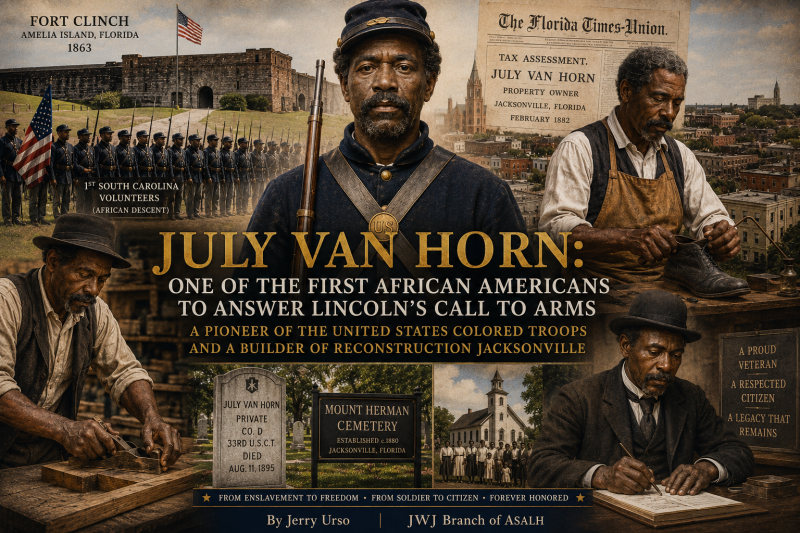
July Van Horn: One of the First African Americans to Answer Lincoln's Call to Arms
A Pioneer of the United States Colored Troops and a Builder of Reconstruction Jacksonville
By Jerry Urso
JWJ Branch of ASALH
Introduction
When President Abraham Lincoln signed the Emancipation Proclamation on January 1, 1863, he forever changed the course of the Civil War and the future of the United States. For the first time, formerly enslaved African American men were officially authorized to enlist in the Union Army and fight for both their freedom and the preservation of the nation.[1] Thousands answered that call almost immediately, understanding that military service represented more than patriotism—it offered a direct path from slavery to citizenship.
Among those courageous volunteers was Private July Van Horn, one of the earliest documented African Americans to answer Lincoln's call to arms. Military records place him in the 1st South Carolina Volunteers (African Descent) during January 1863, making him a member of one of the first federally recognized Black regiments organized during the Civil War.[2] That regiment, commanded by abolitionist Colonel Thomas Wentworth Higginson, would become a proving ground for African American military service, forever changing public opinion about the courage, discipline, and patriotism of Black soldiers.[3]
Although July Van Horn never became a nationally known figure, the surviving documentary record reveals an extraordinary life that intersected with some of the most significant events of the nineteenth century. He marched with one of America's pioneering Black regiments, became one of the first African American soldiers to operate in Florida during the Civil War, witnessed the transformation of the 1st South Carolina Volunteers into the 33rd United States Colored Troops, and later helped build Jacksonville's emerging African American community during Reconstruction.[2][4]
His life demonstrates that history is often made not only by famous leaders, but also by ordinary men whose courage altered the course of a nation.
The Missing Years
Like many formerly enslaved African Americans, the early life of July Van Horn remains largely hidden behind the silence created by slavery. Later census records identify him as having been born in Florida about 1830, but few surviving records document his life before the Civil War.[5]
How he arrived in Union-controlled Beaufort, South Carolina, remains one of the great unanswered questions surrounding his life.
One possibility is that Van Horn was born into slavery in Florida and later sold through the interstate slave trade into coastal Georgia or South Carolina. Throughout the decades before the Civil War, thousands of enslaved Floridians were forcibly removed from their homes and sold throughout the Lower South as cotton cultivation expanded. Families were routinely separated, and enslaved people were transported hundreds of miles from their birthplace.[6]
A second possibility is equally compelling. Following the Union capture of Port Royal in November 1861 and the occupation of coastal communities throughout the Department of the South, thousands of enslaved men and women escaped plantations seeking refuge behind Union lines. Many immediately volunteered for military service, believing that carrying a rifle for the United States offered the surest guarantee that freedom would never again be taken from them.[7]
The surviving records cannot yet determine which path July Van Horn traveled. What they do reveal, however, is that by January 1863 he stood among the first generation of African American soldiers preparing to fight for the Union. Whether he reached Beaufort after surviving the domestic slave trade or by escaping slavery himself, his enlistment transformed him from property under the law into a soldier of the United States Army.[2]
Joining the First South Carolina Volunteers
July Van Horn entered military service at one of the most remarkable moments in American history.
The 1st South Carolina Volunteers (African Descent) had been organized during the previous year from formerly enslaved men living within Union-controlled territory around Port Royal, South Carolina. Initially organized under General David Hunter and later placed under Colonel Thomas Wentworth Higginson, the regiment became a national experiment testing whether African Americans could serve effectively as combat soldiers.[3]
Higginson quickly discovered that the experiment had already answered itself.
In Army Life in a Black Regiment, he repeatedly praised the courage, intelligence, discipline, and determination of the men under his command. Far from confirming the racist assumptions common during the era, the regiment demonstrated that formerly enslaved men could become highly effective soldiers when given the opportunity to serve.[3]
July Van Horn belonged to that remarkable brotherhood.
Within weeks of joining the regiment, he found himself preparing for one of the earliest military expeditions conducted by African American troops in the Civil War—a campaign that would carry him into Florida and make him one of the first Black Union soldiers to set foot in the state under federal authority.[3][4]
Fort Clinch and the St. Mary's River Expedition
Only weeks after enlisting, July Van Horn found himself participating in one of the most important early campaigns conducted by African American soldiers during the Civil War. On January 23, 1863, Colonel Thomas Wentworth Higginson led the 1st South Carolina Volunteers (African Descent) from Beaufort, South Carolina, on the St. Mary's River Expedition, an operation intended to strike Confederate resources along the Georgia-Florida border while demonstrating the military effectiveness of Black troops.[4][5]
On January 26, 1863, the regiment landed on Amelia Island, becoming the first African American Union regiment to set foot on Florida soil in organized military service.[4][6] Their arrival represented a profound reversal of the old social order. Only weeks after the Emancipation Proclamation became law, formerly enslaved men entered Florida not as human property but as soldiers of the United States Army, armed and commissioned to preserve the Union and destroy slavery.
Higginson established Fort Clinch as his forward operating headquarters. The massive Third System brick fortification overlooking the entrance to the St. Marys River provided an ideal base from which to conduct operations into northeast Florida and southeast Georgia.[4][6] The regiment gathered lumber, bricks, food, and other supplies needed to strengthen Union defenses while simultaneously disrupting Confederate logistics and encouraging enslaved people to flee to Union lines.[5]
For July Van Horn, the expedition carried deep personal meaning. Every mile advanced into Confederate territory represented another blow against the institution that had defined his first three decades of life. Military service was no longer simply about preserving the Union; it had become a campaign to liberate people who remained in bondage.
The First Test of Black Soldiers in Florida
During the expedition, the regiment encountered Confederate resistance near Township Landing, often referred to as the Battle of Hundred Pines.[5][7] Confederate cavalry attempted to surprise Higginson's command, believing the newly organized Black regiment would quickly collapse under fire.
Instead, the opposite occurred.
The men of the 1st South Carolina Volunteers held their positions with remarkable discipline, returning accurate fire and forcing the Confederates to withdraw. Although the engagement was relatively small compared to later Civil War battles, its historical significance cannot be overstated. Throughout the North, critics continued to argue that African Americans lacked the courage or discipline necessary for military service. The performance of Higginson's regiment provided powerful evidence to the contrary.[5]
In Army Life in a Black Regiment, Higginson repeatedly praised the steadiness and professionalism of his soldiers. Their conduct during these early expeditions helped silence many critics and encouraged the continued expansion of African American enlistments throughout the Union Army.[5]
For Private July Van Horn, these engagements marked his transition from an enslaved man newly entering military service to a seasoned Union soldier whose courage contributed to changing the nation's perception of Black military capability.
Jacksonville, Harriet Tubman, and the Expanding War for Freedom
Following the St. Mary's River Expedition, the 1st South Carolina Volunteers participated in the First Occupation of Jacksonville during March 1863, becoming among the earliest African American troops to enter and occupy Florida's largest city under Union authority.[5][7] Jacksonville would later emerge as one of the South's most important centers of African American political, religious, educational, and economic development during Reconstruction, making Van Horn's military connection to the city especially significant.
At the same time, another remarkable African American was serving the Union cause within the Department of the South.
Harriet Tubman worked as a nurse, humanitarian, scout, and intelligence operative, caring for Union soldiers suffering from dysentery, malaria, typhoid, and other diseases that often proved more deadly than Confederate bullets.[8] Contemporary accounts describe Tubman gathering medicinal roots and herbs, preparing remedies that earned the respect of Union physicians and officers.[8]
Several historical accounts also place Tubman in Fernandina and the Fort Clinch area during Union operations in northeast Florida, where disease threatened soldiers stationed along the coast.[9][10] Although no surviving military record identifies individual soldiers treated by Tubman, July Van Horn served in the same Department of the South during this critical period. Together, Tubman and the soldiers of the 1st South Carolina Volunteers represented two complementary dimensions of African American service—one providing medical care and intelligence, the other demonstrating on the battlefield that Black soldiers could fight with courage, discipline, and honor.
The campaigns of early 1863 transformed both the war and the nation. They proved that emancipation and military service were inseparable and that formerly enslaved men like July Van Horn would play a decisive role in preserving the Union and expanding the meaning of American freedom.[5]
The Birth of the 33rd United States Colored Troops
As the Civil War progressed, the War Department sought to standardize the growing number of African American regiments serving throughout the Union Army. On February 8, 1864, while the regiment was operating in northeast Florida during the Union campaign that preceded the Battle of Olustee, the 1st South Carolina Volunteers (African Descent) officially became the 33rd United States Colored Troops (USCT).[11]
Although the designation changed, the soldiers remained the same.
July Van Horn continued serving with Company D, carrying forward the experience he had gained during the regiment's pioneering operations in South Carolina, Georgia, and Florida. Muster rolls preserved in his Compiled Military Service Record document his continued service and show periods of detached duty guarding important railroad lines and military infrastructure.[2] Such assignments were essential to Union operations, as Confederate cavalry frequently targeted railroads, bridges, and supply routes in an effort to isolate Federal garrisons.
The creation of the United States Colored Troops represented one of the most significant military developments of the Civil War. By the war's conclusion, nearly 180,000 African American soldiers and approximately 20,000 Black sailors had served the Union. Their courage not only contributed to military victory but also transformed public attitudes toward African American citizenship and equal rights.[5]
As one of the earliest men to enlist, July Van Horn belonged to the generation that made that transformation possible.
Returning Home: Building Reconstruction Jacksonville
Following the Civil War, July Van Horn chose to make Jacksonville, Florida, his home.[12][13] Like thousands of African American veterans throughout the South, he returned not to the world he had known before the war but to a society struggling to redefine itself after emancipation.
Jacksonville became one of Florida's leading centers of Black political, educational, and religious life during Reconstruction. Former Union soldiers established churches, schools, mutual aid societies, businesses, and fraternal organizations while working to secure the rights guaranteed by the Thirteenth, Fourteenth, and Fifteenth Amendments.
Veterans such as July Van Horn brought more than military experience. They carried discipline, leadership, and a profound understanding of the value of freedom. Having risked their lives to preserve the Union, they expected to participate fully in the civic life of the communities they helped rebuild.
State and federal census records place Van Horn among Jacksonville's growing African American population during the decades following the Civil War.[12][13][14] Although surviving records reveal only glimpses of his daily life, they demonstrate that he successfully established himself within the city's expanding Black community.
A Property Owner and Respected Citizen
The Jacksonville newspapers provide further evidence that July Van Horn achieved something remarkable for a man born into slavery.
During February 1882, The Florida Times-Union published a series of municipal tax assessment notices listing July Van Horn among Jacksonville property owners.[15][16][17] These notices may appear routine to modern readers, but they carried extraordinary significance in the decades immediately following emancipation.
Only twenty years earlier, Van Horn himself had been legally considered property.
Now his name appeared in the public record because he owned property.
For formerly enslaved African Americans, land and property ownership represented independence, stability, and citizenship. It reflected years of hard work and determination in the face of enormous obstacles, including discrimination, political violence, and economic hardship throughout the Reconstruction and post-Reconstruction eras.
The tax notices also demonstrate that Van Horn remained an active participant in Jacksonville's civic life long after his military service ended. Rather than fading into obscurity after the war, he became one of the many Black veterans who quietly helped lay the foundations of modern African American Jacksonville through industry, perseverance, and community involvement.[15][16][17]
His Final Illness
By the closing years of the nineteenth century, July Van Horn had become one of Jacksonville's oldest surviving African American pioneers. He had lived through slavery, emancipation, the Civil War, Reconstruction, and the difficult decades that followed. Few men in Jacksonville could claim to have witnessed such dramatic changes in American history.
On September 6, 1894, Jacksonville readers opened The Evening Times-Union to troubling news. The newspaper reported:
"July Van Horn, one of the oldest citizens of this place, is dangerously ill and is not expected to live through the day."[18]
The brief notice reveals something important about Van Horn's standing within the community. The newspaper did not simply identify him by name; it described him as "one of the oldest citizens of this place." Such language suggests that he was widely known within Jacksonville and recognized as one of the city's long-established African American residents whose life stretched back to the years before the Civil War.
Remarkably, the newspaper's prediction proved incorrect.
Although believed to be near death in September 1894, documentary evidence demonstrates that Van Horn survived the illness and lived for nearly another year.[19][20] His recovery stands as another testament to the resilience that had characterized his entire life—from surviving slavery to enduring military service and helping build a new life during Reconstruction.
Death and Burial
On August 11, 1895, Private July Van Horn died in Jacksonville after a life that spanned one of the most transformative periods in American history.[19]
His burial was recorded in the Mount Herman Cemetery Burial Register, one of Jacksonville's oldest African American cemeteries and the resting place of many of the city's early Black pioneers.[20] Mount Herman became the final home for ministers, educators, craftsmen, business owners, veterans, and civic leaders who built Jacksonville's African American community during and after Reconstruction.
Recognizing his faithful Civil War service, the federal government later furnished an official military headstone identifying him as:
July Van Horn
Private
Company D
33rd United States Colored Troops[19]
That simple government marker carries enormous historical weight. It permanently records that a man once held as property under American law died as an honored veteran of the United States Army. His military service became part of the nation's permanent historical record, ensuring that future generations would know he answered Lincoln's call during the Civil War.
More than a memorial, the headstone symbolizes the extraordinary transformation experienced by thousands of formerly enslaved men who exchanged the chains of bondage for the uniform of the Union Army.
Legacy
The story of July Van Horn extends far beyond the biography of a single soldier.
His life reflects the broader history of African Americans who transformed the United States through courage, sacrifice, and perseverance. Born into slavery, he emerged during the nation's greatest crisis to become one of the earliest African Americans to answer President Abraham Lincoln's call to military service. As a member of the 1st South Carolina Volunteers, he helped prove the effectiveness of Black soldiers during the opening months of African American enlistment. He marched with the first Black Union regiment to enter Florida in organized military service, participated in pioneering expeditions under Colonel Thomas Wentworth Higginson, and continued serving after his regiment became the 33rd United States Colored Troops.[2][5][11]
After the war, he remained in Jacksonville, where he became a property owner, taxpayer, and respected member of one of the South's most important African American communities.[12][15][16][17] His life demonstrates that the struggle for freedom did not end at Appomattox. Like countless Black veterans, Van Horn continued building the nation he had helped preserve by establishing roots, supporting his community, and living as a citizen in a society still struggling to fulfill the promises of emancipation.
Today, July Van Horn deserves recognition as one of Florida's earliest documented Black Union veterans and as one of the pioneers who carried the ideals of freedom from the battlefield into everyday life. His story reminds us that the history of the Civil War was written not only by famous generals and politicians, but also by ordinary men whose extraordinary courage forever changed the course of American history.
Honoring a Forgotten Soldier and a Forgotten Cemetery
This article is more than the biography of one Civil War veteran. It is an act of remembrance.
Private July Van Horn rests in Mount Herman Cemetery, once one of Jacksonville's oldest and most important African American burial grounds. Established around 1880 to serve the growing Black communities of LaVilla, Brooklyn, New Town, and Durkeeville, Mount Herman became the final resting place for formerly enslaved men and women, ministers, teachers, laborers, business owners, mothers, children, and veterans who built Jacksonville after the Civil War.[21][22]
Among them were veterans of the United States Colored Troops, including soldiers of the 33rd U.S. Colored Troops, the regiment in which July Van Horn served. These men risked everything to preserve the Union and secure freedom for millions, only to have many of their own graves forgotten by later generations.[21]
During the twentieth century, Mount Herman Cemetery suffered the same fate as many historic African American cemeteries across the South. Decades of neglect were followed by redevelopment. Today, much of the cemetery lies beneath the Emmett Reed Community Center, surrounding park facilities, parking areas, athletic courts, and adjacent development. While some marked graves were relocated, historians and preservationists believe that many burials remain beneath the existing landscape, their occupants never removed before construction occurred. Modern investigations and historical research continue to document the cemetery's significance and the likelihood that numerous graves remain undisturbed beneath the present-day park complex.[21][22][23]
For generations, thousands of Jacksonville residents have driven past, played ball, attended community events, or walked across ground without realizing they were standing above one of the city's most sacred African American historic sites. Beneath that soil rest many of the very people who transformed Jacksonville after emancipation—men and women who survived slavery, rebuilt families, established churches and schools, founded businesses, and defended the United States during its darkest hour.[21][23]
July Van Horn is one of those forgotten pioneers.
His government headstone records his military service. His cemetery register records his burial. His muster rolls preserve his faithful service. His name appears in census records and Jacksonville newspapers. Yet for more than a century, his story remained largely untold.
May this article help restore not only the memory of Private July Van Horn, but also the dignity of the countless men, women, and children who remain buried within the historic grounds of Mount Herman Cemetery. Remembering them is not simply an exercise in genealogy or local history—it is an act of justice. Their lives, sacrifices, and contributions deserve the same respect afforded to every generation that helped build this nation.
As long as their names continue to be spoken, their stories researched, and their sacrifices remembered, neither July Van Horn nor the forgotten citizens of Mount Herman Cemetery will ever truly be lost.
References
[1] Abraham Lincoln. Emancipation Proclamation. January 1, 1863.
[2] Compiled Military Service Record of July Van Horn, Private, Company D, 33rd United States Colored Troops (formerly 1st South Carolina Volunteers), Record Group 94, National Archives and Records Administration, Washington, D.C.
[3] Higginson, Thomas Wentworth. Army Life in a Black Regiment. Boston: Fields, Osgood & Co., 1870. Library of Congress edition.
[4] National Park Service. "Robert Sutton." April 10, 2024.
[5] Official Records of the Union and Confederate Armies (War of the Rebellion), Department of the South, St. Mary's River Expedition, January–February 1863, and related reports.
[6] Fernandina Observer. "Part Three – Freedom Comes to Fernandina." April 7, 2016.
[7] Official Records of the War of the Rebellion, reports concerning the Battle of Township (Hundred Pines), January 26, 1863.
[8] University of Virginia School of Nursing. "Flashback Friday: Harriet Tubman, Nurse."
[9] The Jaxson. "Harriet Tubman in Jacksonville." March 20, 2024.
[10] Amelia Islander Magazine. "Fort Clinch's United States Colored Troops." February 8, 2022.
[11] War Department, General Orders redesignating the 1st South Carolina Volunteers as the 33rd United States Colored Troops, February 8, 1864.
[12] Florida State Census, July Van Horn, Duval County, Florida.
[13] 1870 United States Federal Census, Jacksonville, Duval County, Florida, July Van Horn household.
[14] 1880 United States Federal Census, Jacksonville, Duval County, Florida, July Van Horn household.
[15] The Florida Times-Union (Jacksonville, Florida), February 10, 1882, p. 4.
[16] The Florida Times-Union (Jacksonville, Florida), February 17, 1882, p. 4.
[17] The Florida Times-Union (Jacksonville, Florida), February 24, 1882, p. 3.
[18] The Evening Times-Union (Jacksonville, Florida), September 6, 1894, p. 3.
[19] U.S. Headstones Provided for Deceased Union Civil War Veterans, 1861–1904. July Van Horn, Private, Company D, 33rd U.S. Colored Troops; date of death August 11, 1895.
[20] Mount Herman Cemetery Burial Register, Jacksonville, Duval County, Florida, burial entry for July Van Horn.
[21] The Jaxson. "Erased: Jacksonville's Mount Herman Cemetery." February 19, 2020.
[22] Black Cemetery Network. "Old Mt. Herman Cemetery."
[23] Jacksonville historical research and archaeological reports concerning Mount Herman Cemetery, including documentation of the cemetery beneath the Emmett Reed Community Center, park, and adjacent development.
