
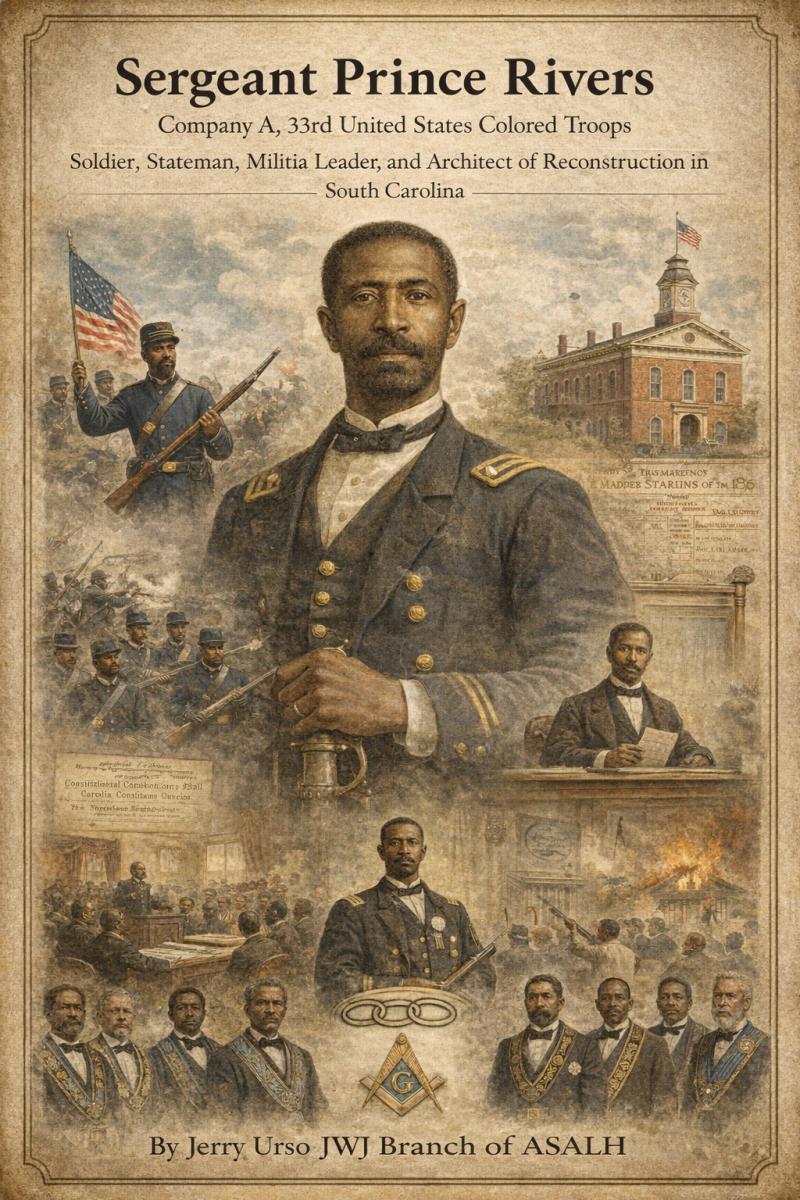
Company A, 33rd United States Colored Troops
Soldier, Statesman, Militia Leader, and Architect of Reconstruction in South Carolina
Introduction
Prince Rivers was born into slavery in the early 1820s in Beaufort County, South Carolina. By the time of his death in 1887, he had lived as an enslaved coachman, a Union Army sergeant and color bearer, a business proprietor, a landholder, a constitutional delegate, a state legislator, a militia officer, a trial justice, and a sworn witness before a state investigating committee. His life traces the dramatic arc of Black political authority during Reconstruction and the organized effort to dismantle it.
Unlike many Reconstruction figures known only through partisan accounts, Rivers appears in a broad documentary record that includes military writings, federal tax rolls, agricultural schedules, legislative proceedings, sworn testimony, newspaper references, and pension records. These materials permit a careful reconstruction of his public career and intellectual capacity. They also allow a measured assessment of later attempts to distort his legacy during the Jim Crow era.
Early Life in Bondage
Prince Rivers was born between approximately 1822 and 1824 in Beaufort County, South Carolina [1]. He was enslaved by Henry Middleton Stuart, a planter and physician whose estate, Oak Point or Pages Point, stood among the Sea Islands plantations. Rivers served as a house servant and coachman. This position placed him in proximity to the household and afforded him mobility beyond the plantation fields.
Evidence from later sources strongly indicates that Rivers acquired literacy while enslaved. Colonel Thomas Wentworth Higginson later wrote that Rivers prepared daily written reports during military service, confirming functional literacy [2]. The acquisition of reading and writing skills under slavery required secrecy and risk, and it suggests intellectual discipline long before emancipation.
The Sea Islands region was politically volatile in 1860 and 1861. South Carolina’s secession and the subsequent bombardment of Fort Sumter signaled impending war. Rivers’s position as coachman likely exposed him to discussions of secession and conflict. Historians have suggested that he developed a political understanding of events unfolding around him and recognized the significance of Union naval operations along the coast [3].
Escape to Union Lines
In November 1861 Union naval forces captured Port Royal Sound. Planters fled inland, abandoning large estates. Henry Stuart relocated to Edgefield County, taking enslaved laborers with him. In early 1862, Prince Rivers seized one of Stuart’s horses and rode back across Confederate-controlled territory to Beaufort County, entering Union lines [4].
This act was deliberate and strategic. The Port Royal region had become the site of federal occupation and early emancipation experiments. General David Hunter organized African American regiments, though his authority to emancipate slaves was initially contested. Rivers enlisted in the 1st South Carolina Volunteers, later redesignated the 33rd United States Colored Troops [5].
His escape marked the transformation from enslaved property to self-determining political actor. It also positioned him at the forefront of Black military participation in the Civil War.
Sergeant and Color Bearer of the 1st South Carolina Volunteers
Prince Rivers rose to the rank of sergeant in Company A of the 33rd United States Colored Troops, as confirmed by pension index records [6]. He also served as provost sergeant and color bearer. The position of color bearer carried both symbolic and tactical significance. The regimental flag represented national authority and military honor, and its bearer stood conspicuously in battle.
Colonel Thomas Wentworth Higginson described Rivers in Army Life in a Black Regiment in language that combined admiration with detailed observation. Higginson wrote:
“There is not a white officer in this regiment who has more administrative ability, or more absolute authority over the men; they do not love him, but his mere presence has controlling power over them. He writes well enough to prepare for me a daily report of his duties in the camp; if his education reached a higher point, I see no reason why he should not command the Army of the Potomac. He is jet black, or rather, I should say, wine black; his complexion, like that of others of my darkest men, having a sort of rich, clear depth, without a trace of sootiness, and to my eye very handsome. His features are tolerably regular, and full of command, and his figure superior to that of any of our white officers, being six feet high, perfectly proportioned, and of apparently inexhaustible strength and activity. His gait is like a panther’s; I never saw such a tread. No anti slavery novel has described a man of such marked ability. He makes Toussaint perfectly intelligible; and if there should ever be a black monarchy in South Carolina, he will be its king.” [2]
This passage establishes Rivers’s literacy, administrative skill, and commanding presence. It also situates him within a transnational discourse of Black revolutionary leadership.
Black soldiers initially received unequal pay under the Militia Act of 1862, receiving less compensation than white troops. Congress authorized equal pay retroactively in 1864 [7]. Rivers and his regiment served despite these inequities, participating in coastal expeditions in South Carolina and Florida.
Entrepreneurship and Economic Advancement
The conclusion of the Civil War did not mark a pause in Prince Rivers’s public activity. Instead, it marked a transition. Unlike many formerly enslaved men who were compelled into labor contracts with limited autonomy, Rivers entered the formal economy with remarkable speed. Federal Internal Revenue Service assessment lists from 1865 record an entity identified as “Prince Rivers and Co.” in South Carolina [8]. The inclusion of “and Co.” indicates a partnership or organized business venture rather than day labor. That Rivers appeared in federal tax rolls in the first year of emancipation demonstrates both economic initiative and access to capital.
This early commercial presence aligns with accounts from the Port Royal Experiment, where formerly enslaved men and women participated in tax sales of abandoned plantation lands. Rivers is reported to have encouraged fellow veterans to pool their funds to purchase property at these auctions, recognizing that land ownership was foundational to long-term independence [9]. His understanding of property as political security reveals economic foresight that extended beyond subsistence farming.
The 1870 Agricultural Schedule for Saint Peter’s Parish in Beaufort County lists Prince Rivers as an agricultural producer [10]. Agricultural schedules were separate from the general population census and recorded acreage, livestock, crop production, and estimated property value. Inclusion in this schedule confirms active engagement in farming and suggests ownership or management of land. In the context of postwar South Carolina, Black landholding represented not merely economic advancement but an assertion of autonomy in a region where plantation control had previously defined social order.
Rivers’s economic activities complicate later portrayals that reduced Reconstruction leaders to caricatures. His transition from military service to business partnership and agricultural production situates him within the emerging class of Black property holders during early Reconstruction.
Political Life in Reconstruction South Carolina
By 1867 Prince Rivers had entered formal politics. Freedmen’s Bureau records identify him in connection with civic activity during the Reconstruction period, reflecting interaction with federal authorities responsible for overseeing the transition from slavery to freedom [11]. That federal officials recognized him as a representative figure underscores his early political prominence.
In 1868 Rivers was elected as a delegate to the South Carolina Constitutional Convention [12]. The convention drafted a new constitution that expanded suffrage, established a statewide system of public education, and restructured local governance. Black delegates played a central role in shaping this framework, and Rivers emerged as an articulate participant in the proceedings.
Following the convention, Rivers was elected to the South Carolina House of Representatives, serving from 1868 through 1874 [13]. Legislative service required familiarity with statutory language, committee procedures, and budgetary oversight. Rivers’s sustained tenure demonstrates political durability in a volatile environment.
One of his most consequential contributions occurred in 1871 when Aiken County was formed from portions of Edgefield and surrounding districts. Rivers was among the African American leaders involved in its establishment and reportedly assisted in selecting the location for the county courthouse [14]. The act of founding a county was not merely administrative. It involved redistricting, allocation of tax authority, and institutional construction. Participation in such a process indicates influence within the state’s governing apparatus.
Rivers also served as trial justice in Hamburg, a predominantly Black town near the Georgia border. In this role he presided over civil disputes and minor criminal cases. Stephen Budiansky describes Rivers issuing written court orders in a smooth, flowing hand, reflecting legal fluency and administrative competence [15]. His judicial authority made him both a symbol of Black governance and a target for opponents of Reconstruction.
Service in the South Carolina Militia
Reconstruction South Carolina maintained a state militia system composed in significant part of Black veterans. These units were legally constituted under state authority and functioned as instruments of public order. The militia also served as a visible affirmation of Black citizenship, particularly in communities where former Confederates sought to restore antebellum racial hierarchies.
Prince Rivers held leadership within this militia structure. A newspaper report from August 25, 1875 referred to “Major General P. Rivers, of South Carolina,” in the context of regional unrest [16]. Although his federal wartime rank was sergeant, this designation reflects recognition of authority within the state militia hierarchy. The title underscores the extent to which Rivers was associated with organized armed defense under Reconstruction governance.
The presence of armed Black militia companies provoked intense hostility from white paramilitary organizations. Rifle clubs and Red Shirt groups emerged throughout South Carolina in the mid-1870s, explicitly committed to dismantling Republican state government and suppressing Black political participation. For these groups, the militia symbolized the inversion of racial authority.
Rivers’s militia leadership bridged his wartime experience and Reconstruction civic responsibility. He embodied continuity between Union military service and state governance. His authority rested not merely on symbolic reputation but on statutory legitimacy within the state’s defense structure.
By 1875 South Carolina’s political climate had deteriorated sharply. White Democratic organizations increasingly relied on intimidation and violence. The stage was set for confrontation in Hamburg, where Rivers’s roles as magistrate and militia leader converged.
Intellect, Literacy, and Public Authority
The surviving documentary record consistently affirms Prince Rivers’s intellectual capacity. His literacy is not speculative. Colonel Thomas Wentworth Higginson explicitly stated that Rivers prepared written daily reports during military service [2]. That responsibility required coherent composition, disciplined observation, and administrative precision. Higginson further asserted that Rivers possessed more administrative ability than any white officer in the regiment, a striking endorsement given the racial attitudes of the era.
Stephen Budiansky’s analysis of Reconstruction violence describes Rivers issuing written judicial orders in Hamburg in a smooth and legible hand [15]. This detail confirms not merely functional literacy but practiced legal writing. Trial justices were required to draft warrants, record judgments, and maintain procedural documentation. Rivers performed these tasks in a community under intense political strain.
His appearance in federal tax records, agricultural schedules, legislative proceedings, and sworn investigative testimony further demonstrates fluency in bureaucratic systems [8][10][17]. Each of these records required engagement with written forms, property descriptions, financial accounting, or legal argumentation. Rivers moved across these domains with apparent competence.
Contemporary observers frequently commented on his composure and bearing. Higginson’s extended description, quoted earlier, portrays a man of command presence and physical discipline [2]. While some of the language reflects nineteenth century racialized framing, the substance of the description emphasizes Rivers’s authority, intellect, and administrative skill.
It is also important to situate Rivers within the broader intellectual culture of Reconstruction. Black legislators and militia leaders were often self educated through church networks, military service, and civic organizations. Rivers’s ability to navigate military hierarchy, economic enterprise, legislative procedure, and judicial responsibility indicates sustained intellectual engagement rather than episodic advancement.
The Hamburg Riot and Political Terror
By 1876 Reconstruction in South Carolina faced coordinated paramilitary opposition. White Democratic rifle clubs and Red Shirt organizations mobilized to reclaim political control through intimidation and violence. Hamburg, a predominantly Black town near Augusta, Georgia, became a focal point.
On July 4, 1876, a Black militia company paraded through Hamburg as part of Independence Day observances. Two white farmers alleged that the militia obstructed a public road and demanded disarmament. As trial justice and militia leader, Prince Rivers attempted to address the complaint through legal channels [18].
The dispute escalated rapidly. Armed white rifle club members gathered in force, bringing artillery to bear against the militia armory. Rivers reportedly attempted mediation, urging both sides to avoid bloodshed. His efforts failed as white paramilitaries demanded unconditional surrender [18].
An exchange of fire resulted in the death of one white man. The militia retreated to the armory but were eventually overwhelmed. After surrendering, several Black militiamen were captured. In what witnesses later described as the “Dead Ring,” white paramilitaries executed prisoners extrajudicially during the night. Four men were killed outright, and others were wounded [19].
The Hamburg Massacre was not a spontaneous riot but a calculated act of political terror. It signaled to Black officeholders that armed resistance to Democratic reclamation would be met with lethal force. Rivers’s prominence as magistrate and militia officer made him a particular target.
Following the violence, his home was burned and property destroyed [18]. The attack represented not only personal retaliation but symbolic dismantling of Black authority in the region. The destruction of his residence mirrored the broader destruction of Reconstruction governance.
Sworn Legislative Testimony and Political Courage
In 1877 Prince Rivers appeared before a Joint Investigating Committee of the South Carolina General Assembly, providing sworn testimony concerning legislative corruption and impeachment proceedings [17]. The transcript of his testimony reveals structured narrative, detailed recollection of caucus meetings, and careful articulation of political events.
He described interactions among legislators, allegations of bribery, and factional disputes within the Republican Party. His language was measured and precise, reflecting legal awareness and political sophistication. The testimony stands as documentary proof of his continued engagement in governance even amid rising paramilitary intimidation.
That Rivers testified publicly after the Hamburg violence demonstrates political courage. Many Black officials retreated from public life following the events of 1876. Rivers instead placed himself on record, contributing to the formal investigation of state affairs.
The combination of militia leadership, judicial authority, and sworn testimony situates Rivers at the intersection of military defense and civil governance during Reconstruction’s final years.
The Collapse of Reconstruction
The events at Hamburg in July 1876 signaled more than localized violence. They marked the systematic unraveling of Reconstruction governance in South Carolina. Paramilitary organizations, including rifle clubs and Red Shirt companies, openly challenged the authority of Republican officeholders and Black militia units. The violence was not spontaneous. It functioned as coordinated political intimidation designed to overturn electoral outcomes and dismantle Black civic authority [18].
In the aftermath of the Hamburg killings, Democratic “Redeemer” forces consolidated control across the state. Federal willingness to enforce Reconstruction protections weakened dramatically. The national political settlement of 1877 effectively withdrew meaningful federal support from Republican governments in the South [20]. South Carolina’s government passed into Democratic control, and the institutional framework that had elevated leaders such as Prince Rivers rapidly eroded.
Rivers’s authority as trial justice and militia leader diminished in the face of this political reversal. Black militia units were disarmed or rendered inactive. Republican legislators were forced from office or politically marginalized. Economic retaliation followed political displacement. Rivers’s home had already been burned in the wake of Hamburg. Property destruction functioned as a warning to others who might assert public authority [18].
The collapse of Reconstruction did not erase Rivers’s earlier achievements, but it did curtail his access to public office and institutional influence.
Personal Decline and Economic Regression
As Democratic control solidified, Black officeholders across South Carolina faced narrowing opportunities. Rivers, who had appeared in federal tax assessments in 1865 and agricultural schedules in 1870, no longer occupied the economic position he had once achieved [8][10]. Later accounts describe him working again as a carriage driver, the occupation he had performed while enslaved. The return to that labor should not be read as evidence of diminished capacity. Rather, it reflected the broader contraction of political and economic space available to Black leaders under Redemption.
The structural dismantling of Reconstruction involved more than electoral defeat. It entailed the systematic removal of Black men from positions of civil authority and the reassertion of white supremacy through legal and extralegal means. Rivers’s trajectory mirrors that broader historical process.
Death and Burial
Prince Rivers died on April 10, 1887 [21]. He was buried in Randolph Cemetery in Columbia, South Carolina, a burial ground that became the resting place for many African American leaders of the nineteenth century. Later commemorative references occasionally styled him “Major General Prince Rivers.” While his confirmed federal military rank during the Civil War was sergeant in Company A of the 33rd United States Colored Troops, contemporary newspaper references from 1875 reflect recognition of his leadership within the South Carolina state militia structure [16]. The adoption of the militia honorific in memorial contexts reflects public memory of his Reconstruction service rather than alteration of his wartime rank.
Legacy
Prince Rivers’s life represents one of the clearest documented arcs of Black political ascent and suppression in the Reconstruction South. From enslavement in Beaufort County to military leadership in the 1st South Carolina Volunteers, from business enterprise recorded in federal tax rolls to landholding in agricultural schedules, from constitutional delegate to legislator, from militia authority to sworn witness before the General Assembly, his career spanned the most transformative decades of nineteenth-century Southern history.
Contemporaries recognized his ability. Colonel Thomas Wentworth Higginson wrote of him:
“There is not a white officer in this regiment who has more administrative ability, or more absolute authority over the men; they do not love him, but his mere presence has controlling power over them. He writes well enough to prepare for me a daily report of his duties in the camp; if his education reached a higher point, I see no reason why he should not command the Army of the Potomac. He is jet black, or rather, I should say, wine black; his complexion, like that of others of my darkest men, having a sort of rich, clear depth, without a trace of sootiness, and to my eye very handsome. His features are tolerably regular, and full of command, and his figure superior to that of any of our white officers, being six feet high, perfectly proportioned, and of apparently inexhaustible strength and activity. His gait is like a panther’s; I never saw such a tread. No anti slavery novel has described a man of such marked ability. He makes Toussaint perfectly intelligible; and if there should ever be a black monarchy in South Carolina, he will be its king.” [2]
This assessment confirms Rivers’s literacy, administrative competence, and command presence during military service. It also situates him within a broader revolutionary tradition through comparison to Toussaint Louverture.
Beyond formal political office, Rivers’s influence extended into fraternal institutions that undergirded Black civic life. The Grand United Order of Odd Fellows later identified him as the “Black Prince of Aiken County,” recognizing his leadership in linking military service with political authority. Within Prince Hall Masonic tradition in South Carolina, he is acknowledged as part of the post–Civil War network of veterans and legislators who used lodge structures as organizing centers for Black political stability. These fraternal organizations provided insurance benefits, burial funds, and secure communication networks at a time when leaders such as Rivers were targeted by paramilitary violence.
Murals and historical markers in Aiken County continue to commemorate his dual role as soldier and statesman. The preservation of his memory within both civic and fraternal contexts underscores the institutional breadth of his influence.
Prince Rivers’s life illustrates the interconnected pillars of Reconstruction Black governance: military service, economic initiative, legislative authority, militia organization, judicial responsibility, and fraternal solidarity. The dismantling of Reconstruction targeted each of these pillars. Yet the documentary record endures. Pension files confirm his service. Tax records document his enterprise. Agricultural schedules record his landholding. Legislative journals preserve his participation. Investigative transcripts capture his testimony. Memoirs record his intellect.
His life stands as a documented case study in both the rapid expansion of Black political power after the Civil War and the organized effort to suppress it. Through that record, Prince Rivers remains not merely a local figure but a representative architect of Reconstruction’s most ambitious promise.
References
[1] Henry Louis Gates Jr., Dark Sky Rising: Reconstruction and the Dawn of Jim Crow (New York: Penguin Press, 2021).
[2] Thomas Wentworth Higginson, Army Life in a Black Regiment (Boston: Fields, Osgood & Co., 1870; reprint editions available).
[3] W. Scott Poole, South Carolina’s Civil War: A Narrative History (Macon: Mercer University Press, 2005).
[4] National Park Service, Reconstruction Era National Historical Park, biographical profile of Prince Rivers.
[5] U.S. War Department, Compiled Military Service Records of the 33rd United States Colored Troops; U.S. Civil War Pension Index, Prince R. Rivers, Company A, 33rd U.S. Colored Infantry.
[6] Higginson, Army Life in a Black Regiment (verbatim passage regarding Prince Rivers).
[7] U.S. Congress, Militia Act of 1862 and Act of June 15, 1864 granting equal pay to United States Colored Troops.
[8] United States Internal Revenue Service, Tax Assessment Lists, South Carolina, 1865, listing “Prince Rivers and Co.”
[9] Records of the Port Royal Experiment and Beaufort District tax sales, 1863–1865.
[10] 1870 U.S. Federal Census, Agricultural Schedule, Saint Peter’s Parish, Beaufort County, South Carolina, listing Prince Rivers as agricultural producer.
[11] Bureau of Refugees, Freedmen, and Abandoned Lands (Freedmen’s Bureau Records), South Carolina, 1865–1870, referencing Prince Rivers in civic capacity.
[12] Proceedings of the Constitutional Convention of South Carolina, 1868.
[13] South Carolina House of Representatives Journals, 1868–1874.
[14] Legislative Act establishing Aiken County, South Carolina, 1871; county formation records.
[15] Stephen Budiansky, The Bloody Shirt: Terror After Appomattox (New York: Viking, 2008).
[16] The Newberry Weekly Herald (Newberry, South Carolina), August 25, 1875, reference to “Major General P. Rivers.”
[17] Journal of the Joint Investigating Committee of the General Assembly of South Carolina, Testimony of Prince R. Rivers, 1877.
[18] Contemporary newspaper accounts and state investigation records concerning the Hamburg Massacre, July 1876; see also Budiansky, The Bloody Shirt.
[19] Mark M. Smith, “‘All Is Not Quiet in Our Hellish County’: Facts, Fiction, Politics, and Race — The Ellenton Riot of 1876,” South Carolina Historical Magazine 95, no. 2 (April 1994).
[20] Political settlement of 1877 and South Carolina “Redemption” era legislative records; see also Gates, Dark Sky Rising.
[21] Randolph Cemetery burial documentation, Columbia, Richland County, South Carolina; Find A Grave memorial record for Prince Rivers, died April 10, 1887.
