
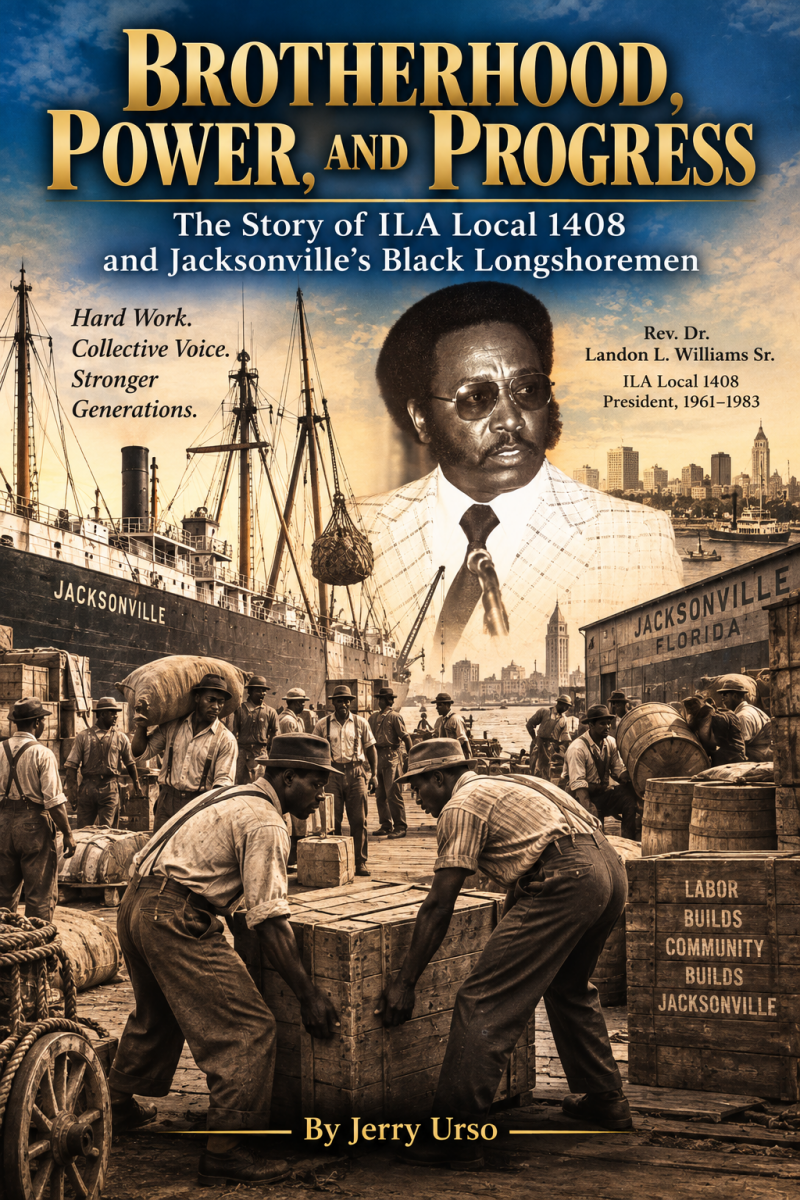
Brotherhood, Power, and Progress
How Jacksonville’s Black Longshoremen Used the Power of the Waterfront to Build a Middle Class
By Jerry Urso
JWJ Branch of ASALH
The Men Who Moved Jacksonville
The history of Jacksonville’s port is often told through ships, docks, warehouses, railroads, cranes, and cargo. We measure its growth by the vessels entering the St. Johns River, the tonnage passing across its docks, and the industries that developed around the waterfront. Yet behind those statistics stood generations of working men whose labor made that commerce possible. For much of Jacksonville’s history, many of those men were African American.
In Southern ports such as Jacksonville, Savannah, and Charleston, Black men historically performed much of the difficult physical labor associated with loading and unloading ships. Historian Eric Arnesen has documented the racial divisions that characterized Southern waterfront labor, where many of the more skilled and better-paid positions went to white workers while Black men were concentrated in the physically demanding longshore jobs.[1] Jacksonville reflected that larger Southern pattern. Before containers, gantry cranes, and modern cargo-handling systems transformed the waterfront, freight was moved through an extraordinary amount of human labor.
Jacksonville’s own employment history demonstrates how important manual labor was to the Black community. By 1894, 67 percent of the city’s Black workers were still classified as unskilled laborers, including men employed on the docks and in lumberyards.[2] For Black men confronting the restrictions of segregation, waterfront employment provided work, but that work was often difficult, dangerous, poorly compensated, and uncertain.
Out of those conditions developed something that would ultimately change the economic position of generations of Black Jacksonville families. Longshore work demanded cooperation. A man working inside the hold of a ship depended upon the men beside him. Crews had to coordinate their movements around heavy cargo and dangerous equipment. Their livelihoods and sometimes their lives depended upon one another. Brotherhood on the waterfront was therefore not merely a fraternal sentiment. It grew from the nature of the work itself.
That brotherhood eventually became organized economic power. In 1935, after previous attempts to organize Jacksonville’s Talleyrand Avenue docks had failed, a determined core of Black waterfront workers came together again. Shipping interests strongly opposed organized labor, particularly the organization of Black dockworkers. Early union members reportedly concealed their union buttons beneath their lapels, behind their suspenders, or inside their hats because being discovered could result in immediate blacklisting.[3] Nevertheless, the men persisted, and in 1936 International Longshoremen’s Association Local 1408 emerged as a collective voice for Black Jacksonville longshoremen.
The significance of what those men accomplished becomes clearer when we consider what they possessed and what they did not. They did not own the ships entering Jacksonville. They did not own the warehouses along the waterfront, nor did they control the shipping companies that determined when and where men worked. Individually, they possessed little leverage. Collectively, however, they controlled something without which the entire system could not operate: their labor. A ship could reach Jacksonville, a warehouse could stand ready, and a company could have thousands of tons of cargo waiting to move, but the waterfront still required men who knew how to unload, handle, transfer, and eventually operate the machinery that moved that cargo.
Organization allowed Black longshoremen to convert the physical strength that employers had always valued into bargaining power that employers could no longer easily ignore. That power was used to fight for better wages, improved conditions, greater security, and eventually a stronger voice in determining the terms under which their own labor would be sold. The same occupation once regarded as some of the hardest and least desirable work in the city gradually became one of the dependable avenues through which Black Jacksonville men could earn wages capable of supporting their families.[1]
The consequences reached far beyond Talleyrand Avenue. Money earned on the docks traveled into Black neighborhoods. It paid mortgages and rents, purchased automobiles, supported churches and neighborhood businesses, and helped educate children. Local 1408 eventually became more than a labor organization. It became one of the institutions through which Black working families could move toward economic security and, in many cases, into Jacksonville’s growing Black middle class.[1][4]
That transformation is central to understanding the cultural significance of Local 1408. The men did not simply fight to make difficult work pay better. Through brotherhood and organization, they challenged a system in which Black labor could be indispensable while Black workers remained economically and socially marginalized. Over successive generations, the strength they developed on the waterfront became a source of opportunity for their families and their community. The history of Jacksonville’s Black longshoremen is therefore not simply the story of who loaded the ships. It is the story of how men who had little individual power learned to stand together, recognize the economic value of their labor, and use that collective strength to help build a Black middle class in Jacksonville.
Before the Union: Strong Backs, Long Hours and Little Security
Long before the creation of Local 1408, Jacksonville’s waterfront was already a place where opportunity and exploitation existed side by side. The St. Johns River connected Jacksonville to national and international commerce, and every vessel arriving with freight created a demand for men willing to perform some of the hardest labor in the city. For Black Jacksonville, the docks provided employment at a time when segregation severely restricted where African Americans could work and how far they could advance. Yet access to work did not mean equality, security, or fair compensation.
By the end of the nineteenth century, Black labor had become deeply embedded in Jacksonville’s developing economy. In 1894, approximately 67 percent of the city’s Black workers remained classified as unskilled laborers, including men working on the docks and in lumberyards.[2] These workers helped move the raw materials and commodities upon which Jacksonville’s commercial growth depended, but their importance to the economy was rarely reflected in their wages or working conditions. The waterfront depended upon Black labor while the larger racial system continued to limit the economic mobility of the men supplying it.
The work itself could be brutal. Before containers and modern cargo-handling equipment, ships were loaded and unloaded through an enormous amount of physical labor. Men descended into ships’ holds, worked around ropes, winches, slings, heavy freight, and moving equipment, and often performed their duties under conditions where a momentary mistake could result in serious injury. Early maritime litigation involving Jacksonville illustrates the hazards surrounding waterfront employment. The 1923 federal case Payne v. Jacksonville Forwarding Co., later cited by Martin J. Norris in The Law of Seamen, involved an injury sustained in connection with work around a vessel and became part of the developing body of maritime law concerning responsibility for workers injured in maritime employment.[5] The case does not establish that Payne was Black or connected to the later Local 1408, but it provides contemporary evidence of the dangerous occupational environment in which Jacksonville waterfront workers labored before the union was organized.
The conditions remembered by Local 1408’s own history were equally revealing. Dock work was among the hardest and least desirable occupations available. Wages were extremely low, benefits were practically nonexistent, and there was no guarantee that a man reporting for work would actually be employed that day. Work periods could extend beyond twenty-four consecutive hours. Transportation presented another hardship because public bus service did not adequately reach the dock area, forcing many laborers to walk considerable distances to and from work.[3] For a Black worker supporting a family, losing even a day’s employment could have consequences at home, and challenging an employer could mean losing access to waterfront work altogether.
The hiring system also placed tremendous power in the hands of those deciding who would work. A longshoreman without seniority, protection, or collective representation depended upon being selected for employment. That uncertainty helped keep workers vulnerable because the possibility of being passed over for the next job discouraged men from openly challenging wages or conditions. Segregation added another layer to that vulnerability. Black workers could perform the labor necessary to move Jacksonville’s commerce while remaining excluded from equal authority over the conditions under which that labor was performed.
Yet the waterfront contained the seeds of its own transformation. Longshore work was rarely an individual occupation. Men worked in gangs, and the success and safety of one worker depended upon the others. They learned one another’s abilities, watched one another’s backs, and shared the experience of exhausting work and uncertain employment. In a society structured to restrict Black advancement, the docks brought working men together day after day and created relationships based upon shared labor and common interests.
That brotherhood eventually allowed the men to recognize something employers could not easily take away. Their individual positions might have been insecure, but their collective labor was indispensable. Jacksonville could build docks, deepen channels, construct warehouses, and welcome ships from around the world, but commerce still depended upon the workers who moved the cargo between ship and shore. The same men who appeared to possess the least power on the waterfront actually controlled one of its most essential resources.
By the 1930s, the question was no longer simply whether Black men could find work on Jacksonville’s docks. The question was whether those men could stand together strongly enough to determine what their labor was worth. The answer would emerge from Talleyrand Avenue, where a small group of Black longshoremen began turning the brotherhood created through shared labor into an organized institution capable of confronting the economic and racial realities of Jacksonville’s waterfront.
1935–1936: Brotherhood Becomes Power
By the middle of the 1930s, Black longshoremen on Jacksonville’s waterfront understood that hard work alone would never guarantee fair treatment. They supplied the labor that moved cargo through the port, yet wages remained low, employment uncertain, and the power to determine working conditions rested largely with shipping companies and waterfront employers. Previous efforts to organize the Talleyrand Avenue docks had failed, but in 1935 a determined group of men decided to try again. Local 1408’s history remembers them as a “strong core of men” who came together despite the considerable risks associated with organizing Black labor in the segregated South.[3]
For these men, union organization required courage as well as solidarity. Shipping companies opposed organized labor, and the effort to organize Black dockworkers faced the additional pressures of segregation. According to the history preserved by Local 1408, early members sometimes concealed their union buttons inside their hats, behind their suspenders, or beneath their lapels. If their union affiliation became known, they could be blacklisted and denied the waterfront employment upon which their families depended.[3] A small union button therefore represented something much larger. It represented a willingness to risk an individual livelihood for the possibility of improving conditions for all.
That risk also reveals the meaning of brotherhood among the early longshoremen. Organization could succeed only if the men trusted one another. One worker could be isolated, intimidated, or replaced, but a group willing to remain together presented employers with a different problem. The longshoremen were beginning to understand that the same cooperation required to safely work a ship could be applied to their economic lives. The brother standing beside a man in the ship’s hold could also stand beside him when wages, hours, and working conditions were challenged.
In 1936, their efforts resulted in the establishment of International Longshoremen’s Association Local 1408 in Jacksonville. The union emerged within a waterfront still governed by racial segregation. Historical research on Southern longshore labor shows that Jacksonville, like other Southeastern ports, developed racially divided union structures during this period. Yet within those restrictions, Local 1408 gave Black longshoremen something they had previously lacked, an organized institution through which they could speak collectively about the value of their labor.[1]
The Florida Times-Union provides contemporary evidence that Jacksonville’s waterfront was part of a much larger labor movement at precisely this moment. On July 12, 1936, the newspaper published “South Atlantic Ports Walkout Is Postponed,” reporting on threatened labor action affecting the South Atlantic waterfront.[6] The timing is significant. During the same year that Local 1408 was establishing itself in Jacksonville, longshoremen throughout the region were demonstrating that organized waterfront labor could influence commerce far beyond an individual dock or city.
The government Port Series material provides additional evidence of how organized longshore labor became incorporated into Jacksonville’s port operations. In its discussion of “Port Labor and Methods Employed in Handling Cargo,” the report identifies ILA Locals 1408 and 1408-A and describes their role in furnishing labor for loading and unloading general cargo vessels and moving freight between ship and dock. The report recorded approximately 228 longshoremen, 42 warehousemen and freight handlers, and 15 freight checkers and shipside clerks registered with the Longshoremen’s Association.[7] Those figures demonstrate that organized waterfront labor was not peripheral to Jacksonville’s maritime economy. It had become part of the machinery through which the port operated.
The creation of Local 1408 changed the relationship between Black workers and the waterfront because it allowed the men to bargain through the strength of the group rather than the vulnerability of the individual. The shipping companies possessed capital, vessels, warehouses, and commercial connections, but the longshoremen possessed the knowledge and labor necessary to move the cargo. Once organized, the men could begin using that fact as leverage to seek better wages, working conditions, and greater security.
This was the beginning of a transformation that would take decades to fully develop. Local 1408 did not immediately erase segregation or eliminate inequality on Jacksonville’s waterfront. What it created was an institution capable of surviving long enough to challenge those conditions. Each generation inherited something the previous generation had strengthened, and the victories won by one group of workers could become the starting point for the next.
The significance of 1936, therefore, reaches far beyond the granting of a union charter. Black longshoremen who had once competed individually for uncertain work began building an organization based upon their common interests. Their brotherhood gave them collective strength, and collective strength gave them economic power. In the decades that followed, they would learn just how powerful that combination could become, not only in determining what happened on Jacksonville’s docks, but in changing what was possible for Black families throughout the city.
Building Power on the Waterfront
The establishment of Local 1408 in 1936 gave Jacksonville’s Black longshoremen an organization, but a charter alone could not guarantee economic security. The union had to survive employer resistance, racial segregation, changing shipping practices, and repeated struggles over wages and working conditions. During the decades that followed, the strength of Local 1408 would depend upon whether its members could maintain the brotherhood that had brought them together in the first place.
Evidence of the growing power of organized waterfront labor appeared only a few years after the local was established. On February 25, 1940, The Florida Times-Union published the headline “Dock Strike Is Effective At Midnight.” The newspaper reported that coastwise shipping in eight Southeastern ports faced a strike involving the International Longshoremen’s Association and waterfront employers.[8] The dispute demonstrated something that Jacksonville’s longshoremen were learning firsthand: waterfront workers did not have to own the ships or the cargo to exercise influence over maritime commerce. When organized longshoremen withheld their labor, the economic consequences could extend from an individual dock to ports across an entire region.
For Black workers, the union offered a measure of protection in an economy where employment opportunities remained restricted by segregation. Longshore work was still difficult and dangerous, but union organization provided a structure through which workers could seek better wages, establish seniority, challenge working conditions, and reduce some of the uncertainty that had characterized earlier dock employment. What had once been an occupation defined largely by a man’s physical strength was gradually becoming an occupation in which union membership, experience, seniority, and skill could provide greater economic stability.
The story becomes particularly meaningful when individual members begin to emerge from the historical record. On March 26, 1950, The Florida Times-Union published the funeral notice “Shrewsberry Rites Set for Tomorrow.” The deceased, Herbert Lee Shrewsberry, of 238 East State Street, was specifically identified as a longshoreman and a member of ILA Union No. 1408.[9] Shrewsberry was not remembered in the newspaper as a great labor leader or public figure. That is precisely what makes his appearance in the record so valuable. He represents the ordinary working membership upon whose shoulders the institution rested.
Men such as Shrewsberry went to the waterfront, worked the ships, paid union dues, supported their families, and maintained the organization from one generation to another. Their importance should not be overshadowed by the presidents and business agents whose names appear more frequently in newspapers. A union survives because ordinary members continue to believe that their individual security is connected to the welfare of the group. The strength of Local 1408 came from hundreds of men making that decision repeatedly over decades.
As the union became more established, waterfront employment also began to assume a different meaning within Black Jacksonville. A job once associated with irregular employment, exhausting hours, and very low wages could increasingly provide a dependable income. That transformation mattered in a city where segregation restricted access to many other well-paying occupations. A longshoreman did not necessarily need a college degree to earn enough money to support a household, and union wages offered some families an opportunity to achieve economic stability that was unavailable through many other jobs open to Black men.
The benefits of that progress extended beyond the individual worker. A better wage earned on the docks became money spent throughout Jacksonville. It helped pay for housing, clothing, automobiles, groceries, education, churches, and neighborhood businesses. A union victory at the bargaining table therefore had consequences at kitchen tables throughout Black Jacksonville. When wages increased or employment became more secure, the effects could be felt by wives, children, merchants, congregations, and neighborhoods that might never have had any direct connection to the waterfront.
This is where the story of Local 1408 begins to become inseparable from the development of Jacksonville’s Black middle class. Economic advancement did not occur solely through doctors, lawyers, teachers, business owners, and other professionals. Skilled and organized working people also built the Black middle class. Longshoremen demonstrated that manual labor, when combined with collective bargaining and worker organization, could provide a family with stability, property, education, and the possibility of leaving the next generation in a stronger position than the one before it.[1]
By the 1950s, Local 1408 had therefore become something greater than the small organization whose earliest members once hid union buttons beneath their clothing. The brotherhood had survived. More importantly, it had begun converting solidarity into economic security. The next generation would inherit that foundation and discover that the same collective strength used to improve wages could also be used to confront larger questions of equality, dignity, and power on Jacksonville’s waterfront.
Landon Williams and a New Generation of Leadership
As Local 1408 matured, a new generation inherited the organization built by the men who had risked blacklisting during the 1930s. Among the most important figures to emerge from that generation was Rev. Dr. Landon L. Williams Sr., whose leadership connected the struggle of Jacksonville’s Black longshoremen to the larger struggle for economic equality and civil rights. Williams served as president of Local 1408 from 1961 until 1983 and eventually rose beyond Jacksonville into leadership positions within the International Longshoremen’s Association.[3][10]
Williams understood that economic power and civil rights could not easily be separated. A Black man might possess the legal right to vote, enter a public building, or sit at a lunch counter, but without access to dependable employment and decent wages, equality remained incomplete. For Jacksonville’s longshoremen, the union hall and the bargaining table became places where another part of the freedom struggle was being fought. The issue was not simply whether Black men could work on the docks. They had been doing that for generations. The larger question was whether they would have a meaningful voice in determining the wages, conditions, and future of the work they performed.
The strength Local 1408 had accumulated became dramatically visible in January 1965, when Jacksonville longshoremen joined a much larger strike extending along the Atlantic and Gulf coasts. Contemporary reporting later revisited by the Jacksonville Daily Record described approximately 1,000 local workers, including about 650 regular union members and 350 part-time workers, waiting as negotiations continued. Williams, then the local union business agent, explained that one of the disputes involved the South Atlantic wage rate. Jacksonville workers were receiving $3.20 an hour, six cents below the rate being sought by the union.[11]
Six cents an hour might appear insignificant when separated from its historical context, but multiplied across hundreds of men, thousands of working hours, and years of employment, those pennies represented money entering Black households. More importantly, the dispute concerned the principle that Jacksonville’s longshoremen should not be expected to accept less for their labor simply because they worked in a Southern port. The men were learning to use the economic importance of the waterfront to demand that their labor be valued more equally.
The strike demonstrated their leverage. Much of Jacksonville’s waterfront activity was brought virtually to a standstill as longshoremen withheld their labor.[11] The significance of that moment cannot be measured simply by the cargo that remained unmoved. For generations, Black men had occupied some of the least powerful positions in Jacksonville’s racial and economic order. Yet on the waterfront, those same men had built an organization capable of interrupting one of the city’s most important commercial systems. Their strength did not come from wealth or ownership. It came from solidarity and from the recognition that the port depended upon their collective labor.
The 1965 confrontation occurred while the waterfront itself was undergoing enormous change. Sea-Land was preparing a major expansion at Talleyrand involving millions of dollars in new port facilities, a lengthy wharf, and a large gantry crane designed for a new era of cargo handling.[11] Containerization promised greater efficiency, but it also threatened the traditional longshore system. Cargo that once required gangs of men to handle individual pieces could increasingly be packed into standardized containers and moved by cranes. The strong back that had defined generations of waterfront labor was being joined, and in some cases replaced, by machinery.
For Local 1408, modernization created both danger and opportunity. Fewer men might be required to move a given amount of cargo, but the men who remained would increasingly operate expensive and sophisticated equipment. The longshoreman was becoming more than a manual laborer. He could become a crane operator, container inspector, mechanic, equipment operator, clerk, or other skilled waterfront worker. The challenge for the union was to ensure that Black workers who had helped build Jacksonville’s maritime economy were not pushed aside when technology made that economy more profitable.
The International Longshoremen’s Association confronted similar changes throughout the South Atlantic and Gulf Coast. As mechanization and later containerization reduced the demand for traditional manual labor, the union fought over job protections, compensation, jurisdiction, retraining, and the workers’ share in the benefits produced by new technology.[12] For Jacksonville’s Black longshoremen, those negotiations carried particular significance. Their fathers and grandfathers had supplied the physical labor when waterfront work was dirty, dangerous, and poorly paid. Now that the docks were becoming modern, mechanized, and economically valuable, they expected to participate in the prosperity their labor had helped create.
Williams’s generation therefore inherited more than a union card. They inherited decades of brotherhood and the responsibility to use the power created by that brotherhood. Their struggle was no longer simply about obtaining a day’s work. It was about wages, seniority, technological change, representation, and the right of Black workers to participate fully in decisions affecting their economic future. By the middle of the 1960s, Local 1408 had demonstrated that when its members stood together, their voices could no longer be confined to the docks. The next struggle would make that connection between labor power and civil rights even clearer.
When the Men Stopped, the Port Stopped
By the late 1960s, the struggle of Jacksonville’s Black longshoremen had moved beyond the basic question of whether Black men could work on the waterfront. They had already proven their value as laborers. The deeper question was whether men who supplied so much of the labor would possess an equal voice when the conditions and compensation for that labor were negotiated. In this sense, the longshoremen’s struggle belonged to the larger civil rights movement. Access to employment mattered, but so did the power to determine what that employment was worth.
On October 1, 1968, International Longshoremen’s Association members began a major strike that affected ports along the Atlantic and Gulf coasts.[13] President Lyndon B. Johnson responded to the disruption by invoking the emergency provisions of the Taft Hartley Act, resulting in a federal injunction and an 80 day cooling off period. The federal intervention demonstrated the extraordinary economic importance of the longshoremen. A labor dispute on the waterfront could become important enough to require the attention of the President of the United States.
When the cooling off period expired, the underlying disagreements had not disappeared. The labor confrontation continued into the winter of 1969. A later Jacksonville maritime publication described the contract eventually reached during this period as the product of a two month strike in the winter of 1969.[14] For Jacksonville’s longshoremen, these national disputes occurred against the backdrop of their own history as Black workers who had spent generations performing essential waterfront labor within a segregated system.
The civil rights meaning of the struggle becomes clearer when bargaining power is considered alongside racial power. Black dockworkers had historically been permitted to provide their labor while important decisions concerning wages, contracts, job classifications, and working conditions were often controlled within structures shaped by segregation. The struggle for a meaningful place in negotiations was therefore about more than money. It concerned whether Black working men would remain merely the labor behind Jacksonville’s maritime economy or become participants in determining the economic rules governing that labor.[1][12]
Containerization made that question even more urgent. The steel container was transforming the waterfront. Cargo that once required large gangs of men could now be packed into standardized boxes and moved rapidly between ships, trucks, and railroads. For shipping companies, the new technology promised enormous savings. For longshoremen, it raised a fundamental question: if technology reduced the amount of labor required to move cargo, would the workers who had spent generations building the industry simply lose their jobs, or would they share in the economic benefits created by greater productivity?
This issue led to one of the most important developments in modern longshore labor, the container royalty system. The ILA negotiated payments associated with containerized cargo as part of its response to mechanization and the loss of traditional longshore work.[12] For Jacksonville workers, the significance extended beyond compensation for technological change. It represented the union using its bargaining strength to insist that modernization could not benefit shipping companies alone while abandoning the workers whose labor had made the waterfront prosperous.
The events of 1968 and 1969 therefore represented a turning point in a struggle that had begun decades earlier. The men who once hid union buttons beneath their clothing now belonged to a labor movement powerful enough that a prolonged shutdown of the waterfront could trigger federal intervention. The contrast is striking. In the 1930s, an individual Black longshoreman could fear being blacklisted simply for belonging to a union. Three decades later, organized longshoremen could participate in a work stoppage capable of disrupting maritime commerce along much of the American coastline.
That power was never simply the ability to stop working. Its greater importance was what the men could accomplish when they returned to work under better terms. Improved wages, stronger protections, greater bargaining rights, and compensation connected to technological change meant additional economic security for longshore families. Those gains traveled from the docks into Jacksonville’s Black neighborhoods, where waterfront earnings helped support homes, churches, businesses, and the education of another generation.
The longshoremen had discovered a lesson that would define Local 1408’s history. Their greatest strength was not found in any single leader, crane operator, checker, or man working inside the hold of a ship. It existed in their willingness to stand together. The brotherhood that had begun among men performing some of Jacksonville’s hardest labor had matured into collective economic power. By the end of the 1960s, Black longshoremen were no longer simply helping move Jacksonville’s commerce. They had demonstrated that they possessed the power to influence the terms under which that commerce moved.
From the Waterfront to the Black Middle Class
The power won by Jacksonville’s Black longshoremen cannot be measured only by contracts, hourly wages, or the number of ships they worked. The greater measure of their achievement can be found away from the waterfront, in the homes their wages helped purchase, the children they educated, the churches and businesses they supported, and the economic security they created for generations of Black Jacksonville families. Local 1408 helped demonstrate that the Black middle class was not built exclusively by doctors, lawyers, educators, ministers, and business owners. It was also built by organized working men whose labor provided a dependable pathway to prosperity.
This represented a remarkable transformation from the conditions faced by the earliest longshoremen. The men who organized during the 1930s came from a waterfront where employment could be irregular, wages were low, benefits were scarce, and merely being identified as a union supporter could result in blacklisting.[3] Their descendants inherited something different. Through decades of collective bargaining, longshore work increasingly offered wages and protections capable of supporting a family. Florida Trend later identified Local 1408 as one of the few consistent sources of good paying, semi skilled employment available to Jacksonville’s African American community.[1]
The transformation was particularly significant because it occurred during decades when racial discrimination restricted Black economic mobility throughout Jacksonville. A Black man did not necessarily need a college degree to enter the longshore profession and eventually earn a middle class income. What he needed was the opportunity to work, develop skills, establish seniority, and participate in a union strong enough to protect the economic value of that work. The waterfront consequently provided an avenue into financial stability for men who might otherwise have been excluded from many of the city’s better paying occupations.
The economic benefits did not remain with the individual worker. A longshoreman’s paycheck became part of a much larger Black economy. It paid a mortgage or rent, bought groceries and automobiles, placed clothing on children, supported congregations, and provided customers for Black owned businesses. Local 1408’s official history emphasizes the continuing local impact of those earnings, reporting that approximately 98 percent of longshore earnings are returned to the Jacksonville economy.[4] The money generated along the waterfront therefore circulated through communities far removed from the ships and cranes where it had been earned.
By the twenty first century, the connection between Black labor and Jacksonville’s maritime economy remained unmistakable. In 2022, Jacksonville Today reported that more than 97 percent of Local 1408’s membership was Black. Charles Spencer recalled that Black workers had historically provided the primary labor force at the port during an era when many white workers did not want the work. He also described how the occupation changed over the decades, moving away from dependence primarily upon physical strength toward jobs requiring greater technical knowledge and skill.[15]
That transition is important to understanding how the union helped sustain economic mobility across generations. The earliest longshoremen carried cargo with their bodies. Later generations operated cranes, inspected containers, maintained equipment, drove specialized vehicles, worked in warehouses, and performed increasingly technical jobs throughout the maritime industry. Local 1408’s official description of its workforce includes longshoremen as well as refrigeration mechanics, welders, tractor trailer mechanics, warehouse workers, and other specialized employees.[4] The occupation evolved, but Black workers remained central to the operation of the port.
Lorenzo Spencer, then president of Local 1408, explained the economic significance plainly in 2022. Maritime employment could provide a good living without requiring a college degree and could create opportunities for Black workers who might not otherwise have access to comparable employment.[15] This was the legacy of the men who had organized generations earlier. They had helped transform waterfront labor from an occupation associated with insecurity into one capable of producing economic stability.
The story of Charles F. Spencer illustrates that transformation. Spencer began working on the Talleyrand docks in 1963 and rose through the ranks of organized labor. On December 20, 1984, he was elected president of Local 1408, a position he would hold for fifteen years before assuming broader leadership responsibilities within the ILA and organized labor.[16] His journey from the Jacksonville waterfront into major labor leadership demonstrated that the union could provide more than wages. It could develop leadership, create influence, and give Black working men a voice in institutions extending well beyond the docks.
Spencer also helped extend the meaning of brotherhood to the next generation. In 1995, he founded the ILA Local 1408 Scholarship Fund, beginning with approximately $20,000 in donations from port union workers.[17] By 2025, JAXPORT reported that the program had awarded more than 1,000 scholarships totaling over $1 million, with many recipients becoming the first members of their families to attend college.[18] The significance of that achievement reaches directly back to the union’s beginnings. Men whose predecessors had once struggled simply to secure fair compensation for physical labor were now using the economic strength of their organization to send young people into colleges and universities.
That may be one of the clearest measures of what Local 1408 accomplished. The first generation fought for the right to organize. Later generations fought for better wages, working conditions, representation, and protection from the consequences of technological change. Eventually, the institution they built possessed enough strength to invest directly in the education and advancement of those who followed them.
The longshoremen were building more than personal prosperity. They were creating generational mobility. A grandfather could work in the hold of a ship, a father could operate a crane or inspect containers, and a child or grandchild could enter college with assistance from a scholarship created by the same brotherhood that had sustained the family for generations. In that progression can be seen one of the most important contributions of organized Black labor to Jacksonville. Local 1408 helped turn the power of the waterfront into economic security, and that security helped Black families build a middle class whose influence extended far beyond the docks.
More Than a Union: The Legacy of Local 1408
The history of ILA Local 1408 did not end when segregation began to fall or when containerization transformed Jacksonville’s waterfront. The organization created by Black dockworkers in 1936 survived precisely because each generation adapted the brotherhood to a changing world. The first generation fought for recognition and protection from blacklisting. The next fought for wages, seniority, representation, and a meaningful voice at the bargaining table. Later generations confronted automation and containerization, developed new technical skills, expanded educational opportunities, and carried the economic influence of the union into the larger Jacksonville community.[3][12]
The reach of Jacksonville longshoremen eventually extended all the way to the United States Supreme Court. In 1982, Jacksonville Bulk Terminals, Inc. v. International Longshoremen’s Association placed a Jacksonville waterfront dispute before the nation’s highest court. The controversy arose after the ILA refused to handle cargo bound for the Soviet Union following the Soviet invasion of Afghanistan. The dispute raised important questions concerning organized labor, collective action, and federal labor law.[19] Nearly half a century after Black Jacksonville longshoremen had risked their jobs simply by carrying a union button, a dispute involving their international union and Jacksonville’s waterfront had become part of American Supreme Court labor jurisprudence.
The transformation of the work itself was equally remarkable. The old image of the longshoreman as a man valued primarily for the strength of his back gradually gave way to a highly skilled maritime workforce operating cranes, inspecting containers, maintaining machinery, handling refrigerated cargo, driving specialized equipment, and managing the increasingly technical movement of freight. Yet modernization did not erase the importance of the worker. As Jacksonville’s port expanded, skilled men and women remained necessary to make the technology function. The equipment changed, but the fundamental truth recognized by the earliest members of Local 1408 remained: Jacksonville’s maritime economy depended upon labor.[4][15]
The union’s influence also moved beyond the gates of the port. The scholarship program established in 1995 under Charles Spencer provides perhaps the clearest example. What began with approximately $20,000 contributed by port union workers developed into a program that, by 2025, had awarded more than 1,000 scholarships totaling over $1 million.[17][18] Many recipients were first generation college students. In this way, the descendants of a labor movement created by men who had once performed some of Jacksonville’s hardest physical work were helping another generation gain access to classrooms, professions, and opportunities their predecessors could scarcely have imagined.
That educational investment reveals something important about the meaning of brotherhood. Brotherhood was never only about the men standing together on the docks. At its strongest, it meant accepting responsibility for those who would come afterward. The early organizers risked blacklisting for workers they might never know. Later members fought over wages and contracts that would benefit men who had not yet entered the profession. Still later, union members contributed money so young people could pursue opportunities beyond the waterfront. Each generation inherited something and attempted to leave something behind.
The cultural significance of Local 1408 should therefore be understood alongside Jacksonville’s Black churches, schools, businesses, civil rights organizations, fraternal societies, and professional institutions. Each provided a different form of strength within a segregated city. Local 1408’s contribution was economic organization. It demonstrated that Black working people did not have to own a corporation or possess great personal wealth to exercise economic power. By controlling their labor collectively, they could negotiate with institutions far wealthier than any individual member.
That lesson remains visible in Jacksonville today. Local 1408’s modern membership continues a tradition stretching back ninety years to the men who organized along Talleyrand Avenue in 1935 and established their local in 1936. The names and technology have changed, but the relationship between the port and Black labor remains significant. As recently as 2022, more than 97 percent of Local 1408’s membership was reported to be Black, demonstrating the extraordinary continuity between the historic Black waterfront workforce and the modern maritime industry.[15]
The story of Local 1408 ultimately belongs to Jacksonville itself. For generations, Black longshoremen helped move the commerce upon which the city prospered, but their greatest cargo may have been carried away from the docks. Their wages entered homes. Their victories created security. Their organization developed leaders. Their scholarships opened college doors. Their example demonstrated the power of collective action, while their brotherhood helped families move from economic uncertainty toward stability and into the Black middle class.
From the men who concealed union buttons beneath their clothing to the generations who operated multimillion dollar cranes and sophisticated cargo equipment, the principle remained remarkably consistent. Jacksonville’s Black longshoremen understood that there was power in work, but far greater power when working people stood together. They took an occupation once defined by strong backs, long hours, and little security and transformed it into an institution capable of building families, strengthening communities, and creating opportunity across generations. Their legacy is not simply the cargo they moved through Jacksonville’s port. Their legacy is the community they helped build through the power of brotherhood.
References
[1] “Black & White,” Florida Trend, 1999. Discussion of race and organized longshore labor in Southern ports, including Jacksonville, the establishment of segregated ILA locals in 1936, and Local 1408 as an important source of well-paying employment for Jacksonville’s African American community.
[2] Immigrant Jacksonville: A Profile of Immigrant Groups in Jacksonville. Historical discussion of Jacksonville’s Black workforce, including the concentration of African American workers in dock, lumberyard, and other manual labor during the late nineteenth century.
[3] Lynn Jones, “ILA Local 1408 Celebrates 80th Anniversary,” Jacksonville Free Press, December 15, 2016. Documents the attempts to organize Jacksonville’s Talleyrand Avenue docks, the 1935 organizing effort, founding of Local 1408 in 1936, opposition from shipping companies, blacklisting, hidden union buttons, poor wages, long hours, lack of benefits, and later Local 1408 leadership.
[4] International Longshoremen’s Association Local 1408, “About Us,” official Local 1408 website. History and description of Jacksonville longshore, maintenance, warehouse, and deep-sea labor and the economic impact of longshore employment in Jacksonville.
[5] Martin J. Norris, The Law of Seamen, Vol. 2, 1951, p. 1040. Citing Payne v. Jacksonville Forwarding Co., 290 F. 936, 1923 A.M.C. 524 (5th Cir. 1923).
[6] “South Atlantic Ports Walkout Is Postponed,” The Florida Times-Union, Sunday, July 12, 1936, p. 12. Primary source supplied by Jerry Urso.
[7] Port Series, “Port Labor and Methods Employed in Handling Cargo.” Government port study identifying Jacksonville ILA Locals 1408 and 1408-A and documenting approximately 228 longshoremen, 42 warehousemen and freight handlers, and 15 freight checkers and shipside clerks registered with the Longshoremen’s Association. Book/government source supplied by Jerry Urso.
[8] “Dock Strike Is Effective At Midnight,” The Florida Times-Union, Sunday, February 25, 1940, p. 21. Contemporary coverage of ILA strike activity affecting coastwise shipping in Southeastern ports. Primary source supplied by Jerry Urso.
[9] “Shrewsberry Rites Set for Tomorrow,” The Florida Times-Union, Sunday, March 26, 1950, p. 3. Obituary identifying Herbert Lee Shrewsberry, 238 East State Street, as a Jacksonville longshoreman and member of ILA Union No. 1408. Primary source supplied by Jerry Urso.
[10] International Longshoremen’s Association and Jacksonville Free Press historical material concerning Rev. Dr. Landon L. Williams Sr. and his leadership of Local 1408. The Jacksonville Free Press identifies Williams as president from 1961 through 1983.
[11] Max Marbut, “50 Years Ago: Longshoremen’s Strike Shuts Down Jacksonville’s Port,” Jacksonville Daily Record, January 19, 2015. Retrospective based on contemporary reporting of the January 1965 strike, approximately 1,000 Jacksonville workers involved, wage and crew-size issues, Landon Williams’s role, and the virtual shutdown of Jacksonville waterfront activity.
[12] International Longshoremen’s Association, South Atlantic and Gulf Coast District, “History of the ILA & SAGCD.” History of the ILA’s expansion in Southern ports, including Jacksonville, and its responses to mechanization, integration, containerization, retraining, and technological change. The page itself contains conflicting dates concerning the district’s establishment, so we have not relied upon it for a precise SAGCD founding date.
[13] International Longshoremen’s Association historical material concerning the Atlantic and Gulf Coast longshore strike beginning October 1, 1968, and subsequent federal intervention under the Taft-Hartley Act.
[14] Florida Journal of Commerce, Vol. 13, No. 9, September 1971. Discussion of Jacksonville longshore labor and Local 1408 President Landon Williams. The publication recalls Williams connecting steady employment with homeownership and describes the existing labor contract as having been produced following a two-month strike in the winter of 1969.
[15] Will Brown, “Black Labor Fuels Jacksonville’s Maritime Industry,” Jacksonville Today, June 27, 2022. Documents that more than 97 percent of Local 1408 members were Black, discusses the historic importance of Black labor to Jacksonville’s port, and describes the transition of longshore employment from primarily physical labor toward increasingly skilled and technical work.
[16] International Longshoremen’s Association, South Atlantic and Gulf Coast District, biographical material on Charles F. Spencer. Documents Spencer’s long career on Jacksonville’s waterfront and subsequent labor leadership.
[17] Jacksonville Port Authority, “ILA Scholarship Fund Marks 30 Years of Giving in Jacksonville,” June 18, 2025. Charles Spencer recounts establishing the ILA Local 1408 Scholarship Fund in 1995 with approximately $20,000 contributed by fellow port union workers.
[18] Jacksonville Port Authority, “ILA Local 1408 Scholarship Fund Marks 30 Years of Giving with Record Scholarship Awards,” August 4, 2025; and subsequent JAXPORT scholarship reporting. JAXPORT documented more than 1,000 scholarships and more than $1 million awarded by 2025. Updated 2026 JAXPORT reporting places the total at more than 1,200 scholarships and more than $1.5 million.
[19] Jacksonville Bulk Terminals, Inc. v. International Longshoremen’s Association, 457 U.S. 702 (1982), decided June 24, 1982. The Supreme Court considered the ILA’s politically motivated refusal to handle Soviet-bound cargo at Jacksonville following the Soviet invasion of Afghanistan. Justice Thurgood Marshall delivered the opinion of the Court.
Additional Book Source Consulted
Earl M. Maltz, The Chief Justiceship of Warren Burger, 1969–1986. Discussion of Jacksonville Bulk Terminals, Inc. v. International Longshoremen’s Association and the case’s place within Burger Court labor jurisprudence.
